All About Bees, Soil & Regeneration with Documentary Filmmaker REBECCA TICKELL

All About Bees, Soil & Regeneration with Documentary Filmmaker REBECCA TICKELL

A Conversation with Documentary Filmmaker REBECCA TICKELL

Today, we explore the work of a filmmaker whose lens is consistently turned toward the most critical issues facing our planet. Rebecca Tickell, in collaboration with her husband Josh Tickell, has created a powerful cinematic catalog of films that are not merely observations, but catalysts for change. They've taken on the complexities of our energy systems, the deep-seated problems within our food supply, and now, with her latest work, Bee: Wild, they explore the essential, fragile, and often unseen world of pollinators.

Their film Kiss the Ground sparked a global conversation about regenerative agriculture, leading to tangible shifts in policy and public understanding. Common Ground continued this exploration, unraveling the intricate web of our food systems. Now, with Bee: Wild, narrated by Ellie Goulding and executive produced by Angelina Jolie, Rebecca brings her characteristic blend of journalistic rigor, personal narrative, and solutions-driven storytelling to the urgent plight of bees, asking us to reconsider our relationship with the natural world.
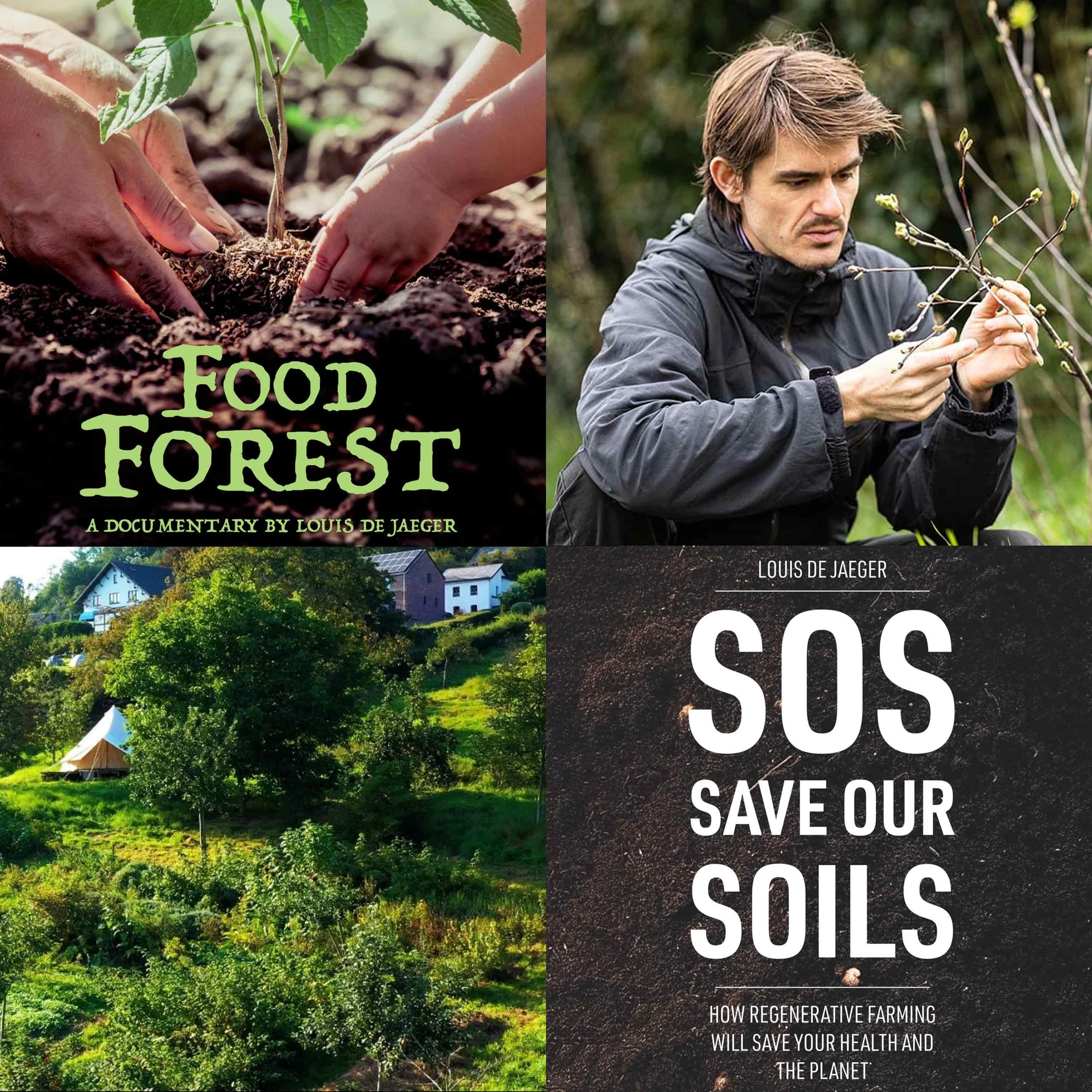
Exploring  Organic, Biodynamic & Regenerative Agriculture with LOUIS DE JAEGER

Exploring  Organic, Biodynamic & Regenerative Agriculture with LOUIS DE JAEGER

The Earth started as one big rock, and soil did not exist. Without soil, you can't really grow trees or any crops whatsoever. We are depleting soils super fast, and it is predicted that in less than 25 years, 90% of our soils will be degraded. We as humans can destroy things in a couple of years that have taken thousands or even millions of years to form. On the other hand, nature regenerates pretty fast. It heals itself. If humans help this healing process, it can go even faster.

CARBON: The Book of Life with PAUL HAWKEN

CARBON: The Book of Life with PAUL HAWKEN

Environmentalist · Entrepreneur
Author of Carbon: The Book of Life
Founder of Project Regeneration & Project Drawdown

We have 1.2 trillion carbon molecules in every cell. We have around 30 trillion cells, and that’s us. So carbon is really a flow that animates everything we love, enjoy, eat, and all plant life, all sea life—everything that's alive on this planet—is animated by the flow of carbon. We want to see the situation we're in as that, as a flow. Where are the flows coming from, and why are we interfering with them? Why are we crushing them? Why are we killing them? For sure. But also, we need to see the wonder, the awe, the astonishment of life itself and to have that sensibility as the overriding narrative of how we act in the world, how we live, and how we talk to each other. Unless we change the conversation about climate into something that's a conversation about more life—better conditions for people in terms of social justice, restoring so much of what we've lost—then we won’t get anywhere.

How can Regenerative Business Help Heal the Earth? - ESHA CHHABRA

How can Regenerative Business Help Heal the Earth? - ESHA CHHABRA

Author of Working to Restore: Harnessing the Power of Business to Heal the Earth

The term regenerative business started coming into the lexicon in 2017, 2018. And regenerative means to regenerate, means to bring life into something. To sustain means to keep the status quo. And regenerative looks at things from a very holistic lens. You know, it's like if you're going to run a regenerative farm, it's all the different components of the farm and the ecosystem ideally come within the ecosystem.

LEWIS DARTNELL - Author of Origins: How the Earth Made Us & Being Human: How Our Biology Shaped World History

LEWIS DARTNELL - Author of Origins: How the Earth Made Us & Being Human: How Our Biology Shaped World History

Astrobiologist · Science Communicator
Author of Origins: How the Earth Made Us · Being Human: How Our Biology Shaped World History

The challenges facing our society at the moment effectively are the unintended consequence of a solution we found in the late 1700s when society was running out of energy, we had no more timber, and we realized we could dig underground for ancient fossilized woodland, which is basically what coal is from about 300 million years ago. The consequence of burning all that coal and then oil was a release of carbon dioxide, changing our atmosphere and warming the planet. So, it's a problem born out of our ingenuity and resourcefulness, but I'm confident that we will find the solution out of our ingenuity and resourcefulness.

John Beaton - Founder, Director & Co-Visionary of Fairhaven Farm

John Beaton - Founder, Director & Co-Visionary of Fairhaven Farm

Founder, Director & Co-Visionary of Fairhaven Farm

What's trending now with beginning farmers is that it is creating this kind of community connection. It's bringing people to the farm. It's connecting them to their food source. That creates community. It helps cultivate culture and connectivity, and so I think overall, it's like the landscape and agriculture as a whole is shifting towards a different direction.