Art is a Fundamental Element of Life - Gallerist HANNAH BARRY on a Life in Art

Art is a Fundamental Element of Life - Gallerist HANNAH BARRY on a Life in Art

There's something fundamental about the value of art and culture. Not just being integrated for vocational reasons, but because the experience of art and having a cultural element in one's life brings enjoyment, learning, relief, or any of the many experiences and feelings that art provides. I think this is quite fundamental as an element of life. Creativity is key in any career and also in personal life, especially in terms of problem-solving, relationships, kindness, compassion, and empathy. The arts, creativity, and the cultural world at large are not just nice to have; they are essential. Their value is fundamental, although sometimes it's extremely difficult to define in a way that aligns with what people might prefer. To see the arts lost from the developmental moments in one's life is tragic. Developmental moments in life come at all points in the arc of one's existence. To see that taken or diminished is unfortunate. Everyone involved in working with artists, artists themselves, or those who are creative knows this and believes in it.

 Empire of AI: Dreams & Nightmares in Sam Altman's Open AI with KAREN HAO

 Empire of AI: Dreams & Nightmares in Sam Altman's Open AI with KAREN HAO

My book is called Empire of AI because I'm trying to articulate this argument and illustrate that these companies operate exactly like empires of old. I highlight four features that essentially encapsulate the three things you read. However, I started talking about it in a different way after writing the book.

The four features are: they lay claim to resources that are not their own, which is the centralization of resources; they exploit an extraordinary amount of labor, both in the development of the technology and the fact that they're producing labor-automating technologies that then suppress workers' ability to bargain for better rights; they monopolize knowledge production, which comes when they centralize talent.

Arabic Literature, Palestine & The Art of Translation with HUDA FAKHREDDINE

Arabic Literature, Palestine & The Art of Translation with HUDA FAKHREDDINE

A Conversation with HUDA FAKHREDDINE
Writer · Translator · Associate Professor of Arabic Literature · University of Pennsylvania

I'm Lebanese. I grew up in Lebanon during the Civil War, and I came to the United States as a graduate student with the intention of going back. I never wanted to stay here. I really thought that my life would happen in Beirut, in a city that I loved and hated in the healthiest of ways. My investments, both literary and intellectual, were rooted there. I came here as a graduate student and joined the PhD program, and then the events continued to unfold there, making life more and more of a risk, building a life in a place like Lebanon. The most important counterpoint in my life was meeting my partner, Ahmad Almallah, who is Palestinian. So immediately, my life became the life of a Palestinian by association. Of course, the past two years—almost two years—have been surreal. I sometimes don't believe that we're going through what we're going through because, as security concerns have become something we think about at home, when we walk from home to campus or my office, I'm constantly anxious to open my mail because often there are things that will require a lot of energy, time, emotion, and are emotionally taxing. There’s a lot of rage now in many aspects of my life, but all that aside, my personal experience—both professional and personal, and at home, familial—are not exceptional. Many other people are experiencing intimidation, silencing, and feeling cornered, censored, and oppressed just because they took a stand—a very decent, normal, basic human stand against genocide.

The Poetics & Pedagogy of Toni Cade Bambara, June Jordan, Audre Lorde &Adrienne Rich in the Era of Free College w/ DANICA SAVONICK

The Poetics & Pedagogy of Toni Cade Bambara, June Jordan, Audre Lorde &Adrienne Rich in the Era of Free College w/ DANICA SAVONICK

A Conversation with DANICA SAVONICK about her book Open Admissions: The Poetics and Pedagogy of Toni Cade Bambara, June Jordan, Audre Lorde, and Adrienne Rich in the Era of Free College

As I was reading Hooks and Freire, a colleague recommended Adrian Rich's essay "Teaching Language in Open Admissions." It was in that essay that I first read about her experiences teaching at CUNY during open admissions, learning that she taught alongside June Jordan, Audre Lorde, and Toni Cade Bambara. Eventually, that essay led me to their archival teaching materials. I was really excited because I found in those materials concrete teaching methods, things they were doing in their own classrooms that I then started trying in my classrooms as well. I also really liked their educational philosophies, thinking about what it means for college to be free and the fact that they were teaching during this revolutionary era. What would that look like today? What would it mean? What could free college bring to our society? What does free college make possible? All of those things coming together led me to the project.

Creative Ireland: How Ireland Is Harnessing Creativity as National Strategy with SHEILA DEEGAN

Creative Ireland: How Ireland Is Harnessing Creativity as National Strategy with SHEILA DEEGAN

How Ireland Is Harnessing Creativity as National Strategy with SHEILA DEEGAN

I left the local environment to pursue Creative Ireland because I really believe in this broader approach. Let's try not to silo things. Let’s try and get people working collaboratively for the benefit of everybody, not just one program over the other. I really hope that young people can hold a sense of social justice as we move forward into a very complicated world. They need to remember that we're all just people and that we all just need each other, whether that's creatively or within the landscape or within the economics.

From 'Bee: Wild' to  the 'Kiss the Ground' Regenerative Agriculture Documentary Trilogy - Highlights

From 'Bee: Wild' to the 'Kiss the Ground' Regenerative Agriculture Documentary Trilogy - Highlights

A Conversation with Documentary Filmmaker REBECCA TICKELL

Today, we explore the work of a filmmaker whose lens is consistently turned toward the most critical issues facing our planet. Rebecca Tickell, in collaboration with her husband Josh Tickell, has created a powerful cinematic catalog of films that are not merely observations, but catalysts for change. They've taken on the complexities of our energy systems, the deep-seated problems within our food supply, and now, with her latest work, Bee: Wild, they explore the essential, fragile, and often unseen world of pollinators.

Their film Kiss the Ground sparked a global conversation about regenerative agriculture, leading to tangible shifts in policy and public understanding. Common Ground continued this exploration, unraveling the intricate web of our food systems. Now, with Bee: Wild, narrated by Ellie Goulding and executive produced by Angelina Jolie, Rebecca brings her characteristic blend of journalistic rigor, personal narrative, and solutions-driven storytelling to the urgent plight of bees, asking us to reconsider our relationship with the natural world.

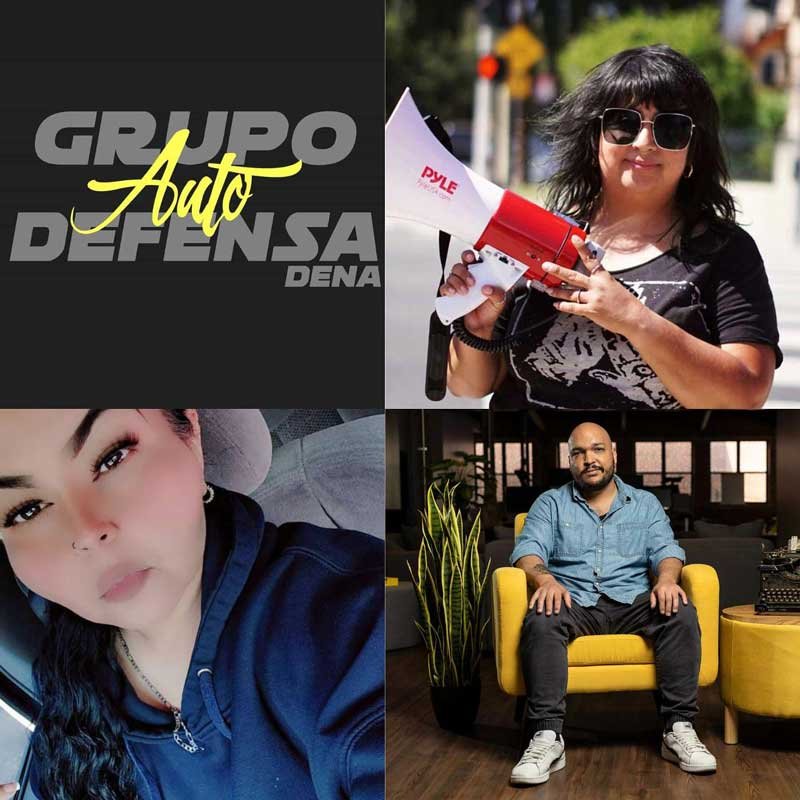
Fighting Back Against ICE: Grupo Auto Defensa’s Courage & Love

Fighting Back Against ICE: Grupo Auto Defensa’s Courage & Love

Grupo Auto Defensa’s Courage & Love
A Conversation with DANIELA NAVIN, JEANETTE DE LA RIVA & MAXMILLIAN ALVAREZ

I think the community came together more when we started getting those notices about people being swept up by these supposedly ICE agents who are just covered up. So that was the thing that made us come out there and start defending everyone who doesn't want to come out to defend themselves.

All About Bees, Soil & Regeneration with Documentary Filmmaker REBECCA TICKELL

All About Bees, Soil & Regeneration with Documentary Filmmaker REBECCA TICKELL

A Conversation with Documentary Filmmaker REBECCA TICKELL

Today, we explore the work of a filmmaker whose lens is consistently turned toward the most critical issues facing our planet. Rebecca Tickell, in collaboration with her husband Josh Tickell, has created a powerful cinematic catalog of films that are not merely observations, but catalysts for change. They've taken on the complexities of our energy systems, the deep-seated problems within our food supply, and now, with her latest work, Bee: Wild, they explore the essential, fragile, and often unseen world of pollinators.

Their film Kiss the Ground sparked a global conversation about regenerative agriculture, leading to tangible shifts in policy and public understanding. Common Ground continued this exploration, unraveling the intricate web of our food systems. Now, with Bee: Wild, narrated by Ellie Goulding and executive produced by Angelina Jolie, Rebecca brings her characteristic blend of journalistic rigor, personal narrative, and solutions-driven storytelling to the urgent plight of bees, asking us to reconsider our relationship with the natural world.

Art, Empathy & Resilience with CADY McCLAIN, Actor, Director, Writer, Artist, Musician - Highlights

Art, Empathy & Resilience with CADY McCLAIN, Actor, Director, Writer, Artist, Musician - Highlights

A Conversation with Emmy Award-winning Actor, Director, Writer CADY McCLAIN

I won my first Emmy when I was 21, which was the result of absolutely devoting myself day and night for two years to doing all the scene work. I attended classes simultaneously and did plays until my mother died. I studied with Michael Howard for eight years. Even when I was so tired I couldn't get up to do a scene, he would say, "Get up and do a poem." It helped me enormously; it saved me. The way I was trained and how I train others is that you know when you’re in the zone. Oh God, it feels so good. It feels like flying. And that's what you want. You want to be so unselfaware that you're on liftoff?

A Life in Acting with Emmy Award-winning Actor, Director, Writer CADY McCLAIN

A Life in Acting with Emmy Award-winning Actor, Director, Writer CADY McCLAIN

A Conversation with Emmy Award-winning Actor, Director, Writer CADY McCLAIN

I won my first Emmy when I was 21, which was the result of absolutely devoting myself day and night for two years to doing all the scene work. I attended classes simultaneously and did plays until my mother died. I studied with Michael Howard for eight years. Even when I was so tired I couldn't get up to do a scene, he would say, "Get up and do a poem." It helped me enormously; it saved me. The way I was trained and how I train others is that you know when you’re in the zone. Oh God, it feels so good. It feels like flying. And that's what you want. You want to be so unselfaware that you're on liftoff?

Abolish Silicon Valley—How to Liberate Technology from Capitalism

Abolish Silicon Valley—How to Liberate Technology from Capitalism

A Conversation with WENDY LIU

Abolishing Silicon Valley means freeing the development of technology from a system that will always relegate it to a subordinate role, that of entrenching existing power relations. It means designing a new system that isn't deluged in the logic of the bucket. It means liberating our worlds from the illegitimate ring of capital. Perhaps this sounds unfair to capital. Perhaps I sound like I'm not grateful enough for everything that capital has given us, but we don't owe capital anything; the things we attribute to capital were built by workers. People can labor and sometimes die in a process. Their contributions are unrecognized in death as in life. So don't thank capital. It doesn't deserve our gratitude, and it doesn't need it. Thank the people who created everything that capital always takes credit for. Capital is a means of accounting for wealth ownership, not its creation. And that means it's perpetually shrouded in a fundamental untruth; we can leap the swamp of capital behind and start over with something new. 

In this episode on Speaking Out of Place podcast Professor David Palumbo-Liutalks with Wendy Liu. Ever since its publication, Abolish Silicon Valley—How to Liberate Technology from Capitalism has proven to be more urgent and insightful. Today, he talks with author Wendy Liu about how developments like AI and LLM, further erosions of intellectual property, and increased invasions of privacy make the case for abolishing Silicon Valley even more important. They talk about how abolition is critical at a time when more and more the private sector has come to eviscerate the public good. Turning to the genocide in Gaza, they discuss the ways Capital has enlisted technology in deadly and horrific manners. They end with a meditation on the commons and how one can live with fewer commodities and find value in common projects to make life more valuable and worthwhile outside of the logic of the market.

Life As No One Knows It - Exploring AIR Aspen with NICOLA LEES - Highlights

Life As No One Knows It - Exploring AIR Aspen with NICOLA LEES - Highlights

& The Future of Museums
A Conversation with NICOLA LEES · Director of the Aspen Art Museum

It's a complicated time to think about how we can slow down, be still, and bring a brilliant group of people together to do something that feels purposeful and can be productive. It's a moment where things are moving so fast. When I brought up the idea of a hinge generation, I think it's impossible to know how we will look back and reflect on this time and these moments. This year, there is a real emphasis on the relationship between the question we have posed for the retreat, which is fundamentally about our relationship with technology and identifying our relationship with the world and how we want to be present in the moment.

The First Artist-Led Global Summit & The Future of Museums - NICOLA LEES, Director, Aspen Art Museum

The First Artist-Led Global Summit & The Future of Museums - NICOLA LEES, Director, Aspen Art Museum

& The Future of Museums
A Conversation with NICOLA LEES · Director of the Aspen Art Museum

It's a complicated time to think about how we can slow down, be still, and bring a brilliant group of people together to do something that feels purposeful and can be productive. It's a moment where things are moving so fast. When I brought up the idea of a hinge generation, I think it's impossible to know how we will look back and reflect on this time and these moments. This year, there is a real emphasis on the relationship between the question we have posed for the retreat, which is fundamentally about our relationship with technology and identifying our relationship with the world and how we want to be present in the moment.

Ten Cases of Hope for Our Future w/ MONICA FERIA-TINTA - Highlights

Ten Cases of Hope for Our Future w/ MONICA FERIA-TINTA - Highlights

MONICA FERIA-TINTA on Ten Cases of Hope for Our Future

I like young people to know that they're extremely powerful. I guess the book was about giving hope because I realized how much we could do together. If a person can manage to argue and make a major impact in the way we are understanding treaties in human rights or other things, imagine what could be if every single person is in their own place in some field, with that alertness and synced in the same way. I believe that ordinary people are the ones bringing changes here. I believe that the communities gathering together – for example, I am seeing that in this country around the protection of rivers – are the ones that will mark the change. It's not going to come from above; it's going to come from below, up. We all have a role. Working for the protection of what we love the most will make you happy. So get into a positive mindset. Learn all you can. Be part of things that make you feel positive. You will see how you will find your way, and there is no place for feeling disempowered. This is the moment where you should feel very powerful because it is us who are going to make the future of this Earth.

ICE’s “Photo-Op” Military Attack on MacArthur Park & Community Pushback: Conversation w/ Journalist MEL BUER

ICE’s “Photo-Op” Military Attack on MacArthur Park & Community Pushback: Conversation w/ Journalist MEL BUER

Conversation with Journalist MEL BUER

From my perspective, it just seemed like a way to terrorize a neighborhood and intimidate the people living there, and intimidate the city in a way that they've been trying to accomplish for the last six weeks, and it wasn't fun. So were there orders? There were no orders to disperse.

Bombs Will Never Liberate Iran: PERSIS KARIM & MANIJEH MORADIAN in Conversation

Bombs Will Never Liberate Iran: PERSIS KARIM & MANIJEH MORADIAN in Conversation

A Conversation with MANIJEH MORADIAN & PERSIS KARIM

 I think one must frame what happened in Iran recently in the context of what is happening in the larger Middle East, which is that Israel and the United States principally are orchestrating a kind of regional shift in their power that can only be seen in light of what happened, and it continues to happen in Gaza and the wider Palestinian Territories, which is that Israel is, by virtue of signaling an aggressive move towards Iran, suggesting that it will continue unabated to exercise its will throughout the region, and that it also is interested in destroying Iranian support for Palestinian rights in the region.

Everything for Everyone: An Oral History of the New York Commune, 2052-2072

Everything for Everyone: An Oral History of the New York Commune, 2052-2072

A Conversation with M. E. O’BRIEN & EMAN ABDELHADI

The book is a speculative fiction novel that imagines a transition out of capitalism in the nation-state in the next few decades, but it is composed of a series of fictional oral history interviews. We imagine ourselves in the future, and we are writing a book to celebrate the 20th anniversary of a food riot that launches the New York version of this kind of revolutionary transition. We are conducting various oral histories with different actors, some who participated in the revolution and some who grew up in the new social form, which is the commune. The book consists of a series of 12 interviews that we trade off as interviewers. It was actually Michelle’s idea to write the book. She had written a fictional oral history interview for an online magazine and invited me to create a whole novel of these interviews. We both have a relationship with oral history as a form of research and engagement with the world. I conduct life history interviews for my sociological research, and Michelle ran a New York Trans Oral History project, which is a great archive that people should check out. It has 200 interviews, so we both have experience in this field. We are both science fiction fans, friends, and comrades. I have spent many years discussing politics, the future, and the left. The book is a culmination of all these elements, representing an intersection of various facets of our lives as scholars, as well as our friendship and comradeship. We pitched the book to Common Notions, presenting a general outline of the world and brief paragraphs about each character we thought we might write about. They encouraged us to proceed, and the rest is history.

A Barrister for the Earth: Ten Cases of Hope for Our Future w/ MONICA FERIA-TINTA

A Barrister for the Earth: Ten Cases of Hope for Our Future w/ MONICA FERIA-TINTA

I like young people to know that they're extremely powerful. I guess the book was about giving hope because I realized how much we could do together. If a person can manage to argue and make a major impact in the way we are understanding treaties in human rights or other things, imagine what could be if every single person is in their own place in some field, with that alertness and synced in the same way. I believe that ordinary people are the ones bringing changes here. I believe that the communities gathering together – for example, I am seeing that in this country around the protection of rivers – are the ones that will mark the change. It's not going to come from above; it's going to come from below, up. We all have a role. Working for the protection of what we love the most will make you happy. So get into a positive mindset. Learn all you can. Be part of things that make you feel positive. You will see how you will find your way, and there is no place for feeling disempowered. This is the moment where you should feel very powerful because it is us who are going to make the future of this Earth.

Another World Is Possible: Lessons for America From Around the Globe w/ NATASHA HAKIMI ZAPATA

Another World Is Possible: Lessons for America From Around the Globe w/ NATASHA HAKIMI ZAPATA

 It's a really dangerous time we're living through, and I do think that when we talk about these progressive policies, a huge problem in the US is that we still have a lot of stigma left over from the Cold War that keeps us from really great ideas because they're branded as socialist or communist. And I’ve seen, in the time I've been a journalist for the past 15 years, how that stigma has slowly faded. And you see that younger people are more and more interested in these ideas, whether or not they're considered socialist.

THE DREAM HOTEL with LAILA LALAMI

THE DREAM HOTEL with LAILA LALAMI

A Conversation with Author LAILA LALAMI
on Dreaming Beyond the Algorithmic State

What happens when the state, with the pretext of protecting public safety, can detain indefinitely certain individuals whose dreams seem to indicate they may be capable of committing a crime?  Set in a precarious world where sleep-enhancing devices and algorithms provide the tools and formulae for making one’s unconscious a witness to one’s possible waking life, this novel touches on a myriad of political, philosophical, and moral concerns as they particularly connect to issues of gender, race, ethnicity, privacy, and the security state.