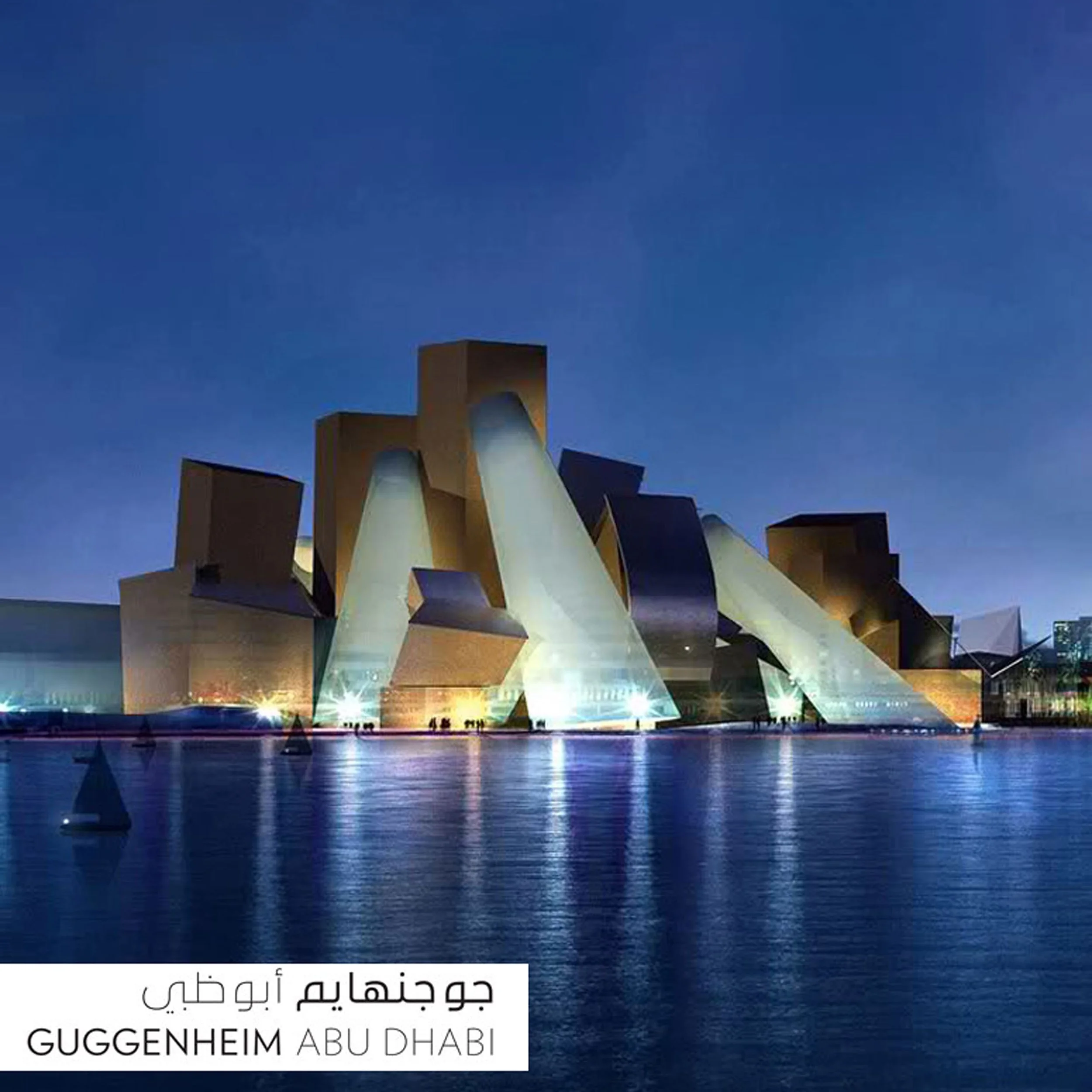
Guggenheim Abu Dhabi is a unique concept. The idea behind the building itself is a dance. It's a living building because it's a dance between spaces. It's a dance between blocks of spaces and shapes and cones, and it's inspiring for the future because the legacy is a huge factor for every project. It's the legacy for young architects and for other architects. It gives them the space to dream more and to feel like it can be possible, and not to be shy. Present more bold ideas that can inspire creativity because you can't see this building and walk in without feeling like you want to be creative as well.
Art museums have long been pillars of culture, but they are now at a critical juncture, navigating a new era defined by artificial intelligence, immersive technology, and the shifting habits of a global audience. The challenge is immense: how do you honor artistic tradition while building a museum for the future? On Saadiyat Island, Abu Dhabi is answering this question in a dramatic way, with the Guggenheim Abu Dhabi. Designed by the visionary architect Frank Gehry, this $1 billion project is more than just a new museum; it’s a statement—a new cultural superpower announcing itself on the world stage. It will be the largest contemporary art museum in the world, several times the size of the Guggenheim in New York, and a key part of their constellation of museums that is expected to contribute an estimated $200 million annually to the local economy. In the lead-up to its 2027 opening, the Guggenheim Abu Dhabi is embracing a new vision: moving from an "exhibition economy" to an "experience economy," where art becomes a conversation, a laboratory for ideas at the intersection of creativity and technology. Amr Hussein is the Digital Media Manager for the Guggenheim Abu Dhabi, and with a background in major sports broadcasting—from the FIFA World Cup to the Olympic Games—he’s bringing a unique perspective to digital storytelling in the arts. We talk to him about his journey and how he’s helping shape the digital narrative for this landmark museum.
THE CREATIVE PROCESS
What's beautiful about the arts, and each addresses it in different ways, is that we're learning, but we don't really realize we're learning because we're so caught up in the story.
And human beings are story. We're constantly telling stories. Actually, I think it's one of the best ways to teach and to learn. You absorb a story; you think you're being entertained by it, but you're really learning. There are so many things that you pick up in a story that aren't just the facts, that aren't just the beginning and the end and what happened.
There's a lot of intergenerational knowledge that's passed on. There's a lot of culture and history that's embedded subtly, and the arts, I think, do that so well. So I want to ask you, what do you feel is the power and the importance of the arts?
And how is the Guggenheim Abu Dhabi addressing, as much as it's celebrating modern and contemporary art, how is it also in dialogue with cultural history and memory in the region?
AMR HUSSEIN · GUGGENHEIM ABU DHABI
Well, especially in Abu Dhabi, it's just not one museum. We are part of a family of other venues. You have the Louvre, the Zayed National Museum, which is opening very soon, and the Natural History Museum will also open after that. Then you have the Abrahamic Family House. When I arrived in Abu Dhabi, the first place I visited was the Saudi Culture District.
And as someone who hadn’t started the first day of my job yet, I went there. You arrive with a mental state, with a kind of energy, and you leave with that energy. What happens in between is your experience, what you went through—whether it's ups and downs, whether it's happiness, memories you encounter.
You blend what you see with your lifeline, with life stories and memories, and all this happens. It's created carefully, and the people building it try as much as they can to deliver the storyline they want to convey. But the personal experience plays a huge factor in what mental state you're coming with what's your life like? What have you seen recently? What's in your mind? Who are you in love with? The beauty of the place is, if you see it in order, it changes how you feel a lot. So I went several times and tried to change my approach; I decided to start from here and go there and then there.
This is what the art is when you see it. At the Abrahamic Family House, there's a mosque, a synagogue, and a church. Inside, there is the Unity Wall where you can leave messages, and people from all over the world, from different backgrounds and beliefs, write heartfelt notes. Even if some of them are not in a language that I understand, you can sense that it’s a canvas of unity. It made me feel hopeful. It was not art created by an artist; it was a collective collage of people.
Then I moved to read about what's happening and what's inside. From there, you go to the Louvre. The Louvre is really interesting in Abu Dhabi, especially because of the exhibitions they do. Right now, they have the Mamluk exhibition, which is amazing—the era of the Mamluks during the Islamic time in the region.
As you move from space to space, you see how it's curated, and it fills you; it changes how you feel about a certain time in history. You understand what I mean because it’s unique; you don’t enter rooms. You have to follow a pathway. At the end of the day, that was my first experience in Abu Dhabi after coming from a new sector. It’s a new challenge. I love to be in a project delivery phase, driven by the sense of achievement at the end.
So that’s why I came. But of course, coming from a new sector made me feel a little anxious, but still hopeful. I arrived with all these feelings to this place, and I left with peace and confidence. I want to start; I want to be part of the project. I want it to shape my identity and have an impact on me. I arrived with energy, and I left with energy. What happened in between was the impact of art on me, experienced through three different venues.
I hope we can deliver the same experience where people can arrive and leave with something that comforts them or makes them feel hopeful. It doesn’t have to be measured or just positive and happy; it could inspire them to think more about certain things. I feel like this might sound pragmatic and practical, but this is where I stand at the moment because that was my very closest experience; the impact arrived just right away and shaped my perspective immediately.
It's still affecting me. I'm very touched by it now, and I feel like this can be something that I hope when people see it, especially in the Guggenheim, where what they're going to see will be so inspiring. They’ll be inspired by much. We have an amazing team of curators shaping the journey inside. It's going to be something that everyone arrives and leaves with thought-provoking experiences, new knowledge, and learning. This is what I hope they take away with them.
THE CREATIVE PROCESS
For those who don't understand, I'm not sure if we really touched on it, but the Guggenheim Museums. It is always a partnership with its museums outside. So there’s a partnership with Bilbao and a partnership in Abu Dhabi. Just tell us how that works, as I think that’s a great model going forward. It’s not just an imposition of art; they come with their museum expertise and programming, but it’s always a partnership. I really like how this is going forward as a model for other museums too.
AMR HUSSEIN · GUGGENHEIM ABU DHABI
As you said, it’s a hundred percent correct. It’s the same; it’s owned by the government there. The collection is owned by Bilbao. In our case, it's owned by Abu Dhabi. They own the collection. And then we have a team; I'm part of Team Guggenheim from New York, and we have a team here in Abu Dhabi, made up of amazing talents from the Department of Culture and Tourism. We work together every day. As you said, it’s Guggenheim Abu Dhabi—a unique concept that is being developed every day.
We have harmony in the teams, and we lead to certain things because we navigate unknowns. In my field of work, it’s like AI or generative AI—how it can be implemented. There is no definitive Guggenheim book, no Louvre book on certain technologies utilized when opening a new museum. So, it’s something we move forward with together. We learn about it and discuss how it can be used, and then we move it forward.
We have the curatorial experience of Guggenheim, where our team presents hundreds of years of curatorial studies and research. The team from New York is here all the time supporting and helping with the research. However, we explore certain new fields together. There is no guidebook for using AI in museums; we are building it together.
It's happening while we're speaking. By tomorrow, we will discuss a new initiative that will show up next week. By the time I see you again in Paris, there will be hundreds of new ideas that people are approaching us with, and we’ll have to see if this is the brand, if this is the Guggenheim Abu Dhabi we want to build or not.
THE CREATIVE PROCESS
And it’s lovely to know that it is a dance because these—you call them cones, but they also seem like a horn, you know? It feels like a musical instrument in a way.
Like the cones of light or horns of light pass through; we should say that. It’s not rigid. It feels airy. Yes, it’s an inspiring space. I should ask you, because I find you have an interesting journey in terms of, and this is really the sign of a creative mind, that you're not limited. You’re open to new experiences, coming from sports to art, and then to digital storytelling.
Who do you think in your life—teachers, parents, collaborators—has given you that kind of openness and curiosity? Who were the models for you growing up as a young person when you thought, “Wow, I want to do something creative like this,” even if you weren't sure what it was yet?
AMR HUSSEIN · GUGGENHEIM ABU DHABI
That's a really interesting question. I never expected it, so I have to think a little bit about it. But as I told you, I've always wanted to live in the intersecting lines between different sectors and fields of life. I've always wanted to live many lives. When you switch from one sector to another, it feels like you're jumping from one life to another. In sports, I was surrounded by people who were all about motivation, and they always have the energy to move forward. They speak in a certain way.
Then you move into a creative field with artists in the cultural sector, and you realize that people are somewhat similar in a certain way. However, there is an intersection that happens, which reminds me of an amazing French person named Paul Ricard. People know him; they know that the racing circuit is named after him. He’s the architect of the circuit, and he lived many lives as well—an entrepreneur, innovator, artist, and athlete. He's a multidisciplinary person whose story inspired me long ago.
Then, when I met Pierre Rabadan, he also inspired me. I got my first invitation to interview for this job one evening after meeting Pierre, and I went through the interviews not knowing where this would take me. My time in Paris shaped me because of the amazing people I met there. You don’t meet people who change careers anymore; maybe that’s something of the past. You can see it on a Wikipedia page where someone was a doctor, then became an engineer and invented something. That doesn’t happen anymore.
But then you look at Paul Ricard, and you wouldn’t believe what you’ll read; he has done everything. Pierre was someone very influential to me. I sat down with him, and he introduced me to a cheese monger, saying this was the best cheese monger in the world. He talks about cheese while building the Olympics and managing important city matters; it makes me want this kind of life where you get inspired every day.
Since the day I joined, I get inspired every day by new things I see or new people I meet. This is the most fulfilling feeling I have—meeting someone who inspires me makes my day. The same goes for sports; you travel everywhere and meet athletes from all over the world, seeing how they approach life differently.
Athletes are always on the edge; they shape me to explore things in me like my love for football. I may be bad at football, but I stopped thinking it was not for me and found something I liked. When I meet artists now in culture, I see sports differently. When I meet people working with artists, I see art differently. Hanging out with curators here helps me notice and explore different philosophies.
I work with a very international team—people from all over the world, around 50 nationalities in this museum. I’ve never worked in such an environment, and it’s inspiring. When you talk to someone from a different country, you can’t help but be inspired. The most important thing for me is to feel fulfilled, and I find fulfillment in learning something new and being inspired every day.
Of course, it doesn’t have to be the same for everyone. People can find fulfillment in charity or teaching kids. Everyone chooses what makes them feel fulfilled, as long as it’s meaningful. If I had to choose one person from the past, I would choose Pierre Rabadan.
THE CREATIVE PROCESS
Well, it’s really a living lab. I like to bring up the excitement about the finalized building. I’ve heard Frank Gehry talk about the emotion of a building, about how it communicates subtle things that you can sense. What are some of those things that have gone into it?
AMR HUSSEIN · GUGGENHEIM ABU DHABI
The idea behind the building itself is a dance. If you see it from a distance—Gehry doesn’t like 3D models; instead, he sketches by hand, folds paper into shapes, and puts them next to each other. This is what you get.
We still have the sketches and the folded papers. How you can see in Gehry’s sketches is a dance; it’s waving. You go from here to there, and this is a living building. It’s a living building because it’s a dance between spaces—between blocks of spaces, shapes, and cones. He visited during the Culture Summit, and from the people who met him (this is available online) he said that the first thing when he got inside the building was, “I can't believe you built it.”
It was beautiful to hear that he managed to see it almost completed. He was visiting during one of the architecture events we had. He never thought it would be built, so you can imagine how fictional the building looks. It was fascinating that he got to see it, and he was happy that it got built. This inspires future architects—legacy is a huge factor in every project.
When you see a building as fascinating as this get completed, it inspires hundreds of architects who have ideas that challenge the norm and what’s conventionally possible. It gives them the space to think, dream, and feel that it can be possible, and it encourages them to present bolder ideas that can inspire creativity.
You cannot see this building and walk in without feeling creative. The sensations inside you that spark creativity get triggered when you see something like this completed. Whether you're an architect, product designer, or artist, you’ll respect the challenge and the journey of the people who made this happen. It will make you feel like you want to challenge yourself and push yourself a little more, and even if you arrive motivated, this experience will elevate your motivation.
This, I think, is the legacy of it. As I told you, it’s a dance. Inside, it’s designed so you can go from one space to another. The curators will be discussing this again soon, explaining the narrative behind it.