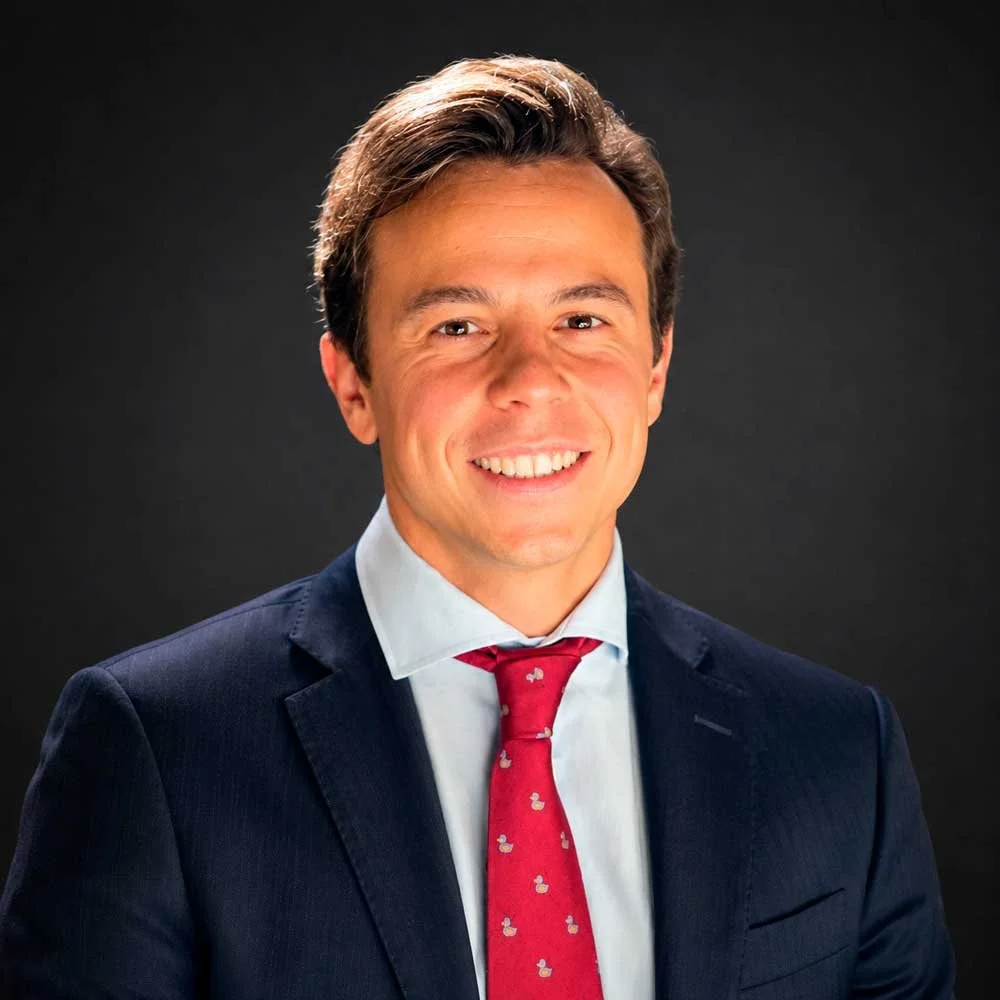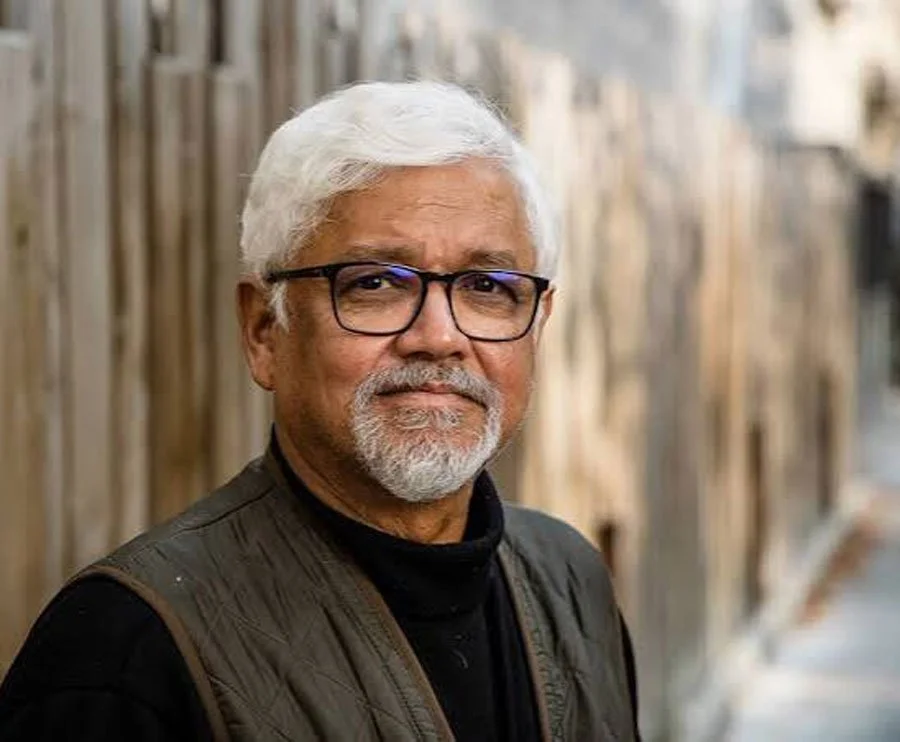


Dominic Chambers (b. 1993, St. Louis, MO; lives and works in New Haven, CT) creates vibrant paintings that simultaneously engage art historical models, such as color-field painting and gestural abstraction, and contemporary concerns around race, identity, and the necessity for leisure and reflection. Interested in how art can function as a mode for understanding, recontextualizing, or renegotiating one’s relationship to the world, the artist sees painting as a critical and intellectual endeavor, as much as an aesthetic one. Chambers received his B.F.A from Milwaukee Institute of Art and Design, Milwaukee, WI in 2016, and his M.F.A. from Yale University School of Art, New Haven, CT in 2019. @ChambersDominic
Where were you born and raised? How did it influence your art and your thinking about the world? I was born and raised in St. Louis, Missouri. Most of my upbringing was in the northern part of the city, which is home to a community that is grossly underserved, undercapitalized, and undervalued. Despite this, I was nurtured by a community of people with enormous faith and fortitude. You’d be hard-pressed to find a person on the north side of St.Louis with a fragile will. No matter the circumstances, they’re a people who keep moving.
My time in St.Louis wasn’t the easiest, but even in the bleakest of circumstances, I was exposed to a kind of poetry I don’t think I would have otherwise had the opportunity to experience. One memory that comes to mind is when my family was unhoused and resided in the park across the street from the St. Louis public library. Unencumbered by the restraints of a bedtime, my siblings and I would play on the jungle gym for hours. One night, in particular, remains with me - the night I witnessed the playground shift from an ordinary structure I played on during the day into a shadowy castle at night. The shadows shrouded the jungle gym, and the architectural contours were what stood out in the field. It. It was the first time I experienced the aesthetic nature of an object change based on the external conditions of a time of day.
Growing up where I did and receiving my cultural education in the way that I did shaped how I moved through the art world more than anything else. Certain ethics and rules of conduct had to be abided by to avoid unfavorable encounters with the neighboring individuals who were often up to no good. And you learn quickly. I was fortunate enough to be shaped by people who taught me to always lead with respect first and leave people better than I found them.
When did you first fall in love with art and realize you wanted to be an artist? For you, what is the importance of the arts? There wasn’t necessarily a moment that affirmed that being an ‘artist’ was something I wanted. As early as I can remember, I loved drawing and found a lot of satisfaction in being able to copy an image from a photograph with a degree of skill. But that was it. I simply didn’t have an understanding or awareness of any living visual artists. Nor did I recognize the role of artists as contributors to cultural discourse and advancement. Not to mention that artists aren’t generally known for being rewarded for their efforts. The common consensus in my community was that artists were only valued and rewarded posthumously. However, what I appreciated and valued about the world of art was the level of skill I observed in the depictions of various images by artists in the art historical canon. Artists like Georges Seurat, Velázquez, and Georgia O’Keeffe, because of their ability to create pictures with magnetic power, confidently conceived through their skill and the quality of their imagination.
That's where it started for me, though. Growing up on the North side of St. Louis, my community, mainly composed of black women, men, and children, celebrated the level of skill someone possessed when it came to any art form. If you could draw well, that was something to be proud of. If you could rap or perform spoken word poetry, that is something worth bragging about to your aunts, uncles, cousins, and friends. You possessed a skill and could conjure something from nothing. My community valued this. I recall fondly the times my mother would introduce me to her friends at church, and the following details about me that were worth mentioning after she introduced me as her son, she would say, “Girl, this my baby. He can draw too.” The pride she expressed when highlighting my skill was something I saw in many of the people I met growing up who had someone in their family who was creatively inclined.
I inherited my mother's sense of pride in my skills, though I was still not convinced it would make for a wise career path if I had any hope of rising above my circumstances at the time. When thinking about what I would do, initially, I thought I’d be a writer and graphic novelist because I loved reading stories and inventing my narratives. The power of storytelling and the medium of language have remained a consistent passion of mine. I’m ashamed to admit I had no desire to pursue higher education because most of my skills were allocated towards the arts and humanities, which have been firmly placed in my mind as an area of study with minimal economic reward. Considering this, I initially opted to work whatever Job came my way, simply, and I would write in the evenings until my stories took off. But at the behest of my high school girlfriend, who threatened to break up with me unless I went to college, I enrolled at St. Louis Community College at Florissant Valley. I became exposed to art history and contemporary artists. My world erupted with possibility, and I set my sights on carving out space amongst those I grew to appreciate and respect, the art history books I read, and the works I would go on to see in various museums during my studies at Flo Valley.
The arts are where I found solace from the estrangement I felt towards mainstream society, both within and outside my community. The arts allowed me to bet entirely on the materials that compose my inner life. I gained a sense of perspective that allowed me to experience a freedom seldom taught or cultivated in other disciplines I’ve observed. The arts community is also the first community I ever felt I belonged to outside my home. One of the most essential elements that affirms the importance of the arts is the championing of the imagination, the absurd, the political, the personal, and the wondrous as fields for cultural evolution and advancement.
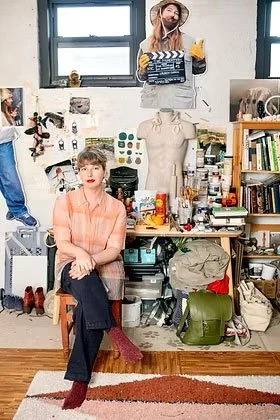
Can you describe your studio environment and how it influences your work? What are your go-to materials and tools right now? When I arrive at the studio, I usually start my day by sweeping and clearing my floor of any leftover debris and trash from the previous day; Most of which consists of latex gloves and paper towels. Both of which I use a lot. I’m a pacer, so having space to roam around and think is very important. Having a floor clear of junk is a must. From there, I’ll look around and consider what needs my attention. I usually have a couple of works going at a time, so I feel what is most attractive to my impulses that day. I like to think of myself as fairly disciplined; it’s hardly possible to maintain a fruitful studio practice without good habits, but I’m not someone who is over-prepared for a studio session. Perhaps my most consistent habit is reading a poem or two every morning before starting work. The poems have become like coffee for my brain. After a brief while of doing the tasks required to maintain a profession - answering emails, having virtual meetings with my studio managers, etc.- I’ll spend some time sketching and making a list, and charting out tasks that need to be completed. As I ready myself for work, I’ll usually play music or listen to a podcast or stand-up comedy special to help settle my mood and focus. Shortly afterwards, I walk over to my station and begin working.
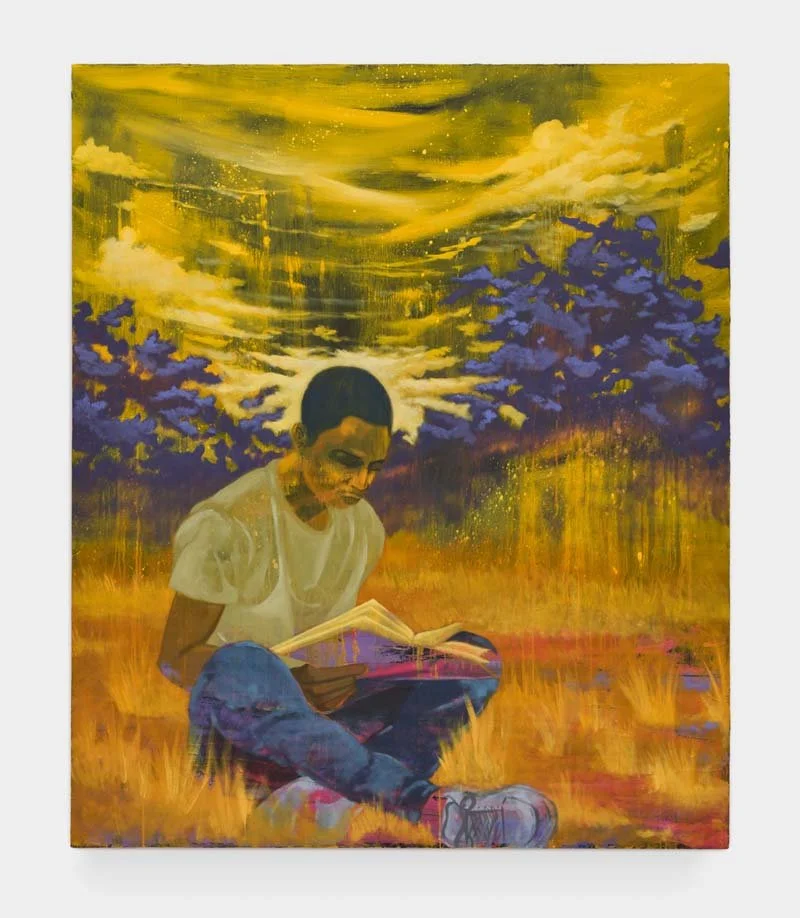
What projects are you working on right now? What kinds of ideas or feelings are you interested in? Many of my themes remain fairly consistent. I’m still greatly invested in the poetics of leisure, the relationship between surrealism and black life, and the poetry of the natural world. But really, I’m allowing my curiosities to remain open.
I’m spending much of my time working on experimental studies for upcoming painting projects, but nothing has been fleshed out yet. There are so many things I want to make, so allocating the time and attention will be a gradual process. That being said, I’m very excited about what’s happening in my studio.
What impact do you hope your art has on viewers? I aim to articulate with skill and quality of thought a measure of what astonishes me.
What I am most concerned with is creating artwork that is strong enough to provoke and galvanize the imagination—in other words, I aim to make work that functions as a means to evoke a feeling of poetry. For me, poetry is an aesthetic encounter, something that is experienced, a visceral feeling that strikes the drum of the imagination and transcends the boundaries of language, and through creative work of any kind, there's an aim to give form to the metrical sensations of our observations and experiences with the language and tools available. The quality of the form is a measure of the quality of the imagination and the skill of the artist who made the work. If the work is successful, I believe that what it attempts to communicate, disrupt, or affirm is heard and felt more loudly and viscerally because it can fill the mind with substantive material.
Which artists, past or present, would you like to meet? And why? There are so many artists I can name, but to name a quick five, I would choose Prince because a conversation on the role of the artist and music would be exciting. Jhumpa Lahiri because she wrote two of my favorite books, The Lowland and Unaccustomed Earth, both of which have a special place in my heart. Tracy K Smith is one of my favorite poets, and the breadth of her imagination is inspiring. Lynette Yiadom-Boakye, I have a deep respect for her practice, both as a painter and as a writer. I’m spending much of my time. Kendrick Lamar’s To Pimp a Butterfly is a masterpiece, and I have a deep admiration for his artistry and commitment to the culture of hip-hop.
What kind of inspiration do you draw from music, and do other mediums also influence your work? Absolutely. I find inspiration in any form of expression delivered with skill, a depth of thought, and having a nuanced relationship to the subject matter doesn’t hurt either. Music, of course, is a significant source of inspiration for me. I’ve been listening to a lot of Little Simz recently; her 2021 album, Sometimes I May Be Introvert, and her recent project, Lotus, have been in rotation. So is Kendrick Lamar's GNX project. What I appreciate about hip-hop in particular is the idea that you can affirm the self and assert who you are in a room through lyrical dexterity and an open challenge to anyone to attempt to usurp
What do you love about living in New Haven? Apart from having affordable studio space, the culinary scene in New Haven is outstanding. While Pepe’s and Sally’s are the city's staple pizza spots, I strongly recommend Modern Pizza if you’re ever in town for a visit.
Can you describe a project that challenged you creatively or emotionally—and how you worked through it? One of the most challenging exhibitions I had to prepare for was my Soft Shadows at Lehmann Maupin exhibition a couple of years ago. At that time, I was navigating a mire of heartbreak, burnout, loneliness, and grief. Needless to say, it was a harrowing season of troubles—my goodness, my mental health was low, and my anxiety was flaring up. Having lost my older brother while simultaneously experiencing an accelerated rise in the art world, with little support, made for a difficult situation to navigate, especially with the looming exhibition, serving as an introductory presentation of my work with a blue-chip gallery. It was a strange time. I distinctly remember feeling excitement and gratitude for my opportunities, as I was heading in a direction I imagined myself going as a student. Still, showing up at your best is hard when your interior is wounded.
Fortunately, I was surrounded by a reliable community of friends who supported me. Not all of them were individuals I’ve met. A few of them were found in books. Others were older artists who were generous enough to offer insight and advice for navigating unfamiliar territory as a young artist.
I also received some therapy. Never waste an opportunity to research and learn about a particular field. I came across the Jungian idea of shadow work, a therapeutic practice in which you focus on the suppressed characteristics and qualities that are a part of our identity, commonly referred to as the shadow self, and work towards acceptance as a means to arrive at a sense of wholeness and contentment. I found this idea quite fascinating, and it became the central theme of my exhibition.
How have important teachers/mentors/collaborators changed the way you do art? Shamelessly, I’ll admit, I have been a lifelong teacher’s pet. I maintain close relationships with many of my professors to this day. I also have a wonderful collection of mentors and supporters, ranging from fellow artists to curators and collectors who have poured so much into me that the words I have available would not be sufficient to express the depths of my gratitude.
Linda Vredeveld and Eric Shultis are two past professors from my time in community college back home in St. Louis. We’ve managed to maintain a great relationship that has remained supportive, stimulating, and enriching. We keep an open dialogue around ideas and the goings-on in the studio. Whenever I’m working on something and hit a wall, Linda and Eric are great for thinking through an art idea or solving issues with a particular work. When it comes to our work, we deeply value the space of critique and discourse. Because we make work to be in dialogue, those two have generously shared their time and attention each time I’ve beckoned them to see what I’m working on.
My undergraduate professor and now friend, Jason Yi, who teaches at the Milwaukee Institute of Art and Design, was the first to show me how to run a studio as a professional artist. I worked as his assistant for a while, and the experience I gained from my time with him has continued to serve me over the years. He has also offered invaluable life advice for navigating rejection, delayed success, and the skills necessary to ensure that the project one invests their time into is one of quality, sophistication, and rigor.
Samuel Messer is another artist and former professor who has profoundly impacted my life. Sam embodies what it means to navigate the world as an artist in a deeply inspiring way. He is generous with his time and attention and has an impassioned love for books and writers. One of the sources of bonding between Sam and me was our mutual love for poetry and literature.
The curator, Kilolo Luckett, has remained a cherished friend, supporter, and collaborator. She was responsible for curating my first institutional exhibition outside of grad school at the Al Wilson African-American Cultural Center in Pittsburgh. She is fiercely loyal to the artists she works with, and one of the things I admire most is her commitment to growing alongside artists. She doesn’t see collaboration as a fleeting exchange facilitated by an institution, but views it as an element in the nucleus of creative society. Without a doubt, she is a force.
Collectors have also become individuals with whom I’ve forged excellent relationships. Robin and Marty Lipson, The Beachum Family, Debbie and Mitchell Rechler, Sonia Kashuk, Jonah and Daniel Kaner, and Leslie and Michael Weissman are among the most generous and earnest individuals I’ve ever met in the art world.
Great artists and mentors like Rashid Johnson, Teresita Fernandez, and Titus Kaphar have been generous with their knowledge, time, and understanding. I’m certain each of these artists has received a call from me at one point while under some inflamed emotional state, and each of them received and handled my disarray with grace.
Sustainability in the art world is an important issue. How does the environment intersect with your work? Does being in nature inspire your art or your process? Sustainability is the perpetual obstacle every artist has to navigate. It isn’t only a matter of keeping the work vital, compelling, and intellectually stimulating; it’s also a matter of ensuring that our interior reservoirs don’t run dry. That is to say that the ability to generate new ideas and live in the imagination becomes increasingly complex the more one exhausts one's interior resources while forgetting to replenish them equally important.
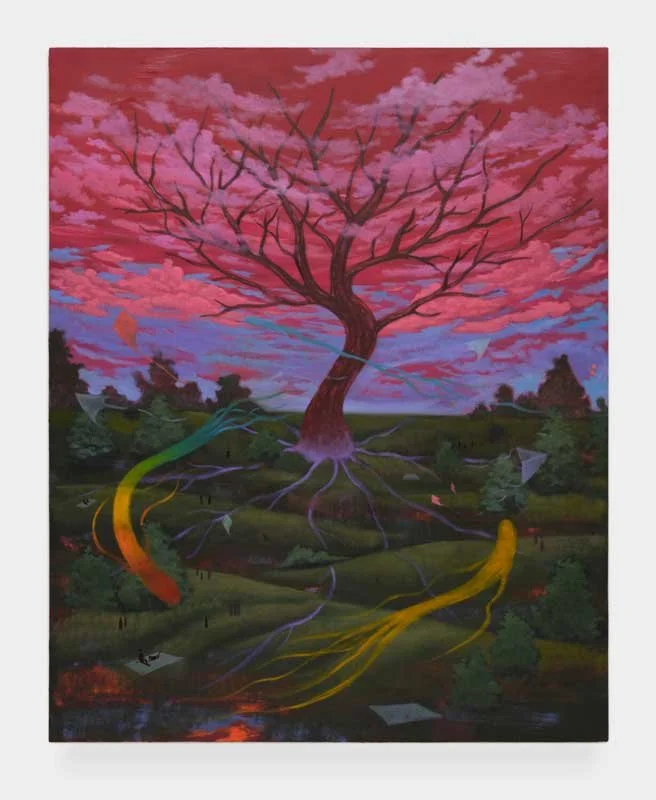
Spending time in nature has been a great source of replenishing my sense of interiority. And I’m often presented with questions, and the opportunity to be swept away by musings born from what is observed in nature has been immensely rewarding. My body of work, the Thunderscapes, was born from a musing I had while roaming through a park filled with skeletal trees that projected jagged and long-limbed shadowy branches into the field around me. Observing this, I immediately thought about where I was in a thunder field, which allowed my imagination to wander. I thought about the possibility of encountering a sky phenomenon like lightning as a natural part of the Earth's landscape that one can run through. Witnessing the shadows around me, I realized that the lightning bolts I sought were found in the shadows of nature.
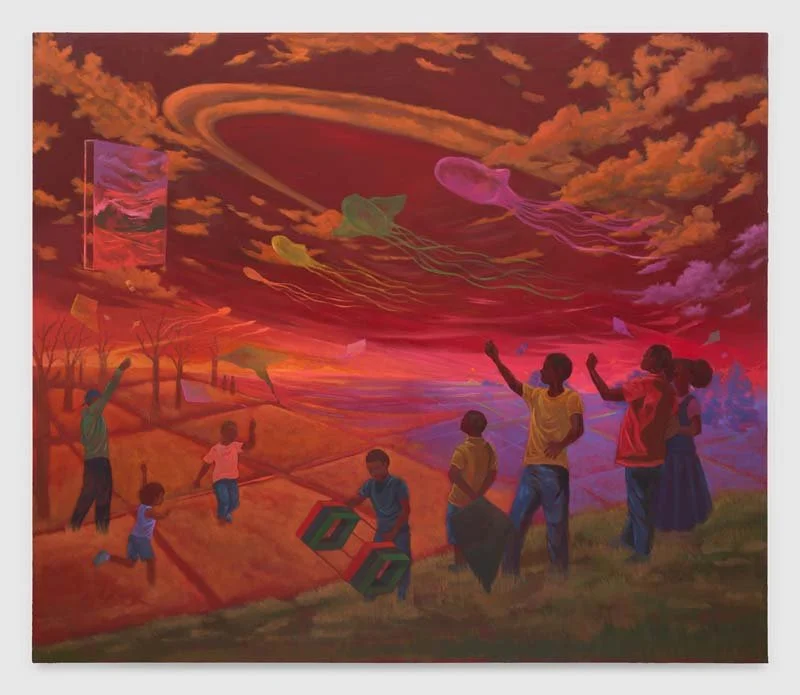
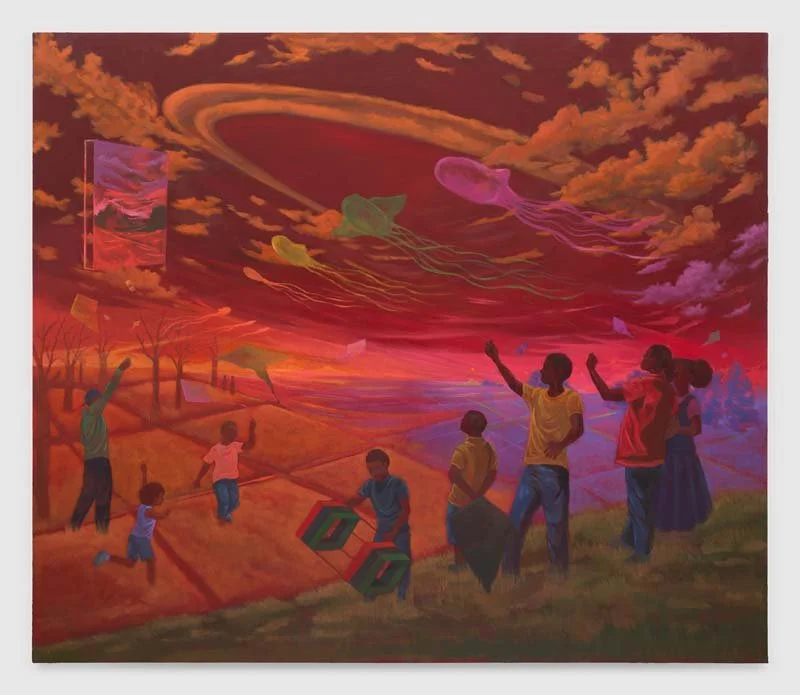
The poet Mary Oliver speaks beautifully about the natural world's power and what is made possible if we simply give it our attention. There is power in this. After all, as Mary Oliver once said, “ Attention is the beginning of devotion.” Granting your attention and making yourself vulnerable to the poetic waves and ranges within the natural world is a transformative act. Before long, you can interpret the curiosities within the natural world with your point of view. A point of view is powerful, as it is the site of departure for articulating your experience and vision of the world. The wind could be a sled that carries a message, the message could be a cloud, and the message's contents could be rain. Clouds could be interpreted as animated brush marks, marching across the blue backdrop of the sky. Clouds are a great poetic form, and the color they hold in their bodies has intrigued me for many years. This is one of the reasons I am so attracted to the activity of kite flying as a form of kinetic leisure. Kite flying facilitates reunion with our vision and the sky above us. The kite also functions as an avatar that allows the imagination to be ferried away by the grandeur of the natural world and the elemental currents that keep the kite in motion.
I could go on. But suffice it to say that the ability to replenish the interior materials that are all too often at risk of being completely extracted from the breakneck pace of the art world. Developing and nurturing a relationship with the natural world is an excellent way of circumventing this misfortune and also facilitates an invitation to experience a form of personal and artistic variegation from the exposure to the poetry that resides outside your door.
What are your reflections on the future of AI in art? What will be the importance of handmade creative works in that future? This will be brief. I have no interest in AI-generated images. I am exclusively interested and invested in the quality and depth of the human imagination. I recognize the benefit AI presents as a tool, but it hardly stands up to the storied history of human innovation and thought. The relationship between the maker and the process of creation is one that is integral to the very nature of being. The ability to deposit a measure of our subjectivity into an object is akin to performing a séance. It is a process that collapses the barrier between past, present, and future as the object in its aesthetic and material life contains a prescient nature that aids our forward momentum as a society. That is where I stand with this.
Exploring ideas, art and the creative process connects me to… Those who think deeply about the world around them.