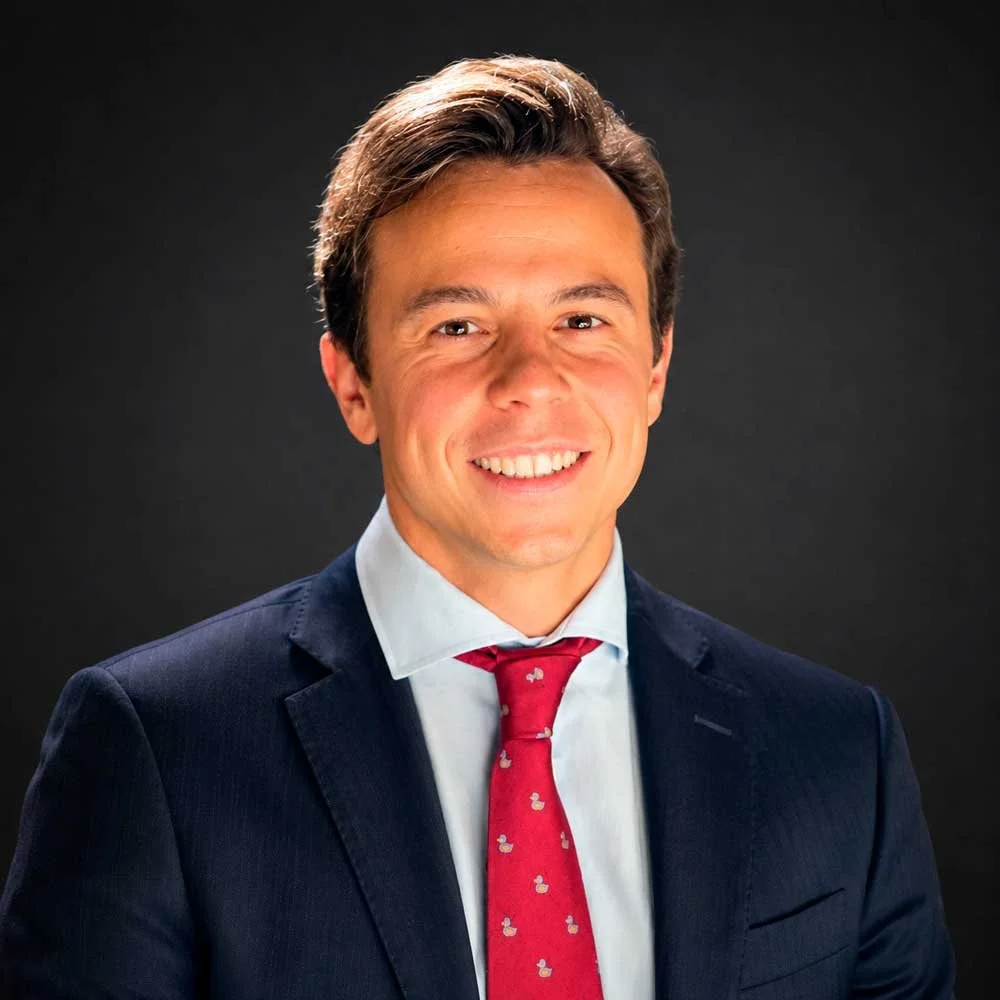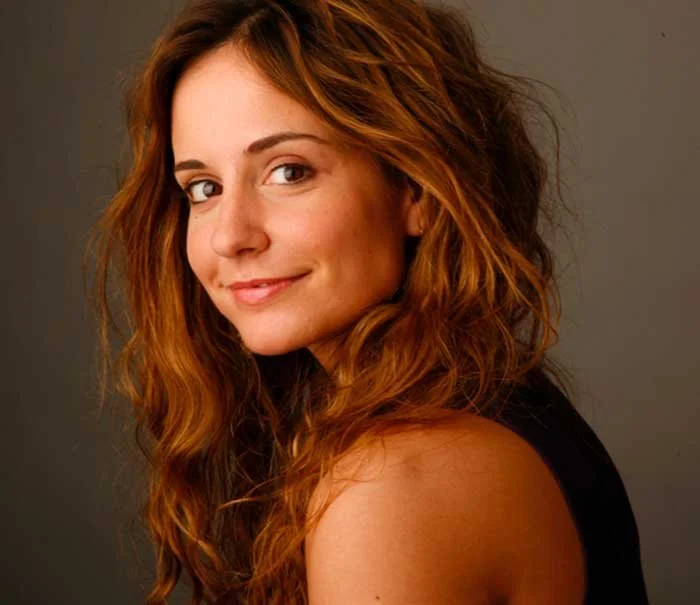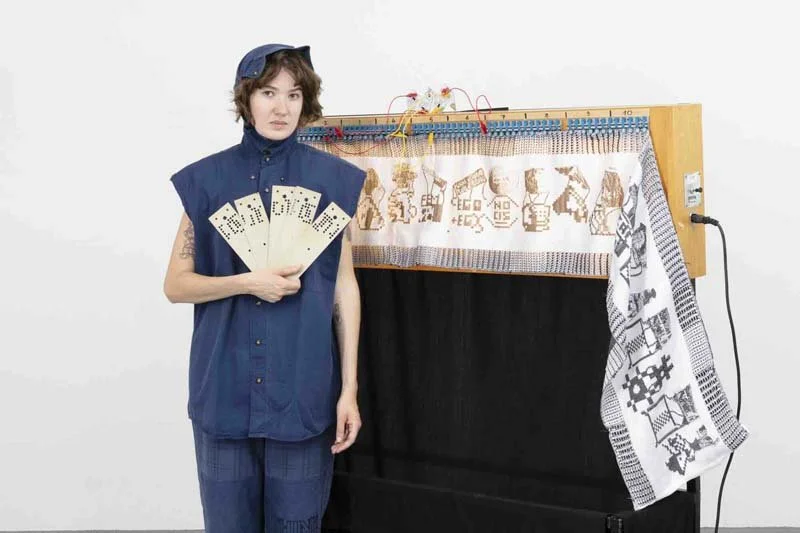


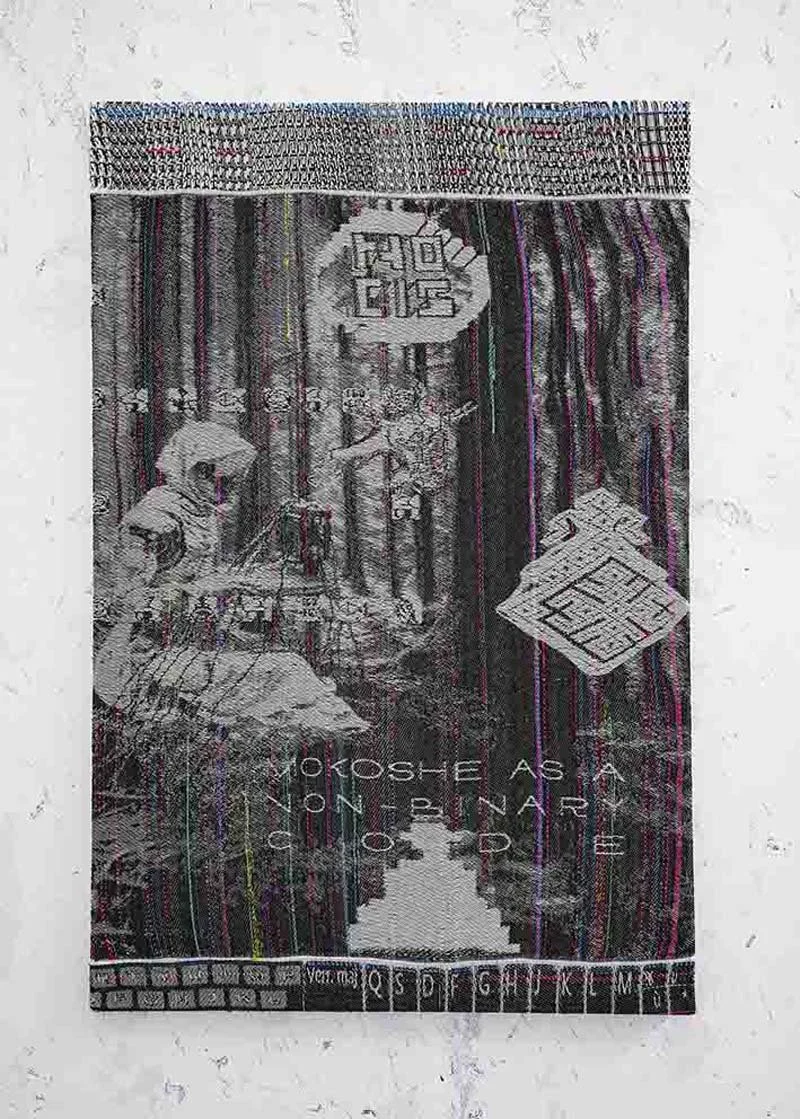
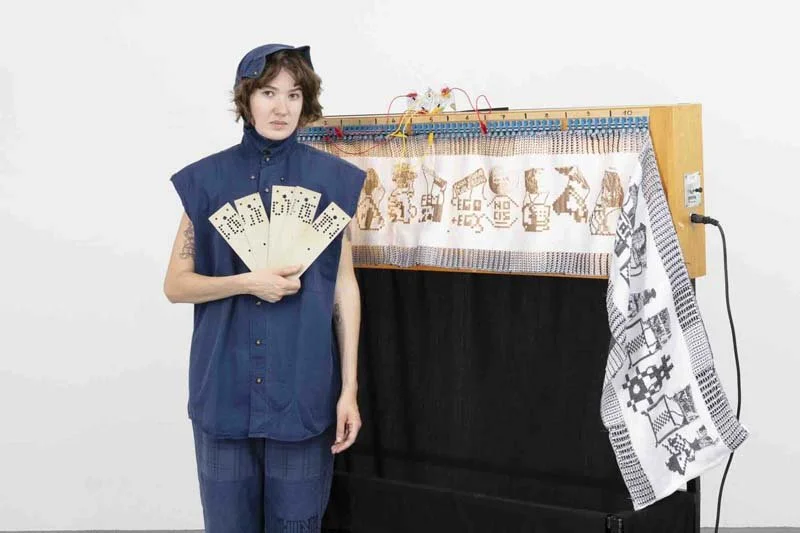
Bérénice Gaça Courtin’s work spans textile arts, audiovisual creation, and performance. For the past five years, she has been researching the life of her grandfather, Kazimierz Gaca, a Polish resistance fighter who worked with the ENIGMA machine during the Second World War. Using a manual digital Jacquard loom, she weaves fabrics embedded with codes inspired by encrypted messages, drawing parallels between loom and machine—both of which are foundational to the development of binary code and computing. In 2023, she created an installation for the Centre Pompidou-Metz, presented in the museum’s Capsule space from September to December. Most recently, her work was shown in the exhibition Under the Weaver’s Hands at the Kunsthalle in Trier. @berenice_gaca_courtin
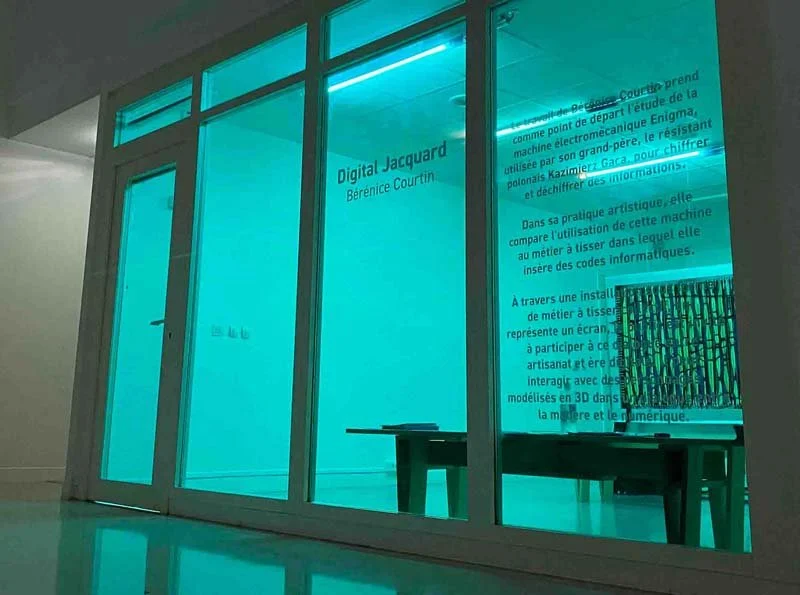
Where were you born and raised? How did it influence your art and your thinking about the world? I was born in Paris, where I started studying and working in fashion in Paris and I was always interested in how and where textile was made.
When did you first fall in love with art and realize you wanted to be an artist? For you, what is the importance of the arts? I would say when I was a kid I was always drawing, making installations in my home, creating small hidden corners and writing. My aunt taught me how to draw, eventhough I was not always connected to the religious influence she was giving me. It still created a sort of necessity in my self-expression and my way to connect with the world and people.
What does your typical day in the studio look like? Walk us through your studio and your most-used materials and tools. At my studio, my Loom is standing in the middle. A typical day will depends on where I am at in my projects. If I am at the stage of designing my future weaving I am drawing with a wall of pictures I took of ((txt)) I wrote and inspirations.
I could also be preparing my Loom adding the threads on it or weaving. If I am preparing a performance, then I would be re-reading and listening to my texts over and over again and making some music to go along with it.
The most used materials are threads that I buy everywhere I travel or I do residences, pens to draw, shuttles to get the threads woven.
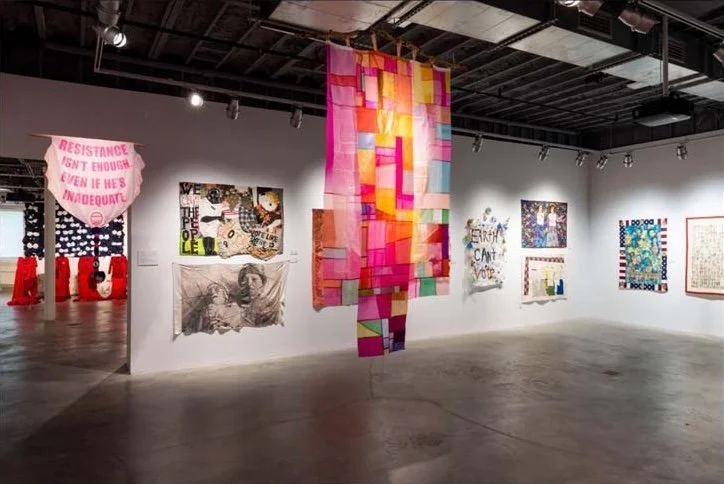
What led you to explore encryption and hidden messages through textile, and what are you working on now? At the moment, I just finished an exhibition about weaving and performance in the Kunsthalle in Trier in Germany. I had about nine wings exhibited as well as my Loom that I activated at the massage and at the finish for performances. I have been working on the theme of codes and extreme and encryption within textiles for the past few years. And in this exhibition, I was having my Loom as a hacking machine able to send cryptic messages through shortwaves. I worked with a musician for the finissage and we were communicating through symbolic visuals and sounds. I am now finishing a public arts culture project of a collective Loom in a village in France at the border with Switzerland talking about the theme of borders and borders scape.
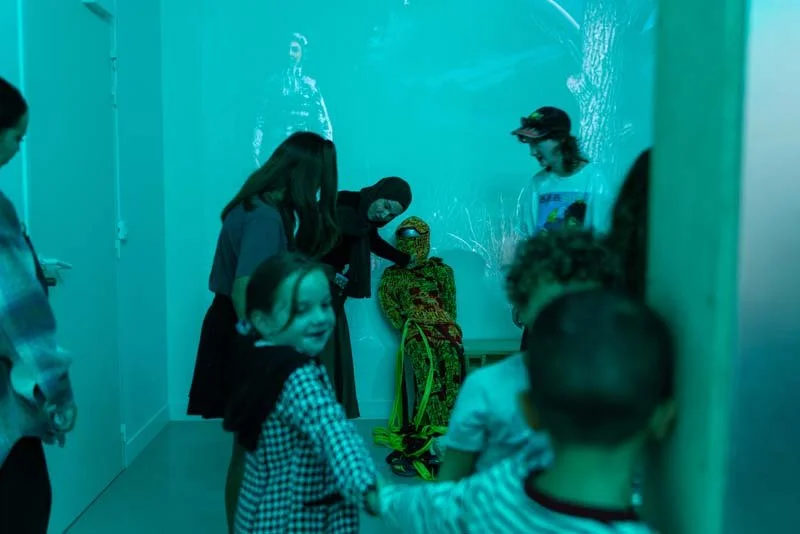
When your work is encountered—whether as a woven piece, a performance, or installation—what do you hope resonates most with people? I really enjoy the interaction with a public in my arts. In this previous exhibition, I was inviting people to think about a symbol of resistance inspired by my own story and my work where I invent an alphabet of resistance. I gathered the symbols and wove them live for the finer. I gave the weaving to the museum of here afterwards as well as a typography for the inhabitants. I am trying to talk about a social fabric within my works and that’s why the contact with people is important always mysterious as well as open and enriching.
I want people to feel like they have a real impact on the work they are observing and they become part of the work themselves.
Are there artists, thinkers, or performers—living or dead—you feel an affinity with, or would love to engage in conversation with? I would love to meet Anna Homler, Angela Davis, Sonya Rapoport, Charlotte Johannesson...
Your practice draws from many sources. What other art forms or real-life encounters do you find yourself returning to for inspiration?
I draw inspiration from Music arts, films and from life experiences such as social gatherings where I take parts.
Living between Geneva and Paris, how do the rhythms and atmospheres of those cities influence your creativity and sense of community? The great thing about living in Geneva is looking at the colour of the lake and the river and to be surrounded by mountains. The art community is vibrant and I enjoy being part of off space exhibitions which take place in very original places such as a garage.
I am also often in Paris where it is good to be in the tumult and the cultural profusion. I get to work with friends in big studios with a lot of other artists.
Your performance at CCCB in Barcelona, based on your grandfather’s story, sounds deeply personal. How did you navigate the emotional intensity of working with family history in a public setting?
The experimental film performance we did about my grandfather with musicians and a movie director. It was hard to be talking about something so personal and so historical at the same time. I dissociated sometimes, but the crew we had made everything smoother, and we supported each other while allowing emotions to flow.
You’ve worked closely with mentors and curators across different fields—from glitch feminism to weaving. How have these collaborations helped you grow or shift direction in your work? Rosa Menkman, a teacher specialised in glitch feminism taught me way of researching within my practice. Giulia Bini a teacher creating exhibitions about art and science and showed me references that I dive into. Francesca Piñol that taught me how to weave. Anne-Marine Gilberteau that programmed me at Centre Pompidou Metz for three months interactive installation. And many more.
In projects like Naturea Culturea, you integrate craft and digital making. What role does environmental awareness play in how you choose materials and methods? Can you share a landscape that’s stayed with you? Sustainability has always been a part of my work, although I tend to call a differently such as in my project Naturea Culturea which merges is craft and digital making. It is important for me to make most things by myself by hands and select preciously my materials. My threads are many times recycled and they look at where wool or cotton comes from if I bought it by it from an artisan.
I have been doing this residency in the Basque Country in Spain where I have been weaving on the jacquard Loom and I had access to the wool of the sheeps coming from the surroundings. It is quite rare to have a local wool in Europe. The mountains there are very green as it was always sunny and rainy at the same time.
I remember the mysterious fog that i would find every day.
With AI transforming so many aspects of creative production, what’s your view on the tension between human-made and machine-generated work? How do you see your own work responding to this moment? AI is scary and intriguing and it is part of my research to try to deepen my knowledge about it. Indeed Allan Turing, whose work was inspired by the one of my grandfather and the other cryptologists he was working with was talking about the risks of AI. I also like the book from Elizabeth called touring talking about the relationship between gender and technologies. It is even more important for me to foster human relationships and arts in these times.
Exploring ideas, art and the creative process connects me to all the things that make my work important for me and reasons why I get the strength to continue. Talking about nature, people, techniques and materiality of how we observe the world as artists, is a good habit for us to remember and connect. It brings me back to the roots of what I do and why.