How to Make an Algorithm in the Microwave with Poet MAYA SALAMEH

How to Make an Algorithm in the Microwave with Poet MAYA SALAMEH

Poetry is like one of the great loves of my life, and I think it's probably the longest relationship I'll ever have. I read a lot of poetry. I also wrote these short stories even when I was pretty young, like in second grade, and the stories kept getting shorter and shorter. My family used to go to Damascus in Syria and Lebanon every summer for three months until 2011, when the Civil War broke out in Syria. In 2015, we made our first return after that gap, and my father and I went to Lebanon for two weeks. It's the first time I felt that I belong. To the extent that was true or not, I'm obviously irrevocably American. I speak broken Arabic. I don't think I could ever live in Lebanon or Syria. But for what it was worth at 15 years old, it was a life-changing trip. I wrote my first official poem on the plane back to San Diego from that trip, and I feel that was a formative moment for me. I felt that I had a story to tell and wanted to put it to paper in the form of poetry.

In 2015, we made our first return after that gap, and my father and I went to Lebanon for two weeks. Being back in one of my two homelands as a more fully formed person and not like a young child, I thought, "Wow, this is the first time I've been in an Arabic-speaking Arab place as a teenager." 

Why We Need Stories in Times of Crisis: ETGAR KERET on Healing, Connection & Creativity in the Age of AI - Highlights

Why We Need Stories in Times of Crisis: ETGAR KERET on Healing, Connection & Creativity in the Age of AI - Highlights

A Conversation with Author · Filmmaker ETGAR KERET
Winner of Cannes Film Festival’s Caméra d’Or · Charles Bronfman Prize & Sapir Prize

When I write my stories, I don't want to solve things in life. I just want to persuade myself that there is a way out. Maybe I am in a cell, maybe I'm trapped. Maybe I won't make it, but if I can imagine a plan for escape, then I'll be less trapped because at least in my mind, there is a way. I think that my parents are survivors. They always talked about this idea of humanity. My parents always said to me, when you look at people, don't look at their political views; that's not important. Look at the way that they look at you. If they see you, if they listen to you, if they can understand your intention, even if it's a failing one, they're your people. And if they can't, it doesn't matter.

I think that when I came with my mother and father, they thought there are people, there are human beings, and there are people who want to be human beings but are still struggling. And you go with humanity; you go with the person who can go against his ideology if his heart tells him something.

Finding Humanity Through Storytelling with Author & Filmmaker ETGAR KERET

Finding Humanity Through Storytelling with Author & Filmmaker ETGAR KERET

A Conversation with Author · Filmmaker ETGAR KERET
Winner of Cannes Film Festival’s Caméra d’Or · Charles Bronfman Prize & Sapir Prize

When I write my stories, I don't want to solve things in life. I just want to persuade myself that there is a way out. Maybe I am in a cell, maybe I'm trapped. Maybe I won't make it, but if I can imagine a plan for escape, then I'll be less trapped because at least in my mind, there is a way. I think that my parents are survivors. They always talked about this idea of humanity. My parents always said to me, when you look at people, don't look at their political views; that's not important. Look at the way that they look at you. If they see you, if they listen to you, if they can understand your intention, even if it's a failing one, they're your people. And if they can't, it doesn't matter.

I think that when I came with my mother and father, they thought there are people, there are human beings, and there are people who want to be human beings but are still struggling. And you go with humanity; you go with the person who can go against his ideology if his heart tells him something.

AI, UFOs, Perception & Reality with Artist, Geographer, Author TREVOR PAGLEN - Highlights

AI, UFOs, Perception & Reality with Artist, Geographer, Author TREVOR PAGLEN - Highlights

At the core of the work is that sense of curiosity, that sense of joy, that sense of beauty, and that sense of learning. I've been fortunate to have all kinds of strange and interesting experiences, whether that's seeing weird things in the sky over secret military bases in the middle of the Nevada desert, going scuba diving and finding internet cables on the bottom of the ocean, or tracking spy satellites in the sky and being able to predict when they'll appear in a flash against the backdrop of stars. The world around us is extraordinary and embodied, right? It is not on screens, and I’m very privileged to have that be so much a part of my process.

How AI is Shaping Perception w/ Artist TREVOR PAGLEN, Author of Trevor Paglen: Adversarially Evolved Hallucinations

How AI is Shaping Perception w/ Artist TREVOR PAGLEN, Author of Trevor Paglen: Adversarially Evolved Hallucinations

How Deception is Sculpting Our Reality
A Conversation Artist, Geographer, Author TREVOR PAGLEN

At the core of the work is that sense of curiosity, that sense of joy, that sense of beauty, and that sense of learning. I've been fortunate to have all kinds of strange and interesting experiences, whether that's seeing weird things in the sky over secret military bases in the middle of the Nevada desert, going scuba diving and finding internet cables on the bottom of the ocean, or tracking spy satellites in the sky and being able to predict when they'll appear in a flash against the backdrop of stars. The world around us is extraordinary and embodied, right? It is not on screens, and I’m very privileged to have that be so much a part of my process.

Abolish Silicon Valley—How to Liberate Technology from Capitalism

Abolish Silicon Valley—How to Liberate Technology from Capitalism

A Conversation with WENDY LIU

Abolishing Silicon Valley means freeing the development of technology from a system that will always relegate it to a subordinate role, that of entrenching existing power relations. It means designing a new system that isn't deluged in the logic of the bucket. It means liberating our worlds from the illegitimate ring of capital. Perhaps this sounds unfair to capital. Perhaps I sound like I'm not grateful enough for everything that capital has given us, but we don't owe capital anything; the things we attribute to capital were built by workers. People can labor and sometimes die in a process. Their contributions are unrecognized in death as in life. So don't thank capital. It doesn't deserve our gratitude, and it doesn't need it. Thank the people who created everything that capital always takes credit for. Capital is a means of accounting for wealth ownership, not its creation. And that means it's perpetually shrouded in a fundamental untruth; we can leap the swamp of capital behind and start over with something new. 

In this episode on Speaking Out of Place podcast Professor David Palumbo-Liutalks with Wendy Liu. Ever since its publication, Abolish Silicon Valley—How to Liberate Technology from Capitalism has proven to be more urgent and insightful. Today, he talks with author Wendy Liu about how developments like AI and LLM, further erosions of intellectual property, and increased invasions of privacy make the case for abolishing Silicon Valley even more important. They talk about how abolition is critical at a time when more and more the private sector has come to eviscerate the public good. Turning to the genocide in Gaza, they discuss the ways Capital has enlisted technology in deadly and horrific manners. They end with a meditation on the commons and how one can live with fewer commodities and find value in common projects to make life more valuable and worthwhile outside of the logic of the market.

An Actor Prepares - SHARON LAWRENCE on Crafting Complex Characters - Highlights

An Actor Prepares - SHARON LAWRENCE on Crafting Complex Characters - Highlights

A Conversation with SHARON LAWRENCE

That transformation was key to my next step as an artist, to knowing that's what acting is. It isn't just posing; it isn't just being a version of yourself in a way that was free. Performing wasn't just performing; it was transforming. I think that artists find that in many different ways, and as actors, there are many ways into that.

SHARON LAWRENCE on Acting, Activism & The Art of Transformation

SHARON LAWRENCE on Acting, Activism & The Art of Transformation

A Conversation with SHARON LAWRENCE

That transformation was key to my next step as an artist, to knowing that's what acting is. It isn't just posing; it isn't just being a version of yourself in a way that was free. Performing wasn't just performing; it was transforming. I think that artists find that in many different ways, and as actors, there are many ways into that.

"We're connected to the lives of every creature on the planet" EIREN CAFFALL - Highlights

"We're connected to the lives of every creature on the planet" EIREN CAFFALL - Highlights

We are in a complex and delicately balanced relationship of connection to everything else on the planet. We begin to recognize, write into, and speak into the complex interdependence and interconnection of every gesture that we make on the planet. Most storytelling that I really respond to, whether it's from my own culture or from previous civilizations, acknowledges that we are in this complex relationship where every gesture we make is connected to the lives of every other creature on the planet. The more narratives we allow to be complex in that way and interconnected, the more we begin to change our brain chemistry around how we protect ourselves and everything that is in relation to us. The more that you have that evolving relationship with it, that's dynamic and alive to the moment you're in, and that's not afraid of the feelings of fear, hopelessness, grief, or pain that attend paying close attention to the world as it is evolving around you, the better we are able to be flexible in the relationship we need to form with fixing what we can and holding onto what we have.

All the Water in the World with Writer & Musician EIREN CAFFALL

All the Water in the World with Writer & Musician EIREN CAFFALL

A Conversation with Writer & Musician EIREN CAFFALL

We are in a complex and delicately balanced relationship of connection to everything else on the planet. We begin to recognize, write into, and speak into the complex interdependence and interconnection of every gesture that we make on the planet. Most storytelling that I really respond to, whether it's from my own culture or from previous civilizations, acknowledges that we are in this complex relationship where every gesture we make is connected to the lives of every other creature on the planet. The more narratives we allow to be complex in that way and interconnected, the more we begin to change our brain chemistry around how we protect ourselves and everything that is in relation to us. The more that you have that evolving relationship with it, that's dynamic and alive to the moment you're in, and that's not afraid of the feelings of fear, hopelessness, grief, or pain that attend paying close attention to the world as it is evolving around you, the better we are able to be flexible in the relationship we need to form with fixing what we can and holding onto what we have.

PAUL LYNCH discusses Prophet Song, Beyond the Sea & his Creative Process - Highlights

PAUL LYNCH discusses Prophet Song, Beyond the Sea & his Creative Process - Highlights

Booker Prize-winning Novelist PAUL LYNCH
Author of Prophet Song · Beyond the Sea · Red Sky in the Morning

We narrate the story of our lives to ourselves. We narrate it in linear fashion. And I know many writers have played with time in all sorts of amazing ways, but we're storytellers. This is what we do. And if you give the brain a story, a prepackaged story, you're giving a cheesecake. That's what it wants. That's why it loves stories. That's why our society is just built on stories. Politics is nothing but stories. Everything you do in the evenings – we sit down, we're watching Netflix – just stories. We consume them all the time. We are just machines for belief.

On Storytelling & The Human Condition with Booker Prize Winner PAUL LYNCH

On Storytelling & The Human Condition with Booker Prize Winner PAUL LYNCH

Author of Prophet Song · Beyond the Sea · Red Sky in the Morning

We narrate the story of our lives to ourselves. We narrate it in linear fashion. And I know many writers have played with time in all sorts of amazing ways, but we're storytellers. This is what we do. And if you give the brain a story, a prepackaged story, you're giving a cheesecake. That's what it wants. That's why it loves stories. That's why our society is just built on stories. Politics is nothing but stories. Everything you do in the evenings – we sit down, we're watching Netflix – just stories. We consume them all the time. We are just machines for belief.

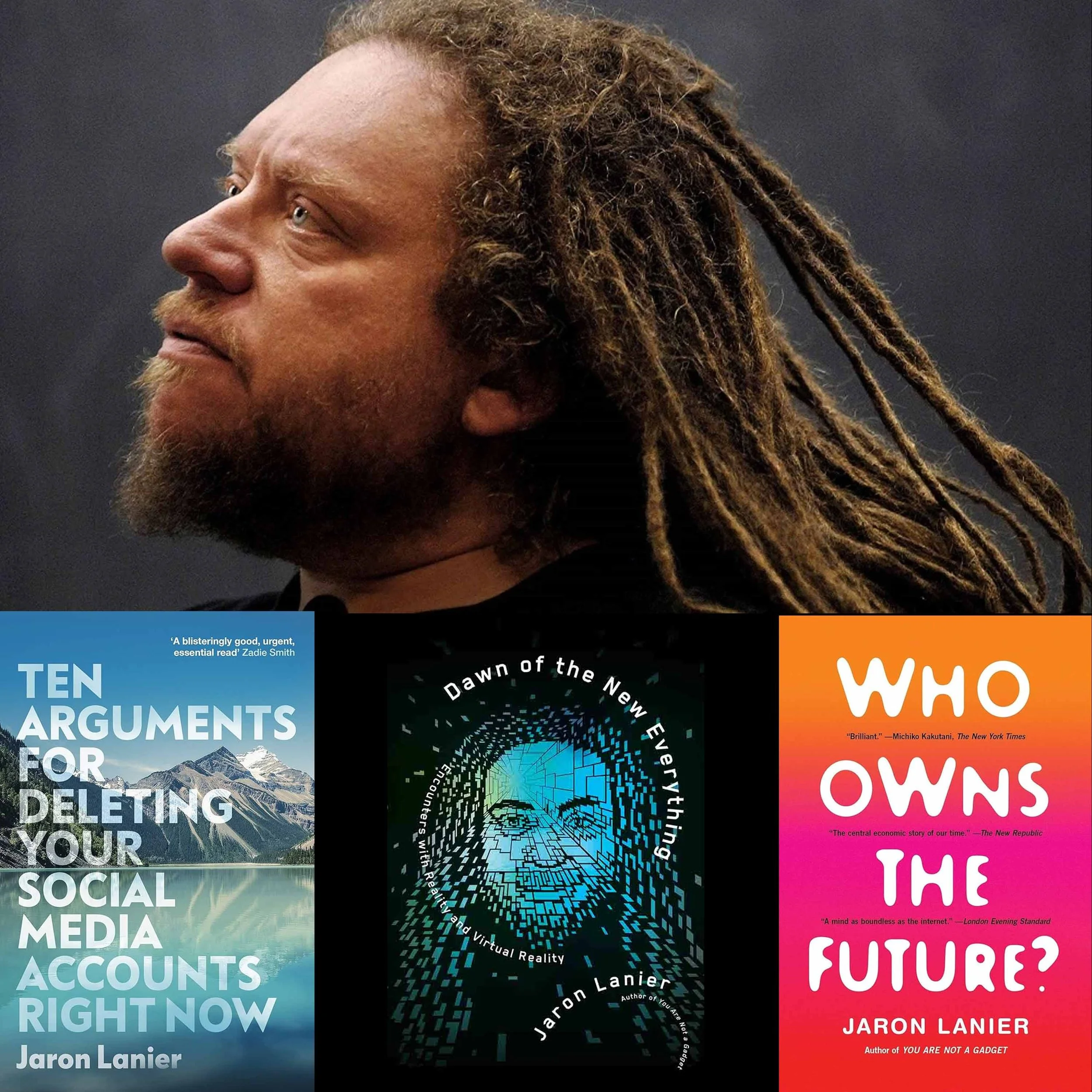
JARON LANIER on Tech, Music, Creativity & Who Owns the Future - Highlights

JARON LANIER on Tech, Music, Creativity & Who Owns the Future - Highlights

VR Pioneer · Musician · Author JARON LANIER
Who Owns the Future? · Dawn of the New Everything: Encounters with Reality & Virtual Reality · Ten Arguments for Deleting Your Social Media Accounts Right Now

AI is obviously the dominant topic in tech lately, and I think occasionally there's AI that's nonsense, and occasionally there's AI that's great. I love finding new proteins for medicine and so on. I don't think we serve ourselves well when we put our own technology up as if it were a new God that we created. I think we're really getting a little too full of ourselves to think that.

When we do that, I think we confuse ourselves too easily. This goes back to Alan Turing, the main founder of computer science, who had this idea of the Turing test. In the test, you can't tell whether the computer has gotten more human-like or the human has gotten more computer-like. People are very prone to becoming more computer-like. When we're on social media, we let ourselves be guided by the algorithms, so we start to become dumb in the way the algorithms want us to. You see that all the time. It's really degraded our psychologies and our society.

AI, Virtual Reality & Dawn of the New Everything w/ JARON LANIER, Father of VR, Musician, Author

AI, Virtual Reality & Dawn of the New Everything w/ JARON LANIER, Father of VR, Musician, Author

Father of VR · Musician · Author JARON LANIER
Who Owns the Future? · Dawn of the New Everything: Encounters with Reality & Virtual Reality · Ten Arguments for Deleting Your Social Media Accounts Right Now

AI is obviously the dominant topic in tech lately, and I think occasionally there's AI that's nonsense, and occasionally there's AI that's great. I love finding new proteins for medicine and so on. I don't think we serve ourselves well when we put our own technology up as if it were a new God that we created. I think we're really getting a little too full of ourselves to think that.

When we do that, I think we confuse ourselves too easily. This goes back to Alan Turing, the main founder of computer science, who had this idea of the Turing test. In the test, you can't tell whether the computer has gotten more human-like or the human has gotten more computer-like. People are very prone to becoming more computer-like. When we're on social media, we let ourselves be guided by the algorithms, so we start to become dumb in the way the algorithms want us to. You see that all the time. It's really degraded our psychologies and our society.

Elon Musk, Putin's Russia, Murdoch's Fox News: How Billionaires Shape Our World with DARRYL CUNNINGHAM

Elon Musk, Putin's Russia, Murdoch's Fox News: How Billionaires Shape Our World with DARRYL CUNNINGHAM

The Lives of Billionaires Comic Artist & Author DARRYL CUNNINGHAM on Making Complex Subjects Simple

No one should be a billionaire because it's damaging. There's a certain level of wealth that's damaging to a country. Billionaires have so much wealth that they have enormous political power, which is undemocratic. There should be a ceiling on wealth. I have nothing against people becoming millionaires or even multi-millionaires. But multi-billionaires are incredibly bad for all of us. If you have so much money that you can buy an entire political party, that's a thing that shouldn't exist.

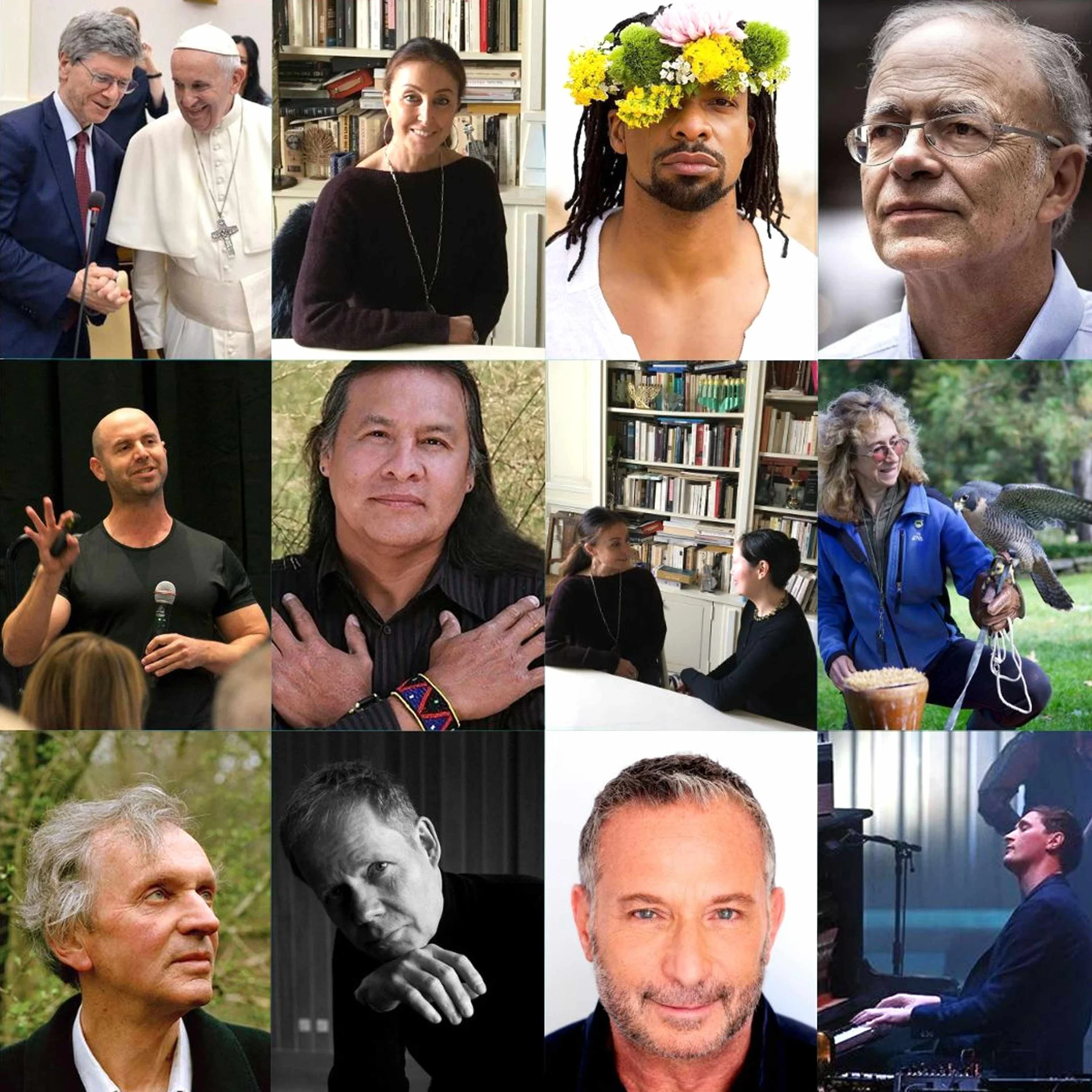
What Does It Mean to Live a Good Life? Artists, Writers, Visionaries & Educators Share their Stories

What Does It Mean to Live a Good Life? Artists, Writers, Visionaries & Educators Share their Stories

Artists, Writers, Visionaries & Educators Share their Stories

How can the arts help us learn to speak the language of the Earth and cultivate our intuitive intelligence? What is the power of mentorship for forging character and creative vision? How can we hold onto our cultural heritage and traditions, while preparing students for the needs of the 21st century?

Assembling Tomorrow: A Guide to Designing a Thriving Future - SCOTT DOORLEY & CARISSA CARTER - Highlights

Assembling Tomorrow: A Guide to Designing a Thriving Future - SCOTT DOORLEY & CARISSA CARTER - Highlights

Creative & Academic Director · Stanford d.school
Co-authors of Assembling Tomorrow: A Guide to Designing a Thriving Future

Today, someone is putting the finishing touches on a machine-­ learning algorithm that will change the way you relate to your family. Someone is trying to design a way to communicate with animals in their own language. Someone is cleaning up the mess someone else left behind seventy years ago yesterday. Today, someone just had an idea that will end up saving one thing while it harms another.

To be a maker in this moment—­ to be a human today—­ is to collaborate with the world. It is to create and be created, to work and be worked on, to make and be made. To be human is to tinker, create, fix, care, and bring new things into the world. It is to design. You—­ yes, you!—­ might design products or policy, services or sermons, production lines or preschool programs. You might run a business, make art, or participate in passing out meals to the poor. You may write code or pour concrete, lobby for endangered species legislation or craft cocktails. Wherever you fit in, you are part of shaping the world. This is design work.

– Assembling Tomorrow: A Guide to Designing a Thriving Future

Can Design Save the World? - SCOTT DOORLEY & CARISSA CARTER - Co-authors of Assembling Tomorrow - Directors of Stanford’s d.School

Can Design Save the World? - SCOTT DOORLEY & CARISSA CARTER - Co-authors of Assembling Tomorrow - Directors of Stanford’s d.School

Creative & Academic Director · Stanford d.school
Co-authors of Assembling Tomorrow: A Guide to Designing a Thriving Future

Today, someone is putting the finishing touches on a machine-­ learning algorithm that will change the way you relate to your family. Someone is trying to design a way to communicate with animals in their own language. Someone is cleaning up the mess someone else left behind seventy years ago yesterday. Today, someone just had an idea that will end up saving one thing while it harms another.

To be a maker in this moment—­ to be a human today—­ is to collaborate with the world. It is to create and be created, to work and be worked on, to make and be made. To be human is to tinker, create, fix, care, and bring new things into the world. It is to design. You—­ yes, you!—­ might design products or policy, services or sermons, production lines or preschool programs. You might run a business, make art, or participate in passing out meals to the poor. You may write code or pour concrete, lobby for endangered species legislation or craft cocktails. Wherever you fit in, you are part of shaping the world. This is design work.

– Assembling Tomorrow: A Guide to Designing a Thriving Future

How Do Utopian Visions Shape Our Reality & Future? - Highlights - S. D. CHROSTOWSA

How Do Utopian Visions Shape Our Reality & Future? - Highlights - S. D. CHROSTOWSA

Author · Historian · Curator
Utopia in the Age of Survival: Between Myth and Politics · The Eyelid · Marvellous Utopia

I like to think of utopianism as “effective social daydreaming” because utopia is associated with consciously imagining societies. Our imagination is always involved in creating reality. The opposition between the two, reality and the imaginary, is not a stark one; they're porous.

Utopia in the Age of Survival with S. D. CHROSTOWSKA

Utopia in the Age of Survival with S. D. CHROSTOWSKA

Author · Historian · Curator
Utopia in the Age of Survival: Between Myth and Politics · The Eyelid · Marvellous Utopia

I like to think of utopianism as “effective social daydreaming” because utopia is associated with consciously imagining societies. Our imagination is always involved in creating reality. The opposition between the two, reality and the imaginary, is not a stark one; they're porous.