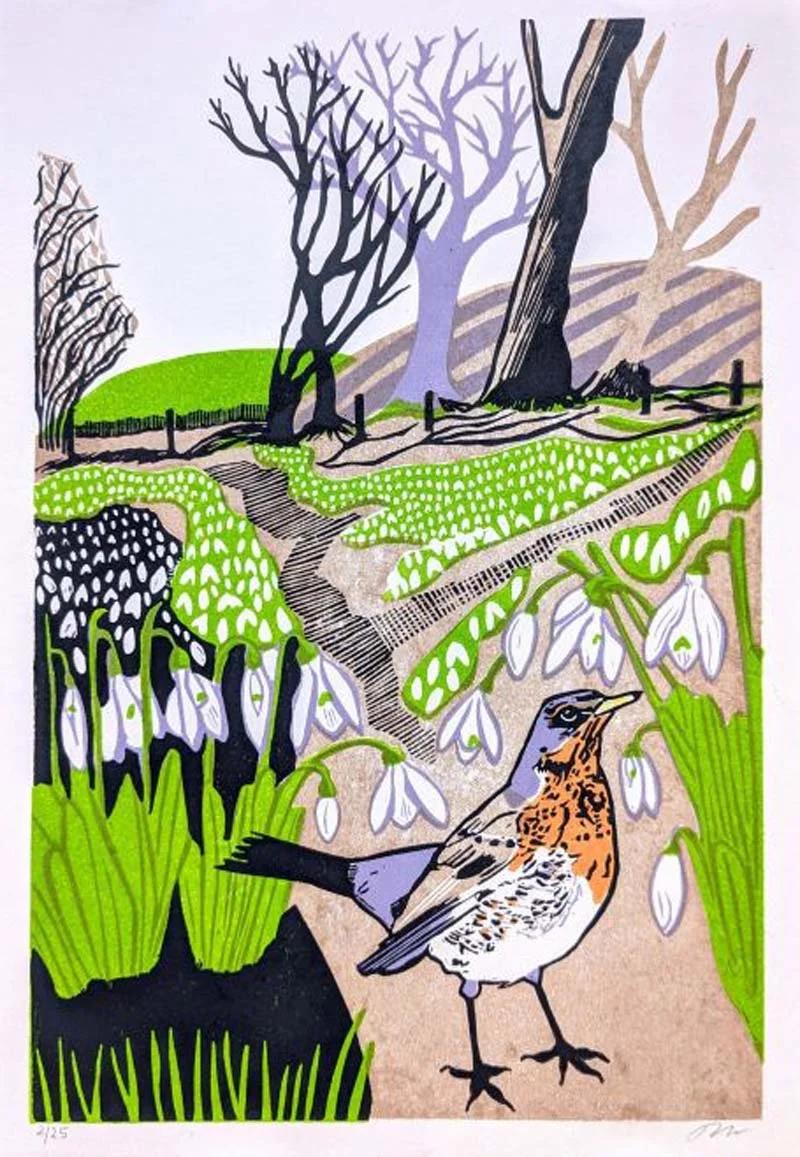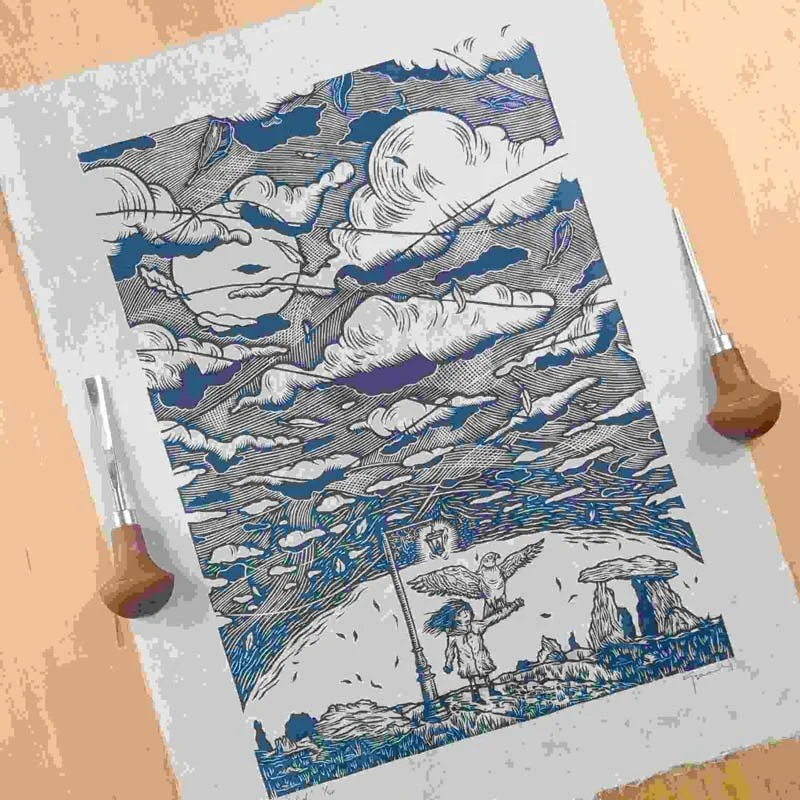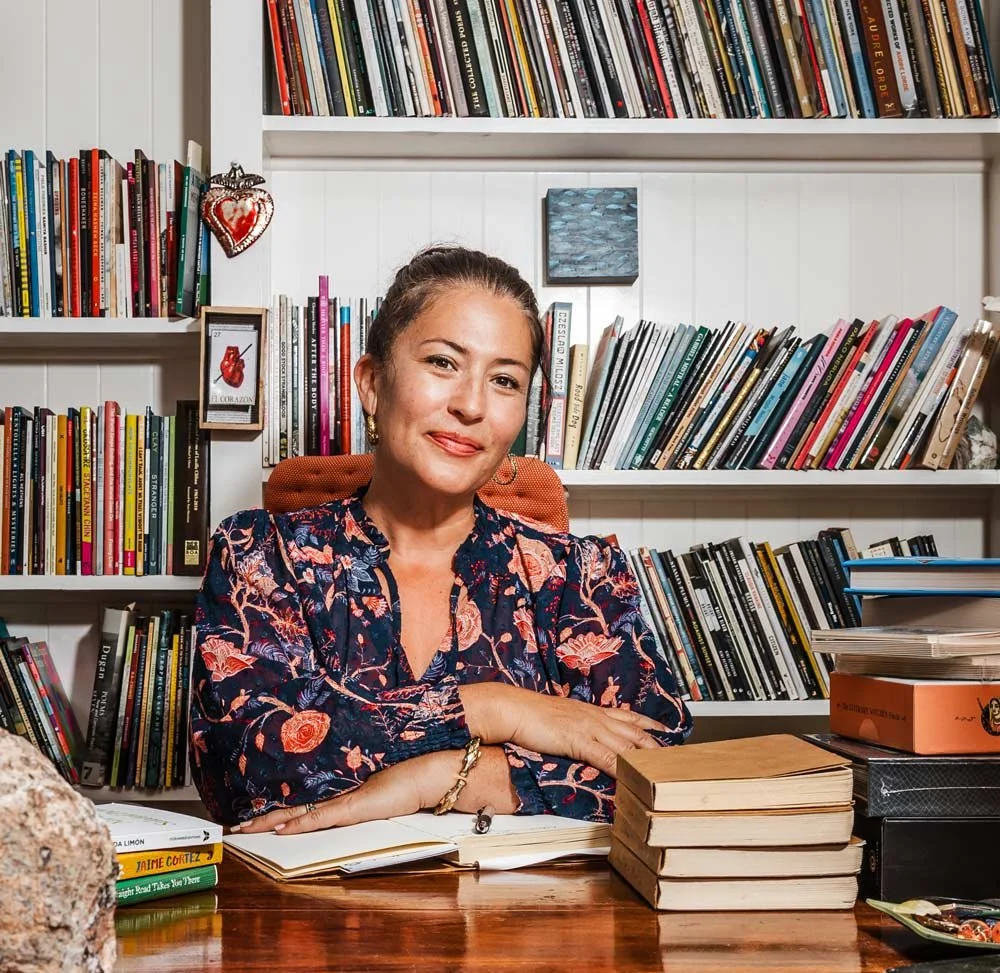


Rebecca Purdue is an artist, printmaker, and writer inspired by the landscape, flora, and fauna that surround her and the long-held tradition of storytelling in British folklore. @bperdue.printmaker
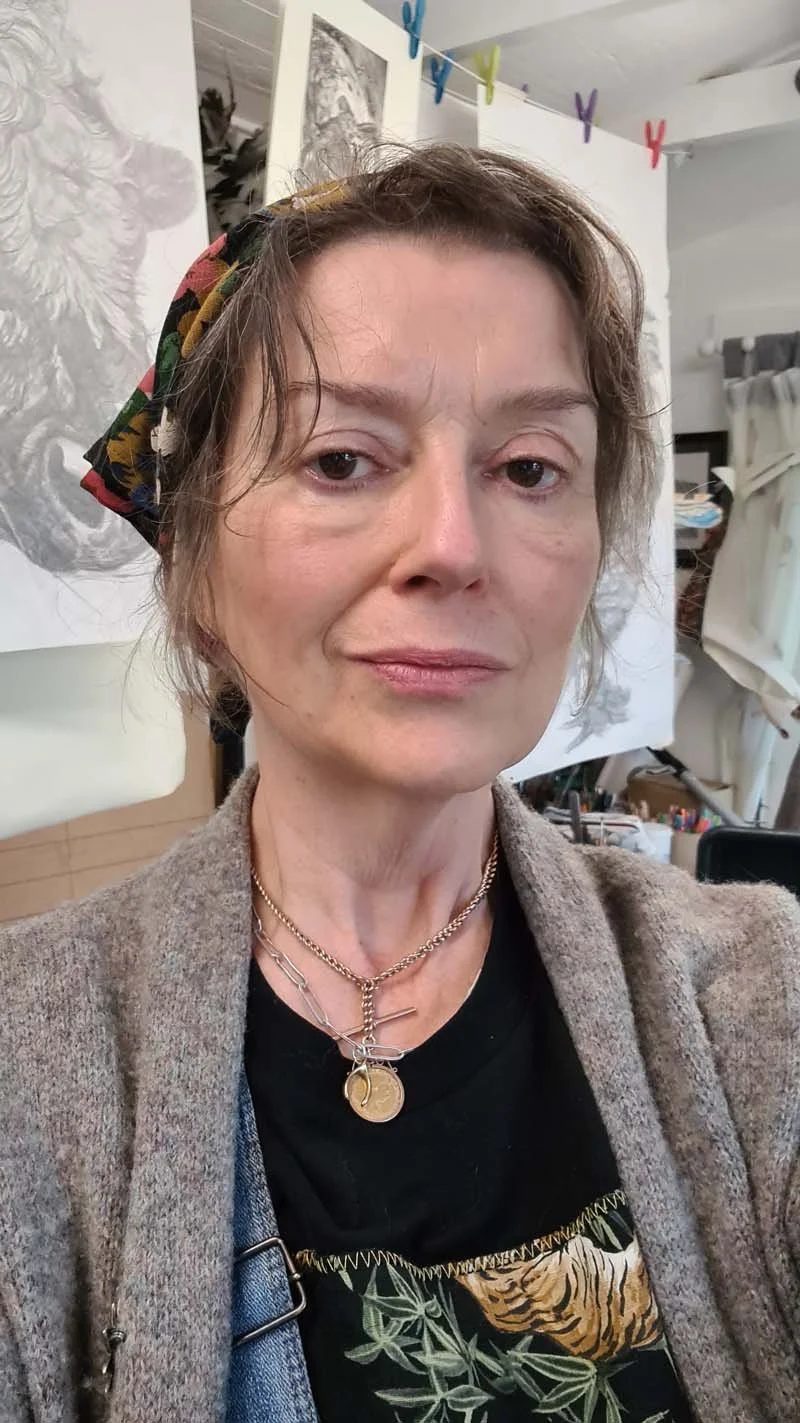
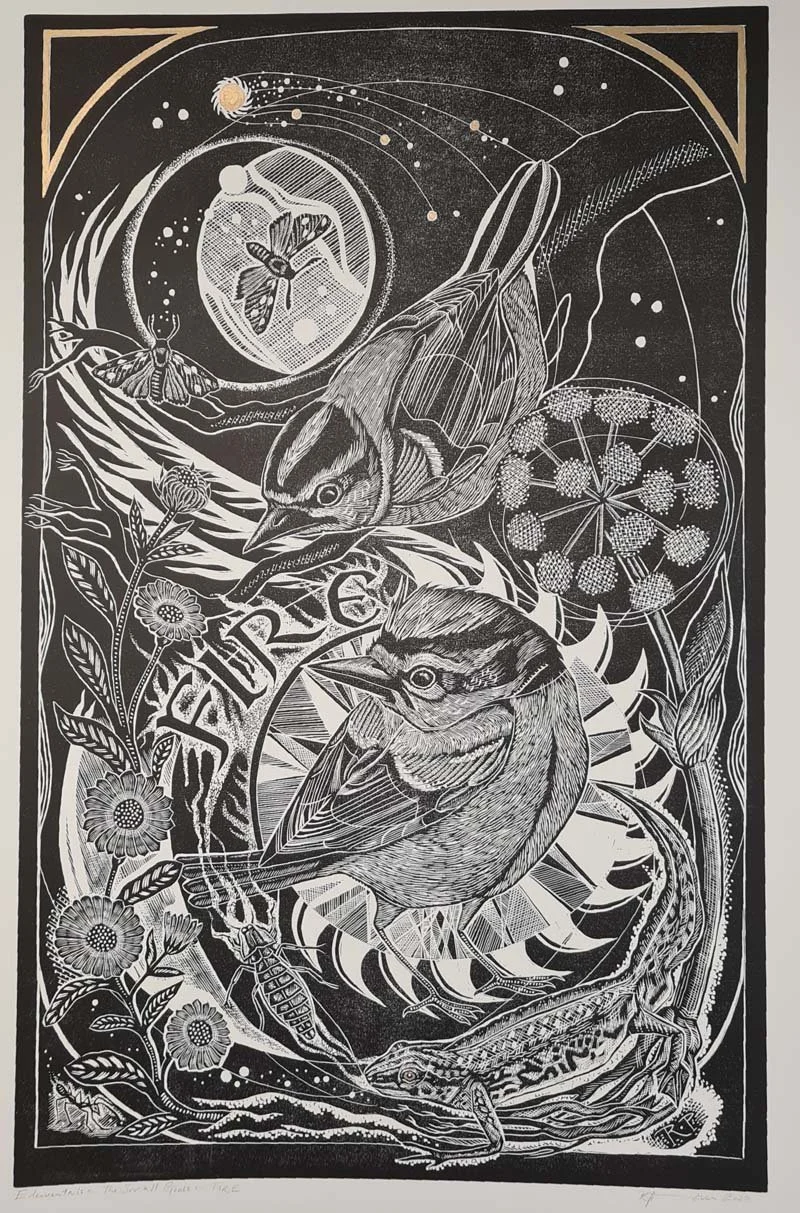
Where were you born and raised? How did that place shape your artistic identity? I was born and have lived my entire life in the primarily rural county of Wiltshire, UK. I am fortunate to have lived in close proximity to the rolling chalk downlands that the county is renowned for. It is this landscape and its dwellers that inspire and inform my work daily.
When did you first fall in love with art and realize you wanted to be an artist? My earliest memories are of making art alongside my mother and sister. It has always been an integral part of my life. I really began to consider the possibility of becoming a professional artist during secondary school, around age 15, and began to plot an educational course of action in order to achieve that.
What creative routines, if any, do you follow? What are your most familiar tools in your creative space? My day begins early. I always start my working day with a walk, which helps straighten my mind for the day ahead and clarifies my thoughts. These walks are information gathering, everything I see, hear, and feel is grist to the mill. I take pictures with my phone if I catch sight of something that interests me for later reference. Almost everything I take gets used in some way eventually, sometimes many years later.
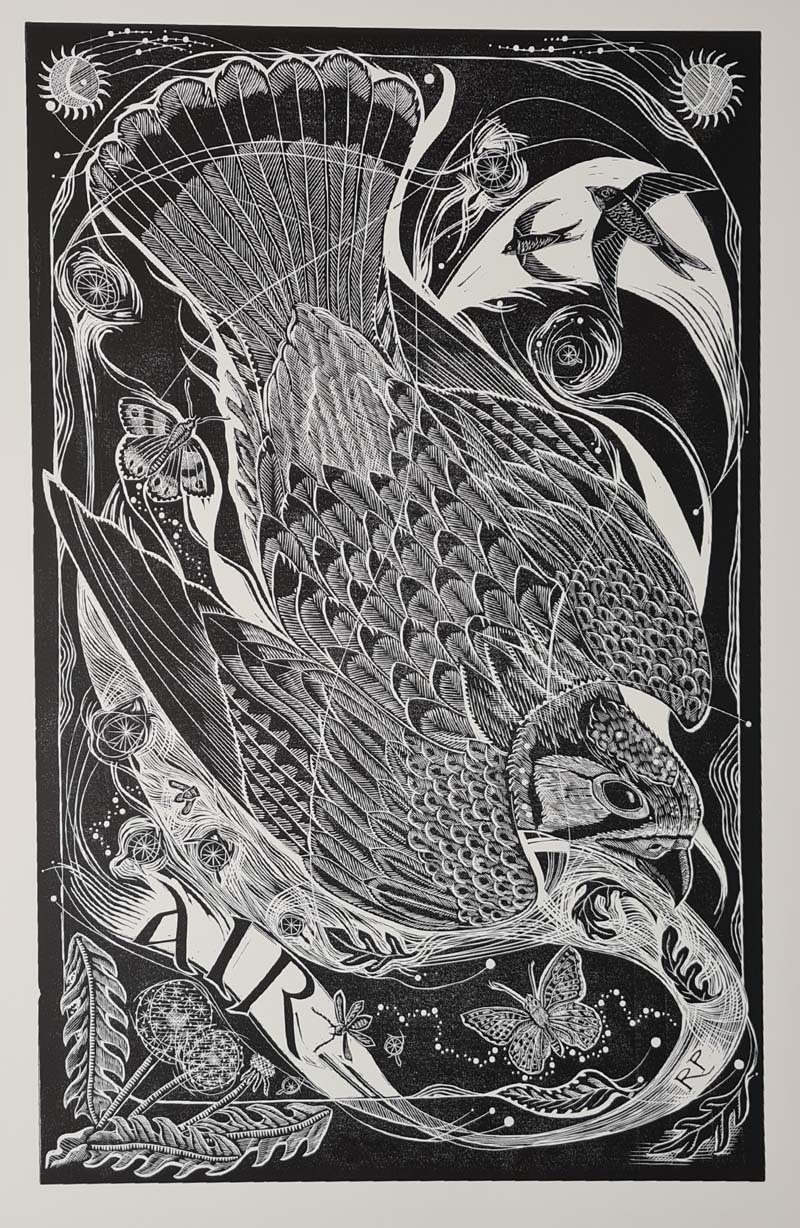
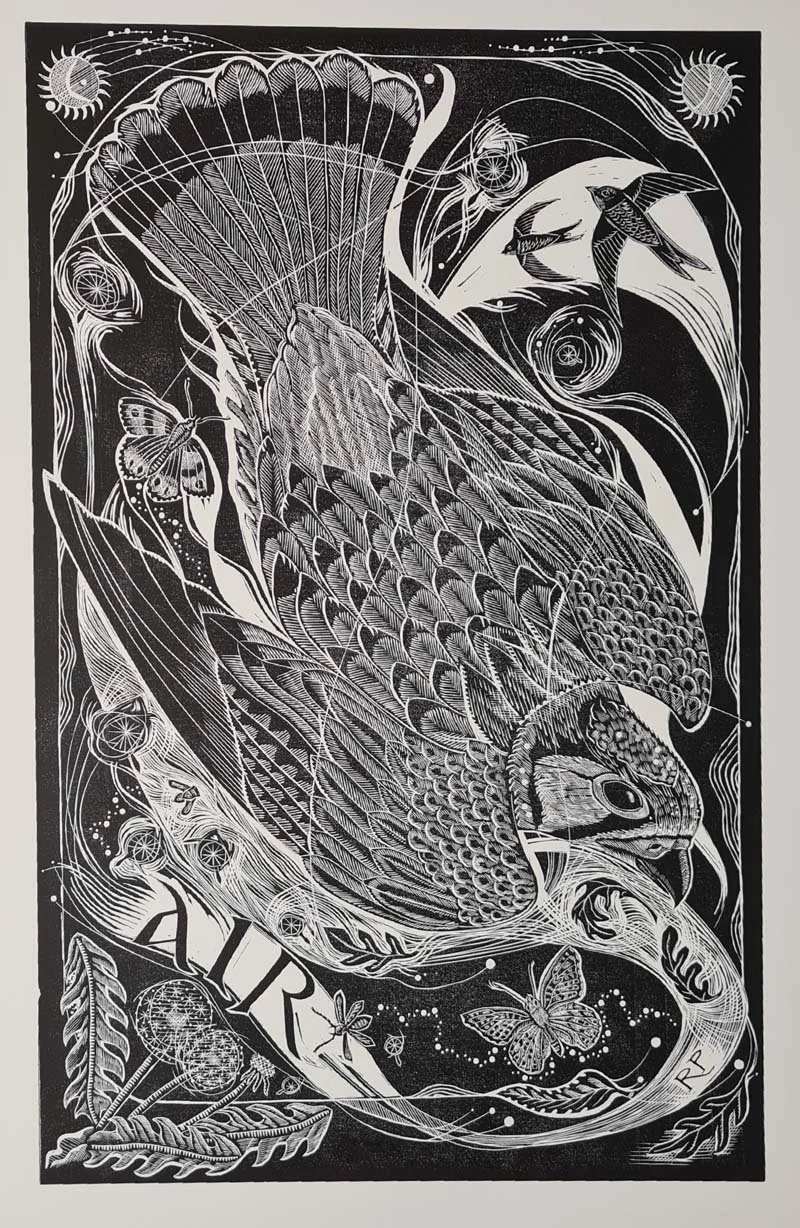
I return to the studio mid-morning and begin working on whatever is in progress. I work from home in a fully equipped garden studio. I am pretty disciplined with working hours, although it's easy, as it doesn't feel like work. It is a privilege and a pleasure. My go-to tools are an assortment of Pfiel gouges, an ancient EC Lyons wood engraving gouge, a gift from renowned wood engraver Simon Brett, an assortment of Japanese wood engraving tools, and of course, my Gunning etching press.
What projects are you working on at the moment? And what themes or ideas are currently driving your work? I am currently working on a series of large-scale linocuts showcasing British rare breed animals. I am interested in the idea that returning to farming native or rare breed livestock is more sympathetic to land conservation and, in turn, could have a beneficial impact on the environment; that may be a return to less intensive farming practices would redress some of the negative impact wrought by over-farming on the soil, water table, and environment at large.
What do you hope people feel when they experience your art? What are you trying to express? I hope that people find my work both thoughtful and thought-provoking. I hope to convey a sense of rooted tradition in both my visual work and writing. I purposely make my work using traditional hand skills and tools to underscore my somewhat Morrisian belief that the greatest endeavours of humankind are the works and knowledge of skilled craftspeople. I hope that people view my work and can appreciate the 'visible' hand of the artist.
If you could sit down with any artist from history or today, who would it be—and what would your conversation be about? I would have loved to have had the opportunity to talk with Stanley Spencer. His rendering of religious themes, casting the 'ordinary' English village and its residents in biblical vignettes, has long captured my imagination. How he made the ordinary extraordinary. Magical!
I would also love to have met and talked with the printmaker Clifford Webb. A master of his craft. I was fortunate to have been briefly taught by Simon Brett in my late teens. He was, himself, a pupil of Webb. I still use the wood engraving gouge he gave me to this day. It is all the more precious since he recently passed away. I would thank them both for gifting the world their beautiful work and for inspiring generations of artists now and to come.
Your work is deeply interested in British folklore traditions. How do the different art forms in those traditions inform your work? I draw inspiration particularly from traditional folk music and music inspired by the English folk tradition. The work of people such as Ralph Vaughan Williams, Shirley Collins, and Alan Lomax, who collected recordings of traditional folk singers, which is archived at Cecil Sharp House in London, is a particularly rich source of inspiration. I am also a mind magpie for snippets of folkloric storytelling. It all seems to live in my head to be plundered for work purposes at will!
How does the environment and community of Marlborough, where you live, nourish your work? Marlborough is a beautiful market town. It's a small place, with everything within walking distance. We are surrounded by rolling chalk downs, ancient stone circles and earthworks, and the ancient Savernake Forest, a former hunting playground of Tudor Kings. The River Kennet runs through the centre of town with all its attendant wildlife; the entire place is chock full of inspiration. There is a thriving art and music scene, and we boast our own independent book and art shop, a rarity these days. It really is a picture postcard place to live.
What’s a project that made you rethink your approach to art? How did you work through the challenges you encountered? I was invited to produce a linocut for the Swindon Art Festival last year, about Menopause. The exhibition was called Beyond a Joke and examined the experiences of women and their nearest and dearest during Menopause. I made a linocut portrait titled The (not) Unravelling. It depicted a woman who held the viewer in a confrontational gaze. She has her arms folded as if she is willfully holding herself together. I used lots of texture and gestural lines to convey a sense of fraying, the implication being that she was coming apart to be remade in a new version of herself. Amongst her hair were words and phrases submitted by friends experiencing menopause. Some were humorous, some distressingly dark and sad. It was a challenging piece to make, and a subject that is outside of my usual practice, but ultimately cathartic and unifying. The feedback for the exhibition was phenomenal. Very positive and often highly emotional. I will be forever proud to have been a part of it. An enormous privilege.
Tell us about important teachers/mentors/collaborators in your life. The most important and influential teacher has to be my mum! Watching her work and learning from her has been the major catalyst in pursuing art as a career and becoming a working artist myself. I was fortunate to have had the most excellent teachers at Art School. I was tutored in printmaking by Clive Scrivens. He was a font of knowledge, a bon viveur, enormously clever and funny. He introduced me to linocut and was instrumental in shaping the printmaker I have become.
Does being in nature inspire your art or your process? Can you share a memory or reflection about the beauty and wonder of the natural world? Being immersed in nature is the life force of my work. Every piece I make centres around it. I had the blessing of an outside childhood. No screens or phones were available. The countryside was my playground. All of that unfettered freedom in fields, hedgerows, ditches, and dens informs my work still.
What are your reflections on the future of AI in artmaking? How do you navigate the line between human touch and machine logic in your work? The thumbprint of the creative is all.
I feel deeply that work made by human hand and mind should be protected as a precious resource at all costs. I feel that AI, and particularly the ongoing issues around mining existing artwork, is troubling for many reasons. There is a place for this type of technological advancement in many fields, but not in the arts. I feel that the very essence of the arts in all its forms, however it is made are the human beings that conceive it, make it and view it.
Exploring ideas, art and the creative process connects me to… Who I am and where I have come from.