

The Earth started as one big rock, and soil did not exist. Without soil, you can't really grow trees or any crops whatsoever. Microorganisms made these rocks into soil, and it took thousands, even millions of years to create soils like we have them today. With the way we are farming today, we are actually plundering that bank account. We are depleting soils super fast, and it is predicted that in less than 25 years, 90% of our soils will be degraded.
We as humans, we can destroy things in a couple of years that have taken thousands or even millions of years to form. So in the snap of a finger, we can destroy so much work. That's an observation I’ve seen in all biomes, and it's pretty scary. On the other hand, nature regenerates pretty fast. It heals itself. If humans help this healing process, it can go even faster.
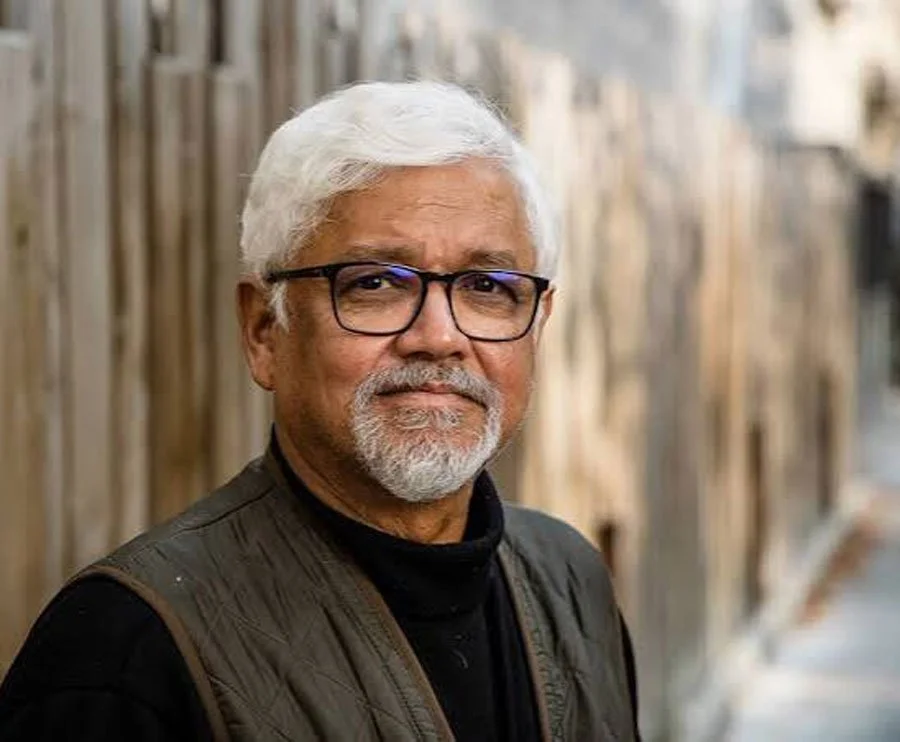
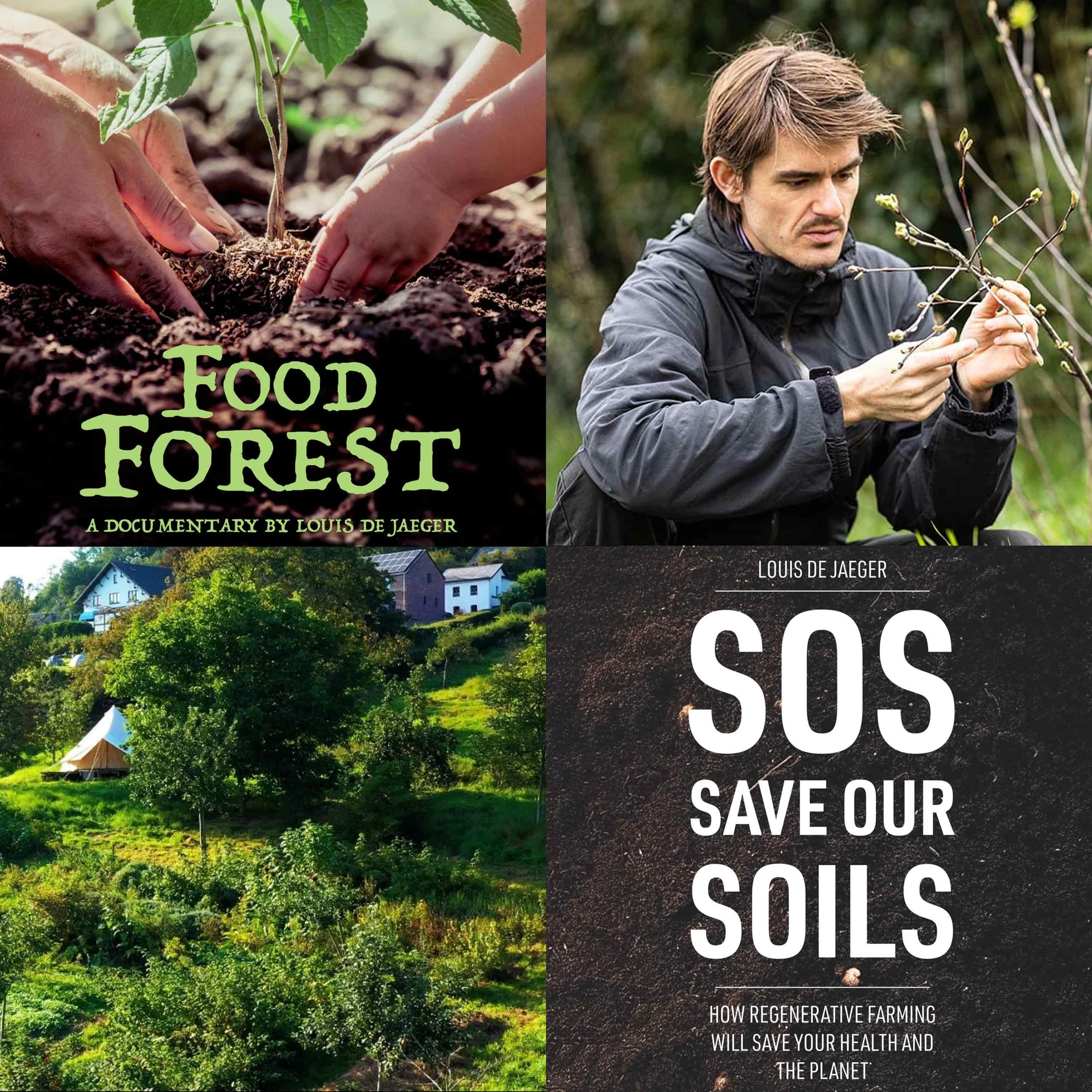
Louis De Jaeger has spent years traveling the world, witnessing firsthand the decline of nature. He is an eco-entrepreneur, a landscape designer, co-founder of the Food Forest Institute, and a leading voice in the regenerative agriculture and food forest movements. He’s founded numerous ventures aimed at creating positive impact and has created over 100 food forest sites around the world. His new book, SOS: Save Our Soils: How regenerative food and farming will save your health and the planet, asks us to consider every meal as a vote for either destruction or regeneration.
THE CREATIVE PROCESS · ONE PLANET PODCAST
We are happy to discuss your body of work, from your book, SOS: Save Our Soils, to the Food Forest Institute. I think it's also helpful to ground those who may have heard these terms but are not quite familiar with them, like food forests, agroforestry, regenerative agriculture, and permaculture. Just unpack some of those terms for our listeners to fully help us understand.
LOUIS DE JAEGER
Yeah, it can be confusing at times to hear all these labels or words, but they actually come back to the same thing: the regeneration of land. The Earth started as one big rock, and soil did not exist. Without soil, you can't really grow trees or any crops whatsoever.
Microorganisms made these rocks into soil, and it took thousands, even millions of years to create soils like we have them today. With the way we are farming today, we are actually plundering that bank account. We are depleting soils super fast, and it is predicted that in less than 25 years, 90% of our soils will be degraded.
So that’s ninety percent. That is really alarming because I like to have food, and I guess you like food too. Everybody needs food to survive. In 2050, that might be a problem if we don't change the way we handle soil. So what do we have to do instead? Instead of extracting things, we have to build the soil.
There are different techniques and ways of gardening or agriculture that build soil. One of the most well-known techniques is organic farming. However, because it has a label and rules, people also started to hollow out those rules. So, there is very good organic farming, while some people are also doing a bit of extractive organic farming. Then you have biodynamic farming, which farms together with the phases of the moon and works more energetically. A lot of these things are actually scientifically proven right now, but for some, they sound esoteric. The nice thing about biodynamic farming is that they use zero pesticides—never, ever. They only use plant preparations.
For me, if I could choose only one type of food, it would be biodynamic, and you can see it with the Demeter label. Then, of course, you have permaculture, agroecology, and regenerative organic farming; they are basically siblings to each other.
THE CREATIVE PROCESS · ONE PLANET PODCAST
That statistic about soil infertility seems large, but if you're losing 0.3% a year, in a hundred years, it adds up quickly. So it's really serious. Luckily, we do have these movements, the regenerative ones. As you say, there are a lot of labels, but they're all kind of family members. The goal is to avoid the more industrialized approaches. If you're going to scale it up, then that raises other questions. How do you scale up these practices?
I do want to delve into how many projects you've done so we can get an idea of scale because the agricultural industrial industry is large. So, on the other end of it, how many acres are we looking at in regenerative and food forestry? Your work bridges the theoretical and the practical, like permaculture. You're helping people design functional, self-sustaining systems.
Having traveled the world and witnessed these diverse environments— not just in temperate zones, but also in tropical zones and deserts—what's the most profound observation you've made about the universal applicability of permaculture design principles, food forestry design principles, across different biomes and cultures? Where do you see those core patterns repeating, even with vastly different flora and fauna?
DE JAEGER
We as humans, we can destroy things in a couple of years that have taken thousands or even millions of years to form. So in the snap of a finger, we can destroy so much work. That's an observation I’ve seen in all biomes, and it's pretty scary.
On the other hand, it's also nice to see that nature regenerates pretty fast. It's inherent. For example, if you cut your finger, in a week that cut will normally be gone because your body will self-heal. It’s an amazing property we humans have, but it’s also an amazing property that nature has: it heals itself. If humans help this healing process, it can go even faster.
Now we have some limiting factors, and a big limiting factor is water. The more water you have, generally, the easier the healing can go. For example, if you go to the south of Spain or to the Sahara Desert or deserts in the United States or Australia, their regeneration goes much slower because there is less water. You need water to build these carbon-like structures that will go into the soil and create these underground cities full of microorganisms, fungi, and bacteria. They need this infrastructure to thrive. They have a hard time living in dead dirt, so you need water to do that.
I also see that there is a lot of degradation being done in Indonesia. The same goes for Africa. When I visited Morocco, it really became clear that the work I’m doing today was influenced by my experience back then. I had this aha moment: I want to do anything in my power to prevent desertification from continuing.
In Morocco, when I was in the desert, I felt uneasy, and I didn’t know why until I realized, oh darn it, there is nothing to eat here. I wouldn't survive here if I was dropped in this desert. I learned that this area didn't used to be a desert; it was a giant lush food forest. There were remnants of that food forest, like beautiful palm trees with pomegranates underneath, some citrus, little donkeys, and a little stream in between. It was very romantic but also very productive at the same time.
I saw similar issues in the south of France and Spain. Spain is becoming a desert, the same as the south of France or the entire Mediterranean region. I lived in the Var, famous for its wine, and every summer, all the villagers would gather together, concerned about the recurring issues. We witnessed entire hills on fire, which was apocalyptic. Just yesterday in the news, around the same region where I lived, there were hundreds or even thousands of hectares that burned again.
It’s pretty scary to see that it’s getting closer to almost anywhere. Even in the Arctic, there have been wildfires. The earth is talking to us, and we better listen.
THE CREATIVE PROCESS · ONE PLANET PODCAST
Most of your projects are in Europe, and I know a lot of our listeners around the world will be in temperate zones. Could you tell us a little about different inspiring projects you've been involved in, or visited, or heard about?
DE JAEGER
I think one of the most inspiring projects is a combination of annuals and perennials. I am 100% convinced that a healthy combination is the best way to go. Let’s say, for example, that the entire world is being fed by perennials, like trees and shrubs. If there is a hurricane or another bad weather event that destroys all your trees, you will have to wait 15 years before your walnut plantation produces fruit again. That means 15 years without food.
Thus, while having trees takes longer and requires a long-term mindset, annuals can produce food much faster. You plant a seed today, and in a couple of months, you'll have your harvest. We need annuals, the sprinters, and perennials, the marathon runners. Perennials also contribute to soil health; they shed their leaves, drawing nutrients from deep down, stop erosion, mitigate wind, and prevent disease.
One of the most inspiring places I've seen is Tolhurst Organic, run by Iain Tolhurst. It's a farm near London, about an hour to an hour and a half from the Thames River. He has combined agroforestry, incorporating trees, with annuals and vegetables— the most delicious vegetables.
The remarkable thing about his farm is that he hasn't imported a single gram of manure or fertilizer from outside, and he doesn’t even have his own animals. He operates a veganic farm. What makes this interesting is the mindset of agronomists. When you go to farming school, where I studied as well, you learn that if you take something out, you need to put something back in. But that’s totally wrong because the earth is a perpetual motion machine. You can take as much out without having to put anything back in.
Why? Because you have an eternal supply of nutrients based in the rocks of the earth. The Earth didn’t start with soil; it began as a rock. It was the fungi, the bacteria, and the plants together that created soil by grinding up these rocks. So the only thing you have to do as a farmer is ensure that you have the right environment for the microorganisms.
These microorganisms will continue to work, mining the rocks that are in the soil, turning mineral content into organic content. Iain Tolhurst does exactly that. Instead of fertilizing his land, he uses wood chips from his rows of trees next to his fields. He doesn't use them as fertilizer but as an inoculation to the soil, giving it just a little kickstart, so the fungi and bacteria can thrive again over the next few years.
What he also does is use a lot of in-between crops, cover crops, or green manure, whichever term you prefer. These plants create something from nothing. They collect water from the soil (H2O) and take CO2 from the air. It’s quite remarkable. Taking something you can't see and combining it with water, CO2 and water produces sugars. I find it miraculous. CO2, something invisible, combined with water gives you sugars. These sugars are then pumped by those plants into the soil. It’s like I always compare it to pancake dough, as the plant creates the sugars, fats, and proteins and pumps it into the soil.
Sometimes, up to 40% of the nutrients that a plant makes for itself are given to the soil for free. If you have a cover crop with various plants from different botanical families, they are all pumping different nutrients into the soil, immensely feeding it.
What feeds the soil? Of course, the fungi and bacteria exchange these nutrients for more minerals and create more biomass. The plants will die, and before you know it, you will have an entirely new soil layer. To me, that represents a totally different mindset on gardening, growing a food forest, or farming.
DE JAEGER
I once heard the quote, "Don't teach people how to build a sailboat, but inspire them and tell them stories about the sea and let them long for the sea."
THE CREATIVE PROCESS · ONE PLANET PODCAST
I often repeat that quote. It’s by Antoine de Saint-Exupéry, the author of The Little Prince.
DE JAEGER
Exactly! I forgot it was him who said that. It’s so true. You want children to know all the beautiful pathways that exist. What we need to do as adults is show them, in an inspired way, all the options available.
Look, this is a door. If you follow that path, you could become a doctor. If you follow that path, you could learn everything about plants—just go to that man who lives in the forest, and he’ll teach you everything. If you can plant that seed inside of them or plant a gazillion seeds, some will germinate.
We need to create favorable conditions for children, providing them with fertile soil. This comes from ensuring they grow up in a loving society, where they understand they can make mistakes. Making mistakes is the best way to move forward; it’s called "failing forward." I love that term.
It’s also how nature works. If a plant’s root hits a rock, it won’t give up and say, "Oh no, there’s a rock." It finds a way to grow around it. By creating a positive atmosphere and planting seeds in the minds of children, they’ll have the space and time to explore. We must also have faith that these things will grow, and this is something we, as adults, can help facilitate.