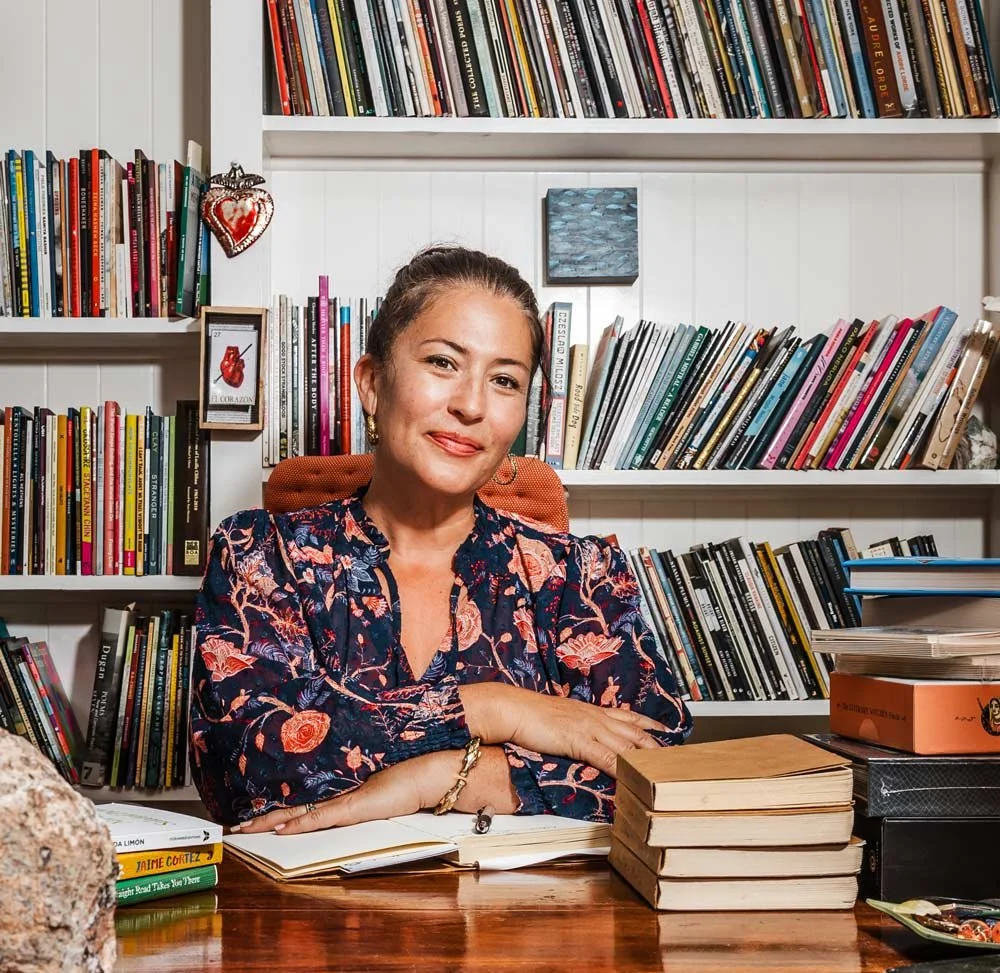


Devon Stackonis is a printmaker and book artist specializing in mezzotint and intaglio techniques. Stackonis’ work is rooted in her ancestral labor history and addresses the lasting environmental, socioeconomic, psychological, and physiological impacts of coal mining and the extractive industry. Stackonis received her BFA from Kutztown University of Pennsylvania in 2018 and her MFA from the University of Wisconsin-Madison in 2024. Her work is held in national and international collections and university libraries. In 2024, she was awarded a U.S. Fulbright Student Research Fellowship to Poland, and in 2025 will be pursuing her PhD at the Academy of Fine Arts in Wrocław.
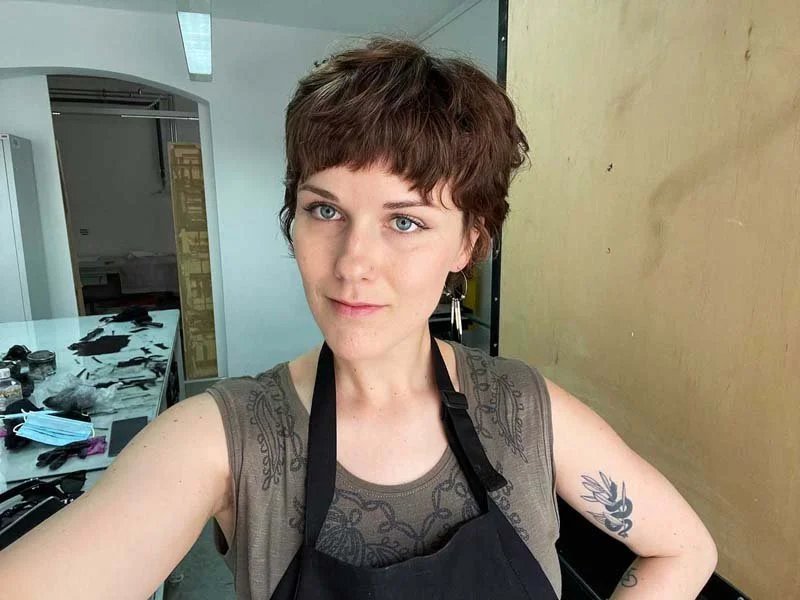
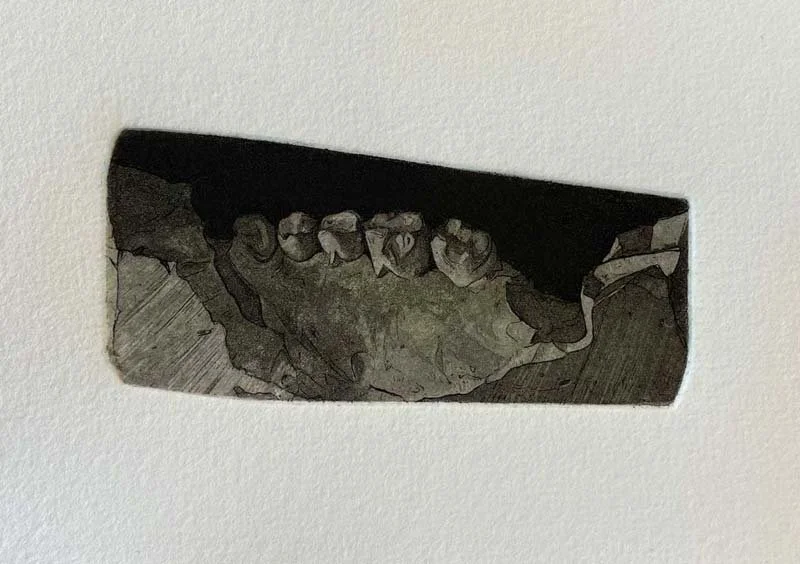
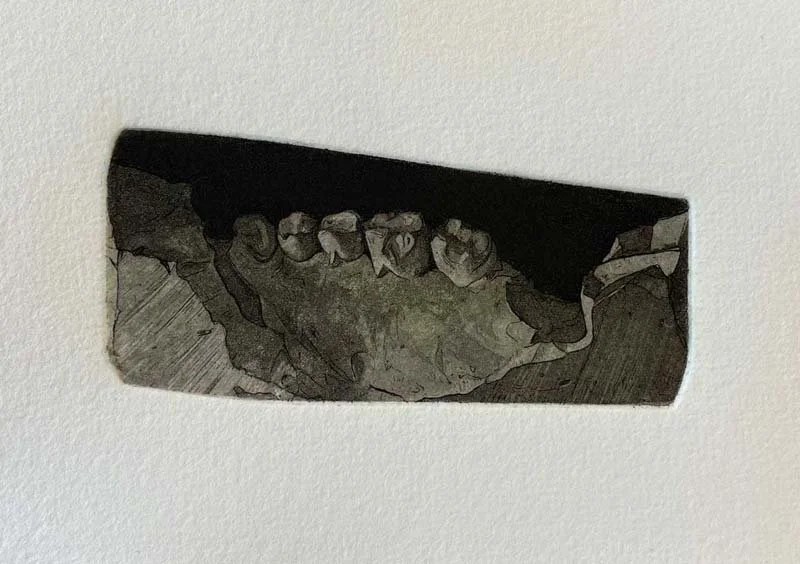
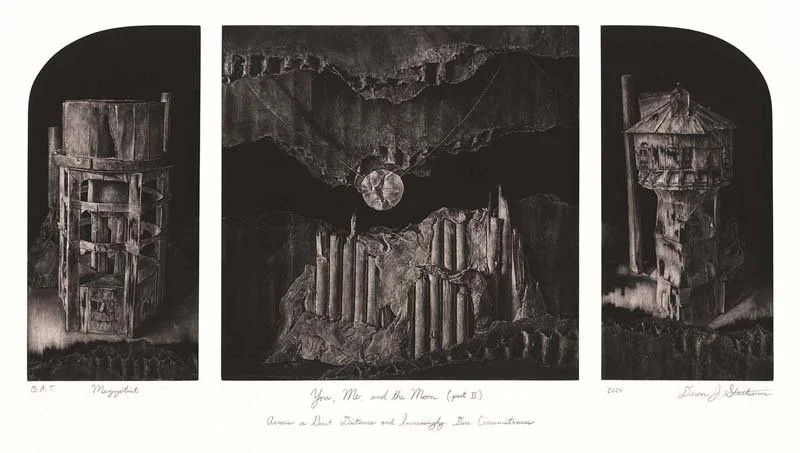
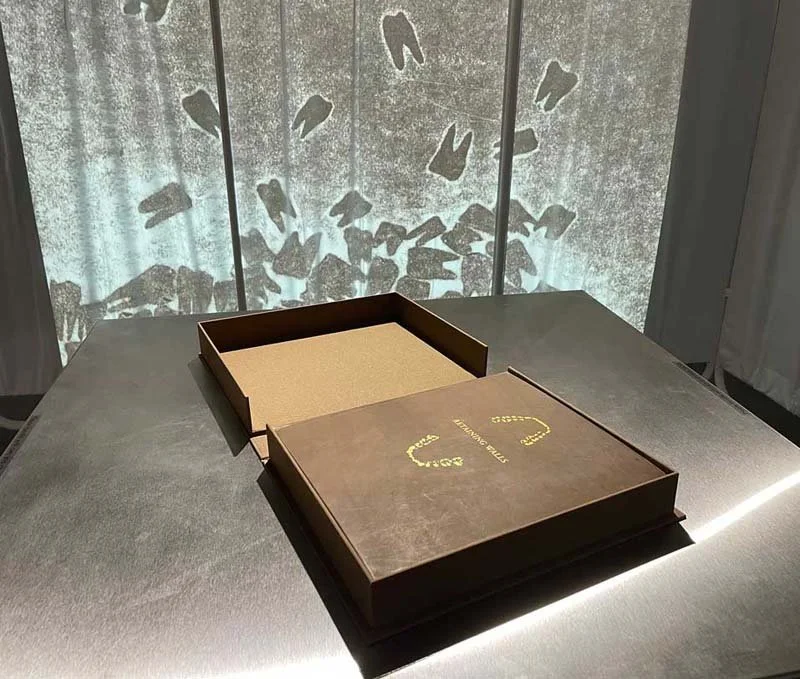
How has your background informed the themes you explore in your art? I was born in Bethlehem, Pennsylvania, grew up in Boyertown, and spent the first 25 years of my life in eastern and central parts of the state. Living around the Coal Region, all this abandoned machinery, structures left to ruin, former factories, and affected areas definitely embedded themselves in my psyche. When I was working my first job in the arts as a Printmaking Assistant at Bucknell University, I was commuting 3 hours one-way by car through coal country back to Kutztown University on Fridays, where I had some remaining credits for my BFA degree. I became very familiar with this area, the dilapidated mining structures I used as landmarks on my route, places like Centralia, Ashland, Frackville, Minersville – now nearly ghost towns that seem to be haunted by their industrial pasts.
When I moved to Wisconsin to pursue my MFA at UW–Madison, I felt even more compelled to make work about where I’m from, with some distance and a new perspective, and began quite a bit of family history investigation. This led me to uncover much about my Polish and Lithuanian ancestors who settled in Pennsylvania and initially worked in the coal mines. I wanted to capture something about that place in my work; its hardships, traumas, transitions, ecological disasters – all framed by the beauty of this dramatic, mountainous landscape – and interlace my own experiences and family histories. I truly never anticipated that I would leave Pennsylvania, much less my country, but following the thread of this project has led me to Poland, where I am currently based.
When did you first fall in love with art and realize you wanted to be an artist? For you, what is the importance of the arts? My mom is a painter and environmental activist, and I looked to her as I considered my own life aspirations. I would sit at her art table as a toddler and pretend to be her, waving a paintbrush around. Thankfully, both parents indulged my early interest, and I was gifted sketchbook after sketchbook. Much of my childhood was spent outside, gardening with my mom or making elaborate stick sculptures in the yard. As we hiked and explored places, she always emphasized the health and needs of individual ecosystems, environmental pollutants, native and invasive plant species, and the impact humans have. As I got older and more seriously committed to an art practice, I focused on landscape scenes that had a visible human or industrial presence. For me, art and nature are inherently linked. As a creator, I feel I have a responsibility to use materials in an environmentally conscious way and to use my creative voice for a cause I wholeheartedly believe in. Like nature, art has the power to inform or shape a perspective in an intimate, experiential way.
What does your typical day in the studio look like? Walk us through your studio and your most-used materials and tools. Since I have been moving around quite a bit the past 12 years, I have become a very mobile maker. I had a studio during grad school, which was nice, but as a printmaker without my own press, I have gotten used to preparing my plates somewhere and taking them to a place with a press when I am ready to take an impression. I typically work on copper plates, with a mezzotint rocker (tool used to prepare the rough surface of the plate to hold ink tone), and a selection of scrapers and burnishers. I have a portable lamp and a homemade light diffuser screen, which allows me to optimize the light conditions for detail work on the copper plate. I am in the process of securing a studio space in Wrocław, Poland, where I’ll be working towards my practice-based PhD in Printmaking and Book Art over the next 3 years; however, I’m leaving my small studio at my mom and stepdad’s home in Tucson set up for the times when I’m in the States. I have acquired A LOT of book materials, so I try to be very organized about my book art projects, keeping the materials for each in a designated box (which all live in Arizona). Although I look forward to the time in my life when I am settled in one place with a larger studio space, I am embracing the transience of my current workflow and between-place-ness.
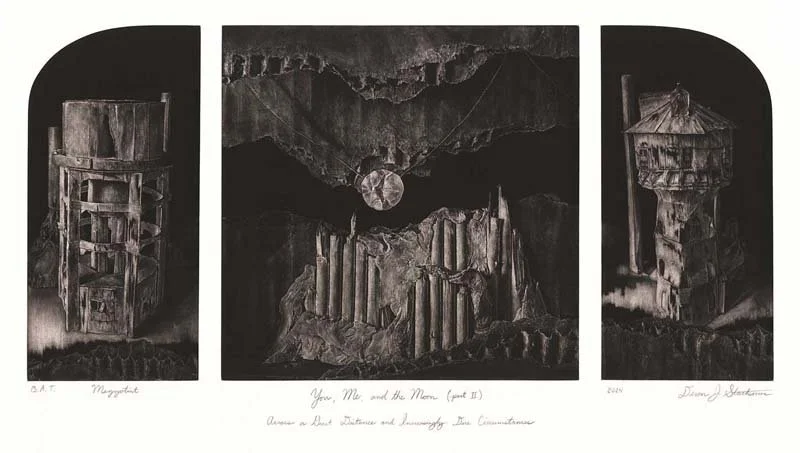
How do your current projects reflect your artistic growth? When I arrived in Wrocław in September of 2024, the region was besieged by record-breaking rainfall. Towns ahead of this city along the Oder River were devastated, and for several days, we waited for the impending river surge. This was followed by hurricanes bombarding the southeastern United States and devastating flash flooding in eastern Spain. Thankfully, the surge never came, and after the flooding in nearby areas subsided, I began exploring mines in southern Poland and became equally captivated by the old water towers I found. Many of these were abandoned and in various states of disrepair, and were located by the railway stations, town centers, factories, and industrial plants that they used to serve.
For my doctoral project, I will continue my investigation of the water towers as a visual metaphor for society’s historical use and control of water with natural forces, as opposed to the next two centuries of unrestricted burning of fossil fuels. The water towers are silent witnesses to the industrial and extractive history of southern Poland, its energy policies, politics, and climate crises. Climate events are increasing in frequency and destruction, a stark contrast to the days of water towers. My envisioned book, which will feature the water pressure towers of southern Poland, primarily the Śląskie and Dolnośląskie regions, with record keeping from the perspective of the towers, observing the changes in the region over the period of rapid industrialization, followed by their gradual decline to disrepair and abandonment.
What feelings are you aiming to evoke with your work? I hope that my work evokes a range of somewhat difficult feelings surrounding the irreparable damage to places, communities, and ecosystems, which have been mutilated for the sake of fossil fuel extraction, and those that are suffering now as the climate rapidly changes. I am not entirely without hope, but in order to hope and to instill a spirit of lasting change, we need to fully grasp just how dire the situation at hand is. My art practice, to me, seems to oscillate somewhere between meditation and mourning. It’s extremely cathartic to make this work, although sometimes painful. And so, I hope the viewer gets this kind of potent melancholy, precariousness, fragility, liminality, a sense of imminent loss, while also appreciating the time that went into it, and maybe finds some beauty in that.
Are there any influential artists and creators, past or present, whom you would like to meet? I would love to someday meet Berlinde De Bruyckere, who is a Belgian contemporary artist and sculptor. I saw a piece of hers in Italy two summers ago, and it just about paralyzed me. Seeing them online is one thing, but to be in the same space as these haunting distortions of organic forms... such a potent emotional experience. I look at a lot of sculpture, but especially appreciate how she blurs the line with nature and decay, using many organic materials. As far as past artists, I would give anything to have conversations with American film director and visual artist David Lynch, Soviet film director Andrei Tarkovsky, and American painter Georgia O’Keeffe. I find all three fascinating in their lives and their work and have been influenced by each in a foundational way, as an artist.
Do you draw inspiration from music, art, or other disciplines? Yes, absolutely. I consume a lot of film and writing and listen to music or audiobooks in the studio almost constantly. This helps me get into the headspace to make emotionally charged work. 90’s shoegaze, slowcore, grunge is probably my sweet spot as far as studio music goes, with artists like Thom Yorke, PJ Harvey, Elliott Smith, Slowdive, Mount Eerie, Mazzy Star, Nick Cave, Cat Power... I’m also a huge Bob Dylan fan.
How does the place you live now nourish your artistic practice? All of the printmaking that is happening all of the time, I still can’t believe this place is real. I’ve lived in places that had very active art scenes, print included, but nothing like what I’ve experienced in Wrocław, Poland. There is such a rich history of graphic arts in this region, and this city seems to have become the cultural hub for it, so much so that now people make pilgrimages here to make work on a grant or to study at the renowned Art Academy, myself included. This is the final week of my Fulbright grant period, and I’m delighted to be returning in September to begin my time as a doctoral student at Akademia Sztuk Pięknych (Academy of Fine Arts) in Wrocław. There’s so much good I could say about this city, but the gallery nights, museums, and abundance of music really do it for me.
Can you describe a project that challenged you creatively or emotionally—and how you worked through it? My MFA thesis project, an artist book titled RETAINING WALLS, evolved from the history of my grandmother and her 12 siblings having their secondary teeth removed at a young age (as a dental preventative measure in a coal town). Echoing the form of 19th-century dental manuscripts, I designed this book to compare bodily extracted forms (teeth) with the mutilation of the land by extractive mining. I wanted to present the long-lasting effects of this industry on the land and on families such as my own. The first passage opens with an observation of my grandmother, struggling to navigate a treacherous path of slate pavers leading up to a burnt-down porch with a set of makeshift cinderblock steps. Throughout the book, my own observations are interspersed with recorded occupational hazards and ecological mining disasters from this region. This project was deeply personal, and I handled it as sensitively as I could, without obscuring the bleak reality. A week before I was planning to finalize the text and order polymer plates for letterpress printing, I was at CODEX Book Art Symposium in San Francisco. It was here that I received the call from my father that my grandmother had died, succumbing to her cancer of the jaw. And so, the following week, I was back in Pennsylvania for her funeral at the Polish cemetery in Wilkes-Barre. I scrapped my original ending passage and decided that the book should end with her passing, since the whole project began with her story. It was a difficult call, but its inclusion helped me through the grieving process tremendously, and I feel I was able to dedicate the project to her more sincerely.
Tell us about important teachers/mentors/collaborators in your life. I have had so many wonderful teachers and mentors in my life thus far. Most recently, I have been working with Professor Christopher Nowicki in Wrocław at ASP. It is my first time working with a mentor in the mezzotint medium, and it’s been fantastic. I owe everything to my Kutztown University mentor, Evan Summer, Professor Emeritus, who first introduced me to printmaking and has consistently encouraged and guided me into this field. I had the privilege of learning book art forms and letterpress from Professor Julie Chen at UW–Madison and learned a great deal from Erin McAdams as well. I want to thank the chair of my MFA Committee, Professor Fred Stonehouse, for his unwavering support in my vision and down-to-earth mentorship throughout grad school. I also worked closely with Professor Emily Arthur, Professor Tomiko Jones, and Professor John Hitchcock, all of whom contributed to my thesis work and studio practice in profound ways. Cheryl Hochberg and I got to know each other at a Guttenberg Arts Residency, although we both had Kutztown in our recent pasts, and she is one of the most valued voices in my inner circle to this day (she also lives and creates in Tucson now, which is great for me!) I wouldn’t be anywhere without the early encouragement from my creative parents, though, who have always been supportive of my decisions.
What’s your relationship with the natural world as a source of inspiration? Being in nature is the only way I feel completely level and balanced as a human and an artist. Almost any idea I’ve ever come up with for a project emerged on a 2 to 4-hour bike ride in rural Pennsylvania or Wisconsin. Especially given that I have been making work that is a reflection of places I love, I have the most clarity about how to depict that place honestly when I spend time observing it, watching it pass by from the side of the road or a gravel trail. I’ve really been missing this over the past year, since I haven’t brought my bicycle to Poland. I have, however, been on some fantastic hiking, skiing, and bird-watching excursions here.
What are your reflections on AI and technology in the arts? How have you incorporated or resisted it in your practice? I despise AI with every fiber of my being. The aesthetic is utterly soulless; it is the societal ruin of critical and creative thinking, and it’s equally horrible for the planet. My wishful thinking is that AI and generative art will largely burn themselves out, but for those that continue to use it, it will just remain a visual warning of “avoid at all costs” for individuals and businesses, because clearly they can’t think for themselves, and I don’t trust their judgment. Handmade works will always be superior. They actually have a soul.
Exploring ideas, art and the creative process connects me to… My ancestors, the histories of places I care deeply about, and my hope for a more sustainable future.