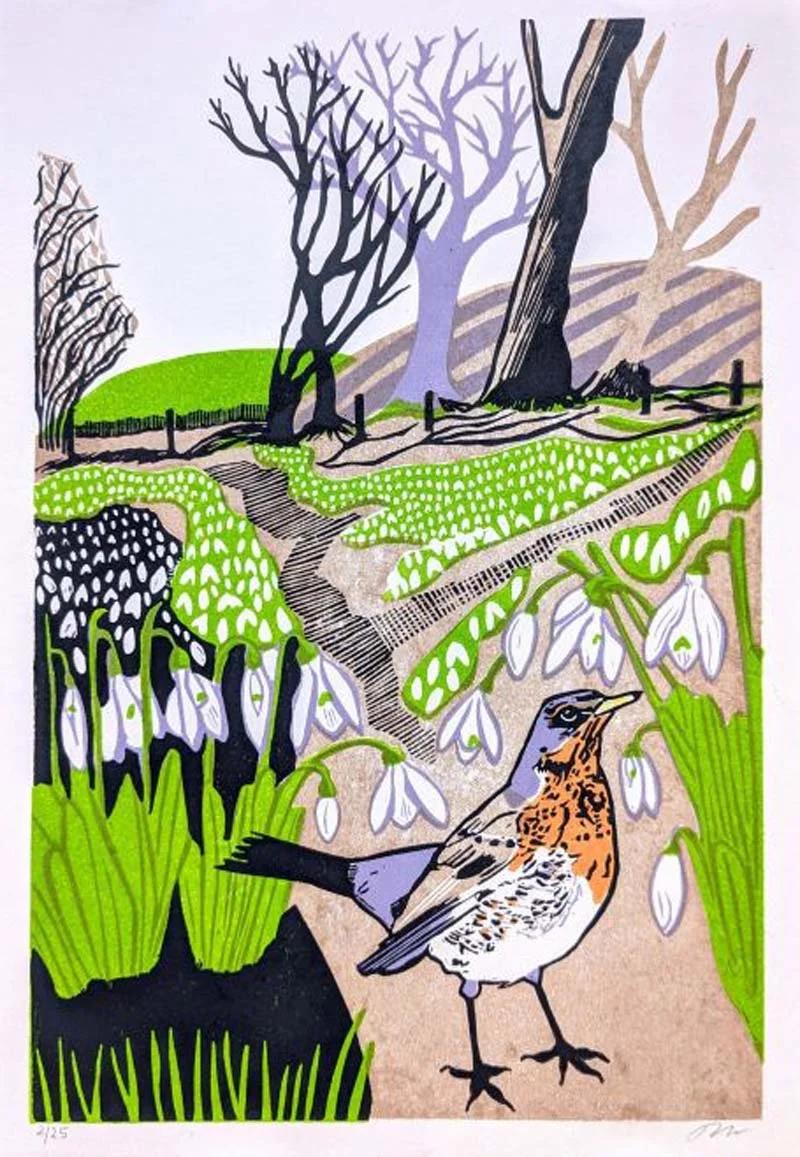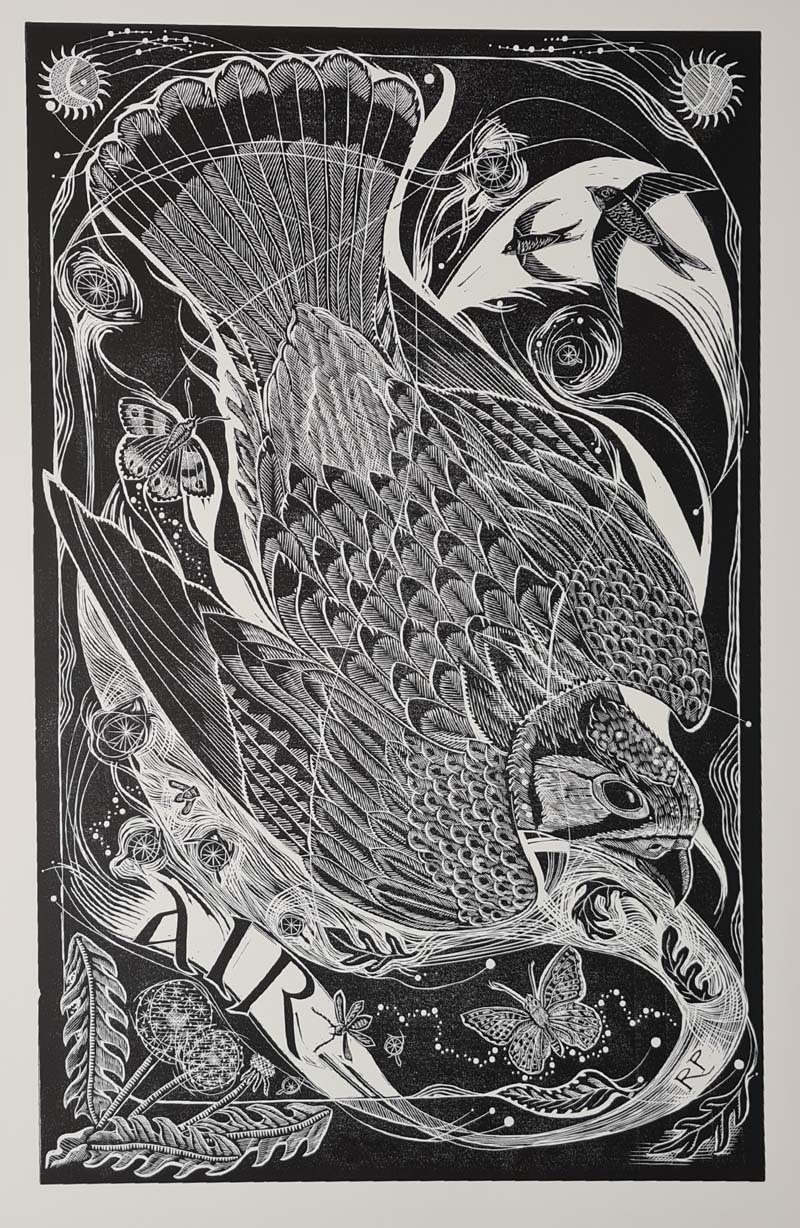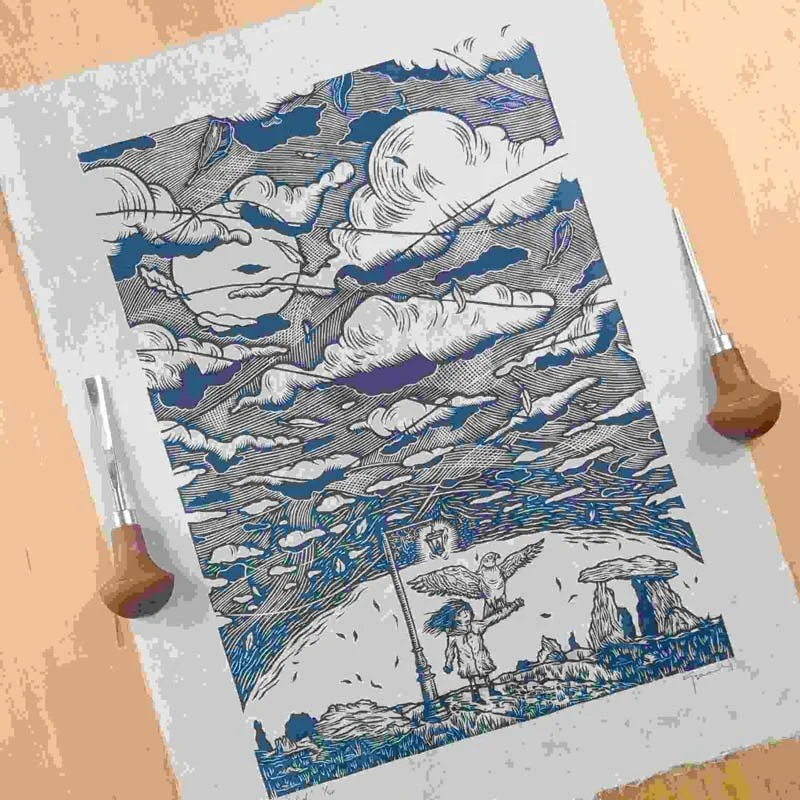


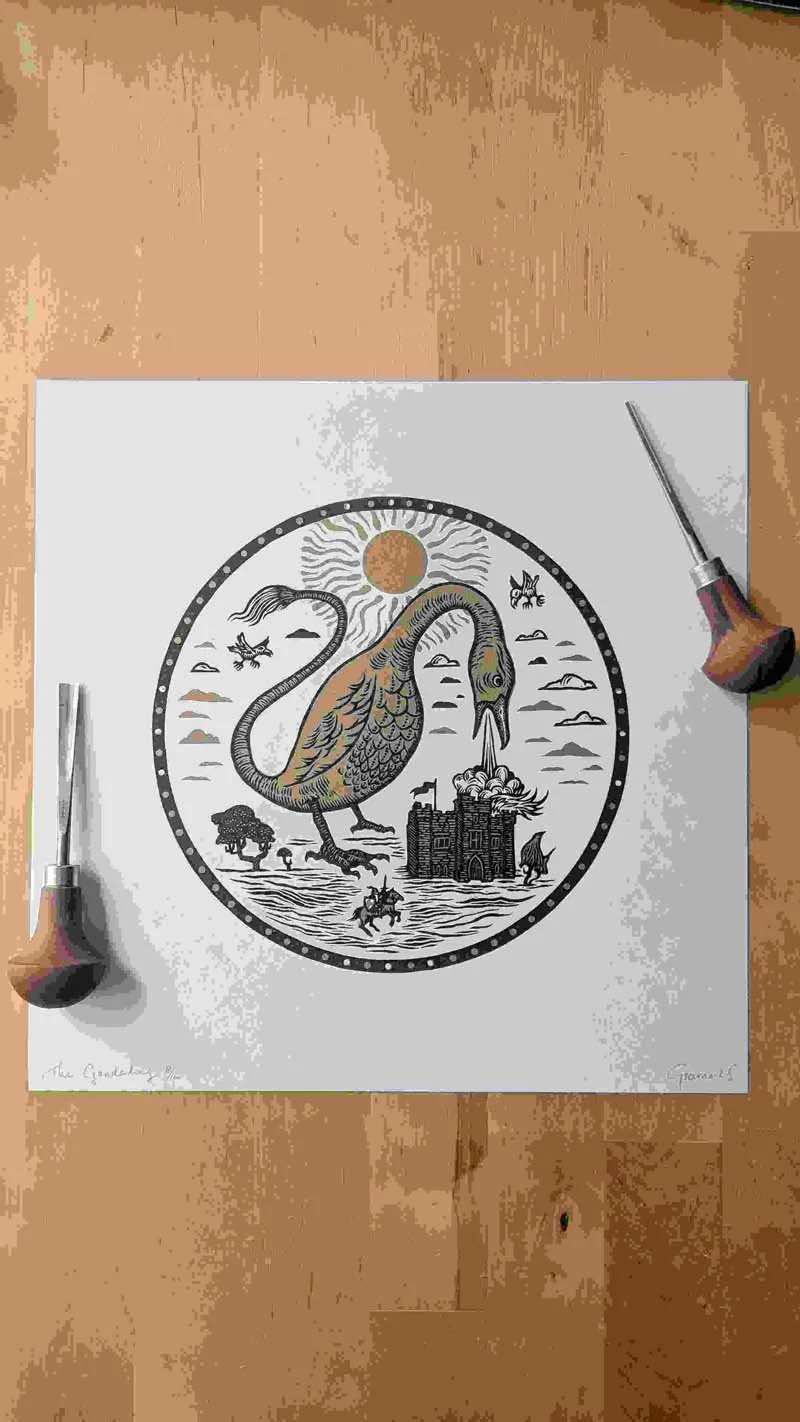
Gareth Barnes, aka Spindle Printer, is an artist based in the UK. He creates bold and unique prints that celebrate his love of history, nature, and storytelling. With a playful twist and his offbeat imagination, he likes to create prints that are engaging and capture people's attention with intriguing details. He mainly produces linocuts but also delves into traditional wood engraving. His work captures a broad mix of subjects, from wildlife to folkloric characters, atmospheric scenes to ancient sites. @spindle_printer

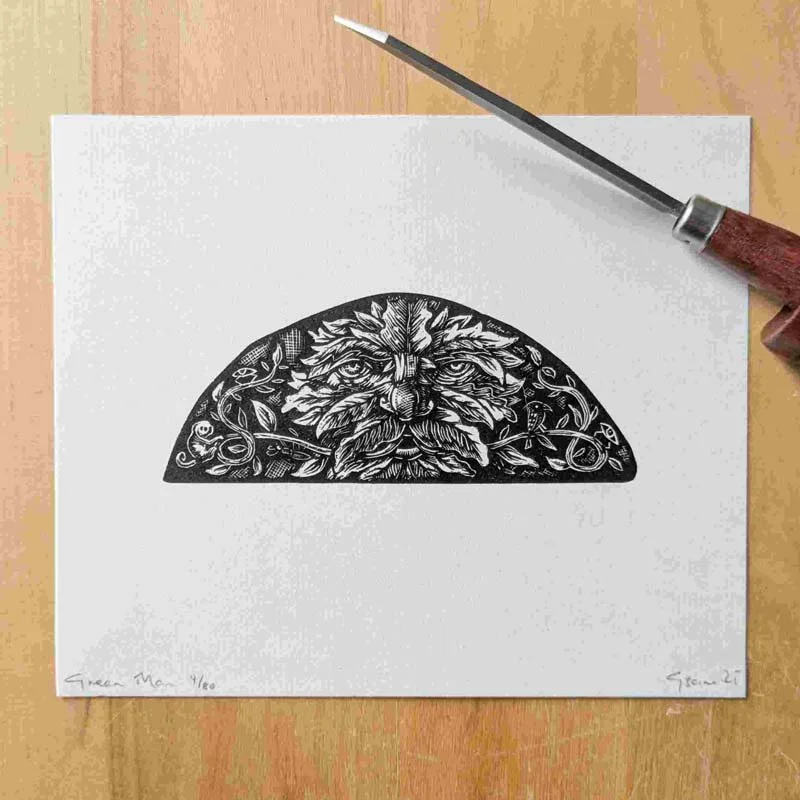
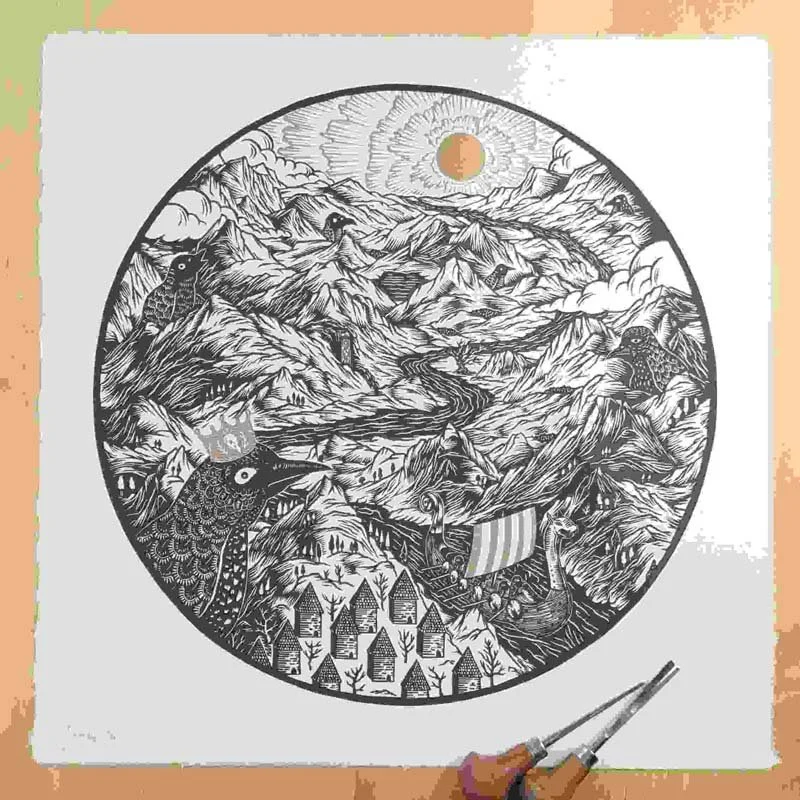
How did your formative years influence your artistic identity? I was born in New Zealand and moved around a lot during my childhood, although most of my upbringing was in rural areas. It’s hard to pinpoint any direct influences, but it was a time when I was absorbed in nature and had my head buried in history books too, so I suppose those experiences were the foundation stones of my later passions, which very much inspired my prints.
When did you first fall in love with art and realize you wanted to be an artist? For you, what is the importance of the arts? I was drawn to creative work very early on. I’m not sure why, as I didn’t have an obviously creative family at the time, but it was something that I naturally wanted to explore and experiment with. I spent a lot of time hanging out with friends at school break times, drawing imaginary characters, while at home, I messed around with photography and drawing from life. It was a mysterious compulsion.
The arts are the backbone of culture and are so important to support and nurture. It challenges thinking, opens minds, confronts what is harmful, and lays a path for people to express themselves. It adds colour, warmth, and heart to the world, which is vitally important, especially now.
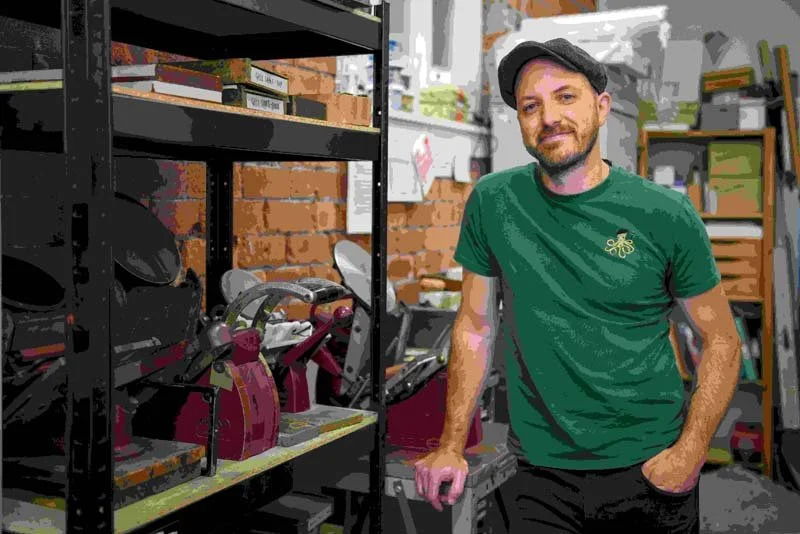
Your home doubles as your studio space. What has working in that creative environment been like? What routines and materials structure your artistic process? My home is very small and can be a little chaotic at times, but it usually works fine! On a typical printing day, I’ll firstly prepare the paper, followed by mixing ink and printing from the lino block, which can sometimes be a long process, especially if I am pressing the prints by hand (using a spoon). When my prints are printed and happily drying, I might have the time to work on new projects, sign and date prints, or get stuck into the carving of a new design. There are always different tasks to tick off.
The equipment I use the most will be my Pfeill linocut tools, which get a solid amount of use. Alongside those, I use my tool sharpening stones a lot to keep them super pointy, Japanese rollers, and a trusty metal spoon for the pressing.
Tell us about your current project and its central ideas. I am currently working on a small wood-engraved print to raise money, via auction, for the charity War Child. Beyond that, I have various print ideas that are floating around in my head and are very much in the sketch phase! My more recent work is very much influenced by my absolute love of history and nature—I’m exploring how they can be merged in intriguing ways.
What do you hope people feel when they experience your art? I like to leave my work open for interpretation. I like to engage people with my prints in whatever way I can, stimulating interest and hopefully the odd chuckle. Some prints have more of a scene, which viewers sometimes see as a story within, while others might feature subjects that people can relate to. It’s all very open, which I like.
Are there any artists whose work you feel a deep kinship with, even if you’ve never met? I would like to meet artists from the medieval period who were responsible for illustrating manuscripts from that period, along with the craftspeople who designed and carved the various creatures that adorn medieval churches. They had such a wild and quirky imagination, and I would really like to understand their motivations and ideas.
Do you draw inspiration from music, art, or other disciplines? Being part of the wider artistic community, I am surrounded by amazingly original art- especially with social media being a platform to showcase it, so I get a huge amount of inspiration from the visual arts, whether it be current or historical. I’ve had so many ideas, too, from visiting museums, gazing at beautifully decorated ceramics, and other objects.
You live in Leeds—what does the environment of the city offer that fuels your art? I love living in Leeds as it has an increasingly vibrant cultural identity with great food, tonnes of creative events, and an independent spirit. It’s also really well placed, with other lovely cities, cute villages, and big outdoor spaces within easy reach when you want a bit of fresh air.
Can you describe a project that challenged you creatively or emotionally—and how you worked through it? Late last year, I completed a commission for a publisher, producing around seventy-five pages of content for their upcoming linocut guidebook. The work covered chapters on materials, processes, and various tutorials. There was a lot of writing and a lot of carefully composed photos to take! As a largely self-taught printmaker, learning through trial and error and making decisions in the moment, I haven’t had to think about my work processes in a methodical way, let alone write about them. It was an interesting challenge, especially when factoring in the photo taking, but I’m really satisfied with the outcome. Thinking about how you create work in this way makes you appreciate the amount of time and energy involved, for sure!
Tell us about important teachers/mentors/collaborators in your life. To be honest, I don’t really have any that feature in my creative life. I very much produce my work independently, presenting it to the world via my website, social media, markets, and the odd exhibition. I therefore gain a lot of feedback directly from the public, and work with some individuals on commissions; however, I wouldn’t say I have any teachers/mentors or collaborators as such.
How does nature inform your creative process? Can you share a memory or reflection about the beauty and wonder of the natural world? Nature definitely does inspire my work, and spending time out in the wild often sparks fresh ideas. It may be something small-scale scale such as a quirky little insect or broader landscapes that go into my memory bank and form the inspiration for prints. Often, print designs will come together in my mind- a merging of different memories and images, but sometimes they come directly from experiences. When holidaying in Anglesey in Wales, I visited a number of ancient sites, and while walking towards the Bodowyr dolmen (Neolithic burial tomb), a buzzard flew and landed on the capstone. The image was really beautiful and directly inspired my linocut print Bodowyr.
Do you see AI as a threat, a tool, or something else in the context of human creativity and artistic innovation? It is becoming clear that AI has rapidly become a very real threat to the livelihoods of so many within countless industries. Along with the huge environmental costs to power it, it takes away human agency, acting as a cost-saving shortcut, bypassing originality and human involvement. This not only has very scary implications socially and politically, but in terms of creative work, it erases true originality, warmth, and meaning. Work produced this way is mechanised and empty, while people who have spent countless hours learning and refining their craft, who invest part of themselves in each single piece of work, lose out. If people can band together and put pressure on the right people, we can ensure that technology doesn't dominate and independent makers still have the power to make a living.
Exploring ideas, art and the creative process connects me to… The wider creative community, my friends, my family, the wild, and the past.