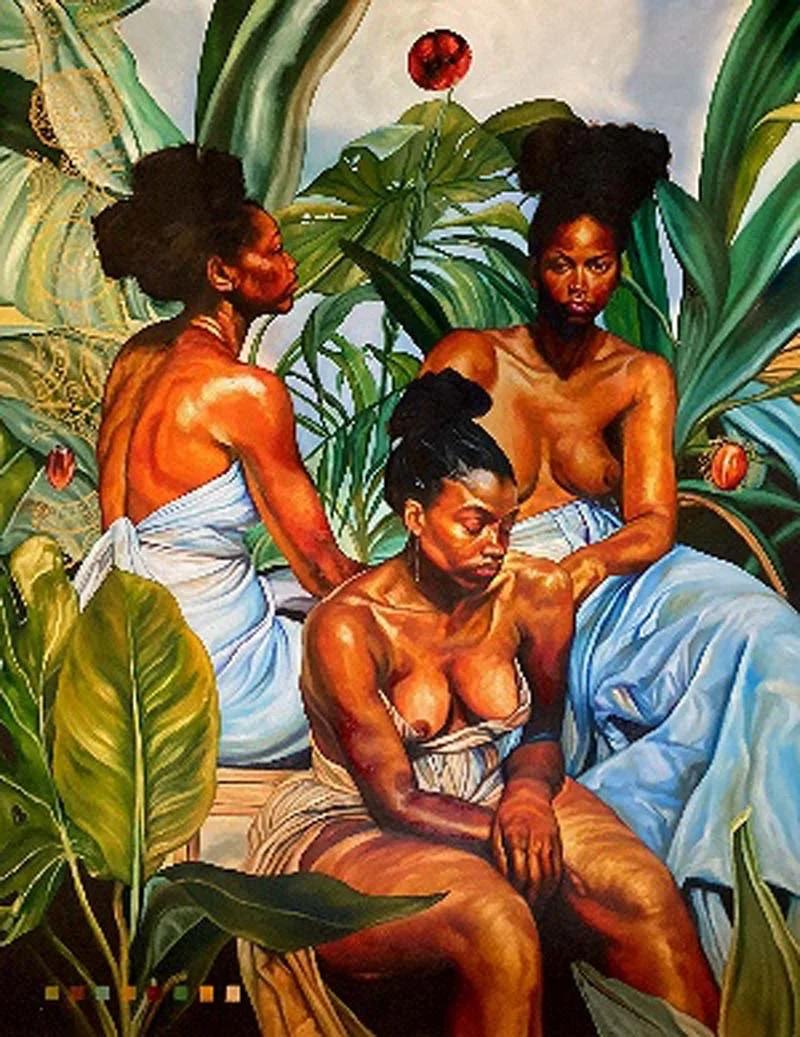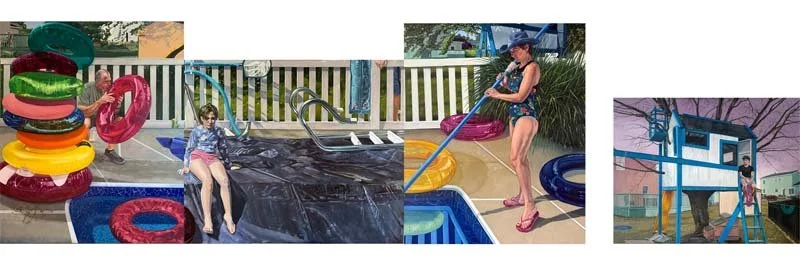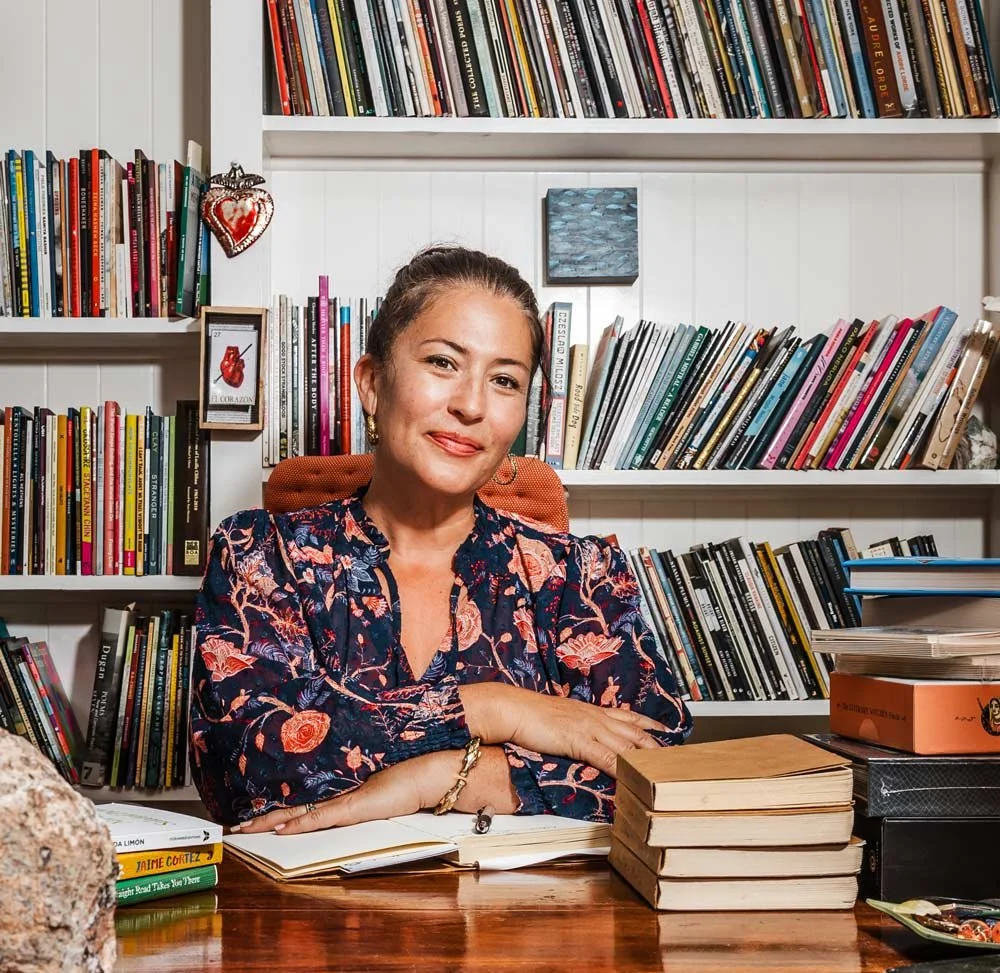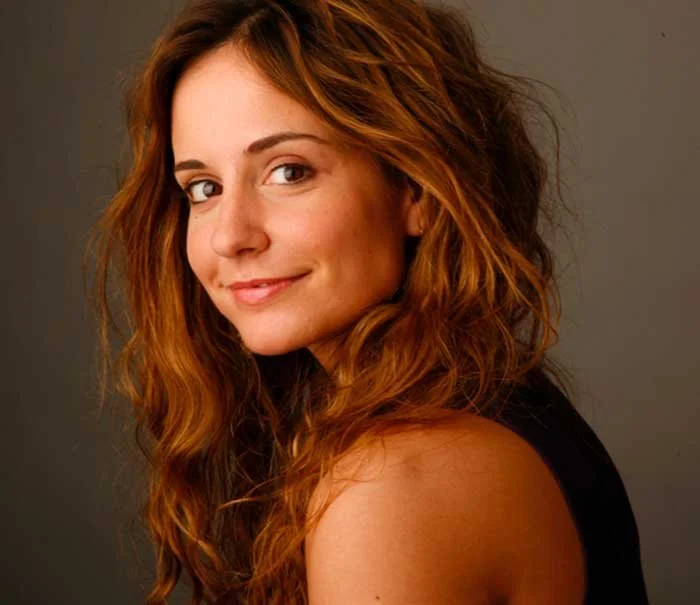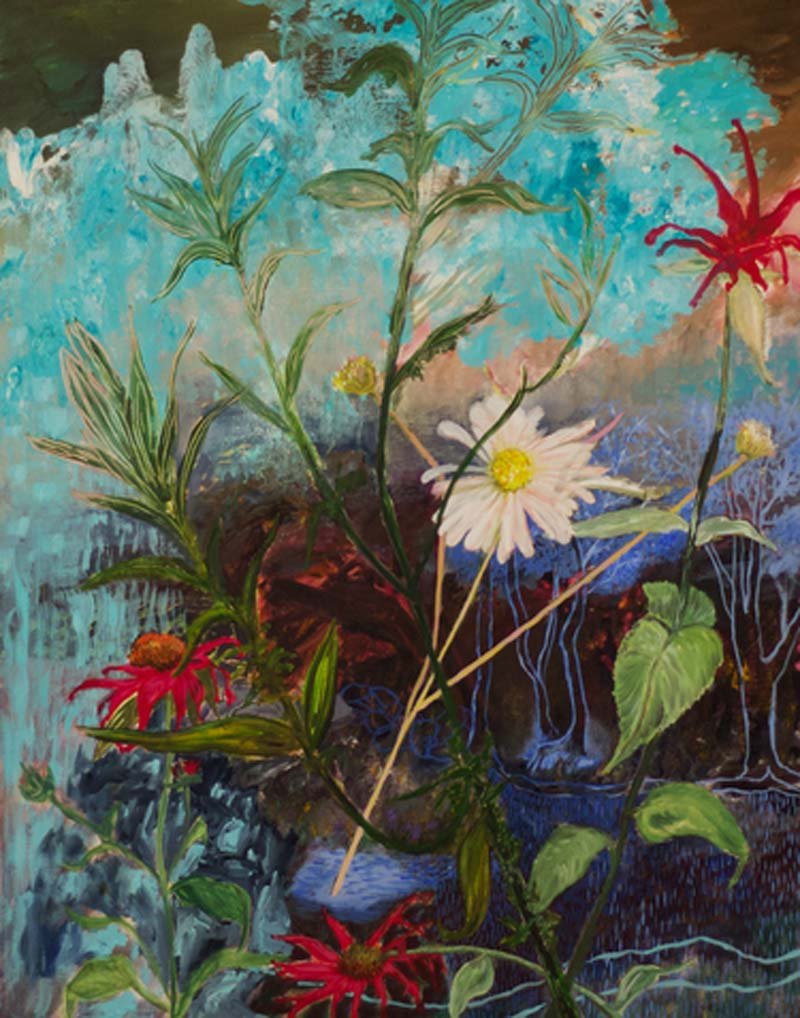


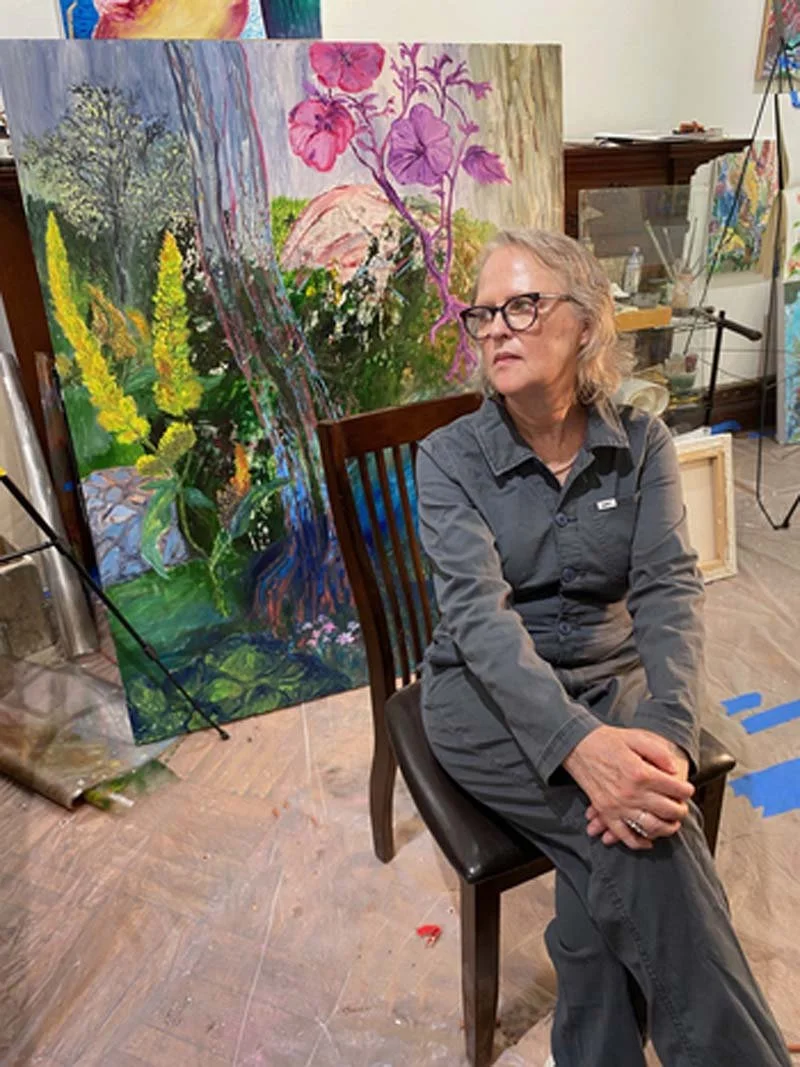
Cecilia Whittaker-Doe is a painter living and working in Brooklyn, NY. In addition to her Brooklyn studio, she has a painting studio in Delaware County, NY. She is married to artist Don Doe and has three children, Zachary Doe, Rowan Doe, and Sheelagh Doe. Whittaker-Doe has shown widely throughout NYC and upstate NY, and her work is included in many private collections. @ceciliawhittakerdoe
Growing up in New York, what aspects of that environment have shaped your artistic perspective? I was born in Peekskill, NY. We lived in the nearby town of Putnam Valley. My father, Tom Whittaker, was a DJ for WFAS radio station in White Plains and my mother, Patricia (Hanlon) Whittaker, was head of the budget department for the local school district. My twin sister Celeste and I were the youngest of seven. My maternal grandmother lived with us as well.
Our house was situated in about 4.5 acres of woods, with a small pasture my dad carved out so we could keep horses. The backyard dropped off rather quickly to a steep, rocky incline that led down through the woods to the pasture. My childhood was spent climbing down and up the rocks, crossing the small brook down past the horse corral, where there was a circular path, a ring, that Celeste and I would gallop the horses around in the middle of the woods. The horses’ names were Sheba and Pepper. There were vines all over; we used to swing on them (sometimes not so successfully).
My Father had a love of animals as well as a love of the wildness of our property. He kept a grassy yard and beyond that was rougher terrain. The yard was edged with tall maple trees, lots of what I think were locust trees, cherry trees, and more. One of my favorite things to do was to walk down the incline, way past the corral and brook, to a wild dogwood tree with glowing white flowers surrounded by tall trees, all with varying shades of green leaves. I'd just hang out there marveling at the brilliance of those white petals shimmering between shadow and light. It was my tree to visit.
We never kept animals as you would on a working farm. I think he just wanted to be engaged with the land, and this was one way for him to do so. It was kind of a funny hobby of his to take on raising baby chicks, rabbits, and the like. We had many other animals on the property over the years, goats, cows, and a crow named Ajax that my dad nurtured back to health upon finding him injured. I'm not sure if it was his leg or wing. I remember the day we set Ajax free again. I was about 7 years old, and it was both a sad experience and an enlightened one as we all watched him soar over the trees.
Sometime during elementary school, Celeste and I were given drawing lessons by our father. He had many hobbies, and one was drawing. He would set up still lives using dolls and whatever was around, and we would sit and draw with charcoal pencils. That's what it was really, just sitting quietly and drawing, not a lot of instruction. I remember falling in love with shadows. I had a rather heavy hand (something that was to be a thorn in my drawing teacher's side while an undergraduate). I just loved to get deeply involved in the darkness of charcoal. I think it was the medium that gave me pleasure. I still find myself searching for those places in my paintings; the deep, rich areas that nurture a kind of hope. Now I use many methods to reach those areas—it could be a thick, messy transfer process onto the painting surface, or it could be a delicately painted part of the painting. I feel those early drawing sessions with my father and my sister gave me something I still pull from today. This and his love of nature in all its complexities. He once told me, just before he passed away, that the reason we make art is so that we can create a place to wonder, to make something that is unique to our own experience.
Not to leave my dear mother out, she was a mathematician whose hobby was reading and writing. She also filled the house with an eclectic style. There were carpets over carpets, each with different patterns. The walls were filled with various reproductions of soft, calm scenes by a lake, straw hats on children while they fished, or some macrame that she liked the look of. There were lots of wooden plaques with sayings on them. And many multi-picture frames with family photos. The dining room was wallpapered with a repeating pattern of baskets, farmhouse style. Every room had a different kind of wood panelling in it. White birch, maple, ash, etc...
My mother, the grounded mathematician, and my mother, the eclectic home designer; always two sides of her working together.
When did you first fall in love with art and realize you wanted to be an artist? For you, what is the importance of the arts? Part of it must have been those early drawing sessions. And walking in the woods behind our house, wandering about, climbing the trees.
The Catholic elementary school I attended assigned the drawing and design projects to me. It was a chance to be outside of the box in a way; there were so many rules and strict orders in Catholic school, art was a way out of that. I think it was 6th grade when I was given the hall bulletin board to design for Christmas. I set about doing drawings of the holy family along with my other influence at the time - Walt Disney characters. I thought nothing of combining the two; they were equally Christmas time to me. The school allowed me to go ahead and plaster a 3' tall image of Dopey with diamonds in his eyes next to a smaller rendered scene of Mary, Joseph, and Jesus with all the animals around them onto that hall bulletin board. The lay teachers got a real kick out of it, and the nuns put up with it. I remember thinking, "...okay, I'm free making art..."
I can also remember seeing images of Chagall's paintings for the first time in high school. I went to Lakeland High in Westchester, and at the time, the school had a separate annex that was exclusively used for senior oil painting. My teacher, Mr. T, was a jazz musician and a visual artist. He introduced us to various artists, but it was Chagall that resonated with me. I can't say why exactly, even today. (I suppose you're thinking it was the goats! Perhaps it was). I never tried to paint like Chagall. At the time, I was only struggling with how to paint anything! I felt very clumsy with paint.
I think my father's sentiments above sum up the importance of the arts for me.
Can you describe your studio environment and how it influences your work? What are your go-to materials and tools when creating art? A typical day in the studio begins with me walking in and getting a quick side glance of whatever I last left on the wall. I love those quick glances upon first walking in. It's like taking in the work with new eyes. I like to process that first quick look before sitting down and focusing more on the work in progress.
I like the process of transferring onto a surface to begin a painting, so I have various plexiglass, acetate, and brayers around. I like to use oil sticks and oil pastels along with the brushed-on color. I've worked on paper, canvas, birch panels, linen, and Sintra panels. Paper has been my go-to for many years before I started using birch panel, which was like hitting a brick wall at first. I got used to birch panel and then moved on to canvas and then linen, which I prefer now. I think canvas or linen is the closest feel to paper, which is satisfying. I hadn't realized just how much I would miss the feel of working on paper, and it's funny that it took me working through panels to realize that and settle on canvas or linen.
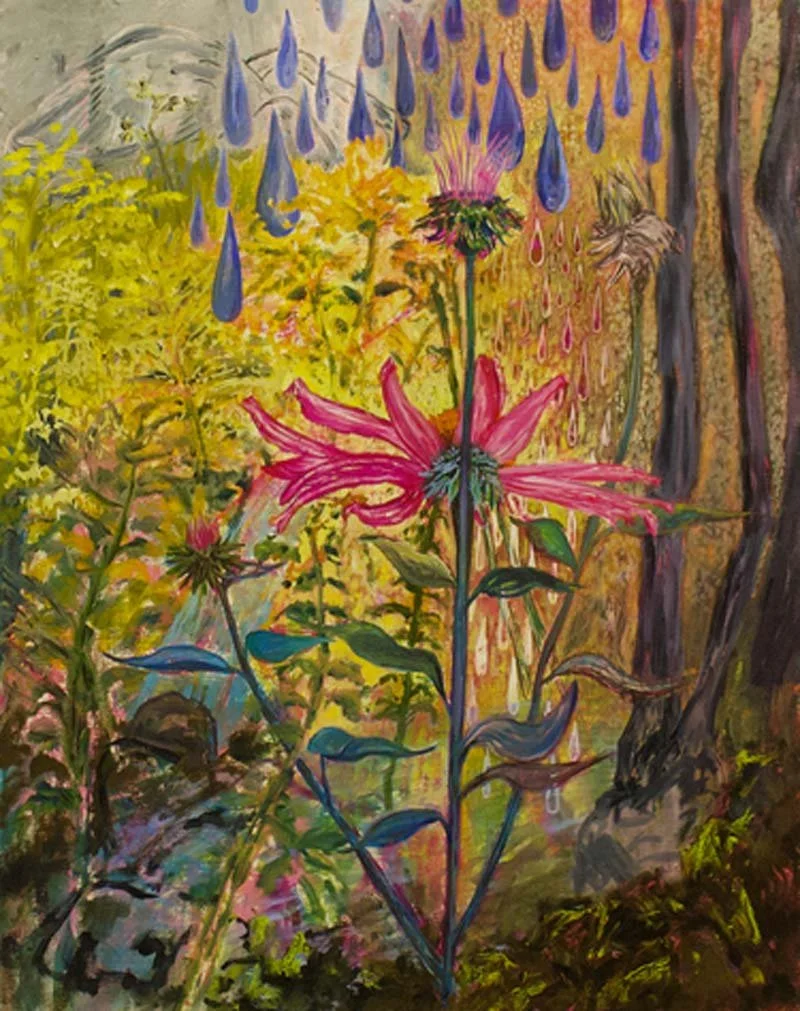
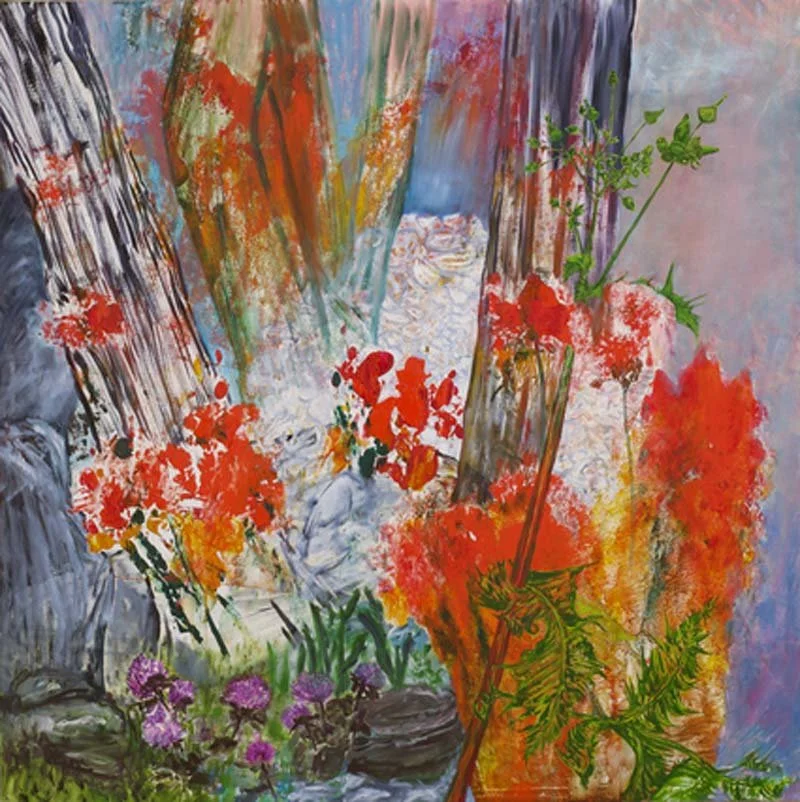
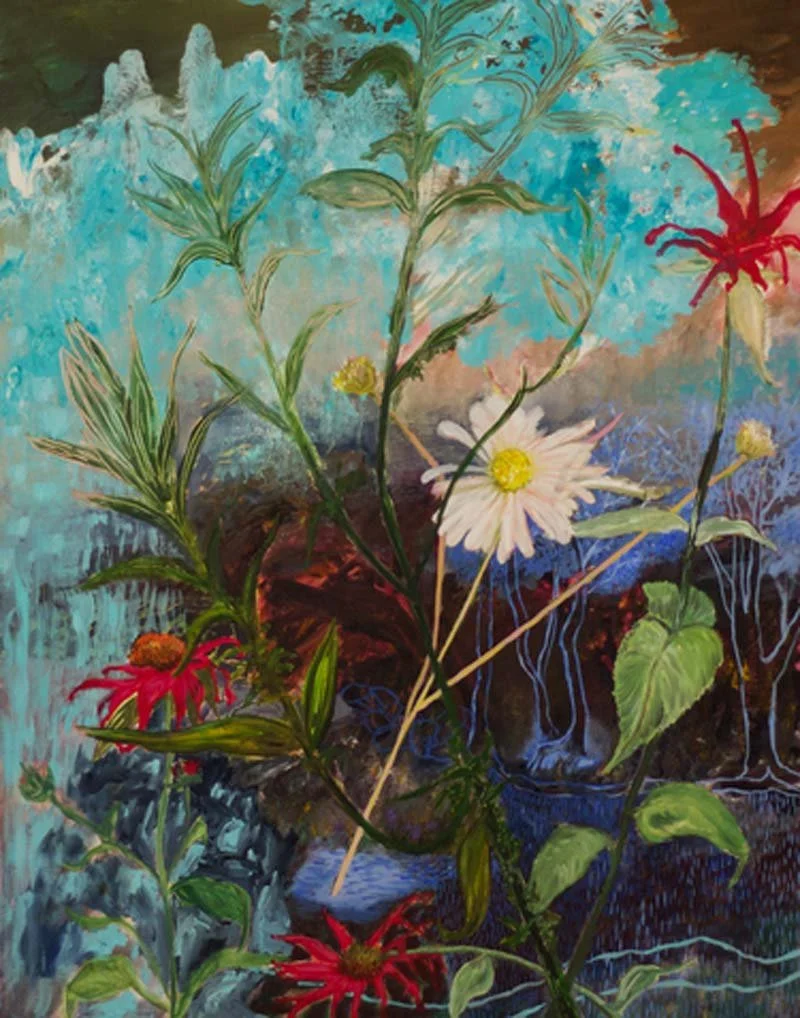
You’re currently working on your show, “Beneath the Trees it Rains.” What has that been like, and what questions or concepts drive the works you’re exhibiting? "Beneath the Trees it Rains" is a solo show that’ll take place at TIC (The Interchurch Center) in Manhattan, and it opens July 23rd. Their Treasure Room Gallery will be presenting over 20 of my recent paintings. There will also be over 20 of my works on paper and drawings showcased in glass wall vitrines encircling the reception area. So it's a big show! Lots of titling of work going on right now. I let my work sit for quite a while before titling. It's a process in itself.
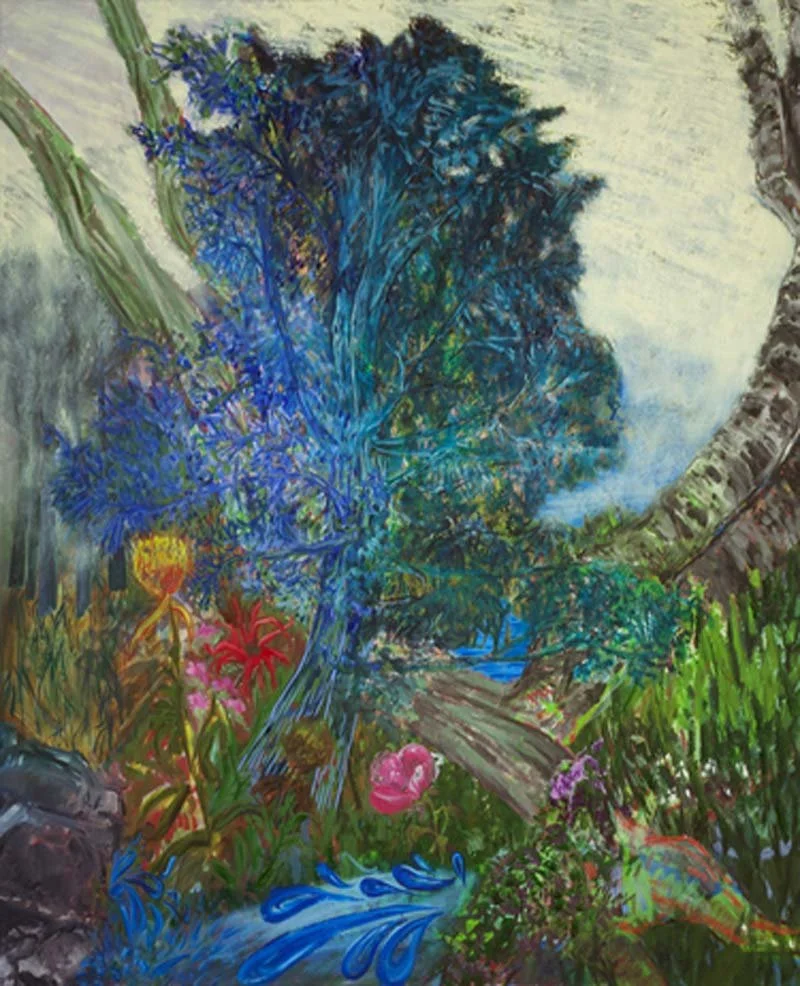
As far as themes driving my work, I have always felt that "landscape" does not entirely fulfill a description of my work. One way I describe myself as an artist is that I'm a painter. That's what I say if someone asks me, it's not "I'm an artist", it's "I'm a painter". When you look at one of my paintings, you'll see a tree, water, and rocks, but this is not a scene I'm depicting as much as it is a collection of images I've placed together in relation to one another for you to conjure new imagery for yourself. That's what painting is like for me, and the natural world seems to be a vehicle for me, probably because it resonates so deeply with me, and so it taps into all kinds of themes that reflect what it is to live in the world.
What do you hope people feel when they experience your art? What are you trying to express? Like they've been to this place, not literally, but at some time in their lives, they've felt what they see in one of my paintings.
It's really a vast expanse I'm trying to express. All that my imagination can get to.
If you could sit down with any artist from history or today, who would it be—and what would you ask them? That's a tricky question because I don't know if I would like to meet all the artists I've admired. For instance, I love VanGogh's paintings. But I think I would be terrified to actually meet him, I don't know.
I've had a couple of people say to me over the years, I remember your work, not you (!). I take it as a compliment.
However, I will give you what is hopefully a more satisfying answer to the question.
To sit and have a coffee with Audrey Flack. She passed away recently. I did a patina for her many years ago, in my twenties. I knew her paintings, and I didn't know her sculptures. I was way too shy at the time to ask her why she wasn't painting. It wasn't until last year when I read her memoir "With Darkness Came Stars" and I saw her show at Hollis Taggart, "With Darkness Comes Stars," that I learned about her block with painting and how she stumbled upon some clay in a closet and started shaping it. This got her back into making, new doors opened with the sculptures, and eventually she got back into painting. It's a difficult place to be when you have a block from painting. I had a block like this for many years. I worked on paper, printing monotypes, and I made drawings. That was my way back into painting. I never stopped making, just couldn't work confidently with a brush for some time. Looking at her paintings, you see how immersed and emotionally connected she was to the images she painted. We paint very differently, but I have great admiration for her work and how she persevered.
Do you draw inspiration from music, art, or other disciplines? I draw inspiration from other artists, from music, from walks.
The music I listen to in the studio varies from The Psychedelic Furs to The Staple Singers, to Eric Dolphy, to Emylou Harris, Nancy Wilson, Serena Ryder, and Ultra-Lounge, among others. Sometimes I'll listen to an album on repeat, not usually the whole time, but for a portion of my day working. I like to keep going the lyrics that might be resonating with me that day. Other days I don't play any music and I enjoy the quiet.
I recently saw a show of paintings by Larry Poons at Yares Gallery. Fabulous paintings that resonated with me. As I mentioned above, I'm always looking, seeing anything that strikes me from a walk around town or out of town in the Catskills. Visiting friends in their studios or putting together a show with friends is another source of inspiration.
Once, when I was working in Tallix Art Foundry, I was given the job of putting a Patina on a monumental Bill Tucker sculpture. I was up on this lift with a torch, flinging cupric acid and ferric acid onto this bronze sculpture that had the surface of the rocks and roots I used to climb on every day. It might have taken me a week or so to finish the job. I still think about that sculpture when I paint rocks. Inspiration can come from the strangest places.
One constant place of inspiration for me is the property we have in the Catskills. I can wander there to absorb the place, and I can focus on watercolors or drawings of the thistles, weeds, mallow, clover, mullions, milkweed....all the plants among the trees, as well as the echinacea and bee balm Don and I brought onto the property. Working in this way, I gather information that I can use in the studio.
Living in New York City, how do its communities and environment nourish your practice? I like my community here in Brooklyn. Walking down the street, there's always someone to say hi to and stop and talk with. Favorite eating spots close by. Walks here are full of history, and quite a few gorgeous gardens. Don and I take walks through the neighborhood often. And of course, I have access to viewing a lot of art in the city. I'm more social here; when I go up to the Catskills it’s quieter, although there's a great community of artists there as well; I feel fortunate to be able to experience both places.
Was there a project or a time in your life that pushed your limits as an artist? How did you make it to the other side? Sometime in my mid-twenties, I became completely self-conscious handling a paintbrush. Every mark I made seemed wrong. I wasn't entirely sure what was blocking me, although I had some ideas. Part of my solution was to immerse myself in making textile designs, and another part of the solution was to produce monotypes.
I had always loved fabric design, and we did need a way of making some money, so I first learned the trade of textile surface design by getting a job in a small company, Creative Consultants, and selling other people's designs. I would shuffle hundreds of designs a day in front of clients to sell them, visually taking in all the techniques, colors, and patterns. Eventually, I would convince my employers to hire Don, who was just finishing up on a Pollock Krasner grant; I was pregnant with our first child and didn't want to continue pushing a large box of designs on wheels around midtown. They agreed, and I took maternity leave while Don learned the textile design business. Eventually, Don and I formed our own small company, Doe Print Designs. This textile design saved me for a while because I was able to pour myself into the designs, and they sold very well, which was incredibly satisfying at the time. Looking back on it, I realize how helpful making these designs was to me as a painter. The rhythm, the color, and the textures would stay with me.
During this time, I also started to make montotypes. Don had bought a small press from a lady in Park Slope who was having a stoop sale - she was selling a press, inks, and all the works for $100.00.
The press is really a clay press. But she had been using it to pull etchings for decorative cards. We still have it. I pulled oil paint monotypes from it and did drawings for about 15 years before I felt an overwhelming desire to paint again.
Tell us about important teachers/mentors/collaborators in your life. I had three undergraduate teachers at SUNY Buffalo who made an impression on me: Richard Gubernick, Roland Wise, and Lori Christmastree.
Richard and Roland taught in the painting department, and Lori taught in the textile design department.
Richard produced hard-edge geometric paintings and was very interested in surface patterns. He had a quiet sense of humor and wanted to know where you were from and its connection to what motivated you to paint.
Roland was a follower of Cezanne. I took a watercolor class from him that had a lasting impression on me. It was a summer plein air class in the park. Roland took a great interest in the shifting perspectives of my watercolors and was quick to find the painting that I was the least secure about and tell me why it was good. In the first oil painting class I took with him, he looked at my painting. which I had inserted the model into twice - one body partially coming in from the edge of the painting - and said, "I'm going to leave you alone..." I liked him immediately. After class, he called me into his office to show me a book on Matisse.
Lori taught me about color. She identified the warms and cools in one of my projects during a class crit. I had no idea what she was talking about. It was my introduction to color theory, though I somehow never took those typical color theory classes.
There was no school of thought imposed there, and I did a lot of experimentation - some pretty awful paintings and some pretty good paintings.
Later, I did my MFA years at Brooklyn College. There, I worked with Archie Rand at a time when I was diving back into painting. He became a mentor to me. He understood where I was coming from and gave me great encouragement, sometimes with words that were difficult to hear. He's remained a friend.
Vito Acconci was there at the time. He was incredibly generous with his time and discussion. Although I found that I couldn't take my painting in the direction our conversations went, I valued those conversations.
Jim Hyde is another painter I studied with at Brooklyn College. He gave me great insights and encouragement as well.
What’s your relationship with the natural world as a source of inspiration? When I was a small child, my favorite thing to do was to go out in the pouring rain to stomp in the mud under our maple tree. I still love walking in mud. I don't think we can separate ourselves from the natural world; all the complexities we hold within ourselves are mirrored in the natural world. And we don't even know all there is to know about it, just as we don't know everything there is to know about our own bodies. We continue to discover.
AI is changing how we do, access, and think about art today. What are your reflections on AI and technology? In what ways do you think human-made work holds power in a digital age? I think beauty is about being in the present because it’s really about a visceral response. I'm not against AI. I use it every day like most of us do today. I sometimes hear it being referred to as a replacement for one thing or another. This seems to me to be a misunderstanding of how we can use it.
To be a maker in the world means you are projecting something out there that may be transformative, whether you use AI to make it or not. Having said that, you can use AI in your process, but it’s not AI that's doing the making.
I've never felt comfortable making a distinction between industrial arts, fine arts, handmade, etc.…I love good design, whether it's a toaster, a pendant lamp, pottery, architecture, cars...
I love to look at things, often not pondering how they were made. If a painting is made using AI, I wouldn't necessarily want to know first. I would want to look and see what I think first.
Exploring ideas, art and the creative process connects me to… In a way, making a painting connects me to my extended family. Then it connects me to my community of friends. We don't have to agree or like the same art; we can sit with our ideas and responses together. It can form a bond with people that can transcend everyday communication.