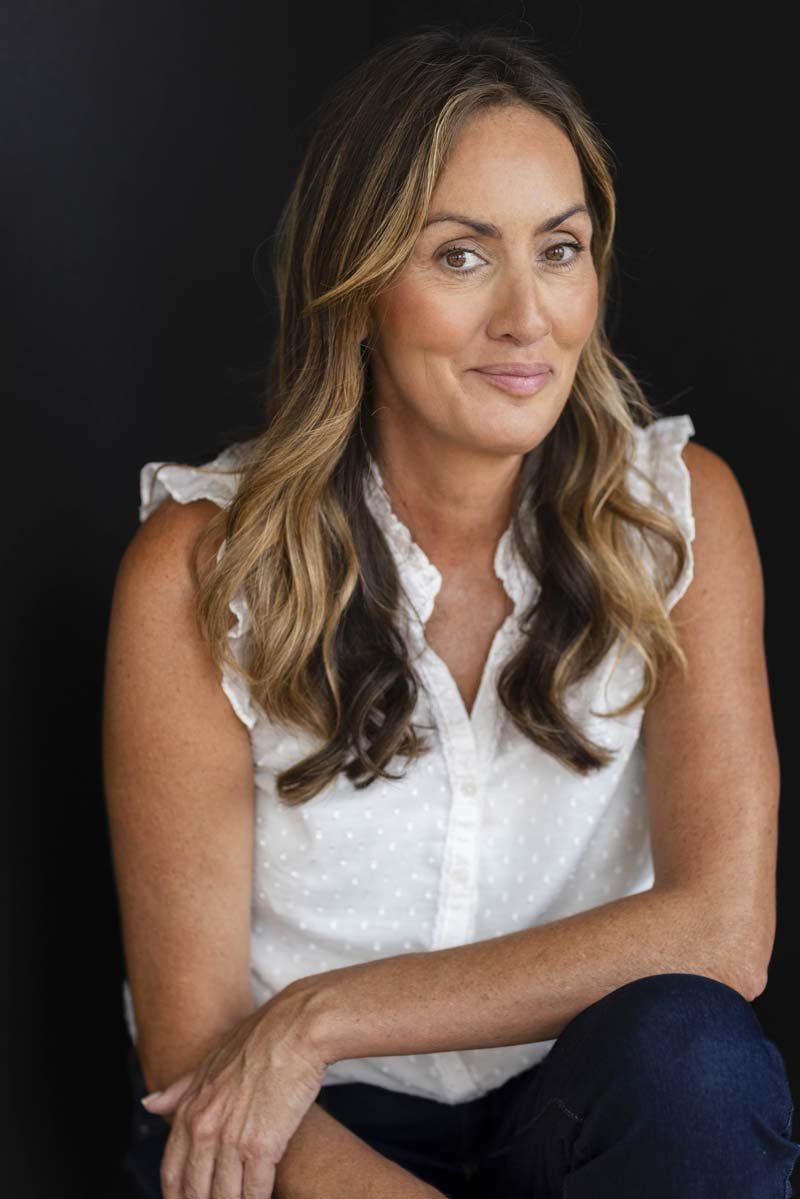


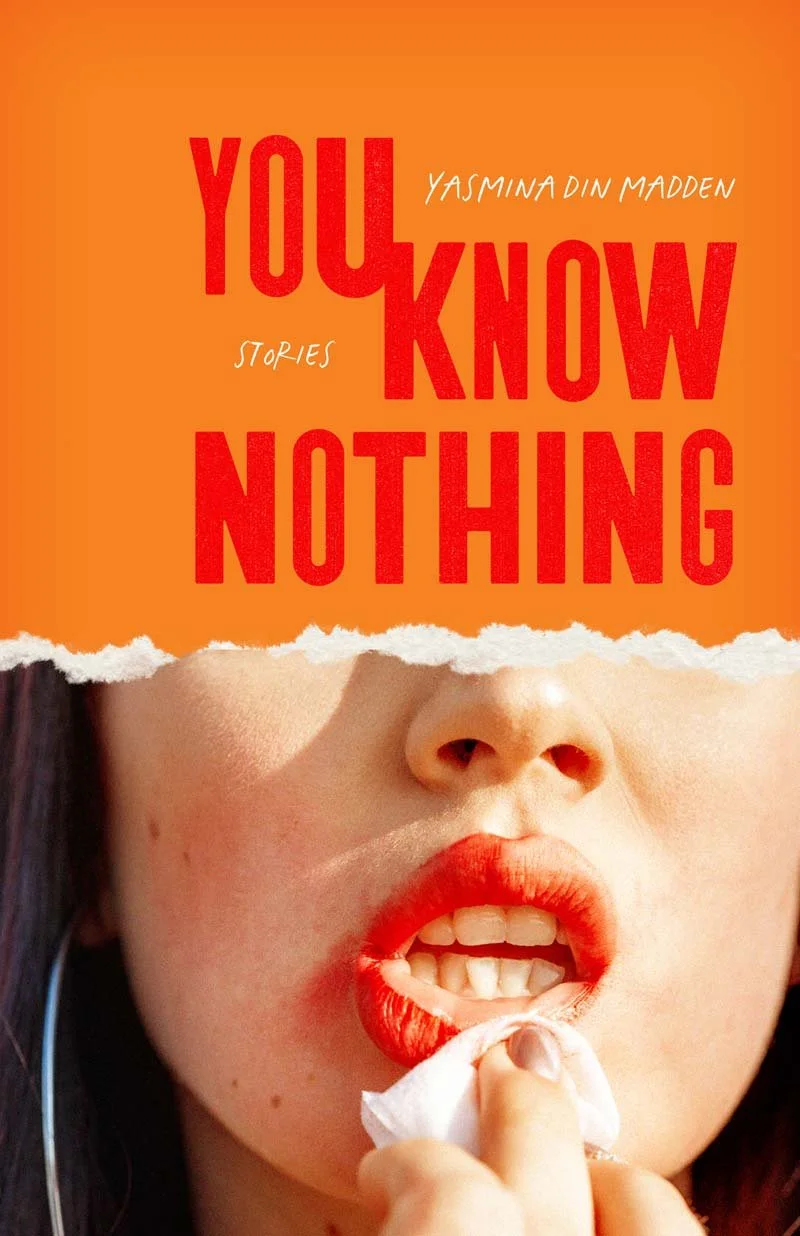
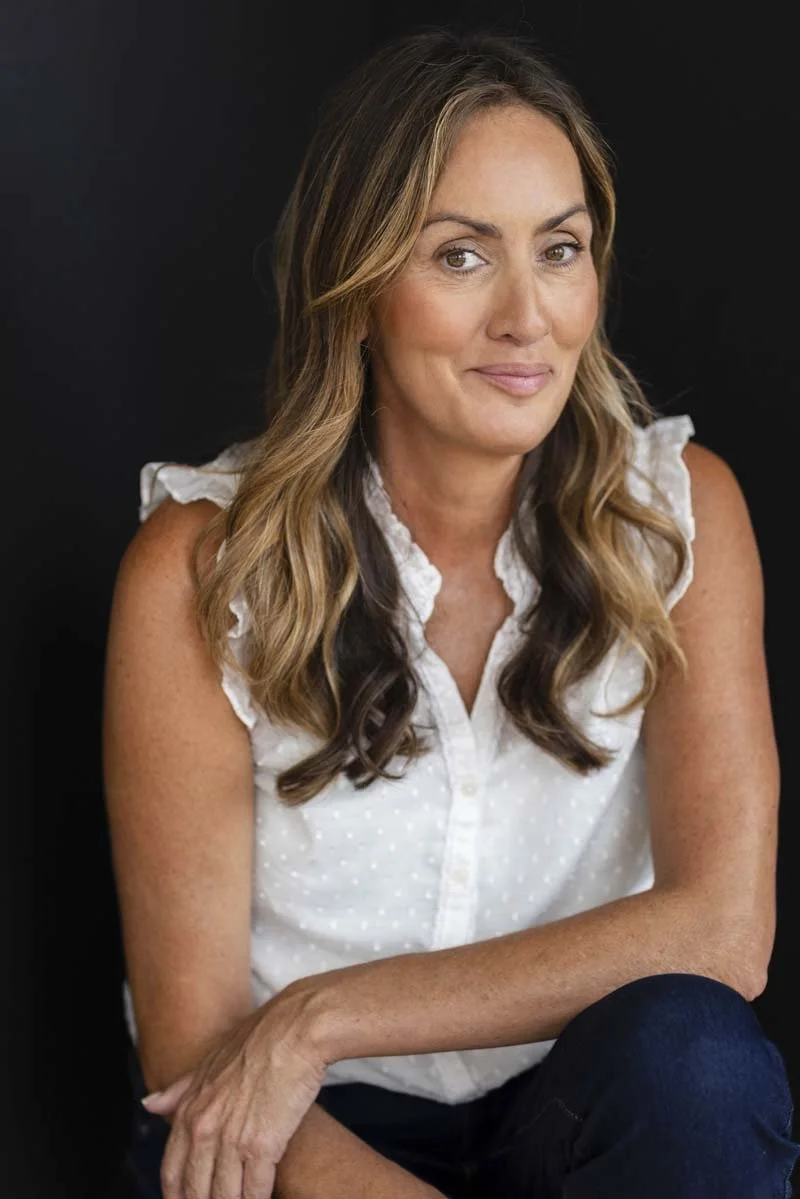
Yasmina Din Madden is a Vietnamese-American writer whose debut collection You Know Nothing is forthcoming from Northwestern University Press in February 2026. Her fiction and nonfiction have been published in Electric Literature, The Idaho Review, The Fairy Tale Review, and other journals. She is the winner of the 2022 Oxford Flash Prize, and she teaches creative writing and literature at Drake University. @yasminadinmadden
You were born in Chicago. How did it influence your writing and your thinking about the world?
I was born and raised in a suburb of Chicago. Given that this was an almost completely white community in the 1980s and early 90s, and my mother was Vietnamese and my father white, a sense of being other informed much of my childhood. I I think that feeling a bit like an outsider is large part of why I'm a writer. I was more often observer than participant if that makes sense. These identities--other, outsider--have influenced every aspect of my writing; I am most interested in exploring characters who do not fit--whether that means fitting into a situation, setting, or culture, or fitting into expectations of gender and sexuality.
What kind of reader were you as a child? What books made you fall in love with reading as a child?
I was a voracious reader from a very early age--I read everything I could get my hands on. So many favorites--I read all the Beverly Clearly books and Judy Blume books, but the books that made me fall in love with reading, the ones I still remember today, include The House with a Clock in Its Walls, by Jonathan Bellairs, illustrations by Edward Gorey; The Phantom Tollbooth by Norton Juster; and Mrs Frisby and The Rats of Nimh by Robert C. O'Brien. When I was a bit older, A Tree Grows In Brooklyn by Nancy Smith left in indelible mark.
Describe your typical writing day.
A typical writing day changes depending on whether I'm teaching or not. I have an rather all or nothing personality (unfortunately, fortunately?), so when I'm teaching, I'm pretty locked in on student writing--most of the writing I do during the semester, is revision of stories or novel chapters. Thankfully, I have large chunks of time during winter and summer breaks, which is when I do most of my writing. During those breaks I might write for five to six hours one day, and two the next over the course of the break. I do not outline stories, but do have a quasi-outline for my novel-in-progress. When I write I edit as I go--can't fight nature, I've tried. The beauty of being an edit-as-you-go writer is that when you finish a manuscript, it's pretty polished and doesn't need a ton of revision. The beast is that I write excruciatingly slowly.
Tell us about the creative process behind your most well-known work or your current writing project.
In terms of my current writing project, which takes alternates between 1994 and 2024, I've been listening to a lot of indie/riot grrrl music from the 90s as inspiration for the novel as the book follows a group of feral teen girls coming of age in 1994 and these same girls as women in 2024. I've also been re-reading The Virgin Suicides by Jeffrey Euginides, because it uses a first person plural POV, as does my novel, and also because I love it so much. The atmospheric quality of that novel is aspirational.
Do you keep a journal or notebook? If so, what’s in it?
Yes, I have a notebook, and it's filled with very fragmented notes, ideas, scraps of ideas, scraps of song lyrics, a very bad sketch or two.
How do you research and what role does research play in your writing?
I research as I go, as needed. The story I want to tell I already have access to--it's been percolating inside for months or even years. Research is secondary and much more connected to the novel I'm working on than to the short stories I write.
Which writer, living or dead, would you most like to have dinner with, and why? What would you ask them?
Oh wow. This is a hard one. Just one? Probably Rachel Khong because I love her writing so much and she would, I'm guessing, be a really good dinner companion. Her writing is so layered--darkly funny and very smart, also painful and tenderhearted, Goodbye, Vitamin is one of my top five novels. If for some reason we had special dispensation to invite one other writer to dinner because our budget just got bigger and we could bring back the dead, than I'd invite Alice Munro (I know, a complex figure right now) because her short stories are so incredible in their scope and compression.
Do you draw inspiration from music, art, or other disciplines?
I love music and definitely draw inspiration from it--as I mentioned, my current novel draws a lot of inspiration from 90s indie/riot grrrl music, and I tend to get obsessed by certain lyrics--which is why I can't listen to music with lyrics while I write. I also find Aideen Barry's work compelling--Barry is an Irish multi-media artist whose work often explores feminist issues, among many other things. Last spring, on a whim I went to a lecture by Tuan Andrew Nguyen at our local art center. I'd never heard of him before but given that he's a Vietnamese artist whose mediums include film and sculpture, I was on board. He showed his short film The Island, which explores the tensions of displacement, war, and refugee status, and the film was so unexpected and compelling--I'm just now digging into more of his work and I'm obviously late to the game because he just won a MacArthur!
Do you have any questions for Mia Funk (artist, writer and founder of The Creative Process)? Or any reflections or creative responses to her paintings?
I love ekphrastic writing, which is part of why I think I'm drawn the the flash narrative form as flash often uses the visual or particular structural forms as the jumping off point for a story. One of the stories in my collection was inspired by an taxonomy of animal mating habits. And recently I had my students write a flash essay in response to a Pulitzer Prize winning photograph of their choice and it produced some very good writing. I hope, in the near future, to collaborate with a visual artist on a hybrid project that focuses on the visual narrative of photography or painting in tandem with the prose narrative it inspires. In looking at Mia Funk's paintings, I'm fascinated by the radical shifts in tone and tension that occur across her paintings. There is the ephemeral quality of the Memory of Water series that, for me, invoke tones of calm, loss, peace, and even grief from painting to painting. And then her Artists in Their Studios Series--particularly Lucien Freud with the Queen and other paintings in this series does a 180 in terms of tone to the satirical.
AI and technology are changing the ways we write and receive stories. What are your reflections on AI, technology and the future of storytelling? And why is it important that humans remain at the center of the creative process?
I think about this a lot, particularly in terms of teaching--trying to get across to my writing students, particularly my fiction and narrative nonfiction students, that using AI to generate stories is antithetical to the creative process--that it is the simmering pot of the things they've seen, heard, done, questioned, imagined that should serve as the impetus for their work. As I writer, I'm not interested in AI, but as a teacher it's something I need to consider--not just the limits of AI on the creative process, but also the innovative ways some writers have used it. I teach "Ghosts" an essay by Vuahini Vara in my flash essay workshop as an example of ethical, creative, and effective use of AI in creative writing. If you haven't read this piece, it was published in The Believer and is beautiful.
Can you share a few recent reads that made an impact on you? Any favorites?
Recent reads that I loved: Katie Yee's Maggie; or A Man and a Woman Walk into a Bar, Jen Beagin's Big Swiss, Maggie Su's Blob: A Love Story and recently reread and loved it just as much--Rachel Yoder's Nightbitch. I'm currently reading Stag Dance by Torrey Peters and it's amazing. As for favorite books: Kitamura's Intimacies, Khong's Goodbye, Vitamin, Beagin's Big Swiss, Emily Brontë's Wuthering Heights, Clare Vaye Watkins's Gold Fame Citrus, Zora Neale Hurston's Sula, Gary Shteyngart's Super Sad True Love Story, John Irving's The World According to Garp, I could keep going but I'll leave it at that. Favorite Writers: Rachel Khong, Katie Kitamura, Zora Neale Hurston, Alice Munro, Raymond Carver, just to name a few.
Exploring literature, the arts, and the creative process connects me to…
who I am at my core and also to the world around me.