

Fort Wayne-based ceramic artist Brady Fanning on gazing, influencing, and creating.
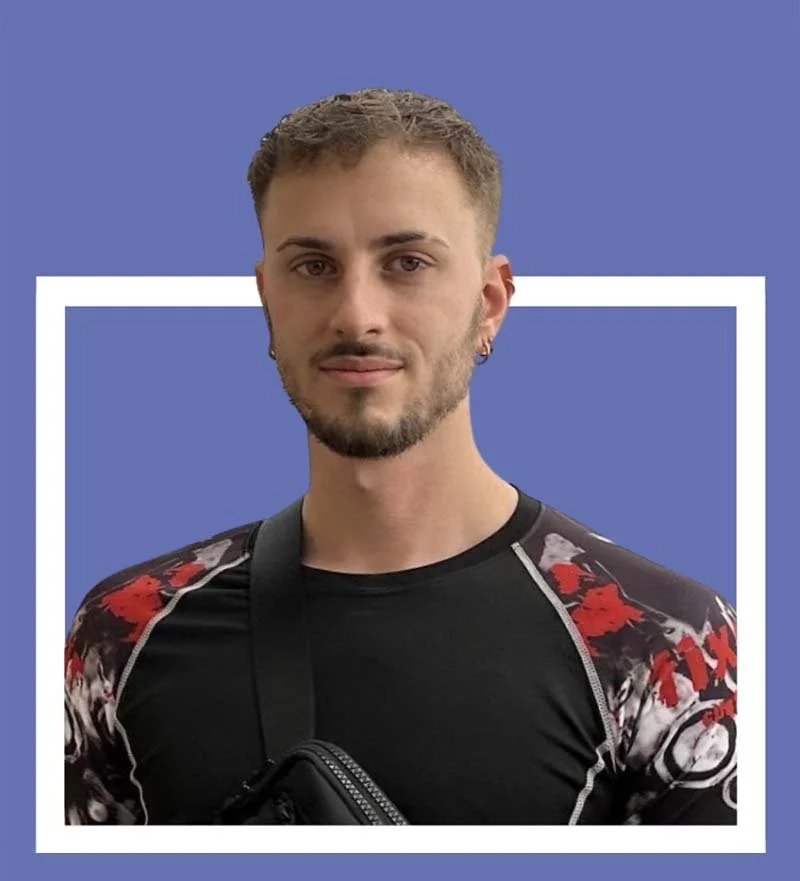
Brady Fanning is a ceramic artist from Fort Wayne, Indiana. He is the 2025 Lormina Salter Fellow at Baltimore Clayworks, where he is currently in residence. Brady graduated with his MFA from the Eskenazi School of Art, Architecture + Design at Indiana University Bloomington and earned his BFA in ceramics from Purdue University Fort Wayne in 2021. With teaching experience in ceramics and 3D design, Brady combines technical skill with speculative design to create intricate sculptures that explore power, protection, and queer identity. He is currently represented by ADC Fine Arts in Cincinnati, Ohio.
His work has been exhibited nationally, including Currents and Charges at the 2023 NCECA in Cincinnati, The State of Clay in Indiana at the Indianapolis Arts Center, and Brilliant Hues & Intimate Forms with Second Story Studio and the Kinsey Institute. Brady received Best in Show at Hot & Sweaty Summer National in 2024 at Backspace Gallery, Bloomington, IN, and at the 2025 NSAL Exhibition at the FAR Center for Contemporary Arts, where he was also awarded the “Chapter Career Award” of $2000.
Most recently, Brady presented his MFA thesis exhibition on April 8th, 2025, at the Grunwald Gallery in Bloomington, IN, and is now continuing to develop his practice through his fellowship and gallery representation. @fkabrady
Where were you born and raised? How did it influence your art and your thinking about the world?
I was born and raised in Fort Wayne, Indiana, Growing up, I played a lot of sports and had a pretty “mid western” life. when I was forced out of the closet at 13, it completely shifted how I related to the world and how I was raised. Embracing that identity early on made me more open-minded, and it gave me a strong connection to queer community—not just around sexuality, but around acceptance, creativity, and finding strength in difference.
That perspective shaped how I think and how I make. My work in ceramics is about transformation, ornamentation, and imagining other futures and outcomes. I take a lot of inspiration from the idea that identities and forms aren’t fixed—they’re fluid, hybrid, and evolving. Growing up in Fort Wayne gave me both stability and a push to carve out my own sense of self, and that tension really drives my practice today.
When did you first fall in love with art and realize you wanted to be an artist? For you, what is the importance of the arts?
I think I fell in love with art in pieces. Early on I found that pulse in the studio. The moment it crystallized into wanting to be an artist came when I was applying to college, and it deepened once I was there, then graduate school. Moving away for graduate school became a turning point: suddenly I had space to take risks, to feed myself with sci-fi and theory, and to let my obsession with ornament, narrative, and the body grow into a practice. A particular undergraduate class on the Italian Renaissance felt like story time and pulled me toward art as both method and narrative. Those strands—craft, story, and the theatricality of history—wove together into a commitment to making work that asks questions rather than giving answers.
The arts matter to me because they’re a form of thinking that is at once sensory and speculative. Making ceramics forces you to negotiate material limits and imaginative possibilities simultaneously: glaze behaves unpredictably, clay resists, and through that resistance and failure, new languages of form emerge. I’m drawn to ornamentation and objects of desire because they reveal how power and attraction are tied to both our bodies and our culture. For me, art is a way to explore identity, sexuality, and imagined futures in ways that straightforward arguments or policies cannot. It allows me to build possibilities—making the everyday feel unfamiliar and charged and making the strange feel approachable and real.
Art also builds community and empathy. Teaching undergraduates and running workshops has shown me how a studio can become a site of care, risk, and transformation. The arts create space for people to see themselves in different scales and textures—to imagine worlds where bodies, genders, and objects can be remade. That process is political, ethical, and generative: art doesn’t just represent change, it invents the tools we need to think and live in new ways.
For me, being an artist is both a calling and a way of asking questions. It’s how I make ideas of desire and power tangible, create objects that hold stories and contradictions, and invite others to imagine and create alongside me.
What does your typical day in the studio look like? Walk us through your studio and your most used materials and tools.
Hmmm, that’s a tricky question to answer. A typical day in the studio usually depends on what I did the day before, which informs my next move. Let’s say I designed a new piece, scaled up all the measurements, and then made all the components on the potter’s wheel. The next day would begin with walking around my wet or leather-hard pieces, checking how they’ve changed overnight—how the clay has dried and how the surfaces are shifting. That observation sets the tone, because ceramics is a medium that’s always in motion, never quite still until it is fully hard. From there, my time splits between trimming, leveling, and constructing large forms, as well as working on the detailed elements that will later attach to them. After that construction, I move back and forth between throwing on the wheel, handbuilding, and carving, depending on what the work demands.
My studio is both a workshop and a sketchbook. Tables are scattered with sketches, and half-finished parts that act like a vocabulary I can pull from to inform my next work. The tools I reach for most are the simplest—loop tools, knives, ribs, and sponges—but I also use airbrushes and a lot of tape when I want more precision in ornamentation or surface effects. I treat glaze like skin, fabric, or armor, accentuating the body of the form or transforming it into something alien and futuristic.
The rhythm of my day shifts between control and surrender: building aggressively ornamented structures, then waiting to see how the material pushes back. Clay collapses, glaze runs, and those accidents often spark new directions that I might explore further. The studio, for me, is less about a fixed routine and more about creating an environment where I can experiment, take risks, and let the work tell me where it wants to go.
What projects are you at work on at the moment? And what themes or ideas are currently driving your work?
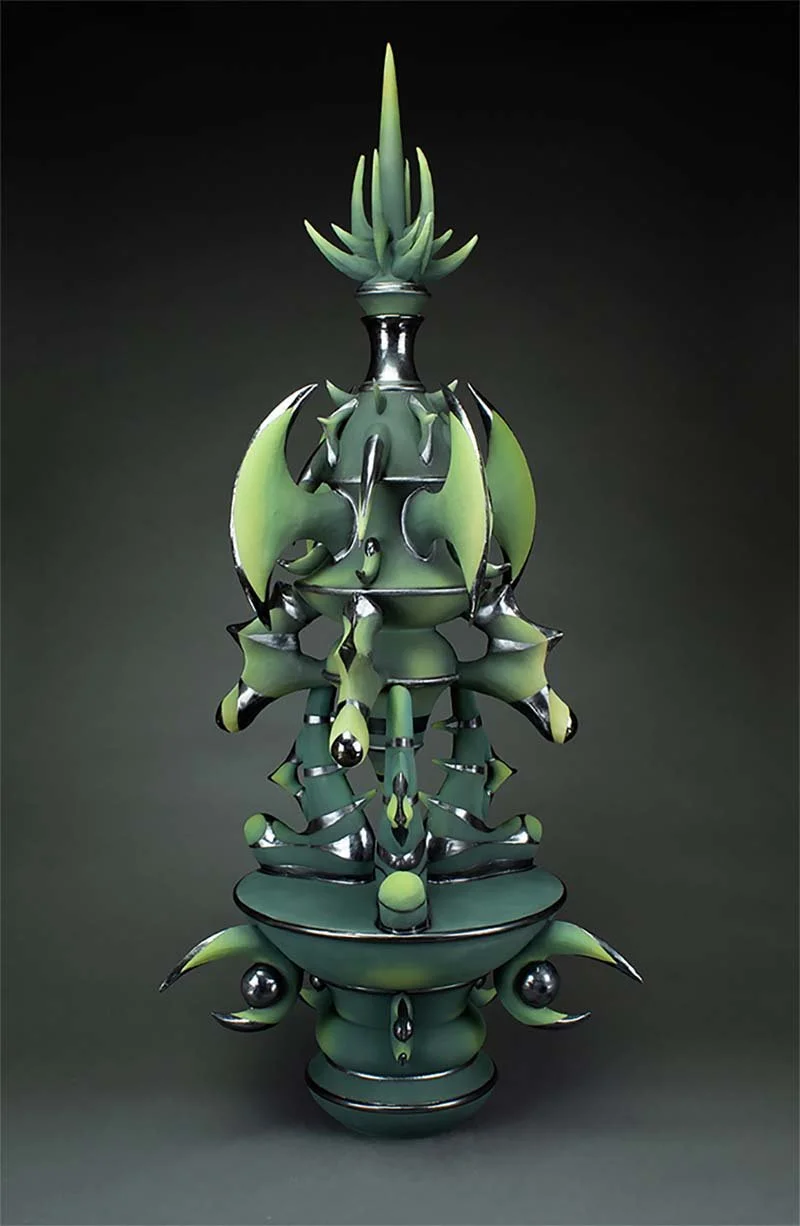
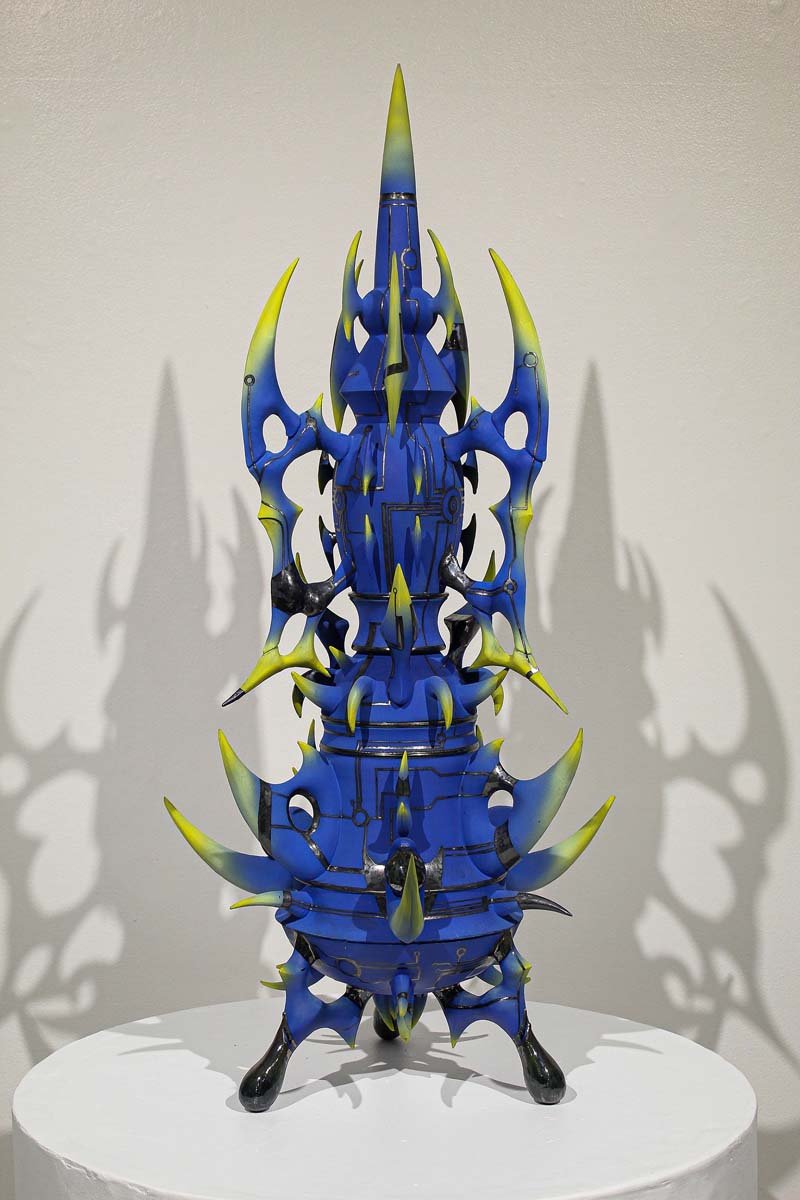
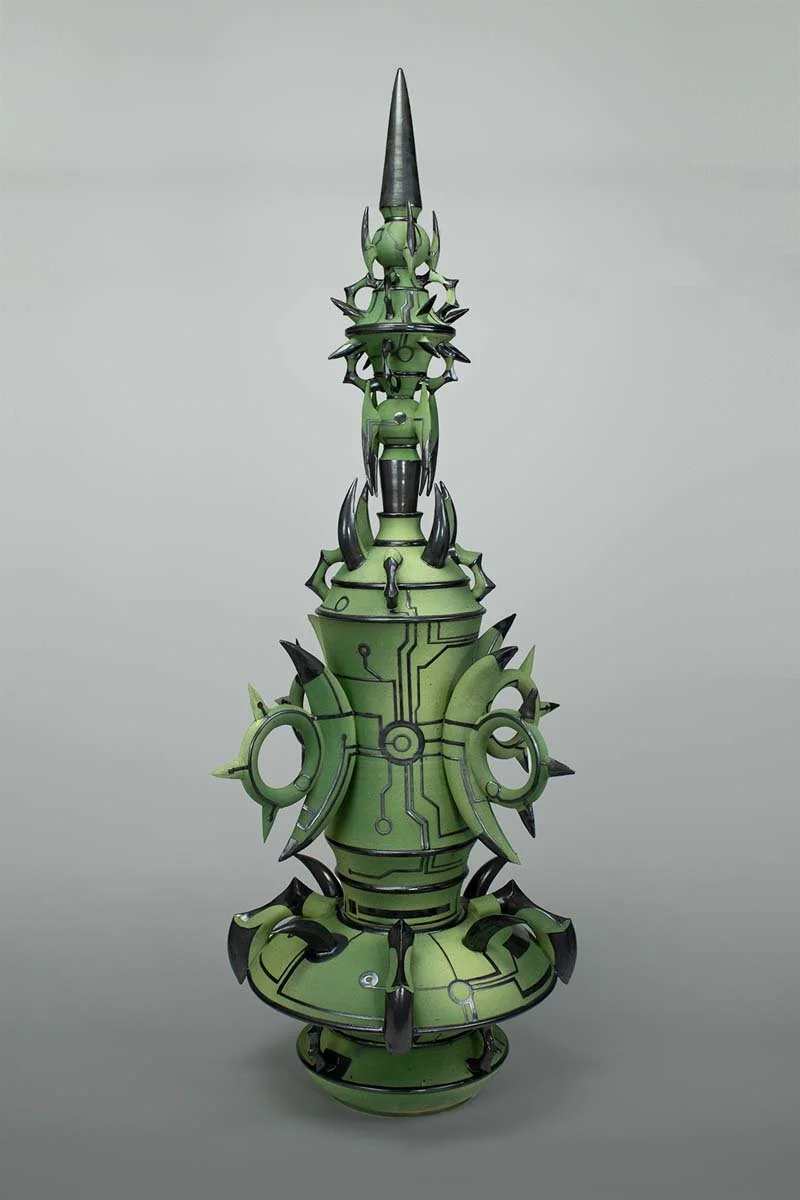
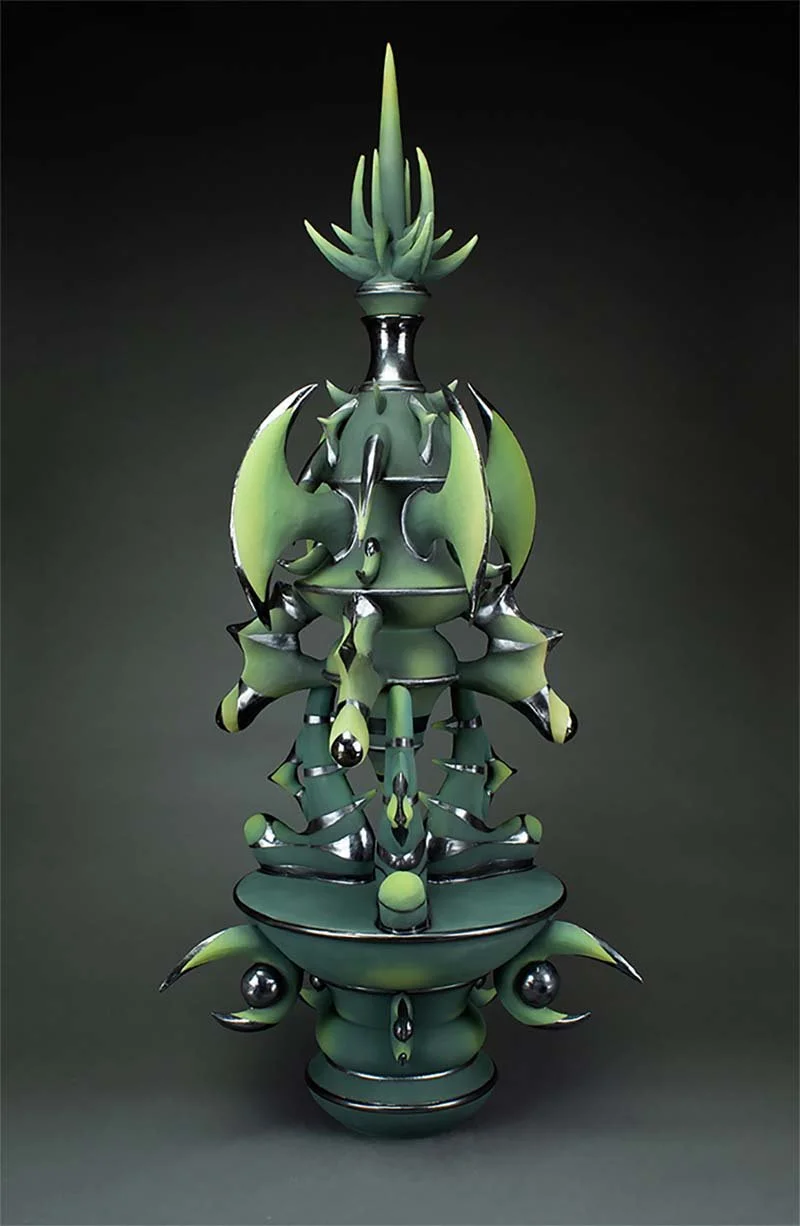
Right now, I’m continuing to expand on the ideas that shaped my MFA thesis exhibition—thinking about my ceramic sculptures as objects of power and desire. I’m interested in how ornamentation and fetishism—through fashion, allure, and supernatural themes—intersect with the body, technology, and speculative futures. My current projects push further into hybrid forms that blur the boundaries between beauty and aggression, nature and technology, and the sacred and the fetishized.
Some of the work grows out of vessel traditions—Greek, Rococo, and architectural references (particularly in how I construct the silhouette of the main body before attaching handbuilt sculptural elements)—but I mutate them into aggressively ornamented, weapon-like structures. Their faceted, insectile qualities make them feel both protective and seductive. I’m especially focused on glaze as a kind of skin or armor, a surface that transforms the object into something otherworldly. Those transformations, to me, echo how identity and queerness can be performed, adorned, or even weaponized through fashion.
Thematically, I’m still circling questions of power, protection, and desire. I’m exploring fetishism in multiple senses: the aura of sacred objects, the way surfaces and ornamentation can be fetishized to create allure, and the erotic charge embedded in certain forms. These threads converge in my studio as I imagine speculative futures where ceramics function not just as vessels, but as artifacts of identity, fantasy, and survival.
What do you hope people feel when they experience your art? What are you trying to express?
I don’t think my work is about providing answers just yet. Instead, I want people to ask questions—about what they’re seeing and what kind of world these objects might come from. Are they remnants of another dimension, another time period, or a post-human future? That ambiguity is intentional, because I want the viewer to imagine and construct their own narratives.
At the same time, I want people to build a relationship with the pieces themselves. The work is designed to pull viewers in through intricate, fetishized, or technological motifs, while also pushing them back with aggressive, even offensive, spikes and surfaces. That tension—wanting to get close but also being held at a distance—creates an embodied experience of desire, danger, and curiosity. It’s in that space of attraction and repulsion that the work comes alive.
I am deeply tied to the work because I want viewers not only to experience it physically, but also to read into its inspirations and meaning. Queerness and the fluidity of form—just like the fluidity of identity—are central to my practice. I want people to recognize these inspirations and then return to the work with new understanding, seeing how it transforms from unfamiliar to familiar, and back again.
Which artists, past or present, would you like to meet? And why?
If I could meet any artists, I’d want to meet the makers from ancient cultures whose work has survived but whose voices have been lost—like Egyptian or Hindu traditions, or really any culture where so much meaning has been erased, destroyed, or mistranslated over time. I’d want to ask them directly what their objects were for, what their gods meant to them, and how they understood the purpose of what they were making.
So much of what we know now is filtered through outside interpretations, often by groups that didn’t share or value those beliefs. I’d love to hear the real intentions behind those works without that distortion. For me, it’s less about meeting a single “famous” artist and more about reconnecting with the original makers who used art to express ancient narratives, power, spirituality, and survival. For example, what were the pyramids actually built for (beyond the recent discoveries of their construction methods), and how were they made? How did people in ancient India carve entire temples out of stone, and how were such meticulous plans carried across generations? Those are the kinds of questions I’d want answered straight from the source, not just through research.
Do you draw inspiration from music, art, or other disciplines?
I draw inspiration from a wide range of sources—animation, visual storytelling, music, speculative fiction, and fashion—all of which shape how I think about and make my work. Sci-fi and dystopian narratives like the Alien franchise and the biomechanical worlds of H.R. Giger inform my interest in blending organic and synthetic forms, while examples like Mortal Kombat or the art produced by Moebius influence how I approach ornamentation, scale, and immersive world-building. The animated series Castlevania and Castlevania: Nocturne shaped my understanding of power, desire, and transformation: weapons like Trevor Belmont’s morning star and Isaac’s forge master blade carry symbolic weight, and Erzsebet Bathory’s sharp, ornate fashion demonstrates how elegance, aggression, and otherworldly design can coexist. Similarly, Scavengers Reign inspired me to explore hybridity and post-humanism, creating forms that feel alive, unpredictable, and transformative.
Fetishism and the power of objects are central to the concept of my work. Objects—whether high heels, corsets, or my ceramic pieces—connect us to desire, identity, and control. They can empower, captivate, or provoke, shaping how the body is perceived and experienced. Fashion, erotic symbolism, and the textures of materials (or glazes) influence how I sculpt, giving my pieces a sense of allure, transformation, and presence. Like luxury objects and sacred relics, my work carries a sense of life, power, and otherworldly significance.
Music is another major part of my process. Driving, atmospheric electronic music—from German techno to cinematic scores like the Annihilation soundtrack or the work of French electronic musician Danger—helps me world-build in my head. Synthwave, electro house, Witch House, and other layered electronic styles shape how I imagine forms, details, and glazes, giving my work cinematic energy and a sense of dynamic presence.
All of these influences—animation, speculative fiction, fashion, and music—feed into my ongoing exploration of transformation, hybridity, and power, allowing me to create my work.
A great thing about living in my city/town is…
A great thing about living in Baltimore as a ceramic artist pursuing the work I do is the city’s energy and creative community. There’s a spirit of experimentation and risk-taking here that encourages pushing boundaries. I’m also new to the city, and its location is ideal—Philadelphia, D.C., and New York City are all nearby, making it easy to expand my network, attend exhibitions, and connect with galleries and collectors. Being in this region allows me to grow my career and take opportunities for showing work to the next level, while still being part of a city with its own experimental arts scene.
Can you describe a project that challenged you creatively or emotionally—and how you worked through it?
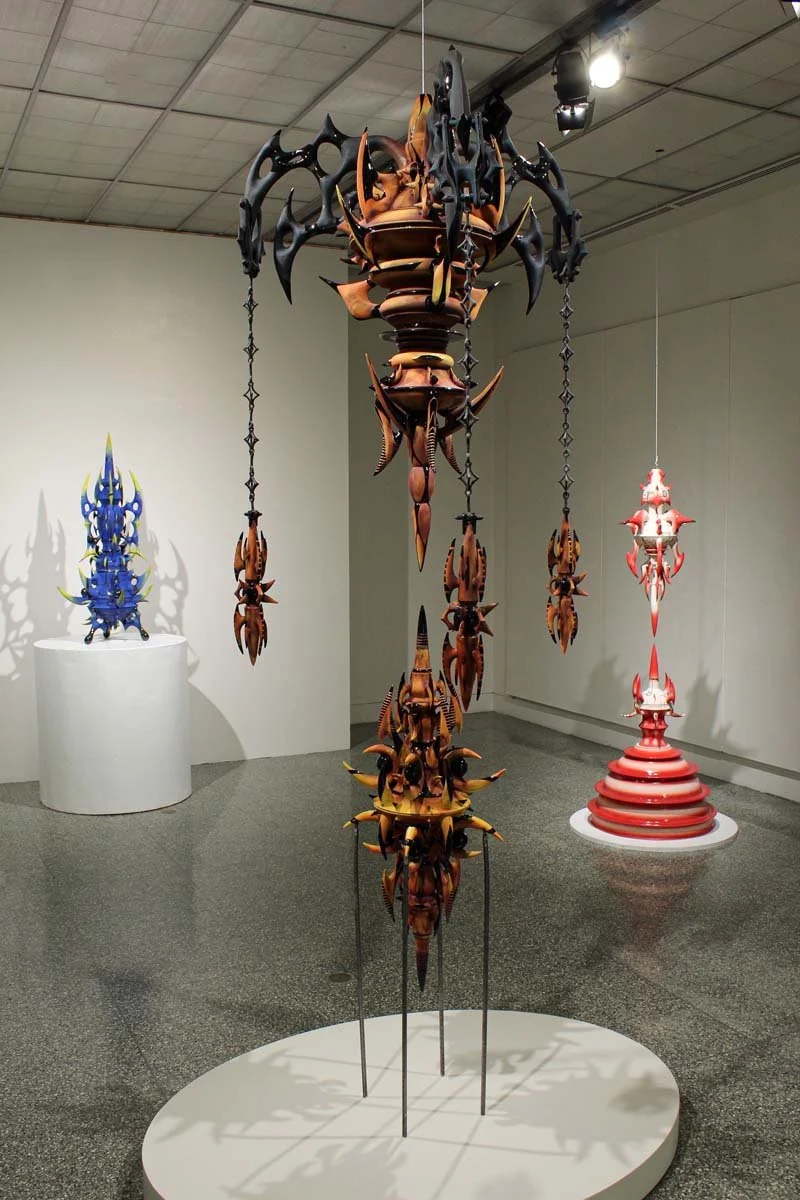
One of the most complex pieces I had ever attempted to make and successfully exicuted was the centerpiece to my thesis show titled Grand Descension. I was conflicted because the ceramic material is very unforgivable and pulling this off was possible but extremely ambitions. This is a little difficult to describe without showing more images of this piece but you can find it on my Instagram (@FKABRADY). The “wings” as I call them, come off of the top shoulder of the piece and are profiled to fit right against it.
When constructing these pieces, My process is very technical. there’s a lot of planning involved—not just in how they’re built, but also in how they can be shipped and installed for exhibitions. For example, if I permanently attached the wings to the shoulders of the piece, the crate would have to be extremely large and nearly impossible to transport. To solve this, I designed the wings to be modular. For each wing there were three vertically aligned clay attachments on each side, meaning that with three wings total, there are eighteen attachment points. To secure the wings once placed in between these attachments, I drilled three horizontal holes in each wing and one horizontal hole for every attachment so a ceramic peg could slot between the attachments and through the wing to be held in place.
Because I don’t settle for less when it comes to craftsmanship—and since clay is unforgiving when it comes to fit or alignment—I had to carefully manage the kiln firings. The wings, which are three-dimensional with varying depths, had to be supported on stilts while firing sideways to prevent warping. They needed to remain completely flat so the pegs would slide in perfectly, leaving no gaps between the wings and the main body. I also had to build them hollow to structurally support the weight of the other attachments that would eventually hang from them.
The main body of the piece had its own challenges. It had to be fired in two sections and bonded afterwards. First, because it ends in a point, it couldn’t be fired as one whole form. Second, I needed access to the interior to install the hanging mechanism, which required leaving the piece open until both sections could be rejoined. After installing the hanging mechanism inside and bonding the two sections, I had to create something to safely hold the piece when it wasn’t suspended, I used “Rhino”(3D modeling program) to design a cradle made of 7 interlocking wood forms that would support it. Once the hanging mechanism was in place, I set the bottom section into the cradle, leaving enough clearance for the point to not touch the ground, and then cement epoxied the two halves together into a single structure.
When all the parts are disassembled, for transport, I also CNC-routed 2-inch-thick Styrofoam in the exact profile of each wing. This ensured that I could pack and move the wings securely without risking breakage, especially since I plan to exhibit the piece again in the future. And this was just for the top of the installation piece.
The bottom part of this installation piece was a vertical double-sided spiked form held up by a welded fixture perfectly aligned with the point of hanging piece. This added another layer of complexity. Because of the spikes projecting from every angle, the piece couldn’t rest flat on any surface when being bonded together. To work around this, I welded a custom fixture: a steel ring that touches the ground with four tall legs ending in U-shaped brackets. This allowed me to place the first half of the spiked form upside down into the fixture. However, since the clay additions weren’t perfectly symmetrical or level, I had to repeatedly take the piece in and out, grinding and adjusting the welded structure until everything sat evenly and aligned vertically from all sides. Once it was as precise as possible, I epoxied it in place and bonded it to the top section while it rested in the display cradle.
All of this was before tackling the complexities of glazing.
Tell us about important teachers/mentors/collaborators in your life.
I’ve been fortunate to have incredible mentors who have shaped me as both an artist and a person. My first teacher was Angie Platt, my high school ceramics teacher in Fort Wayne, Indiana. She’s the reason I fell in love with clay. Angie supported me through every step of my early journey, constantly pushing me to grow as an artist and encouraging me to enter the Scholastic Art and Writing Awards. Her influence was crucial to the foundation of my career, and without her guidance, I don’t think I would have pursued ceramics the way I have.
In undergrad, Seth Green became one of the most influential professors I’ve ever had. Seth taught me what true craftsmanship looks like—he held himself and his work to a flawless standard, and if something wasn’t right, he would fix it rather than settle for less. He treated clay not just as material, but as a way to capture transcendence—objects that elevate and feel sacred. Watching how he approached his practice, balancing precision with the unpredictability of fire, taught me how to embrace both control and chance in my own work. His example shaped how I think about being in the studio, but also how I want to show up for others as an artist in the community. Beyond his own practice, he was selfless with his knowledge, always advocating for community and showing up for his students—even at three in the morning—because he truly cared. Not every artist is meant to be a teacher, but Seth gives back what he’s learned, and he showed me the importance of holding myself and my work to the highest standards while also investing in others.
Virgil Ortiz has inspired me in an entirely different way. He taught me that ceramics can be the center of a practice, but it doesn’t have to be its limit—you can expand into anything if you put your mind to it. He flew me out to New Mexico, shared where he was from, and introduced me to his art and community. His practice made me realize that ceramics isn’t confined to a close-knit circle, but exists within a much larger art world. Virgil also gave me a mindset shift: to never say “I hope,” but instead “I will.” He taught me that manifesting requires being specific and determined about what you want. That perspective pushed me to dream bigger, to clarify my intentions, and to pursue my career with conviction.
During graduate school, I had the privilege of learning from Malcolm Mobutu Smith, Chase Gamblin, Teresa Larrabee, and Tim Mather. Each of them guided me through the transition into life as a ceramic artist, teaching me not just about clay, but about how to approach challenges and think critically as an artist. They offered me endless ways to solve problems with the material, pushing me to take risks, refine my ideas, and build confidence in my own voice. Their mentorship helped me grow into the artist I am now, balancing technical skill with conceptual depth.
Together, these mentors taught me passion, discipline, community, and the importance of believing in myself. Each of them has left a lasting imprint on how I work, how I teach, and how I see what’s possible.
Sustainability in the art world is an important issue. Can you share a memory or reflection about the beauty and wonder of the natural world? Does being in nature inspire your art or your process?
Sustainability in the art world is something I think about through the lens of growth, decay, and regeneration—cycles that constantly occur in the natural world. I’ve always been fascinated by the intricacy of plants and insects and how they evolve with resilience. The way a plant twists around a structure, the exotic forms of carnivorous plants and the defense mechanisms of other plants, or an insect’s exoskeleton, which both protects and adorns it, directly informs how I build the attachments or shapes of my forms. In nature, I notice the details—the shapes, thorns, ridges, colors such as the iridescence of a beetle’s wing, or the structures I examine—and these intricate elements often become starting points for my work. They remind me that beauty often comes from adaptation and survival. In the studio, I translate these observations into ornamentation, structure, and surface treatment, creating pieces that feel alive. It’s not simply “being” in nature that inspires my practice, but observing and mimicking the design strategies that nature has developed.
AI is changing everything - the way we see the world, creativity, art, our ideas of beauty and the way we communicate with each other and our imaginations. What are your reflections about AI and technology? What is the importance of human art and handmade creative works over industrialized creative practices?
AI is changing everything—it’s shifting the way we see the world, how we create, and even how we define beauty. I find it exciting yet horrifying. On one hand, AI opens doors to ideas and possibilities I could never have imagined on my own; it pushes the boundaries of creativity and lets us experiment at incredible speed yet part of it feels not genuine. But I also think that AI and technology should be tools to inform or help, not replace the human element. When it’s used to generate art without human input, it becomes a problem—especially in today’s art climate. People sometimes treat it as an end-all solution rather than a tool, and that can overshadow the value of handmade work.
The importance of what I do is that AI cannot replicate it. It can try, but it will never be me or have the three-dimensional finesse of my touch and the way I use clay. Process is huge to me—if there were a way to create what I make digitally or mechanically, it wouldn’t capture the tactile sense of throwing clay on the wheel, stacking and assembling, and making decisions throughout the process to complete my work. As of now, it’s impossible, and even if it were possible in the future, it wouldn’t be within my lifetime.
Handmade art is precious because once it’s commercially manufactured, the personal connection the artist has with it is diminished. The message may remain, but the craft and intimacy vanish. It becomes less about human presence and more about mass production and profit. That’s why human art, the tangible, tactile, intentional work we create with our own hands, remains irreplaceable. It carries a depth, a story, and a presence that AI can never fully replicate.
Exploring ideas, art and the creative process connects me to…
my own imagination, to the world around me, and to the shared human experience of making and expressing something that carries intention, emotion, and presence. This exploration is what shapes our individuality, and the deeper we go, the more we can share with the world—offering diverse perspectives that have the power to inspire change and make the world a better, more connected and community driven place.