

How can art represent time in a static image?
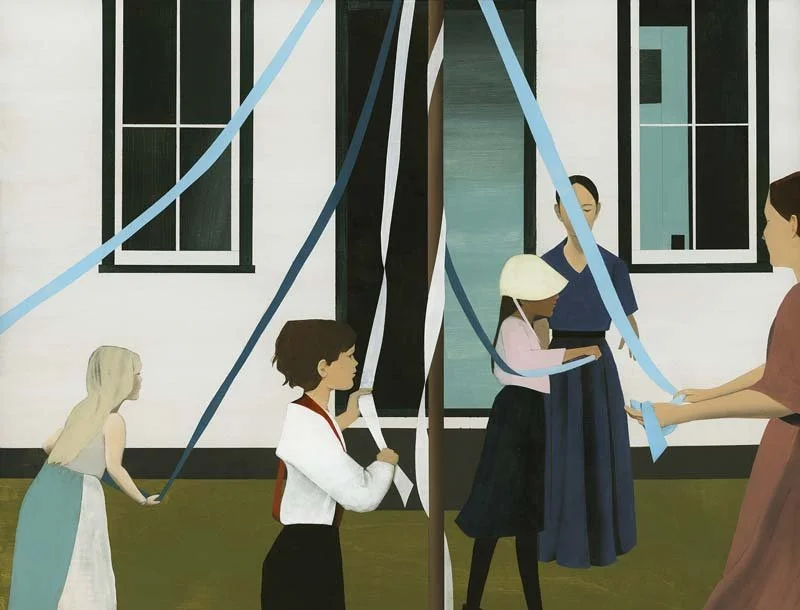
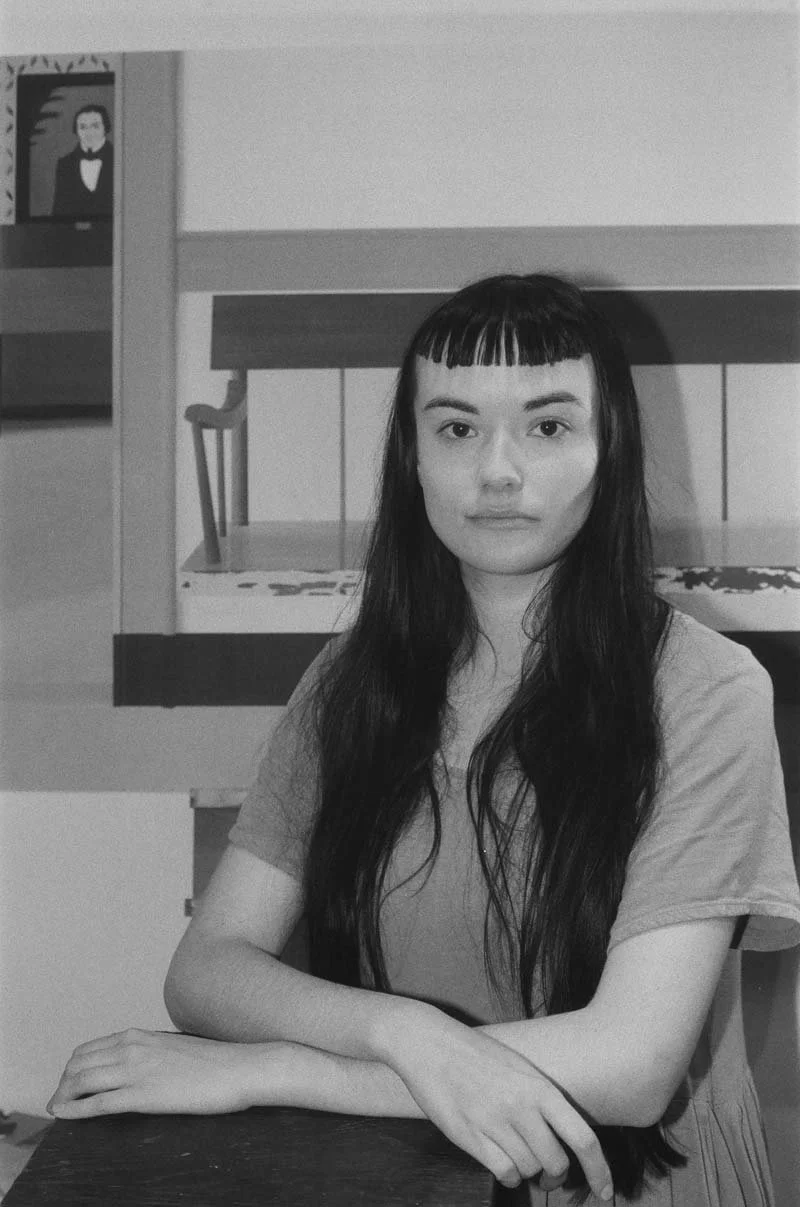
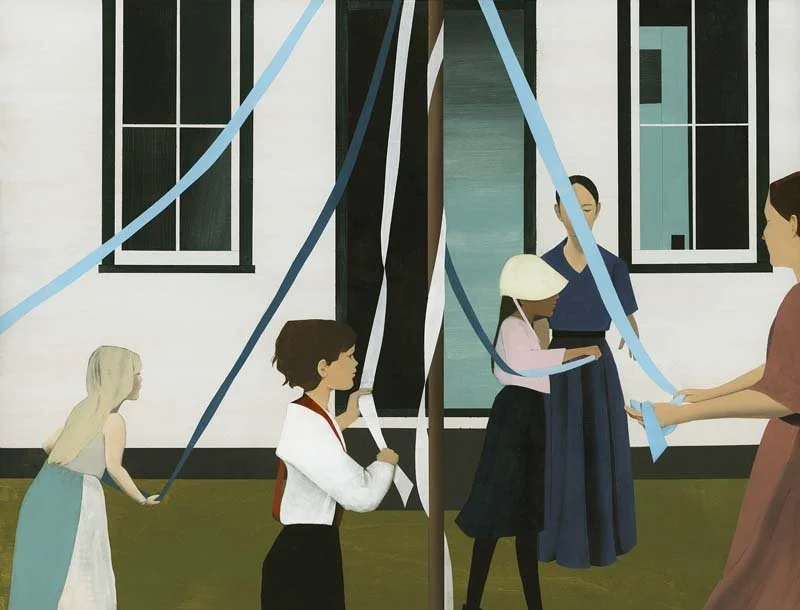
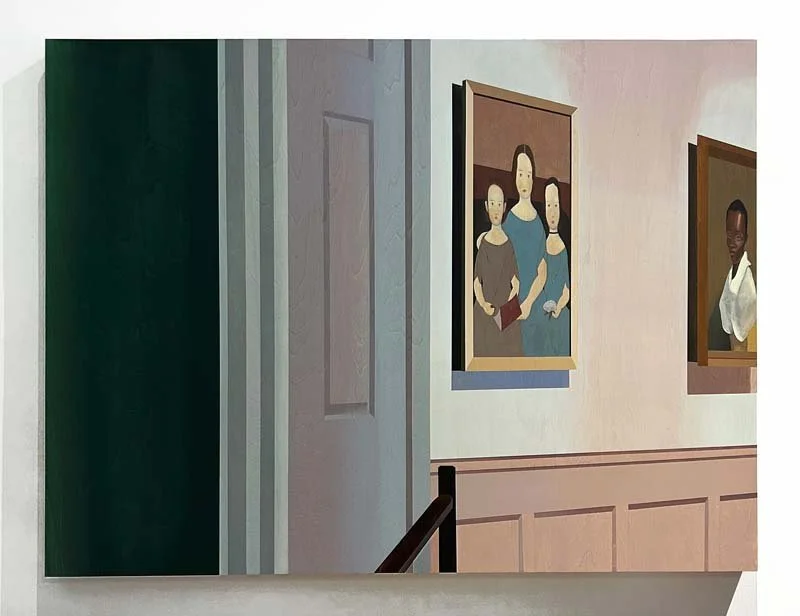
Emily Pettigrew is a representational painter, whose work is distinguished by sparseness, subtlety, and timelessness. Emily Pettigrew’s pictures emanate a quiet reverence for both history and nature. Pettigrew’s narrative paintings, which depict lone or small groups of figures, landscapes, and American architecture, had their inception in her formative years in Maine. Pettigrew explains: “My love for the starkness of the landscape of my childhood is reflected in a spartanism in my work. My foundational principle of painting, is the removal of excess parts—a paring down to an image’s most beautiful elements.” Currently based in the Catskill Mountains, Pettigrew’s subject matter has become increasingly imbued with the regional history of the area and points to themes of the ‘growing block universe’ and the almost tangible presence of past time. There is a magical strangeness scintillating through the clean lines and simple houses of Pettigrew’s world - the indication of something eldritch that rural sternness and 90-degree angles couldn’t fully repress. @_emilypettigrew_
Where were you born and raised? How did it influence your art and your thinking about the world?
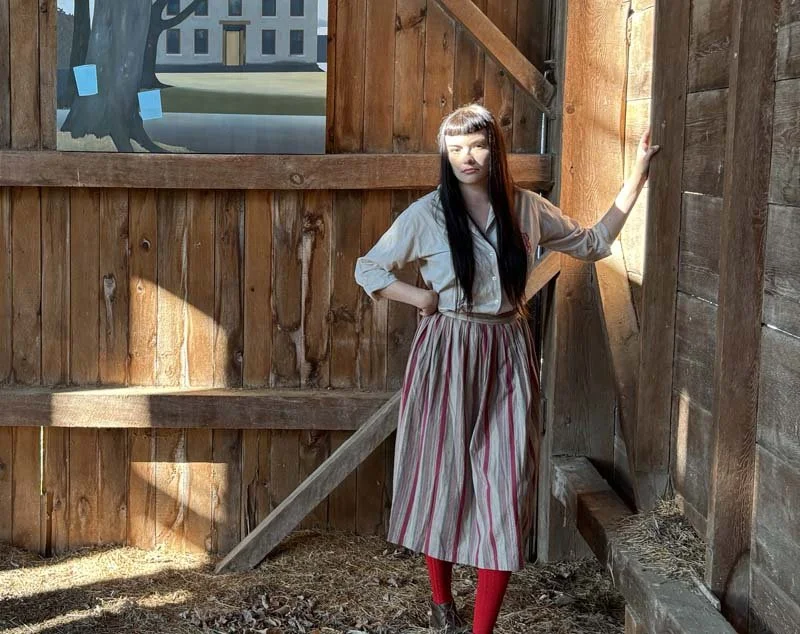
I was born in York, Maine, and raised on the coast in Blue Hill, Maine. The spare and lean visual quality of Maine, both in its architecture and land, has prompted many painters to create; people like Andrew Wyeth, Will Barnet, Alex Katz, Lois Dodd, Neil Weillver...
What influence did your family have on your decision to pursue art?
I can't remember a time when I didn't know I would be an artist. It wasn't a question for me. My mother is a painter, and my father is an oceanographer, and I can recall at one point having a vague idea that all women were artists and men did other jobs. For me, art is an attempt at correcting the outside world to match my inner world and recording moments and places when those two do serendipitously align without my intervention at all. Finding these places and moments are really the most joyful points in my life.
What does your typical day in the studio look like? Walk us through your studio and your most-used materials and tools.
I attempt to work for six hours a day in the studio with the expectation that I will rarely be able to meet that goal because of my health issues. I have daily pain from a connective tissue disorder, and have had to learn over the years to accept that limitation, which first began interfering with my work around age 26. Sitting for long periods exacerbates the issue, so I do all of my work standing up. I use an easel to allow me to adjust the painting so that I am not stooping down and can work at eye level. The tools I use are straightforward. I work in acrylic on wood and begin the process with a graphite preparatory drawing. I work from photographs I have taken and display the reference on my phone screen because I like that some noise and detail of the real world gets lost at that small size.
Are you exploring any specific themes or concepts in your latest work?
I just finished up a group of works for a show I'm doing with one other painter and a sculptor called "American Grain." The show was conceptualized and curated by Madeleine Bialke for Huxley Parlour Gallery in London. The theme works well for me as a continuation of my depictions of historical American architecture and the visual of wood grain that I often leave showing through the paint in my work.
What do you hope people feel when they experience your art? What are you trying to express?
I hope they are initially struck a sense of order and peacefulness but one which is also subtly charged with underlying unnamed sense of unease. Most of all I hope someone is looking and saying to themselves 'wow, how exciting that there's someone else who sees like I do’
Which artists, past or present, would you like to meet? And why?
I wish I could have met my favorite painter, Will Barnet. I have visited his grave. I would like to meet Alex Katz. I have attended a party he was at but didn’t work up the courage to approach him.
Do you draw inspiration from music, art, or other disciplines?
Definitely. I’m very excited by folk traditions, particularly ones I have an ancestral connection to and I’m fascinated by archeology, especially of the British Isles. I also find listening to music while I paint really helps me keep my energy up. I mostly listen to Folk music, from the old traditional Childe Ballads, to the 70s revival bands like Steeleye Span, and current Folk singers like Radie Peat and John Francis Flynn. I’ve also listened to a lot of Bollywood music since I was a teenager. Recently I've been going most often to Ila Arun.
A great thing about living in the Catskills is…
I love the land where I live here in the Catskills. This was dairy country and there's a.lot of pasture land, some still with cows, some without. There are mountains, rivers, and waterfalls, some of which are directly outside my door. I feel a strong connection to the land here and it's very easy to observe and participate in the turning of the seasons. Harvest still means something here and asserts itself on your consciousness with its timeliness where as in a city or suburb it has only the vaguest of echoes in seasonally flavored coffees.
Can you describe a project that challenged you creatively or emotionally—and how you worked through it?
To paint something you have to figure out how to translate it into your visual language and I like to work out how to paint something new in every piece I do.
Tell us about important teachers/mentors/collaborators in your life.
My mother was my first artistic influence. I would sit next to her in her studio and make my own images of animals or faeries as she worked on landscape paintings of Maine. She also had many art books around that I loved to look at. A few of my favorites as a child had the images of Illustrators like Kay Nielsen, Brian Froud, and Alphonse Mucha. My favorite painting as a child though was always "Christina's World" by Andrew Wyeth. The teacher I was most thankful for is Tim O'Brien (the illustrator not the author). I was Tim's student at Pratt Institute in NYC and the most important thing he gave me was just to believe in me and trust my own vision of what I wanted. I am also very thankful to my partner, Ryan Steadman, who is a fellow painter, art writer, and curator, and who, at the beginning of my career helped me to navigate the nuances of the art world in which he was much more seasoned than I was.
Sustainability in the art world is an important issue. Can you share a memory or reflection about the beauty and wonder of the natural world? Does being in nature inspire your art or your process?
My work often deals with the density of time. I search out places where the depth of human interaction with the land can be felt and seen and, though I am interacting with these places in my modern life, create a sense of disorientation of past and present. I find these places to be like portals or areas where the veil thins to a larger understanding of the vastness of geological time and the minuteness of the scale of an individual’s reference. When looking at time from this wider perspective, how much more substantial a river is than a cooperate headquarters becomes vividly clear. I feel very strongly that in our modern emphasis on the efficient and disposable we have become so disconnected from what is real and enduring that we don’t notice the grossly corrosive power of our wastefulness.
AI is changing everything - the way we see the world, creativity, art, our ideas of beauty and the way we communicate with each other and our imaginations. What are your reflections about AI and technology? What is the importance of human art and handmade creative works over industrialized creative practices?
To build on that last answer, I think AI is stupid, destructive, and massively wasteful. But I am also perhaps naively optimistic that it will go away because at the point we are at now, AI cannot create anything that compares in quality to a good writer or painter.
Exploring ideas, art, and the creative process connects me to…
a greater whole and the world outside of myself.