

London-based artist Nick Offer on landscapes, light, and darkness.
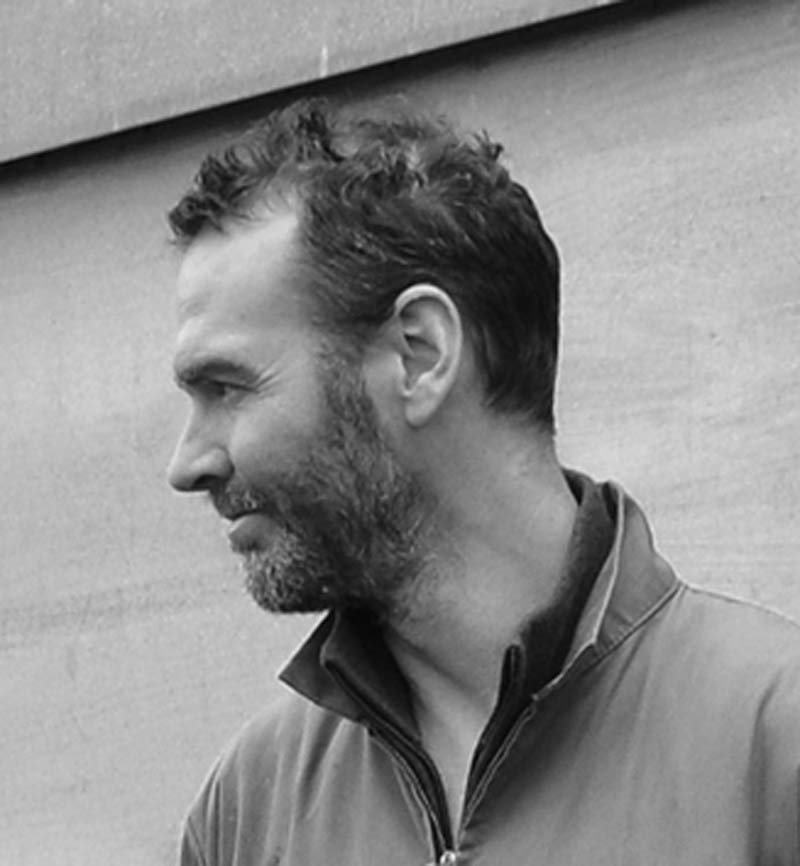
Nick Offer was born in London, studied art in Edinburgh, and lived in Barcelona, Ghent, and London before emigrating to Australia 5 years ago. Prior to his arrival in Canberra, he worked mainly as a chef, as well as stints teaching and as a features writer. Since the move, he has participated in sixteen award shows in Australia – winning one (The Doyles Landscape Award 2024) and being highly commended in several others. He has also had two solo shows (M16 Artspace, Canberra). Prior to that, he exhibited regularly in London (‘Figurative Art Now’ and ‘The Lynn Painter Stainers Award’ at the Mall Galleries, The Battersea Art Fair, other competitions, as well as solo shows at The Bomb Factory and Krilova Stelfox). A recent portrait and landscape are soon to be exhibited (3rd October) at the ‘Figurativas 25’ awards in The European Museum of Modern Art (MEAM) in Barcelona. @nick_offer
Where were you born and raised? How did it influence your art and your thinking about the world?
I was born in London and grew up in the city and its suburbs. Being there at a young age certainly helped nurture an interest in the arts, as museums were accessible. Exhibitions may not have had a huge influence, but seeing them validated the idea of being an artist in one’s mind.
I attended Edinburgh College of Art (BA Painting) and then Winchester School of Art (MA European Fine Art), which actually took place in Barcelona.
Both colleges were located in wonderful cities, which certainly had an influence on my artistic development. Barcelona, in particular, is notably sympathetic towards the arts. I played the drums in several bands and found a community of musically, as well as, artistically inclined people, as a result. The fact that within these communities (which often merged), artistic endeavors were taken seriously was a big influence. It wasn’t the usual case of ‘oh, you’re a painter or a musician, you must be a slacker.’ Though, to be fair, I had my moments.
When did you first fall in love with art and realize you wanted to be an artist? For you, what is the importance of the arts?
Painting was always what I did best and, since I’m a fairly literal sort of person, I just decided at an early age that’s probably what I should do. That view was cemented when I was sixteen and a girl I liked asked me what I would do career-wise. I wanted to impress her, so said, ‘oh I’m going to be a painter.’ I realised after I said it that I actually meant it.
What does your typical day in the studio look like? Walk us through your studio and your most-used materials and tools.
I like to get into the studio early: a few days a week at about 5.30 am, and the rest – due to other commitments - at about 8.30 am.
Going in early assuages the guilt one feels about doing what one wants. It also helps with feelings of inferiority compared to people doing important stuff in suits. And, of course, you get more done. I’d recommend it.
As soon as I enter the studio, I take a breath and look at the painting I am working on. 90% of the time, I know exactly what to do with it in that instant. Fresh eyes. I work quickly and instinctively for half an hour or so. Then make a black coffee and look at what I’ve done.
From there, the rest of the day follows a similar pattern. Work, look, work, look, coffee, work, look, coffee, etc. Sometimes, I listen to music on headphones (most often country or blues). I don’t generally eat lunch since I usually have to leave at 3 pm.
I use all sorts of tools – scrapers, rollers, spray paint, sponges, as well as brushes. I use stencils a lot, which I cut out myself from A3 prints of photos.
What projects are you at work on at the moment? And what themes or ideas are currently driving your work?
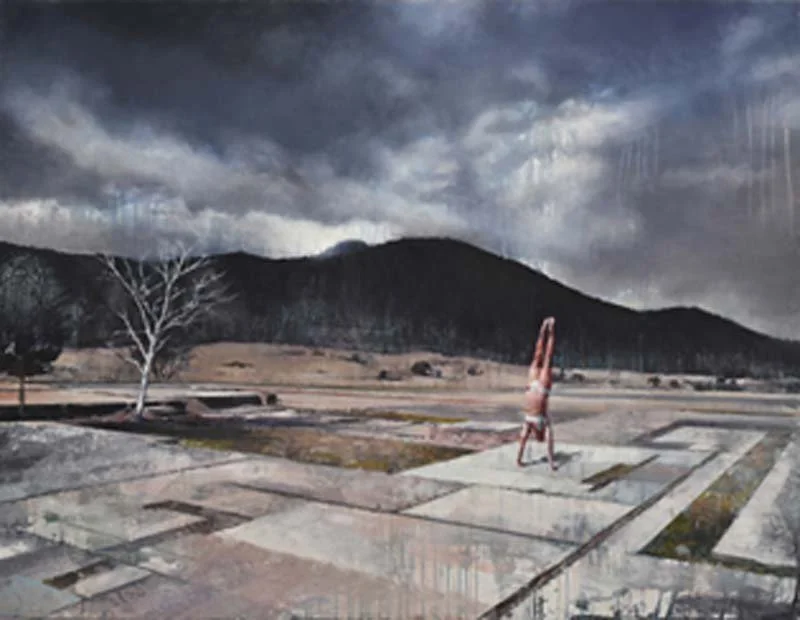
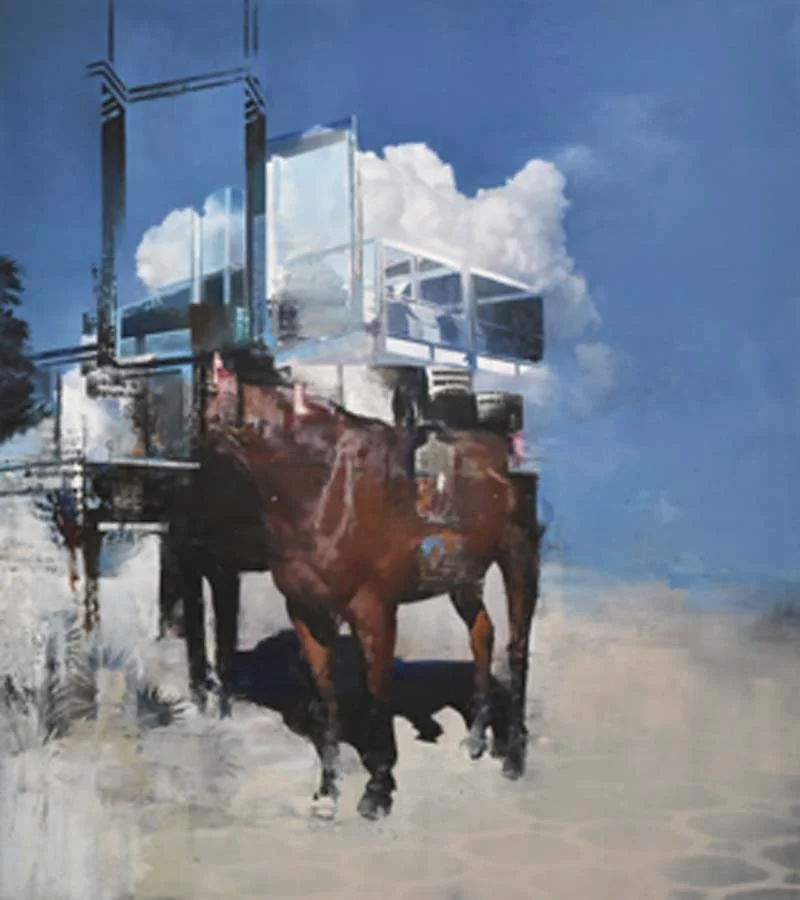
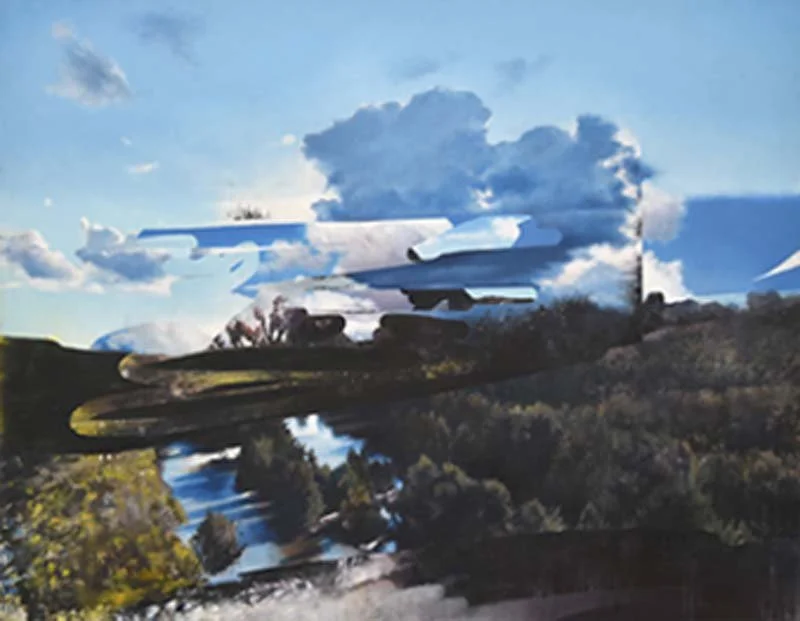
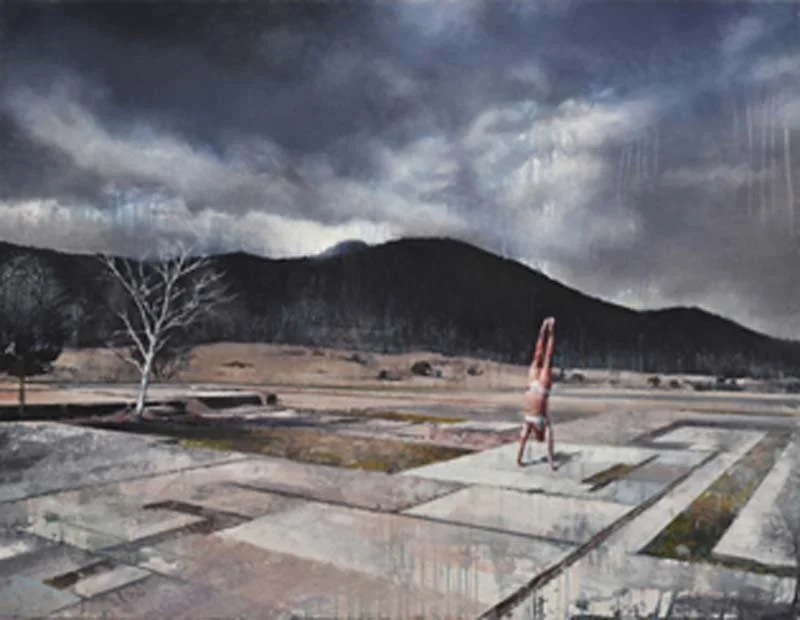
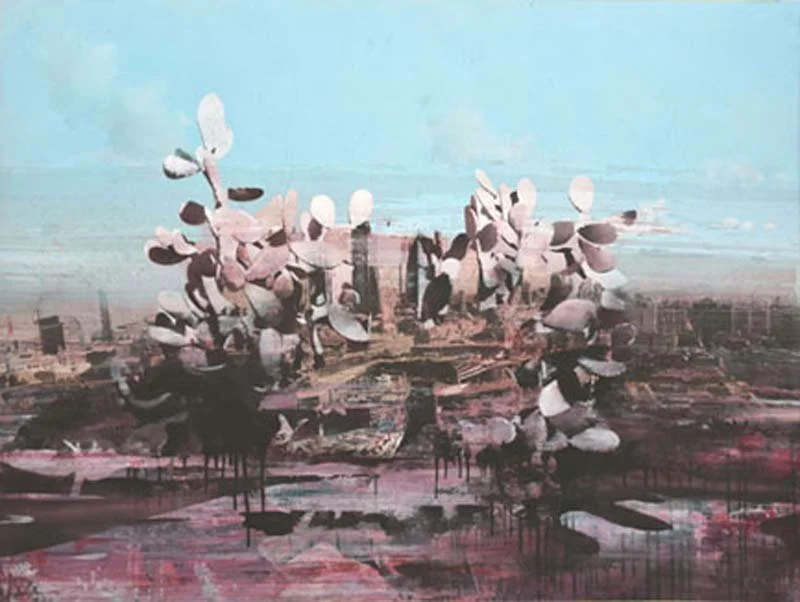
I currently take a 3-pronged approach, all relating to landscapes: firstly, multi-media paintings based on digital collages, which are thematically linked and aim to stretch the medium and genre. Secondly, landscape paintings, which are based on sketches and photos of a scene, which I then try to recreate on a large scale in the studio with a variety of materials (like when a film director sets up in the editing room after he has finished filming). Finally, and less frequently, I paint from life – portraits and exteriors.
The first approach bears the most description. It involves layering, usually established at the preliminary collage stage. As layers are added digitally, I rub parts out to reveal bits of a layer or layers beneath. I have found that this achieves two effects: firstly, the base layer acts as a kind of subconscious – peaking through, sometimes brutally - the realism of the final layer in the same way as one’s subconscious thoughts can intrude on everyday life.
Secondly, layering can mimic a temporal flow. I.e., from the first layer as the oldest to the last layer as the newest. This can be a way of exploring how the history of a place might impose itself on the present.
In both cases, the ‘rubbing out’ has a rhythmic function which links the layers – i.e., it might echo the directional flow of one or other layer (or counteract them). It helps to unify elements of the image. The effect is achieved in the paintings by using stencils that I cut from large printouts.
Other important factors for me in this approach are the fracturing of surface realism, the seeping through of abstract paint, and the containment of the energy of these abstractions within the sharp edges of the stenciled forms.
I work on aluminum composite because it is a very smooth surface, and when primed, make for clean, stenciled images. Also, because it lends itself to vigorous paint application and scraping back.
Finally, I am drawn to polarities within an image. Often, I find the opposing forces of organic and synthetic elements to be stimulating – particularly as this emergence occurs more and more frequently in life. Also elements of light and dark, abstraction and realism, Apollonian and Dionysian (i.e., passive and aggressive – a placid blue sky, for example, combined with a violent streak of black).
What do you hope people feel when they experience your art? What are you trying to express?
I hope that my paintings have an unsettling effect, initially, at least. The subject of the image asserts itself in an original way that doesn’t stoop to pathos or cheap emotional manipulation. That the image might feel inevitable and that the feeling lingers.
Do you draw inspiration from music, art, or other disciplines?
Absolutely, mainly from music. But also to a certain extent from film and literature.
Musically, there are sounds – mostly relating to electric guitar – which I would love to recreate visually. Foremost is the sound that John Martyn achieved with his Echoplex pedal on his early to mid 70s recordings (e.g., ‘Solid Air’). It has a gritty, funky aural quality which evokes in my mind quite a literal visual equivalent.
Also, the sounds that Marc Ribot gets on the early 80’s Tom Waits records (e.g., Rain Dogs). And Ry Cooder’s rhythm and slide playing generally.
Cinematically, I find the combination of violence and melancholy in Sam Peckinpah’s films very moving. Something to aim for in painting. And the frenetic editing in some of Scorsese’s films has an energy which would be wonderful achieve statically as it were.
A great thing about living in my city/town is…
not much happens so I don’t feel guilty about spending most of my time painting.
Tell us about important teachers/mentors/collaborators in your life.
My secondary school art teacher gave me an easel and paints in exchange for a painting when I left. That was a very wise thing to do – empowering and practical.
After that, though, I didn’t have much luck with tutors. Most gabbled on about how truth didn’t exist and other conceptual bullshit, wasting everyone’s time. The tutor on my MA course used to stride in to my studio from time to time, point at a picture and demand in heavily accented German, ‘WHAT IS THIS ABOUT?’ (And then act surprised when I declined to answer such a boorish intrusion).
The only good advice a tutor ever gave me was to wear overalls in the studio. He noticed that I was painting in clean clothes and this was inhibiting me. Sensible.
Sustainability in the art world is an important issue. Can you share a memory or reflection about the beauty and wonder of the natural world? Does being in nature inspire your art or your process?
I paint from life a certain amount and find that the most beautiful aspect of observable nature is often the conjunction of close tones and hues. E.g., the subtle gradation of cool to warm hues on a person’s face or light to dark tones on a tree trunk.
AI is changing everything - the way we see the world, creativity, art, our ideas of beauty and the way we communicate with each other and our imaginations. What are your reflections about AI and technology? What is the importance of human art and handmade creative works over industrialized creative practices?
On the one hand, I see AI as a potentially amazing tool for an artist in the same way as a camera obscura was, or photography, or even photo editing technology. If it can be used as an expedient to help generate new and profound images that communicate very directly with one’s subconscious, then it could be a fantastic enabler.
I fear, though, that humanity will be well shafted by its broader and more sinister applications in a fairly short space of time.
Exploring ideas, art and the creative process connects me to…
ego.