

Can the tedious parts of creation create joy, as well?
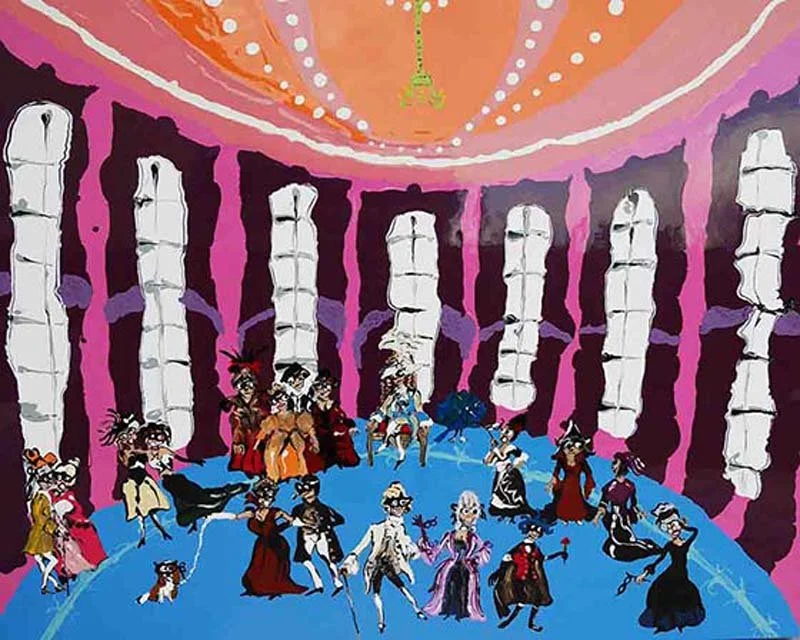
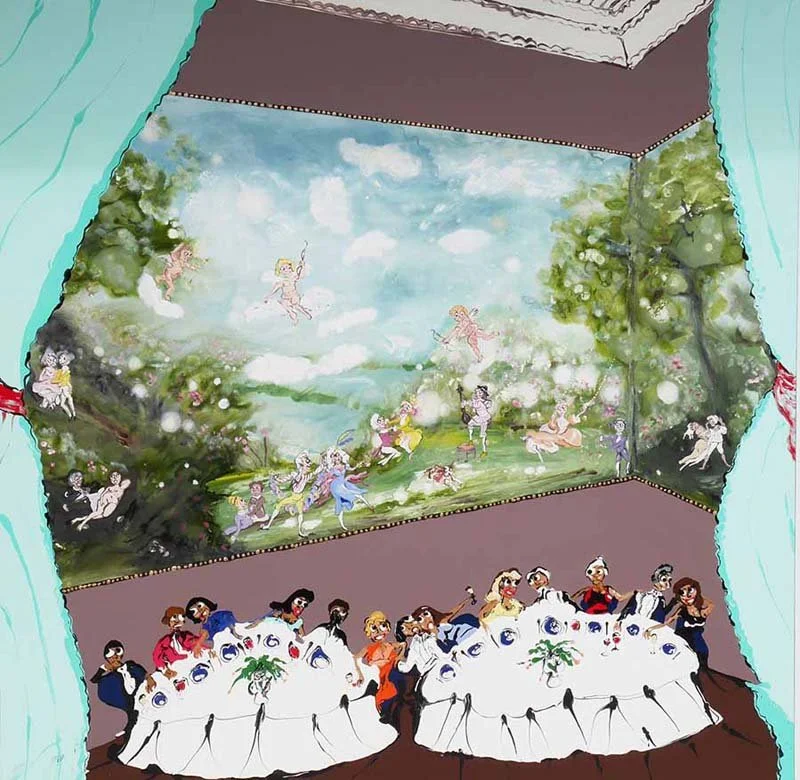
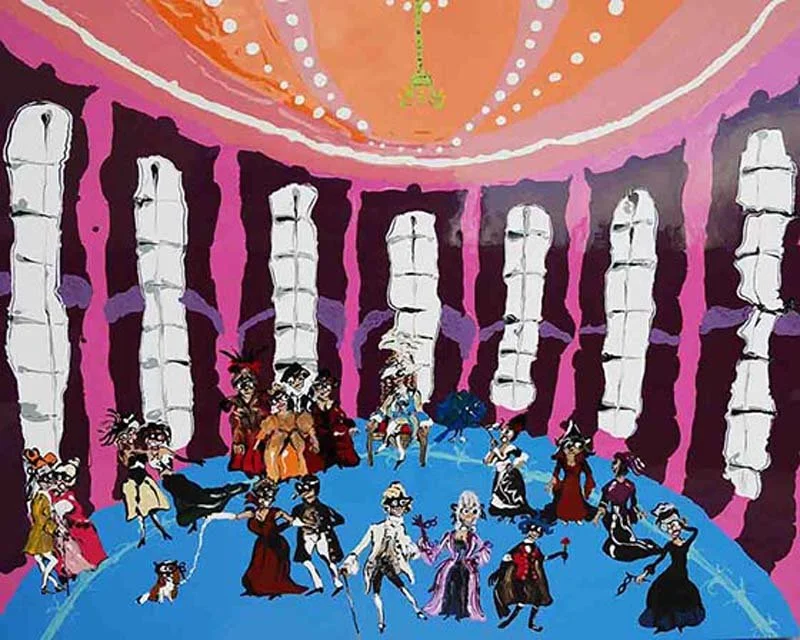
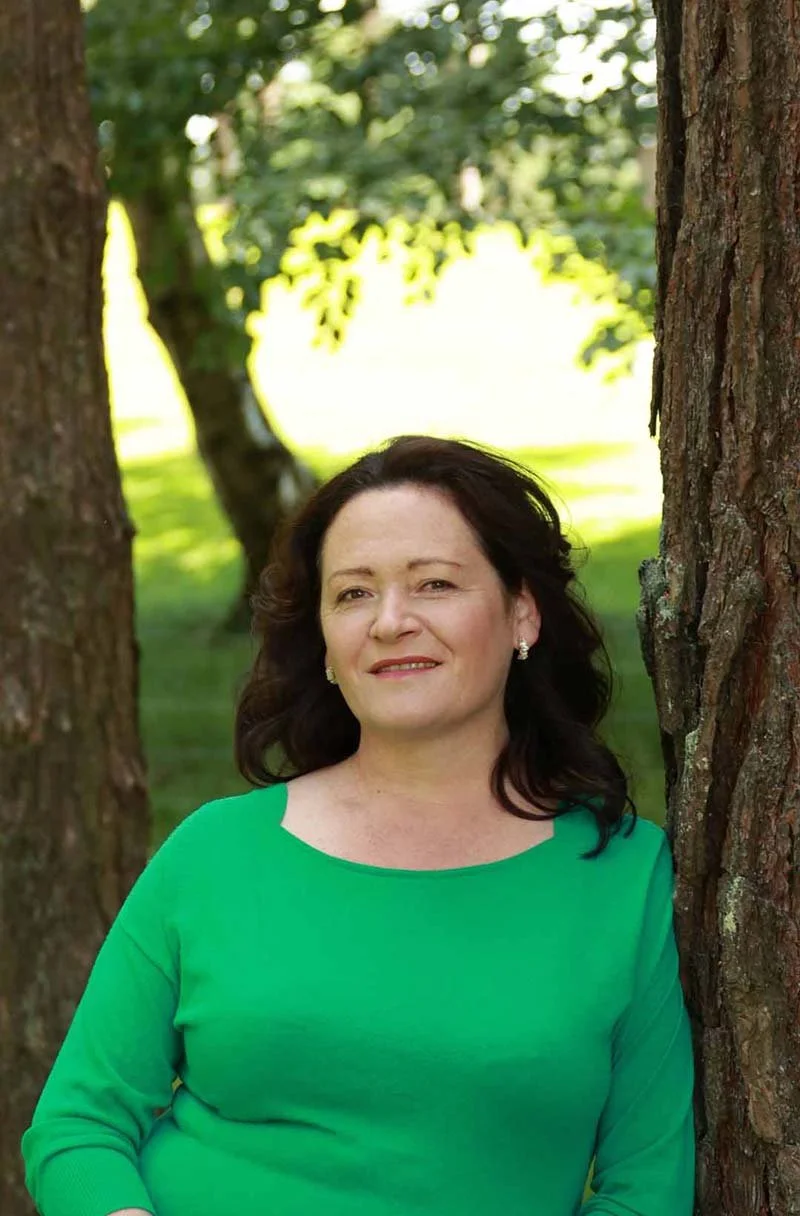
Mary Ronayne is a storyteller at heart. Contemporary Irish artist Mary Ronayne creates vivacious, theatrical paintings that stage scenes of leisure, indulgence, and cultural excess — both past and present. Her works are rich in gooey colour, high-status possessions, and playful absurdity, offering a satirical lens on modern life while disarming viewers with charm and wit.
Ronayne draws inspiration from a broad tapestry of influences: modern society, Renaissance imagery, opera, historical literature, and the glossy world of interior design. Her signature style blends allegory with whimsy, as deflated bodies, melted faces, and questioning glances — especially from her female figures — subtly critique the pleasures and contradictions of consumer culture and social performance.
At the core of her practice is a unique process that bridges digital and traditional methods. She begins by constructing her scenes in Photoshop, assembling disparate characters, props, and environments into complex narratives. These are then translated into bold, large-scale paintings using enamel and domestic paints on wooden panels — a medium that allows for vibrant contrasts between glossy and matte surfaces, and a finish that’s both polished and unpredictable.
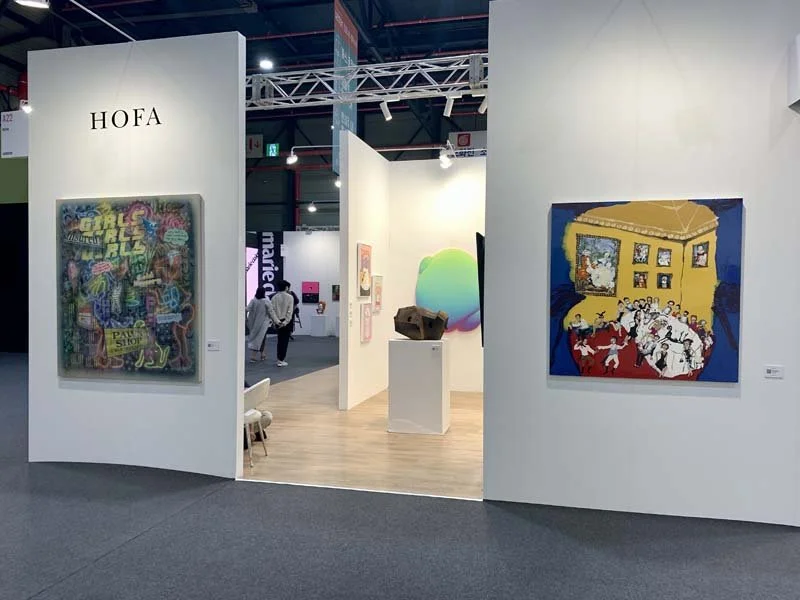
Based in County Kildare, Ireland, Ronayne has exhibited widely. Her solo shows at HOFA Gallery in London have been complemented by international showcases at major art fairs including KIAF, Art Miami, Art Central Hong Kong, Contemporary Istanbul, ART SG Singapore, ZONAMACO Mexico, Art Fair Tokyo, and The Armory Show in New York. Her work has entered private collections worldwide and was featured at Phillips 20th Century & Contemporary Art Day Sale in Hong Kong.
Ronayne studied Fine Art at TU Dublin, History of Art at Cardiff University, and holds an MA in Art in the Contemporary World from NCAD, Dublin. She is currently represented by the HOFA Gallery, London. @maryronayne
How did being born in Ireland influence your art? Did it change how you viewed the world?
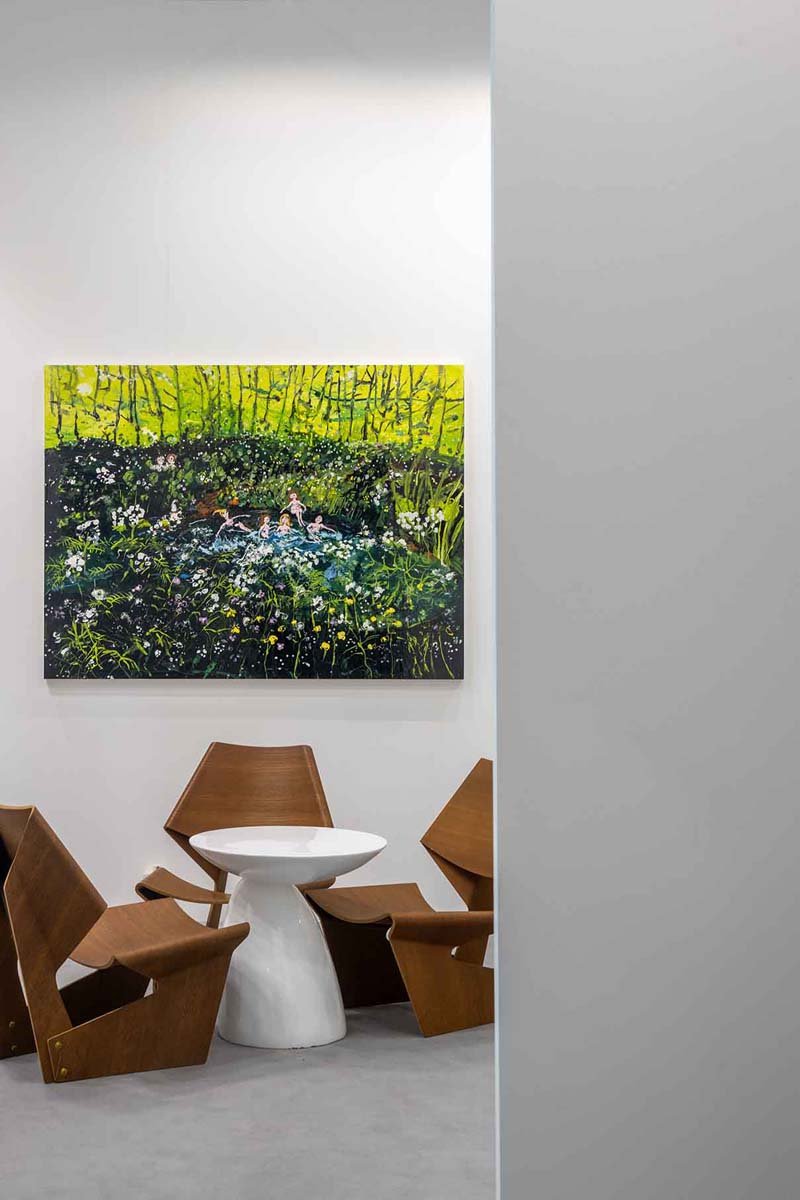
I was born and raised in County Carlow, Ireland, in a large house with a tower — a good place for a child with a vivid imagination. As one of seven children, I often found quiet corners to daydream, draw, and read. The beauty of the surrounding Irish countryside left a deep impression on me, and its colours continue to influence my work today — particularly in recent paintings inspired by Irish rivers, nature, and wildlife.
My work is rooted in Irish culture, but it's also inseparable from the Irish landscape. The luscious, glossy greens of the fields and the flowing blues of the rivers shaped my visual memory of rural Carlow. Now living near the Curragh in County Kildare, I’m still surrounded by vast, uninterrupted landscapes where the sky — whether blue or grey — melt into the green below. Enamel paint, with its rich, glossy texture, has become the ideal medium to capture this vibrant and ever-changing environment.
When did you first fall in love with art and realize you wanted to be an artist? For you, what is the importance of the arts?
I was drawn to the arts from a very young age, even though it wasn’t encouraged at home and I had little access to artistic resources. What I did have was a vivid imagination, nurtured by books from the travelling library, which opened up new worlds to me.
Around the age of eleven, I discovered magazines about artists and their lives, and I had a moment of real clarity — I knew then that this was what I wanted to do with my life. From that point on, I committed myself fully, building a portfolio that led to my acceptance into art school at sixteen.
For me, the arts are essential — they offer a way of seeing, questioning, and making sense of the world. Art allows us to explore beauty, absurdity, joy, pain, and contradiction. It creates space for curiosity and reflection, both personal and collective. It has always been my way of navigating life.
What does your typical day in the studio look like? What are some of your most used materials and tools?
I’m very disciplined and work in my studio Monday to Saturday, either painting, thinking, or sketching out ideas. My studio is located just beside my home, which means I have very few interruptions during my working hours.
The studio itself is about 40 square metres and quite long, with plenty of natural light flooding the space. It might look chaotic to someone else — every surface, especially the tables and floor, is covered in paint splatters — but for me, it’s actually very ordered. I know exactly where everything is.
Because I work primarily with enamel paints, I paint on flat surfaces rather than upright easels, as enamel drips too much when vertical. This can sometimes be tricky, especially when I’m juggling several pieces at once. After I finish a painting, I keep it lying flat for anywhere between 4 to 12 months depending on its size and paint thickness. Enamel paint is deceptive — its surface dries quickly, but it takes months to fully cure. Finished works then dry on shelving units that line my studio walls.
I have shelves stocked with a wide variety of enamel paints from different manufacturers, each with unique properties I exploit for particular effects or finishes. I own hundreds of brushes, but I don’t invest in expensive sable or hog hair brushes because enamel paint is very harsh on brushes and they don’t last long.
My day usually starts with a morning walk, and then I head to the studio around 11 or noon, working through to 7 or 8 in the evening. I especially love working late when the noise and distractions of the day have quieted down — that’s when I feel most focused and creative.
What projects are you at work on at the moment? And what themes or ideas are currently driving your work?
At the moment, I’m deep into a project that’s been sitting with me for years — a series based on an aerial view of overlapping backyards. It’s loosely inspired by Chinese wallpaper motifs, where layers of domestic spaces merge into one another in a dreamlike, almost theatrical way. The composition is like a colour and shape puzzle I’m trying to solve, and at the heart of it all is green — a colour I’m currently obsessed with. When a colour grips me like this, I feel compelled to keep using it until I’ve worked through the fascination.
I’m also pushing myself technically by working on a much larger scale — triptychs and beyond. It’s a challenge I’ve set myself, to see how far I can take my materials and storytelling at this scale.
Another theme that’s emerging in my recent work is the idea of journeys — vast, sweeping, almost biblical or epic in nature. These are not just physical movements, but psychological or emotional voyages as well. I’m interested in how these narratives can unfold across large-format compositions, pulling the viewer through space and story.
What do you hope people feel when they experience your art? What are you trying to express?
First and foremost, I hope people feel a sense of joy when they encounter my work. That’s often the initial invitation — a vibrant palette, playful scenes, and a certain theatricality that draws the viewer in. But beneath that surface, there’s always more.
During my MA in Contemporary Art at NCAD, I was introduced to many exciting new ways of making art — participatory practices, relational aesthetics, public intervention art, and more. These approaches were intellectually and politically engaging, but I often found they lacked something essential for me: the feeling of joy. Joy is too often dismissed in contemporary art as frivolous or lacking critical weight — yet I believe it can be a powerful and valid mode of communication, one that allows for subtle questioning, satire, and emotional truth.
In my work, I use joy and humour as an entry point, a kind of disguise or softener for deeper themes — like desire, excess, social performance, and the quiet absurdities of daily life. I’m a keen observer of people and the things we try to conceal, especially our longings. I like to explore these tensions with a wink — expressing them in ways that are both visually rich and psychologically complex.
Which artists, past or present, would you like to meet? And why?
I’m a keen admirer of many Irish artists, and I recently had the pleasure of meeting Elizabeth Cope — someone whose work has fascinated me since I first encountered it. Her way of working is both immediate and relentless, which gives her paintings a kind of fluidity and urgency that feels very alive. As it turns out, she lives in Shankill Castle, just ten minutes from where I grew up, and I believe the landscape influenced us both in similar ways. I can see echoes of it in her work, and perhaps in mine too.
Another memorable influence was seeing the enamel paintings of Australian artist Sidney Nolan at the Irish Museum of Modern Art in 2012. I was struck by his use of such a commonplace material, and by how his so-called ‘naive’ style was used to explore something as complex and symbolic as the figure of Ned Kelly — a kind of anti-hero woven into the fabric of Australian identity. That use of enamel resonated with me, and continues to inform my own practice.
I also deeply admire the work of Alice Neel, Chantal Joffe, and Marlene Dumas — painters who are unafraid of emotion, imperfection, or ambiguity. Their ability to convey psychological depth through gesture and distortion is something I return to often.
In general, I love being in the company of painters, writers, and thinkers — especially witty writers who can translate their experiences of the world with intelligence and humour. That blend of depth and levity is something I value greatly, both in art and in life.
Do you draw inspiration from music, art, or other disciplines?
Yes — all of the above. I draw inspiration from many disciplines, especially visual art, music, literature, design, and travel. I love visiting exhibitions to see how artists approach and present new ideas. During the lockdown in Ireland, I really missed the stimulation of seeing art in person — I felt starved of colour, texture, and visual energy. Literature, which usually offers some solace, wasn’t enough for me then.
After the lockdown, I travelled to Finland for a month-long artist residency, hoping to reconnect with creative work and a sense of community. But unfortunately, lockdown was just beginning there, and the studios were eerily empty. The snow, though initially beautiful, only amplified the isolation. I became so desperate to see art that I travelled — through a snowstorm — to a coastal town where a museum was due to reopen. I was thrilled at the idea of finally being surrounded by artwork again… only to find the reopening had been delayed due to the storm. It was a deeply disappointing, almost comic moment that reinforced how vital visual art is to my well-being.
When I’m working, I usually listen to very calm music — I’ve even created my own “art playlist” to set the right tone. Beyond that, I find inspiration in a wide range of sources: travel, paint catalogues, comic books, glossy magazines, religious iconography, antique furniture, wallpapers, and fabric patterns. I’m constantly observing and collecting — both physically and mentally — the textures, motifs, and atmospheres that later feed into my work.
A great thing about living in my city/town is…
Well, it’s in Ireland — so it’s green. I live in a rural area, which means I’m surrounded by the nature I need to feel both calm and creatively inspired. It’s also a private existence, which suits my practice well — there’s little room for interruption, and I can stay focused on my work.
At the same time, I’m close to family and friends, which gives a strong sense of connection. And Dublin is nearby, offering access to excellent exhibitions, new ideas, and a vibrant cultural scene. It also helps that Dublin is a well-connected travel hub — I can easily fly to other countries to experience different cultures, which is something I really value.
Can you describe a project that challenged you creatively or emotionally—and how you worked through it?
One of the biggest challenges in my practice has been finding the right look and feel in my painting — something that truly matched the vision I had in my head. After college, I spent years self-teaching Old Master techniques and styles. I felt it was essential to understand the depth and discipline behind traditional painting. I also experimented with nearly every painting medium available, always in pursuit of a specific surface quality — something shiny, yet light and fluid, almost like watercolour, but with depth and richness.
It was incredibly frustrating at times. I tried glass, plastic, all kinds of layering techniques — but nothing gave me the effect I was after. It took years of trial and error before the answer finally became clear: enamel paint. The realisation came to me quite suddenly, but once I tried it, I knew it was the right material.
Even then, it took time to get to know the medium properly — enamel can be tricky and unpredictable — but that’s also part of what I love about it. It’s been a long journey, but incredibly rewarding to see how far I can push this material and how well it serves the narratives and surfaces I want to create.
Tell us about important teachers/mentors/collaborators in your life.
Immediately after art school, I had four children in quick succession. Life became very full, very quickly, and I was never really part of the 'art world' in the conventional sense. During those years, I had to be my own educator, my own critic. I taught myself new techniques, took every opportunity to visit exhibitions when I could, but was rarely in the company of other artists. Still, it was a valuable time — I learned how to carve out space for my work, often late at night after the children had gone to bed. The pace was slow, but I was okay with that. It taught me that you can work as an artist while raising a family and juggling other responsibilities.
I was also working as an art teacher in Dublin during this period, which kept me connected to the fundamentals of art-making and to the creative energy of students. That role helped reinforce my discipline and commitment to the craft.
In a way, being outside the traditional art scene allowed me the freedom to develop my own voice without external pressures. I wasn't trying to fit into a particular movement or expectation — I was simply working, experimenting, and learning on my own terms.
Regrettably, I’ve only had two notable exhibitions in Ireland so far — a group show at The Dock in County Leitrim in 2019, and my first and only Irish solo show at The Fenderesky Gallery in Belfast in 2020. Around that time, I was approached by HOFA Gallery in Mayfair, London, and I’ve been represented by them ever since.
Sustainability in the art world is an important issue. Can you share a memory or reflection about the beauty and wonder of the natural world? Does being in nature inspire your art or your process?
Sustainability is something I take seriously in my practice. I’m careful to dispose of any leftover materials — especially liquids — in a responsible way, and I try to remain conscious of my environmental impact.
But more than that, nature has always been at the core of my artistic impulse. It was really the starting point of my interest in art — trying to capture the awe I felt in nature through colour, light, and mood. I think that’s why I often become fixated on a single colour in my work. I'm still trying to absorb and translate something that feels just out of reach.
I take hundreds of photographs of the natural world. I'm not always sure what I'm looking for — I just know I need to collect it. One folder on my computer contains hundreds of images of the River Barrow, where I’m drawn to its dark, dramatic tones — blacks, greens, shadows. Other folders are dedicated entirely to grasses. It’s not about the grand view, but the intimate, overlooked details.
Recently, while visiting the Uffizi Gallery, I was struck by the way early religious paintings gave such attention to the terrain underfoot and the trees in the background. These elements were rendered with such care and reverence — it reminded me of a recent body of work I created based on Irish rivers. In many ways, it was my own form of landscape painting — a way to quietly honour the natural world that continues to inspire and ground me.
AI is changing everything - the way we see the world, creativity, art, our ideas of beauty and the way we communicate with each other and our imaginations. What are your reflections about AI and technology? What is the importance of human art and handmade creative works over industrialized creative practices?
I’ve been working with digital tools for a long time. Over 25 years ago, I began teaching Photoshop to art students when the software was still relatively new. I had to learn it for my job, but I quickly became fascinated by its capabilities — how it allowed me to experiment and manipulate images in ways traditional materials couldn’t. I still use it today to explore ideas and develop potential layouts for my paintings. I also use Illustrator to design unusual panel sizes for my work, especially when I want to break out of standard formats.
So, I can’t help but feel excited about the potential of AI. It’s a powerful tool, and I believe it could open up new avenues of creativity and make art more accessible to more people. While I’m not entirely sure how that will unfold, I’m cautiously optimistic. Technology has always changed how we make and think about art — AI is just the latest chapter in that ongoing story.
At the same time, I believe there will always be a space — and a need — for handmade, human-crafted work. The physicality of painting, the imperfections, the textures, the time invested — these things carry emotional and material weight that can’t easily be replicated. I think we’ll see both forms existing side by side: AI-generated art and handcrafted work, each offering something different, each pushing the other in interesting ways.
Exploring ideas, art and the creative process connects me to…
myself, the world around me, and a broader, often unseen network of thinkers and makers. My initial process is deeply private — it’s my time to work with materials and ideas, to try to make sense of the world through form, colour, and narrative. It’s how I process, understand, and respond to what’s happening both inside and outside of me.
What fascinates me is how, after completing a body of work, I often discover that others — artists, writers, musicians — have been exploring similar themes. There’s a kind of quiet synchronicity at play, a connected thinking among creatives responding to the same cultural moment, even while working independently. In that way, art becomes a form of collective expression — different voices articulating shared questions, fears, joys, and reflections.
When the work finally meets an appreciative audience, I no longer feel alone in the process. That moment of recognition — of resonance — completes the cycle.
As an artist, I have to stay open and sensitive to the world around me. Sometimes that sensitivity takes the form of a colour, an atmosphere, or an idea that insists on being explored. I believe that urge is part of a wider, almost systems-based thinking — a kind of intuitive contribution to the collective consciousness. In many ways, artists give humanity a voice — offering shape and meaning to thoughts that haven’t yet found language.