

Netherlands-based artist Linda Toolsema on transitioning from economics to art, the practice of urban sketching, and finding purpose through observation.
Linda Toolsema is an illustrator and urban sketcher based in Groningen, the Netherlands. She draws almost daily, mostly in sketchbooks, and loves drawing outside on location. Her sketchbooks are full of nature, people, and old things like buildings, historical costumes, and archaeology. Originally trained as an economist and researcher, she turned to drawing as a way to find joy and purpose when health issues forced her to slow down. She is passionate about drawing the things she notices as well as noticing through the act of drawing itself. @lindatoolsema
You grew up in the Dutch countryside. How did that environment influence your aesthetic preferences and your worldview?
I grew up in a small village in the Dutch countryside. It wasn’t that far from the city, but we hardly ever went there. I was always surrounded by flat land, wide views and big skies. It definitely gave me a preference for green, open spaces. Art didn’t really play a role in my life as a kid. I loved to draw, but didn’t have access to art books, lessons, or museums. I remember getting a small watercolour set when I was 18. The local library had exactly two books on watercolours, both showing how to paint hydrangeas in pastel colours – and I did not enjoy pastel colours. It was such a revelation when I discovered (many years later) that one can paint deep darks and intense reds with watercolour!
Was there a specific moment or teacher that sparked your desire to become an artist?
During my second year in high school (around age 14) we suddenly got a new art teacher. He was a somewhat eccentric, chaotic and enthusiastic artist – unlike anyone I had ever met before. I think he scared me a bit at the beginning, but that changed quickly when he started grading our drawings. Whereas the other teacher had always given me passing grades, with the new one I got much higher grades. Moreover, he said kind things both about my techniques and my creative ideas. That was highly stimulating and boosted my artistic confidence. Later, I read a book about an artist. Unfortunately, I don’t remember which book it was, nor much about the story. I think the protagonist was a writer. He went somewhere quiet to focus on his project for a while, and ended up working in a very old, overgrown glasshouse somewhere in France. For some reason that resonated with me. I wanted to do that! Unfortunately, it wasn’t a very clear job description. When it was time for me to choose a career, I had no idea whatsoever and ended up being an economist. Despite pursuing a career outside art, I continued to draw and paint, just for myself. For a while I nearly stopped making art when my academic career took off and we had children. But as soon as I had some time to myself at the end of the day, with the kids in bed, I came back to it. It started as self-care and turned into self-expression, seeking that state of flow where I only think about my drawing and can forget about everything else. Surprisingly, my art also turned out to have a very social aspect. Through online courses, social media, and real-life drawing events, I have met so many nice people and made new friends, both in real life and online, near and far.
How do you manage your studio practice alongside the physical limitations of ME/CFS, and what materials do you gravitate toward?
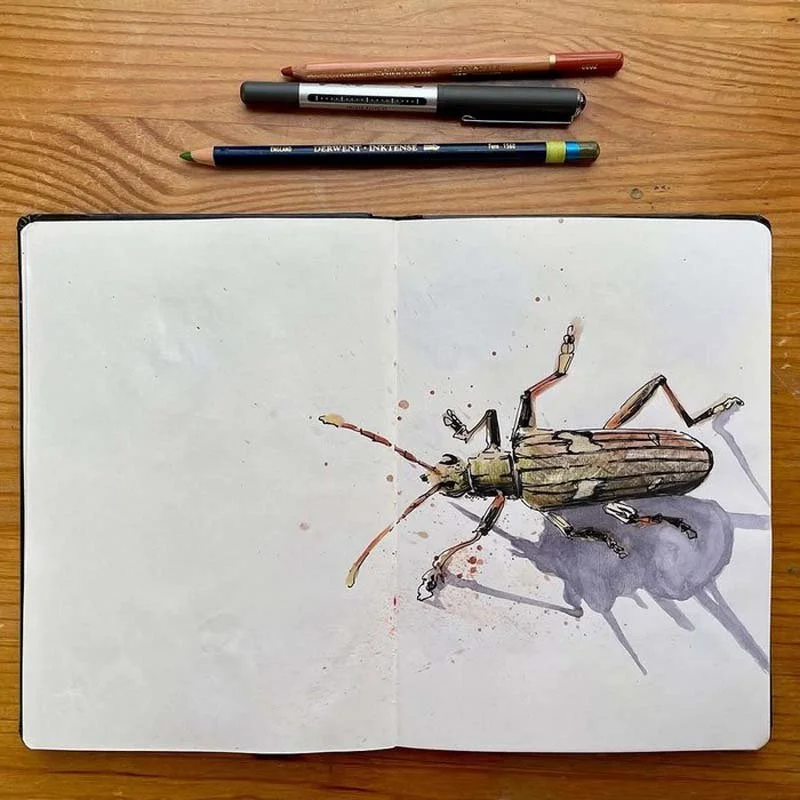
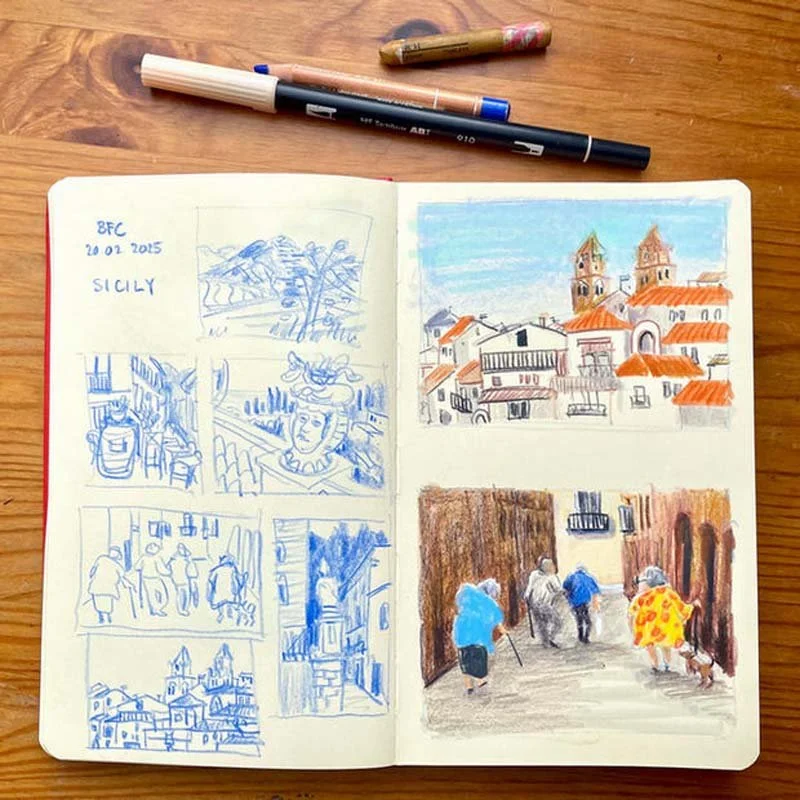
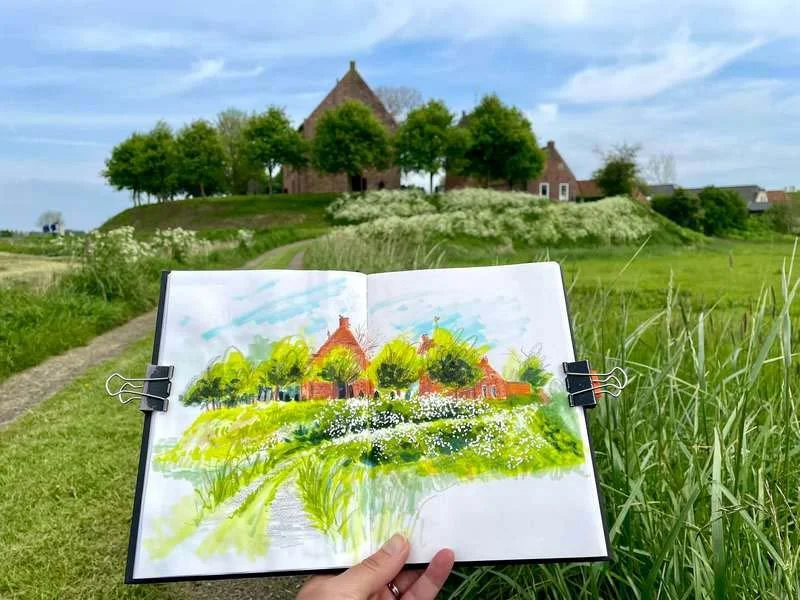
Although I draw a lot, I am not a professional artist (yet?). For a long time, art was ‘just’ a hobby next to my work as an economist. In the last decade, however, the relationship between my day job and my art has changed, largely due to health issues. I have ME/CFS, which means that my energy is rather limited and I had to reduce my working hours. A year ago, things got worse with long covid on top, and I have not been able to return to work since. I am still mostly housebound, and because it is not clear how my health will develop, I’m currently in a bit of a weird state in between my old career and an unknown future. Of course, this means that energy for making art is limited too, but fortunately there are many ways to make art. I work almost exclusively in sketchbooks and mostly with relatively clean materials that I can use even when lying on the couch. Now that my day job has been shifting to the background, I am thinking more and more about the possibilities of becoming a professional artist/illustrator in the future, if my health allows. It has always been a dream to illustrate a book, and that seems to become a more realistic option. I am fortunate enough to have my own studio. During the COVID lockdowns, my husband and I quickly discovered that we cannot work in the same room, and we created another office space for him. So now I have my own studio with a messy old table for art, a computer desk, a couch for when I need to rest, and plenty of storage space. It even has lovely views of the countryside and lots of sun! It is definitely my favourite room of the house. At the moment I’m spending most of my time here on the couch, but I love sitting at my drawing table for a little while and just play in my sketchbook, drawing by myself or on a Zoom call with friends. When I have a bit more energy, I work on bigger personal projects that could potentially become a book one day. And when I don’t, I draw collections – I pick a theme (often a kind of animal), leave my sketchbook open on the table, and every now and then add a very quick, small sketch to the page. I always keep a big open tool bag on my drawing table with my most used supplies. It currently holds pens, coloured pencils, water-soluble crayons, water-based markers, small watercolour and gouache sets and some sketchbooks. It’s easy to carry around the house with me and use at the dining table, on the couch or in the garden. In the studio I also like using acrylic paints or inks. I am not a purist; I will mix my materials as it suits me. The only thing I don’t use is oil paint, because it isn’t very convenient to use in sketchbooks. I am a big fan of sketching from observation on location, or ‘urban sketching’. I have been active in the national and international Urban Sketching community for a decade. I am a co-organizer of our local Urban Sketching group and was part of the local team for the international Urban Sketchers Symposium in Amsterdam in 2019. When I sketch outdoors, I like to pack light – again because of limited energy. Like many urban sketchers, I always bring a couple of black pens and a small watercolour set. When I draw from observation, it is important to me to capture the colours that I see. For example, if a hot pink bike or a dark green awning captures my attention because of its lovely colour, I want to recreate them in my sketch in that same colour. I love how a small but well curated watercolour set allows one to mix any possible colour in the world. Recently I have been drawing a lot with coloured pencils and markers, but with those I need to bring a big bag if I want to have every colour with me. On location watercolour is simply hard to beat.
You mentioned shifting from line to shape. What current themes or experimental approaches are driving your work right now?
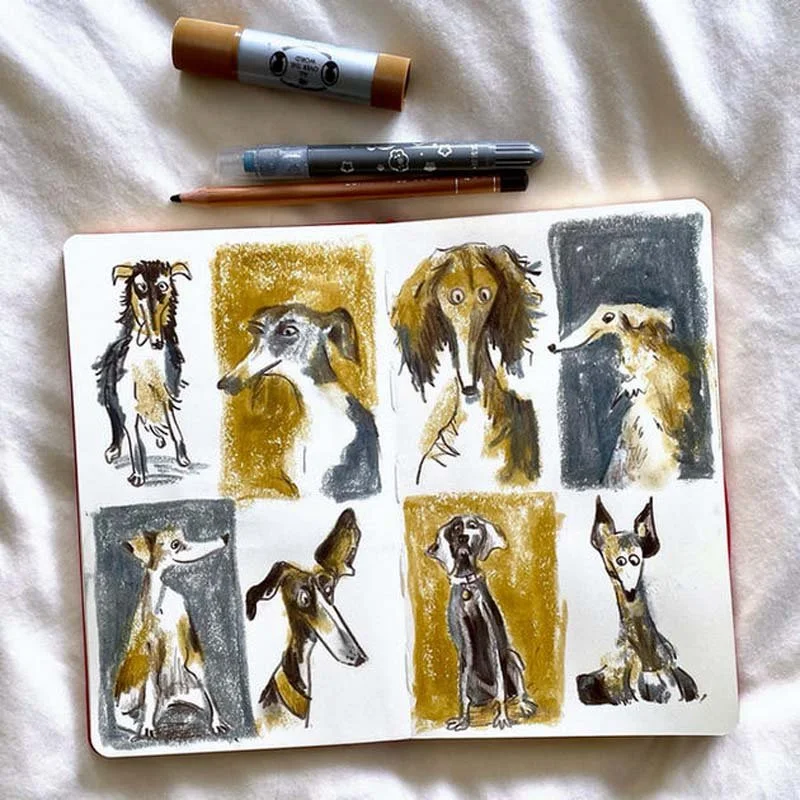
At the moment I am focusing on drawing for fun and relaxation. It surprised me that this doesn’t mean that my work is not developing. I used to draw mostly in pen, but since a few years I have been using coloured pencils much more, often on top of a base layer of marker, watercolour or gouache. That is shifting my focus from line to shape – even though I’m still probably more of a ‘drawer’ than a painter. I am also stepping away from realistic colours and experimenting with limited colour palettes, especially when I draw from reference photos or imagination. I regularly draw with an international group of online friends via Zoom where we take turns suggesting topics and finding reference images, resulting in a huge range of subjects. That always leads to random new knowledge and discoveries, which I enjoy immensely. When I draw by myself, I also like using reference photos. I find it rather difficult to draw purely from imagination! I love drawing old buildings as well as landscapes, preferably from places that I have visited in the past or ones that are still on my bucket list. Recently I have also been drawing a lot of animals.
When viewers engage with your sketches, what kind of connection or reaction do you hope to spark? To be honest, because I draw mostly for myself, I don’t usually think much about the potential audience’s experience. I share my drawings on Instagram for those who enjoy looking at them. I hope it will inspire them to look at the world around them in a different way, perhaps noticing or appreciating more. (This is related to the connection I mention below, under the question about ‘sustainability’.) And I do love inspiring others to draw! For that reason I’m always happy to answer questions about materials, drawing on location or how to get started. As I mentioned before, I have started working on some bigger personal projects that may potentially result in tangible outcomes (books??) in the future. Now that I am unable to do paid work, I miss the meaning and purpose that I used to find in my job, and I have been thinking about alternatives. Don’t get me wrong, I understand that illustrating books is a job in itself! At the moment it is unclear how much I’ll be able to work in the future. But sometimes I do feel the need to keep myself busy with a bigger project with social relevance. I was already experimenting with character development and storyboards, and after reading about scientific research on bird migration I started developing a children’s book idea on a little bird. It can be read as a simple children’s story as is, or be used as a starting point to talk about climate change. I always love books that have multiple layers, where parents can take other things away from it than young children, and when kids get older you can perhaps read the book together in a slightly different way. My drawing friends regularly tell me that my style may be well suited to non-fiction, and my love for archaeology has recently gotten me into a rabbit hole of ideas for illustrating history.
If you could sit down with any artist from history, who would it be and what would you discuss?
I would love to be able to have a chat with some of the first impressionists who broke with the tradition of painting in the studio and focusing on verisimilitude. As I enjoy drawing on location – and preferably finishing my sketches in at most two hours or so – it would be interesting to hear their thoughts about why and how to paint en plain air, omitting details, finding focus and showing the light.
Beyond the visual arts, where do you find inspiration for your practice?
This is a difficult question for me. Of course I draw inspiration from the art that I see, but that may simply be the sketches of friends shared online (not necessarily Art with a capital A). I may see them use colours, techniques or subject matter that I then want to try for myself. In fact, I draw inspiration from the entire world around me, including everyday items like the fruit bowl in the kitchen.
What is uniquely inspiring about living in Groningen and engaging with the local community?
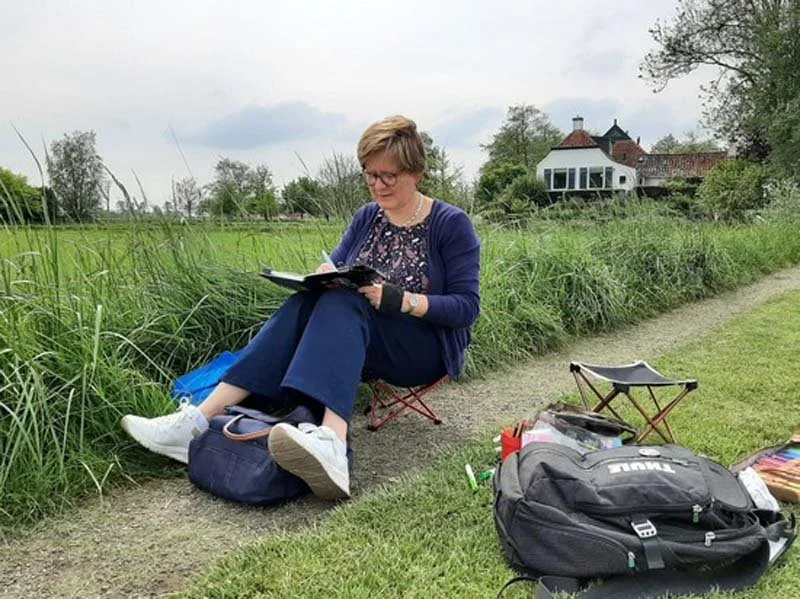
I live at the edge of a small village. I enjoy our views of the countryside, the space and the fact that some aspects of life here are a bit simpler and more old-fashioned or traditional than in the city. Being housebound I’m not able to engage much at the moment. But in the past decade I have been involved in the Urban Sketchers community – when traveling but also locally. I hope to be able to do more of that in the future! As co-organizer of our local group Urban Sketchers Groningen I am not only facilitating and stimulating others to sketch on location, but also interacting with the locals at a different level. For example, we get in touch with employees or volunteers at the locations that we visit (e.g. museums, cafes, churches, gardens) as well as with passersby on the street, who come and see what we are drawing and often tell surprising stories about the locations.
Can you describe the experience of the Sketch Tour Portugal and how it challenged you creatively?
In 2018 I was invited to join the Sketch Tour Portugal, a project where the Portuguese tourism board asked urban sketchers from Portugal and abroad to draw the country. If I remember correctly, we were asked to do six drawings a day. I was not a very quick sketcher, and we were also doing several hours of traveling between locations each day. But my travel companion Pedro Cabral and myself were up for a challenge and worked really hard. Most evenings we sat down after dinner in the hotel lobby to add a bit of colour to the drawings we had made on location. It was such a special experience to discover a new region and focus only on how to capture it in our sketches for an entire week.
Who have been the most influential teachers or mentors in your artistic journey?
I mentioned my art teacher in high school above (see the question ‘When did you first fall in love with art and realize you wanted to be an artist?’). I did not go to art school, but was inspired by many illustrators and artist teaching online courses on various platforms, as well as by many urban sketchers who share there art online (I could begin listing name but the list would be endless).
How does the practice of urban sketching and drawing from observation deepen your connection to the natural world?
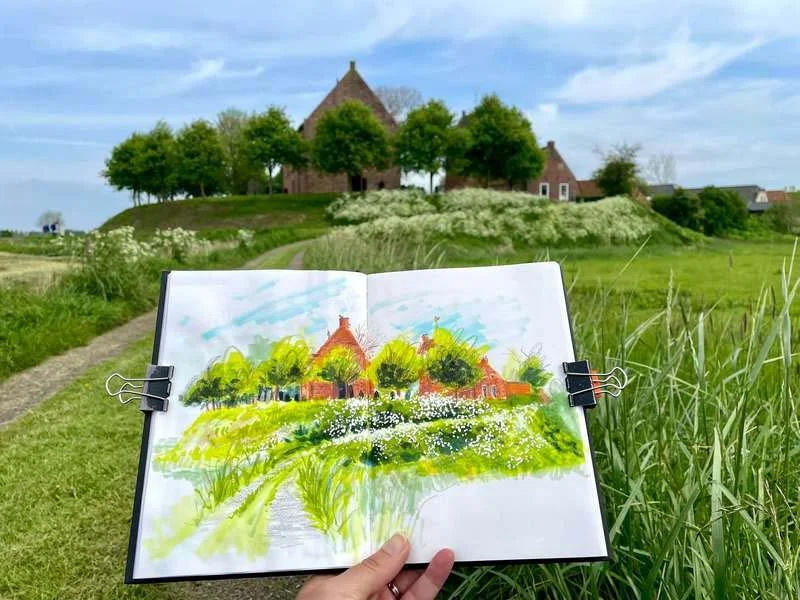
I have talked a lot about urban sketching already. An urban sketch is defined as ‘a drawing created on location, indoors or out, capturing what the sketcher sees from direct observation’. Despite its name, that doesn’t necessarily have to be in a city, and I actually enjoy drawing in nature just as much. Admittedly, all those different shades of green can be quite a challenge to capture! But by drawing from observation, we are observing our subject so much better and see so much more, and I feel that builds a special connection. It imprints the place – and whatever is happening there at that moment – in our memory. Also, it makes us look differently at the world around us. I remember clearly how I looked at my local landscape in a new way one day driving back home from work. I had just started painting classes after not drawing much for a couple of years. It was late afternoon in the spring, the sun came out and I suddenly noticed how blue the sky was, and how chartreuse the grass! I had to tell my husband about it when I came home but I don’t think he understood, haha.
As AI begins to mirror human output, what do you believe remains the 'irreplaceable core' of human creativity?
I’m not sure I have much to add about his debate that hasn’t already been said (and better) by others. We need human art in this world, for the heart that people put in their work and their genuine creativity.
Exploring ideas, art and the creative process connects me to…
the world around me, in a way that nothing else can.