

“The humanity of error will never be replicated by a machine.” Robert Szot discusses the vital necessity of the handmade in a digital age.
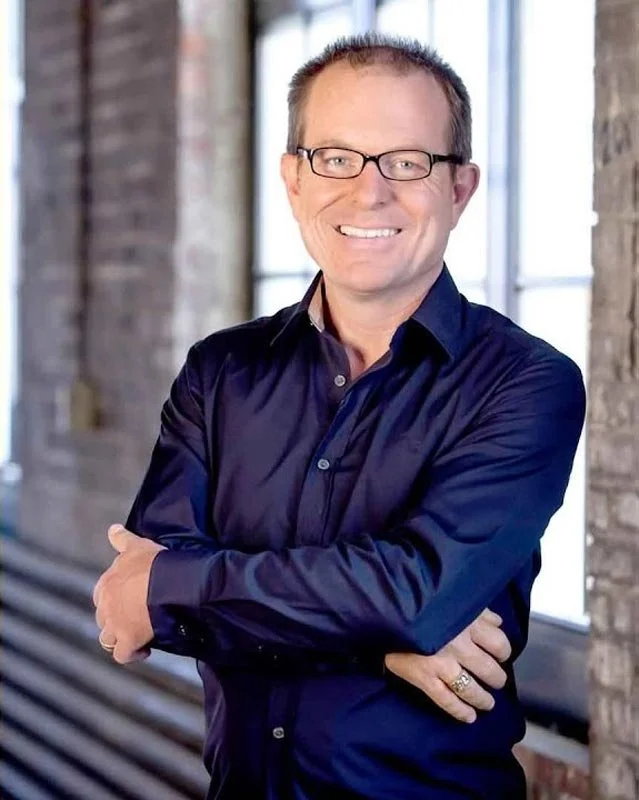
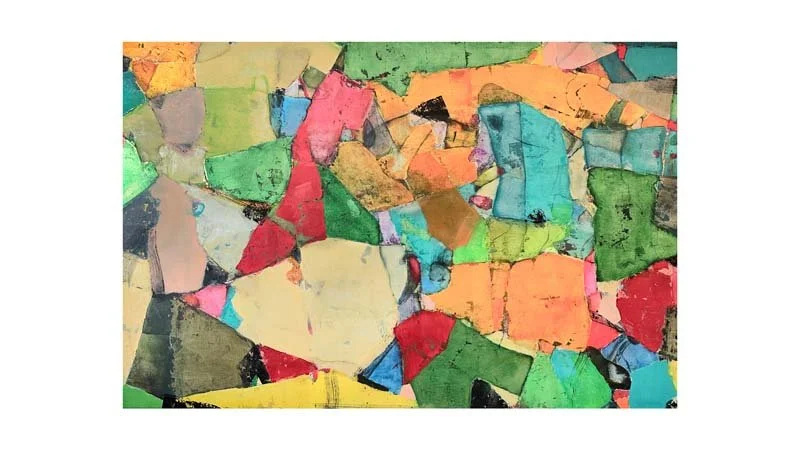
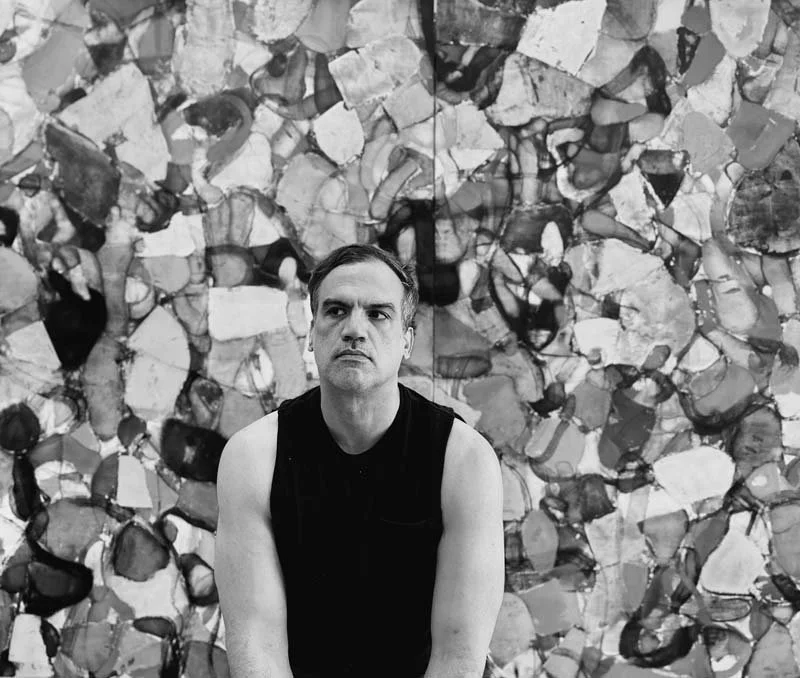
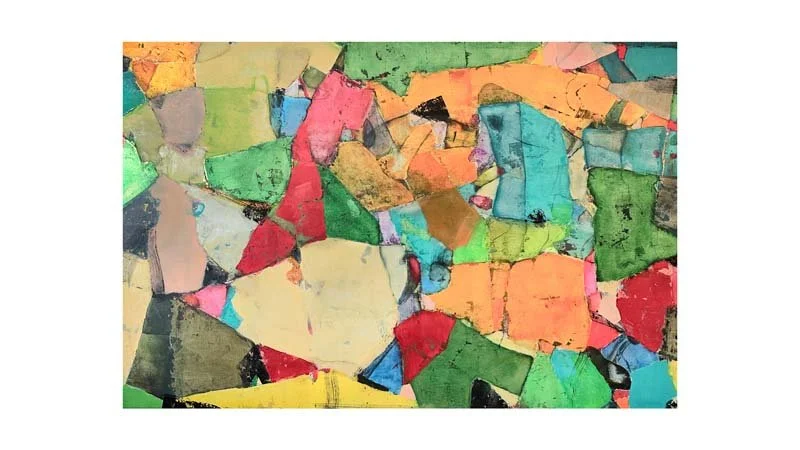
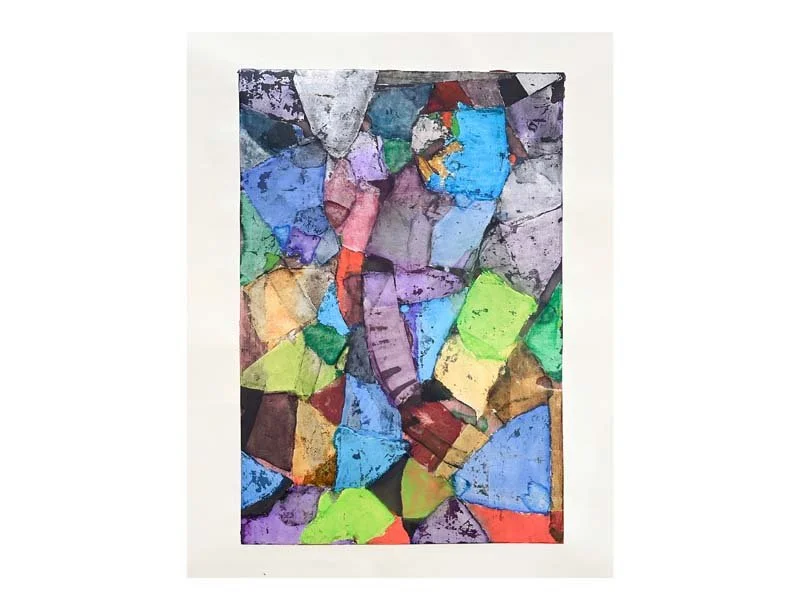
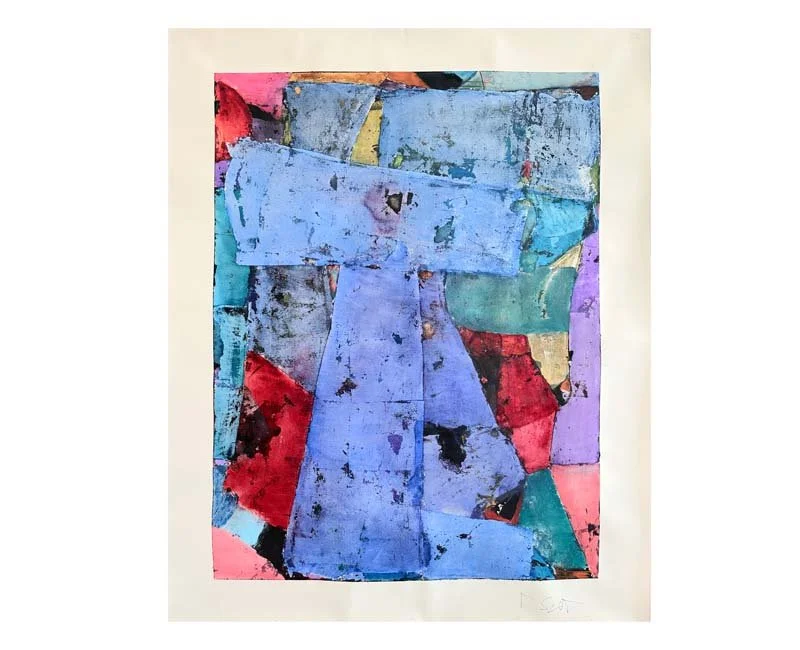
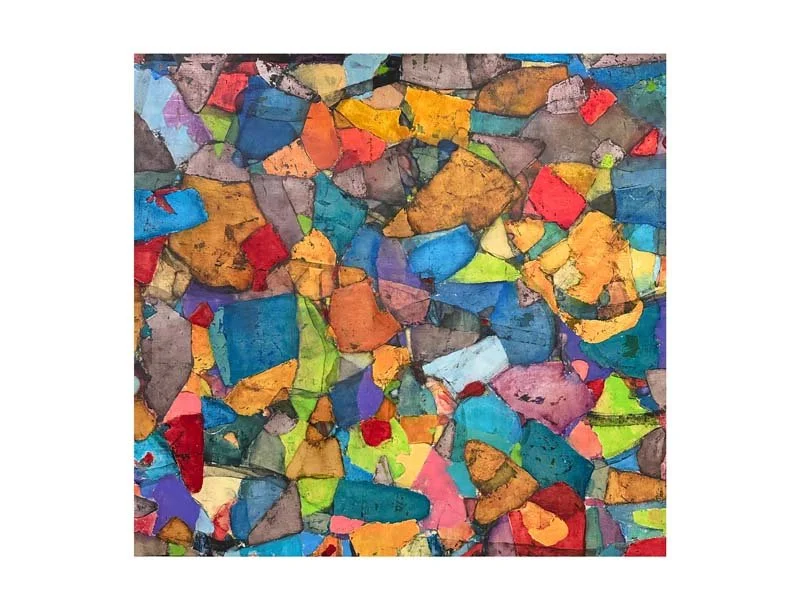
Robert Szot (b. 1976) was born in Morristown, New Jersey, and studied journalism at the University of Texas before turning to painting. He is based in Brooklyn, NY, and Los Angeles, CA. His work has been featured in major galleries and publications, and continues to gain recognition for its complexity, rigor, and emotional resonance. Known for his layered abstract compositions, Szot brings an emotional and architectural sensibility to the canvas. Drawing on more than two decades of intuitive exploration, his work resists easy categorization—offering viewers not fixed narratives, but visual terrains built through risk, revision, and restraint. Szot's new body of work continues his exploration of geometry, color, and surface tension, but introduces bolder chromatic juxtapositions and subtle uses of metal leaf, adding a new dimension of light and texture. @robszot
How did your upbringing in Texas influence your art and your thinking about the world?
I was born in Morristown, New Jersey, but was moved to Houston, Texas at the early age of 3, so I consider myself to be a Texan in many ways. My childhood was pleasant albeit quite sheltered in terms of broader ideas of art and culture. In my teens, I discovered institutions like the Rothko Chapel, the Museum of Fine Arts, and the Menil Collection, all in what turned out to be my backyard. I have always admired these places and still visit them frequently; they went a long way in developing my interest in art. In particular, the Rothko Chapel, its tranquility and silent nature, taught me a lot about the quiet contemplation that art (especially painting) demands. It was a fascinating discovery.
When did you first fall in love with art and realize you wanted to be an artist? For you, what is the importance of the arts?
I fell in love with art and decided to pursue it as a legitimate career when I first saw the work of Egon Schiele during a visit to Rome with my older brother. I was in my early 20s and, after having spent a number of years as a computer programmer, found myself searching for a bit more meaning and purpose out of life. My inclination was to discover something for myself, something that I could claim exclusive authorship of without committee or outside influence. Schiele's work spoke to me, and still speaks loudly to me now. I could hardly believe someone could say so much in what I perceived to be such a limited vocabulary. Immense things hidden in a single line or a diffuse bit of watercolor or gouache.
I was instantly hooked and believed fully that I could do something as profound. Art was always in my peripheral vision, but not something I ever had much confidence in my own ability to ever execute successfully—but I took a shot at it anyway being young and brash—and I moved to NYC at 25 to make my way as a legitimate artist. Now, two full decades into my career, I am of the opinion that art (and painting in my particular circumstance) is the last great bastion of the individual. It may be the last place where an inclined individual can create singularities that are of their own making and responsibility. It is the greatest thing a person can do short of saving a life or an act of charity.
What does your typical day in the studio look like?
I work 8 to 10 hours everyday, with Fridays off. I don't take breaks and frankly haven't had a vacation in 20 years. It is not that I am a glutton for punishment—I have just worked hard to obtain some small position in the art canon and I want to keep it and stay sharp and relevant. Plus I like to work. My latest studio is a very public storefront on a main thoroughfare in the Los Angeles neighborhood of Atwater Village. Having such a public place to work is unusual for me to say the least—I am not used to being so accessible. I have frankly come to enjoy the exposure a storefront offers, however, and locals from the neighborhood often stop in to ask questions or just to visit this strange person that has set up shop in their neighborhood. The space is a defunct hair and nail salon and I will get the occasional request of a haircut—I am not kidding.
It is a good-sized studio and I consider the space an essential tool for my art making. Having been in and out of so many studios during my NYC years, this new space offers me a great sense of permanence and that is also essential. Outside of this, my go-to materials include a near portrait grade oil primed linen, an endless supply of paper towels and my ever-growing collection of brushes that go back to the very beginnings of my painting career.
What projects are you at work on at the moment? And what ideas are currently driving your work?
I have been planning an exhibition for my NYC gallery that would be comprised of perhaps only four or five paintings. These paintings would be my largest to date, somewhere in the 80-by-130-inch range, a la The Water Lilies by Monet. I've got titles for two of the works, “DREAMLAND” and “Wonders Greatly Reduced,” and these titles have already conjured up images of layered mysteries and shrouded colors. I'm excited by the prospect even though nothing has even begun in real terms, but the concept certainly has gotten my attention.
I don't use ideas or themes in my work. I certainly do not pre-plan compositional outcomes or even color palettes for that matter. I feel like ideas are too limiting and much too specific for my taste. I prefer to work openly, allowing the painting to actively dialogue with me as I respond to it in real time. This process keeps the work fresh and allows a lot of room for searching and surprising results. Intention still runs very deeply in this process despite the rather improvisational nature of how I work, and each mark or bit of information is thought about several times before it gets executed.
What do you want your work to reveal about the human condition?
I don't want there to be any separation between who I am and my work. I want to be inextricably bound to it. Good painting, especially abstract painting, speaks directly about the artist's decision making and is a direct conduit to their individuality. The story that gets told is the story of their lives, not the story of ideas or gimmicks or the “why” something was done. I was at the Metropolitan in NYC one spring day, perhaps six months after I arrived in the city, and I found myself standing in front of Willem de Kooning's Easter Monday. A giant canvas with great spaciousness dotted with colorful activity. I remember looking at it and feeling like I knew a little more about de Kooning as a person through this work. We make a lot of the same decisions and mistakes, he and I, and I found that particular fact very shocking.
It was through that painting that I began to feel very much a part of a larger collective, one that sat a bit higher up on the mountain of humanity. An exclusive group of creators, a group open to anyone willing to make the decision to dedicate their lives to the deepest expressions of being human. It is a sentimental notion, I know, but I have been carrying that idea with me for a long time and have been trying to get my work to do the same thing for other people that come across it. I am not interested in the expression of message or idea, I want to communicate in that base, unspoken language we all share as people. That's it. Not too big of a goal, right?
Which artists, past or present, would you like to meet? And why?
I think Philip Guston is at the top of that list. Francis Bacon, de Kooning and Louise Bourgeois came in close seconds. I just like the attitude of these artists because their attitudes, both in work and life, are incredibly consistent. I think of the artist Ed Ruscha in the same way. I went to his retrospective at LACMA recently and was taken aback by the consistency of the attitude in his work, a trait that has carried through his work for 40-plus years. It was such a treat to see. I think these artists probably wouldn't want to talk about art, and that is a plus. I would rather hear about their day-to-day affairs, perhaps learn a bit about what they like to eat or read. That would be really interesting to me. I like the detritus of people's lives, the throwaway common and everyday stuff. I like the detritus of an artist's life too; I went to Cy Twombly's studio in Kentucky and searched everywhere for a trashcan or the dumpster.
Where do you look for inspiration beyond the visual arts?
I really take my inspiration from working. Having a consistent studio practice compels me to create more work, to challenge my conventional thinking and push my own boundaries. I can't readily identify anything in the outside world that actively inspires me, but I do like to read and enjoy being outside when I have the opportunity.
A great thing about living in Los Angeles is…
Access to culture and an abundant variety of flora and fauna.
Can you describe a project that challenged you creatively or emotionally—and how you worked through it?
I think every project has its emotional and creative challenges. They are probably multiplied when you are working toward an exhibition and as you approach the ending of that working period you start to hyper-focus on things like the messaging in that body of work—is it saying what you want it to? Is there clear authorship in the body of work? What can I adjust to make the entire exhibition just a bit better? Those can be particularly difficult times—you are balancing emotional and physical exhaustion with the growing anticipation of the exhibition opening. Then you have to let everything leave the studio, and what happens with that work is entirely out of your hands.
Who have been important mentors in your life as an artist?
I didn't go to art school and I am not academically trained. My mentors are really my friends and peers. I need a support network like everyone else, mine tends to be just a handful of people (some working artists, some not) that I have come to rely on.
How does the natural world inspire your art?
There is a place here in Los Angeles, it's a museum and botanical garden called the Huntington Library. It is a vast place, 200 acres I think. It is simply the most beautiful place I have ever visited in terms of natural beauty. It is an extraordinary place and I fantasize about having my work in their permanent collection.
In a world of infinite AI generated images, how do you define the value of the "human signature" in art?
AI will never replace the artist. The humanity of error will never be replicated by a machine and the beauty of quirkiness can not be made artificial. Do not mistake me, people gravitate toward quantity and will buy something cheap even if it is a copy or a painting produced by a computer, I know they will. However, you will never be rid of that core group that will accept nothing less than a creation made by human hands, human minds. I am one of those people. Owning something cheap simply for the sake of owning it is abhorrent to me; I don't even like "fine art" prints that come out of a computer printer. There will be a market for things like AI "art" but you will never fully erode the beauty of and the interest in singular acts of human creation.
Exploring ideas, art and the creative process connects me to…
who I am, inwardly.