

You have to build a space within which the fear can't get you
So you have to leave space in your narrative for their voice to fit as they read it to themself. I spend a lot of time doing this voice method, which is the Alfred Wolfson voice method. He was a soldier in the First World War, and when he was hearing people scream for their lives, it was completely irresistible. You hear someone screaming for their life, you want to go into no man's land and rescue them. It's unbearable to listen to its full expression of their humanity screaming for you. And he was thoughtful. And the thing that puzzled him was why people don't agree to be fully expressed while they're alive. Why does it only happen in their last moment? Why wouldn't you live being fully expressed?
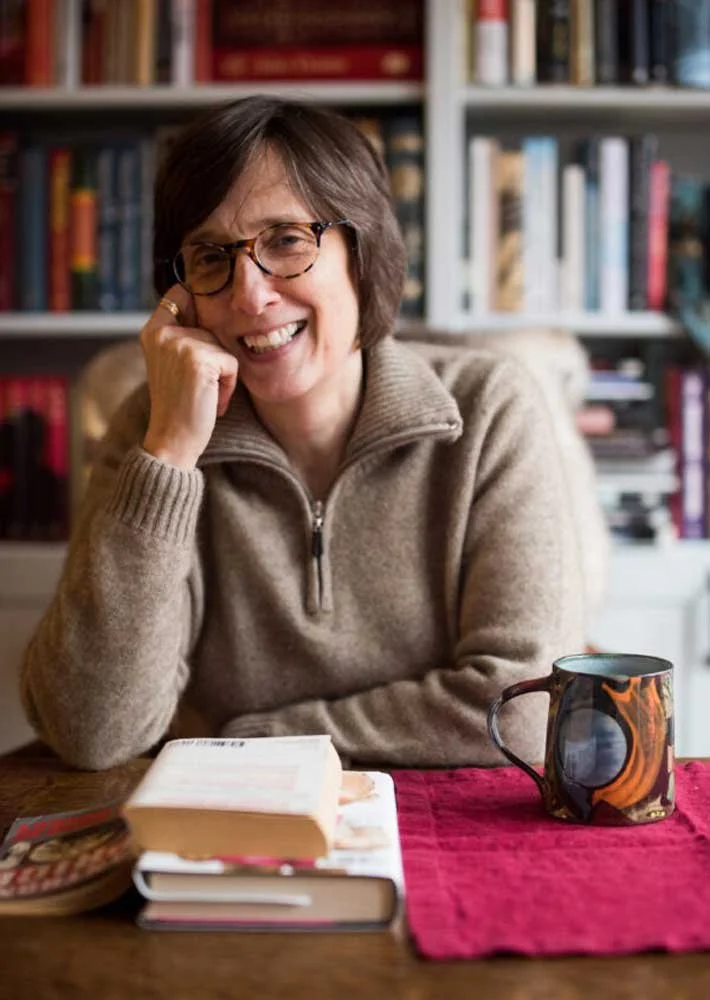
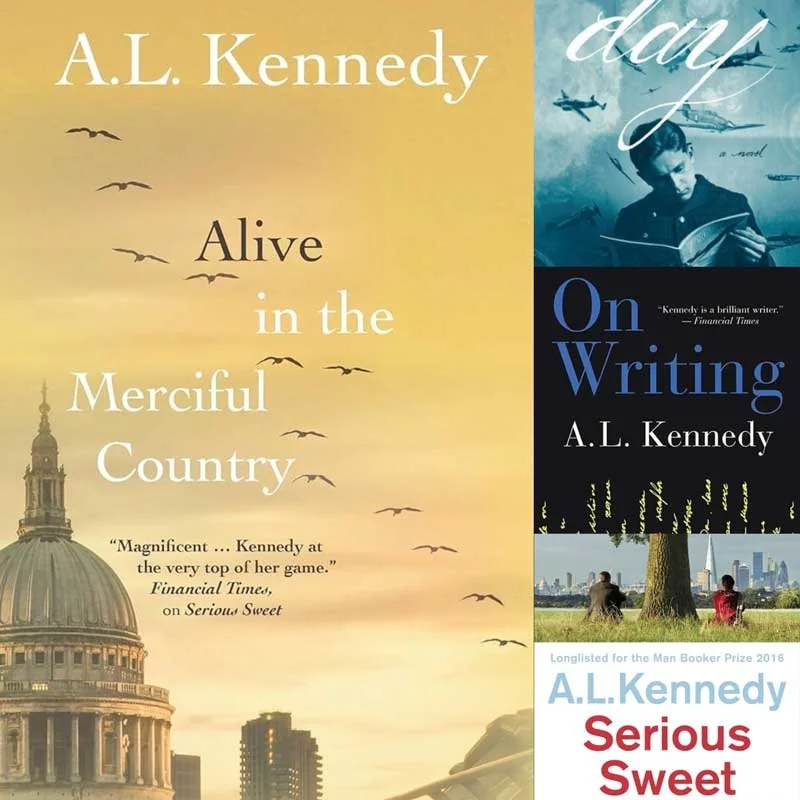
My guest today is AL Kennedy. She is one of Britain’s most acclaimed and versatile literary voices, a writer who can inhabit the internal life of a soldier in a POW camp, as she did in her Costa Book Award-winning novel Day, as easily as she can navigate the "professional lying" of a modern civil servant.
Her latest novel, Alive in the Merciful Country, takes place during the 2020 lockdown. It tells the story of a primary school teacher who receives a confession from an undercover police officer who infiltrated her life decades earlier. It’s a provocative investigation into state power, the "Spy Cops" scandal and the search for mercy in an age of surveillance. It’s a book about the breakdown of trust. We talk about her life, her activism, and why she believes fiction is the only way to tell the truth when the facts are forbidden and how she balances the truth of her novels with the relief of stand-up comedy.
AL KENNEDY
The thing is to be essential. Then you get close to universal humanity, which becomes essential to the person reading you. If you do the voice work with a group, there'll be a point where somebody's so open and so realized and so themselves, you suddenly have this realization about them. With my voice teacher, we did a whole week where it was just back and forth doing it. I was listening to her and then I just thought, oh, wow, you're Jewish. And it wasn't that I didn't know she was Jewish, it's just I thought, wow, your Jewishness is so close to your heart, so part of your fiber.
And there was another guy, and you heard him, and it's like, oh, you're gay. That's one of the things. And the pearl that you're making, that's you. And there was another woman and it was just, oh man, you're just one of the nicest human beings I've ever met. There's something in you that's so untouched by the world. It's extraordinary that the song of somebody will tell you such articulate information. It's so essential and always so beautiful and slightly different. Saying it in words isn't enough because it's something much more penetrating. It gives you such strength. But obviously if you're doing theater, just the mechanics of being loud enough that people can hear you is useful. So the battle with fear is quite fundamental to being able to put marks on paper. You have to build a space within which the fear can't get you.
THE CREATIVE PROCESS
What you say is really important about how we all can become victims to these systems. We all are more or less vulnerable to the systems we live in. And when you talk about people who have less connection to education in a way that's really critical and reflective. I read that our attention spans used to be 12 seconds. It's now 8.5. I didn't even know if a thought can fit into that attention span.
AL KENNEDY
Yeah, the thing with that, I don't know if that's true. I tend to be skeptical because that seems to be a really fast operation of evolution for no reason. There's no evolutionary pressure for that to happen, so it's happening within our life. But when we say, "What did you do today?" and the answer is "I went for a drive," we accept that as one activity. But it's not. It's checking wing mirrors. It's checking rearview mirrors. It's keeping an eye on speed, controlling direction and looking for hazards. It's knowing your route and dealing with whatever amount of technology there is. The choke or changing gears if you have a car where you have to do that. And there tends to be an analysis of how particularly young and suspicious people behave online. Where instead of saying, "What did you do today? I was online," they say, "Oh, you were looking at this and you were looking at that, and you were changing from here to there". Therefore, you have no attention span.
It's like, no, dude, I was just online and I had a lot of windows open. What's your problem? So, when you look at the analysis, it's a little weird because these are the same people who will watch a Netflix series for a day and a half. Don't tell me that you have to break all information and drama down into eight-minute increments because nobody has an attention span.
Clearly, if something is good and interesting, you hook people. That's how it works. I used to work in a charity doing arts work, and sometimes I would go into schools. The terrible teachers would always say, "Oh, this class has no attention span". And I would say, "Well, I'm just going to go in and find out what they want to do". And you'd always get, "No, you have to tell them what to do because they can't decide anything". And it's like, yeah, see you later. In an hour you would talk to people and take their opinions and their ideas seriously. By the end of the thing, they would've decided what they wanted to do and set about doing it. And it's like, I think you'll find you are a crappy teacher, and you've parentified them. You'd have to work around it. With the great teachers, children would come up to them. If they'd made up a song or a rap, they'd show it to the teacher. It's like, we're working with you, but this is the main person, so we're going to show her. Because we know she's interested. If you have media that are not interested in people, people are not interested in them. So I don't blame them for having no attention span; blame the stuff for being shit.
THE CREATIVE PROCESS
Your mother was a primary school teacher, your father was a psychology lecturer and you're also a university lecturer. Growing up with those influences, how did that pairing of education and the need to explore the hidden parts of our mind form your ideas of what is true?
AL KENNEDY
Ooh, goodness, that's an hour. I mean, it was not a relationship that worked well for them. So as a small person, you're sort of thinking, well, what is this? I was always interested in why people say something when clearly they're not doing that or describe themselves as something when clearly they aren't that thing. I find it understandable that people fall for very bad lies. It's disappointing, but clearly, being educated, being taught how to read and how to really read being mentally agile is hugely important for allowing you to live a full life. And to know who you are, be able to express yourself with nuance instead of with violence or to even understand what you're feeling. It underpins democracy, as a bajillion people have said. We are seeing now that the Venn diagram is a circle of undereducated people who can be shoved to being de-educated, misinformed, misled and pulled into what they always get pulled into, which is some form of fascism actually.
THE CREATIVE PROCESS
Why is a teacher a central figure for you in terms of protecting the child's imagination from the adult world?
AL KENNEDY
I think because part of the complete decline and destruction of the social discourse and democracy in the UK began a very long time ago with the real savage, multi-pronged attacks on education and teachers from Thatcher onwards. They knew, partly instinctively and partly statistically, that what you have to do is destroy education and then you can do anything. What you have to do to diminish resistance is to destroy education. If you are an ideologue and you don't want to exist in the real world, if you want to peel away from reality and just believe your daydreams—and as it happens, they're the darkest daydreams—you have to diminish education. You diminish rationality, belief in an agreed reality and the very predictable consequences of actions to believe mythologies about what human nature is. If you look at Minnesota, of all the states, why would you try to do this in Minnesota?
There was a great interview last weekend with an anti-ICE demonstrator who said a bunch of sensible stuff. He said this beautiful thing: they only have force; they don't have love. That's kind of everything you need to know. Force gets the qualifier "only". It's not enough. Toxic masculinity and dick-waving ain't going to do it for you. That blows away in the wind because it has no underpinning. If you have love, eventually you're going to win. It's not that people aren't going to die or terrible things aren't going to happen. But if you stay centered in that, you'll get through and you will not have turned into a monster in order to overcome monsters, which is the big question. There are two questions in the book and two answers. Anna is incredibly furious that people are being treated so badly and killed by machinery designed to be a murder-suicide pact. But she goes with love, and Buster goes with, "I'm going to shoot bad people in the head". He thinks doing it to bad people will make him a good person. It won't; it just makes you very broken.
THE CREATIVE PROCESS
I hadn't known the whole Spy Cop scandal. It's interesting that you share a name with Spy Cop Mark Kennedy. Can you unpack that for listeners?
AL KENNEDY
Yeah, Mark Kennedy is one of the famous outed spy cops. I think every government wants to infiltrate everything that could be oppositional. It's a very long-established habit, even an Elizabethan habit, to put double agents into resistance cells. But under Tony Blair, who was truly authoritarian in the way that Keir Starmer is, he wanted at least one spy cop in completely peaceful organizations like Greenpeace. Spy cops were everywhere, and largely, a lot of them were very awful. In fact, one of them had a nickname because she was so awful. There's a beautiful story of a demo in London where far-right neo-Nazis were attacking a radical bookshop, and there was a counter-protest. It was quite violent. One person in the front row of the neo-Nazis and one in the front row of the anti-fascists were both spy cops, and they ended up punching each other and kicking off the violence. It's insane.
There probably wouldn't have been any violence if these two cops hadn't thrown the first punch. There was an amount of provocateur behavior, pushing people to do certain things. If you could drive a van, you were very useful. These guys would turn up with a van. Apart from that being utterly undemocratic, reprehensible and unnecessary, they had a huge budget and real impunity. They just kept gathering money, power and stuff.
Also, what's the best cover? If I take drugs, sleep with somebody or father a child with somebody, then surely I'm not a spy. Mark Kennedy was one of the famously revealed people. You also had newspapers having people at the end of phone lines or in person pretending to be people to get stories. Up to a point, a little investigation might be legitimate, but this was a huge criminal enterprise of bloggers gathering information by pretending to be people.
I have a friend who was one of these bloggers, and it destroys a personality because you're a Nigerian prince for two weeks, a German researcher for two weeks and then a nice window salesman who needs a phone number. He was terrifying because he demonstrated how you get any information you want. Not by hacking or doing anything technologically sophisticated, but just by knowing human psychology. You listen to the person at the end of the phone line, say the right thing to get a little bit of information, which gets you another little bit of information. Way back before the information age, newspaper proprietors could get your bank details, medical details, phone numbers and addresses just by keeping at it.
THE CREATIVE PROCESS
Buster seems like a cipher for where that eventually goes. He heads toward a disembodied place, which to me feels like a metaphor for AI. The risk is that the younger generation won't be able to tell the difference or that we will start to prefer the fake.
AL KENNEDY
The problem seems to be people my age. My experience of people in their twenties and younger is that they're smart and hip to this stuff unless they've really been massaged into the incel community. But people 40 and above seem very vulnerable and naive. Researchers analyzed how fascism took over a democracy with a complex artistic inheritance. They looked at Milgram and Zimbardo and said, "Okay, that's how it happens. So we'll do that again". We'll do it online, in your home, in your pocket and in your TV. We'll give you a story that's not true and see which one you believe. We can do that super fast because that's really all AI is. We're doing the things human beings do, just very fast. "Oh, you believe that one? Okay, we'll pull you down the rabbit hole this way". It's these weird places where 40-plus people hang out and say, "Immigrants stay in hotels and get given food in the UK". But dude, that's because they're not allowed to stay anywhere else. They have no way of getting accommodation. You are not letting them have council accommodation and you're giving them food because you won't allow them to work. That's literally the only way they would have food and shelter.
Once you believe that thing, they pull you a little further until you lose friends because you are going mad. You're slowly in a dream, and it provides you with new friends through things like Grok. Now you can see a woman's breasts without ever having to say hello to one or compromise your awfulness, leading to a male loneliness epidemic. No, there's a male terrible behavior problem making lots of young men very lonely. There's an epidemic of divorce in the US because women are finally saying enough of this. I think they're going to get a South Korean situation where respectable men won't be around people groomed to behave appallingly. They only have this toxic friend group. That's how you radicalize people. You get people to tell you things about themselves so you know how psychologically vulnerable they are. There's the cliché that if a Black or brown person does something, it's because they're Black or brown. If a white person does something, it's because they're psychologically frail or having a bad day.
THE CREATIVE PROCESS
For Anna and the other characters, the lockdown was a pause. We saw a flourishing of biodiversity and a rewilding. What are love and beauty to you?
AL KENNEDY
The good thing is, I don't know because it's always different. It's always evolving, flowing and flexible. If it weren't, it's either dead or beginning to die. Creation is movement and flexibility. The interesting thing with lockdown was for those two weeks, everybody knew they were in the same situation. It was scary, and we were all paying a huge amount of attention. We were looking at dance, music and paintings, and it made us cry. People were pushing pianos in the streets playing for old people, or standing on balconies playing the saxophone, making us cry. People were photographing leaves, realizing how beautiful a leaf is. Separated from the people they loved, there was a huge awareness of how much you do love those people. We had a huge amount of time to think about everyone we missed. The things that are important are simple, specific, beautiful and strong. We had two weeks of our media being nice to us, talking clearly and slowly without the bullshit of telling us to be angry or scared. They talked to us like friends, the way media always should, because we pay for them and they serve us.
Then, everybody says the lockdown was terrible because everyone went mad. No, about two weeks in, all the Peter Thiels and Elon Musks realized humanity was becoming unified. We were getting deep into empathy, creativity and doing beautiful things for free for each other. They decided they had to stop this. They stepped on the gas and found the vulnerable, lonely people who couldn't cope with the inrush of things they were feeling. In the space and silence, unmet needs became overwhelming. Governments weren't putting in help or creating unified resiliency. They hosed cash to people for bullshit and committed horrendous crimes instead of supporting people. They decided to give cash to their friends and leave people completely alone. It was the moment democracy failed us just as we were becoming ready to be ideal citizens.
THE CREATIVE PROCESS
You're an environmental activist, which is part of the story in Alive in the Merciful Country. Millions of people die from respiratory issues caused by pollution or other invisible things. Epidemics and pandemics were a predicted effect of climate change. When you meet people, do you think there's a novel behind what they reveal?
AL KENNEDY
That's living the life of a vampire. I started working with people in care homes, family centers and prisons. I had no privacy at all. Social workers would tell me intimate details of people's lives that I shouldn't know. They had no privacy, so you tried to make a tiny bubble of creativity and privacy for them. Seeing what writing did to them—that it liberated them, made them more articulate and gave them status—showed me its power. If I am with anybody for more than 20 minutes, I will never take your life and use it. You end up at my age and have no friends if you go that way. Nobody will tell you anything because you're going to rip it off and make money from it. It's also not as useful as you would think. You end up with stolen elements jammed into an imaginatively created world. Why not create it all imaginatively? Then it will all be of a piece and organically coherent.
THE CREATIVE PROCESS
How does your activism feed into Anna's story? Is the general environmental situation still your main concern?
AL KENNEDY
If you want to pay rent for having been given a louder-than-average voice, you can feel personally unbalanced if you don't do something useful with it. It's another way of looking at the power of narrative and feeling good about humanity. It's like standup. If the narrative in the media is sloppy and gullible, and you're in a standup club the next day, the audience gets it. People are very sharp. We did an illegal all-day literary event in Trafalgar Square. Every moment of that was pure magic and the best literary event any of us had ever experienced. We were sitting on concrete in an underpass surrounded by cops who also seemed to be having a nice time. You're always really talking to the cops. They know all this shit. They know more than you do.
AL KENNEDY
I saw a commentator who talked about being radicalized online. He was asked how he could be happy and post lighthearted things when tragedies like Rodney King happen. We didn't say enough when that happened. It's about living in ideology, not reality. If cops are allowed to shoot anybody in their car, eventually it will be everybody. If people are allowed to execute disabled people, eventually they'll execute everybody, and your country will be in flames. It comes down to education. Just crack a history book, and you will know you have entered a murder-suicide cult. The big thing I'm worried about is when MAGA collapses, the psychic injury will be massive. In Nazi Germany, there was a wave of suicides. Guys committed suicide and took their families with them because their reality was on fire and they had no tools to deal with it. I really worry there will be mass suicides when it falls.
THE CREATIVE PROCESS
Many of your novels center on relationships between two characters, such as between John and Meg in Day. How do you create deep, interesting dynamics between these characters and make them different every time? What aspects were inspired by your own experiences?
AL KENNEDY
When I work with students, it's difficult to talk about character creation because they've been de-educated. The people who report on literature are journalists, and academics build theses by putting facts together. When you're dealing with imagination, that's not how it works. You have to live a life relying on things that make no sense, like vibes. We're not taught how our minds work or how we find the roots of a story. If you're building a character, it takes years of research, similar to finding out about King Charles I. Eventually, you have a bag of bits that feel right and seem to belong to an entity. You create an autobiography, a psychology, a history, a context and an interior color palette as if they were a real person. You ask questions and provide answers. It's a long process to create a person from scratch, but it becomes coherent because you're simultaneously creating a plot and other symbolisms. You build somebody who never was, which allows someone else to inhabit them. Then you perform another miracle: putting marks on paper that make somebody see, feel and hear a place and time that isn't there. It's miracle upon miracle, done a step at a time.
THE CREATIVE PROCESS
Speaking of helping people, we forget but writing can be a physical process. You teach creative writing, and you also studied theater at university, right?
AL KENNEDY
Yeah. And it was much more useful, I found, because you discover you have a body and you move and you exist in space, which means you sort of have an understanding of the focal point in a narrative. If there isn't one, it all seems to float about in a void, which isn't what you want. You discover you have a voice, and you begin the exploration of voice—the voice in your head, the voice on your page and the voice out loud. They're three slightly different things, but they intertwine. If you improve one, if you deepen one, you deepen them all, and they get joined by the triple strand of the reader.
So you have to leave space in your narrative for their voice to fit as they read it to themselves. I spend a lot of time doing this voice method, which is the Alfred Wolfsohn voice method. He was a soldier in the First World War, and when he was hearing people scream for their lives, it was completely irresistible. Lots of people wrote about this. You hear someone screaming for their life, you want to go into no man's land and rescue them. It's unbearable to listen to its full expression of their humanity screaming for you. And he was thoughtful. The thing that puzzled him was why people don't agree to be fully expressed while they're alive.
Why does it only happen in their last moment? Why wouldn't you live being fully expressed? So he devoted his life to trying to find a way to make that happen. You sing notes beyond your range, except your range expands. You discover beneath your range, it goes low to the fullest extent of your breath. Your breath expands. You don't know how big you are, how much you can breathe, how loud you can be or how open your mouth can be. It's fascinating and hugely moving. I've been the person doing it for an audience, and the audience were really moved; they thought I was going through emotional this, that and the next thing. I was having zero feelings, but it's hugely articulate to just have a human voice happening to you. Even if there are no words, it really makes you think, wow, if I'm going to deploy words, I better be adding something, and I'd better be having that fundamental music as far as I can make it happen. It's a fascinating thing if you're thinking about how do I express myself?
I don't want autobiography because it's cheap and ridiculous. It's not enough, and it's theft. The thing is to be essential. If I go into me and I'm essential, then you get close to universal humanity, which becomes essential to the person reading you. The more particular you are, the more universal you are.
I do the voice work one-to-one quite often. If you do it with a group, there will be a point where somebody is so open, so realized and so themselves, you suddenly have this realization about them. With my voice teacher, we did a whole week where it was just back and forth. I was listening to her and then I just thought, oh, wow, you're Jewish. It wasn't that I didn't know she was Jewish; it's just I thought, wow, your Jewishness is so close to your heart, so part of your fiber. And there was another guy, and you heard him, and it's like, oh, you're gay. That's one of the things. And the pearl that you're making, that's you. There was another woman, and it was just, oh man, you're just one of the nicest human beings I've ever met. There's something in you that's so untouched by the world. She spends part of her time dressing up as a suffragette and being in demonstrations. She's just a golden person. It's extraordinary that the song of somebody will tell you such articulate information, and it's so essential, always so beautiful and slightly different. Saying it in words isn't enough because it's something much more penetrating. That is fascinating, and I spend so much time doing that.
It gives you such strength. I try to get anyone who's trying to write or wants to write to do it. I said to one working author, "Have you ever tried doing voice stuff?" I saw him about a year later and he said, "I went away and worked with this voice person for an hour. I came home, and my wife said, 'Oh my God, you're standing so straight, you look so happy, fulfilled and yourself.'" I asked, "So you've kept doing it?" And he said, "No, I just needed to do it once. I never need to be—yeah, the hour was fine. I want to limit my livingness." So that in itself is fascinating. Obviously, if you're doing theater, just the mechanics of being loud enough that people can hear you and being brave enough to stand on stage is useful. The battle with fear is quite fundamental to being able to put marks on paper, and you have to build a space within which the fear can't get you. There will always be fear, but you have to say, "You are waiting outside the door until I need you, and then I will use you to rewrite because you will become the fear of what if they don't understand me," which is a useful fear. But the other fear is, "I need you to not be around just now."
THE CREATIVE PROCESS
That goes back to naming the character or talking about people's essential goodness without all the pretense. I think back to your novel Day and the character Alfred Day. We only discover who we are when we are tested sometimes. Like a prisoner of war camp, crushed down to who you are in essence, what you're trying to protect and what life meant to you. That's great creative writing or living advice.
AL KENNEDY
If you have a good education system, you don't have to be in a work camp, go to war or cling to wreckage after your ship went down to find out who you are. You kind of have that information. It's either the worst experiences of your life or the most beautiful. The Quakers say great pain or great joy opens the gates of the soul. I think they've now rewritten it, and I don't like the new wording, but that used to be it. And that's it; it can be joyful, assisted by friends and beautiful, or it can be hellish.
THE CREATIVE PROCESS
Beautiful, because it's that pause that maybe some people only really gave themselves during COVID. We talked about AI a lot. We're also working on a project with the Center for European Policy Studies about AI and creativity. It's horrified me on so many levels regarding what it does to creativity. You write about "don't let them steal your imagination," which has already been taking place with all the scraping. As it continues to become more advanced and accelerated, I don't think an algorithm can replicate the joy that you get from writing. But what are your overall reflections on how it's changing society?
AL KENNEDY
It's not doing well. You have to really emphasize it's a huge self-dealing stock bubble based on theft, and we've decided to ignore the fact that it's based on theft. It's not particularly popular, nor is it really that useful or producing anything of quality. It's multiple different appearing and disappearing entities who give money to each other in a closed loop. It's inherently hideously unstable. It may be too big to fail, but I don't know if it is, and it's never going to turn into general AI. At the top of it are these ideologues who are genuinely delusional, who think they can upload their consciousness to general AI and become God-like figures who live forever. And it ain't that. It's just a vast plagiarism machine, which firehoses chicken nugget slurry at people who very quickly realize they don't want to eat chicken nuggets every day. Also, please take this off my customer service area. Please remove this from my page that I'm trying to write. It's like Clippy—a giant, super intrusive version of Clippy. Clippy used to turn up and say, "Looks like you're writing something, can I help you?" It was a little paperclip with eyes.
THE CREATIVE PROCESS
And the first thing you did when you got a new computer was to remove Clippy. Get the hell out of here. All they've done is make Clippy impossible to remove. I do have a funny story about that. Think about Nicholas Kristof, the journalist whom people credit with saving lives by highlighting the atrocities in Sudan. The contemporary version of Clippy suggested it be deleted. Like, that’s not an important fact. That journalism that could save lives is not important.
AL KENNEDY
It's gibberish, and it's the wrong set of priorities. It's designed to be the only kind of person that all of these oligarchs want, which is a woman who is endlessly reassuring, sexually available and placating, who will agree with everything they say. That's the worst friend in the world.
THE CREATIVE PROCESS
Bringing it back to Alive in the Merciful Country and the landscapes you've lived in—real and imaginary. Could you share your reflections on how being in the Highlands affects the cadence of your writing and your way of looking at the world?
AL KENNEDY
I have a lot of friends who reflect this back as well. There's this idea of GOD—the Great Outdoors being spiritual. If you read Moby Dick, it's hugely about the essential spirituality of water. The healingness of being near it, on it or in it. We are very watery, saltwatery creatures; without salt, we die. I remember being in the Middle East, in the Holy Land. You could see why it gave birth to three major world religions because it's so pitiless but so beautiful. We're so irrelevant to it, and it's so clear it could kill us that we have to do something about that relationship. But it's achingly beautiful, extraordinary, atmospheric and dominating. You get a sense of scale.
All the advice is, if you start, take a walk. Be somewhere beautiful, look at something beautiful. Be in an elevated place. Be in a place that's larger than you to make yourself and your problems go back to the right scale. I always love nature, and I love ravens. I put a lot of ravens into the novel just because they're adorable. Some places that I love are New England, London, Essex, Sark and beautiful Colonsay. I was writing mainly during lockdown and unable to go to any of the places I loved, so I kind of went back to them. I really wanted Buster to be in real places so it was identifiable. He seemed to be unreal as a person anymore because he'd fragmented from lying and pretending so much, but he was very physically and animalistically there in identifiable physical places.
And Anna's address is an identifiable physical place. The blue door is there, the address is there and the street is there. It's interesting that in being separated from these real places, it becomes a journey. In closing, as you think about the future and the kind of world we're leaving to the next generation, what would you like young people to know, preserve and remember?
AL KENNEDY
It's rough. It's none of my business. There's so much toxicity with old people telling young people what to prioritize. I hope they have a planet they can live in and a survivable future. Should they want advice, I would offer it. Hopefully, they realize everything good is about love. Anything that isn't about love, whatever hat it's wearing, whatever mask it is, will eventually destroy you to some degree, and you have to be smart about that.
My grandfather was a cardsharp, and he would beat you at poker or anything. He could count cards and cut to any card he wanted. He taught me there are people out there with skill sets you can't even imagine, pulling stuff that would never occur to you, which makes you vulnerable. You can't imagine the mindset of somebody who would do X, Y, Z. That's why you go see a stage magician and don't understand what they're doing.
You don't understand how somebody would build a device to put a note inside a loaf of bread inside a box for a living. That's not why you're going; you're going because it's wonderful. But he taught me everybody's a mug and everybody can be lied to. There are predators and darknesses swimming in the ocean as you paddle along. It's how you respond to that and keep yourself and others as safe as possible in a world where there are always going to be shadows in the depths. It's never going to be perfect, but aim for maximum safety and maximum manifestations of love and joy.
THE CREATIVE PROCESS
Those are really meaningful words, helping us see the shadows and finding joy and love. Thank you, AL Kennedy, for inviting us into your imaginative world. By helping us examine the abuses of state and personal power, you help us understand ourselves, our times and what it is to lead a meaningful life. Thank you for adding your voice to The Creative Process.
AL KENNEDY
Thank you for asking me. And if I said anything sensible, please remember I got it from somebody else.