

In a world that demands simplicity, what is the value of embracing the complicated?
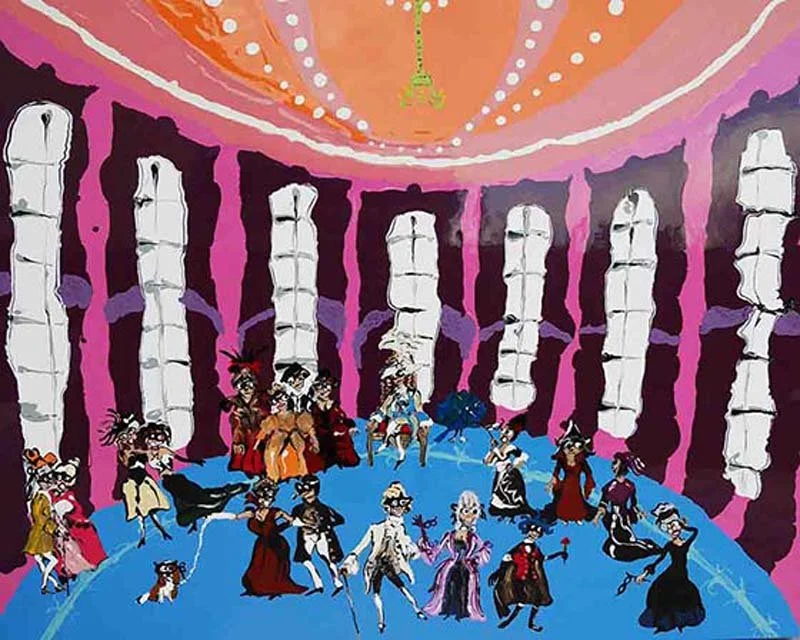
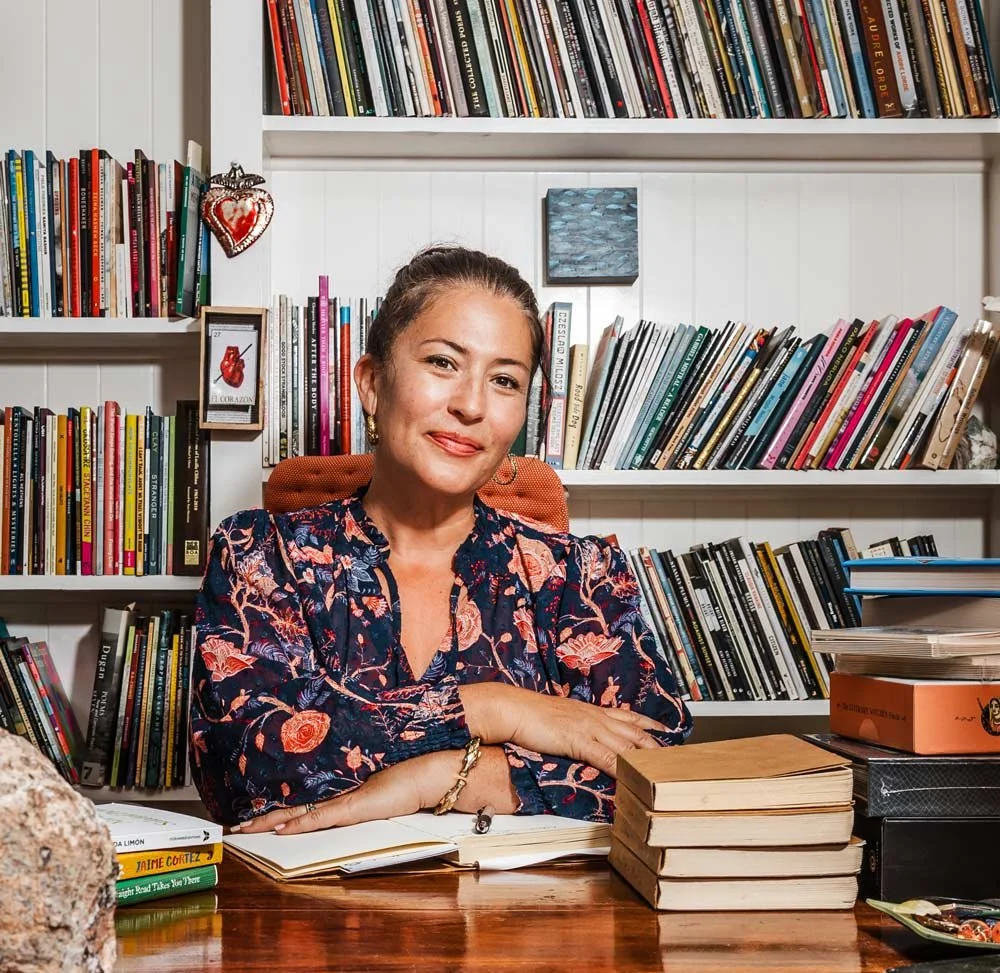
Dannielle Hodson (b. 1980) is a London-based artist and graduate of the Royal College of Art (MA Painting). She previously studied Womenswear Fashion Design and Fine Art at Central St. Martins and completed the Turps Banana studio painting programme. Her work has been exhibited in solo and group exhibitions at galleries, art fairs, and public institutions. Hodson’s practice explores themes of complexity, transformation, and the human condition, often drawing upon personal history and psychological landscapes to navigate the space between the known and the unknown. @danaedoodles
How did your upbringing in Wolverhampton and Telford shape your imagination and your approach to art?
I was born in Wolverhampton, UK. We moved to Telford in Shropshire when I was about 7 or 8. Telford at the time was a new town in the countryside—new developments surrounded by acres of fields so it felt like there was lots of space and I had a lot of freedom to roam around. There wasn’t really much to do and that can be boring but it made me inventive. I learned how to be alone and how to entertain myself and create my own fun. In the absence of distraction my imagination became powerful. It also meant that I read a lot and that’s where my love of reading began.
Can you recall a moment when you recognized art as your chosen path? Falling in love with art has so many layers to it! As with most kids, I loved drawing. My Nan (Ninny) taught me to doodle (make a scribble and find faces in it). I became obsessed with this, creating increasingly complex scribbles peopled with evermore tangled faces (this is why I got the nickname Danaedoodles). I don’t know if my acute sense of pareidolia fed into this or if this gave me such intense pareidolia but it was definitely the beginning of seeing multiplicity.
My secondary school had an excellent art and design department, the teachers were very supportive. I remember helping to make (what felt like at the time) giant life sized props for school musical productions and I designed the school sports trophy which was fabricated and used within the school. I think those real life design opportunities shaped my understanding of the place for art in the everyday.
My mum was a fashion designer when I was very young and made leather stage costumes for bands and models. I remember she made me a fire hydrant red ruched leather jacket (it had enormous puffy sleeves) and mini skirt to match; I felt amazing in it! I was bullied for wearing it to school by my teacher because I looked strange especially compared to other kids but it didn’t bother me because I enjoyed the excitement of the clothes, the feel and smell. Fashion was there for my first love and seemed like a real job I could do. In the early 90’s growing up in a culture void meant my access to the outside world was through fashion magazines—Vogue and Sunday supplements. I remember reading about John Galliano and Alexander McQueen and I was sick with longing. They had graduated from Central St Martins college and that became the place I had to go.
Studying at Telford College of Art and Design aged 16 would be my first time in an artist community; this really shaped my world. I loved the diversity of the students, it was like all the strange kids came together and it felt great. Our tutors were also very engaged, they felt radical and were passionate and free thinkers and I’m so grateful to them for sharing their enthusiasm about art with us. They cemented my love of learning and my deep appreciation for artists. We went on a trip to London in a coach to see the groundbreaking Sensation exhibition at the Royal Academy. It was a profound experience, like a mind explosion, and even as I type this now I get goosebumps because this was the moment I knew I had to be in London and go to Central St Martins. My fashion teacher (the fashion part of my BTEC was at an A LEVEL college) told me not to apply because I wouldn’t get in and that I would waste my first place. I don’t think she was bad I just think it was the mindset of people at the time in that place, people like us (less privileged/working class) don’t do those things. Fortunately my other tutors really believed in me and I made some batshit crazy outfit to put in my portfolio and I got in!
St Martins was insane. Coming from Telford it was incredible, people from all over the world, dressing differently, eating differently—all together making fashion/art and I loved it.
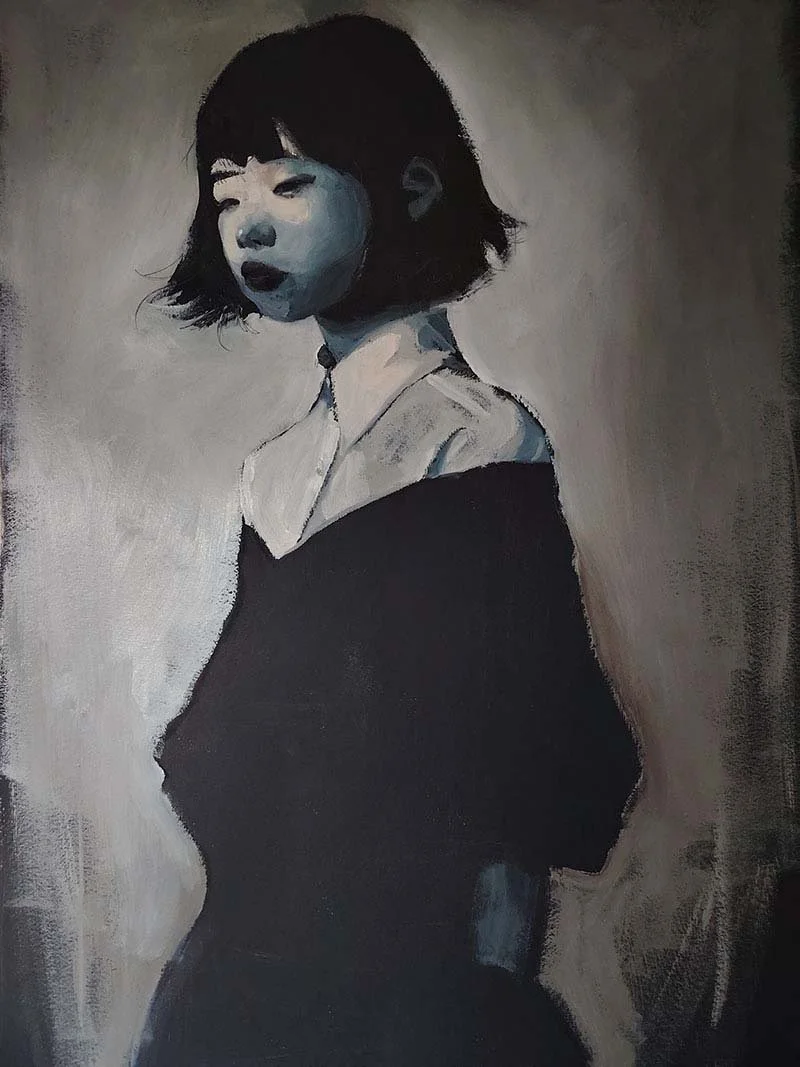
Becoming an artist happened later in life. In around 2006 my life got turned upside down when I was out in a club with friends. In a bid to calm a situation, I came between two girls arguing, underestimating how volatile the dispute become. One of the girls grabbed my throat and in that moment, instinctively I hit out at the girl. I was holding glass… both of our lives were changed forever in a sliding doors moment. In a split second life forked and the path I thought I was taking was no longer available to me. What followed was a period of desolation; I really struggled to get to grips with my new reality. It wasn’t until I went to prison and the worst thing that could happen did, that I started to rebuild my life. In prison I returned to doodling the way my Nan taught me to and it rekindled something buried deep inside of me. I also began painting self-portraits using oil paint for the first time (college had been about bitumen and house paint). Painting was a catharsis and in many ways saved my life. My paintings went on to win me prizes and exhibitions: the Koestler Award, my piece was exhibited at Royal Festival Hall; and an open call by Outside In, a charity I later became a Trustee for. I won a solo exhibition in Pallant House Gallery and this was the beginning of my art career when I understood the power of the arts, to heal, to transform, to create—a force for good. My involvement with the charity Outside In exposed me to many people like myself who, through art have coped with difficult situations and learned to thrive. I have so much admiration for them.
Describe a typical day in your London studio.
A typical day in the studio starts with meditation followed by a mushroom coffee. I really love mushroom coffee! If I’m starting a painting I make automatic marks on a canvas using a raw umber, a classic underpainting colour. I play loud music, mostly house music, sometimes classical. I love Agnes Obel’s September Song for this particular purpose and can listen to it on repeat. I dance a lot in the studio; being of the 90’s house music was this thing that really brought people together and it just makes me feel good, that’s the kind of energy I initially want to transfer to the canvas.
The next stage of painting is slower so a typical day will start with mixing oil paint—not too much because it always looks different on the painting and I like variety but something to get going with. I like to look at art historical paintings for colour palette inspiration and make a louder more saturated version. Oil paint is beautiful to paint with, very alive and gives you opportunity to build or remove, it’s very forgiving. I use brushes/fingers/rags/palette knives and a variety of painting mediums like wax or gloss to get different textures/surfaces. I also use the ‘end of the day paint,’ the detritus/scrapings/muddy globs; this has to be part of the work to make it more real—it also prevents excessive waste.
While I paint the main body of the painting I usually listen to social science audiobooks that explore the human condition trying to make sense of why we do what we do. I can also binge Netflix series, I’m not fussy about highbrow or lowbrow material it’s nice to switch it up and I’m alone for hours, sometimes a sitcom is good company.
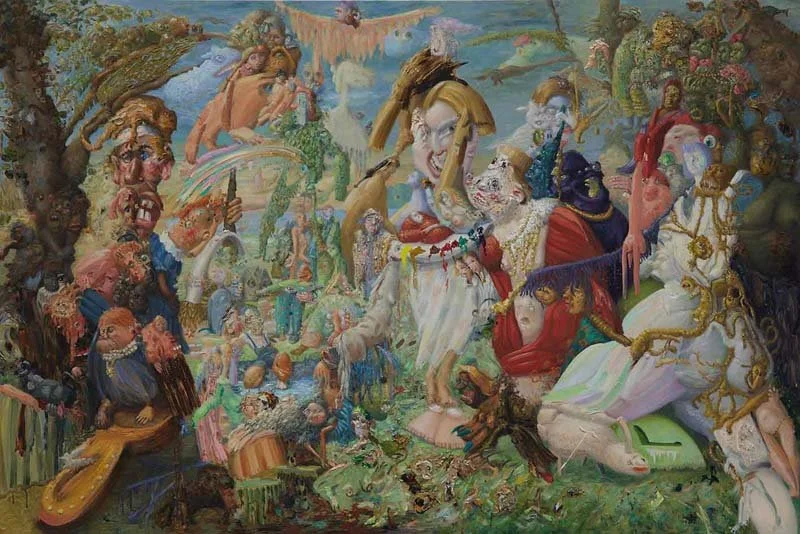
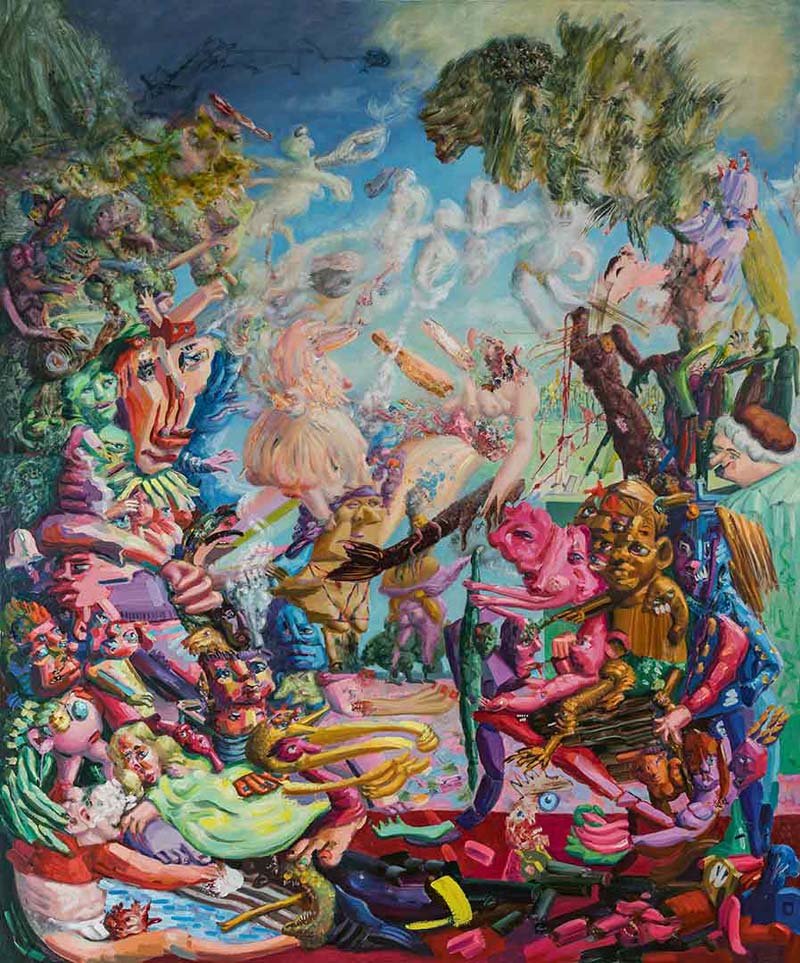
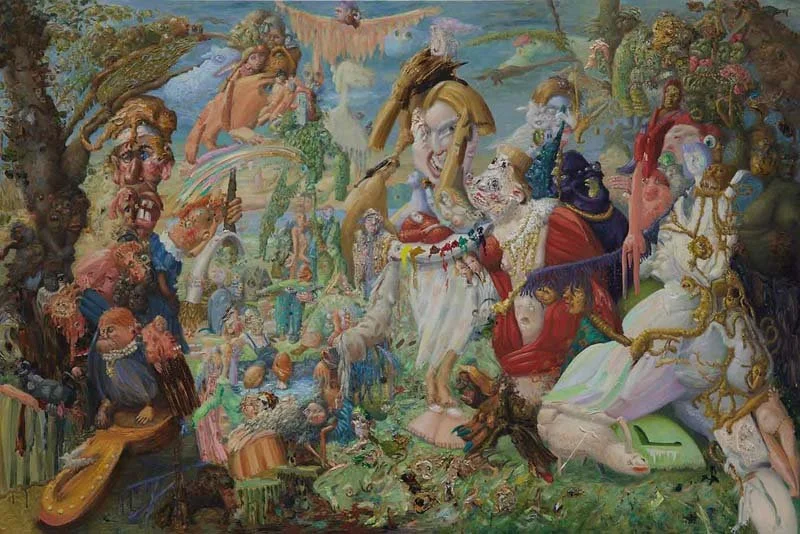
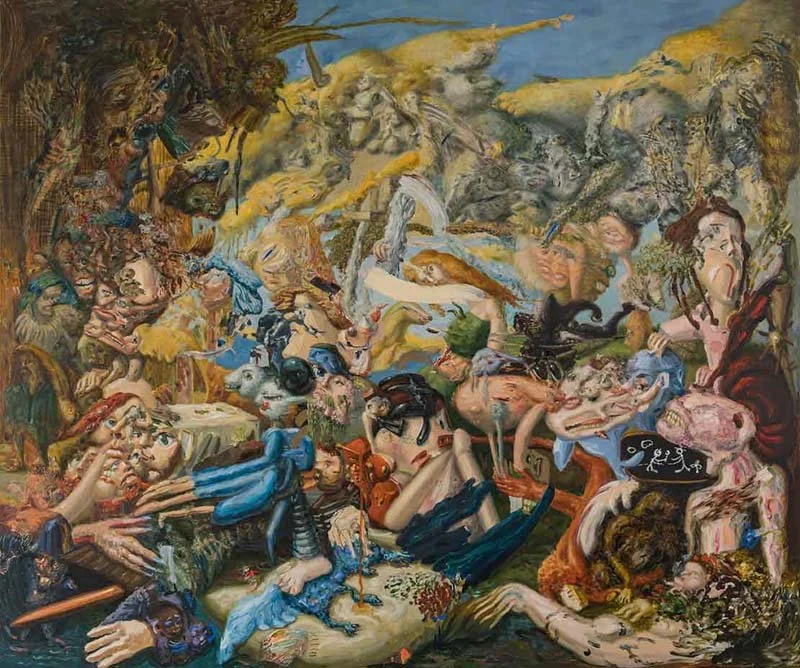
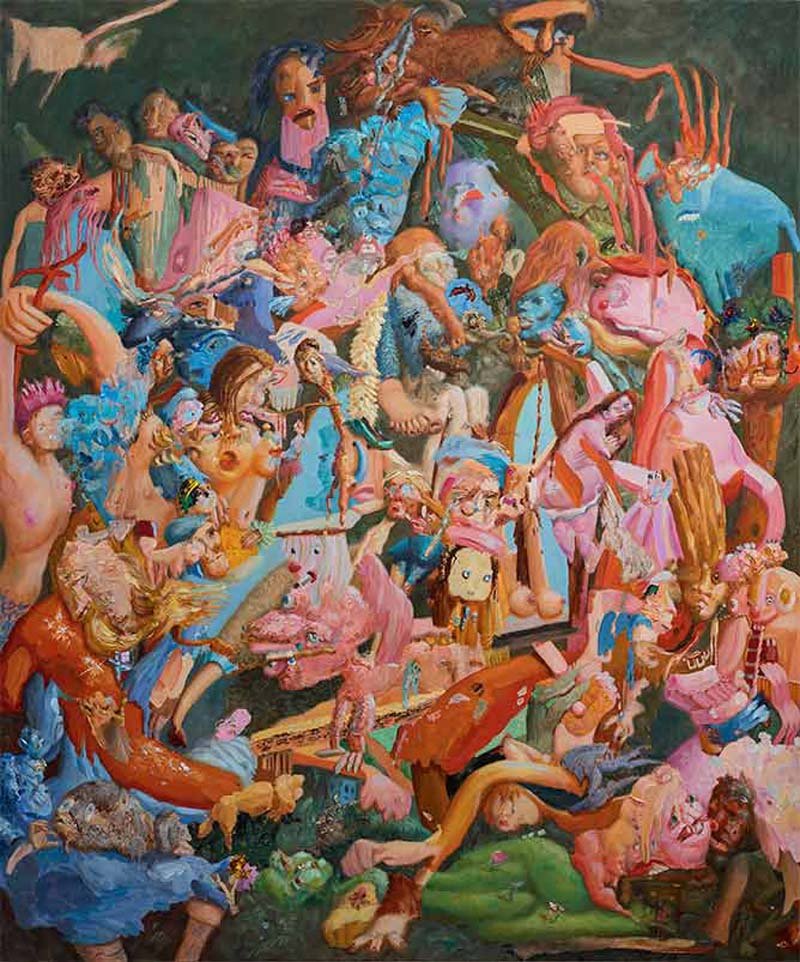
What I actually do all day on my canvas is not so straightforward! I look at the random marks I’ve made on my canvas, much like I did when I was a kid looking at scribbled doodles and I look at what they resemble from the known world and I give them a little bit of a helping hand to materialise as something close to that but not entirely that, like clouds look like things but they are never really that, more an idea or a gesture of a face or hand is perceived, and that way I’m realising the characters, or people and places of the painting and not of the known world which creates something strange between known and unknown. I am also painting everything that I see—it’s hard to explain but I paint many outcomes at once, an arm of one figure may be the leg of another. It makes painting slow because I spend so long looking and it is quite tiring mentally, I’m done after 5-6 hours or I start making a bad mess opposed to a good one. Ultimately, the painting always dictates what is going to happen. I have no real plan and I don’t want one, that is where the excitement comes from the unknowing, the frustrated nervous energy, serendipitous brush strokes, ugly blobs of leftover paint. If I knew what I was going to do I would be bored very fast.
I'm very comfortable with the not knowing where the painting is going to go. I might use an art historical painting as an anchor for the work; this is simply to give some coherence. However, each day is a new day and I allow the painting to go wherever it wants to go, it becomes a record of fleeting ideas, and as the painting transforms from unfinished to finished many of those dialogues and thoughts overlap and are concurrent.
Tell us about your "Forking Paths" body of work and the themes driving your practice.
I've just finished work on a body of work for a solo show at Kravets Wehby Gallery in New York. The show is titled Forking Paths after The Garden of Forking Paths in Fictions by Jorge Luis Borges.
The Garden of Forking Paths is a story about a book that is also a labyrinth nestled inside a detective story. The story that is a labyrinth pursues, at every forking path (point of decision making), every outcome, so all possibilities are possible and simultaneous. This is the kind of complexity I felt I was dealing with in my painting and reading that story gave me permission to lean into that. I’ve noticed the more complex the work becomes, the more complex it can become, like I’ve reached a new threshold of mental load. I’m often asked why I don’t do less, why do I do so much—there aren’t many examples of doing more. The more complex things become in real life the more one might strive for simplicity but I feel the opposite to that, I want to welcome it all and hold it because complexity is the life I know and understand. I’m a working mum of two children, if I’m not doing at least 3 things at once shit won’t get done. I titled one painting, If Everything, Nothing, which might feel pejorative but for me it's wonderful, to be so full that no one thing has the power, everything is equal, connected and no less or more important than the whole or Gestalt.
When viewers navigate the complexity of your paintings, what kind of engagement do you hope to spark?
While I don't wish to dictate anyone’s experience of my work I do hope that people have an experience with my work and follow one line of thought within it only to realise it’s part of another. We are living in an attention economy where everybody is vying for attention however I think what I’m after is more about a slowing down and looking and being surprised by seeing where something goes and realising if you look at it differently from another angle you will see something else, there are no right or wrongs, just different ways of seeing and if I can talk to the bigger picture of this there is definitely a communication problem in the world, an inability to see from the other perspective and allow conflicting opinions to sit side by side. Rarely is anything this OR that, there is always a bigger picture.
Which artists, past or present, would you like to meet, and what would you like to discuss with them?
I am extremely uncritical and love every artist I meet! From the past I’d choose Hieronymus Bosch. Most people reference him when looking at my work but I can’t say it’s a conscious choice on my part. I am going to bet that he is very ordinary and the work is where all the interesting stuff is. I can’t imagine what we might talk about, I’m a bit socially awkward at the best of times so maybe I’d just buzz off his energy.
Present, I’m fascinated by David Altmejd. I love the work but also listening to him talk—about energy and transformation—and the way his work comes to life. I think we share similar sensibilities towards making. Art school can push you towards meaning and there needs to be this big explanation about something or a real political agenda, and it's rare to hear someone just talk about energy.
How do literature and art history inform your paintings?
I take lots of inspiration from art, but it feels stolen, like I’m a magpie collecting shiny things for my nest, taking what I need from it because I like it, not because I’m paying tribute to that artist and I wrestle with that but it’s the truth. I look at historical paintings for their colour palettes and to borrow some of the composition that the artists so painstakingly worked out. On my studio floor I lay books out, I might have a page open in an Oskar Kokoschka catalogue, as well as a Soutine and Willem de Kooning, so that I remember to be loose and have a page open at a Titian or Rubens painting for composition and one of Paula Rego’s sculptures because I seem to think in sculptures and I like the homemade quality of hers. It’s not copying or inspiration as such, more a reminder not to get stuck in reality and the importance of energy and brushstrokes.
I’m also inspired by books about writing and how to write. Transformation is a major theme in my work and I’ve learned the backbone of any story is that something or someone has to change. If A-B is a straight line and nothing really happens then I for one will stop reading, I can’t associate with it, life isn’t A to B and chaos is more certain than we give it credit for. I know this isn’t necessarily what people are looking for in a still image, to have unexpected change and transformation, but it’s what I strive for and the art of storytelling is a good guide.
Magical realism or fantasy books are my favourite genre and I’m working my way through them! Takashi Murakami, Susanna Clarke, Ursula Le Guin, Angela Carter, John Connolly, Salman Rushdie—so many great authors who shift the world, just a bit, and encourage a different way of seeing.
What is the significance of the cultural landscape of London to your creative practice?
Walking through Hyde Park to the Serpentine Gallery. I don’t mind what’s on I just like the experience, the rollerbladers, pedalos, swans and ice-cream/coffee followed by art.
Can you describe the challenge of resolving a painting where you have no initial plan?
Every painting is a challenge, I just keep on keeping on!
Tell us about teachers or mentors who influenced the artist you are today.
I am fortunate that I enjoy learning and I have had good teachers. I think that a healthy mindset is to go into the learning environment like a blank page and listen, not everything will be relevant or important but some things will be and small pieces of wisdom will accumulate into something interesting. One of my favourite teachers was Sergei Pavlenko, I feel like he really taught me how to paint, not necessarily any formulas or rules but about energy—we’d always start with a beautiful mess and I still do. Every time I’d paint something that looked like the thing he would come over with a palette knife and scrape the paint off because I’d made a copy—it looked like the thing—but it had no life! I think that’s the most important lesson I ever learned and to this day I hear his voice in my head as I paint. I value all of the mentors and tutors from the various schools and colleges I’ve studied at. I'm grateful to Phil Allen a fantastic painter and tutor from Turps Banana and the Royal College of Art, he is very generous with his critiques of paintings. He told me very early on when I started Turps that my stories were more interesting than my paintings. I really had to think about what to do about that! I figured that I had to bring the colourful life I’d lived into the paintings for them to perform or function like I wanted them to. That was the beginning of making the work—my work—as it is now. His constructive criticism was a gift.
Sustainability in the art world is an important issue. How do you integrate environmental consciousness into your studio routines?
Sustainability is important to me. I realise I'm producing a product and there are enough things in the world so in order to rectify that with myself I don't make tonnes of work, I'm not a very prolific painter. I spend a long time in each painting to make it something very special that I want to put out in the world, I don’t abandon canvases, I make them work, I give them what they need and stay with the problems that arise and work them into the narrative.
I'm conscious about the heavy metals in the paints that I use and have moved to non-toxic cleaning products and try not to wash my brushes too often and if I have to only using natural products. I use old rags for cloths, I asked my neighbours to donate any old garments that can no longer be worn because they have stains on etc for me to use as rags so I'm trying to make my footprint as light as it can be while I recognise that we all have a footprint.
Does being in nature inspire your art or your process?
I think beauty is all around us, I teach my kids to notice the things around them. On our walk to school my children and I will look at the different bushes and plants examine their leaves and notice which flowers are coming out. We once saw a bush full of snails and we made stories up for the rest of the walk about the acrobatic snails; we watch ants busy carrying stuff and notice different kinds of ants when we are abroad. I have lots of spiders in my studio—sometimes I get lucky and can watch them spin a web and other times I have to keep rescuing them from the sink—my studio is in the garden. I like being outdoors I don't think any one bit of nature is more special than another I’ve taught my kids that this is their home too and we are blessed to have them around us.
In an era where digital tools like AI are redefining reality, what is the importance of the physical, haptic act of painting?
I don't know how I feel about AI, on one hand I think it is fantastic to have many tools at your disposal and ultimately it is a tool which you have to learn to use—I haven’t—however I’m mindful about its impact on imagination and the speed at which it produces.
Process is important to me, it’s like exercise, I do something hard and I’m rewarded, I gain muscle, I grow, it’s not easy but I overcome challenges and arrive somewhere, not necessarily where I’d envisioned but where I am supposed to be and I’m better for it. The journey is important.
There is a lot to be said about haptic feedback and the sensation of being with material—the physical part of the creative act, I think that it can explain why a lot of troubled people find comfort in art making, not as distraction but purpose.
I personally don’t feel happy sitting at a computer but thankfully we are all different—if it was all I had I’d take it. It's possible that AI can give people who are not able to use other forms of art making access to art making and I think that is great.
I get a lot of AI videos in my Instagram feed. AI has definitely shifted our conception of reality and it’s a big moment. We know a painting is not reality it never presents as reality, its simulacra, however AI presents as reality and that is confusing. I’m then tempted to ask, what is reality anyway?
Exploring ideas, art and the creative process connects me to the universe—all the possibilities that are endless and all possible!