

London-based artist Ilsa Brittain on the unifying principles of life, the complexity of interconnected systems, and the meditative investment of time.
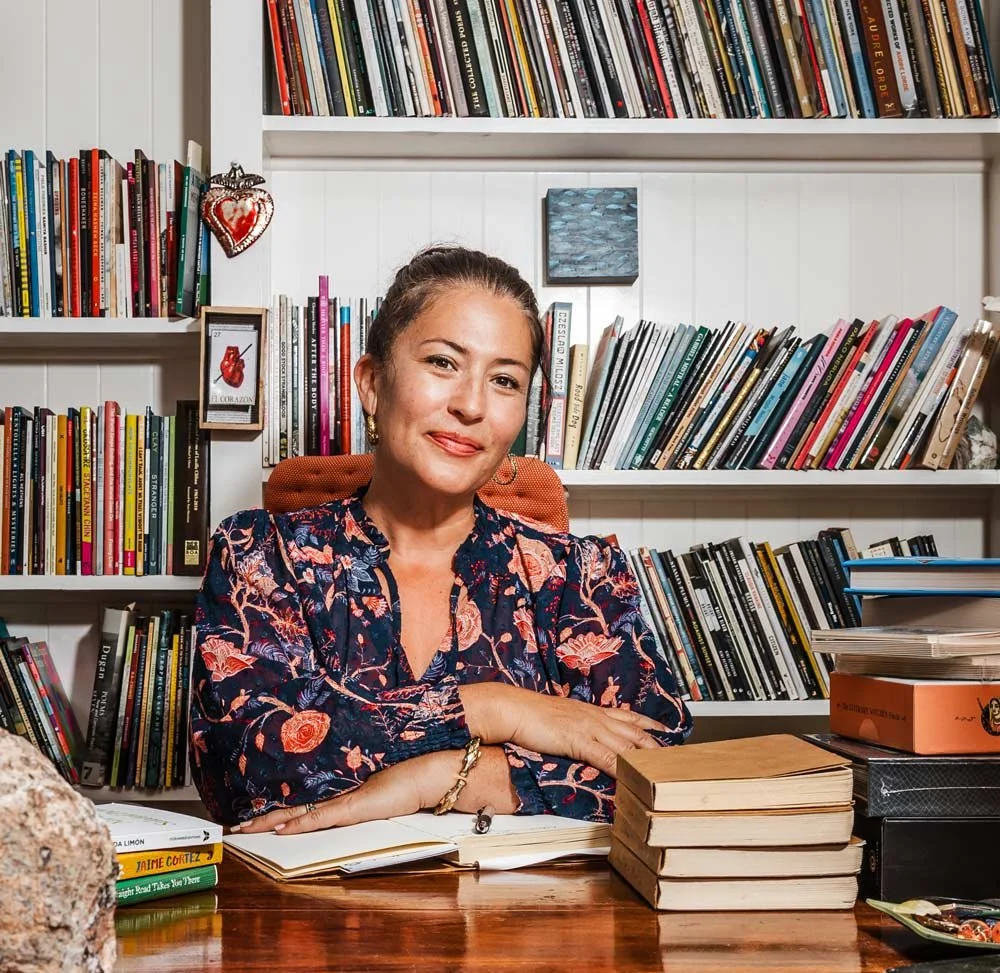
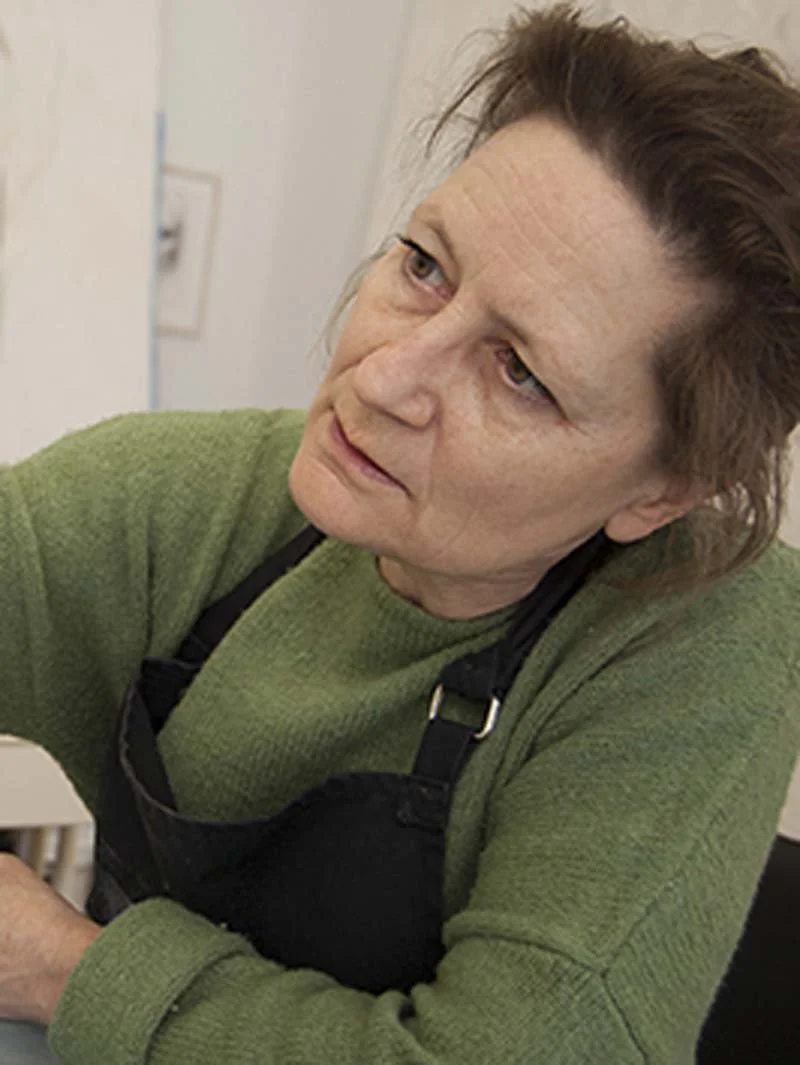
Ilsa Brittain is a UK-born artist with a global background that spans childhoods in forests and on boats to humanitarian work in Nepal and Cambodia. Having studied art in Moscow and New York, she is now part of the London art scene. Her work is deeply informed by broad life experiences and an inquiry into what unifies the lived experience across cultures and species. Brittain builds her paintings through a process reflecting the evolution of life: starting with a field of color and slowly layering interconnected complexity to explore the fundamental nature of being alive. @ilsabrittain
How did your upbringing in the forest and your years at sea influence your art and your thinking about the world?
I was born in the UK, spent my first years running wild in the forest, left to live life on a boat where I was home-schooled sailing round the Mediterranean, returned briefly to enter the school system not understanding the purpose of the restrictions we were expected to endure, married and left again to travel the world working for Aid agencies and the UN and to raise our own children. It was in Kathmandu that I decided I needed a formal education in Art. I managed to gain a UK degree in Fine Art in just over 6 months and then went to New York to complete a masters. Two intense years later I rejoined my husband in Vienna and then finally returned to the UK.
I would say my experiences have led me to have a broad and open view. Seeing how different cultures develop different strategies to navigate the similar demands of social living, it becomes clearly apparent there is no ‘right’ answer or one way of doing things. There are consequences of different choices and solutions, some more desirable than others, but no one thing can be isolated, everything operates as an inter-connected system. It is even embedded in the language—you cannot truly understand a culture unless you speak their language. This has made me curious about what is beneath the level of culture, morals, acceptable behaviour etc., what is fundamental to the human experience, what is it that unifies us all. Then I want to know what connects the human lived experience with other living things, what is it that we share with other animals, with plants, with micro-organisms. At a fundamental level what is it to be alive?
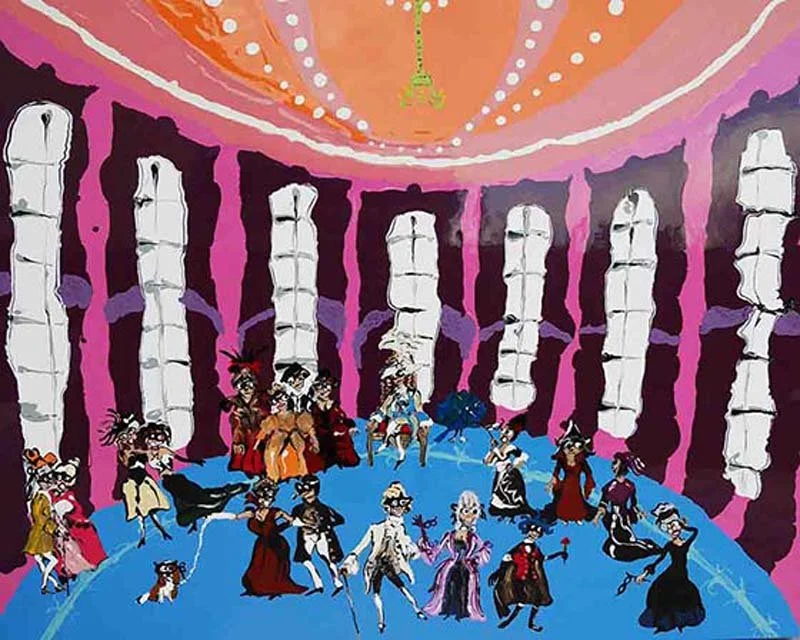
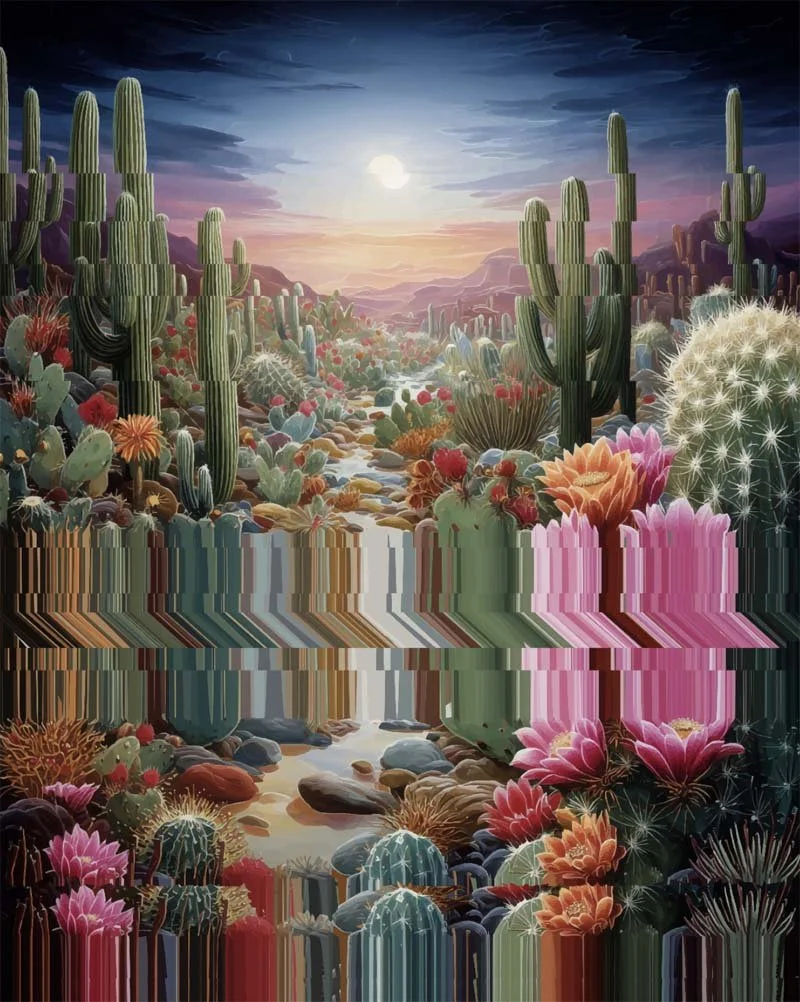
This curiosity about the unifying aspects of the lived experience, and the interconnectedness of systems, informs my work. I build the paintings in a way that reflects my thinking about the process of evolution of life—first with a field, then with a mark, more and more marks, and then the slow building of interconnected complexity. A field of colour is built up by laying down complementary colours in sequence over each other with enough transparency that, rather than sitting as an opaque block, it feels like a transparent depth. The imagery is then built out from this field with multiple marks that layer by layer (maybe up to thirty), increase the complexity. All the way through I am looking to not break the continuity and the connectedness of everything even though distinction is required to describe anything. As I build the imagery I look for ways to create different levels of ‘noise’—I want to create the feeling that everything is made up of smaller things. I look for ways to imply movement, relating to the idea that nothing is permanent, everything is in motion—yet I create a clear environment that is visually available to explore in detail and become immersed in. For me this relates to the strange tensions we live with as conscious, being both witness and participants in our lives and environments.
Can you recall a moment when you recognized art as your chosen path?
I can’t remember not wanting to be an artist but there have been many many times when I wish I didn’t—it is not an easy road. However, I do believe it is a pursuit worthy of the chase, there is a reason we have always had art. I think it is primarily because it is mighty confusing being human, with all the different drives we have to navigate. Art is a way to explore these notions, both as makers and viewers, and there is a need for it to be continually made in order to explore each new contemporary setting of the human journey.
Describe a typical day in your studio.
I turn up at the studio every day I can. Sometimes, if I don’t want to break the creative process, I will sleep in my studio and work for continuous days until I am through to the other side of it. My tools are paints, mediums, applicators, surfaces, reference material and the thoughts I have. I am built as a uni-tasker so like to work exclusively on one thing at a time, but don’t always have that luxury. I use music for the moments I need to fly, silence for the moments I need to make decisions, and podcasts/audio books for the times I need to get through the long hours of execution.
Tell us about your current projects involving cloth motifs and the themes driving your work.
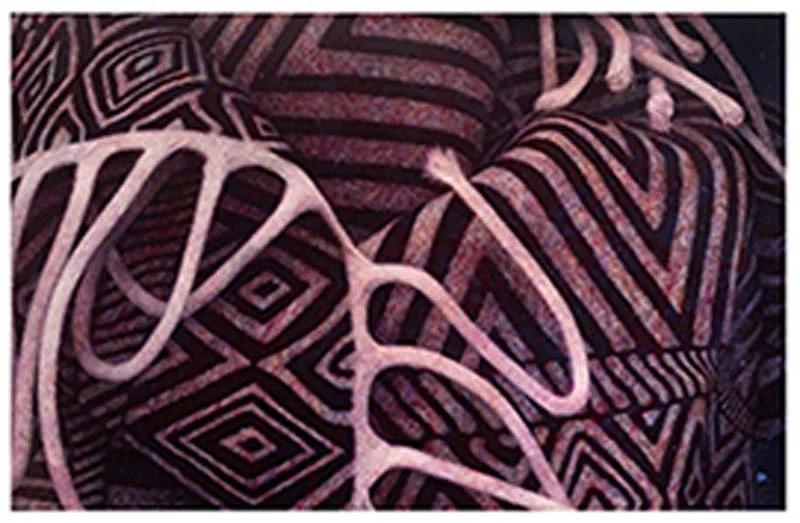
I am currently working on a series of paintings where I am using cloth as a central motif. I like that it is a familiar object and associated with functionality, safety and comfort. Also, that its production and the patterns incorporated in it, come from a long culturally entangled history. Each time a piece of cloth is thrown down, laid down, wrapped round etc. it will fold in an entirely unique way. It is impossible to make it fold in exactly the same way twice, yet it is governed by predictable laws of physics. For me this makes it an exciting motif, a bit like each of our lives where the combination of our particular experiences and personality are unique in their totality but common in their parts.
By rendering the cloth, an inanimate object, as if in movement and as if chance and will might be at work simultaneously, I am thinking about the thin line between what is living and what is not, whether chance or free-will is operating, and how a moment is past, present, or future. For me these are the mysterious fundamental aspects governing everything in our mental and physical world, just below the surface. The cloth is painted with a series of multiple layers of pigments and mediums each with a different application process. I want the detail and the modelling to make it appear tangible, touchable, but just out of reach as if it is submerging below the surface of the canvas. I want the surface, glossy and highly reflective, to push the image of the cloth even further below the surface, and bring in the context of the surroundings, even the viewer themselves. I want to create something that is both a painting and an object, something comforting and familiar but questionable about what it is.
When viewers experience your art, what emotions or ideas do you hope they connect with?
The paintings are designed to be inviting and confusing, a pleasure to be immersed in, where the viewer can spend time in contemplation and is prompted to do so as concepts are slowly elicited. I find this happens most effectively in person where the mystery of the materiality, the illusion, the scale and the reflections operate with and against each other in an interesting tension of possibilities. I want the work to go as deep as the viewer wants it to go.
Which artists, past or present, would you like to meet, and what would you like to discuss with them?
I’d love to meet the pre-historic cave painters, and also have the ability to converse with them, to understand what they were doing and why. I sense their reasons might still have relevance today and that would make me feel strangely euphoric, as if there were something so much bigger running beneath our ego idea of self. I’d like to meet Leonardo, Michelangelo, and Raphael to get the gossip on what kind of men they were and what they really thought of each other. And to understand what a different demand it must have been to be an artist in those days.
I like meeting contemporary artists because they invariably give me a new insight into their work that opens it up to more interesting understandings, and reveals something about the contemporary issues we are concerned with. And because I love their work I would love to discuss the ideas in more depth with: the Japanese artist Chiharu Shiota (b1972)—her work has so much to do with connection, with the building of memory and experience, and that fine link between our mental and physical worlds; the American artist Jackie Brookner (1945–2015)—her bio-sculptures are such a wonderful bringing together of nature, of life, of sustainability, of the entwined nature of everything—they are inspirational; The German artist Alicja Kwade (b1979)—her installations open questions about our shifting understandings of time and space which I am particularly interested about.
Do you draw inspiration from music, literature, or other disciplines?
I look at a lot of art and listen to music every day. I read and take in the current conversations in terms of news, discoveries and new understandings. They all feed me and inform my work but they also distract me. When I really need to concentrate I shut everything off.
What is the significance of the character of London to your creative practice?
I love having access to London—as in any major city there is always something new to discover, and whatever you might need you will be able to find it. Each city has a character to it, which I imagine shifts through different times. I remember arriving in Hong Kong after living in a remote area of China. I couldn’t get over the pace, the energy, the drive to achieve buzzing on every turn of the streets. The enormity of the wealth sealed up in every building blew my mind. Arriving in New York from Kathmandu I had a similar feeling. London has a different, slower character, spread over a much larger expanse. It feels like a globe of endless small towns all pushed together. I don’t think it is possible to get a sense of it as A city. Every time I have an exhibition in a different part of London I feel like I am in a different city, but this is part of its character—it has a long history, a broad footprint, and a mingling of many different cultures.
Can you describe a project that challenged you creatively or emotionally—and how you worked through it?
My work deals a lot with the intensity and depth of the thought process. My own thinking can go down intricate rabbit holes that open up to fields of ideas that overlap and interweave and become impossible to describe with the limited linear nature of language. But with an image one can create something that can be seen as a whole instantly as well as explored slowly as all the different aspects can be considered in relation to each or in isolation. The colours, the shapes, the motifs, the familiar, the strange, the brush strokes, the composition, areas that demand attention and areas that invite contemplation—all these aspects can be considered all at once, individually or as layers of understanding.
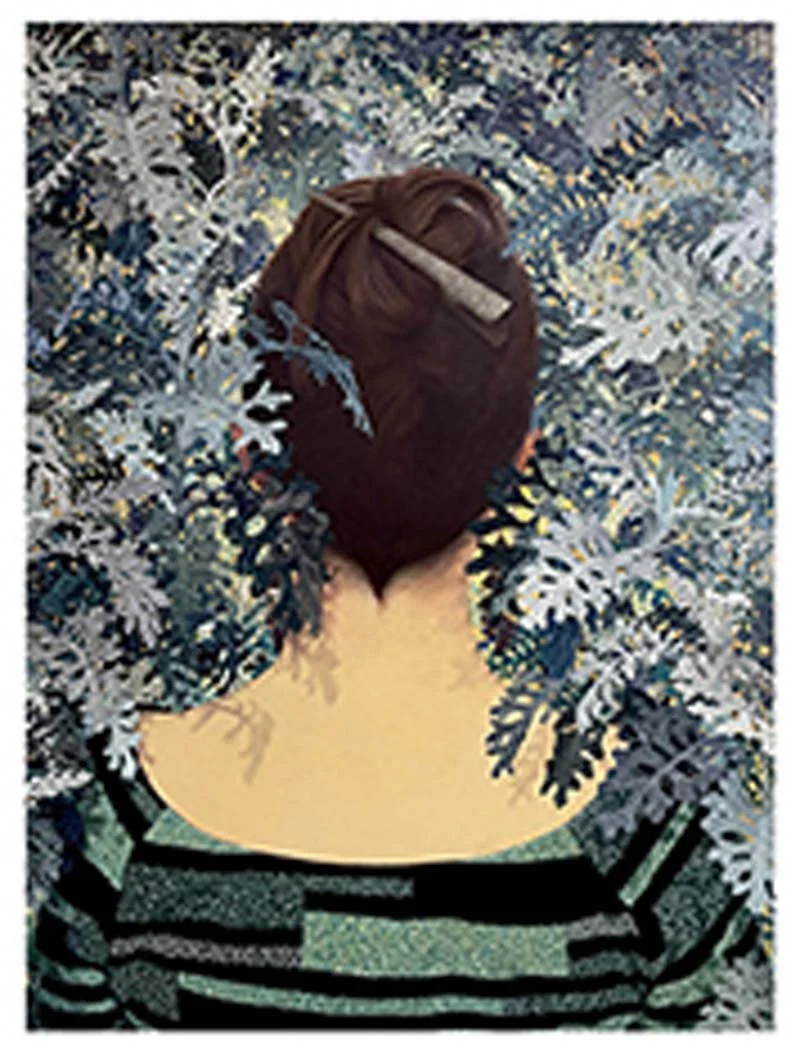
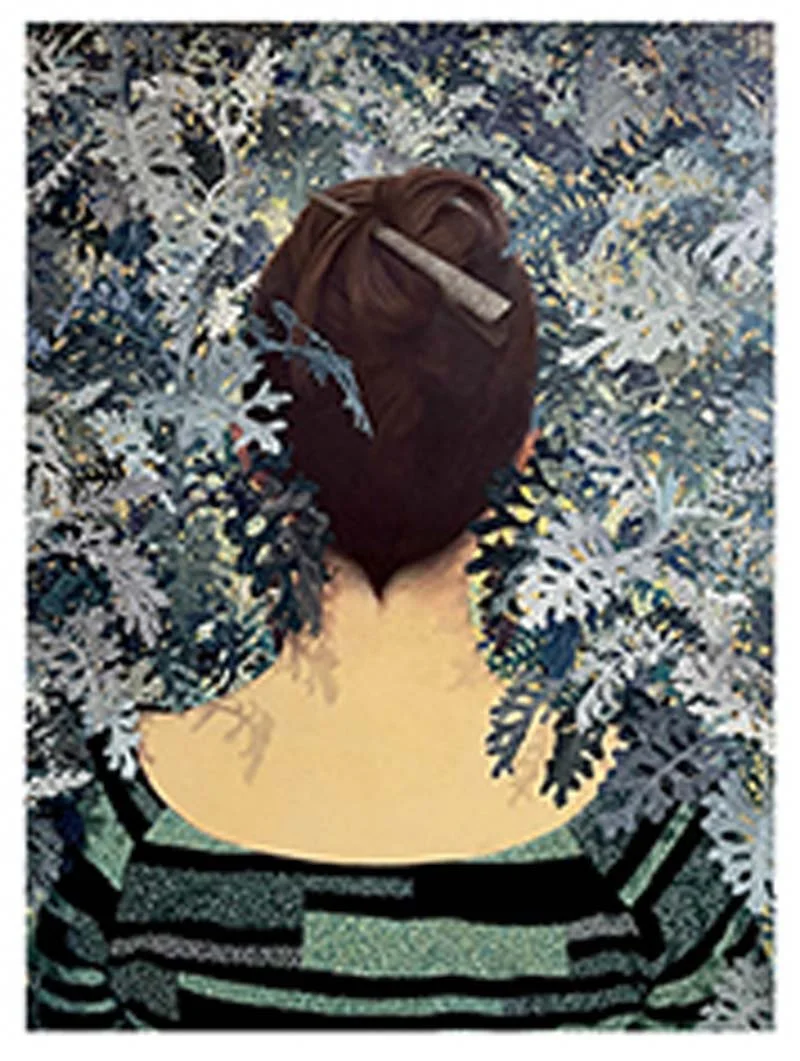
I wanted to make a painting that dealt with this intensity and depth of thought. The image is the back of a girl’s head embedded in a thick density of leaves. Normally, a painting like this would be tackled by giving an impression of the detail rather than providing the detail itself, and the detail would get even less as you went deeper into the imagery. I wanted to provide the detail all the way to the back so the viewer could become as immersed in the beauty and complexity of each leaf as the girl seemed to be. I wanted the spaces between the leaves to open up as the viewer properly entered the work, as a world opens up the more you consider it. I wanted there to be available a fast read, a slow unfolding, and a deep interpretation. Because so much detail was required, and each and every leaf had to be individual, and painted by hand, the painting required an intense investment of time—it took two years to paint! Through that time I went through all the crises of the creative process—the euphoric dream of an idea, the creeping doubt of its worthiness, the tediousness of hard labour, the pilgrimage of belief, the loneliness of self doubt, and the glow of achievement—all circling round during the two years of the process. I hope these things are embedded in the painting itself—what it is to lose yourself in the wonder of an idea, how different it is from the outside and the inside, how dangerous it is to get so buried in an obsession, but how obsessions open up unexplored possibilities, all the emotions of following your own path. This is what I went through in the process of making this painting. After I finished it though I felt like I was on the other side of it, in a new terrain, where I gave myself permission to follow my own path with my art. It was if it had locked me up, in a beautiful space, and then released me.
Tell us about important teachers/mentors/collaborators in your life.
In terms of picking up the skills required to make the work I do, I have been self taught and classically trained, I have borrowed and learnt from everything and everyone I have come across in person, in books, and online—I am grateful to all of them, but I couldn’t name one over another in terms of influence. Really my journey properly began when I stumbled upon a particular way of painting with acrylics (up until this moment I had principally worked with oils) involving multiple layers each with a different application process. These layers when combined allowed me to create imagery that has textural tangibility but at the same time, because of the very reflective surface, seems to exist below the surface of the canvas, making it feel somewhat beyond reach.
As I was developing this way of working I also became increasingly curious about what it is to be conscious, sentient, emotional, biologically evolved, part of the whole network of life. This is when I realised what the imagery I was creating was aligning with and when I found my real teachers/mentors/collaborators—the authors of some of the most interesting books/lectures/podcasts, who are opening up new understandings in each of their fields of expertise. I will select just a few of them that have had a particular impact on my thinking and have also informed my work: Entangled Life: How Fungi Make Our Worlds, Change Our Minds, And Shape Our Futures (2021), by Merlin Sheldrake. He reveals how interconnected life is and how ubiquitous fungi are—neither plant nor animal they are found throughout the earth, the air and our own bodies. Nearly all life relies in some way on fungi. Life on the Edge: The Coming of Age of Quantum Biology (2014) by Jim Al-Khalili and Johnjoe McFadden. They explore how quantum mechanics (entanglement, superposition, wave particle duality etc) may be at work within complex life forms for processes ranging from bird navigation and plant photosynthesis to the way enzymes carry out biochemical reactions. Moral Animal: Why We Are the Way We Are: The New Science of Evolutionary Psychology (1995), by Robert Wright. He unravels the evolutionary advantages of moral behaviours. Becoming Earth: How Our Planet Came to Life (2025), by Ferris Jabr. He reveals how life doesn’t just make opportunistic use of the environments and materials present on the earth—it actually makes them. He shifts the understanding of Earth as a planet on which life thrived, to Earth as a planet that came to life—a vast interconnected living system. Power, Sex, Suicide: Mitochondria and the Meaning of Life (2006), by Nick Lane. He shows how the development of complex life on earth (ie more than unicellular life) required such a particular sequence of events that the chances of it happening were so unlikely that it only happened once. It then went on to drive the development of the incredible diversity, ingenuity and complexity of life we see today. Braiding Sweetgrass: Indigenous Wisdom, Scientific Knowledge and the Teachings of Plants (2020), by Robin Wall Kimmerer. She gives beautiful insights into the thinking of the native American Potawatomi people and their relationship with the land and nature, from both the perspective of a long cultural heritage and western scientific training. Lights On: How Understanding Consciousness Helps Us Understand The Universe (2025), by Annaka Harris. She explores the views of leading scientists on the nature of consciousness, whether it is an emergent aspect of complex life, or whether it is in fact the fundamental building block of all life, even the universe. I could go on—there are so many wonderfully interesting investigations into the fundamental aspects of what it is to be alive, conscious, sentient, and connected. These are the ideas that inform my work and, I hope, are buried in the depths of it.
Sustainability in the art world is an important issue. Does being in nature inspire your art or your process?
Being in nature, surrounded by woods, out at sea, on top of a mountain, in a garden, is a place where one is gifted rather than demanded of. Walking down a city street can be exciting and full of possibilities, but it can also be wearing to have one’s attention demanded of in all different directions, to be constantly encouraged to feel in need of more, to be surrounded by people yet feel lonely. In contrast, spending time in nature is a gift that invites you to breath deeply, enjoy the smells, take pleasure in the sounds, bathe in the visual feast, contemplate the wonder of the diversity and ingenuity of life, and feel the possibility of connection to a life force that you are part of—all without demanding anything of you. The feeling of insignificance in a city can be crushing. Out at sea, surrounded by the vastness of the ocean and the skies, I feel a totally different sense of heart-warming insignificance, I feel an unshackling of the responsibility for being alive and a shift to experiencing what it is to be alive. For me this is an integral and necessary part of my existence and one that feeds my practice.
In an era where digital tools like AI are redefining reality, what is the importance of the physical, handmade act of creation?
I think the arrival of AI and soon to arrive ASI, along with the exponential development of AI agents etc is going to cause an unprecedented paradigm shift that nobody can fully predict. The fact that we are moving ahead with few effective guardrails is scary to say the least. But I think we have reached the point where we are going to have to accept that we cannot control what happens. I think it will affect absolutely every aspect of living—how we work, how we interact, where the power lies, our sustainability and our development. I have heard equally convincing predictions of utopian futures (eg Sam Altman) and apocalyptic futures (eg Geoffrey Hinton), for ourselves and for all life on the planet. I am excited by the new possibilities and worried about how they will be leveraged. However, because the effect of the changes are so unpredictable it is impossible to prepare, we can only be resilient and adaptive, and concentrate on our small spheres of expertise.
The art world is already being influenced by the use of AI generated imagery which is as realistic (almost) as photography and super skilled painters. Online, where a lot of the work is seen, it is difficult to separate was is authentic and what is generated. The speed with which it can be generated lends itself to more experimentation but less depth. As with the introduction of any new tool it will take a while before real ‘art’ can emerge. But it certainly is fitting that that AI becomes part of the process, as throughout history our experience, our evolution, and our expression has entwined with our technology. However, just as much as we might crave a walk in the forest as a salve against the bombardment of a city, it may be that the hand-made, the authentic, the investment of personal human time and meaning may be given a more particular currency. And art often finds itself on the fringes rather than in the mainstream.
Exploring ideas, art and the creative process connects me to… what it is to be human. Most tasks or jobs have a goal to be achieved that is to do with providing a solution or a service, and one that is measurable in a clear way that determines whether or not the goal has been achieved. The job of an artist—exploring ideas, art and the creative process—is not a job, it is a painful luxury—one without a fixed financial exchange, without a transparent validation process, or even an agreed understanding of what it is. That is also its freedom. The word ‘artist’ is a loose term that covers many different occupations from making pleasing imagery to shocking the structural pillars of our social fabric, from eliciting a quick laugh to creating a zone for deep contemplation, from exploring a new tool to pioneering new terrain for art expression, and everything in-between.
History has taken us through different ideas about what art is for and what the acceptable formats are, and through contemporary times it seems the fashions can change in just a matter of a few years. As artists we are framed within all these ideas and must find, or carve out, our place amongst them. I think the task requires strength, independence, and individuality, but also a desire to connect, and finally a clarity about what you are doing. For me I would say the journey has not been straight forward, has definitely taken a lot longer than I thought it would to get here, and I don’t know how far ‘here’ is along the way, but I do have some clarity about what I am doing. My practice requires I spend considerable time exploring my own ideas and the ideas of others in the fields of human development, psychology, philosophy, the evolution and ingenuity of life, and the interconnectedness of all things. Lately, and I think this is a contemporary thing, the question of what consciousness is has come to the forefront of investigations. For a long time it has been a taboo subject for scientific investigation, but as the study of subjective experience has become more sophisticated and more scientifically rigorous, it seems the topic is more open for serious discussion. And it gets very interesting! Being able to explore these ideas, allowing them to inform the visual forms I am creating, pushing the limits of what paint can do, are all rewarding aspects of my practice. Finally, to see how people respond to the work, when the concepts that I am contemplating are considered in connection with their own ideas and experiences, is affirming of everything I believe in.