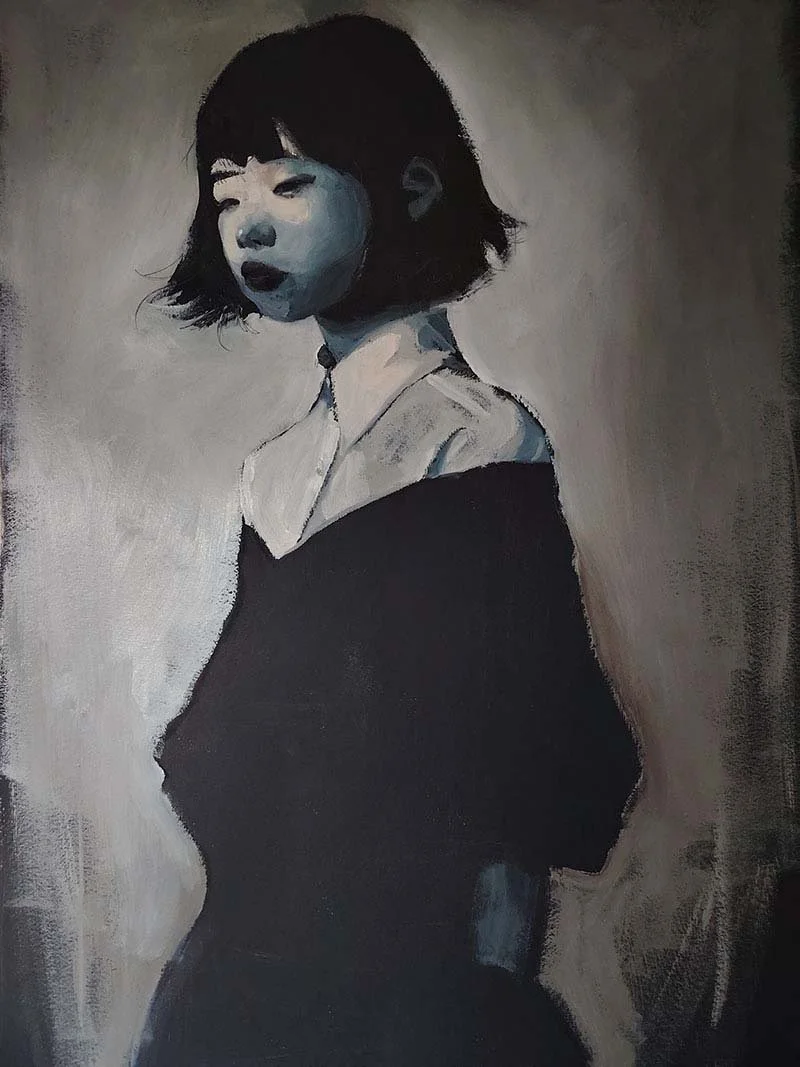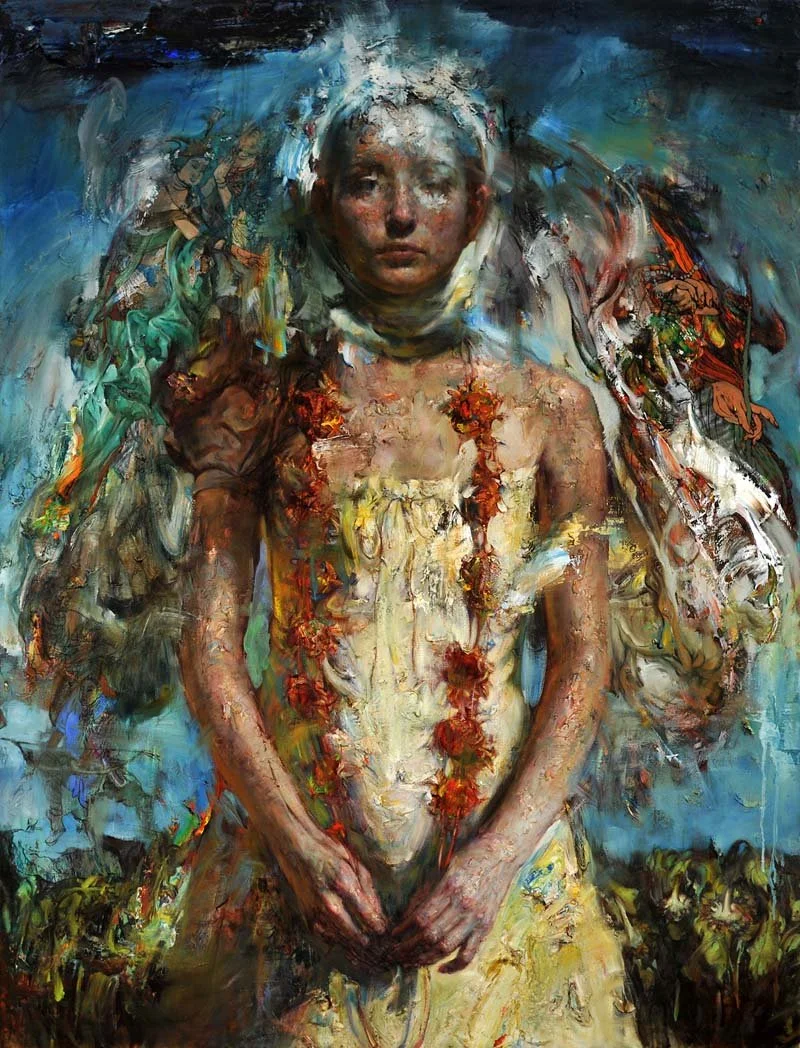


Wexford-based artist John Busher discusses his childhood on lighthouses, the influence of Irish Civil War archives, and his expansion into painterly ceramics.
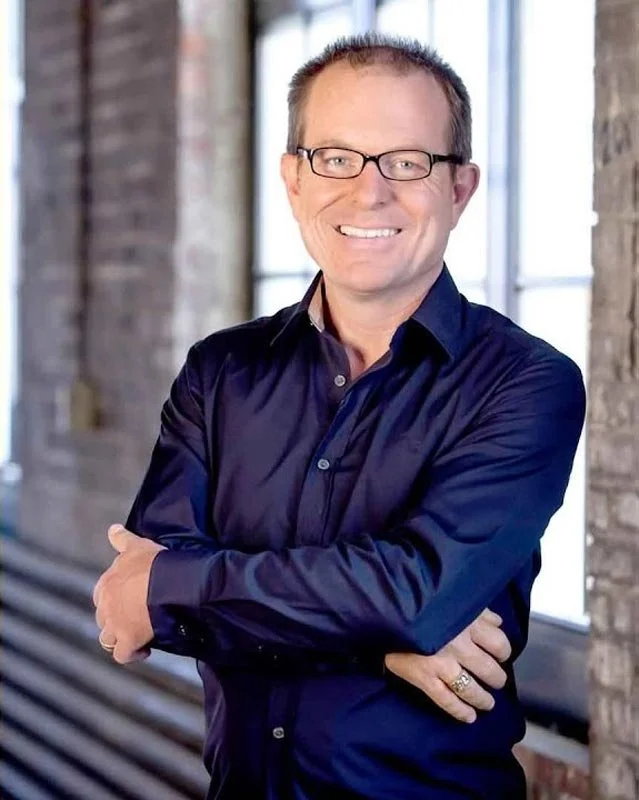
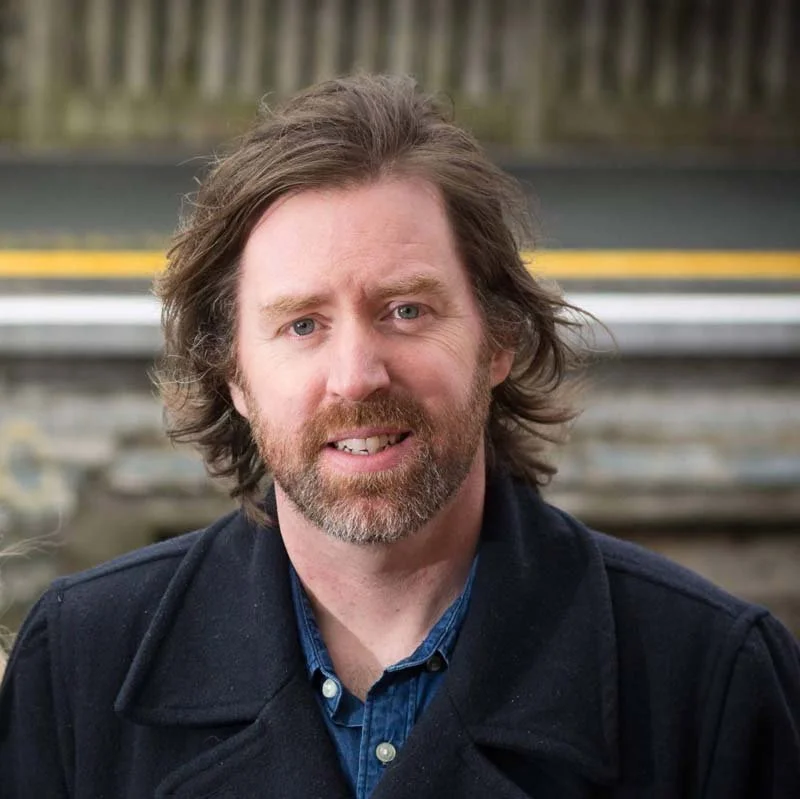
John Busher (b. 1976) is a Wexford-based artist and a graduate of the National College of Art and Design (MA Art in the Contemporary World). His multidisciplinary practice—centered on painting but expanding into printmaking, drawing, and ceramics—investigates the overlooked and the discarded. Often drawing from archival research and oral histories, such as his recent work on the Irish Civil War, Busher creates visual vocabularies that explore the intersection of memory and place. His work is held in the collections of the Office of Public Works (OPW) and Wexford County Council. @john.busher
How did your upbringing in Enniscorthy and your early years on lighthouses shape your imagination and your approach to art?
I was born in Enniscorthy, Co. Wexford, Ireland. Growing up in a rural setting in Ireland in the 1980s was a wonderful experience; we had only recently joined the EU and felt slightly on the periphery of things. My early childhood was spent on lighthouses. My father was stationed in Roches Point lighthouse at this time, and we lived there with my siblings before starting school. As a nation, we’re immersed in our cultural identity, and it’s often taken for granted. The richness of this can be found everywhere. But the sense of being on the edge of things gives you a certain autonomy; this could be found in the music scene that emerged here in the 80s, all of which grew out of DIY culture.
Can you recall a moment when you recognized art as your chosen path?
My most formative experience of art was seeing a portrait of my mother that my father drew; it was exceptional in terms of draughtsmanship. This hung in the ‘good room’ of my grandparents' home, always a place where the best china was kept for guests that might arrive. After that, when I was in Junior Infants, I was taught by a nun. She also recognised I had some talent and often presented work to my peers; this kind of formal recognition continued throughout my childhood. In my early teens, I was very involved with music, but also art. It was about this time that I became very focused on the possibility of being an artist.
Describe a typical day in your studio.
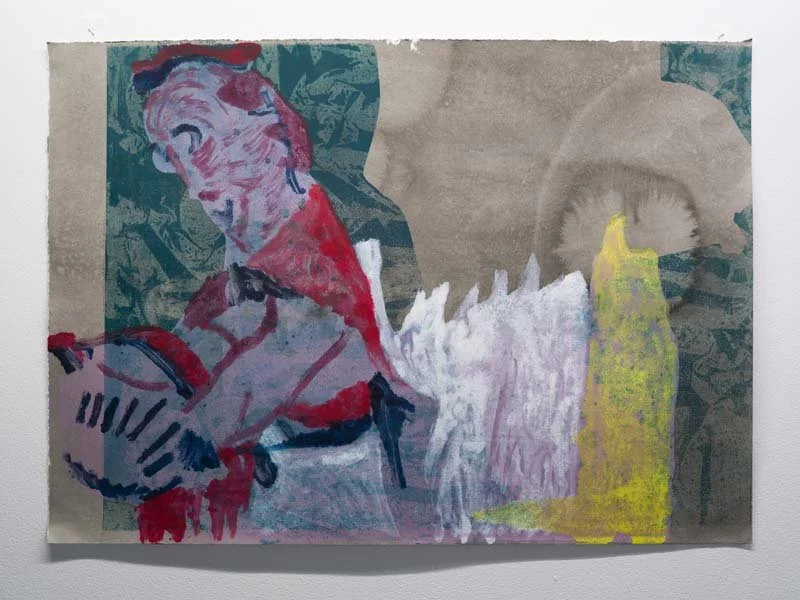
It often started with a walk; there’s an abundance of sites to walk through. My favourite perhaps is a walk called the Ringwood, it’s an ancient monastic walk traced back to the establishment of a local abbey that’s no longer standing. It also depends on what project I’m working on or what medium. I tend to work across a number of different media, but painting is the core part of my practice. Printmaking, drawing, and ceramics are also important to me. I often work for a solid four hours, take a break and come back again later in the day or evening for another four to six hours. I’m currently developing a body of work in hand-built ceramics. I’m attempting to expand my painting practice in three dimensions, so some of the motifs you might find in my painting are making their way into ceramics. I’m attempting to apply a painterly approach to image making through glazing and adapting this language.
Tell us about your recent research into the Irish Civil War and the themes driving your work.
I recently staged a solo show at Rathfarnham Castle, Dublin, which was followed up with a commission for a commemoration project. This involved researching the Civil War in Ireland in 1922, so a lot of this was engaging with archival services and reading. I tend to move between this and practical work in the studio, which over the last two months has developed into an expanded practice in ceramics in response to this research. Thematically, this follows a thread; memory and place are key aspects that underpin everything. In this case, I’m researching train lines that no longer exist but were targeted by the IRA during the Civil War. This is all in a local context, so at times it involves meeting people and collecting oral history. This project may culminate in a site-specific piece, as some of the old train stations where ambushes took place still exist as dwellings.
When viewers experience your art, what emotions or ideas do you hope they connect with?
I tend not to think about what a person might experience. As an artist, I think you’re always trying to get closer to what you want to say. Often, this isn’t even clear to yourself, so it’s very difficult to say how a person might interpret what you’re doing. I’m drawn to the overlooked, things that are forgotten or discarded. So perhaps I’m trying to shine some light on this. I think as an artist, you’re always building up a vocabulary; words often don’t come easily. So the visual has always been important to me.
Which artists, past or present, would you like to meet, and what would you like to discuss with them?
Munch has always been an inspiration to me. I made a pilgrimage of sorts to Oslo last year and saw his cottage in Åsgårdstrand. I was deeply moved to be present where he created some of his most iconic paintings, and to be in the vicinity of the place that was fundamental to his life and work. I’d ask him mostly about life in the late 19th Century, his formative years in Grunerløkka and what it was like living there. Another artist I adore is Ensor, I’d wish to meet him because he bridged the gap from realism into something macabre and fantastical. Again, I’d probably just ask him ordinary things about Ostend.
Do you draw inspiration from music, film, or other disciplines?
I mostly draw inspiration from music and film, science fiction and horror in particular. I like to draw from a mood in a film. I know film-makers often borrow from painters. The opposite is also true, Dario Argento’s Suspiria is wonderful, the sets and colours.
What is the significance of the geography of Wexford to your creative practice?
The abundance of nature nearby, the mountains and sea are just a 30-minute drive away. It’s a unique and interesting place steeped in history, and it played a major role in Ireland’s pathway to independence in 1798. There’s so much history it’s difficult to take it all in at times, so culturally there’s so much to immerse yourself in. We also get a little more sunshine than the rest of the country, so that’s helpful in a country where the weather is notoriously bleak.
Can you describe a project that challenged you creatively or emotionally—and how you worked through it?
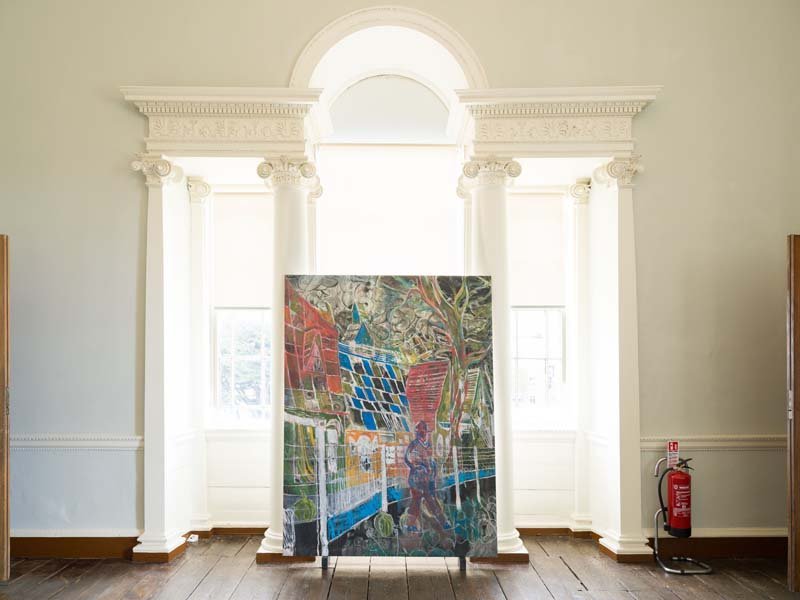
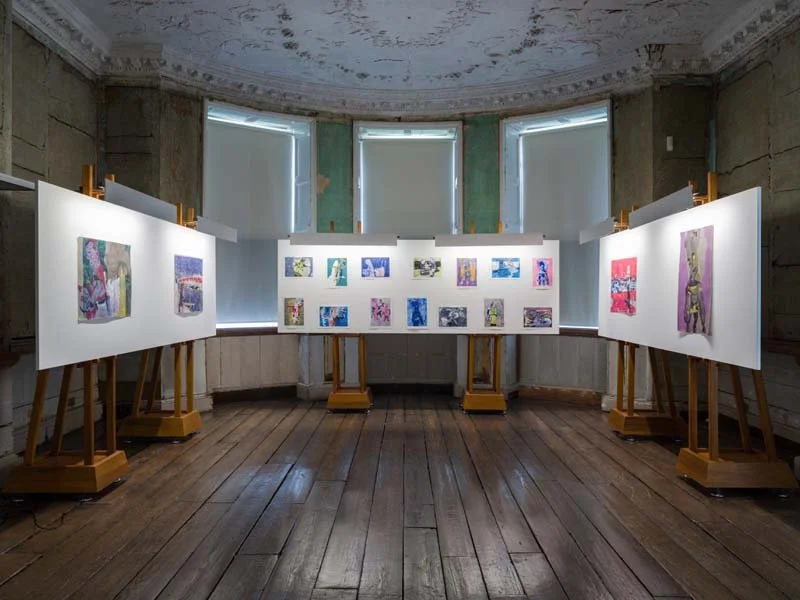
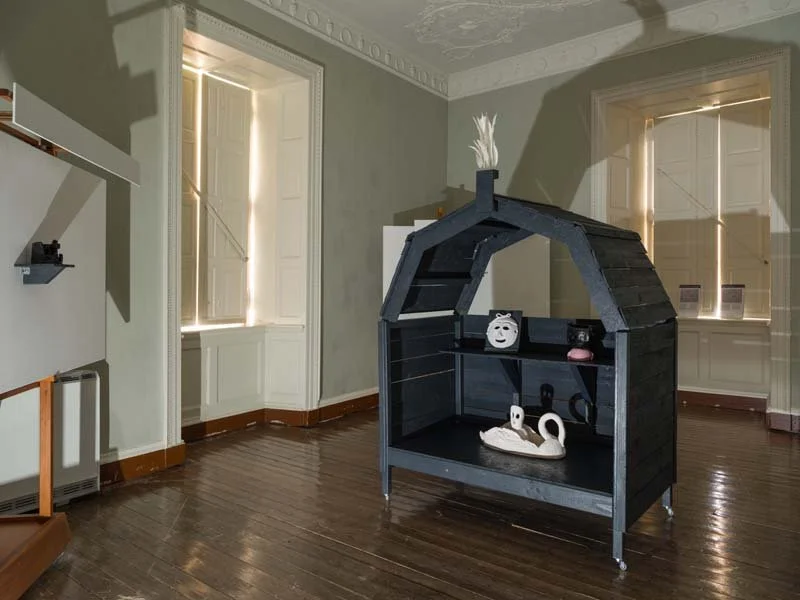
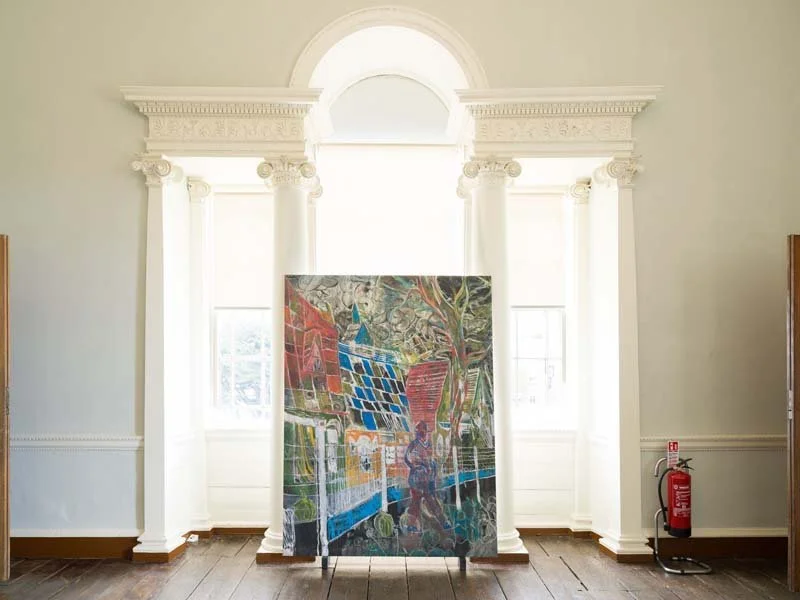
I worked on a project titled ‘Tidal Ballads Sung Wrong’, it’s a fictional title set in a time where countries are being faced with environmental issues, such as rising tides. The ‘Tidal Ballad’ is a lament on lost cities and towns that succumbed to rising tides. It’s also a nod to a time when the gentry could be heard singing ballads traversing a local river. So I was looking at where those two things could meet. I presented this project in ‘City Assembly House’, Dublin, at one point the first public gallery in England & Ireland. This was a very demanding space for a solo exhibition, and looking back, it was an ambitious show. I was commissioned to produce a wallpaper at David Skinner’s studio, in tandem with this, I was creating a body of work in painting, drawing and printmaking. This was also an opportunity to introduce a sculptural element to my practice. I constructed an octagonal pavilion for the space. This was an anchor for both my printmaking and ceramics; the majority of the prints were produced in the studio at Cill Rialaig. There isn’t any quick fix for working on projects like this, apart from being extremely organised in how you approach it. It’s important to take a break after projects like this; it’s unrealistic to expect to go back to the studio and continue as normal.
Tell us about important teachers/mentors/collaborators in your life.
I had an excellent teacher at secondary school, Paul McCloskey. He really noticed my talent and helped nurture it and prepped me for my portfolio submission when I applied directly to NCAD after school. I remember Kevin Atherton at NCAD being particularly kind and encouraging; he seemed to appreciate what I was doing. And was always engaged and humorous in crits.
Sustainability in the art world is an important issue. Does being in nature inspire your art or your process?
Without a doubt, nature is always inspiring. I was recently on residency at Cill Rialaig, a magical place that I cannot put into words. The residency always asks that you don’t post about the location, as they want to keep it Ireland’s best-kept secret. But I’ve yet to come across a place as wonderful, all surrounding landscapes and nature are astoundingly beautiful. It would be very difficult not to get inspired. On the last trip, I also visited Great Skellig, where my father was stationed at the lighthouse when he was very young. It was interesting to see pathways that were etched with signatures from past keepers and the monastic settlement. From a sustainability point of view, recycling materials is always important. I used a lot of wooden construction, so I try to recycle this and reform it for new pieces. So a lot of them are just reincarnations.
In an era where digital tools like AI are redefining reality, what is the importance of the physical, handmade act of creation?
There will always be a thirst for the handmade; new technology was always perceived as a threat in the past. Photography was hailed to bring an end to painting, but painting has had a rebirth in the past twenty years; this can be felt at all the art fairs. AI lacks human authenticity, and people are craving this now more than ever. AI is a symptom of a problem; the more we drift away from honest human connection, the greater the need to pare things back to the bare essentials.
Exploring ideas, art and the creative process connects me to…
a past, present and future.