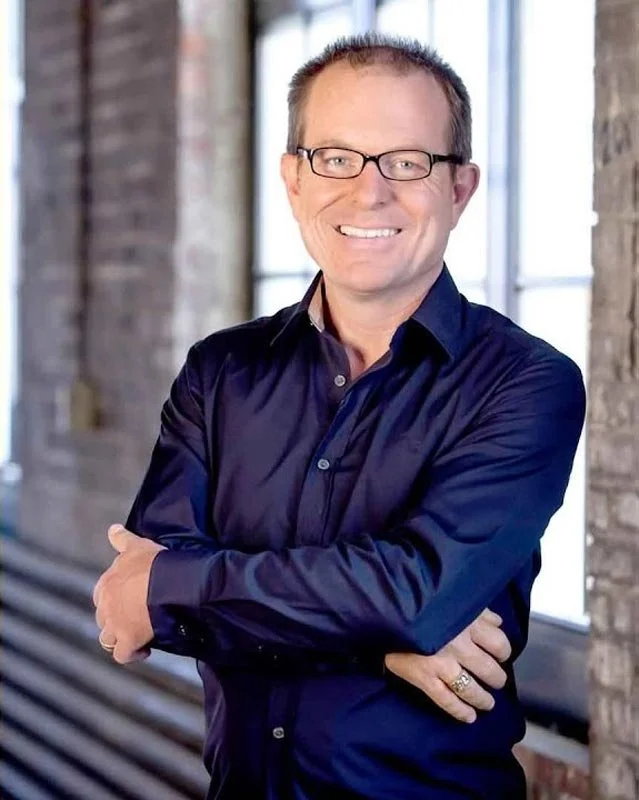


Dutch painter Taco Sipma discusses the intersection of graphic design, ritualistic iconography and the human drive to impose meaning on uncertainty.
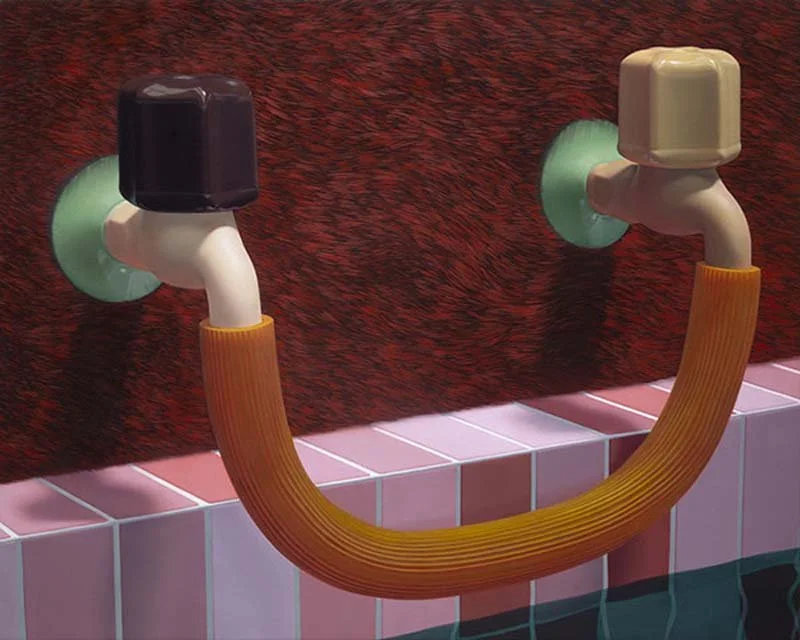
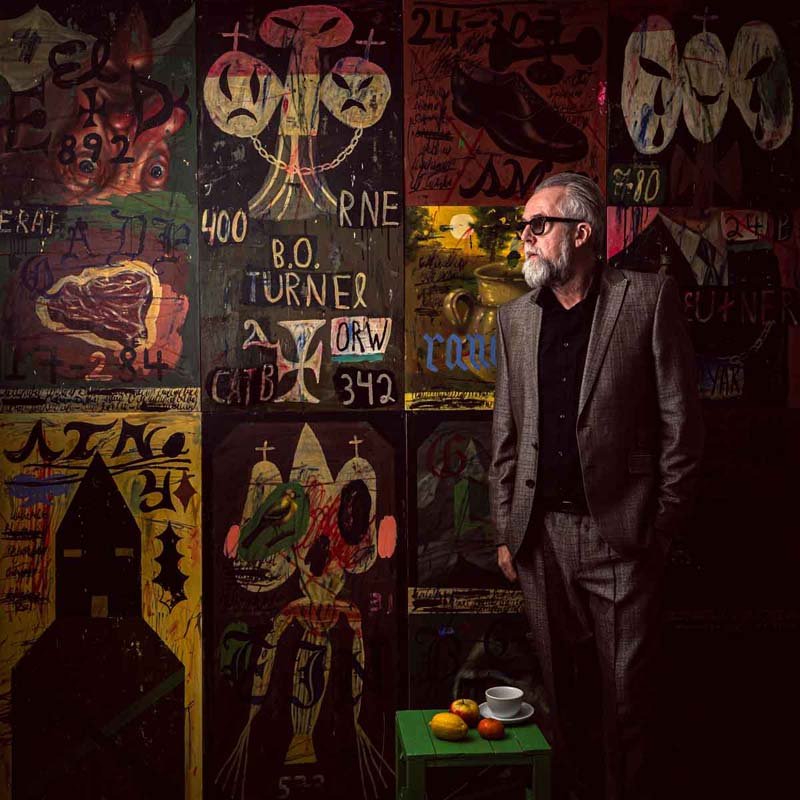
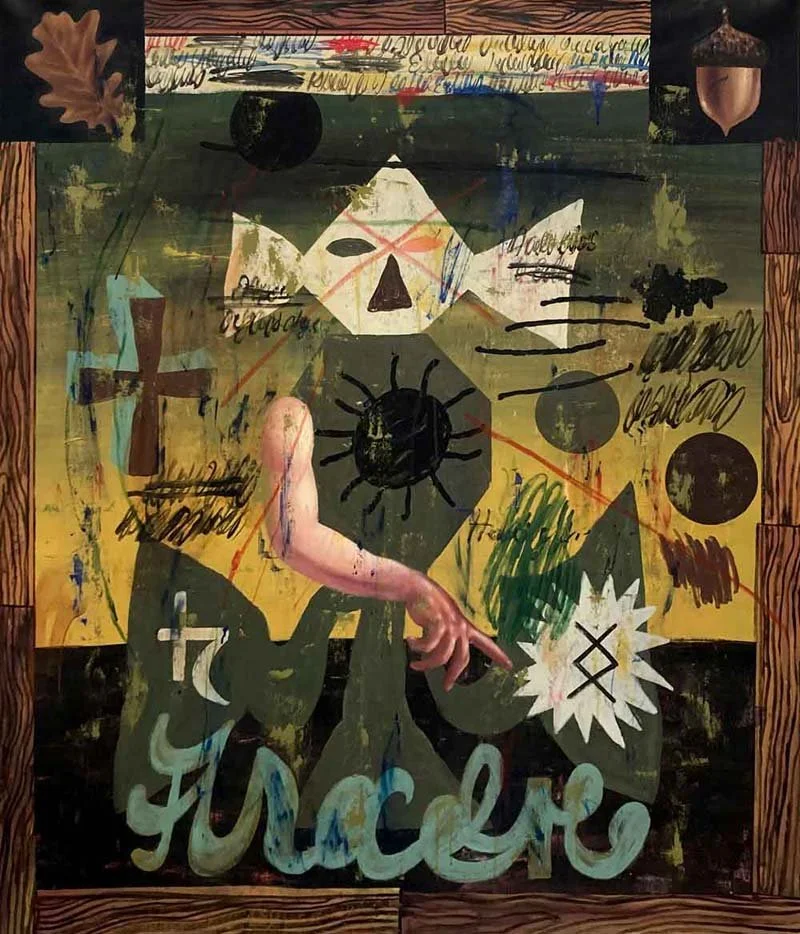
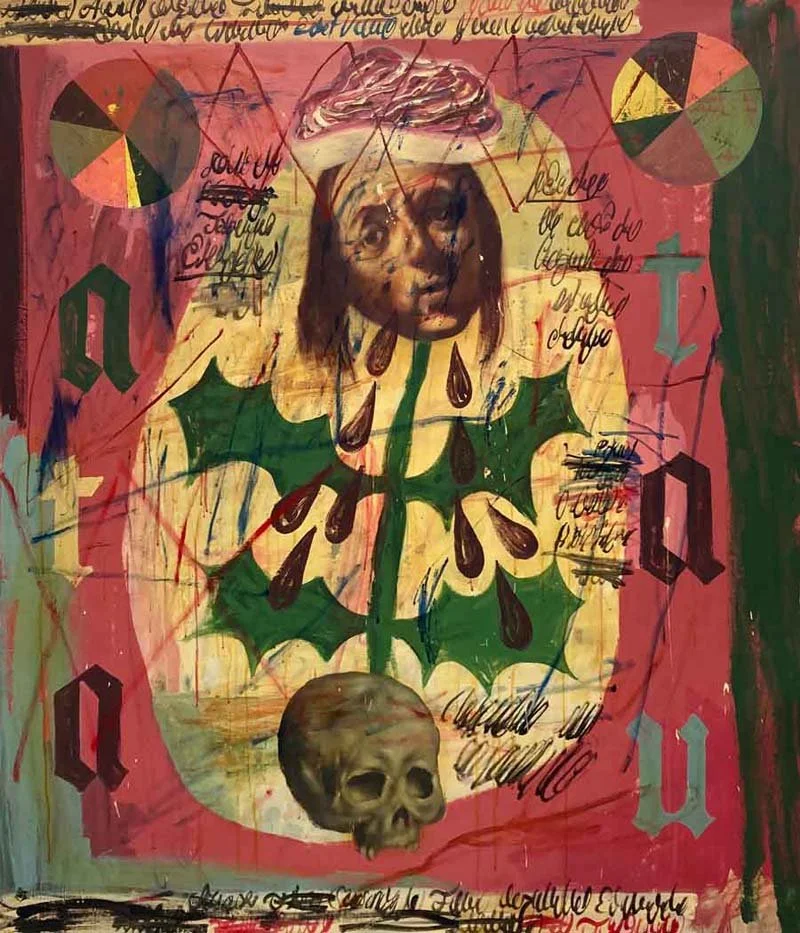
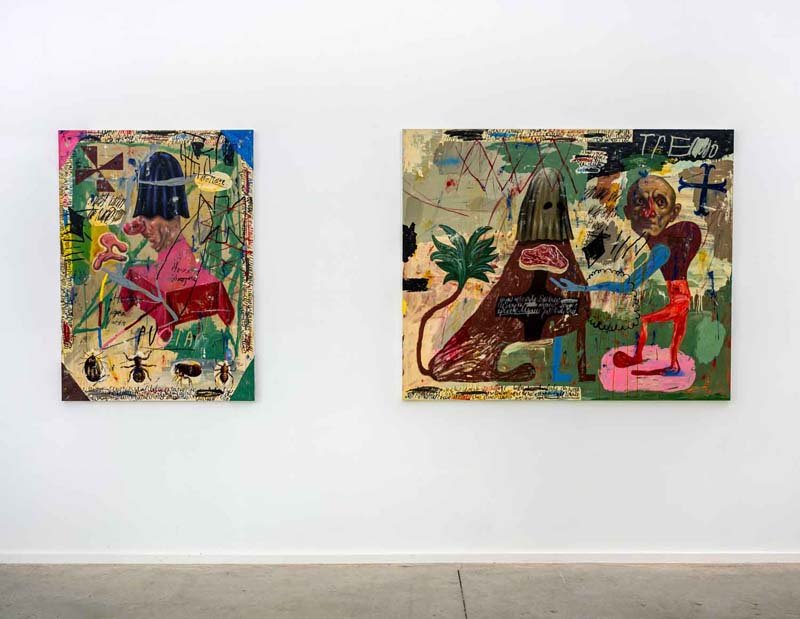
Taco Sipma is a Dutch painter who constructs aesthetic environments where mystical symbolism, pseudo-linguistic elements, and ritualistic iconography converge. Drawing on a thirty-year career in graphic design, Sipma investigates the human impulse to impose structure upon life’s uncertainties—whether through religion, conspiracy thinking, or personal mythologies. His process involves a meticulous layering of acrylics and oils, resulting in a visual language that invites deep reflection while deliberately resisting resolution. @tacosipma
How did your upbringing in the Netherlands influence your art and your thinking about the world?
I was born in Terneuzen but grew up in Bergen op Zoom, a small town in the south of the Netherlands with little to no opportunities in the arts. From a young age, I realized that if I wanted to pursue something creative, I would have to move to a place with richer cultural ground. Growing up in a town with such limited possibilities taught me self-sufficiency. The drawback of having no facilities to rely on is that you must create them yourself. But the advantage is that, in doing so, you can shape them to fit your own needs. It pushed me toward a kind of “do-it-yourself” mentality and showed me early on that if you want something, there’s no use waiting for all the stars to be aligned or get anyone's permission—you just dive in deep. I’ve always been true to that principle; I never had any formal training for design or art. Just got started, asking myself the question “how hard can it be.” The first years of course, made me feel like missing the first five minutes of a movie; it’s only five minutes, but it sometimes made me wonder; did something essential slip past me. But it made me work extra hard to overcompensate for my (imagined) shortcomings.
Can you recall a moment when you recognized art as your chosen path?
Like many artists, I was an avid drawer as a child. Even before I could read or write, I felt drawn to letters. To me, they were mysterious signs that, together with images, formed an inseparable whole. I copied letters, invented my own, and filled every drawing with secret symbols and numbers. From a very young age, it was clear to both me and those around me that my path in life would be in the creative field. My fascination with the interplay of typography and imagery naturally led me toward the applied arts. At fourteen, I began volunteering to create posters and flyers for the local music venue. That was where I first learned the basics of typography, screen printing, color, and illustration. Skills I picked up on the job. I loved the work, and a few years later I moved to Rotterdam, the Netherlands’ second-largest city, to pursue a career as a graphic designer.
Although I became fully immersed in graphic design and typography, I always had a deep love for contemporary art. I admired the freedom of expression, its experimentation, and its autonomy, qualities that were often harder to find in the applied arts. After working as a graphic designer for over thirty years, I finally decided it was time to pick up a paintbrush and answer the urge to create art myself. About seven years ago, I began painting seriously. I had dabbled in it before, but never with real commitment. From that moment on, I taught myself how to paint, while also searching for my own artistic voice—a process that took some years. To my surprise, I realized that what I do now as an artist is remarkably close to how I approached art as a child: the combination of text and imagery, the unreadable typography, the mystical symbols. It had all been waiting quietly in the back of my mind until I finally gave it room to surface. I may have come to art later in life, but I am deeply grateful that I did. Answering that inner call has been transformative. Art is now one of the most important parts of my life. Not a day goes by that I don’t paint, read about art, study painting techniques and art history, or discover new artists. It continues to be an endless source of knowledge, inspiration and joy.
Describe a typical day in your studio.
Most days, I’m in the studio by around 10 a.m., six days a week. I start with coffee, checking my emails, and reviewing the work I did the day before. Sometimes I notice a weak spot in a painting that I feel I need to fix before I can move forward. That always feels like a chore. After that, I plan my next steps. Although I don’t work with sketches or a fixed plan, I usually have a general idea of what comes next. From a technical standpoint, I need to consider the order of layers, especially since I work with both acrylic and oil paints; it matters what will end up as the top layer. The most challenging part is leaving room for improvisation—for the areas I’m unsure about. This space allows the painting to evolve in unexpected ways. My process involves a lot of back and forth: painting, scratching off, revising, making mistakes, panicking, discovering the beauty of a mistake, and sometimes “killing a darling.” It took me a while to realize that this iterative process is not a lack of method—it is my method.
My studio is relatively small (25 m²), so I keep one corner clean for books, my computer, and storage. The rest of the space is dedicated to painting. I built a wooden wall that tilts slightly backward (around five degrees), as I prefer to work on unstretched canvas. The tilt, combined with gravity, allows the canvas to lay flat against the wall. I am drawn primarily to acrylics, sometimes layering oil glazes on top. I also experiment extensively with house paints. Industrial paints often have an appealing consistency: opaque, slightly drippy, and generally compatible with artist acrylics. To create textures, I mix in sawdust or chalk. I also enjoy experimenting with industrial oil-based stains, which add a depth rarely achieved with traditional artist paints. Lately, I’ve been exploring mixtures of wood glue and paint, which create a gooey, challenging texture that forces me to work differently and faster, since the glue dries within 3 or 4 minutes—it requires a lot of brushes though. Speaking of brushes, I prefer old, worn, chewy and fluffy ones. I wear my brushes out to the point that the handle sometimes breaks. And even then I repair them, since I regret to say goodbye to an old worn-in brush. I know how long it takes to get accustomed to a brush. New brushes feel too stiff and rigid, so I often sand the hairs and soak them to break them in before using. Since I trained myself to never use anything else than brushes at all circumstances (I never use crayons, felt pens, markers, airbrush or anything), good brushes are of the essence.
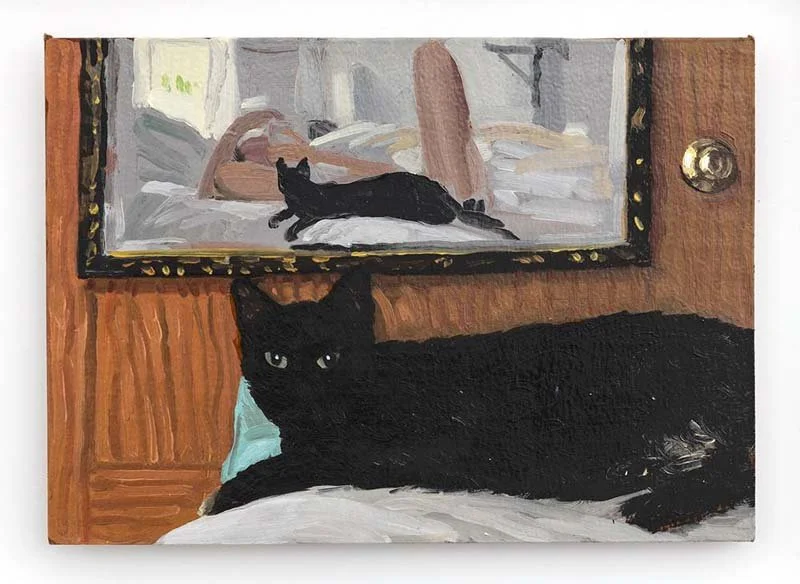
During the day, I paint in long, uninterrupted sessions, which is essential for the level of concentration my work requires. My cat, though free to roam outside, keeps me company while I work. Music is also integral to my routine—I listen to a wide range of styles, always at low volume, so I can still hear myself think, but while watching the paint dry, I like to play old-time Hawaiian music on my lap steel guitar. I usually finish around 5:30 p.m.
Tell us about your upcoming exhibition "A Seat at Both Tables" and the themes driving your work.
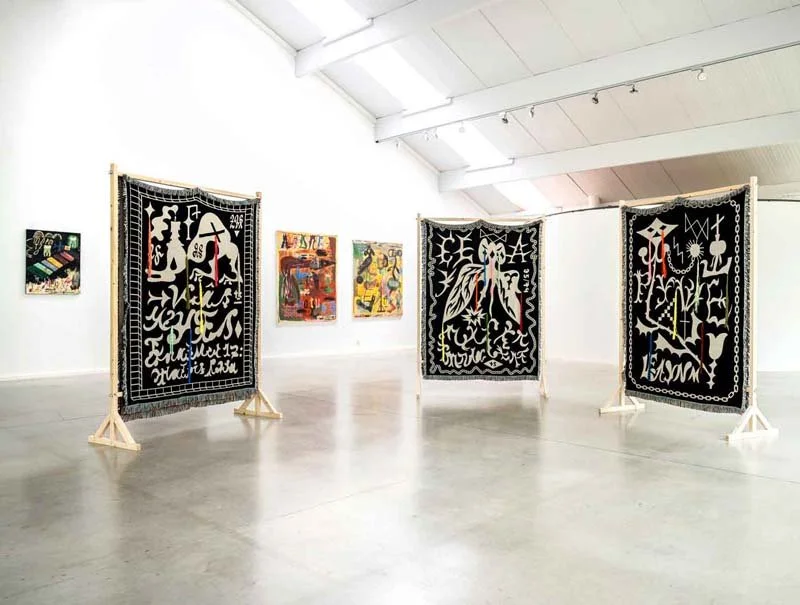
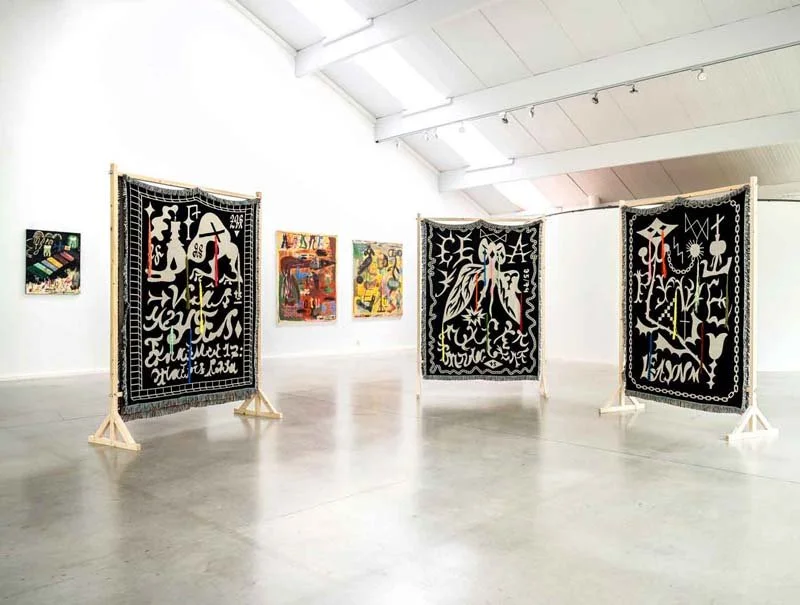
At the moment, I’m preparing my upcoming solo exhibition at 22a Gallery in Belgium. Since this will be my first solo show with this particular gallery, we decided to approach it as an introduction. The presentation will combine recent works with selected older pieces, allowing visitors to trace the development of my practice over the past few years. The title of the exhibition, “A Seat at Both Tables,” reflects my reluctance to confine myself to a single style or approach. A central part of the show will be a series of six black-and-white tapestries, partly previewed during my solo exhibition at Feinkunst Krüger in Hamburg last June. By the time this interview is being published, this project will be ready. Working with tapestry is new to me, and it’s been fascinating to see the results in production. Designing them is a very different process from painting: more structured, yet I still resist working with a fixed plan. Instead, I begin by drawing a variety of symbols, typographic forms, shapes, and creatures, then assemble them intuitively. This idea of “mix and match” also informs an ongoing series of smaller paintings on 61 x 61 cm wooden panels. Each is painted as a stand-alone work, but later I select and combine them within a single frame, forcing them into dialogue. It’s a bit like putting strangers together in a room to see what unfolds—the narrative only emerges once the work is complete. I hope to have several of these panels ready for my upcoming show at Ruby Soho Gallery next April.
Another project in progress that I’m excited about is making a super large apocryphal altar piece for a church in Belgium, loosely inspired by the Ghent Altar piece “The Adoration of the Mystic Lamb.” The church is being re-developed and in the meantime some art projects will occur there. This will be my biggest painting installation so far. Through these works, I aim to construct an aesthetic environment where mystical symbolism, pseudo-linguistic elements, and ritualistic iconography converge. They explore the human drive to impose structure and meaning on life’s uncertainties—whether through religion, conspiracy theories, personal mythologies, brands and advertising, cults, idolatry, or any other (self-made) system of belief.
When viewers experience your art, what emotions or ideas do you hope they connect with?
I create paintings as if they were relics of a cult, fragments of a conspiracy, or apocryphal extensions of a religion. The texts and headlines within them—where they remain legible—are written in an invented language without predefined meaning. They serve as visual devices, shaping atmosphere and occasionally suggesting significance. By denying pictorial space in the classical sense—eschewing depth, horizon, perspective, or gravity—I gain the freedom to arrange pictorial and graphic elements as though the paintings themselves were allegorical vessels of communication, rendered in an unfamiliar or long-forgotten visual language. My background in graphic design and typography introduces a tension throughout the work: the expectation of communication is subverted in favor of ambiguity and conceptual destabilization, where image and typography merge into a singular visual lexicon. Textual fragments—appearing as headlines, incantations, or liturgical echoes—remain deliberately open, functioning like a phonetic language stripped of grammar or dictionary. These inscriptions operate visually and atmospherically: oracular, rhythmic, oscillating between the ominous and the consolatory. I resist definitive readings. My visual language tempts the viewer with the familiarity of signs and structures, yet it ultimately resists resolution. Instead, the work invites engagement: to inhabit a space of semantic indeterminacy, and to create personal meaning in the absence of prescribed narratives. Sometimes I do not get my paintings either; sometimes I get them after they’re finished. But they’re hard to explain in words. Or as Edward Hopper once said: “If you could say it in words, there would be no reason to paint.”
Which artists, past or present, would you like to meet, and why?
I would love to be able to go to the Cedar Tavern in New York in the fifties to hang out with the abstract expressionists there. Especially Willem de Kooning, a fellow Rotterdam citizen, whose work I have always admired. I can't think of a specific question I would ask him, but I would love to see him paint the Woman series.
Do you draw inspiration from music, art, or other disciplines?
Although art is, of course, an important source of visual inspiration, my attention also extends beyond the visual. Religion, graphic design, mysticism, propaganda, advertising, cults, conspiracy theories, misinformation—these are all fields where a strong tendency toward symbolism (both verbal and visual) and kitsch (the obvious aim to please and convince) merge into a hermetic whole. The sincerity and compulsiveness so characteristic of folk art and art brut are also key sources of inspiration. Such work is often labeled as “amateur art,” with “amateur” carrying a negative connotation. For me, however, amateurism is a positive quality. The word literally means “lover.” It reflects the idea of approaching each problem with enthusiasm and fresh eyes, whereas professionalism is more often guided by efficiency, routine, and risk aversion.
Literature and language are another important source of inspiration. A single word or sentence can spark the beginning of a new painting. I keep a list of words and titles that I often go through to get started with a painting. I can also draw inspiration and energy from the unapologetic attitude (sometimes defying good taste) of artists like The Butthole Surfers, Lightning Bolt, Die Antwoord, Paul McCarthy, Jonathan Meese, etc.
What is the significance of the move to the countryside to your creative practice?
I lived in Rotterdam for 32 years. It’s a vibrant city with plenty of museums, galleries, and a strong cultural infrastructure. Yet, three years ago, my girlfriend and I decided to move to the countryside, craving a life closer to nature. We found a modernist bungalow on a spacious plot near the village of Ossendrecht. The village itself has little to offer—at least to me—but the surrounding landscape is beautiful, and the people are incredibly friendly. The area lies within a Dutch-Belgian national park. After so many years in the city, the quiet that envelops our home feels like a true blessing, whereas the proximity of the lively city of Antwerp comforts my inner city slicker.
Can you describe a project that challenged you creatively or emotionally—and how you worked through it?
It might be a bit corny to say, but each and every painting that I start is a challenge. When I start a new painting, I—all of a sudden—seem to have forgotten how to make a painting. Not only the conceptual part, but also the technical part. It’s a strange thing; each painting seems to follow the curve from total insecurity (the start) to bold confidence (the end). And the further the painting is finished, the more risk I seem to take.
The tapestries I’ve been working on recently (being so close to graphic design) unexpectedly pulled me back into the result-driven mindset I know from my background as a graphic designer. In doing so, they seemed to take away much of the freedom I usually feel when painting. Naturally, I also had to find a way to translate the world I create as a painter into a visualization that would meet the technical demands of a loom. A loom comes with its own limitations, and I realized that the forms I could use would need to be as graphic as possible. For this, I drew on three major sources of inspiration: the garments of Schema monks, the Asafo flags of the Fante people in Ghana and the chasubles Matisse designed for the Rosary chapel in Vence. Instead of sitting behind a computer, I decided to start by freely sketching a large collection of unrelated symbols, typographic forms, and characters on paper. I then digitized these drawings, from which I distilled a number of tapestries almost like a jigsaw. The result, to me, feels more like a necessary visual collage than a carefully preplanned composition of imagery. I’m always searching for fresh ways to express myself, which led me to begin creating digital drawings and collages. They function almost like autonomous graphic posters, echoing the visual language of communication. Working digitally is a completely different process from painting, one that pushes me to reconsider and expand my own visual vocabulary. At this stage, I’m still exploring whether this work will only remain a catalyst for my paintings or evolve into an independent project, intended for publication or exhibition.
Tell us about important teachers/mentors/collaborators in your life.
When I first moved to Rotterdam, I happened to meet two guys who had just started a design agency. After a casual chat, I ended up joining them, and eventually became a co-owner. What made this encounter so impactful was that they introduced me to the world of cultural, artsy, and experimental graphic design. They had a strong sense of visual ethics and refused to bend to every client’s demand—sometimes even going as far as firing clients themselves. From them, I learned the importance of being stubborn within reason, unafraid of confrontation, and confident enough to risk losing a client if necessary. That mindset of self-assurance has shaped and supported all of my creative endeavors since.
Another turning point came when I reached out to Dutch painter Bram Herens. A few years ago, as I was beginning to take painting seriously, I asked him if he could give me some guidance. Bram is not only a very skilled painter, but also deeply knowledgeable about paint, materials, and technique. While the lesson itself was helpful, the real breakthrough came at the end of the day as we were cleaning brushes. Casually, he said: “I think every good painting has at least two essential ingredients: drama and mystique.” That simple statement hit me like an explosion—it perfectly captured what I had been searching for and it connected my visual imagination with my already existing interest in belief systems, religion and kitsch. It literally opened my eyes on what to paint and how to paint it. To this day, it remains the principle by which I judge my own visual ideas and paintings.
Sustainability in the art world is an important issue. Does being in nature inspire your art or your process?
I’m not the kind of artist who absorbs every external stimulus and immediately channels it into my work, like some seem to do. My surroundings don’t appear to have much influence on what I create. That said, I deeply appreciate that my studio is quiet and surrounded by nature—it feels calm and serene, which I love. I moved from the city to the countryside three years ago, yet there’s no sign of that shift in my work. Honestly, I feel like I could just as easily be painting on the moon without it changing the outcome. My paintings come from a cerebral, internal process rather than being shaped by what’s happening outside of me. Still, I’ve been curious about how nature might literally leave its mark on my work. I’ve experimented with leaving some paintings outdoors for a few months, just to see how the weather and environment might interact with them. So far, though, the results haven’t been especially rewarding. Twice in my life, I’ve had the chance to witness the phenomenon known as sea sparkle. It happens when huge gatherings of microorganisms light up through a process called bioluminescence. Because it’s so unpredictable, stumbling upon it feels like pure luck. It remains, without a doubt, the most breathtaking, awe-inspiring thing I’ve ever experienced. The beach then, feels and looks like an incredible chaotic interactive art installation.
In an era where digital tools like AI are redefining reality, what is the importance of the physical, handmade act of creation?
AI is such an all-encompassing concept and has such a profound influence on our future that, for now, I will limit my focus to AI in relation to visual art. I believe that art—both applied and autonomous—is a crucial reflection of who we are as humans, what drives us, and what connects us. Applied arts (although they visually mark our times), regrettably, are often undervalued for their cultural significance and judged primarily on cost-effectiveness and efficiency. This makes them particularly vulnerable to being outsourced to artificial intelligence. I fear that personal, truly original design will stagnate because clients, tempted by cheap AI solutions, will be less willing to hire a relatively expensive designer. Once we become accustomed to this impoverished visual culture, authenticity may even become something that alienates rather than attracts. A similar shift began around the year 2000. Before the advent of the internet, (applied) art in each country or region had its own local flavor, shaped by tradition, history, culture, language, taste, and so on. In other words, you could tell where a work originated just by looking at its form. Visual culture was truly vernacular. With the rise of the internet and social media, everyone now draws “inspiration” from the same source. This has created a kind of “international style” that is the same worldwide and lacks roots or authenticity. It’s a style stripped of its cultural heritage, leaving visual culture poorer and more homogenized worldwide.
In applied arts, artificial intelligence solves a problem—albeit at a cost—namely, cost-efficiency. In autonomous art, however, there is no problem that needs solving. The conception of art has never been a problem, and efficiency or cost-effectiveness are (to me) sworn enemies of autonomous art. Industrializing art in the sense of conception, renders it meaningless. It reduces works to design objects without meaning, context, creator, origin, or oeuvre. Enjoying an artwork to me is getting involved in what another human has to say. I personally don’t care what a computer has to say as long as it mimics what humans could do better themselves. Look for instance at the fuzz around the paintings made by AI-Da; the paintings are—to say the least—not sensational. The only interesting thing about them is that they were conceived by a computer and executed by a human-like robot with a wig. But we already had paintings made by real people, so what’s the point? I can however, imagine AI making interesting art when it conceived and produced something otherworldly that a human being could never have come up with. That said, I can imagine that for now AI as a tool can be an enormous source of inspiration for many artists, opening up unforeseen applications. My stance on the use of AI in art is primarily postmodern: everyone is free to use whatever tools serve them. Yet I must admit that I have seen little—if any—autonomous visual art as an end result of AI, that truly justifies the immense energy-consuming production method that AI entails. Only time will tell what position AI gets in the art world; as autonomous artists, or as an artist tool. But the paintings by AI-Da sold for millions (because they mark a spot on art histories’ timeline) forecast a position in the art world in whatever form or shape.
Exploring ideas, art and the creative process connects me to… This is a tough question to answer. I never think of the creative process in general or about exploring ideas in particular. I just do things, mostly propelled by intuition and eagerness to see what happens. It feels a bit like asking a bird about aerodynamics; to the bird there is no such thing as aerodynamics, there’s only the possibility of flying. It’s the difference between theory and practice. If you search “creativity” online, you’ll find endless pages: scientific explanations, practical how-to guides, business gurus with their formulas. Interesting as they may be, none of this knowledge actually makes you more creative. In fact, when you chase theory as a way to become creative, you miss the essence of it. Creativity is about total commitment, embracing uncertainty and possible failure. It means acting on instinct, heading for the unknown, beginning without knowing if it’s worth it, risking mistakes, accepting outcomes that differ from your expectations. It’s like leaping over a fence—you might land in poison ivy, or you might strike gold. So, thinking again about your question, I’d say this: exploring ideas, art, and the creative process connects me to my most courageous, happy, open-minded and least judgmental self.