

There are many ways in which I think human exceptionalism has seeped into the sciences, but one of the many ways is through the methodologies we use when we compare the intelligence of humans and other species. In particular, in my field, I’m a primatologist by training, comparing the cognitive abilities of humans with the abilities of our closest living relatives, the great apes. Many times, those studies compare the intelligence of captive chimpanzees who are living in highly restricted, manmade environments. Often, these chimpanzees have been separated from their biological mothers at birth. They're often separated from the group during testing. They're subjected to very human-centric experimental paradigms, like playing with plastic puzzle boxes or computer touchscreens, and we're measuring how they perform on these tasks.
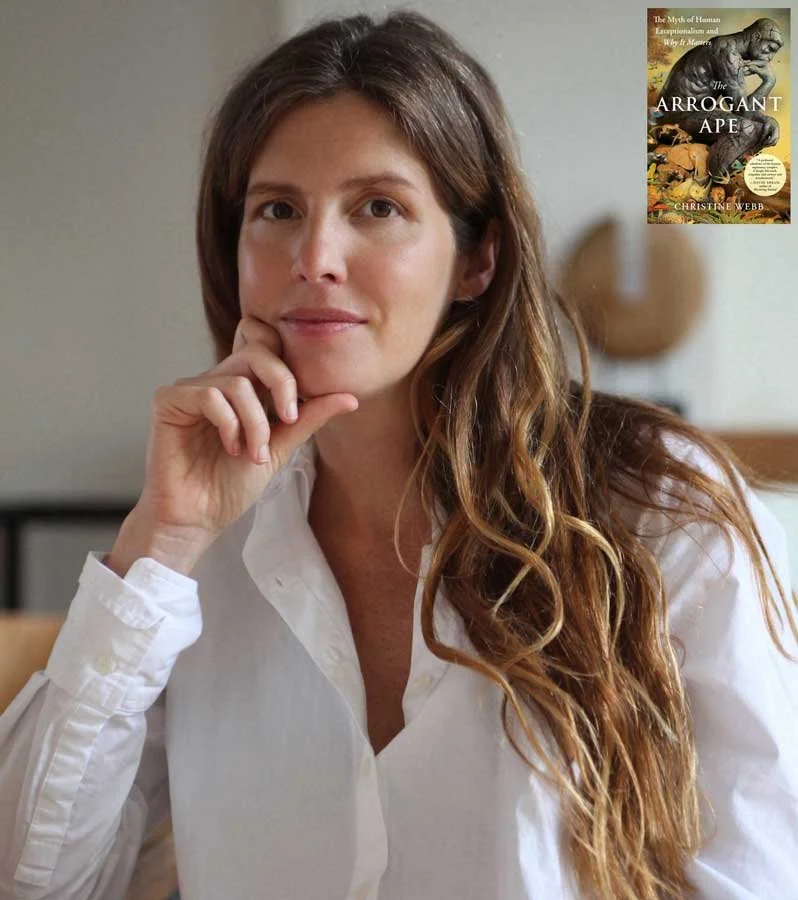
In this episode of Speaking Out of Place podcast, Professor David Palumbo-Liu talks with primatologist Christine Webb about her new book, The Arrogant Ape: The Myth of Human Exceptionalism and Why it Matters. The title of the book itself is a concise and precise description of its two constituent halves. First, Webb tells us how science itself, from premodern times onward, has operated with an assumption it keeps reconfirming constantly--that humans are not only exceptional, but also superior to other forms of life. Webb convincingly debunks this science over and over again. And most importantly, she explains how this myth has devastating political, cultural, and environmental consequences. Combining scientific and humanistic studies, we go into some detail about what this arrogance produces, and why we desperately need a much more humble sense of ourselves.
Christine Webb is an Assistant Professor in the Department of Environmental Studies at New York University, where she is part of the Animal Studies program. Her research is driven by growing awareness that the ecological crisis demands a profound shift in how we understand other animals and our place among them, leading to two intersecting lines of inquiry. First, her work seeks to elucidate the complex dynamics of animal social life and to apply this knowledge to foundational questions in animal ethics and conservation. Second, she is interested in how prevailing societal norms, values, and institutions shape contemporary scientific knowledge of other animals and the environment, with a critical emphasis on human exceptionalism. Her debut book, The Arrogant Ape: The Myth of Human Exceptionalism and Why it Matters, was recently published with Avery (Penguin Random House) and is being translated into 17 languages.
DAVID PALUMBO-LIU
So thank you so much for, to begin with, being on the show, but most importantly, writing this book. It's an amazing book, and I instinctively and urgently was drawn to it.
Looking at the genocide in Gaza, the famines in Sudan, Yemen, and elsewhere, and the dissolution of democracy are global ecological crises. Among other things, I found it ridiculous that we should hold ourselves up as somehow being superior to anything. So many facts point in the opposite direction.
So I bought your book and invited you to be on. I then set out to read the book, and I found that you cover such an immense field in terms of biology, science in general, and also address these other concerns so forcefully and urgently that the book is an amazing combination of different interests with a central message that is compelling and urgent. I came upon this paragraph at the end on page 255, and I would love for you to read it. It's the one that begins, "As I write."
CHRISTINE WEBB
I wrote this passage, I guess a little over a year ago now:
As I write, the United States is experiencing deepening divisions and escalating tensions around an upcoming presidential election. Political instability and social fragmentation are not unique to this country but indicative of broader trends of growing nationalism. I might argue that a lot of the breakdown of the West right now parallels the story of human exceptionalism. American exceptionalism holds that the United States has a unique history and mission to transform the world, giving it superiority over other nations.
But the rallying cry "America First" is just as hubristic as the rallying cry "Humans first." Both ideologies require us to move beyond the hierarchical paradigms that have too long constrained our manner of thinking.
DAVID PALUMBO-LIU
Wonderful. That was such a perfect and succinct statement, and you built up to it in such a convincing and methodical way. Could you tell us a little bit about how you set out to write this book in the first place?
CHRISTINE WEBB
Thank you so much for having me on this show. The book grew out of a course that I taught for many years at Harvard, and it was a small discussion-based seminar course. I witnessed how engaging ideas transformed the way that my students experienced and related to the more-than-human world. Also, engaging with these ideas and having conversations with my students had a very similar effect on me. For many of us, the world became more vibrant, alive, and animate, and the relationship that resulted stemmed from the perception of the world as such. To help that world and to help other species and to advocate on behalf of the human.
DAVID PALUMBO-LIU
I was going to say that one of the things that struck me as I began reading your book was I kept bumping up against this feeling like, why didn't I think of that? In other words, you come up with examples that go so against our instincts, and our instincts, of course, are learned.
The one thing that struck me is the millions of examples, but the one which you talk about how human intelligence is measured. You said we measure humans in environments that they’re comfortable in, more or less, but then the counterparts, the other animals, are in captivity, and it skews the data enormously. I thought, as I said, I never thought of that. It's so interesting how we become so conditioned to accept these assumptions about what science is and how science is done. So could you talk a little bit about the ways in which we accept science as being flawed to a certain degree, but still within fairly normal parameters? The one story I love in particular is the acronym WEIRD. Could you talk about that as perhaps one example and then expand as you wish?
CHRISTINE WEBB
Your response of "Why did I never think about that?" had me thinking several times while writing this book, and I think that's a testament to the fact that human exceptionalism is everywhere and nowhere all at once.
Exactly. It's so ubiquitous that it's almost hidden. In the paragraph I read, I go on to differentiate human exceptionalism from American exceptionalism because I think American exceptionalism is often much more visible, stated, and identified. Sometimes it’s not, but it's a phrase that many of us know well, whereas human exceptionalism is often not stated so candidly. Because of its normalization, we don't often name and identify it, and it often goes unnoticed. That is true in many dimensions of our lives—in politics, in the media, in our language, in our textbooks and education. But it's also true in our sciences. That is deeply concerning to me because science is the way of knowing that many of us have come to trust to explain the world around us and to explain humanity's place in that world.
DAVID PALUMBO-LIU
This whole idea of disinterest, right?
CHRISTINE WEBB
Exactly. There are many ways in which I think human exceptionalism has seeped into the sciences, but one of the many ways is through the methodologies we use when we compare the intelligence of humans and other species. In particular, in my field, I’m a primatologist by training, comparing the cognitive abilities of humans with the abilities of our closest living relatives, the great apes.
Many times, those studies compare the intelligence of captive chimpanzees who are living in highly restricted, manmade environments. Often, these chimpanzees have been separated from their biological mothers at birth. They're often separated from the group during testing. They're subjected to very human-centric experimental paradigms, like playing with plastic puzzle boxes or computer touchscreens, and we're measuring how they perform on these tasks.
Then we’re comparing the performance with the performance of humans. Most of the time, those humans are fully autonomous, WEIRD humans. What I mean by WEIRD is this acronym—coined by the anthropologist Joe Henrich at my former university. WEIRD stands for Western, Educated, Industrialized, Rich, and Democratic. He used this acronym to highlight how the vast majority of what we know about human psychology comes from a minority of the population, a subset of the population known as WEIRD, which is basically college undergraduates.
*
Speaking Out of Place, which carries on the spirit of Palumbo-Liu’s book of the same title, argues against the notion that we are voiceless and powerless, and that we need politicians and pundits and experts to speak for us.
Judith Butler on Speaking Out of Place:
“In this work we see how every critical analysis of homelessness, displacement, internment, violence, and exploitation is countered by emergent and intensifying social movements that move beyond national borders to the ideal of a planetary alliance. As an activist and a scholar, Palumbo-Liu shows us what vigilance means in these times. This book takes us through the wretched landscape of our world to the ideals of social transformation, calling for a place, the planet, where collective passions can bring about a true and radical democracy.”
David Palumbo-Liu is the Louise Hewlett Nixon Professor and Professor of Comparative Literature at Stanford University. He has written widely on issues of literary criticism and theory, culture and society, race, ethnicity and indigeneity, human rights, and environmental justice. His books include The Deliverance of Others: Reading Literature in a Global Age, and Speaking Out of Place: Getting Our Political Voices Back. His writing has appeared in The Washington Post, The Guardian, The Nation, Al Jazeera, Jacobin, Truthout, and other venues.
Bluesky @palumboliu.bsky.social
Apple Podcasts · Spotify · Website · Instagram