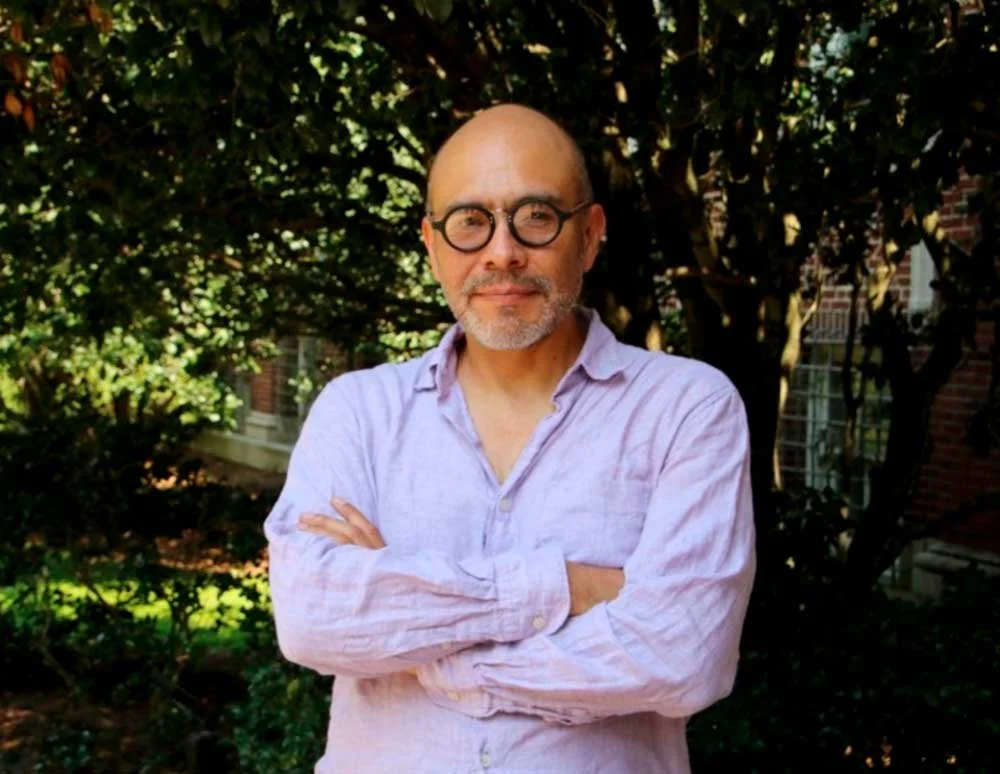


Yuri Herrera on Benito Juarez and Today's Political Crises
In this episode of the Speaking Out of Place podcast, Professor David Palumbo-Liu speaks with novelist, essayist, and scholar Yuri Herrera about his new novel, Season of the Swamp, which is a deeply researched and dazzlingly imagined account of Benito Juarez’s time spent in exile in New Orleans. We learn about what that time and place offered to Juarez’s understanding of a world coming into being—one of créolité and carnival, of mixedness and multiplicity, and what these sometimes hallucinatory moments offered his political vision. They talk about what kinds of new visions of freedom are discovered in the midst of forms of slavery that horrify Juarez. Very importantly, we hear how all of this relates to the present day—to the genocide in Gaza, the violent ICE attacks in the United States, and the descent into unbridled, and unmasked fascism. Yuri reads from his novel and discusses the importance of mixed languages and the new social worlds they reflect.
Yuri Herrera (Actopan, México, 1970). His first three novels have been translated into several languages: Kingdom Cons, Signs Preceding the End of the World, and Transmigration of Bodies. In 2016 he shared with translator Lisa Dillman the Best translated Book Award for the translation of Signs Preceding the End of the World. That same year he received the Anna Seghers Prize at the Academy of Arts of Berlin, for the body of his work. His latest books are A Silent Fury: The El Bordo Mine Fire, Ten Planets, and Season of the Swamp. He is a professor of creative writing and literature at Tulane University, in New Orleans.
DAVID PALUMBO-LIU
Welcome to the show, Yuri. I am so honored to have you on because I have admired your work for a long time. The novels are great teaching texts because they open up the imagination in really specific ways.
I thought I would begin with a personal appreciation of Season of the Swamp because I really keyed in on your notion of political opposition work in exile taking place at particular times and in particular spaces. I came up in the sixties, and my first college experience was at San Francisco State. A lot of my favorite professors were leftist Greek journalists who had been expelled in the 1967 junta. This was also the time of the Third World Liberation Strike and the American Federation of Teachers strike. San Francisco at that point was a vibrant space not just for the issues of Greece but also Iran and the Philippines.
Do you know the novel by Bienvenido Santos, who was in the Philippine government in exile in Washington, D.C., along with playwrights Severino Montano and Jose Garcia? He writes this tragicomic novel called What the Hell for You Left Your Heart in San Francisco. It is about a group of expatriate Filipinos engaging with different facets of life, much like Season of the Swamp. They start a Philippine cultural magazine, and the theme is how Filipino culture can exist in exile. The material support for the magazine comes from a Filipino doctor whose specialty is performing vasectomies. The irony of these notions of culture and politics existing both in and out of the home state is really interesting to me. Why did you write Season of the Swamp, what attracted you to this particular interlude in Juarez's life, and could you give us a little bit of background as to the historical context?
YURI HERRERA
Benito Juarez is a really important figure in Mexican culture, politics and history. He is probably the most respected figure in that sense in Mexico, only akin to what Lincoln is in American culture. Juarez was an orphan in the state of Oaxaca who spoke a variant of Zapotec, an indigenous language. He was sent to a seminary and was going to become a priest, but in his own words, he felt repulsed by the way the priests were manipulating the people in Oaxaca.
He then became a lawyer, a congressman, a governor and a judge. By the moment this story happens, he is not a public servant anymore, just a professor at the Institute of Arts and Sciences. Years before, he had become an enemy of the dictator Santa Anna, who is the guy who pretty much lost the territories to the United States. This crazy powerful person held a grudge, got him arrested, sent him to Veracruz and was going to exile him in Europe. Instead, Juarez got off the boat in Havana and came to New Orleans to wait it out and start conspiring with other people.
This whole story is in pretty much every biography, but just in a couple of lines or a single page. Every biography recognizes that he learned something really important during his time in New Orleans, but nobody knows what happened. Usually, people say it was the influence of another exile, Melchor Ocampo, that made him so sharp and ready. After New Orleans, he came back to Mexico, immediately became Minister of Justice, started the separation between church and state, became president and headed the resistance against the French.
When I arrived in New Orleans, I realized he had been here. I had it in the back of my mind all these years, and after maybe ten years, I started thinking I was ready for this topic in different ways. I had a personal and political relation with New Orleans; I was not just a newcomer anymore. It is a very complex city, though a lot of people just talk about partying on Bourbon Street and the cliches. This also gave me the opportunity to go back to a topic that has been very important to me throughout my life, which is migration. Juarez was an extreme migrant in the sense that he was exiled and persecuted. I could understand his astonishment arriving in a city usually codified just as Black and white, whereas there is a lot more here.
DAVID PALUMBO-LIU
I sensed a strong autobiographical element in there. One of the lines I wanted to follow is these different timeframes. You talk about the present, but also Juarez and what he is reacting to in the past. If Signs Preceding the End of the World was about movement and moving across various tableaus, there is a lot of stasis and intensity in Season of the Swamp. Two words popped out about the way you describe that world: mixedness and carnival. A lot of what Juarez processes is how things shapeshift and people occupy different positions. Could you talk about how this feeds into his political vision and what he reacts to in the environment?
YURI HERRERA
Juarez was an extra well-educated person. He studied law, taught physics and was very well versed in the French philosophers. He was a man of the Enlightenment. He knew Latin, Zapotec and Spanish, and he could read French, but he could not read or speak English. He had never been out of Mexico before this time.
It was a very intense landing in a place that even today sometimes feels improbable. If you can imagine what it was 170 years ago, it must have been like landing on a different planet with an array of languages being spoken. Indigenous languages were spoken, and indigenous people still came to the city for ceremonies. You also had exiles from many places and a strange mix of the different Black populations. People usually talk about Black culture as if it were a single thing, but you had enslaved people from different parts of Africa, people from Haiti, and exiles from Cuba and Mexico. All this showed the exiles what a truly cosmopolitan place could be. It was aligned with what these exiles were thinking: we have to create our own identity and not just follow what the Europeans dictate.
One thing that is powerfully plausible is the ideological influence that New Orleans music could have had on them. You had a confluence of African music that was not respected at the moment but would eventually change the way the entire world understands music. On the other hand, you had a very intense European classical music life with several opera companies. When you have hundreds of enslaved people gathering on Sundays in Congo Square playing drums for hours, and just a few blocks away opera companies staging recent compositions, you have an accidental avant-garde. The white people in power probably did not recognize this, and the Black people were not allowed to see how influential their culture was. But someone like Juarez, originally a marginal person himself, could have seen that there was something new happening here. There was a new way of thinking coming from this clash. Jazz would happen 70 years later, but the elements were already there.
DAVID PALUMBO-LIU
It is not just one piano; it is ten pianos. This idea of multiplicity and variance. Another keyword is simply freedom. Can you talk a little bit about how New Orleans presented freedom?
YURI HERRERA
That is a very complex thing. One of the problems of Benito Juarez in Mexican history is that when he separated church and state, it was important because the Catholic church held more than half the wealth of the country. They were keeping the country poor while sustaining their colonial position. However, the church also served as an umbrella for indigenous communities that had preserved their ways of organization. The reforms meant Mexico was going to be a country of individuals instead of a country of corporations.
What is documented from their trip here is that these exiles were amazed by the commerce and wealth happening in the port without tariffs and taxes. It was an example of economic freedom. At the same time, they witnessed the other side of the system: slavery, which used people as objects and property. Slavery had not existed in Mexico since the beginning of independence, and they were absolutely horrified. This solidified their conviction that individual freedom was crucial in creating a new state. As I say in the novel, when he witnesses an execution, the law is so terrible that it has to be the same for all. They started taking away privileges from the army and the church, which created problems for indigenous communities but guaranteed that every individual had power over their own destiny.
DAVID PALUMBO-LIU
You show the immensity of the choices they are making. You have Benito having two dreams, and I especially like the second one because he is dreaming through Melchor Ocampo. Could you talk about those two dreams?
YURI HERRERA
One of the dreams has to do with rationality, understanding how the world can be explained through reason. The second one was born from a title I loved: Melchor Ocampo Socialist Vampire Slayer. Ocampo had been governor of Michoacan. He was adopted as a newborn by a rich family and received an aristocratic education. He read French utopian socialists, was one of the first to translate Marx into Spanish, and was a classic liberal. He was the most educated of all the exiles and a great influence on Juarez.
In this dream, Ocampo battles vampires who represent people who exploit people of color. This city has turned all the tragedy and horrible things happening to its inhabitants into a subversive way of occupying the streets and having a party with any pretext. Anne Rice wrote about vampires here, and since Ocampo is in a dream, I could do whatever I wanted to explain his heroism and the culture of the city.
[ + ] READ MORE
I am going to read the first two paragraphs in Spanish, and then the rest in English. "The last thing he recalls with any clarity is the night he was coming back from the French tip and passed the theater with two distinct streams of people entering and exiting... He slipped in among those who paid to enter the theater, an enormous salon where there were probably 30 couples dancing quadrilles, polkas and mazurkas. A block away was another theater. The stage was filled with a single instrument. Ten pianos. Nine in a semicircle, each expectant pianist seated on a stool, and the last in the center unoccupied. A man in a frock coat came out on stage and bowed... Gottschalk. One by one, the other pianos began to join in chaotically until finally they synced up in one patriotic song. Then abruptly, nine pianos fell silent, and Gottschalk started to play the Overture to Don Giovanni and was interrupted by the second piano playing the Overture to Norma. The audience laughed, and the musicians all started playing at once. Ten pianos playing different overtures. The audience clapped and shouted whenever they wanted, becoming part of the concert."