

When one looks at the relative power imbalance between the Palestinian people on one hand, including the paramilitaries that are clearly existing in Gaza, and the Israeli armed forces, they have been bombarded from land, sea, and air. They have been starved and are being starved. They have been chased from pillar to post by the hundreds of thousands, up and down this very small strip of land.
All of it can be attributed to a scorched-earth policy of these Israelis to destroy every aspect of civilian life that we are all familiar with: schools, homes, roads, religious buildings, governmental offices, hospitals, medical centers, and so on. The idea is not new by any means. Anyone familiar with Israel's settler colonial endeavor in Palestine, particularly around 1947, 1948, and 1949, will know that scorched earth tactics are a policy.
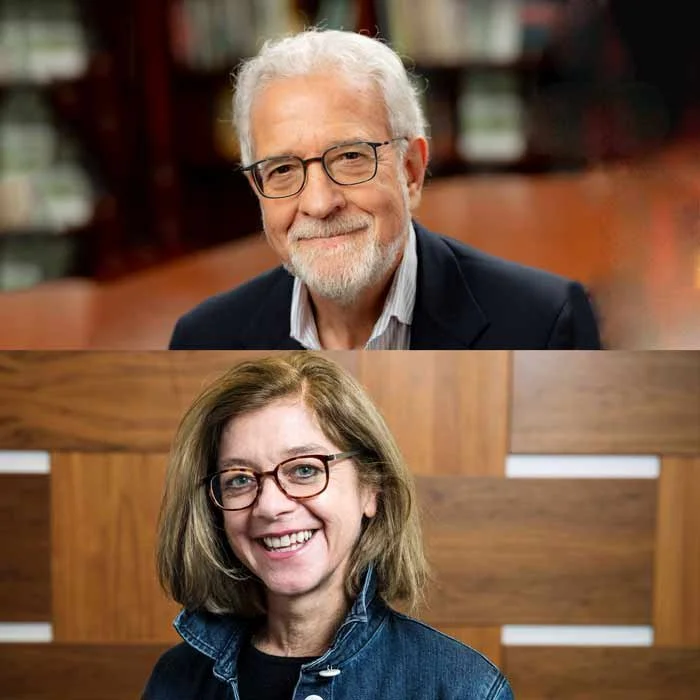
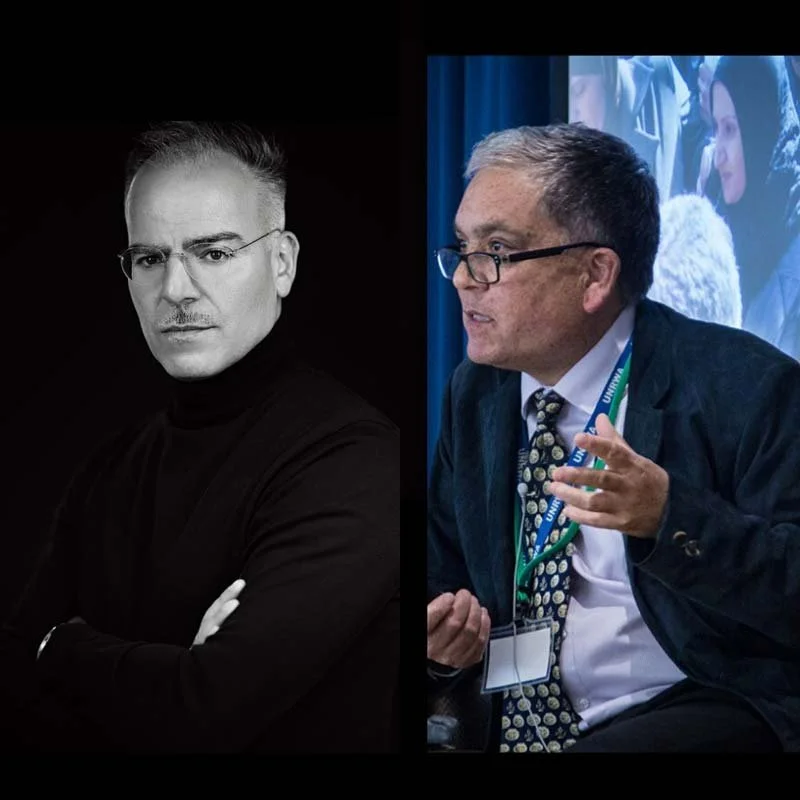
In this episode of the Speaking Out of Place podcast, Professor David Palumbo-Liu speaks with Ardi Imseis and Chris Gunness for an urgent discussion of Israel’s accelerated genocide and ethnic cleansing in Gaza and the West Bank. These eminent international human rights scholars discuss Israel’s longstanding violations of international law and the complicity of the US. They also discuss at length the responsibility of states to immediately halt their direct and indirect support for the genocide. Our conversation includes an in-depth discussion of the UN and both the usefulness and shortcomings of international law. They end with a call to international civil society to use the information, rules, and judgments of law to do what too many states fail to do—protect the rights and lives of Palestinians and bring forth justice.
Dr. Ardi Imseis is Associate Professor of Law, Faculty of Law, Queen’s University. He is author of The United Nations and the Question of Palestine: Rule by Law and the Structure of International Legal Subalternity (Cambridge University Press 2023). In 2019 he was named by the UN High Commissioner for Human Rights to serve as a Member of the UN commission of inquiry into the civil war in Yemen. He has served as legal counsel before the International Court of Justice, including the Court’s groundbreaking 2024 opinion on Legal Consequences arising from the policies and practices of Israel in the Occupied Palestinian Territory, including East Jerusalem. Between 2002 and 2014, he served in senior legal and policy capacities in the Middle East with the United Nations Relief and Works Agency for Palestine Refugees in the Near East (UNRWA) and the United Nations High Commissioner for Refugees (UNHCR). He has provided expert testimony in his personal capacity before various high-level bodies, including the UN Security Council, the UN Human Rights Council, and the UN Committee on Economic, Social and Cultural Rights. Professor Imseis’s scholarship has appeared in a wide array of international journals, and he is former Editor-in-Chief of the Palestine Yearbook of International Law (Brill; 2008-2019) and Harlan Fiske Stone Scholar and Human Rights Fellow, Columbia Law School. Professor Imseis holds a Ph.D. (Cambridge), an LL.M. (Columbia), LL.B. (Dalhousie), and B.A. (Hons.) (Toronto). He appears today in his personal capacity.
Chris Gunness covered the 1988 democracy uprising for the BBC in what was then Burma. After a 23-year career at the BBC, he joined the United Nations as Director of Strategic Communications and Advocacy in the Middle East. In 2019 he left the UN and returned to London. He founded the Myanmar Accountability Project (MAP) in 2021.
DAVID PALUMBO-LIU
Thank you both so much for being on the show. You're both so busy doing many important things. I'm really happy to have you here so that you can share some of your work and thoughts with our audience. Let's begin with Israel's ever-increasing carnage and destruction, which seems to be spreading further and further with really no end in sight.
I would love to get your thoughts on these campaigns and the response of the international community. Let's start with the increasingly dangerous and horrific situation in Gaza with Israel's invasion of Gaza City and the expulsion of Palestinians further south. What are your assessments of these latest moves?
ARDI IMSEIS
David, my sense is that the Israelis are engaged in the late stages. I hope not, but the late stages of an attempt to finish the job on the Palestinian people in the Gaza Strip, by which I mean indeed they may depopulate, at the very least, the Gaza Strip of its people. For the past 22 months or thereabouts, these Israelis have engaged in total war on a civilian population that is largely incapable of defending itself.
When one looks at the relative power imbalance between the Palestinian people on one hand, including the paramilitaries that are clearly existing in Gaza, and the Israeli armed forces, they have been bombarded from land, sea, and air. They have been starved and are being starved. They have been chased from pillar to post by the hundreds of thousands, up and down this very small strip of land.
All of it can be attributed to a scorched-earth policy of these Israelis to destroy every aspect of civilian life that we are all familiar with: schools, homes, roads, religious buildings, governmental offices, hospitals, medical centers, and so on. The idea is not new by any means. Anyone familiar with Israel's settler colonial endeavor in Palestine, particularly around 1947, 1948, and 1949, will know that scorched earth tactics are a policy.
Overwhelming force is a policy because you can under any number of pretexts destroy homes, lives, and society. Equity claims the territory, but if there is nothing to return to, then there is nothing to return to. That's precisely what they are saying openly and doing openly as a matter of public record.
There's an irony to it because, to the extent that 80% of the population of Gaza are themselves not Gazans, they are Palestinian refugees registered with UNRWA, and they are registered with UNRWA because these are refugees who have a connection to events in 1947, 1948, and 1949. They can trace their origins to homes and lands and properties that are now presently inside Israel.
But this begs obvious questions for the lawyers and for others. If Israel is really concerned about the civilian population of Gaza and wants to move out of the way of whatever bombardments they want to undertake because they have a, in their view, legitimate right to use force to dislodge the masked fighters, why would they not allow these people back to their homes, lands, and properties in places like the Negev Desert or in Ashkelon or in Jaffa or other places in Israel?
At the bottom, the reason they won't do this and the reason they're continuing in their policy course to destroy Palestinian life in the Gaza Strip is because they want Palestinians gone and out of occupied Palestine. They want Palestinians as a national group to no longer exist between the river and the sea, and that's why they have their eyes on Gaza Street right now. Only time will tell what will happen, but it is harrowing that we should have to watch this, especially as a Palestinian.
I now speak that we would have to go through watching this without any real response from the international community. By "real," I mean beyond lip service, but actual, tangible actions. I was just saying to a friend the other day, and I wound up in Canada, that in 2005 or thereabouts, the Canadian government made a big point of arguing for the responsibility to protect doctrine.
That where a state is involved in massive violations of its population or population subject to its control, so goes the argument: states with authority, with power, particularly the Western liberal democracies, should take a duty upon themselves to intervene physically to protect those people. They had a responsibility to protect, and now we see complete silence from these Western states on the issue of the responsibility to protect. They don't raise it because some bodies are deemed more worthy of protection than others.
CHRIS GUNNESS
If I can just add to that, David, I believe that we are witnessing what Israel hopes is the final stage of the colonial erasure of Palestine. I say this because Israel's finance minister, Bezalel Smotrich, has said so proudly. Boasting, and on the record, a few days ago, he announced the greenlighting of 30,000 new housing units in a huge Jewish settlement bloc, which will cut the West Bank in half, making access to their capital and holy sites occupied illegally and illegally annexed East Jerusalem off-limits to hundreds of thousands of Palestinians. When he made this announcement, he actually said, and the quote is something like, "We are now seeing the destruction of a Palestinian state—not in words, but in deeds." So he has said it. We don't need to speculate about what Israel is doing in the West Bank, where tens of thousands of Palestinians have either been forcibly displaced, injured, or killed. Their homes have been demolished in the refugee camps where Ardi and I used to work in the West Bank.
So it is happening in actions. Mr. Smotrich, you have proudly announced the colonial erasure of certainly Palestine in the West Bank. If you look at what's happening in Gaza, as Ardi has put so well, we are seeing mass displacement and ethnic cleansing. We are seeing what the former Israeli Prime Minister, Ehud Olmert, announced as a concentration camp. He invoked the Holocaust. Once we start seeing the Holocaust being weaponized, we really are witnessing the complete bankruptcy of the Jewish state and the Zionist enterprise.
Let us be clear that from the word go, if you read Herzl and Jabotinsky, it is very clear that what they wanted was as much of historic Palestine as possible with as many Jews in it and as few Palestinians as possible. That Zionist project has now reached expression in the most far-right, nuclear-armed, ultra-religious government in the history of Israel, which is spoiling for a Holy War against a very radicalized Middle East. Therefore, in that context, what Ardi rightly identifies is the shocking silence and lack of action by those with the power to do something, which is frankly unfathomable.
When you look at what the world is facing—a potential nuclear Holy War between a far-right government in Israel and Iran—who knows? It's shocking that no one is doing anything, and that is despite the obvious loss of life and the appalling indignities to which the Palestinians in Gaza and the West Bank have been subjected since 1948 and indeed before that.
DAVID PALUMBO-LIU
So let's really drill down on the duty of states, but before we get to that point, Chris, you mentioned the West Bank, and this is something that Americans don't know a lot about. We know about Gaza; we know about the accusation that it's a war against Hamas and that the Palestinian population is getting in the way. But talk more about the West Bank and what's going on there.
CHRIS GUNNESS
Can I just quickly debunk this idea about the war against Hamas? Yeah. The idea that you need to completely demolish Gaza City, the largest city in the West Bank, possibly in Palestine—Ardi, correct me if it's bigger than Ramallah or not—but the point is that the idea that you are trying to defeat Hamas by doing what Israel is doing is just a joke.
Nobody would take that very seriously. And by the way, the definition of state-sponsored terrorism—again, I bow to Ardi's legal analysis on this—if the definition of terrorism is the use of violence to achieve a political end, then surely the Israeli government saying our political end is to defeat Hamas, to make sure that Hamas is never elected again, never exists again, and we are going to use genocide to do it—is that not state-sponsored terrorism? Is that not state-sponsored genocide?
ARDI IMSEIS
As it happens, let me just offer the following clarification—it's a pointy-headed lawyer clarification, a technical one. It happens, Chris, that there is no single definition under international law of terrorism.
As such, there are 19 treaties, multilateral treaties, that touch on aspects of terrorism, but for political reasons, which you'll be well aware of, states have not been able to agree on what the definition of terrorism ought to be. Historically, whenever I've heard the term terrorism, I automatically take it to mean a political view. It is the word that comes with a moral judgment on the justice of the putative terrorists or freedom fighters, depending on which side you may be on regarding the justice or rightness of their use of force.
I borrow here from Professor Edward Said, who wrote extensively about this, particularly in relation to covering the land in one of his monographs. The use of the term terrorism obfuscates basic principles of cause and effect. Why do people take up arms in the first place? This is relevant to our conversation on Gaza and occupied Palestine.
This goes to the whole point about October 7th, or not the point, but its genesis. Where did it come from? I recall on the 25th of October, 2023, right, so not very far after the fateful day of October 7th, the Secretary-General of the United Nations, Antonio Guterres, said October 7th, and I quote, "did not happen in a vacuum." His words, not mine. The response from the Western states, who are supportive of Israel, was very strong. They came under a lot of pressure, and that is because it goes to the point of legitimacy.
Any questions of cause and effect? Terrorists, we are told now—20, 25 years, a quarter-century into the global war on terror—are not rational. They cannot be trusted. They use force irrationally for ends that are not of this world. Therefore, what you do in response to the violence of the terrorist can be justified very easily, and that's the whole point of treating history as though it began on October 7th.
But as the Secretary-General reminded us, there was history before October 7th. The vast majority of people on Earth are aware of this history, even if they are not experts on the question of Palestine. They don't need to be experts to know that the people of the Gaza Strip stopped living and working back in time prior to October 7th under an illegal blockade for about 16 or 17 years that rendered, among other things, 95% of the drinking water of the Gaza Strip undrinkable for human consumption, with a 60% unemployment rate among youth.
These people were living under a persecuted group under this illegal blockade and within a 56 or 57-year illegal foreign military occupation declared as such by the International Court of Justice in July just last year. Israel is, in fact, an aggressor in occupied Palestine, and the Palestinian people there are being ethnically cleansed. They are being persecuted.
It's easy to portray what they do in response—the penny-ante attacks they make in response, relatively speaking—as criminal; you can't attack civilian objects as was done on October 7th; you cannot attack civilians as was done on October 7th. But you can most definitely launch a resistance against legitimate military targets, and those persons, military or otherwise, on the Israeli side, who are directly participating in hostilities. Those attacks are perfectly lawful.
It's easy to couch all of that with the label of terrorism because of the goals sought by the hegemonic power, which is to depopulate occupied Palestine of its indigenous population and justify in any way they can, legal, political, and other representations, et cetera.
CHRIS GUNNESS
Interesting. I want to come back to David's points about the importance of the West Bank, but just to say that it's not just the terrorism epithet that's being used; it's the antisemitism epithet that's been used. Hamas, according to Benjamin Netanyahu, is the same as the Nazis. He’s literally weaponizing the Holocaust, which many of my Holocaust-surviving friends are utterly revulsed and insulted by.
But what you are guessing is that people like Danny Danon, the Israeli ambassador at the United Nations, putting on a yellow star, which Jews in Europe were forced to put on. Now I know people who were forced to wear yellow stars, and they were absolutely disgusted when Danny Danon did this because this is the end. This is the absolute moral bankruptcy of the Zionist project once they have to lower themselves to weaponizing the Holocaust.
But to come back, David, your question about the West Bank: when Ariel Sharon pulled the settlements out of Gaza in 2005, his rationale—which he stated publicly—was that he wanted to regroup and consolidate the state as it were. In a sense, in those days, Gaza was seen very much as a sideshow, way down on the Egyptian border. Of course, it isn't. It's actually key to defining what Palestine will look like.
I don't dismiss Gaza as a sideshow at all, but that's how Sharon saw it. It was very clear, and I was working in the UN's political office in those days. It was very clear talking to our Israeli interlocutors that they saw the West Bank as very much an integral part of Judea and Samaria, as they called it. They saw that all the really important Jewish holy sites were there. It's very much part of the sort of biblical land, all of that sort of Zionist mythology.
I think for that reason we are going to see what I think Itamar Ben Gvir, Netanyahu, and others see as a sort of once-in-a-lifetime opportunity to ethnically cleanse the occupied West Bank because I think they realize that they've got until the midterm elections in the US to do pretty much whatever they want, and they're using it to full and maximum effect at the moment, both in terms of settler violence—which has the full support and protection of what I now call the IGF, the Israel Genocide Forces—and the massive expansion of settlement blocs.
To touch on something you raised earlier, David, at every stage, really going back to the early days of the state and certainly the early days of the occupation, at every stage, Israel announces something, looks over its shoulder, sees what the reaction in Brussels is, what the reaction in Washington is, gets a very weak response. "This is unhelpful" was the classic term out of Washington for many years. Then they get on with it.
There's a wonderful new history by the Oxford historian Avi Shlaim at St. Anthony's College, Oxford. His new book, Genocide in Gaza, and one of his chapters looks at the fact that going back to the very first Israeli Prime Minister, Levi Eshkol, who was the Prime Minister at the start of the occupation in 1967, he was speaking out of two corners of his mouth. On one hand, he talked about a peace agreement with the Egyptians, with the Jordanians, et cetera. On the other hand, he was greenlighting settlement expansion.
That's very much the shtick of Zionism. It has its spokespeople around the world, liberal Jews in America and Israel saying, "No, we all hate Netanyahu. You don't understand. We want to live side by side with our Arab Palestinian brothers and sisters," blah, blah. That's how Zionism does what it does. It has the Hasbara operation preaching liberal Zionism. To be honest, there's no such thing as left-wing colonialism; there's no left-wing, nice way to steal someone's land, which is effectively what they're doing.
But now what we are seeing is the naked face of Zionism. They're not even bothering to put a velvet glove on. They're just coming out with this stuff. The reason they're able to do this is that there is such a weak reaction from my own government in the UK, but most importantly from governments like the American government, and the Europeans have been very weak. The Germans are belatedly thinking about doing something, but effectively this is a green light. As Ardi will explain, it is either borderline or real complicity. There are international obligations on states to prevent genocide and to prevent occupation, and that was made very clear in the ICJ advisory opinion of last July.
*
Speaking Out of Place, which carries on the spirit of Palumbo-Liu’s book of the same title, argues against the notion that we are voiceless and powerless, and that we need politicians and pundits and experts to speak for us.
Judith Butler on Speaking Out of Place:
“In this work we see how every critical analysis of homelessness, displacement, internment, violence, and exploitation is countered by emergent and intensifying social movements that move beyond national borders to the ideal of a planetary alliance. As an activist and a scholar, Palumbo-Liu shows us what vigilance means in these times. This book takes us through the wretched landscape of our world to the ideals of social transformation, calling for a place, the planet, where collective passions can bring about a true and radical democracy.”
David Palumbo-Liu is the Louise Hewlett Nixon Professor and Professor of Comparative Literature at Stanford University. He has written widely on issues of literary criticism and theory, culture and society, race, ethnicity and indigeneity, human rights, and environmental justice. His books include The Deliverance of Others: Reading Literature in a Global Age, and Speaking Out of Place: Getting Our Political Voices Back. His writing has appeared in The Washington Post, The Guardian, The Nation, Al Jazeera, Jacobin, Truthout, and other venues.
Bluesky @palumboliu.bsky.social
Apple Podcasts · Spotify · Website · Instagram