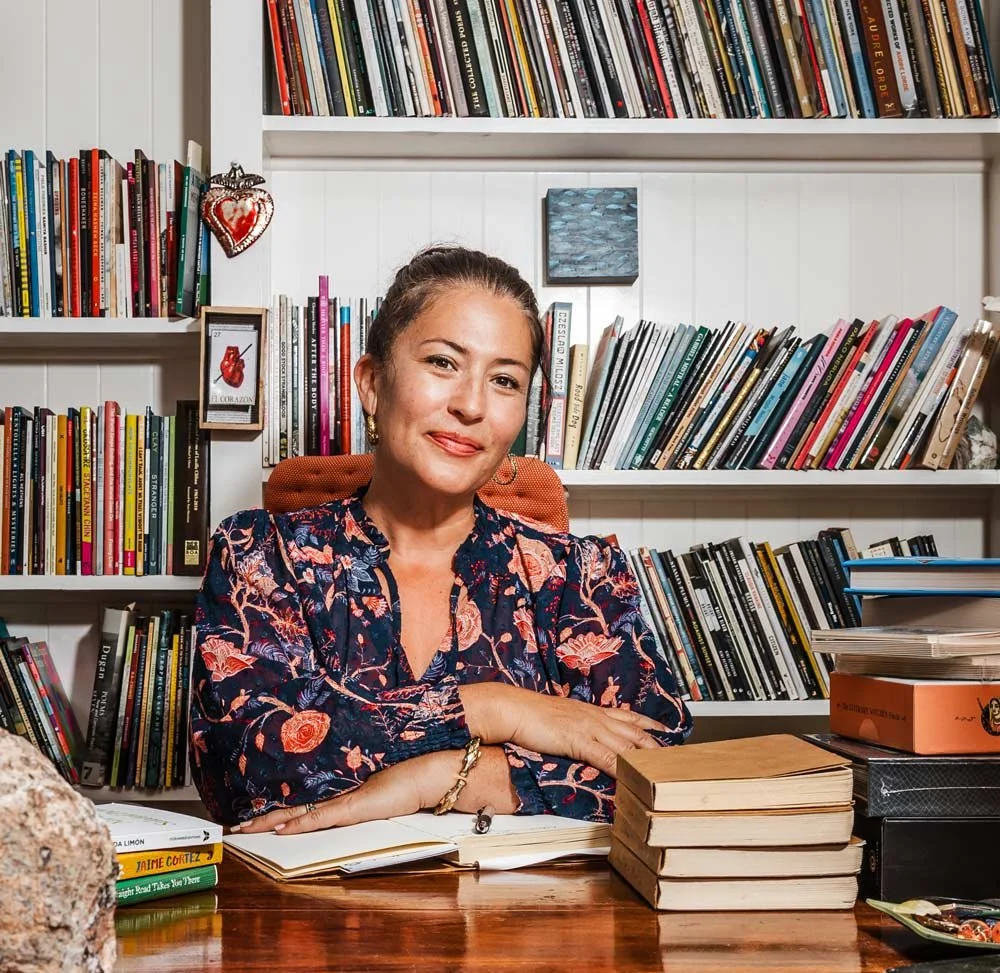
I'm Lebanese. I grew up in Lebanon during the Civil War, and I came to the United States as a graduate student with the intention of going back. I never wanted to stay here. I really thought that my life would happen in Beirut, in a city that I loved and hated in the healthiest of ways. My investments, both literary and intellectual, were rooted there. I came here as a graduate student and joined the PhD program, and then the events continued to unfold there, making life more and more of a risk, building a life in a place like Lebanon. The most important counterpoint in my life was meeting my partner, Ahmad Almallah, who is Palestinian. So immediately, my life became the life of a Palestinian by association.
In this episode on Speaking Out of Place podcast Professor David Palumbo-Liu talks with Huda Fakhreddine, writer, translator, and scholar of Arabic literature. Among the many topics they touch upon are the challenges of teaching Arabic literature, especially Palestinian literature, in a time of genocide, when universities, professional organizations, and political groups militate against any honest discussion of these topics, and punish those who do. They talk about the notion of belonging and the importance of being able to choose what to belong to, and what not to. Huda speaks of the freedom found in living in Arabic, and explains what that means to her. She also reads in Arabic and English Nima Hasan’s stunning and wrenchingly beautiful poem, “Old Song.”
Huda J. Fakhreddine is a writer, translator, and Associate Professor of Arabic Literature at the University of Pennsylvania. She is the author of Metapoesis in the Arabic Tradition (Brill, 2015) and The Arabic Prose Poem: Poetic Theory and Practice (Edinburgh University Press, 2021), and the co-editor of The Routledge Handbook of Arabic Poetry (Routledge, 2023). Among her translations are The Sky That Denied Me: Selections from Jawdat Fakhreddine (University of Texas Press, 2020), The Universe, All at Once: Selections from Salim Barakat (Seagull Books, 2024), and Palestinian: Four Poems by Ibrahim Nasrallah (World Poetry Books, 2024). Her creative work includes a book of creative non-fiction titled Zaman saghīr taḥt shams thāniya (A Brief Time under a Different Sun), Dar al-Nahda, Beirut, 2019 and the forthcoming Wa min thamma al-ālam (And then the World), Manshūrāt Marfa’, Beirut, 2025. Her translations of Arabic poems have appeared in Protean, Lithub, Words Without Borders, Nimrod, ArabLit Quarterly, Asymptote, and Middle Eastern Literatures, among many others. She is co-editor of Middle Eastern Literatures and section editor of the Encyclopedia of Islam.
HUDA FAKHREDDINE
Now, after 691 days of genocide, when I try to look back and think about when things stopped being the same, I don't know where to start dating that. Of course, the past two years—almost two years—have been surreal. I sometimes don't believe that we're going through what we're going through because, as security concerns have become something we think about at home, when we walk from home to campus or my office, I'm constantly anxious to open my mail because often there are things that will require a lot of energy, time, emotion, and are emotionally taxing. There’s a lot of rage now in many aspects of my life, but all that aside, my personal experience—both professional and personal, and at home, familial—are not exceptional. Many other people are experiencing intimidation, silencing, and feeling cornered, censored, and oppressed just because they took a stand—a very decent, normal, basic human stand against genocide.
On the cosmic level, nothing should be the same when this planet silently witnesses a genocide continuing to happen for almost two years. Nothing should be the same. Something has been broken that will never be mended again in who we are as a species, as individuals, and as collectives. I've made that statement several times while talking about the work we do here as academics and as teachers and instructors, and in my case, as a student of the Arabic literary tradition.
Every time I sit down to write something, prepare for a class, or even speak with a student, I cannot do it without the knowledge and awareness that here we are engaged with a tradition as it is being annihilated. Here we are translating and reading literature that belongs to a tradition that is under attack in the most vicious, savage, vile way.
Speaking Out of Place, which carries on the spirit of Palumbo-Liu’s book of the same title, argues against the notion that we are voiceless and powerless, and that we need politicians and pundits and experts to speak for us.
Judith Butler on Speaking Out of Place:
“In this work we see how every critical analysis of homelessness, displacement, internment, violence, and exploitation is countered by emergent and intensifying social movements that move beyond national borders to the ideal of a planetary alliance. As an activist and a scholar, Palumbo-Liu shows us what vigilance means in these times. This book takes us through the wretched landscape of our world to the ideals of social transformation, calling for a place, the planet, where collective passions can bring about a true and radical democracy.”
David Palumbo-Liu is the Louise Hewlett Nixon Professor and Professor of Comparative Literature at Stanford University. He has written widely on issues of literary criticism and theory, culture and society, race, ethnicity and indigeneity, human rights, and environmental justice. His books include The Deliverance of Others: Reading Literature in a Global Age, and Speaking Out of Place: Getting Our Political Voices Back. His writing has appeared in The Washington Post, The Guardian, The Nation, Al Jazeera, Jacobin, Truthout, and other venues.
Bluesky @palumboliu.bsky.social
Apple Podcasts · Spotify · Website · Instagram