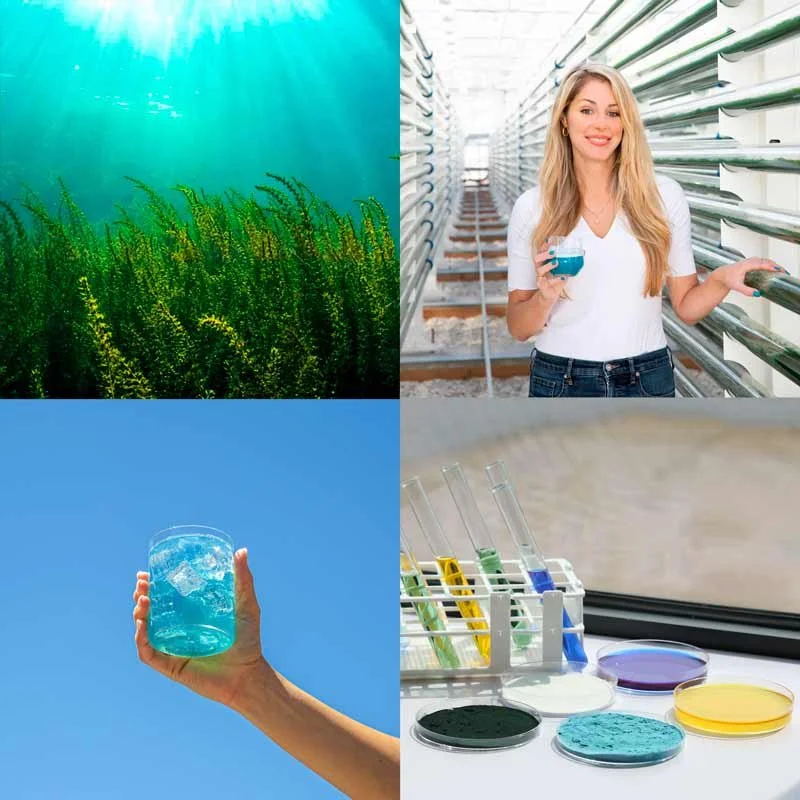


What if everything you thought you knew about protein... was wrong? We grew up believing that meat, eggs, and dairy were the champions of strength. But science—and nature—have a different story to tell. From the depths of ancient lakes comes a tiny green organism so nutrient-dense, it’s redefining what real fuel means. It’s called Spirulina—and it’s not the food of the future. It’s the food of right now. Packed with more protein per gram than beef, bursting with iron, magnesium, antioxidants, and every essential amino acid, Spirulina is fueling athletes, aiding doctors in recovery programs, and even being studied by scientists as a solution to global malnutrition. And at the heart of this revolution is a company turning nature’s most powerful superfood into clean, sustainable, life-changing nutrition.
THE CREATIVE PROCESS · ONE PLANET PODCAST
Today we have Julia Streuli from FUL Foods and Oberon Sinclair from the creative agency, My Young Auntie, here to talk about the wonders of spirulina. But before we go into that, the way you two met is an interesting story.
JULIA STREULI
Well, I think before Oberon and I even met, I knew who Oberon was and what she had built with Kale. I still remember this moment. It was back when I was working in Silicon Valley in the tech software world, and I read an article about what Oberon had done with making kale into this global phenomenon food on restaurant menus and in our diets. I remember thinking, here I was in the heart of Silicon Valley, amidst all of this innovation and excitement around how what we are building can make the world a better place. It just struck me that here is somebody creating massive impact with something so simple, yet profound. When we think about it, food finds its way onto our plates multiple times a day, and with it comes the potential to improve people's health and well-being and even the planet. I really drew inspiration from what Oberon had done by taking this nutritionally powerful crop and treating it like a brand. It really planted the seed for what we built with FUL Foods today. I remember doing research after reading that article on what is going to be the next kale, what foods have these nutritional properties and climate potential to be the next “it” food. It was always kind of part of my vision to reconnect with Oberon, and I was so grateful when we did.
OBERON SINCLAIR
In January, Julia called me and said, "It's so great to talk to you." I was like, "Wow, it's amazing to talk to you. What are we talking about?" She said, "We've created the purest, best spirulina on the planet." I said, "Well, I know that my daughter puts it in her smoothies, and there's blue powder all over my kitchen. I know it's really good for you, but I haven't done a deep dive." So, we've been working together for the past year and my God, it's mind-blowing, actually. Mind-blowing. I met Julia and her two partners, and I said, "I'd love to work with you."
Through this process, this wonderful algae that is literally the first living organism on our planet can save us from putting artificial dyes and gasoline in food, has excited me to work on this campaign because it’s really incredible what it can do. Every day I learn something new about what spirulina can do, and it's been a really exciting year for us.
JULIA STREULI
I think we always had the vision in mind of extracting different nutrients from spirulina with very targeted applications. In its whole form, spirulina, although incredibly nutrient-dense and great as a supplement, is hard to incorporate in many applications. This is because of its smell and color. Instead, we thought, "Let's extract the phytonutrients, so the blues and the oranges. Let's extract the protein where there's a booming market," particularly with interest in vegan sources that are non-allergen. Let's extract the oils, so omegas, which we know are essential for human health. Let's create all of these different ingredients with very clear applications. Although it is a very healthy substance, one that is quite limited in terms of applications because of product properties and color, on one hand, it seems so futuristic, but it's also so primordial at the same time. It is both kind of this essential living organism. It needs CO2, so what we breathe out, and light, which is abundant. From there it grows like the most high-yield crop you can imagine. There’s this sense of abundance from what is already abundant. To unlock its full potential in human diets, we need to be strategic in how we think about the nutrients that spirulina produces.
In its whole form, it's this thick green sludge. But if you extract protein, there's a huge booming market and human need for protein. If you extract fats, omegas, etc., if you look at the recent FDA ruling around the color transition, every food and beverage company now is looking for a natural source of color. Spirulina can provide that. It's about looking at this ancient substance and seeing how it can plug into our future food system in a way that works for people and the planet.
Real-World Impact: Spirulina in the Food Industry
We're already selling to and partnering with some of the biggest fast-food companies in the world, and they're using this for beverage applications. Beyond that, we're also launching everything from boba to gummies and many other products that children have traditionally consumed. When you think of those brightly colored food and beverage products, a lot of them are geared toward children. This is even more exciting for me because, instead of something artificial and potentially damaging, we have something as beneficial as eating your peas. I think this reinforces that there's a global need for these rich, resource-efficient sources of nutrition that will have these future-proof elements. You're going to be able to produce a lot of nutrition and protein and oils without fear that there's going to be some kind of flood that wipes out your crop.
Or if you need to scale production, you can do so quickly. You don't have to wait for the next growing season. There's a real excitement in how quickly it grows and can be continuously harvested. This dynamism aligns with how a lot of the food industry is evolving.
With something like spirulina, we can easily scale production using very limited land in a matter of weeks. That flexibility will be critical when we look at the food system of the future.
Closed-Loop Cultivation and Climate Solutions
One thing that is reinforced daily in this job is that you really can't think about human diets without talking about planetary health. This was clear from the research that Sarah, Cristina, and I first did as students when we looked at the future of food and what will be critical for feeding our growing population by 2050. If you look at what we eat, it’s inextricably tied to the environment, our climate, and the resilience of global supply chains. If we look at challenges like water scarcity, which you mentioned, Mia, or even biodiversity loss or soil degradation, which are impacts of much industrial food production, it's clear that what is ideal nutrition production must be defined not just by what sustains human bodies, but by a longer-term vision of what sustains life on this planet. For this, we have to look at crops like spirulina that are more resource-efficient and in line with nature, which does not have this extractive dynamic. Instead, there is one of mutual benefit.
When we look at spirulina production, we can recycle most of the fresh water we use—85%. It captures two times its weight in CO2, and we don't need arable land to grow it. A crop like spirulina can actively serve human and planetary well-being, and those are the kinds of crops we need to be investing in.
OBERON SINCLAIR
As I said, this is one of the most exciting campaigns I've ever worked on, and I love learning every day about whatever I need to learn. Beyond kale, which I still love and promote, this to me is the future. I'm working with three super powerful women doing incredible things, and they're still a startup, which blows my mind. I think this is the future, and I would be excited to work on a documentary to show the process because I'm not that scientific with all the details. If we showed people how it was extracted, how it looks in these bioreactor machines, it would really help people understand. It’s very exciting for me. It’s almost like directing a movie, but in real life with a superfood, beyond a superfood—a superhero. That, to me, is fantastic and exciting. I love being excited, which is why I promoted kale. At first, I did it as a marketing campaign, but it became real. I’ve enjoyed every moment, and I enjoy every moment of working with Julia because I learn something every day and get to surprise people by explaining to them what the future looks like for this ingredient and these applications. It feels like we're on the cusp of something very exciting. For the first time in history, there is a clear market demand for natural colors. There’s growing awareness and demand for functional ingredients and for high-quality resource-efficient sources of protein. It feels like you have the right ingredient with clear impact potential, but the market is also ready for it. And you supercharge that with the color blue.
JULIA STREULI
Toward a Regenerative Food System
We have to think about the planet we're leaving for the next generation. To do that, we must shift from an extractivist mindset to a regenerative one. The way we create, grow, and produce food must actively restore planetary health rather than deplete it.
That is the only way forward when considering all of the resource constraints we face, but also all of the potential that innovation creates by looking to old sources for new solutions. There's immense potential to draw on that can help us achieve this regenerative relationship with nature.
Julia Streuli is a mission-driven entrepreneur passionate about building companies that bridge health and sustainability. Before founding FUL Foods, she helped launch and scale a Silicon Valley impact-tech startup, where she led global partnerships with companies, as well as collaborations with NGOs and philanthropic foundations. Her career has spanned emerging markets, social innovation, and community health – from the U.S. to Europe and Southeast Asia. While earning her MBA from INSEAD, she met her co-founders and began shaping the vision for FUL Foods.