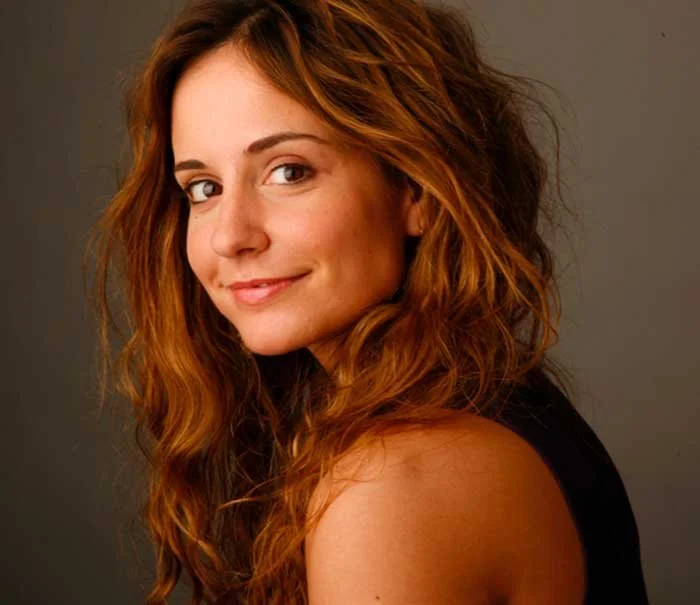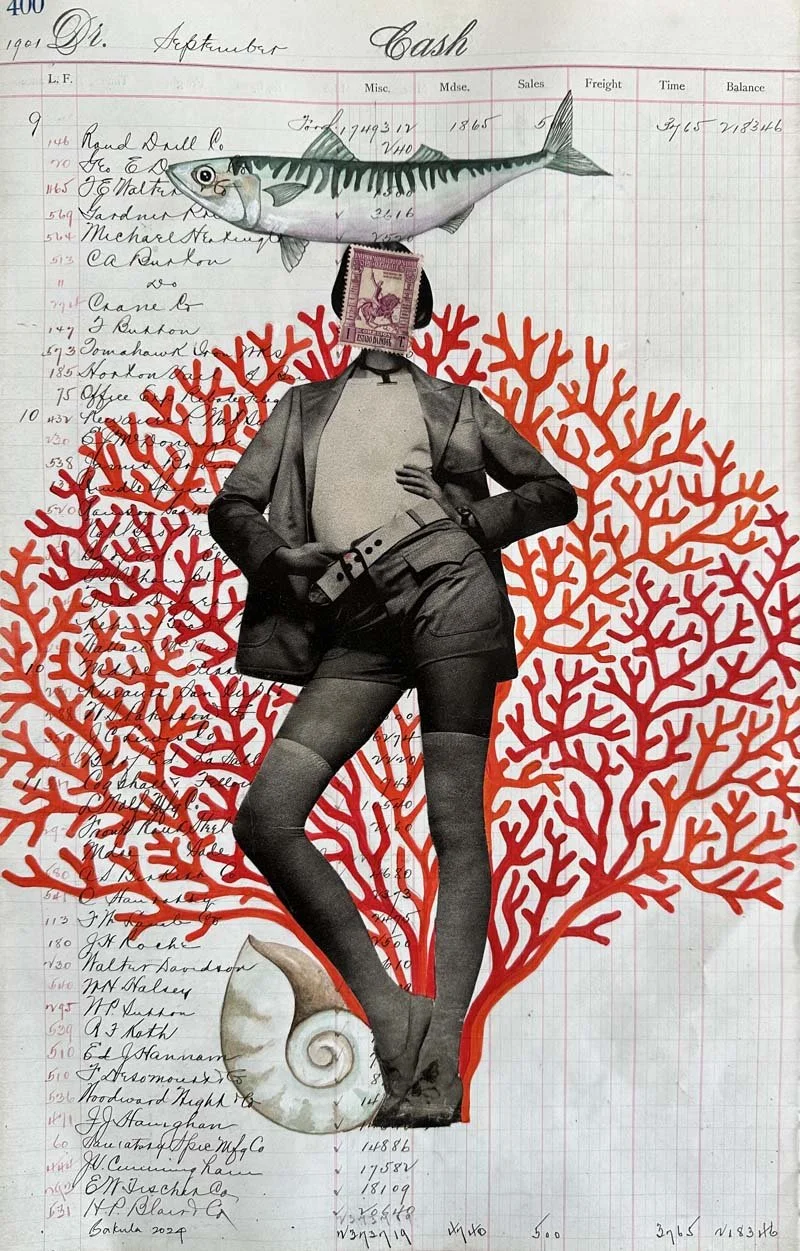


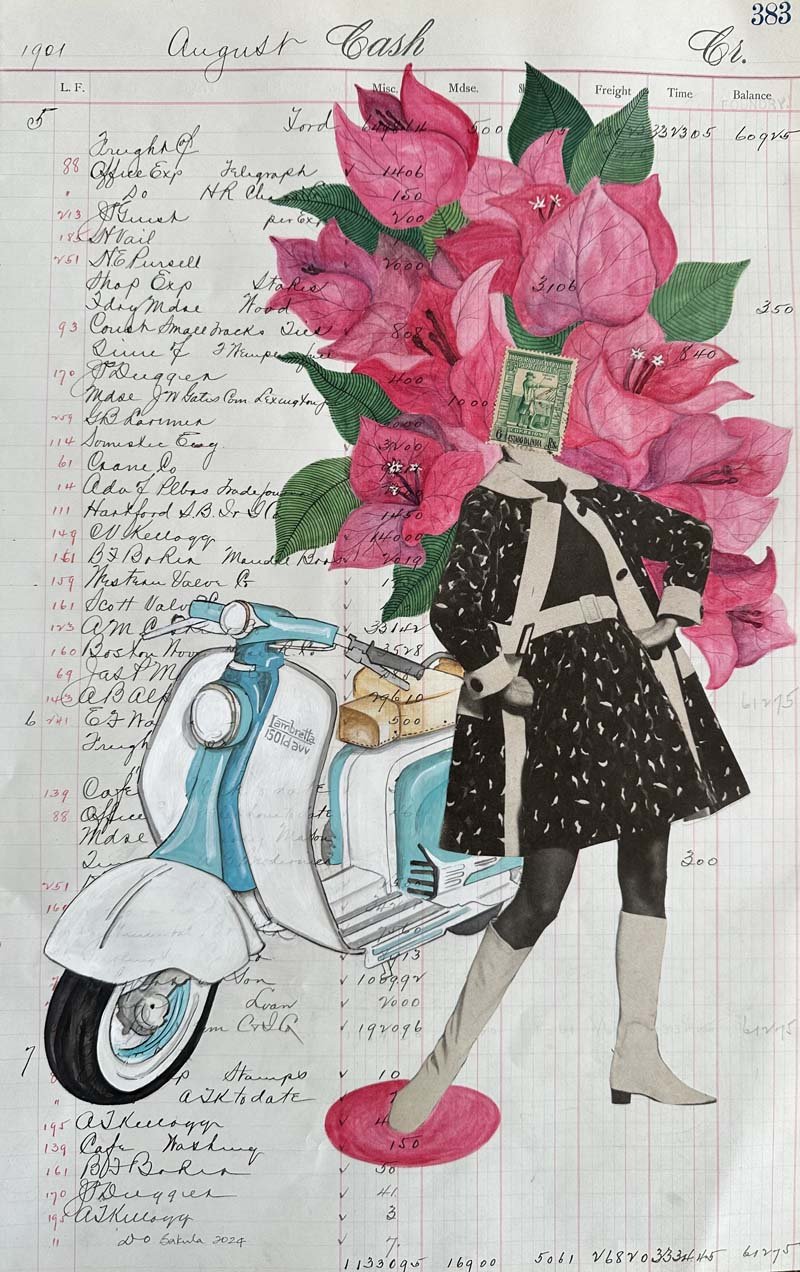
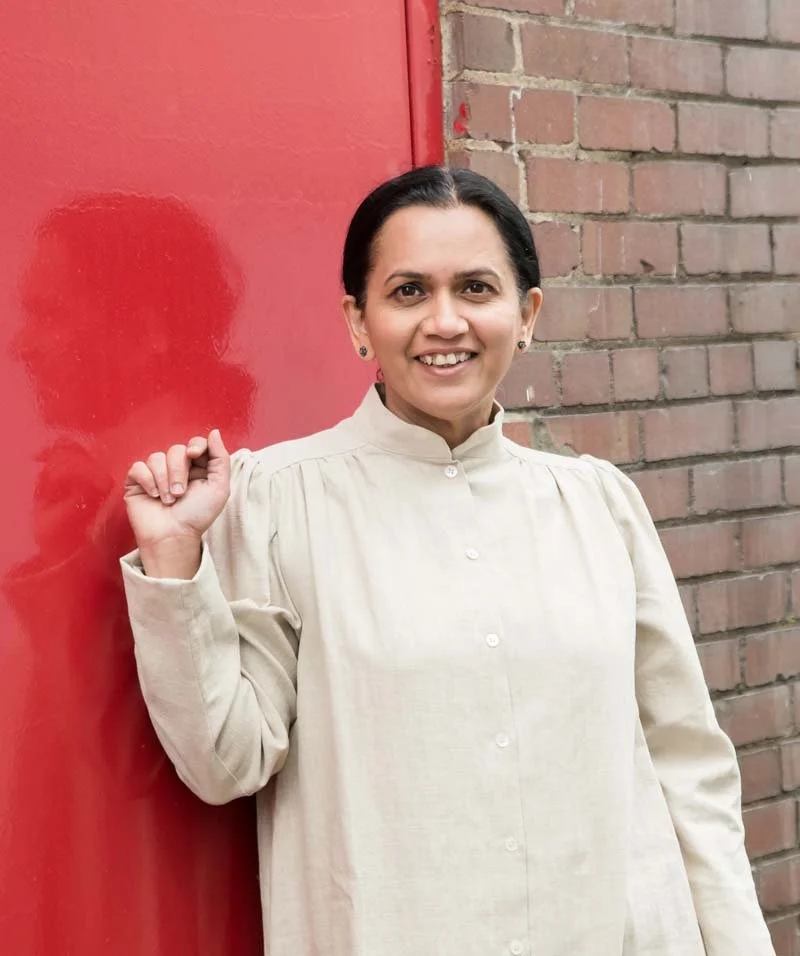
Born in 1975 in Bangalore, India, Bakula Nayak is an artist and designer with a background in architecture and a Master’s in Communication Design from Pratt Institute, Manhattan. She began her career in New York’s fragrance industry and retail package design before founding her own design firm. In 2013, she turned to art, using symbolic visual storytelling on vintage paper to explore personal and collective experiences. Her work draws from literature, emotion, and discarded materials, focusing on women’s lives, meaning-making, and cultural themes. Now based in Pittsburgh, USA, she maintains strong ties to Bangalore and exhibits internationally. @bakulanayak
How did your upbringing in Bangalore influence your art and your thinking about the world? As a child, I was deeply encouraged by my mother to pursue art—not just as a creative outlet, but as a way to understand and respond to the world. She constantly urged me to think beyond myself. I was only 11 when I painted scenes from the assassination of the Indian Prime Minister, the Indo-Russian Peace Treaty, and the Live Aid concerts for famine relief in Ethiopia. These early experiences taught me that art could be more than beauty—it could be witness, protest, memory, and empathy.
This way of thinking became a foundation. Even though art wasn’t seen as a viable profession in the environment I grew up in—and I was expected to marry by 17—I never stopped being curious about the world through a creative lens. As a compromise, I studied architecture for my undergraduate degree and later earned a Master’s in Communication Design from Pratt Institute in New York. These disciplines shaped my visual thinking: the structure, composition, and clarity I bring to my art today come from that training.
When I returned to art in my 40s, as a mother of three, it was in small moments stolen at the dining table while supervising homework or after the kids went to bed. Space and time were tight, so my art became intimate, portable, and deeply personal.
I also began translating my experiences as a woman, a mother, and someone living with chronic illness into my work. Though personal, these themes resonated with women everywhere—across geographies and cultures. And in that way, I found myself coming full circle: like my mother once encouraged me to do, I still use my art to connect private realities with global conversations. My work is rooted in lived experience, but always in dialogue with the world.
When did you first realize you wanted to be an artist? For you, why is it important to make art? I fell in love with art as a child in Bangalore, sitting beside my mother while she encouraged me to draw, paint, and think deeply about the world around me. I didn’t know then that I wanted to be an “artist” in a professional sense—I just knew that making art helped me understand life better. I was painting world events at age 11, not because I had to, but because I felt them. Art made me feel connected—to history, to people, to emotion.
But despite that early love, becoming an artist didn’t feel like a real option at the time. I took a long route back to art, through architecture, design, motherhood, and illness. When I returned to it in my 40s, I realized art had never left me. It was simply waiting for me to be ready.
To me, the importance of the arts lies in their ability to hold what words often can’t—grief, wonder, complexity, joy, contradiction. Art helps us pay attention. It allows people to feel seen, to ask questions, to connect across boundaries of culture, gender, and time. Especially for women and marginalized voices, art becomes not just expression, but survival, protest, healing, and record-keeping.
Art gave me a language when I didn’t have the words. It still does.
What is your creative space like? Are there any tools or routines that structure your creative process? My mornings tend to be full, mostly with the rituals I need to keep myself well. Meditation, stretching, a bit of exercise, and getting my son off to school. It’s only when the house quiets down that I truly begin.
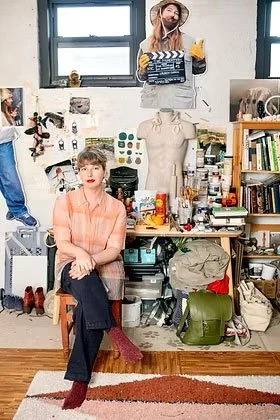
Although I have a separate studio on another floor, I often find myself working at the table near the kitchen. There’s something comforting about being close to everyday life—I can stir a pot, switch laundry, and then return to a line or a layer of paint. One day, maybe, I’ll give my work singular, uninterrupted attention—but for now, this rhythm feels honest and real.
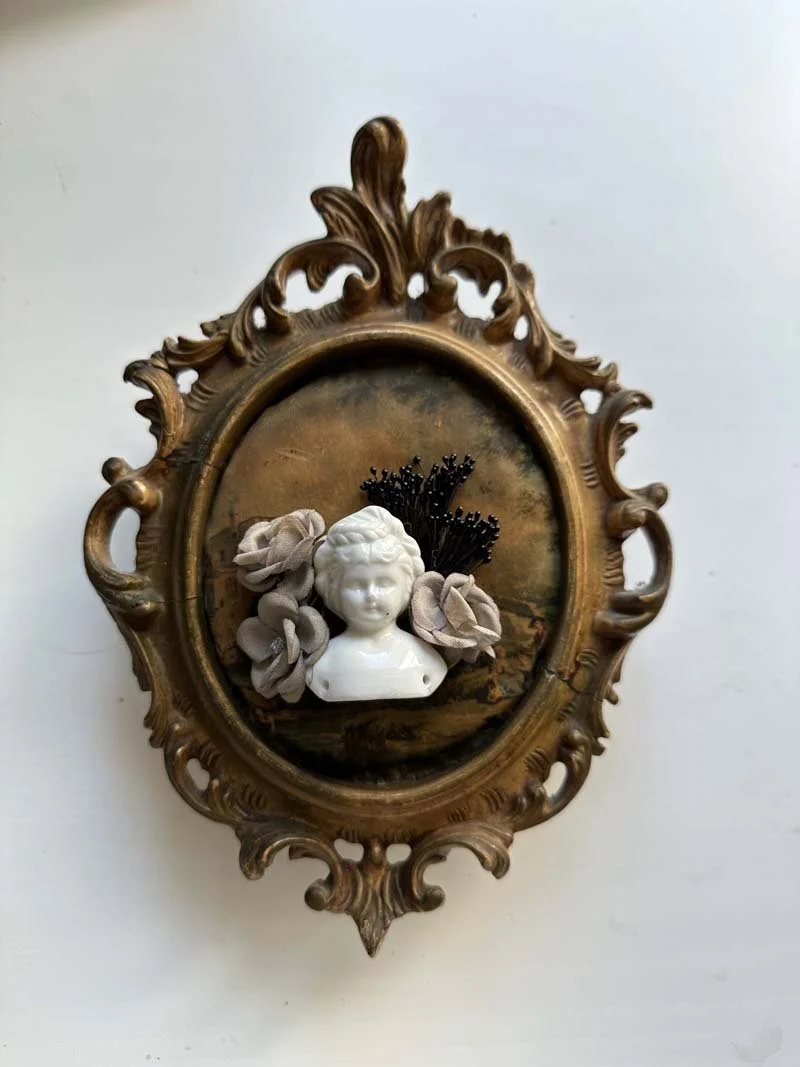
My space is filled with things that bring me joy: vintage and handmade objects that feel like tiny time capsules. I have bowls of collected seashells, feathers, wooden birds, and an ever-growing army of ceramic rabbits. They surround me with beauty, memory, and a sense of wonder.
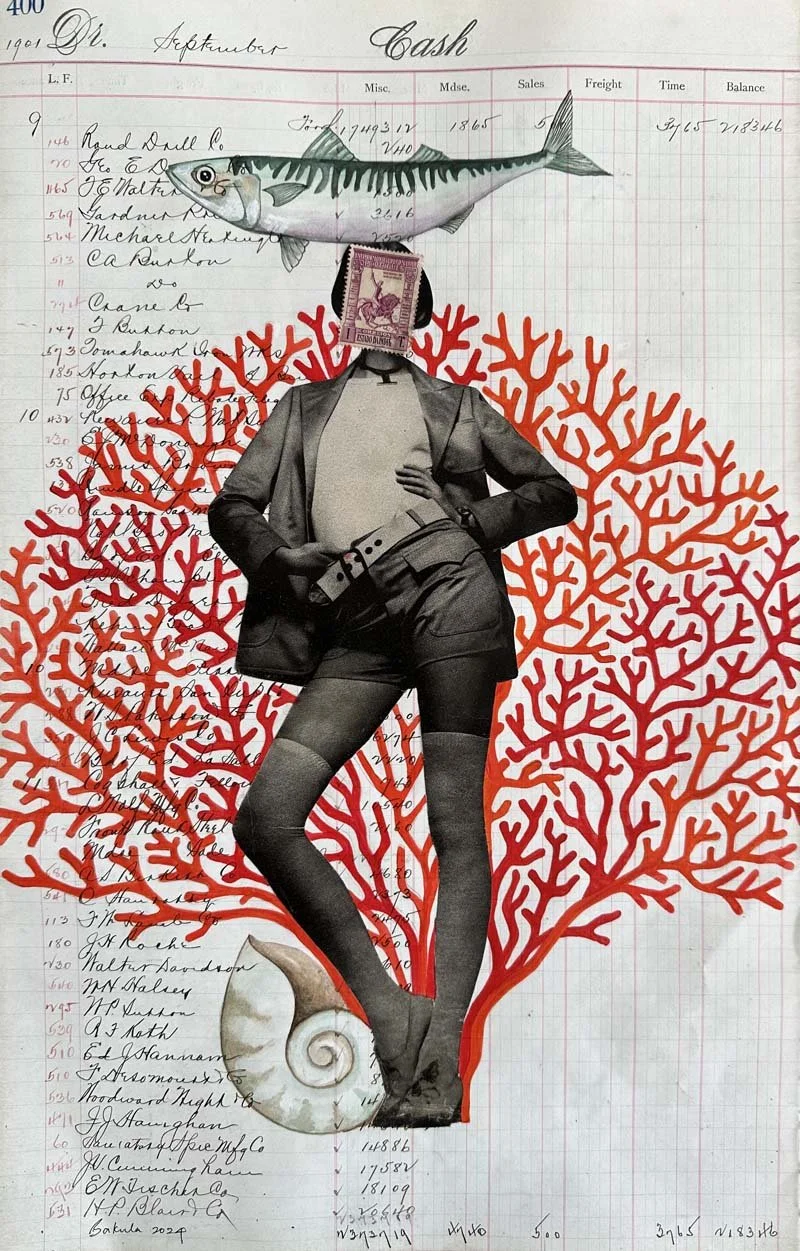
I mostly work with vintage paper and photographs, so my studio holds an evolving archive of aged textures and forgotten stories. My tools are always within reach—brushes in one holder, pens in another, and separate jars for color pencils and graphite. It’s a space that’s both practical and poetic, where the past meets the present, and where everyday life quietly folds into my creative process.
What concepts or feelings did you explore with your recent work, and what’s next? I recently completed a painting that was acquired by the Children’s Museum of Pittsburgh and wrapped up a deeply fulfilling residency at the Carnegie Library. At the moment, I’m working on a series of projects centered around food justice, with a particular focus on how traditional farming practices are being displaced by commercialized, industrial agriculture.
This shift doesn’t just affect how food is grown—it transforms what we eat, how we relate to the land, and ultimately, our health. I’m interested in the invisible systems that shape our daily lives and how women, especially, are entangled in the labor of nourishment—as growers, preparers, and caregivers.
These new works continue my larger practice of using art to explore resilience, memory, and the emotional weight of care, often through layered storytelling and symbolic imagery. Whether it’s through vintage papers, found objects, or visual metaphors, I’m always looking for ways to connect the personal with the political—the intimate gestures with larger systems at play.
What do you hope people feel when they experience your art? I hope people feel seen, moved, and gently disrupted when they experience my art. Much of what I try to express lives in the quiet, often invisible corners of life—the emotional labor of women, the weight of care, the complexity of love, the stories passed down in silence. I want my work to hold space for what often goes unspoken.
I’m not trying to offer answers. What I’m drawn to is the act of witnessing—of making visible what has been overlooked, whether that’s a mother’s exhaustion, the erosion of traditional farming, or the beauty in something worn and discarded. I want people to pause, look closer, and feel a little more connected—to themselves, to others, and to the histories that shape us.
If my work can stir recognition or make someone feel less alone in their experience, then I feel it has done what it was meant to do.
Which artists, past or present, would you like to meet? And why? I would love to meet Frida Kahlo—not just for her iconic art, but for the way she transformed pain, identity, and womanhood into a visual language that still resonates so deeply. Her ability to tell raw, intimate stories while engaging with politics, culture, and the body is something I connect with deeply in my own work. I’d want to ask her how she protected the emotional core of her art while living through so much physical and personal turmoil. I’m drawn to artists who don’t look away—who use their work to hold contradiction, to ask hard questions, and to carve space for vulnerability and complexity. Those are the conversations I’d want to be part of.
Do you draw inspiration from music, art, or other disciplines? Yes, I draw inspiration from many disciplines. I love looking at other artists’ work and make it a point to regularly visit galleries and museums—it’s both a source of learning and a quiet dialogue with other makers, past and present. When I travel, one of my first priorities is always to see local art. It’s a way of understanding a culture through its creative language, and those experiences often find their way into my work in unexpected ways.
Music is another constant presence in my studio. It shapes my mood, sets the rhythm of my day, and often guides the emotional tone of a piece. Sometimes I’ll listen to something soft and contemplative when I’m drawing fine details, or turn to something more intense and layered when working through a complex concept.
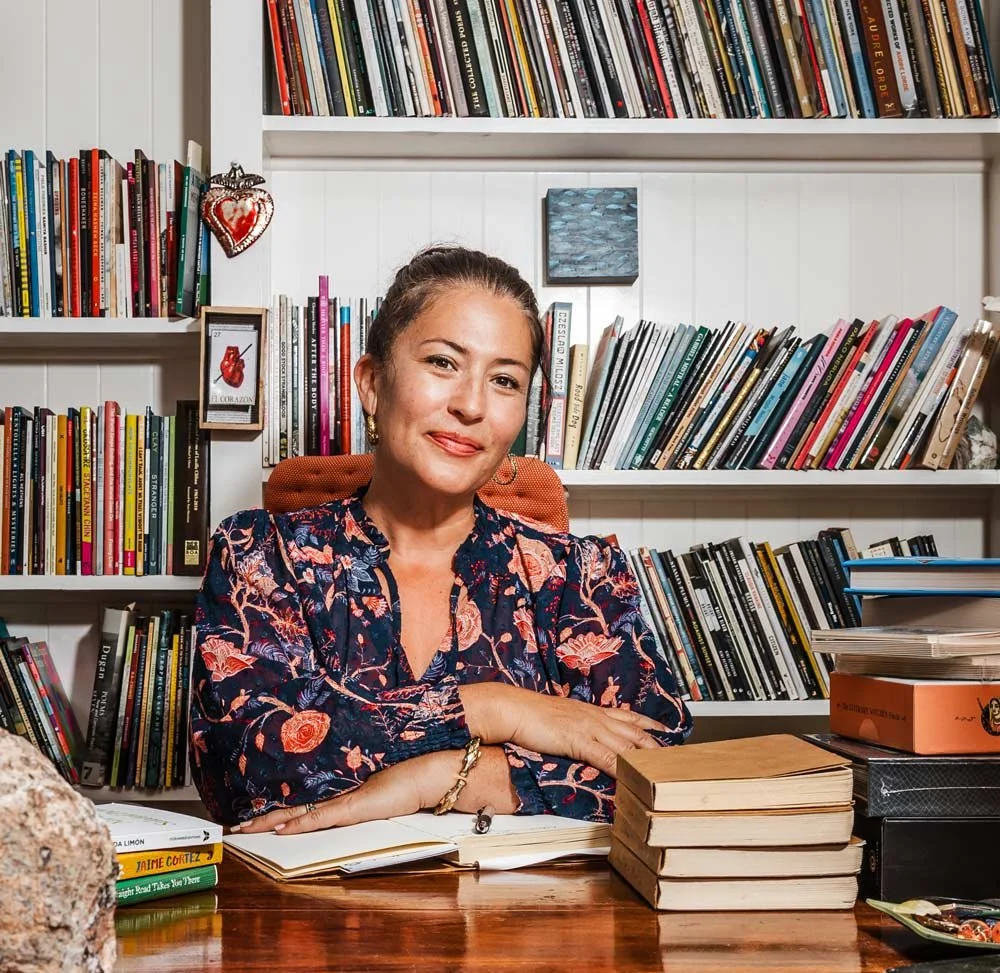
I also find inspiration in literature and poetry—the way language holds metaphor and rhythm often mirrors how I think about visual storytelling. Even design, architecture, and craft traditions feed my work, especially in terms of structure, materiality, and texture.
More than anything, I’m inspired by the layers of everyday life—by overlooked objects, repeated gestures, old letters, shared meals, and quiet acts of care. These ordinary details are often where the deepest meaning lives, and I try to let that guide the heart of my work.
You live in Pittsburgh now—how does its environment feed your artistic practice? A great thing about living in Pittsburgh is the way it blends grit and creativity—it’s a city with a deep industrial past and a surprisingly vibrant, supportive arts community. The neighborhoods each have their own character, the people are kind and grounded, and there’s space here—both physically and emotionally—to make and grow. I love how the city holds both history and reinvention at once. And the rivers, bridges, and changing seasons give a beautiful rhythm to daily life.
Who were the teachers, mentors, and collaborators who taught you how to see the world differently through art? The first was my landscape design teacher during undergrad in India. He was only a few years older than us, having just completed his master’s, and returned to teach with a fresh and passionate approach that was unlike anything we were used to. He came prepared with thoughtful lesson plans, treated us as equals and collaborators rather than students to be lectured at, and constantly pushed us to think beyond what we believed we were capable of. His classes were infused with creativity—often through assignments that had little to do with the curriculum but everything to do with growing as thinkers and artists. He not only encouraged me to apply to study abroad but also took it upon himself to convince my very hesitant parents that I had the potential. That single belief—and his efforts on my behalf—changed my life. I even worked briefly for him before heading to Pratt Institute, and he remains the most pivotal turning point in my story.
The second was my graduate professor at Pratt, Chava Ben-Amos, a Holocaust survivor and three-time cancer survivor. Her resilience and undiminished joy for design and teaching were deeply moving. She took a personal interest in me—inviting me to her home, sharing stories, and showing me her own work with such generosity. Despite all she had endured, she carried an enthusiasm and warmth that left a lasting imprint on how I think about both art and life.
Both mentors, in their own ways, taught me that encouragement, trust, and curiosity can transform someone’s path—and I carry that forward in everything I do.
Sustainability in the art world is an important issue. Can you share a memory or reflection about the beauty and wonder of the natural world? Does being in nature inspire your art or your process? Sustainability in the art world is something I think about often, especially because nature is such a quiet, constant source of joy and grounding in my daily life. My desk faces my backyard, which ends in a small wooded patch—a place full of life and change. From there, I watch foxes slip through the trees, wild turkeys strut across the lawn, and a parade of birds—woodpeckers, cardinals, blue jays, chickadees—visit throughout the year. The trees shift colors with the seasons, and every change brings a new kind of beauty.
Each spring, I plant red flowers in a window box just so I can watch the hummingbirds return. Their presence feels like a reward for paying attention. The simple act of opening the window and hearing birdsong reminds me to slow down. These are the moments where I feel most connected—to myself, to time, and to something larger.
This connection to the natural world deeply influences my art. My work often incorporates botanical imagery—flowers, fruits, and plants—as symbolic language. The beetroot becomes a stand-in for love and emotional labor, the magnolia for purity and feminine beauty, the fiddle leaf fig for new beginnings and growth. These are not abstract symbols—they’re plants I live with, growing around me in my garden, becoming part of my visual vocabulary. Through them, I reflect on relationships, womanhood, resilience, and transformation.
Nature doesn’t just inspire me—it informs how I think, create, and relate to the world. It reminds me of the importance of slowing down, of cycles, of rootedness—and those values guide both my process and my hope for how art can exist more sustainably.
What are your reflections on AI and technology? What is the importance of human art and handmade creative works over industrialized creative practices? AI is undoubtedly changing how we create, see, and share art—and how we imagine the world itself. It’s powerful, and like any tool, it has its place. But for me, it’s very similar to what I explore in my work on traditional farming practices versus commercialization. Just as industrial farming may be efficient but often strips away depth, care, and connection to land and people, AI-generated art can risk losing the soul that comes from lived experience.
I believe human-made art carries something irreplaceable—our imperfections, our intuition, our emotions. Art is not just about producing beautiful images; it’s about resonance. It’s about making someone pause, feel, and remember they’re not alone. That kind of connection comes from an emotional core that can’t be replicated by algorithms.
Handmade creative work also holds the weight of time—it carries memory in each layer, in each decision made by hand and heart. That’s something I deeply value in my own process: the touch, the symbolism, the quiet conversation between the artist and the material.
AI can be an incredible tool, even a collaborator at times. But I think it’s important not to lose sight of why we make art in the first place—to express, to connect, to heal, to disrupt, to witness. And those are deeply human things.
Exploring ideas, art and the creative process connects me to… To myself, to others, and to the unseen threads that tie our personal stories to something universal—memory, emotion, and the shared human experience.