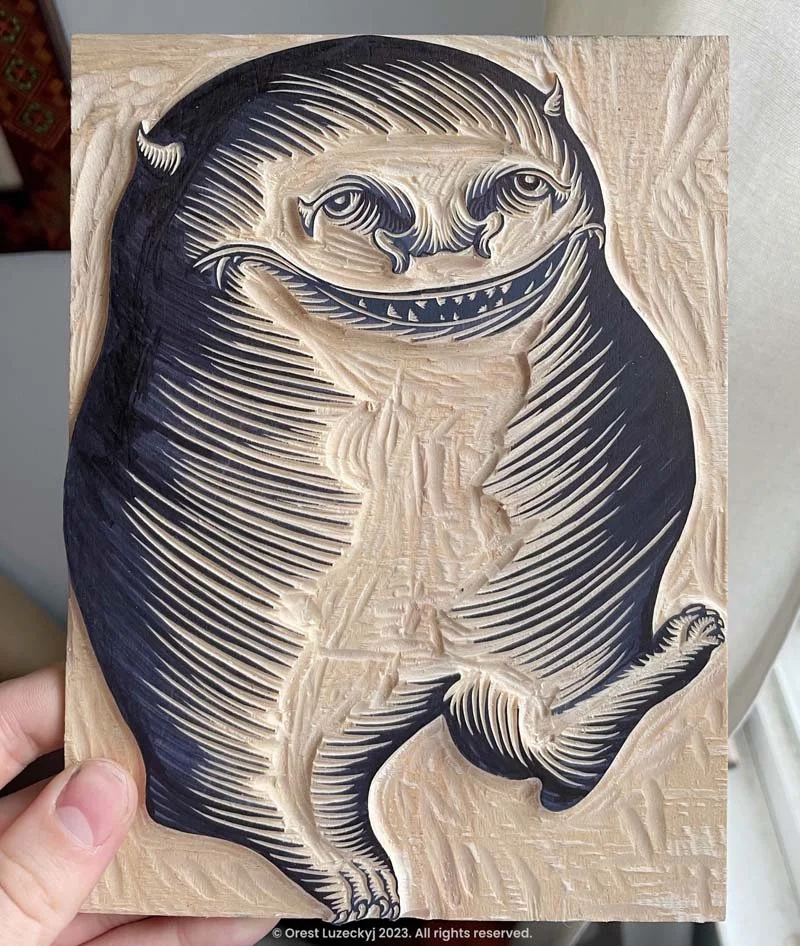


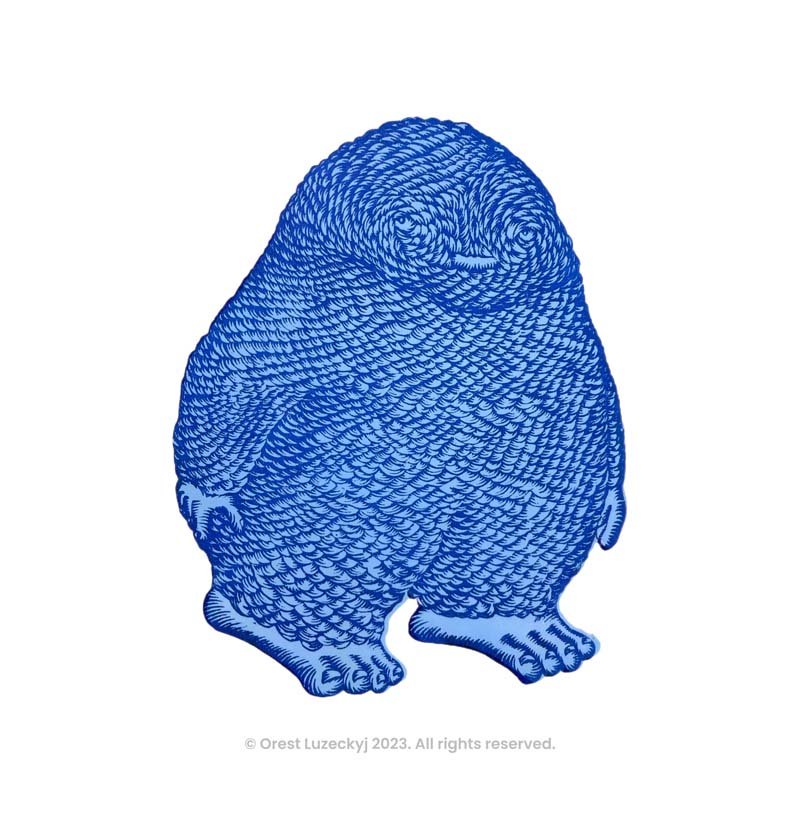
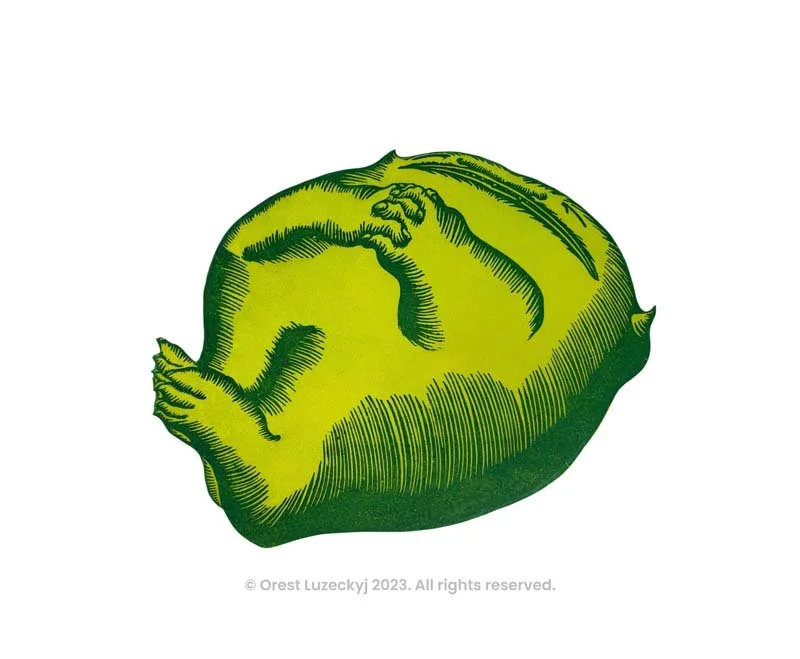
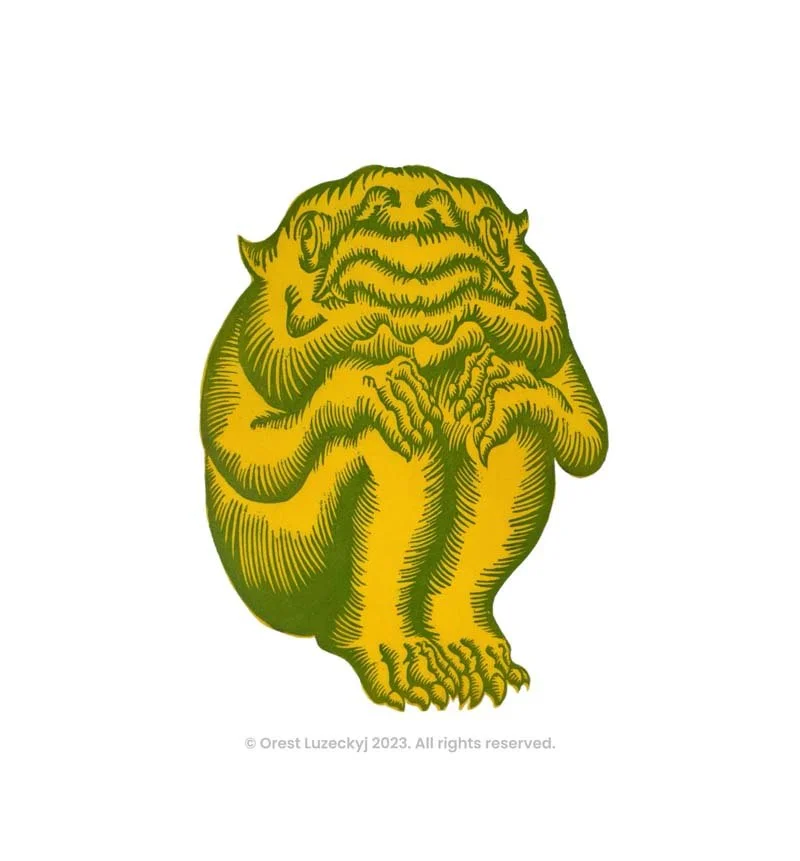
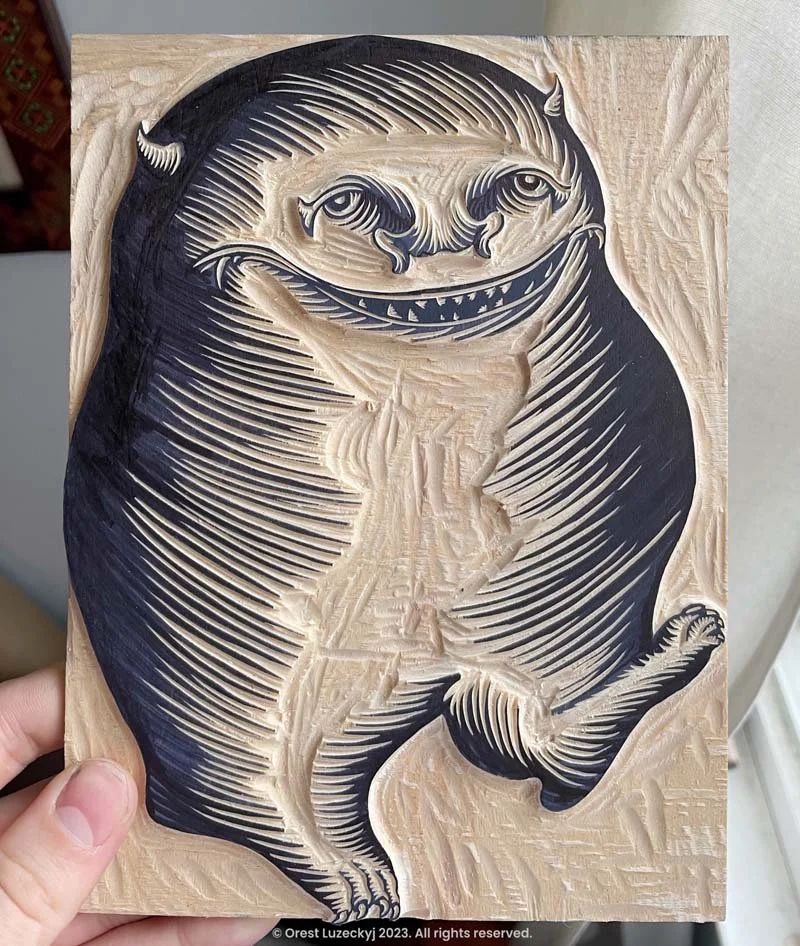
Orest Luzeckyj is an independent artist specializing in woodcut printmaking. His work features original monster designs that explore and express a range of emotions and moods. Each piece is part of his imaginative universe, Monsters On A Picnic, where creatures reflect inner experiences through bold, handcrafted visuals. Orest shares his creative process and artwork online, where he has built a growing community of fans and collectors. His work blends emotional storytelling with traditional printmaking to create art that is both playful and deeply expressive.
What role did your early life play in shaping your artistic voice? I was born and raised in Bucks County, Pennsylvania, where the surrounding nature has had a lasting impact on my artwork. I’ve always been drawn to the local landscapes and flora for their forms, textures, and especially the region’s distinct color palette, which I often try to echo in my work. Growing up immersed in this environment taught me to recognize beauty in the everyday, and that appreciation continues to shape how I see the world. In finding inspiration at home, I’ve learned to seek it everywhere else I go.
When did you first realize you wanted to be an artist? For you, what is the importance of the arts? I started drawing at a very young age, and as I grew up, my mom would share her art history books with me. I was especially drawn to abstract modern artists; their work felt strange, original, and otherworldly. Making art has always felt natural, like it’s just part of who I am. I believe art plays a vital role in how we process the world. It helps us express what words can’t and brings a sense of healing through that connection.
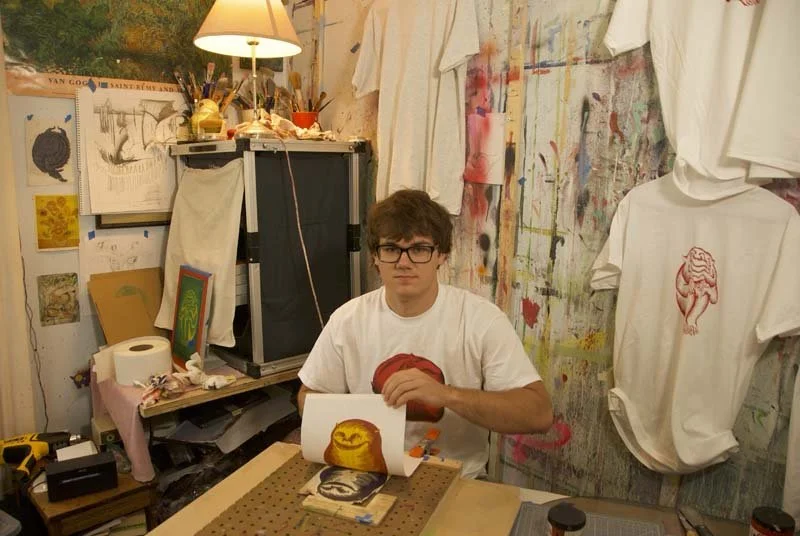
What does your typical day in the studio look like? Walk us through your studio and your most used materials and tools. Most of my day is spent making prints from woodcuts I’ve carved, and then starting new designs. I usually begin printing around 11 a.m. and wrap up by 3 p.m. After that, I spend time sketching new monster ideas and carving new blocks.
My studio is a small 12-by-12-foot room. One wall is covered in old paint from past projects, and the space holds a few desks, an old drafting table, drying racks, and storage shelves. It’s compact, but everything fits.
For printmaking, I use Japanese paper, oil-based ink, and Takach press brayers. I roll the ink out on a glass plate, then use a custom registration board I designed to help align my prints. Most of my work involves two-color prints, so accurate registration is important to combine multiple carvings onto one sheet of paper.
What concepts and intuitions are driving your current creative projects? I’m currently developing a woodcut series focused entirely on original monster designs. My goal is to create a large collection of images that feel complete and iconic; monsters that people will instantly recognize and remember. I like to explore different moods within the subject, sometimes making the creatures cute and approachable, and other times eerie or unsettling. I enjoy playing with contradictions using color and emotion in unexpected ways. A towering monster might look anxious and uncertain, while a sinister goblin might be printed in a soft, pastel pink. I identify with each monster I create, and I just enjoy bringing new ideas into existence. I just always want to create more! The majority of my inspiration comes from within, and I use the monsters to express myself in a comforting way.
What do you hope people feel when they experience your art? What are you trying to express? I hope my work encourages people to pause in their day and experience a shift in thought; something they haven’t felt or considered before. I want viewers to feel inspired and reminded of their own creative potential, to realize they can make whatever they imagine. My artwork is a direct reflection of who I am, so when someone engages with it, they’re also engaging with me. At its core, my work is about expressing emotion, translating what I feel into something visual, meaningful, and hopefully beautiful for others to experience and enjoy.
Which artists, past or present, would you like to meet? And why? Francis Bacon and Willem de Kooning are at the top of my list. They are my two favorite artists, and I can’t fully express how much their work means to me. I’m deeply inspired by their bold use of color and powerful sense of composition. Their paintings feel almost sculptural, with a dimensional quality that brings them to life. As an artist, their influence will always hold a special place in my heart. They both found something more within the figurative form and turned it into something entirely original. I strive to do the same with my work.
I would also love to meet Takashi Murakami. I’m inspired not only by his art but by how he has successfully built a creative business around it. George Condo and Alex Katz are two other artists I admire deeply. Condo’s imaginative figures and emotional expression resonate with me, while Katz’s refined technique and compositional choices continue to influence my own work.
What other art forms play a role in your creative practice? I find a lot of inspiration in the music I listen to, especially modern alternative rap. I’m drawn to how it pushes the boundaries of what music can be. Some of my favorite artists include Chief Keef, Yung Lean, Sematary, Smokedope2016, and GLO GANG. Their sound and energy often influence the mood and tone of my work. I also enjoy bands like Boards of Canada, Mayhem, and Cocteau Twins. Beyond music, I find inspiration in everyday life. I believe everything is connected, and that sense of connection helps me see meaning and creative potential in even the smallest moments.
What do you love most about where you live? The surrounding nature where I live is incredible. Just a 10-minute drive in any direction can reveal a completely different landscape. There is a strong sense of depth everywhere, and I always find something new and interesting to find. I also appreciate the rich history of my area. I live near the site where George Washington crossed the Delaware to defeat the British, which gives the region a deep historical significance. That history adds another layer of beauty and meaning to the area.
Can you describe a project that challenged you creatively or emotionally—and how you worked through it? Throughout 2024, I worked on a series of large-scale oil paintings, each around three by four feet. Adjusting to the size was a challenge, and I jumped into the project without much planning. I was also new to oil painting, so it took time to get comfortable with the medium. Choosing the right subject matter added another layer of difficulty. My solution was simply to keep going and commit to finishing every painting I started. Over the course of the year, I created around 60 paintings, though I only liked about 10 of them. I do feel proud of the last ten pieces, which show clear progress compared to the earlier ones. Although the project is still ongoing, I’m putting it on hold for now to focus on other work. I’m letting the ideas sit and evolve in the background, so that when I return, I can approach the series with a clearer and more thoughtful vision.
Tell us about the important mentors or collaborators in your artistic life. My mom has always been one of my greatest teachers and mentors, especially when it comes to my artwork. I constantly turn to her for advice and feedback on whatever I’m working on, and her insight has been invaluable throughout my creative journey.
At Penn State Abington, artist and professor Bonnie Levinthal introduced me to the medium of woodcut printmaking. Her encouragement and support were instrumental in inspiring me to develop my current series of woodcut prints.
I’m also incredibly grateful to John Thompson, who gave me the opportunity to have my first solo exhibition at Penn State Abington. He also worked closely with me as I designed and built my custom registration board, which I now use for all of my woodcut prints.
Finally, I’d like to thank Peter Hornberger, my professor for several business courses. He helped me see how my artwork could grow beyond the studio and become a viable business. His guidance gave me the confidence to begin building my work into something larger and lasting.
How do ecological concerns intersect with your artistic practice? I always make an effort to avoid wasting materials. I try to use everything as efficiently as possible and recycle whenever I can. Nature is one of my greatest sources of inspiration, especially trees and open fields. Each tree has its own unique character and sense of expression, and I find that incredibly inspiring.
What are your reflections on AI and technology? What is the importance of human art and handmade creative works over industrialized creative practices? I don’t support companies using AI to take artists’ work without their permission. I believe that in the future, AI should be more strictly regulated so it can only pull from sources that have explicitly agreed to be used. While I occasionally use AI to find basic information, I never rely on it to generate new ideas for my artwork. Personally, I’ve never felt drawn to AI-generated art. It often feels too perfect and lacks the imperfections and emotion that make art engaging. To me, it feels empty and difficult to connect with on a meaningful level.
Exploring ideas, art and the creative process connects me to… To something beyond our world, helping us grow and expand our understanding of our reality.