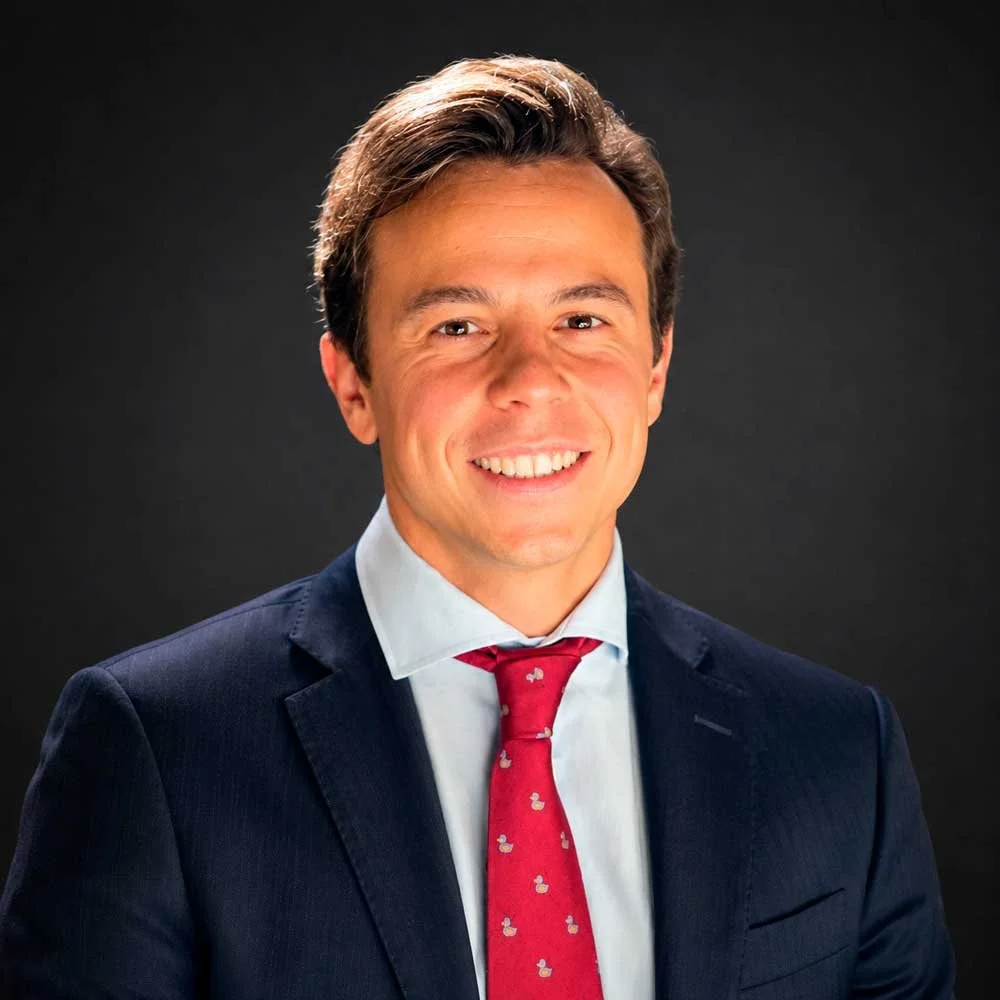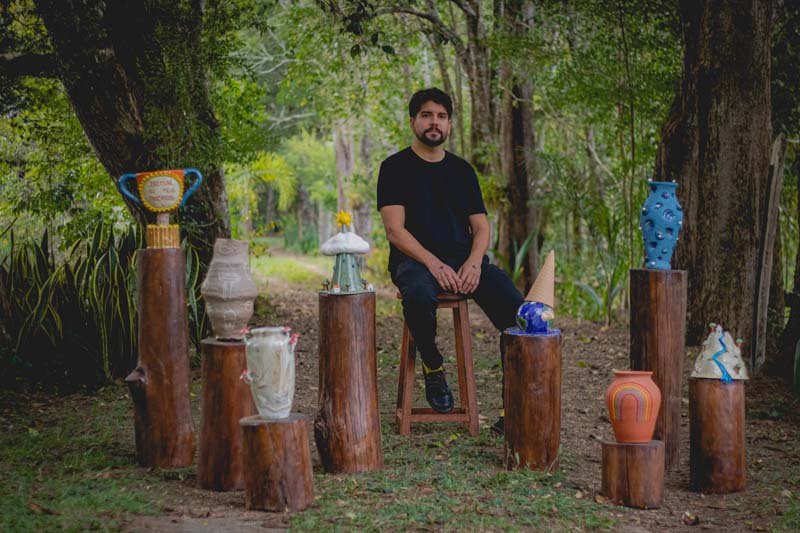


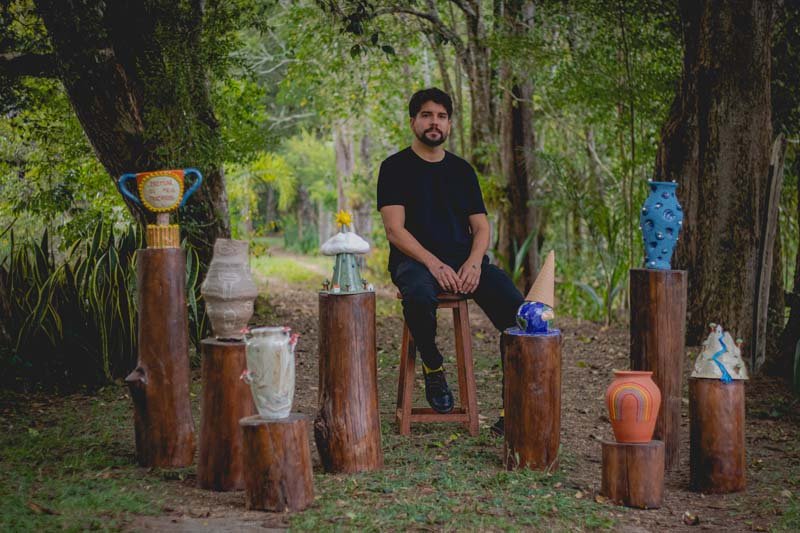
Tiago Castro Gomes holds a Bachelor's degree in Film & Audiovisual and a Master's degree in Communication from the Universidade Federal Fluminense, Brazil. Since childhood, he has been in contact with the visual arts, influenced by his maternal grandmother, a painting teacher. Between 2013 and 2014, he studied at the School of Visual Arts at Parque Lage, in Rio de Janeiro. In 2016, he began his training in ceramics at SESC São Paulo and has since taken part in various other short courses and artistic training programs, such as the ICCC – Cultural Institute of Ceramics of Cunha, and CUÁS – Free School of Art and Culture of Cunha. He currently lives and works in the south of Minas Gerais, Brazil.
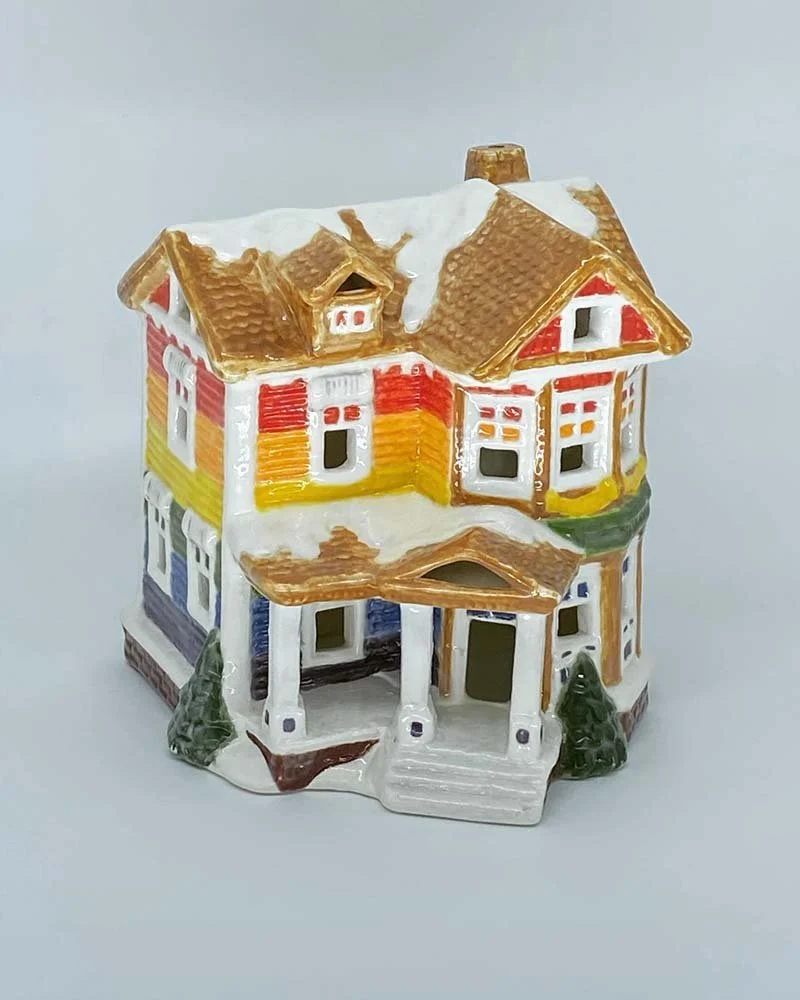
Reflecting on your childhood in Brazil, how did it mold your artistic thinking? I was born in a small town in the countryside of Brazil called Lorena, in the state of São Paulo. Since my father was an electrical engineer working on hydroelectric plants, we moved around constantly. I lived in cities of all sizes, with different cultures, landscapes, climates, and so on. I believe that early on, this gave me an awareness of the vast diversity in the world and sparked my deep love for travel.
Moving often as a child, however, wasn’t always easy—you constantly had to adapt and make new friends. I think art has always been a place of refuge for me, something I could carry with me when I felt lonely.
I grew up in a small, but extremely open and encouraging family. When I first said I wanted to study film, for example, my parents were very supportive.
I should also mention that my grandparents were artists. My maternal grandmother is a painting teacher, and my paternal grandmother also painted as a hobby. My maternal grandfather was a big cinephile and worked as a radio broadcaster for many years. He also enjoyed inventing plays and other games to entertain his grandchildren.
So I was raised in a highly creative environment in many different forms. As far as I can remember, I was always drawing, painting, acting... This made me see art as something essential to life.
It was through art that I found ways to express myself and navigate difficult times, such as coming to terms with being a queer person during adolescence, or, more recently, living through the pandemic.
When did you first fall in love with art and realize you wanted to be an artist? For you, what is the importance of the arts? I believe I fell in love with art as a child, though I wasn’t really aware of it at the time. As I mentioned earlier, I was always watching films, listening to music, painting, drawing, acting. I truly believe that every child is deeply creative and naturally interested in art—all it takes is for their parents to encourage it and provide an environment where they can engage with and express themselves through different forms of artistic expression.
Every time I exhibit my ceramic works, I’m surprised by the reactions of children. They’re often extremely curious, asking insightful questions and offering surprisingly sharp critiques of my work. It’s both funny and fascinating—and it made me realize how much of my own inner child is present in what I create today.
So, for me, art is all of this. It’s the way we express how we exist in the world, how we communicate, how we survive the complexities of being alive, how we support one another—and, in a sense, how we are more alike than different. That’s why art is such a universal language, one that transcends any barrier. Through art, we understand that we are all human.
What does a day in your creative space entail? Walk us through your most-used materials and tools. About a year ago, I moved to a house in a rural area. My small studio is now close to where I live, surrounded by greenery and animals. It's quite isolated and quiet—and honestly, that brings me a great sense of peace.
I usually wake up and head straight to the studio. I put on some music, depending on my mood, and begin working. I keep a notebook filled with sketches and ideas, which I explore without much of a fixed order, letting things unfold as they will.
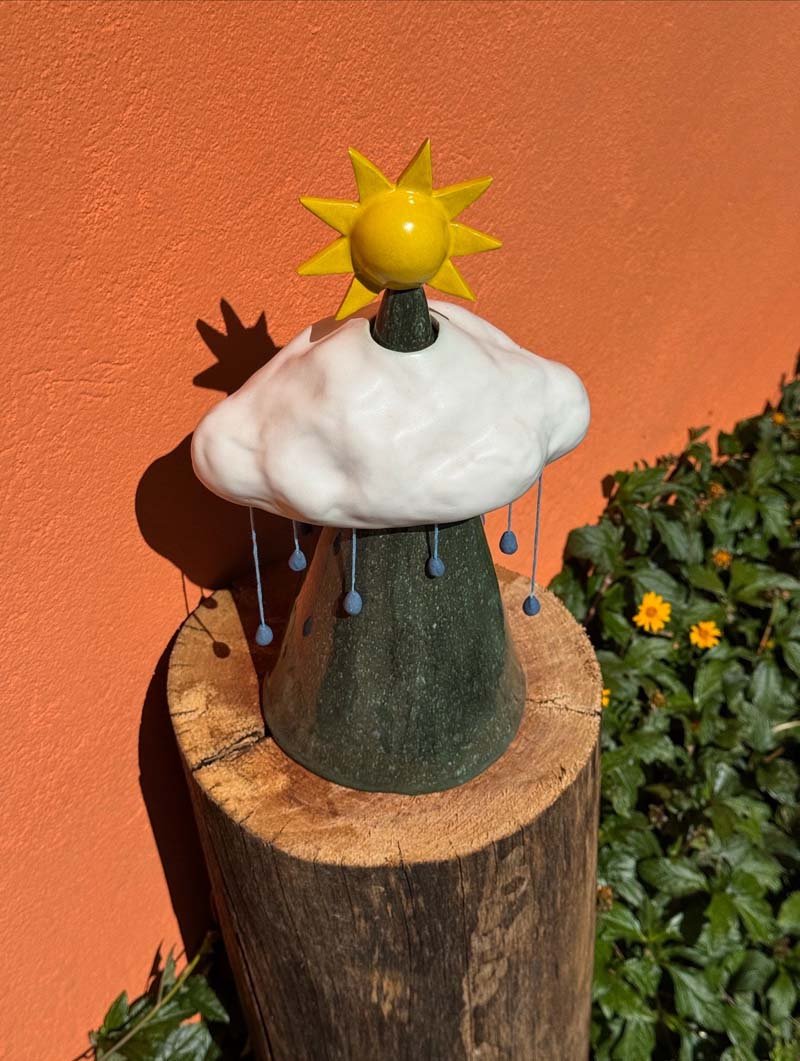
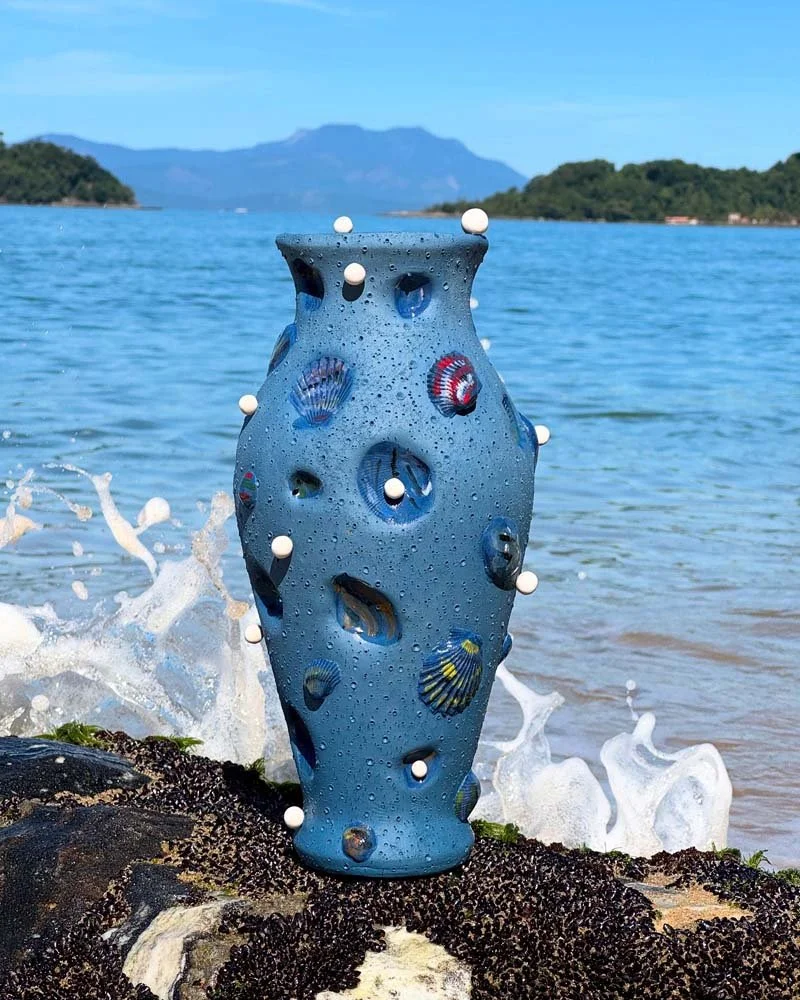
Ceramics is currently my main medium, but I’ve been trying to open myself up to other forms of expression. I already incorporate embroidery and illustration into my ceramic work, but lately I’ve been experimenting with elements from my surroundings—like wood, stones, seeds, and shells.
I believe that the environment deeply influences an artist, and living so close to nature has definitely transformed my work over the past few months.
What have you been creating recently? What mediums or ideas are you currently experimenting with? I usually work on many ideas and pieces at the same time. That’s because ceramics involves several stages, and each one requires its own ideal timing. For example, you need to let the clay dry a bit before it can be better shaped or cut. So I move between different pieces over the course of days, alternating my focus.
Lately, I’ve been more focused on sculpture and especially interested in using basic shapes—the sphere, the cone, the square—to create both figurative and abstract works. It feels like a kind of return to fundamentals.
In philosophy, for instance, these shapes can be seen as symbols or archetypes of basic forms of reality and human experience, each with its own meanings and symbolic associations. The square often represents stability and order, the sphere symbolizes perfection and completeness, and the cone can suggest duality and transformation.
In the history of art and design, basic forms have always held significance—we can think of Gestalt theory or the Bauhaus movement—so it’s certainly not a new idea. But I believe that, as an artist, returning to the basics can be a powerful way to move forward and take the next steps in my practice.
What do you hope people feel when they experience your art? What are you trying to express? I truly hope that people can feel something when they see my work—whatever that feeling may be, it’s all valid. With so much constant stimulation around us, we sometimes become numb. I hope, in some way, to pull people out of that numbness—as presumptuous as that might sound.
I would hate to create something that people are indifferent to. That’s probably why I put so much of myself and my emotions into each piece. Because I believe I’m working with universal themes that others can relate to—laugh at, mock, or reflect on.
A few days ago, I was thinking about putting together an exhibition called “Life isn’t wonderful (but sometimes it can be)”—and I think that captures a lot of what I’m trying to express.
There’s often a bit of humor in my work, a kind of gentle laugh at the human condition and how hard it can be. But it’s precisely that difficulty that makes life so unique—and, sometimes, surprisingly beautiful.
Maybe that’s what I’m trying to express right now.
Which artists, past or present, would you like to meet? And why? There are so many artists I’d love to meet that just thinking about this question gives me a bit of anxiety—how can I possibly choose only a few?
I’d definitely love to meet some of the great names in cinema, like Georges Méliès, Alfred Hitchcock, and Marilyn Monroe, and some of the giants in music—from Mozart, Bach, and Beethoven to Freddie Mercury, Madonna, Lady Gaga, and Lana Del Rey.
When it comes to visual arts, I’d want to meet the classics like Michelangelo, Monet, Van Gogh, Johannes Vermeer, Picasso, as well as more contemporary artists like Ai Weiwei, Yayoi Kusama, Damien Hirst—and some amazing Brazilian artists too, like Tunga, Cildo Meireles, Lygia Clark, Adriana Varejão, Beatriz Milhazes...
Oh, and then I started thinking about writers—I’d absolutely love to meet Clarice Lispector, Lucia Berlin, Machado de Assis... So many people I admire. I’d better stop here or I’ll never finish. Let me just say they all helped being alive and being excited about life.
Are there creative fields outside of visual art that influence your work? Absolutely. Other art forms are a huge source of inspiration for me. Many of my pieces are inspired by song lyrics or excerpts from books, for example. I love the idea of creating an image from words—of translating something into a visual language. I think that’s part of why I first studied film and now work with ceramics.
Beyond music, film, and other visual arts, I should also mention that psychology and psychoanalysis are major sources of inspiration for me. I’ve been in therapy for many years and have always enjoyed reading Freud, Lacan, and other psychoanalysts (even if I didn’t always fully understand them).
These days, I follow a lot of YouTube channels and podcasts on the subject, so psychoanalytic themes definitely find their way into my work. One of my most shared and sold pieces, for example, is a vase with a “hole” in the shape of a puzzle piece, engraved with the words ‘there will always be a lack of something’.
What keeps you creatively connected to your place of residence? I believe the best part of living in my current town is the connection I have with nature, far from the chaos and problems of big cities. Being able to create calmly, in silence, and without pressure feels like a true blessing.
Every day, I have the opportunity to pause and observe the world around me—the animals, the wind, the clouds, and how everything is constantly changing.
All of this has deeply influenced the way I see the world and the way I create my art.
Can you describe a project that challenged you creatively or emotionally—and how you worked through it? I'll answer this in a very personal way. When I began to dedicate myself fully to ceramics, I was going through several periods of grief.
On top of the pandemic, I had just lost a job and come out of a relationship. Ceramics became my main refuge. It helped me process those losses, channeling my pain into many of the pieces I created.
Therapy, together with the act of making art, allowed me to look at my wounds in a very raw and honest way. It wasn’t an easy process to go through—but it was one that truly healed me. At first, I felt a certain shame and fear about revealing so much of myself through my pieces. But the more I shared what I was feeling, the more I received a positive and reciprocal response from others—many of whom were also going through similar things.
That helped me feel less vulnerable and less alone in my grieving process. It reminded me that pain, when expressed through art, can become a point of connection—not isolation.
Who were your most meaningful teachers? During my time at the School of Visual Arts at Parque Lage in Rio de Janeiro, I had the privilege of studying with incredible teachers such as Fernanda Lopes, Suzana Queiroga, and Adriano Pedrosa. They definitely helped me develop a more mature and professional understanding of art.
Later, during the pandemic, I moved to Cunha, a small town in the countryside of São Paulo. Known as the capital of high-temperature ceramics in Brazil, Cunha became a turning point in my journey. There, I was fortunate to have inspiring mentors in ceramics, such as Luciano Almeida, Luciane Yukie, and Alberto Cidraes.
They taught me a variety of techniques and helped me elevate my work, encouraging me to think of ceramics as something transcendent—a practice that requires respect. It's the transformation of matter through the four fundamental elements: water, fire, earth, and air.
I had never seen ceramics with such depth and devotion before.
How do the natural world and ecological concerns intersect with your work? Creating in the midst of nature is one of my greatest sources of inspiration right now. For example, I live in a region surrounded by mountains, and that often finds its way into many of my pieces, whether consciously or not.
But beyond the aesthetic, I also try to bring a sense of awareness to the fact that natural resources must be used more responsibly—otherwise, the planet will collapse.
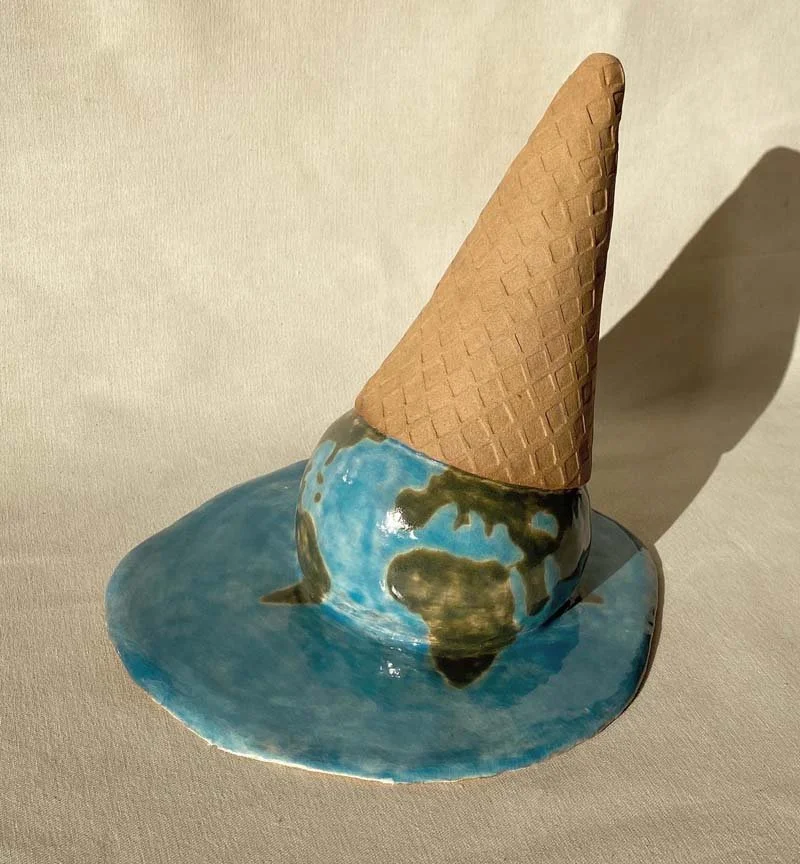
I once created a sculpture shaped like an ice cream cone with a melting globe on top, intended to speak about global warming and eco-anxiety. It remains one of my favorite pieces and also one of the most talked about and shared, which says a lot about how urgent and important this issue is today.
What are your reflections on AI and technology? What is the importance of human art and handmade creative works over industrialized creative practices? I believe AI can be an important ally, but it should never replace human beings—especially when it comes to artistic creation, which is such a deeply subjective and inherently human process.
To me, art is something that sets us apart from all other species. It is our private refuge, a space where artists are able to capture and share with society their most intimate—and yet universal—emotions and visions. These often stem from a desire to process or overcome trauma, fear, neuroses, and so many other internal struggles.
On a personal level, art has helped me get through many difficult moments— art has saved me, and continues to save me. That’s why I believe that, as a society, we can never stop making art. And by “making,” I mean creating with our own hands, our own bodies and minds—not outsourcing everything to external tools like AI.
We need to remain capable of learning by doing—of making mistakes, disliking our work, trying again, destroying, rebuilding.
AI tends to aim for shortcuts, to reduce time, to always be correct, to avoid contradictions… but those are exactly the things that artistic creation teaches us about life.
Exploring ideas, art and the creative process connects me to… Myself and the humanity we are all part of.