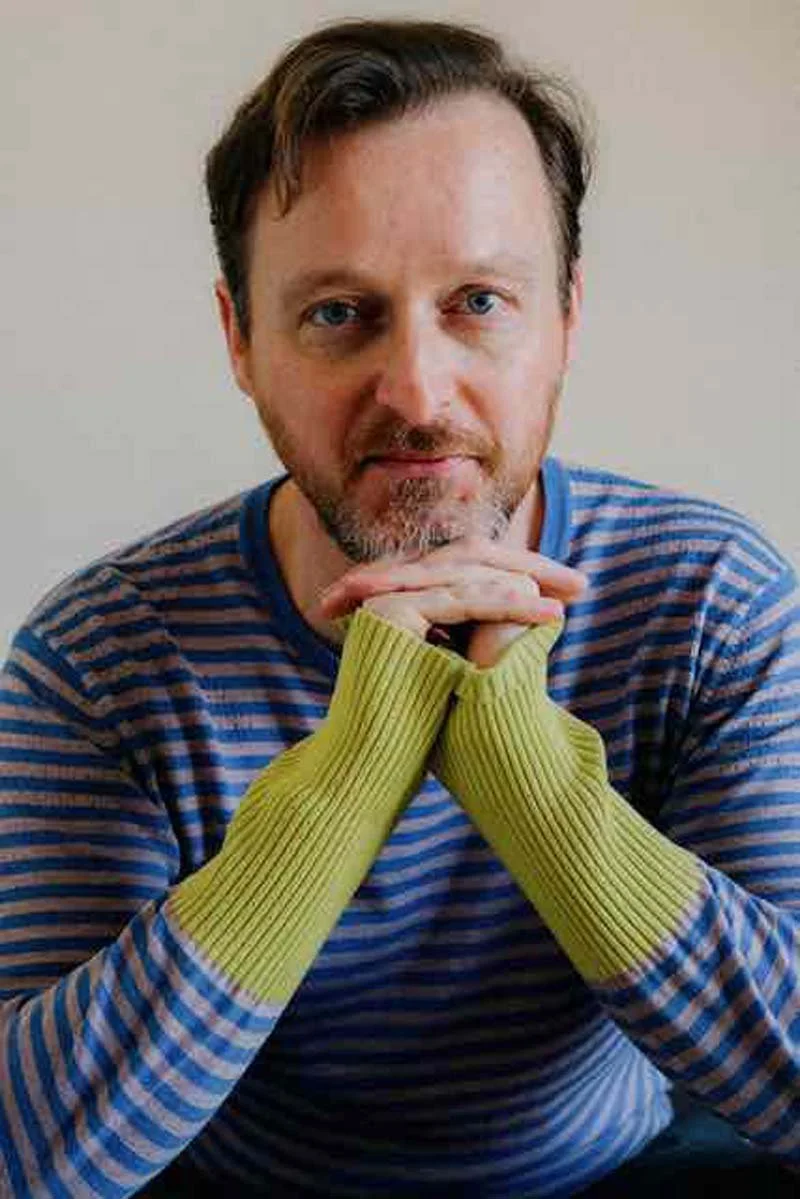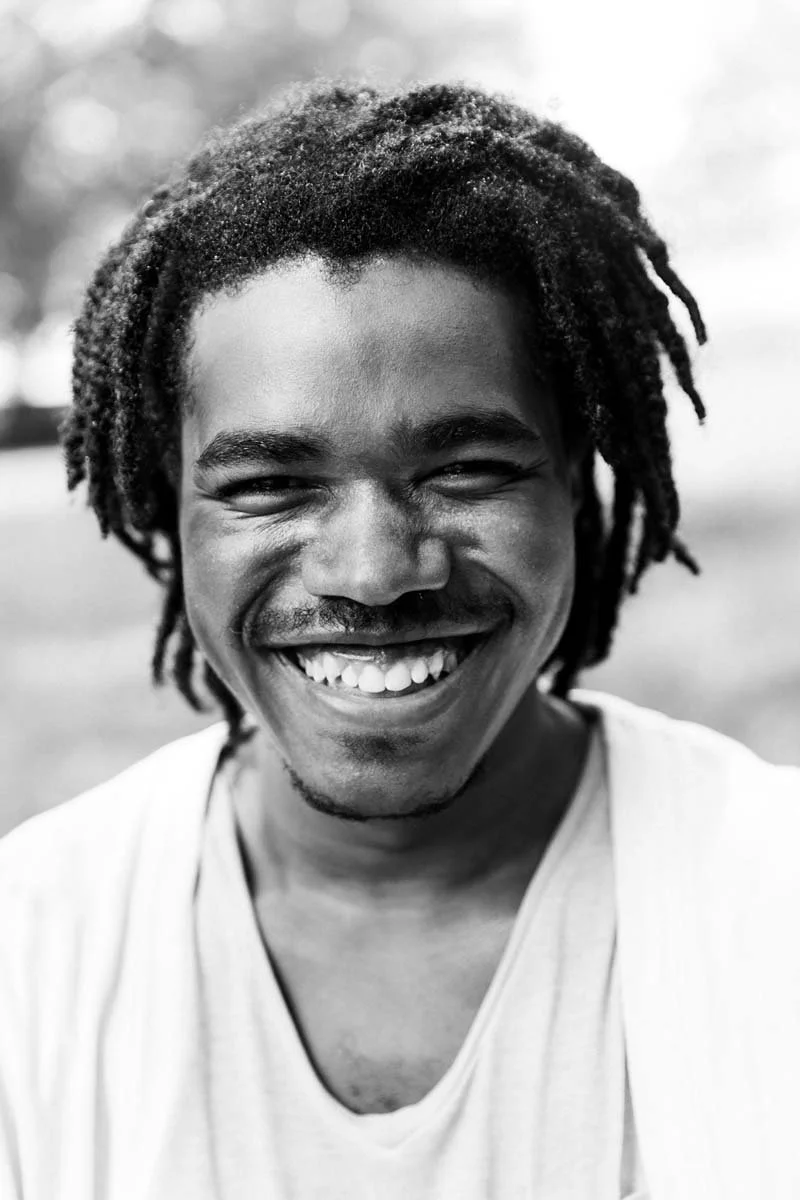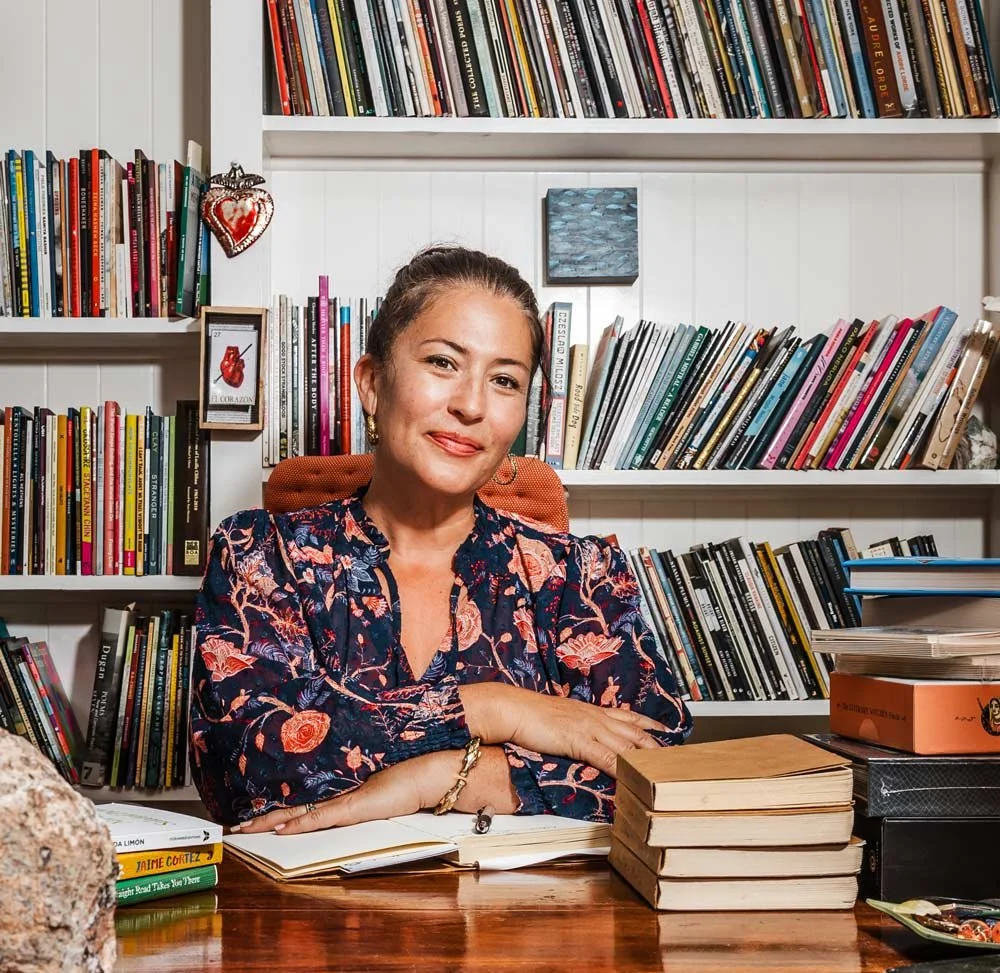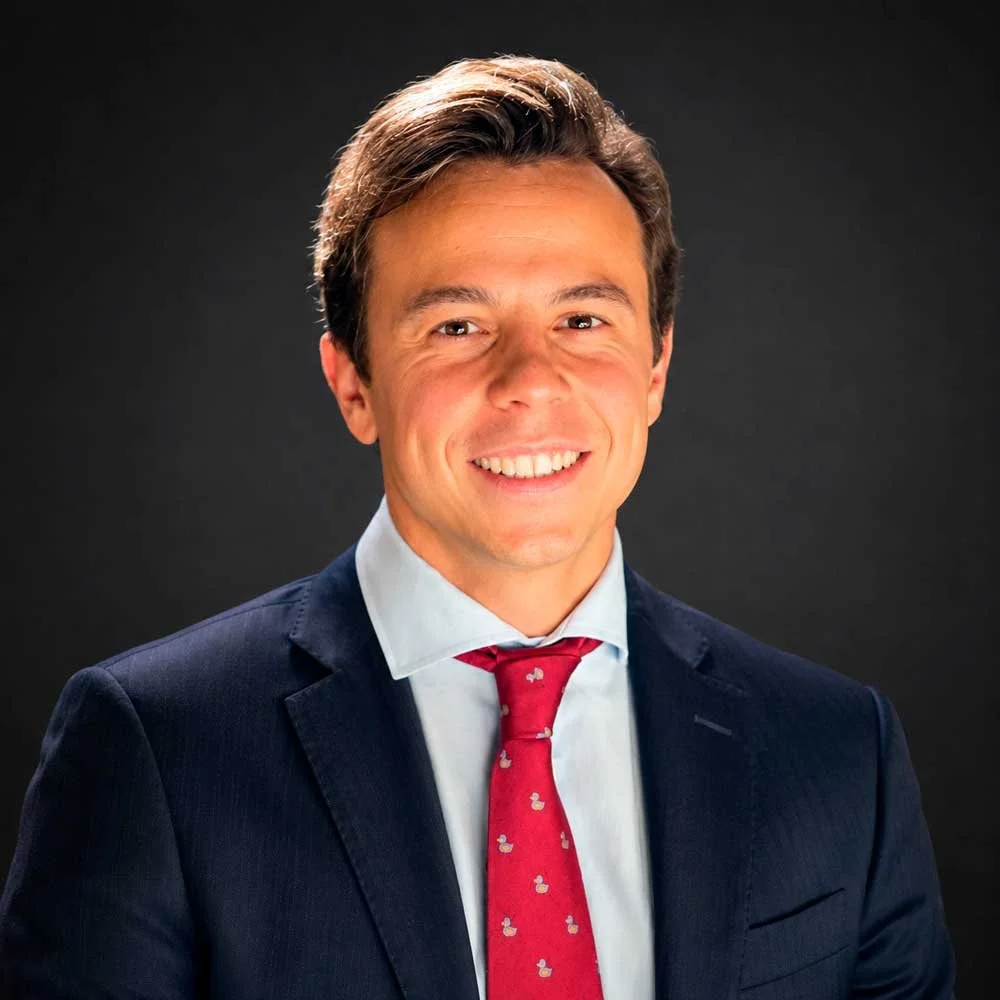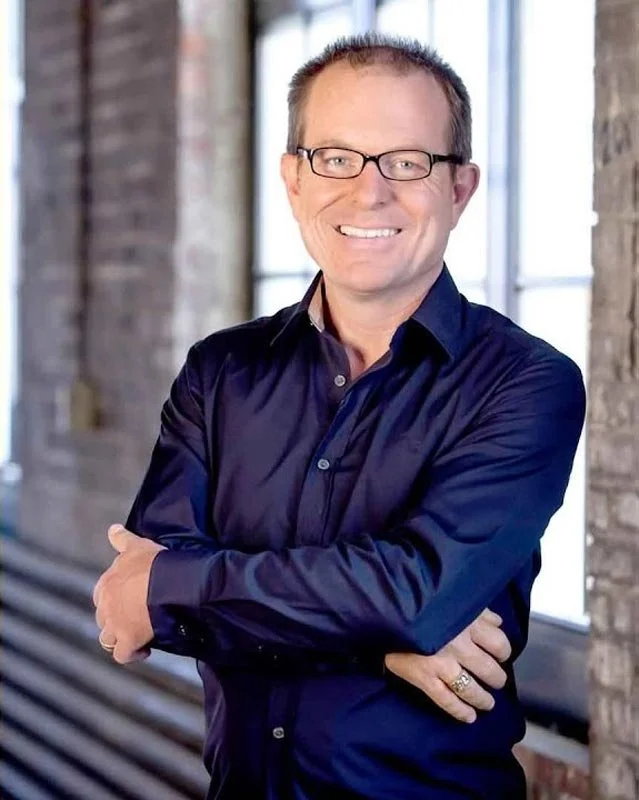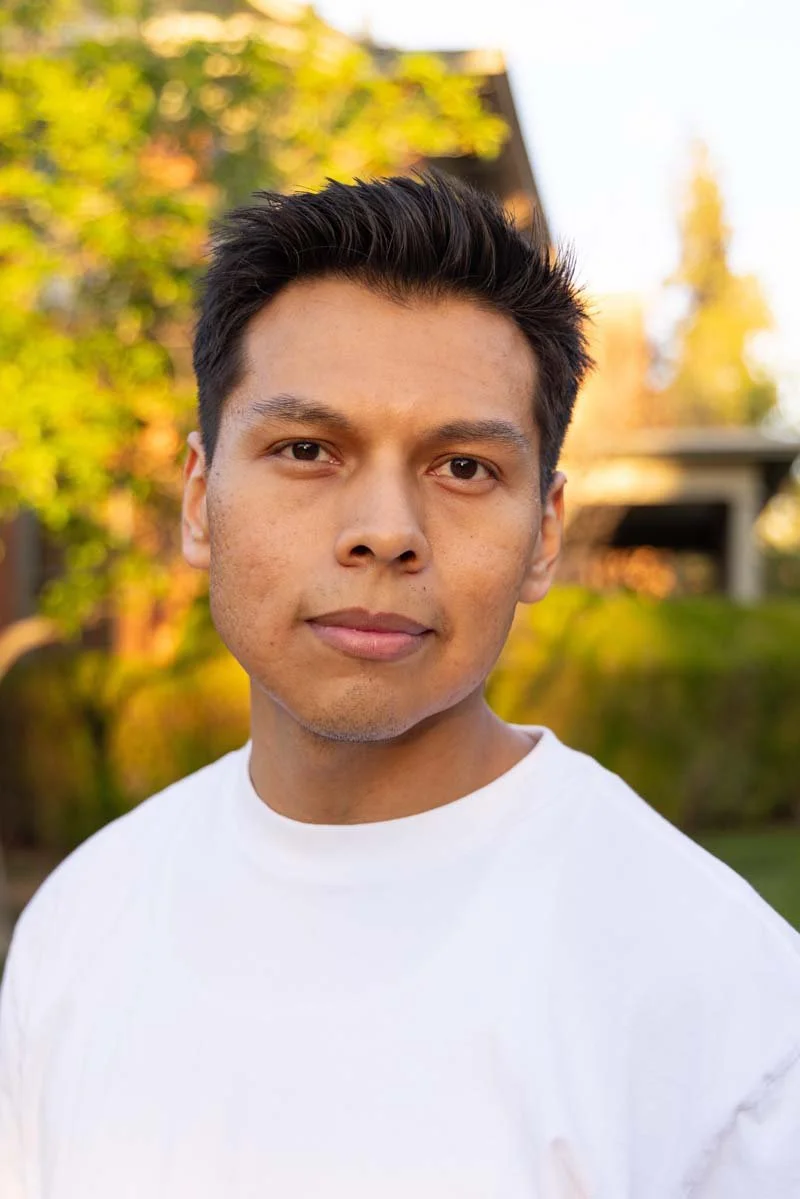


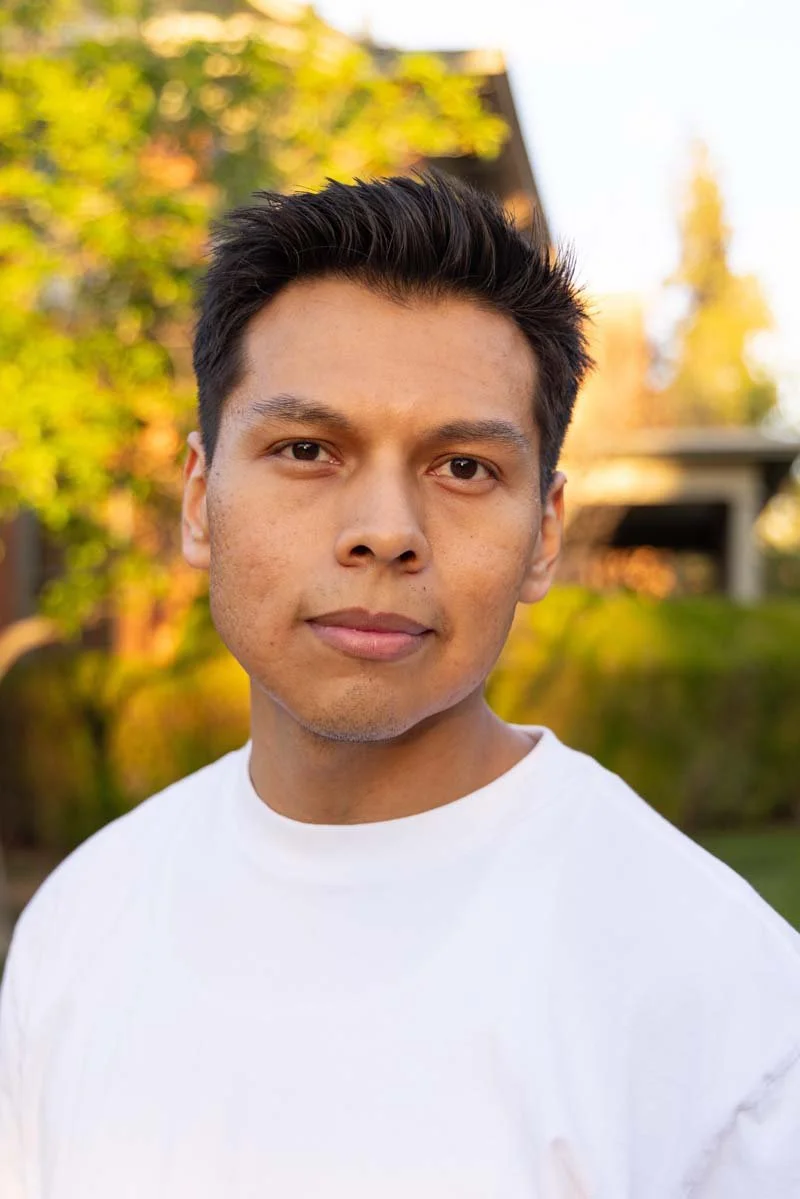
Chris Hoshnic is a Navajo poet, playwright, and filmmaker, honored with the 2023 Indigenous Poets Prize for Hayden’s Ferry Review and 2025 Poetry Northwest James Welch Prize. His fellowships include the Native American Media Alliance’s Writers Seminar, UC-Berkeley Arts Research Center, and the Diné Artisan and Authors Capacity Building Institute, with support from Indigenous Nations Poets, Playwrights Realm, Tin House, and others. He has been published in Poetry Magazine, The Kenyon Review, and elsewhere.
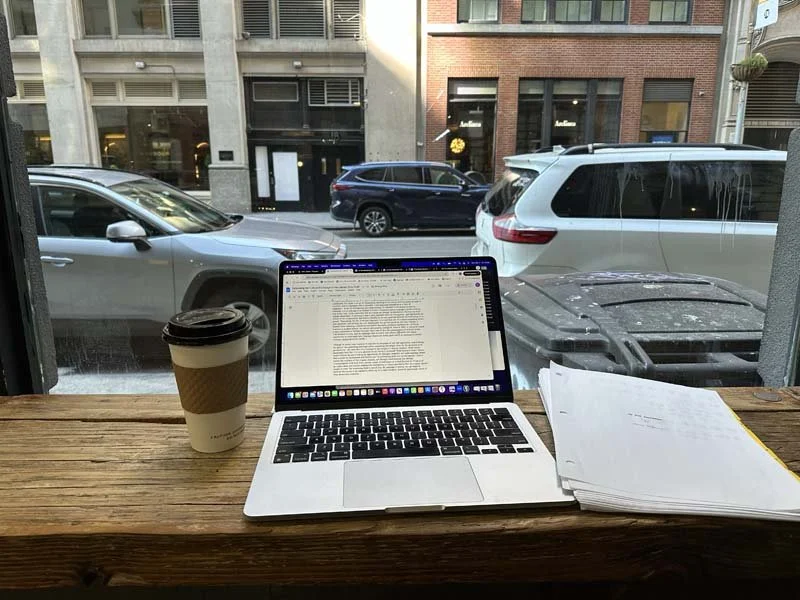
How did being raised between the Navajo reservation and its surrounding towns influence the way you think and write about the world? I was born in Shiprock, New Mexico. My life has been one of movement, oscillating between the Navajo Nation, its surrounding border towns, and Phoenix, Arizona. I’ve migrated in wide arcs, but Sweetwater (on the reservation) has always been my anchor. I think this place, both physical and in memory, reorients my writing.
As a child, I was captivated by the polished dreamscapes of television and literature; the nuclear families with their summer camps, road trips, and Rockwellian kitchens. I longed for that kind of stillness and scripted joy. But my reality was one of caretakers and cousins, of being left in the trusted hands of others while my parents worked hard to sustain us.
All of this migration, longing, caretaking, has left an imprint on my writing, I think. It’s taught me that home is not always a fixed structure, but a series of returns. That love is not always loud or picturesque, but often quiet and practical. That stories are carried not only in language, but in movement. My thinking about the world is shaped by this tension, between what we’re told to desire, and what we inherit. Between the imagined ideal and the reality of what resilience and community look like.
How did reading shape your childhood? Any particular titles that changed everything? As a child, I remember reading a lot of Junie B. Jones and Goosebumps, stories that came in long, familiar narratives. I was definitely drawn to their consistency, the recurring characters, the unfolding series.
Reading was, in many ways, a quiet act of survival. In the shuffle between the reservation, bordertowns, and the heat of Phoenix, stories gave me a kind of rootedness. A plotline could stretch longer than a lease. A fictional world could feel more stable than the one I was in.
The strange truth in that longing is that Navajo was my first language. Somewhere in that migration between books became my bridge to English. These series, with their humor and suspense, became my translators. They held space for me to make the leap from one language to another, from one sense of home to the next.
Books didn’t just teach me to read—they taught me how to stay in one place long enough to feel connected.
Are there any routines or rituals that support your writing process? Tell us a bit about a “typical” day of writing, if it exists. I recently completed a week at the Juniper Institute at UMass-Amherst, where our workshops were led by Tiana Clark. On the final day, we focused on process; how we arrive at the page, what shapes our voice, and how form and content negotiate with each other. I kept returning to this idea in screenwriting about how a "concept" and a "story" are not the same. A concept might be, “a monster lives under the bed,” but a story might be, “a Navajo character, estranged from their culture and language, moves into a house steeped in colonial history, only to discover something monstrous living beneath it.” The difference lies in depth, in specificity, in stakes I recognize as my own. One is horror. The other is a haunting. It's social, historical, and personal. It's that thing another mentor always asks, how do you bring yourself to the page?
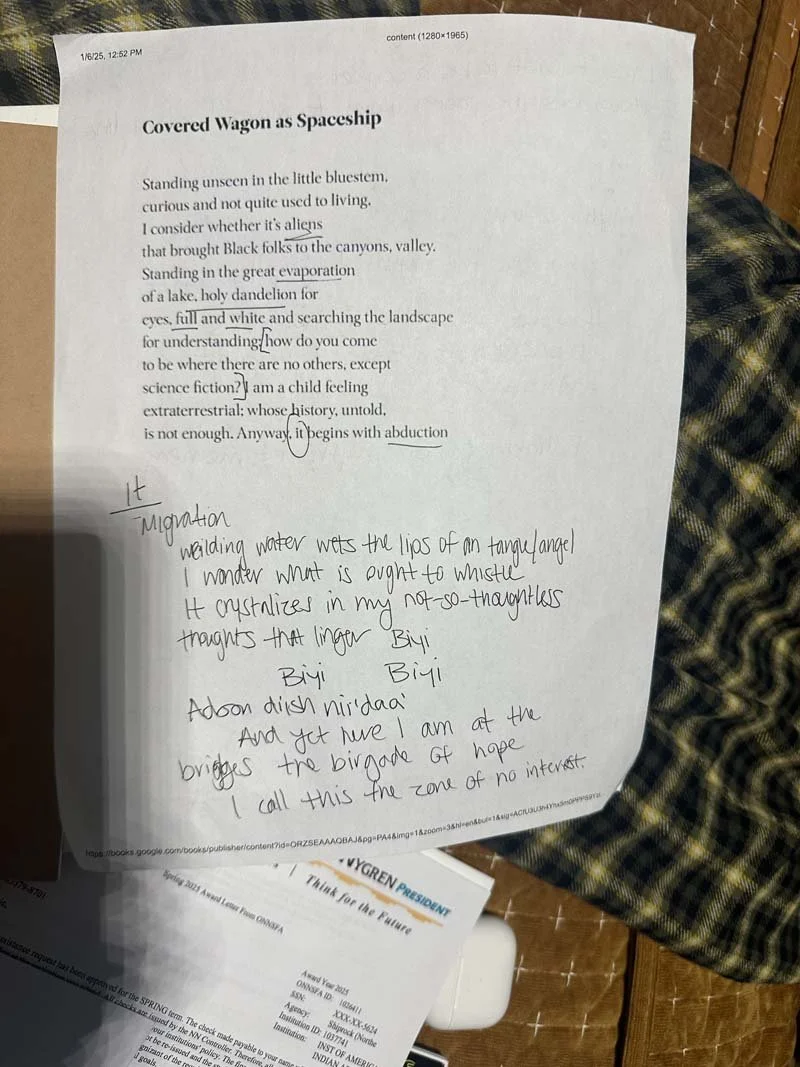
That’s how I think about poetry, too. I’m always wrestling with form. Even when I'm not at my desk, I'm writing, texting lines into my Notes app while walking, riding the Lyft, eating dinner. If a line comes in Navajo, I find a quiet corner and record myself. Those moments feel urgent, but I don’t always know what they are yet. That generation isn’t useful to me immediately. Sometimes, it takes years for those fragments to find their shape. They begin as concepts, waiting to be sculpted into story.
A typical writing day for me is less about sitting still and more about circling around an image or a sound. Often, I’m deep in research, looking for an anchor. I can spend days studying the architecture of a sonnet before attempting to write one. Between those days, the writing can come in other forms, like a screenplay or play. I’ve found that poetry and film are constantly in conversation with each other, both obsessed with rhythm and form.
My writing practice is fluid. Some days, it looks like note-taking. Other days, it’s voice memos in Navajo, or a rabbit hole of research. But always, it’s a migration, a search for a form spacious enough to carry what I need to say.
Tell us about the creative process behind your most well-known work or your current writing project. My current project, “ni’hikeyah tʼáá jííkʼe, all free nations, todas las naciones libres: migratory in verse,” is a collaborative, community-rooted online anthology that explores the reciprocity of translation as a form of migration. It’s a space where migratory poetics take center stage, where language, memory, and movement intersect.
The creative process behind the anthology is deeply collective and intentionally multilingual. We began with the question: what happens when migration demands not just the crossing of physical borders, but the constant, layered act of linguistic and cultural translation? Translation, in this context, is not simply a technical exchange of words, but one that shapes how migrants, past and present, understand and express their identities.
We centered the recollection of the Bush administration as a historical anchor, which, I believe, was the last time the rhetoric of borders, war, and belonging was reshaped. Poets and artists like Inés Hernández-Ávila and Ayling Dominguez, from across various diasporas, responded to that era’s language and legacy, confronting how its policies rippled through our communities. Their works don't just reflect on the past; they resist it, revise it, and reimagine what freedom and nationhood might mean in our current moment.
The process has been as much about curation and conversation as it has been about creation. The anthology truly invites readers not only to witness, but to participate and rethink democracy, challenge violent narratives, and consider how history moves through us, across languages and landscapes.
In building this project, I’m reminded that writing is not always solitary. It can be a communal act of remembrance and resistance.
Do you keep a journal or notebook? If so, what’s in it? I do keep a notebook now, but mostly because writing workshop spaces tend to privilege the page. There's an unspoken democracy in everyone showing up with pen and paper, and I honor that. It’s a gesture of presence, of meeting others where they are.
But if I’m being honest, my real notebook lives in my phone. I write almost everything in my Notes app. I fully embrace technology. There’s something fluid, even poetic about typing a line while walking or waiting in line at a coffee shop, knowing it can shift and evolve without the weight of the page. The physical notebook can feel too fixed for me, too final.
That’s part of why I envisioned "ni’hikeyah tʼáá jííkʼe, all free nations, todas las naciones libres" as an online anthology. I love the idea that someone can carry poems, translations, and histories in their back pocket. Accessibility is everything. I want my writing, and the writing I share with others, to be as immediate and reachable as texting a friend. A poem should always feel accessible.
Now, I carry a physical notebook mostly for planning and workshops. It’s less about necessity and more about respect for the space and the people in it.
Research is a core part of your practice. How do you conduct your research, and how does your writing take shape from it? Research is how I orient myself, how I make sense of form, history, and lineage. I try to keep everything organized through spreadsheets. I love spreadsheets. For each project, I create a kind of digital constellation: links, titles, quotes, fragments, all living side by side. It becomes an archive I can return to, reshape, and reimagine as the work evolves.
I’m especially drawn to JSTOR. There’s something expansive about diving deep into a poetic form, like ekphrasis, and watching the way it ripples through time. I’m fascinated by how a form emerges in a particular moment and then moves beyond it: who used it, who redefined it, and how it’s been taken up by artists, activists, and marginalized communities. A single poem can echo across centuries, shaping the thinking of politicians, writers, or movements, sometimes without us even realizing it.
That’s the power of poetry, its quiet and lasting influence. Even a single line can haunt a culture, shift a conversation, or offer language where there once was none. Research gives me context. It gives me a question to start from. And more than anything, it gives my writing a sense of rootedness.
Which writer, living or dead, would you most like to have dinner with? This answer changes all the time, depending on where I am, emotionally and creatively. But right now, it’s James Baldwin.
I’ve just arrived at the thesis, the crux, of my first manuscript. It finally feels like something entirely my own. For a while, I imagined the anthology I’ve been building would serve as my first major work, especially as I shape it during my MFA. But it began to feel too expansive, too collective to carry alone. Now, as I move inward, into the solitude of my own project, I find myself thinking about Baldwin, about his exile, his time in France, and what it meant to leave America in order to fully see it.
There’s a part of me that wonders about that kind of abandonment. I understand the madness he speaks of, this “American madness.” But as an Indigenous person, that option feels complicated. We don’t have the luxury of leaving entirely. If we leave, who tends to the land? Who speaks to it? Who remembers the places that carried us, even when the nation-state did not?
At the same time, I think about migration not as escape but as return, as something deeply human. We were migratory long before colonial borders tried to contain us. Sometimes I wonder if those colonial infrastructures, the lines drawn across land, the roles we’ve been told to play, have conditioned us as Indigenous people to believe that "stewardship" requires staying put. But I believe the land is more generous than that. I believe, if we leave, it will forgive our absences. And it will call us back when we are most needed. Perhaps now is not that time, as most conflicts are mostly about "ownership" and not what the land truly wants.
I'm forever circling that question, and if I could have dinner with Baldwin, I’d want to ask him about the state of America. How he kept writing toward it, circling it, questioning it, even after he left. If America was no longer a part of his daily life, why did it remain so present on the page? His writing carries an unmistakable fire, what feels like rage, but I’d want to listen for his grief. The grief that lingers after exile. That’s the conversation I long for.
I think we would understand each other. Not entirely, but enough to sit in that silence between worlds and call it a kind of truth.
Do you draw inspiration from music, art, or other disciplines? All the time. I’m constantly drawing inspiration from music and other art forms, though my relationship to them has shifted over time. I used to be deeply influenced by the sonic quality of music. How rhythm, tempo, and tone could inform the cadence of a poem or the mood of a scene in a screenplay or play. Music used to anchor the emotional world of whatever I was writing.
But eventually, I learned that poetry and music operate on different frequencies. What started as inspiration sometimes became imitation. Sound is not just music, it’s also voice. And I realized that writing too closely beside a song could sometimes smother my own voice. It became replication rather than conversation.
That’s where research has become essential to my process. If a song or a piece of art is moving something in me creatively, I want to understand why. What is the lineage behind that sound? What histories and cultural textures are woven into it?
Lately, I’ve been listening to The Marías. I’m captivated by their layered sound, but I also find myself asking questions. Their music shares a sonic atmosphere with Billie Eilish, and I’m curious to know how those similarities came to be. Who came first? And what are they each pulling from? The difference is that The Marías cite D’Angelo as a major influence. But D’Angelo’s sound, intentionally or not, has become absorbed into environments like upscale retail spaces, which could be seen as another form of cultural appropriation. His soulful, deeply Black sound has been repackaged as the background hum of the “white shopping experience.”
So yes, I draw inspiration from music, art, and other disciplines, but now, I approach that inspiration with more awareness. I listen not only for the feeling, but for the context. I want to know the histories embedded in the sounds, and how they’re being carried forward, by whom, and for what purpose.
AI and technology are changing the ways we think about and receive poetry. What are your reflections on AI, technology and the future of storytelling? What can machines never replicate about human storytelling? AI can be a powerful tool. There’s no denying that. But tools, especially in Western thought, often become things we lean on too heavily, as if they can replace the body or the experience itself. In Navajo thinking, our hands are tools, but not just our hands. We use many parts of our bodies to communicate, to gesture, to create. There’s even a joke about how Navajos point with their lips, and while it makes people laugh, it has a history. That way of pointing comes from Indigenous sign languages, developed between tribes that didn’t speak the same tongue. These signs became shared, embodied language. Some tribes point with the chin, others with the thumb. But pointing with a finger? That’s colonial.
So when I think about AI, I think of it similarly, as just another kind of tool. Its presence in our lives means something. What that something is, I’m still trying to understand. Of course, the way it extracts resources is another conversation, but it can be useful, even generative. But it shouldn’t replace the act of human storytelling.
Stories are not just things to be reorganized. Stories are lived. They are felt. They carry breath, memory, grief, and joy in ways a machine cannot replicate. AI doesn’t care; it can’t. It doesn’t feel. It doesn’t carry the story in its bones. It only rearranges. There's a word in Navajo, "ńdadoodleeł." It can mean "changing once again" or "it'll come back around." There's a cyclical nature to it, and AI is doing something similar. How can we make that work in our favor for the betterment of our communities?
Tell us about some recent reads that have really moved or surprised you. Lately, I’ve been completely absorbed by Variations on Dawn and Dusk by Dan Beachy-Quick. I didn’t begin my poetry practice drawn to ekphrasis—in fact, I resisted it. But over time, I’ve come to admire how it can stretch the boundaries of the form. Ekphrasis lives at the intersection of image and language, and more often than not, it becomes a kind of translation. "Translation as feeling," "as vision," "as memory." That’s what makes it so compelling.
Beachy-Quick’s work is deeply curious about the language we use for light, how we name what is fleeting and ungraspable. He seems to be reaching, through language, for what can’t fully be seen, like birds who perceive colors beyond human comprehension. There’s something reverent in that reach.
As for favorite writers of all time, that answer shifts depending on who I am in a given season. Right now, I’m drawn back to Virginia Woolf. Her experimental work was a portal for me into more complex and nonlinear literature. She gave me permission to be fluid on the page. And then there’s Middlemarch by George Eliot, a book I return to again and again. On the surface, it almost reads like an early 2000s CW drama: love, betrayal, ambition. But beneath that is a dense exploration of power, gender, and economics that speaks deeply to the Indigenous condition.
In Middlemarch, marriage is often the only way for a woman to survive. That resonates. I think a lot about who Indigenous people are forced to attach themselves to in order to survive, be it bordertown banks, predatory leases, or institutional aid, scholarships, the kindness of strangers. We’re often surviving from hand to hand. And when a Native person does “make it,” financially or otherwise, that success is rarely unburdened. There’s always someone asking for help, or someone resentful that you got out. It’s always, always about money.
That’s why Woolf and Eliot speak to me. They both write about navigating constraint, inheritance, and survival. About people trying to lead in systems that were never designed for them. Middlemarch especially talks about money with such precision. It reminds me that the structures we live within, be they economic or familial, are never just background noise. They shape the very core of who we are and how we move through the world.
Exploring literature, the arts, and the creative process connects me to… To community. Especially when I feel most alone. There are times I move through life with a deep sense of isolation, not because anyone has made me feel unwelcome, but because curiosity can sometimes turn inward too far. It becomes a kind of solitude.
Art, whether it’s writing, reading, or creating, pulls me out of that. It offers me a place to speak with others, not just to myself. Once a piece of writing is “done," whatever that means, I get to share it. I get to perform it, have others read it, let it breathe outside of me. I often shift the way I read a poem live, searching for a shared rhythm with the audience, hoping to land on a common pulse.
The act of making is invigorating and never truly complete, not even after publication. But something powerful happens when the work begins to live beyond me. When it comes back, for readings, discussions, conversations like this, it feels like what Natalie Diaz uses for language reclamation, a hawk returning to the wrist. It’s weathered, it’s flown, and now it returns to be nurtured again. In those moments, I get to reintroduce the poem to the world once more, fed, transformed, and alive. That’s where I find community: not just in the making, but in the sharing, in the returning.