

Creativity, Transhumanism & The Myth of Machine Consciousness
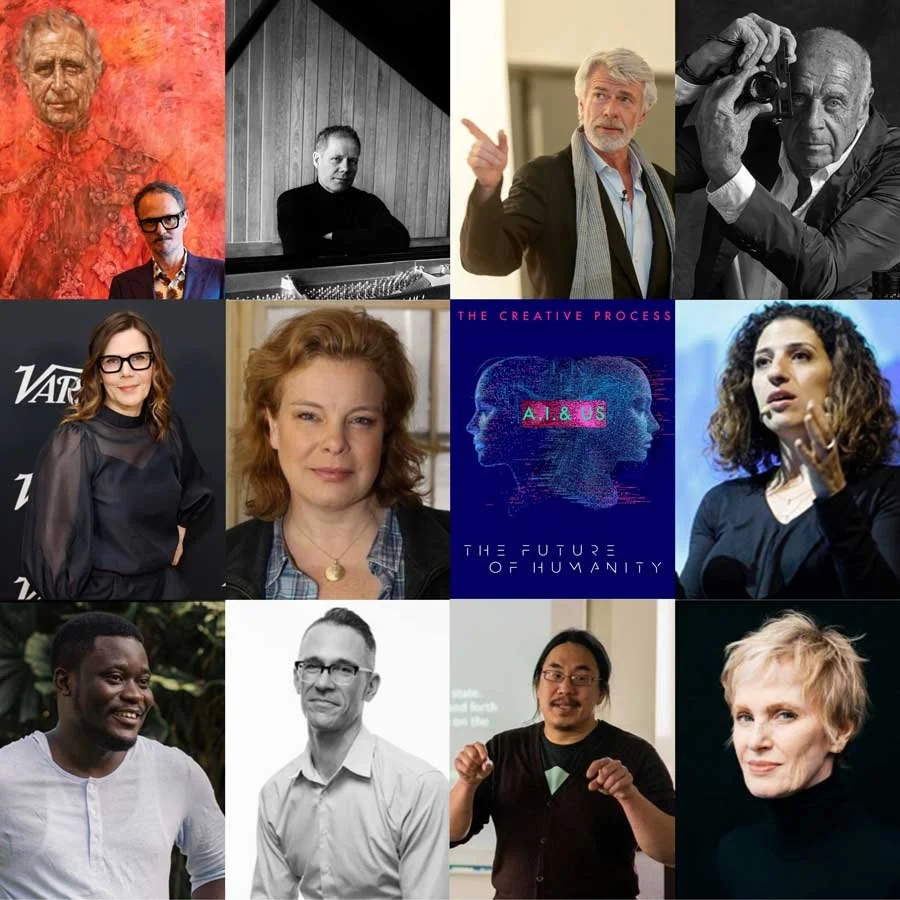
It is an ordinary human impulse to find a reflection of ourselves in the machines we build. But what happens when the lifeless begins to talk back, to paint, to compose and to simulate our emotions? How do we hold on to what makes us human? Today we hear from philosophers and writers Siri Hustvedt, C. Thi Nguyen, and Bayo Akomolafe on the myth of machine consciousness. Artist Jonathan Yeo, playwright and screenwriter Laura Eason, composer Max Richter, and photographer Ralph Gibson discuss why the struggle of the creative process cannot be outsourced. They are joined by actress Catherine Curtin, neuroscientist Liad Mudrik, tech journalist Jacob Ward, and museum director Chris Dercon, who examine the power of imperfection, imagination, intuition, and how to avoid getting lost in the machine.
SIRI HUSTVEDT
Author of Ghost Stories · What I Loved · The Summer Without Men
With AI, I agree. First of all, artificial intelligence is not going to go away. Technology can change, obviously it has changed a great deal, but we are not going to eliminate AI. This is not a realistic position to take. Also, I do think that there are certain tasks that AI is perfectly suited to that can be useful. Calculation is the most obvious one.
There is no question that people working in biology labs, et cetera, can take advantage of ways to collate huge amounts of data that they could never have done before. All this I am totally for. The problem is more what I was saying earlier, which is that the fantasy of human-like robots that can entertain you at dinner and love you. I think this is quite dangerous, or act as therapists now. There is a movement in psychiatry, for example, to create AI therapists.
I think this is dangerous to me because a machine will be able to simulate therapy talk. We know this goes way back to the first computer program for a therapist, which is to repeat what the person says. Oh, I see you are having some conflicts with your father, tell me about that. Yes, we can make a program that will ask some of the right questions, but the human encounter, the sense of that living body is missing. And again, you can simulate forms of empathy, but it is not real empathy.
Machines do not think, they do not feel, and there is no such thing at present of anything that is close to what they call general AI or general intelligence. We do not think the way machine learning thinks. Now that does not mean we cannot be impressed and amazed by what these machines can do, to mistake them for other humans. As I wrote, people have always projected human feelings onto things. I loved dolls when I was a little girl, for example. I had whole scenarios and stories that I acted out, and I would arrange them in different ways.
I really loved it, and I projected human feelings onto my dolls. Of course, when I got a little older, I knew they were not going to come to life at night. But we do that, if you give a person a humanoid-like robot, human beings will have feelings for them. All children are animists too. So that is a very ordinary human experience.
JONATHAN YEO
Portrait Artist · Creator of the Immersive Exhibition Spectacular: The Art of Jonathan Yeo in Augmented Reality
It is yet at a stage where it is going to invent a new genre of art other than a neo-surrealism, which I think we are going to see a lot of because it is very easy to do whether you are an artist or not. That is my really quick and slightly lazy take on it. There are general worries about AI, and I am not talking about robots taking over the world. I think more about how it will gradually and subtly affect our behavior.
One of the dangers is I think we get a bit risk-averse and we get less good at making decisions for ourselves because there will be increasingly suggestions based on vast amounts of data and pattern recognition that we will use without even being aware. The suggestions we get say, you read that book, you might like this one, or you listen to that music and therefore you might like these ones. It is not always right, but sometimes it is good enough and interesting enough and finds things that would otherwise have taken you a long time to find, that you go with it. And you get a bit lazier, you start to lose the skills of going and hunting for the things yourself.
CATHERINE CURTIN
Actress · Stranger Things · Homeland · Insecure · Saturday Night
Death and life is such a mystery that the fact that we are so imperfect and life is so imperfect that it is so funny. New York is full of the funniest people and you would never expect somebody to go, okay, AI, this is the end of humanity. Oh, well okay, you are a New Yorker and you are telling me that AI is the end of humanity. I feel like the reason why AI will never completely take over is because we are subversive. Humans are subversive, we are imperfect, we do imperfect things.
Art is about imperfection, and life is about imperfection. One day when we all lie down on our deathbeds, because that is going to happen to us all, none of us are spared except maybe Elon Musk getting frozen, who knows?. For the most of us, there is imperfect life. Death is the imperfection of life. Because life is just a fleeting thing for everyone, for all of us.
There is no way that a computer or an AI can know death. So the AI can never, in that sense, know life, because every day you walk and think, I was just on my way to do the Zoom with you guys. I just went to grab my bracelet, which was sitting next to my grandmother's picture, and I loved my grandmother. AI does not touch us because we exist on a level of such mortal frailty, mortal cruelty, mortal love, and hate.
Jealousy, insecurity, freedom, joy, wackiness, and being in the moment ensure that when one of my neurotic fellow conspiracy theory New Yorker friends says to me that AI is the end of the world, it is just not possible because the world is not that permanent for any of us. This is an impermanent destination that we are on.
SIRI HUSTVEDT
Novelist · Memoirist · Essayist
Memories of the Future · Living, Thinking, Looking
Ghost Stories · Mothers, Fathers, and Others
What has happened in AI from the very early days is these endless predictions that here is the moment it is going to come. I cannot remember, the first was 2000, and then it is 2008. And now I think there are a lot of predictions that it will be 2030, but it is not going to happen. Because it is a mind-body problem. These people believe that the human mind is basically a kind of software and the hardware supports it.
This paradigm in the neurosciences, which was once a working model, is now abandoned by many cognitive scientists and neuroscientists because they realize that the material we are made of is part of how we think. You cannot isolate it, as we are also not brains in vats. Our fantasy land and science fiction has and continues to invade thinking in these tech worlds. They are philosophically naive in many ways, and they do not bother to correct that because they feel they are on top of the world.
C. THI NGUYEN
Philosopher · Author of The Score: How to Stop Playing Somebody Else's Game · Games: Agency as Art
One way to put Bernard Suits' theory about games is that playing games is doing things inefficiently on purpose. There is a more efficient way to run a marathon to get to a certain point in space than running a marathon. You could take a taxi or take a bicycle, but we take that constraint because we want to do something for our own sake. I have argued that art is a game and there is a sense in which artists are making their own game. Some people have said something like that.
I think there is a way in which all of art is a very similar game that obeys certain similar rules. The rules are really hidden, and the rules are basically do it yourself. Do not develop your opinions about art from other people, even if they are experts who know more than you. Do not make paintings just by copying other people, even if they are amazing. Even if copying Rembrandt would get a better painting than doing it yourself, the rules are to make stuff without following experts.
The rules are to make stuff out of your own sensibility, and I think that is not a rule we have to follow in the world, but it is something that we do. One way to put it is that an easy way for me to have an incredible painting is either to buy it or to carefully copy somebody else's painting, but I do not do that. If I just wanted to have nice-looking art around, that would be no explanation. The reason I make art under that constraint, and I am not a great painter, is because I want to be involved in the creative process. Art is a game because we take the hard way and do it ourselves out of our own capacities because that is what we want to be lost in.
BAYO AKOMOLAFE
Philosopher · Psychologist · Author · Founder of the Emergence Network
I think what many people think of as posthumanism from the lips of tech bros in Silicon Valley is actually transhumanism, not posthumanism. Transhumanism is humanism on steroids. It is the future of control. One day we might be able to live forever, and we might be able to do everything we want. We would not need to get up to get a haircut or get up to breathe. We would just assign it to a bot, an AI tool, or a robot to do for us.
I get that most of the conversations thus surround AI as a tool. In the ways I have just described, and in other settings, AI is a tool or a threat. In my opinion, AI is also a trickster. There is nothing that emerges in these times that is not already part of harmful exercises. AI has data centers that are built on the backs of Africans.
There is nothing to be romanticized about this. In the age of Trump, Jeff Bezos, and Mark Zuckerberg, it is a very tempting thing to treat them as villains, but also to leave out the outsized role these harmful technologies can play on our children and our ecologies. But I think AI is also a troubling crack in human exclusivity. I do not think it is about merging our intelligences together, because intelligence is not human. So AI, in the words of my dear sister, Vanessa Andreotti, is already a misnomer.
Artificial intelligence suggests it is a step down from where we are as natural intelligences. I do not think either of us has intelligence, as it is not a property to own. Instead, intelligence is a field that enlists bodies and how it comes to matter, turning the whole world upside down because it means we are not in charge. We are not the ones running the operation. The world might enlist plastic, or it might enlist other kinds of bodies, microbes, or whiteboards to be intelligent in the ways that we have accommodated the concept. But the world is much more than that.
C. THI NGUYEN
Philosopher · Author of The Score · Games: Agency as Art
Games wake us up to a life of play, while metrics drive us down into grueling optimization, and sometimes we let external institutional systems, rankings, metrics, and measures set our desires and goals. Let us give this phenomenon a name. Call it value capture. Value capture happens when your values are rich and subtle or developing that way. You enter some social, typically institutional setting that offers you simplified, often quantified renditions of your values, and the simplified versions take over.
If you want a portable version, try this. Value capture occurs when you get your values from some external source and let them rule you without adapting them. Value capture happens when a restaurant stops caring about making good food and starts caring about maximizing its Yelp ratings. It happens when students stop caring about education and start caring about their GPA. It happens when scientists stop caring about finding truth and start caring about getting the biggest grants.
CHRIS DERCON
Museum Director · Curator · Director of Fondation Cartier
Fmr. Director TATE Modern · Grand Palais RMN
Now we say suddenly the museum is many different things, and suddenly it becomes true because of the crisis we are living in. So there is time for reinventing things. We have to be courageous enough to really start some things from scratch. That is an exciting time and it is very important not to panic, but to look at the things we did well, the things we did not do well, and the things we did not have time to do. We were thinking about them, and now we need to do all of that all of a sudden, and we can do it because the pressure is on.
It is quite a scene to go into a museum which is kind of empty. It is like when I did the Night Watch project where I invited filmmakers to come and film at night at the Museum Boijmans Van Beuningen. I based the commissions on the book Nadja by André Breton. In that book, André Breton describes the scene where seven young men locked themselves up at night in the museum in order to admire the portrait in one of the rooms of the woman they love. They are passionately in love with her.
The idea of locking yourself up at night and just having the museum for you was the basis of the script for people like Sakharov who did a film about that. You have a kind of interesting emptiness. It is a chance where everything is lying there in fragments, and we have to piece things together again to set priorities. It is an exciting time to be a museum director or a museum curator because it is a very difficult time. You have to make choices.
That is the reason I think making the right choices is more important than creativity. And to understand what the decision-making process is. It is a difficult time, but it is also an exciting time.
JONATHAN YEO
Creator of the Immersive Exhibition Spectacular: The Art of Jonathan Yeo in Augmented Reality · Portrait Artist
I think there are all kinds of unforeseen consequences of these things in the short term. I am sure it will be a fun tool for artists and non-artists. It will make it much easier to storyboard things, and we will soon be able to dictate a sort of animation or even a movie in real time. But it will not be the same as having to come up with the ideas yourself, and I hope we do not lose the ability and the imagination of having to think things up from scratch.
MIA FUNK
Artist · Writer · Host of The Creative Process and One Planet Podcast
When you look at the incentives driving the AI market right now, the gap between digital convenience and physical consequences is impossible to ignore. We have built an AI image generation industry now valued at over $12 billion that is driven by over 150 million monthly users. The volume of output is degrading our information ecosystem and the simple ability to detect synthetic media and trust the news. That is just the image generation part of the AI puzzle because there is practically no industry that does not have an AI aspect, either overtly or covertly as back-end optimizations and supply chains. There are potentially positive benefits in healthcare, agriculture, balancing energy grids, access to education, and so on.
The flip side, such as AI used in the military, for surveillance, and disinformation, is where things can get dangerous. It is also a story about the future of work, environmental impacts, and resource extraction. Generative AI emitted over 50 million metric tons of CO2 last year, putting its carbon footprint on par with New York City. People do not realize that the computing power required to sustain this is doubling every 100 days. That is according to the World Economic Forum.
The infrastructure is already altering local climates with billion-dollar data centers taking over the world, creating heat islands that warm surrounding areas by up to 16 degrees Fahrenheit. There is the noise pollution. We know this is not just a story about software. It is a question of whether we are willing to let algorithmic efficiency override what makes us human, and at what cost to the planet, people, and society?
LAURA EASON
Emmy-nominated Producer · Screenwriter · Playwright
Three Women · The Loudest Voice · House of Cards
I think there is the practical piece of it that whenever there are these advances in technology, as has always been the case, people and their jobs are displaced. I worry about the human piece of it, of people losing work and being replaced. I do not think AI is just the new printing press. This is a chronic problem that happens, but I am worried for our industry and for jobs that are going to be replaced. That said, I think the benefit remains to be seen.
The thing that is most exciting to me is what is unique about people and their idiosyncrasies. The large language models are feeding you something that exists, but it is not a new idea. It is mashing up stuff that has been existing, but it is not a living, breathing human soul with all of its complications and complexities. I just do not think that that thing will ever be able to replace the spirit. Not to get too existential, but when someone dies, the body is there, the spirit is gone, and that is no longer the same thing.
To me, the AI feels like the body. It feels like it does not have the life spirit that humanity will bring to art. It maybe will be a good carbon copy for certain people, but it is never going to be the hot burning flame that humanity and a human soul will bring to art. I think it will be great if I have a book that I am sent and that I am adapting, and I can say, hey, do chapter summaries for me, AI. So that as I am doing my adaptation I can quick check chapter 12 and remember if there is a detail I am forgetting.
But I just do not think it is ever going to make something that is truly great or inspired or new. I think there is plenty that it can do, and maybe with some of the visuals there is potentially a world where we do not have to go shoot in Nebraska, where you can just tell the computer what you want it all to look like. Again, I do not know how that is going to feel. I do not know if it is going to have the same kind of carbon copy, but not essentially the same because it is not the actual place. Of course, I worry about AI being fed the same biases, prejudice and short-sightedness that exists in humanity and then beginning to just reflect that. It is sort of feeding back entrenched ideas and not moving to a new place. But like everything and like all technology, I think there are probably huge pros and huge cons.
MAX RICHTER
Composer · Pianist · Producer
SLEEP · The Blue Notebooks · The Leftovers · Ad Astra · Hamnet
I think the thing about AI is that creative work made by these systems is obviously of a variable quality. Generally speaking, because of the way that over decades research dollars have gone into speech recognition and language models, they are probably more advanced than compositional things. Generally speaking, AI music is not very good. I think at the moment it is probably much less good than text, but I think there is a bigger question. Because going back to this idea of other minds, creative work is about how a human being encounters reality and how they respond to that. It is a way to share the experience of one human being with another human being. That is really what creative work is, and that for me is the test.
So an AI can simulate the products of that, and that is fine. It is a simulation of what human creative experience might be, but it is not the same thing. It is a different thing. Personally, I am more interested in computers doing the things that human beings cannot do. I do not really want a computer's version of Middlemarch because I have George Eliot, thanks. I would rather have a computer write text that I cannot imagine a human being writing. The same applies in other spheres, which to me is much more interesting.
I can imagine that as AI becomes more established, there are going to be economic consequences, that is for sure. Because it is perfectly easy for a system to be trained to simulate writing a film score or something. It might be quite easy to do that. And that I guess is going to cause some economic problems. In a way, we are facing a situation where technology sort of hollowed out physical jobs. Now it is going to start hollowing out knowledge-based jobs. I think that is a big challenge and it is going to need some careful thinking about how we manage the social consequences of that.
That is a big thing. But on a purely creative level, as far as musical creativity is concerned, it goes back really to what I think creative work is. It is the evidence of a human mind encountering reality. That for me is what is interesting about creative work and that is what makes me want to engage with it. If you take the human mind out of that, then I am just not that interested.
JACOB WARD
Author of The Loop: How AI Is Creating a World Without Choices and How to Fight Back · Host of The Rip Current Podcast · Correspondent · NBC News · Fmr. Editor-in-Chief of Popular Science
One thing that I come back to all the time is this idea called the Jevons paradox. William Jevons was a 19th-century British economist who was trying to figure out on the part of the British Empire if we were running out of coal. Because it was a huge problem. He was saying that if we run out of coal, then this empire is going to collapse and so we have to figure this out. One of the things he was trying to determine was why we are running out of coal at a time when we are using coal more efficiently than ever. There had been this new invention in terms of steam engines that was using coal so much more efficiently, and yet they were blowing through it at this higher rate. Ever since, the Jevons paradox has become the name for when we use a thing more efficiently, we do not use less of it, we use more of it.
It is true with water; the more reservoirs you build to hold drinking water, it turns out the more water we consume, and I would argue it is true of labor-saving technology. With technology like AI, there is this illusion that we are going to somehow work less because this thing enables us to work more and more efficiently. I think that instead we are going to burn through people's time even faster. You are already seeing companies lay people off because they say we just do not need this number of people. That means that the people who remain are expected to do all those fired people's work. I just think that is going to be true in the creative industries. I think it is going to be true in the professional world as it has been true with water and coal and everything else.
I agree with you. I started worrying about this in 2019. There was an article that came out in MIT Technology Review by a guy named Sean Dorrance Kelly. He made the argument that AI cannot create art and that it is impossible for true creativity to lie inside AI. He goes on and on about the philosophical basis of how true creativity, as we understand it academically, comes out of humans. I remember reading that and thinking, as well-reasoned as this argument was, this guy is missing the point. It is not going to matter what our academic definition of creativity is when millions of people every day and the market generally embrace automated art in a huge and transformative fashion.
Fundamentally, what is going to make art possible is whether people engage in it. And people have already shown that they are going to be very happy to go ahead and engage with something slapped together by AI in a few milliseconds. There are places where I look at it and I think it is funny and diverting. There is an AI-generated song that gives you technical instructions on how to steal an F-16 fighter jet. How do I steal an F-16? And then there is this great chorus. It is catchy as hell, it is hilarious as a concept, it makes me laugh every time, and I think to myself, Sean Dorrance Kelly, sorry buddy. The ship sailed the second it became available to people.
We are seeing the effects of people's conformity. We are seeing people's personal presentation obey a certain conformity based on technology. I was just in Portugal on a trip recently, and whenever I travel abroad, I am always so excited to see what the kids are wearing. I just want to see what youth fashion is doing in that place. I went there and those kids were dressed exactly like my kids. It was the same outfits exactly, and I realized this is the TikTok effect. This is people watching the same fashions go around and around, and it is creating this culture of conformity.
Between these two things, this mass marketing of a look or a thing or an aesthetic or whatever it is, it is because there are these norms being pushed and I really worry about it. Some people have tried to argue in court that AI can create an original work and should be given the copyright for that work. I am curious what you think about it. Do you think that these systems which can absolutely mimic something like music incredibly easily—that is no problem, music is one of the easiest things for AI to generate—can we consider AI the author of a thing?
LIAD MUDRIK
Neuroscientist, Professor of Psychology · Tel Aviv University
Co-author of “Consciousness science: where are we, where are we going, and what if we get there?" (Frontiers in Science)
I think that although it is very tempting to think about GPT as conscious because it sounds sometimes like a human being, I do not think that it has the ability to experience. It is manipulative, and even irrespective of that, you can think about maybe consciousness without a limbic system, but you cannot think of consciousness without meaning and experience. What GPT is doing is manipulating words in an incredibly brilliant way. It can do amazing things. Is there anyone home so to speak, is anyone qualitatively experiencing the world? I do not think so. I do not think we have any indication for that.
RALPH GIBSON
Photographer
The Sonambulist · Self-Exposure
Sacred Land: Israel Before and After Time
I have of course given thought to this. Even as I speak, AI is exponentially improving. It goes very fast. They are scraping more and more different things. You have to have a source for anything in AI. It comes from somewhere. One of the things we will notice is that I have a colleague in Brazil who helps me with everything and organizes my online stuff. We are dear friends, and thanks to Zoom we talk three or four times a week.
He said, and I am not personally threatened by it, that I should not be. How could somebody describe one of your photographs to make me one? Now the other thing is this, what makes any work of art unique? Why do some works of art endure? There is this question of religious morality and certain religions forbid art. One of the reasons is because God is immortal and art is too. The Mona Lisa is now 500 years old and she is still trucking along. As long as that object remains, what it produces is going to have qualities of immortality.
I work introspectively as an artist. That is the operative word here. I do not really feel that you can say to an artificial intelligence, show me an Anselm Kiefer in a moment of self-doubt. I do not think he is threatened, nor am I. I think the key word here is introspection. I just do not think you are going to be scraping that out of Wikipedia or any of those great search engines.