

Journalists, Writers, Activists, Political Scientists, Economists & Filmmakers Discuss Democracy & The Fight for Truth
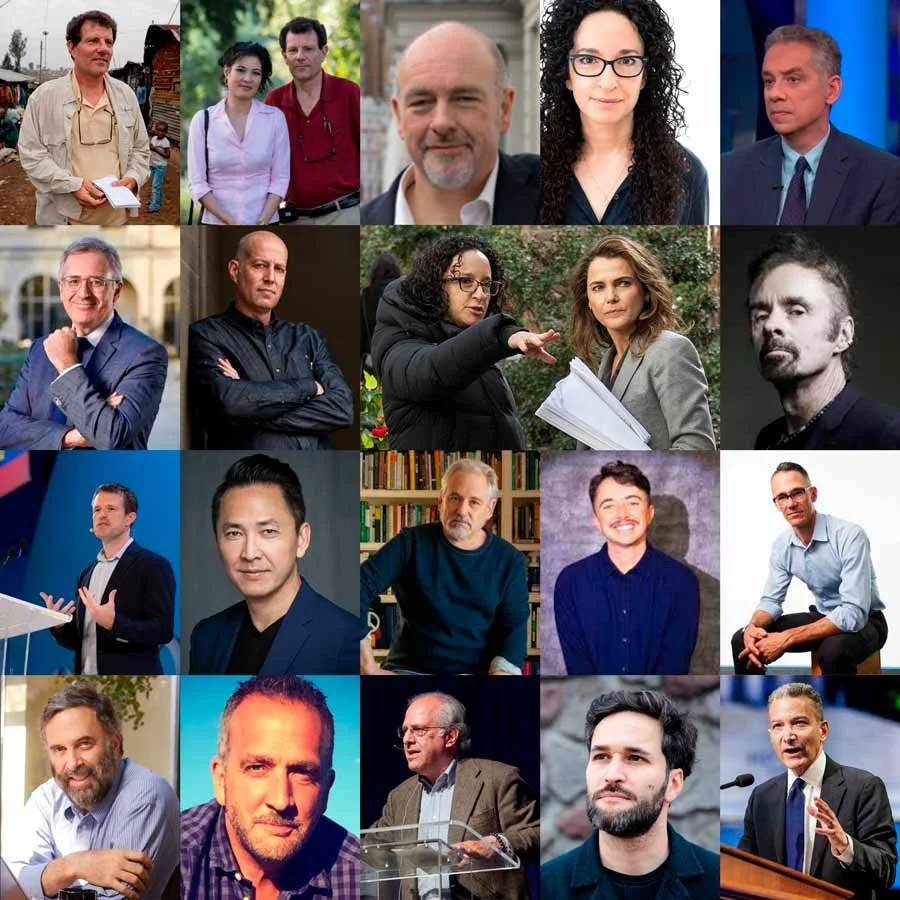
Today we explore the collapse of the journalism business model, the rise of "spin dictators," and how disinformation has become the new censorship. But even as empires struggle and media consolidates, the pursuit of truth remains an act of hope. We hear from foreign correspondents and journalists Nicholas Kristof, Abrahm Lustgarten, Michael Maren, Richard Black, and Jacob Ward. They are joined by scholars and economists Jeffrey Rosen, Sergei Guriev, James Fishkin, Richard D. Wolff, and Daniel Susskind. Finally, writers Viet Thanh Nguyen, T.C. Boyle, and Lee McIntyre, television showrunners George Pelecanos and Debora Cahn, and activists Dean Spade and Mike Davis explore the impact of language, authoritarianism, truth, and the complexities of human conflict.
NICHOLAS KRISTOF
Pulitzer Prize-winning Journalist · NYTimes Op-Ed Columnist
Author of Chasing Hope, A Reporter's Life
Coauthor of Half the Sky · Tightrope · A Path Appears
There are all kinds of changes, and part of it is that the business model for journalism is kind of collapsing, and traditionally newspapers were often monopolies or oligopolies, and so they were making money, and so they were perfectly fine being committed to covering important things that readers weren't terribly interested in.
And that business model has already collapsed for local journalism around the country. We're losing an average of two and a half newspapers each week around the country. We've lost more newspaper journalists than we have coal miners over the last decade. And in terms of national, international coverage, then, look, the New York Times still has a good business model. The Washington Post has a business model in the sense of Jeff Bezos has a large checkbook. The Wall Street Journal is doing okay. But the news weeklies are collapsing, television is struggling.
If you think about the world right now, there are still reporters covering the war in Ukraine, there are still folks covering the war in Gaza, but you don't have reporters covering what's probably the world's biggest humanitarian crisis right now, the famine in Sudan, with some exceptions, of course. But it isn't getting much coverage. Yemen wasn't getting much coverage when it was the biggest crisis. And I think that's fundamentally because it's expensive and dangerous to cover those kinds of international stories. And there's not much of an audience for it. Once I did back-to-back columns about the Yemen humanitarian crisis and Brett Kavanaugh when he was nominated for the Supreme Court.
And the Kavanaugh piece I could whip off in a few hours. The Yemen piece resulted from an expensive, somewhat dangerous trip to Yemen. And it wasn't just that the Kavanaugh piece got fifty percent more page views or double the number. It got seven times as many page views. And so you can understand why an executive producer doesn't want to send a camera crew to Yemen when they can put a Democrat and a Republican in a studio together and have them yell at each other.
ABRAHM LUSTGARTEN
Senior Reporter ProPublica · Author of On The Move: The Overheating Earth and the Uprooting of America
And so that's one criteria that really needs to change. And the other, and it's harder to solve, is the consolidation of media by the big successful outlets and the loss of local reporting, which is so critical and really in many ways more important than what the New York Times does on a national or global level, to be able to have small communities know what's happening in their own school districts and their own streets and hold their own local officials accountable. That's just disappearing and it's a really hard challenge to address because it requires money, but it also requires dedication and training and committed people.
And as a career choice, it's a hard sell. We don't make a lot of money and we're not always very appreciated as you point out. There's a lot of skepticism and a lot of distrust for the media. So it's sort of a thankless position at the moment. I don't think historically it's always been that way. And I don't think it will be, but at the present moment, it's a tough environment to tell young people to go into. And I recognize that that's difficult, but I think it's really important and I would still encourage anybody who's interested to do it.
And what I tell them is, do it if it's based on a sense of mission, not an ambition certainly to make money because there is none. I went to graduate school. I took on debt to study journalism. I wouldn't recommend that for other people. I think you learn through practice. And if you combine that need for practical practice with the need for local reporting, I'd say aspiring journalists should just start doing the journalism, whether you publish it on your own website or you go do it in a small town for a small struggling newspaper or a small struggling website.
That's where the experience comes from. And then you're immediately injecting content and good reporting into that world that needs it at the same time that you're learning.
LEE MCINTYRE
Philosopher · Author of On Disinformation: How To Fight For Truth and Protect Democracy · How to Talk to a Science Denier
So this chapter is called Truth Killers. 2021 was an American tragedy. It was also completely predictable patriots and face paint who carried sharpened flagpoles, bats and zip ties into the Senate chamber were the inevitable result of seventy years of lies about tobacco, evolution, global warming and vaccines after the truth killers provided a blueprint for how to deny scientific facts that clashed with their financial or ideological interests.
It was a small step for unscrupulous politicians to figure out how to use this strategy to lie about anything they wanted, such as the baseless claim that the 2020 presidential election was stolen and that the January 6th were actually peaceful protesters. Antifa in disguise.
Welcome to the world of reality denial, where truth is subordinate to ideology, feelings have more weight than evidence and democracy hangs in the balance. Throughout history, autocratic leaders and their wannabes have understood that the quickest way to control a population is to control their information source.
But in a society that still has a free press, disinformation is the new censorship. Remember that scene in Indiana Jones and the Last Crusade where Harrison Ford has finally found the Holy Grail, but can't tell which one it is because it's surrounded by a hundred fakes. That's the point of disinformation. If you can't hide or destroy the truth, surround it with bullshit. You can always kill it later.
RICHARD BLACK
Director of Policy & Strategy · Global Energy Think Tank · Ember
Author of The Future of Energy · Fmr. BBC Science & Environment Correspondent
So you've got public service broadcasters, they're the kind of obvious ones where like the BBC, that are working within a charter that basically prescribes independence. And I'm very, very fortunate, I spent pretty much all of my journalistic career in the BBC, very, very sort of free place to work.
You've got other newspapers that basically newspaper supplies a niche. And so there is a niche out there of people that are reasonably well informed and they want stuff to be broadly accurate and interesting as well. So the UK context, for example, you've got The Times that fits into that niche people subscribing to the Times. It seems to me don't want falsehoods, they want intelligent analysis of important issues.
Stuff that's relevant to financial institutions such as the Financial Times or Reuters. They again have to be pretty much on the money because their audience is well informed and they're not going to pay for rubbish. So there are definitely a lot of islands of sanity out there. Meanwhile, perhaps the most worrying aspects of this whole thing is the number of people that don't engage with news at all. My mum has quite a few acquaintances like this who simply are not interested at all in what the news is. And if that grows, then that becomes a massive, massive problem, I think.
JACOB WARD
Author of The Loop: How AI Is Creating a World Without Choices and How to Fight Back · Host of The Rip Current Podcast
So OpenAI had its developer day where they have debuted a whole bunch of new things that you'll be able to do from within ChatGPT. You'll be able to connect ChatGPT to a bunch of apps and create stuff without ever really leaving ChatGPT, there's all this stuff that people are sort of excited about, but one of the other things they announced was the ability to make ten-second AI generated videos through their program and suddenly my social media feed is full of some stuff that is kind of cool.
And then it'll be like, oh, here's Martin Luther King as a DJ, and I think to myself, well, first of all, they haven't gotten any permission from anybody to do that, right? They haven't gotten permission from the Dr. King estate, certainly. And then I'm thinking to myself, boy, it's not far from that to depicting Dr. King in some other bad way. Some way that is less funny and less noble. So the way in which, yeah, like you say, it's about to be so easy to be as hateful as you want to be in a very emotionally resonant and convincing way, that's one of the things being created here, very carelessly.
LEE MCINTYRE
Philosopher · Author of On Disinformation: How To Fight For Truth and Protect Democracy · How to Talk to a Science Denier
Good investigative media is expensive, but this kind of both-sides journalism, where they'll book a liar just so that it doesn't look like they're biased, because they'll have a liar in the program to tell the other side. But again, another quotation that I wish I could take credit for this one, Stuart Stevens, how do you tell both sides of a lie? You can't.
So really respect for good old-fashioned investigative journalism, just the hard-nosed person what Meet the Press used to be with Tim Russert, where he said that his guiding philosophy was to study everything that he possibly could and then take the other side. In interviewing the person, that's how to do it. But you don't see that done as much anymore. You do find people who are not afraid to go there. Christiane Amanpour is a brilliant example of this. Nicole Wallace, another great example of this.
So you do find people who are not afraid to go there. My latest beef against the media is that up until recently, they wouldn't even use the word disinformation. They would say misinformation, which is toothless because misinformation just means a mistake. But disinformation is a lie, which means there has to be a liar, which means you have to expose the plot.
Who's the liar? Why are they lying? Who's the money behind the lie? But I think the stakes are high enough that we have to do that. I've been cheered recently that you do now see many legacy media outlets using the word disinformation, and that's, I think, key.
JACOB WARD
Tech Correspondent · Host of The Rip Current Podcast
But journalism, the worry, and I think this is true, is like we've just come to a place where social media has created the illusion that if you have a lot of visibility, then you are the right person to talk to. People who have no qualifications other than being highly visible are the ones that wind up on the national stage discussing important matters.
I have talked to several people who are trying to create some sort of system that would actually establish whether someone really is a credible source rather than just the most visible source. And that's just been the part of the attention economy is the illusion that if you are out there and visible on a topic, then you must be the right person to speak on that topic.
JEFFREY ROSEN
President & CEO of the National Constitution Center · Legal Scholar
Author of The Pursuit of Happiness: How Classical Writers on Virtue Inspired the Lives of the Founders and Defined America
The idea of being moved by opinion rather than fact and expressing allegiance to an ideology rather than being open-minded to evidence is the definition of a faction. A faction is any group, either a majority or a minority, animated by passion rather than reason, devoted to self interest rather than a public good. And that's exactly what the algorithmic rabbit holes and filter bubbles and echo chambers encourage. And it's a serious threat.
SERGEI GURIEV
Economist · Co-author of Spin Dictators: The Changing Face of Tyranny in the 21st Century · Dean of London Business School
So we need deliberation for this. We, in the public square, we need debate. And this is exactly the challenge you mentioned, the problems of mainstream media. Mainstream media are the spaces where we are supposed to debate things. And indeed, if you just put an issue to a vote and you don't discuss this issue before that creates a vote, which is reasonably random. And so this is why we need media, and this is why we need deliberation.
JAMES FISHKIN
Author of Can Deliberation Cure the Ills of Democracy?
Director of Stanford’s Deliberative Democracy Lab
Well, that's a big question. The three ills of democracy that I propose to address with this method that we've perfected now over the last several decades, and maybe 160 elaborate projects are, first, democracy's supposed to make some connection with the quote-unquote will of the people. But how can we estimate the will of the people when everyone's trying to manipulate it? The public is subjected to misinformation, disinformation.
Our public sphere has decomposed into filter bubbles or enclaves where people hear like minded voices because they find them congenial. Algorithms of social media make that convenient to get information that way. So finding the will of the people is the first problem. The second problem is that the way our political communications systems have evolved, we get more and more extreme partisan polarization.
And the divisions have mostly by party, but sometimes by other divisions have become seemingly intractable and those divisions lead to deadlock and a perception that democracies cannot get anything done, which opens the door to some variance, soft or hard, of authoritarianism or people at least lose faith in democracy.
SERGEI GURIEV
Economist · Co-author of Spin Dictators: The Changing Face of Tyranny in the 21st Century
In this book, Spin Dictators we did tell a story of the transformation or the way dictators, how non-democratic regimes work. And we argue that in recent decades we've observed an emergence new model of dictatorship, which pretends to be a Democratic regime. This model is actually to deceive people through propaganda, through selective censorship, through targeted, but limited and hidden repression.
And this is dangerous exactly because people would say, this is not actually a non-democratic regime. Maybe it's an imperfect democracy. Maybe we should not worry too much about regime like this. Because eventually they will get back to the right track. But what we show in this book is that actually majority of non-democratic regimes today are dictatorships, like this dictatorships, which are hidden deniable manipulating rather than openly repressive using terror against their citizens.
And in that sense, the main danger here is that we don't understand that these regimes are actually enemies of freedom and we really need to understand how they work and how to stand up to them.
VIET THANH NGUYEN
Pulitzer Prize-winning Author · The Sympathizer · The Committed · To Save and to Destroy · A Man of Two Faces
So as a writer, I do believe that art and literature in and of themselves are important. One of the most important reasons why is because language is crucial. Part of the way that states and authoritarian regimes exercise their powers, not just through physical violence and intimidation, but through a maltreatment of language itself. I mean, Trump is a perfect example of this. Everything that comes out of his mouth in terms of language is horrifying.
For anybody who has any sensitivity to language, you know, the excesses of his language in terms of insults, in terms of hyperbolic praise for his psycho fans and so on. It's a perfect example of how language is used by an authoritarian and by the state in order to obfuscate reality and in order to intimidate people. That language is ugly from my perspective. And so there is something about being committed to literature and to art that awakens us to the importance of beauty.
And I think about what John Keats, the poet, said, “Beauty is truth, truth beauty.” You can't separate these kinds of things. So if you're committed to the beauty of language, you're also committed to this idea that language has a relationship to truth. And you can see that authoritarians don't have a relationship to truth. They have a relationship to the abuse of truth because language is one of the most crucial ways that authoritarianism extends its power. What I've discovered as a writer is that fear is a good indicator that there is a truth. To speak the truth in a society is oftentimes an act that requires some courage.
T.C. BOYLE
Novelist · Short Story Writer · No Way Home · Blue Skies
The Tortilla Curtain · The Road to Wellville
And further, Mia, we see in Europe and America the rise of fascism. You know, I was born in a democracy. I now live in a fascist dictatorship. The first thing that this president has done is cancel all green initiatives. So, drill baby drill, just to make everything that much worse. I don't really have a lot of hope for the future.
What I have done in my career is just try to assess who we are, what we are, why are we here, how come we animals are able to walk around and wear pants and dresses and talk on the internet, and the other animals are not. It's been my obsession since I was young.
GEORGE PELECANOS
Award-winning Novelist · Screenwriter · Showrunner · Producer
The Wire · The Deuce · We Own This City
King Suckerman, in a way, it was an easy book to write because it was set during the bicentennial 1976, and I was still a teenager. But I remember that year more than any other year I've lived probably. It was the pinnacle of a lot of things. The idea was that it was the top of the mountain of fun that we didn't realize then that we had to go down to the other side of the mountain. So you're climbing up and all these fun things are happening.
You're smoking weed, you know, free love. We partook of what the sixties generation kicked in the door for us in the seventies and everything was, it was all good. You know, Reagan was on the horizon and everything that came with that, but we didn't know it. And the other thing was that the civil rights movement had opened a lot of doors for people to get to know each other. Friendships.
We felt very optimistic in that time that things were just going to get better, and now we've seen that we were wrong. Which is the most disheartening thing about our current situation in the United States is that we were wrong. That half of our country is racist, to put it bluntly. And that what happened back then didn't take, and all these snakes have slithered out of the ground now once again, that we have to deal with.
DEAN SPADE
Professor of Law at Seattle University · Activist · Author of Mutual Aid: Building Solidarity During This Crisis (and the Next) · How to Build Relationships, Hook Up, and Raise Hell Together
And we're living through a pretty extreme backlash that, of course, is not just because of the mainstreaming, it's also because of the rise of the right wing and fascism in the United States. And it's particular one of the things that's got its hold on is, which is not surprising is gender and sexual politics. That's something fascism likes to care about, and it's using queer and trans people's lives and particularly trans people's lives and also reproductive health issues as a way to recruit people into a politics that's actually like really terrible for them, unfortunately.
DEBORA CAHN
Showrunner · Creator Netflix's The Diplomat
Exec. Producer Homeland · Writer Producer The West Wing
You know, I don't happen to be meeting only the good ones. I'm meeting a cross section that is not necessarily selected for any individual quality. There are nice people who are working hard and basically selfless. So if that's the case, like how do we get where we are? How is it that we have violent conflicts playing out in fifteen different places in the world right now? It isn't because there's a better value system and a worse value system, it isn't because there's a right religion and a wrong religion. It is because it's really, really complicated.
RICHARD D. WOLFF
Economist · Founder of Democracy at Work
Author of Understanding Marxism
The United States lost. In Afghanistan, the United States set out to destroy and defeat the Taliban. But Afghanistan is today ruled by the Taliban. The United States was defeated. In Iraq, it was defeated. In Ukraine, I mean, I understand Americans are in denial. But everywhere else in the world, it's crystal clear that the United States has been defeated.
Okay, you can have a few of these, and let me tell you, as a professor, as I go around the United States giving talks, often to college students, when I lean across the podium and I come to that part of my story where I talk about the defeat of the United States, you should see their faces. This is the first time someone has said that to them. They don't think Americans lose wars. Any of them. That's a level of self delusion that will come back to haunt you because you are going to make terrible strategic mistakes. The idea in Washington that you could defeat Russia in Ukraine by a program of economic sanctions on top of the military, that was a terrible mistake. It didn't understand that Russia could turn to its BRICS allies, above all China and India, and sell the oil and gas to them that the Europeans will no longer buy, hoping thereby to cripple Russia. It failed. Russia's economic growth is better than Europe's for the last two or three years.
I mean, it's a grotesque miscalculation, but it should be a warning. The level of self delusion you have is leading you into terribly self destructive miscalculations.
VIET THANH NGUYEN
Author of The Sympathizer · The Committed · A Man of Two Faces · To Save and to Destroy
I think the indication is that at least a large portion of the United States has not learned those lessons, and unfortunately, that portion is in power. The Trump administration is certainly taking these wrong lessons to a level that will lead us to all kinds of war. We are already at war with immigrants. That is an explicitly stated goal of the Trump administration, and there is an internal war against these immigrants. There is an acceleration of the militarization domestically of the United States, which is an indicator of how much more military aggression in terms of foreign policy the United States will exercise.
But let us be clear that this is an outcome of democratic policy too. The Democrats have been wholehearted supporters of the forever war. Democrats have been responsible for a lot of the wars that the United States has fought in the post-World War II era. Democrats have also given legitimacy to extrajudicial drone strikes and to the militarization of the police domestically. Even if the Republican party under Donald Trump is accelerating things, the Democrats have also been very complicit in a lot of this as well.
So yes, we are an empire that has passed its peak that is struggling to hang on via force and violence versus diplomacy and negotiation. These are very, very bad signs, but also repetitions of things that the United States has been doing fairly consistently in the post-World War II era.
DANIEL SUSSKIND
Economist · Author of A World Without Work: Technology, Automation and How We Should Respond · What Should My Children Do? A Human's Guide to the Age of AI · Growth: A Reckoning · Co-author of The Future of the Professions
I think Brexit is a really good example of a difficult trade-off being badly managed by our existing political institutions. The idea of resolving such a difficult question through a referendum, a one shot yes or no mechanism where the deliberation that informs that referendum isn't the kind of careful considered deliberation of a citizen's assembly where you have got lots of time and you are well briefed and you can discuss civilly. But instead it's done politically through political campaigns and through adversaries it is not the way to resolve that difficult issue.
Fundamentally Brexit is a trade-off between growth and other things that we might value and care about protecting particular industries, places, cultures and traditions. That stuff has a value, but of course so does the economy and so does growth in the economy. And Brexit was a decision to pay a price in terms of growth to protect these other things that we might care about place, community industry, political independence and autonomy and so on. That's a really difficult trade-off.
It's a trade-off where there are legitimate grievances on all sides and it's one that really demands careful deliberation. It's one that seems to me would be so well suited to a citizen assembly or something like that. But instead we did it through a referendum and it just felt like such an inflexible, inappropriate mechanism for dealing with such a big trade-off, such a big question. So I think it's really interesting that you raised that because I think it's a good example of where a citizen assembly would have worked really well to engage in a trade-off between growth and other things that people value and care about.
RICHARD D. WOLFF
Economist · Founder of Democracy at Work · Author of Understanding Marxism
So what unifies in a sense, what lies behind all of these, is the profit imperative. The prioritization of profit over everything else. Because it's profitable to build housing in unsafe areas, we do it. We pay the price because it's profitable. We turn against our allies around the world. Because it appears to a politician to be a profitable gamble to play. Where others would be eager to sustain an alliance, our political leader currently thinks it's fun and profitable to him as a vote collector to enact a theater of Mr. Tough Guy.
It's all theater. The position of the United States in the world, economically and politically, is the weakest it has been in my lifetime. And I was born in the middle of the 20th century, so I have watched the rise of the American empire and the success of American capitalism in the second half of the 20th century. But over the last 20 years, I have watched that turn into its opposite, into a decline, and the decline is visible everywhere unless you live in the United States and you consume mainstream media where there is a level of denial that will be recorded historically as one of the great examples.
Not just of a declining empire, which typically has people who can't face it, who refuse to see it. You can go to Great Britain today and find people, quite a few, who think we still have the British Empire, even though everyone who isn't crazy knows that that's silly. We are earlier in the decline phase than the British are. They've had to do it for a century. We've just had to do it for a couple of decades, and so it is fresh, and we still have political leaders, as for example in the presidential election just behind us, in which neither Mr. Trump nor the Democrats who ran against him ever said a word about a declining empire.
They outdid each other in pretending otherwise. It's extraordinary. You don't solve problems by denying them. Your doctor makes that point to you every time you visit. Your psychiatrist, your therapist, your boyfriend, your girlfriend. You need to face the issues that shape your life. They're not going to go away all by themselves, and yet that's the way this society is dealing with the fire in Los Angeles or each of the other problems.
DANIEL SUSSKIND
Economist · Author of A World Without Work · What Should My Children Do? · Growth: A Reckoning · Co-author of The Future of the Professions
These are fundamental moral questions about what we care about as a society. And the place to answer those moral questions is not, in my view, in treasuries and central government statistical offices. It's not for technocrats and economists and statisticians to answer these questions as they're trying to do today, but it's for citizens, it's for politics. And so a big theme of the book is about trying to push down some of these difficult moral questions about what we care about as a society. And how much we care about those things relative to one another to push them down to new kinds of political institutions. Citizens assembly, citizens panels, citizens juries that can engage with these difficult trade-offs and debates rather than leaving them to, as we do today, economists and statisticians.
JAMES FISHKIN
Director of Stanford’s Deliberative Democracy Lab
Author of Can Deliberation Cure the Ills of Democracy?
So deliberative democracy is itself, when properly done, a kind of democracy that can speak to the interests of a community, and we need that all over the world. We haven't found people changing parties, but we've found people coming to a decision about the issues. The New York Times featured the changes which I reproduce in the book both among Democrats and Republicans. The Democrats changed dramatically in terms of lowering their support for the most ambitious and expensive social programs.
The Republicans changed dramatically on immigration. Where before deliberation, something like 80 percent of the Republicans wanted to send undocumented immigrants home. This was in the 2019 case before the 2020 election, 80 percent wanted to send the undocumented immigrants to their so-called home countries. After deliberation, only 40 percent. That's a 40 point drop. But the Democrats changed on some of the social programs by as much as 40 points too. There were movements, in other words, on some of the economic issues by the Democrats in favor of things that were initially supported strongly by the Republicans.
DEBORA CAHN
Showrunner · Writer · Executive Producer
The Diplomat · Homeland · The West Wing
The question of who's good and who's bad is always front of mind for me because my basic goal is to get to the place where no one is good or bad, everybody is in an unspeakably complicated situation. From the very beginning of the series, The Diplomat, this event happens. We believe that it was perpetrated by Iran. And fairly quickly, we learn through the relationships that have been built over time between our heroes, Kate and Hal, and people in other countries that they've negotiated with, that the assumptions that we're making are completely incorrect.
In fact, the people we assume have some sort of malintent toward us were working with a whole other set of motives and were being falsely accused. Someone else is sort of playing on the stereotypes we have of those people in order to send us off in the wrong direction.
MIKE DAVIS
CEO of Global Witness
Yes, our work is all founded on our own investigative research, and it takes quite a few different forms. So it includes the undercover investigation done by the team I first worked with and learned from in Cambodia when I first started with Global Witness, and we still use undercover techniques to get information, which often includes use of hidden camera filming for instance. And we also use a range of what you might call classic field research or journalistic techniques where our staff get to remote hard to access places to witness and document what is going on firsthand.
We also build partnerships with organizations in the countries where we're doing that sort of work. We're very reliant on our partners and very proud to work with them. For instance, the investigation to do with cattle ranching in Brazil and the role of international banks. That was done in partnership and outstanding Brazilian organization, Imazon, and in some cases we're working with people who aren't part of organizations. They are citizens who perhaps share our agenda to expose and confront abuses of power to do with natural resource extraction and the climate, and we form relationships with them which will sometimes go on for years.
I mean, forgive me for indulging in a bit of personal reflection for a second, but I did work in Myanmar for several years. I wasn't based there, I was based in Cambodia nearby. And that was an example of how we do this sort of thing. We built up a network of partners and sources which was absolutely essential to being able to expose the multi-billion dollar jade business and who was controlling it. Essentially some of the same sorts of people who've just instigated a coup. And so I've been calling and messaging some of my friends from that work some years ago now. But they are my friends. I'm still in touch with them. So those personal relationships are in some cases very important.
Increasingly we use data investigation techniques. That's a great question and it's one we think about quite a lot as a campaigning organization which specializes first and foremost, I would say less in mass mobilization and awareness raising, and more in very deep dive investigations into the sort of issues which I described earlier. And also advocacy, which tends to be quite targeted on policymakers and decision makers in companies and intergovernmental bodies. But we obviously think hard about the question you raised. How do we get the message through more broadly?
And we do that through a variety of means. Some, if you like, a little bit more on the traditional side. We often work with mainstream media to try to get our investigative findings, our recommendations, our messages out there because they can help us to broadcast those in a way which we can't. But we also work increasingly through online means, more active use of social media. We have a fantastic communications team. We have an absolutely brilliant data investigations team, which forms a natural complement to that, and we often work with partners too.
To give you an example. We have a very talented group of campaigners working out of Brussels who are trying to persuade policymakers in the European Commission that they should introduce a law which would hold companies accountable for the whole range of harms which they sometimes inflict, both on the environment and on human beings.
MICHAEL MAREN
Fmr. Foreign Correspondent · Screenwriter · Director of A Little White Lie
And there's a book I read a long, long time ago. I was reading about apartheid in South Africa, and I'd read a lot of books about it, and I was interested in it. And then I read a book by Bill Finnegan called Dateline Soweto. And Dateline Sowetowas simply the story of one Black South African journalist, and what his daily life was like, what it was like for him to try to cover stories for a newspaper based in Soweto. And I understood then more than I did reading these big, fat academic tomes, that one story well told can capture more and inform more and be much more effective than 500 pages of an academic study that covers virtually everything, or that attempts to cover virtually everything.
You need to know a character really well. And that requires really, it requires empathy. And which I think journalism is, to bring it back to that, it's the same thing in certainly novel writing, you need to have a real level of empathy with your characters. And that's earned. That's earned by listening and paying attention to people and then being really moved and being moved to write something. So journalists are needed now more than ever, real journalists doing real work.
I think there's a quite a lot of interesting stuff happening domestically. The thing that as somebody who was a foreign correspondent for years, when I was based out of Nairobi, Kenya for a number of years, and there were Time, Newsweek, the Boston Globe had someone over there, the Chicago Tribune had someone over there, the Los Angeles Times. I mean, there were a lot of foreign publications, Le Monde and journalists from all over the world who were reporting on what was going on in Africa. Today there's very few sources for that kind of thing.
There's a reason that Americans should have American journalists in countries and the French should have French journalists because if you're a local journalist, you're under tremendous pressure from a government. With what's going on in China today, it's very hard for Chinese journalists to report the truth about what's happening, where as a foreign journalist, you have a level of immunity from being jailed or persecuted in some way. I would love to see more journalism start to the point where there's more correspondents in more places, because I think we become really ignorant about what's happening around the world.
And it makes it easier for authoritarian governments to suppress news if they're in a position where they can silence local journalists, which they can do very effectively. As for Americans, we're left with the New York Times, the Washington Post, and the Wall Street Journal. And some wire services, and everybody else relies on those sources. The Chicago Tribune doesn't have a Nairobi bureau anymore. And that's really unfortunate. Time and Newsweek barely exist, and they don't have bureaus overseas doing that.
So your news is sourced from fewer and fewer places in some ways. On the other hand, when terrorists took over the Taj Hotel in Mumbai and suddenly Twitter took over and I remember seeing this Twitter feed for the first time of people on the sites. So I mean, there's, again, it cuts both ways.
NICHOLAS KRISTOF
Journalist · Author of Chasing Hope, A Reporter's Life · Coauthor of Half the Sky: Turning Oppression into Opportunity for Women Worldwide · Tightrope: Americans Reaching for HopeTightrope · A Path Appears: Transforming Lives, Creating Opportunity
Journalism is an act of hope. What impels reporters forward is our faith that if we get the story and shine a light in the darkness, the public will respond and change will come. That's why reporters rush toward gunfire, talk their way into drug dens, scramble toward riots, and in my case right now, take a small plane into the heart of the Congo Civil War. Our adventures are not always well executed, however, and at the moment, I'm not brimming with hope. The plane is in trouble, and I'm petrified, thinking, so this is how I die.
Not in old age. Inconsolable grandchildren at my bedside on the family farm in Oregon. With the farm dogs giving up gopher hunting to come inside and muzzle their goodbyes. No, not that. My end is looming far from family in a fiery plane crash in the vast Congo rainforest. I'm in a chartered plane with other journalists. Our small plane is sputtering, the pilot steadily losing control.
It looks as if my ashes won't be scattered on the farm and on the Pacific Crest Trail as I had hoped, but rather my remains will mingle with termite mounds in a jungle on the other side of the world. A baboon or okapi may notice, but no one will. I guess I'm not giving anything away, but I actually do survive that crash.