

How much of our consciousness is shaped by our bodies? That rhythmical reality is something we often take for granted until it is disrupted by grief or illness. Much of what we consider the mind is happening in the body.
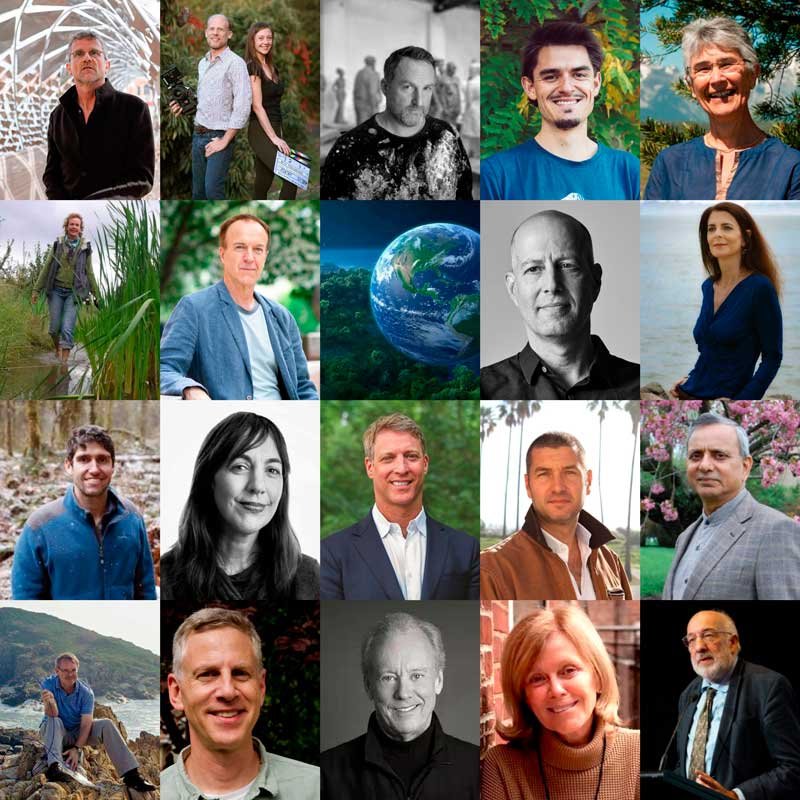
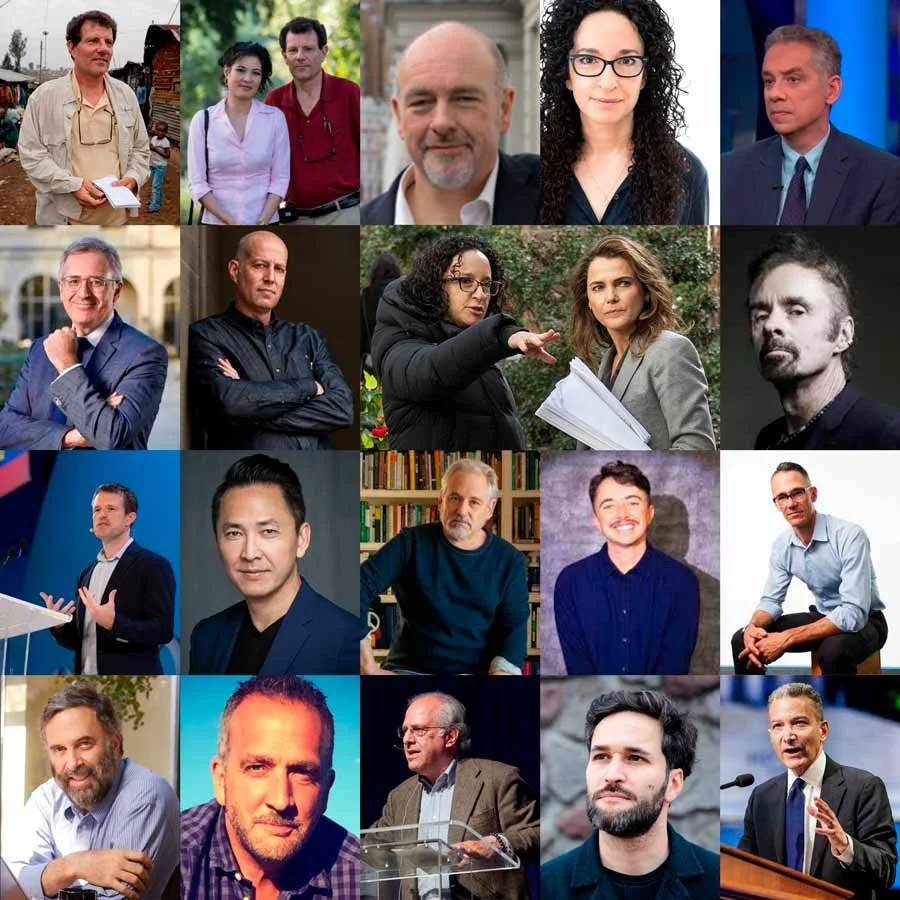
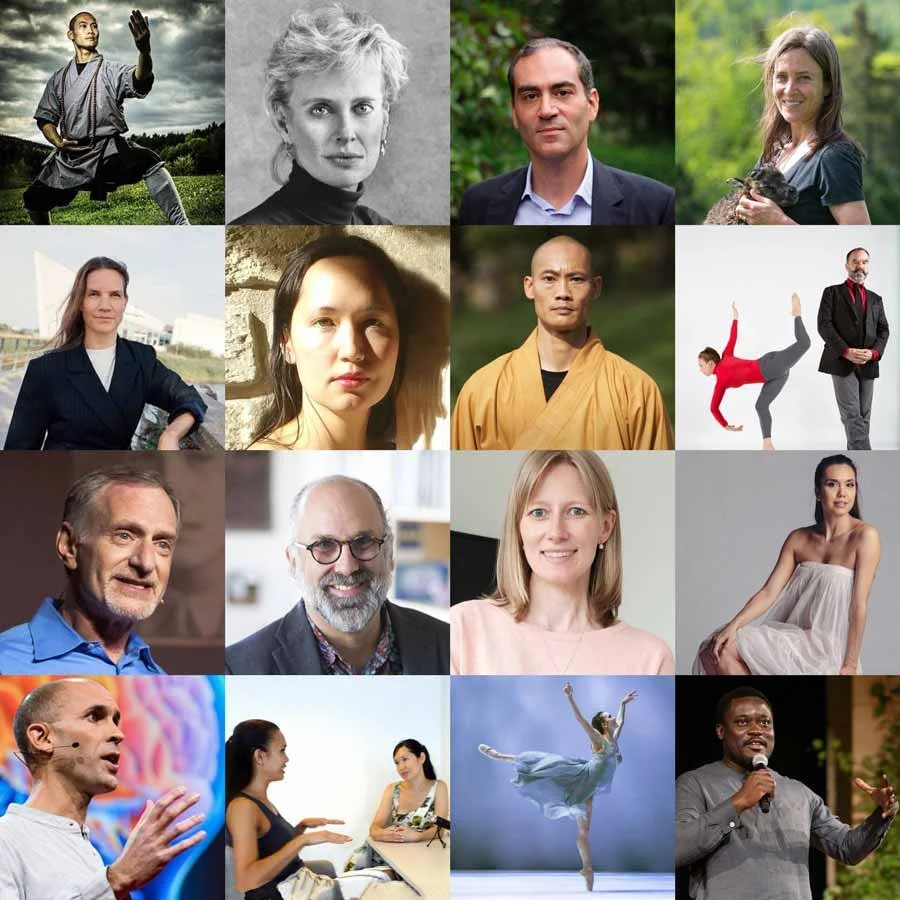
Today, we are looking at embodied cognition, the idea that we think with our limbs, our breath and our physical interactions with the world. We hear from researchers and neuroscientists Anil Seth, David J. Linden, Dr. Guy Leschziner and Daisy Fancourt, who are studying how much touch, sleep and the arts physically alter our brains. We will also talk with philosophers, advocates and spiritual leaders Arash Abizadeh, Bayo Akomolafe, Master Shi Heng Yi and Helen Whybrow. Finally, to understand how this translates into art and movement, we are joined by author Siri Hustvedt, curator Marie Nipper, psychiatrist Robert Waldinger, dancer and ballet stager Noelani Pantastico and choreographer Sean Curran.
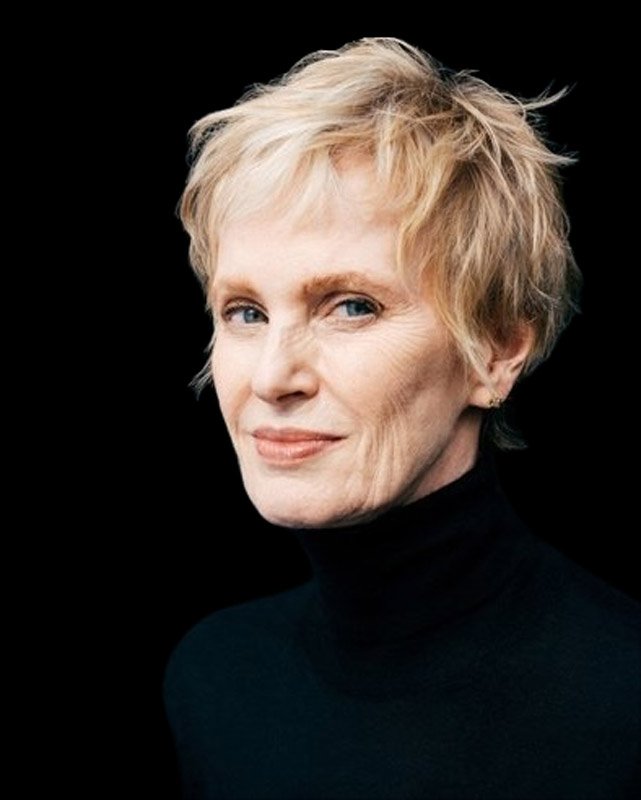
SIRI HUSTVEDT
Author of Ghost Stories · What I Loved · The Summer Without Men
Time remains a problem. Time, when you think about it, is abstract and invisible, but timing is not, right? The rhythms of our body—day and night, sleeping and waking, heartbeat, breathing—all of that is part of our timing. I think that when someone dies that you love, that was part of your rhythmic reality every single day. When that is abruptly taken from you, the feeling of time itself gets screwed up, to put it bluntly.
I like to think about those bodily rhythms and the external rhythms. We have lots of things. The menstrual cycle is a rhythmic reality for women for part of their lives. The moon, the tides, all of this, I think, is connected to rhythmical reality.
GUY LESCHZINER
Neurologist, Professor of Neurology & Sleep Medicine · King's College London · Author of Seven Deadly Sins · The Nocturnal Brain · The Man Who Tasted Words
Sleep is really important for memory. We think that one of the primary functions of sleep is to consolidate memories, both in terms of autobiographical memories but also in terms of emotional memories. One of the theories about why we dream is to try and clean up our memories and rid them of their emotional content, which is why some researchers have termed REM sleep, or dreaming sleep, as being overnight therapy.
One of the other interesting theories about why we dream is that what we are doing while we are dreaming is tweaking our model of the world. The brain works as a prediction machine. We expect what we are going to see, and we expect what we are going to experience.
It is only when our senses are telling us something different from our expectation that we have to tweak our expectation of the world. It is difficult to do that when we are awake because we are taking in all these impulses from around us. When we are in dreaming sleep, when we are offline, that is the time to integrate our experience of the day into that model of the world that we have. It is that sort of adjustment of how we understand the world to be that may be what is going on in REM sleep.
DAISY FANCOURT
Author of Art Cure: The Science of How the Arts Transform Our Health
Director of WHO Collaborating Centre on Arts & Health · Prof. Psychobiology & Epidemiology at UCL
We now know a lot about the biological mechanisms that the arts activate. When we feel happy when we engage in the arts, that is not just ourselves willing ourselves happy; that is because the arts are activating reward networks within our brains. They are affecting things like dopamine release and uptake, which means that there are hormones in our brains that are increasing that happiness. Similarly, when we think about the arts relaxing us, that is not just perceived relaxation.
We know from studies now that that is about reductions in stress hormones like cortisol and also reductions in autonomic nervous system activity, so that our heart rates slow down and our breathing slows when we are engaging in relaxing arts activities. In fact, in the research that I have led in the UK at UCL, we have looked at immune function in particular, showing that arts engagement helps to reduce levels of inflammation in the immune system. This is so important because inflammation is not only related to physical illness but also to mental illness symptoms like depression.
One of the reasons that the arts help to reduce those low symptoms is because they are reducing the biological inflammation that is associated with depression. Studies like this are so exciting because they are showing this is not just a placebo effect. It is not just what we wish was happening or want to happen when we engage in the arts. These are deep-seated biological processes that the arts activate.
HELEN WHYBROW
Shepherd · Organic Farmer · Author of The Salt Stones: Seasons of a Shepherd’s Life
My experience is it feels incredibly joyful, full of wonder and full of a sense of wholeness. Here I am, a part of this absolutely intricate intelligence that I do not understand, but I am an extension of it. I am part of it. My actions have reactions in nature and the other way around. I really think that regardless of how far any one person in their personal life gets from nature—even if you are an entirely urban person, spending all of your days sitting behind a computer and walking on concrete—if you were put down on a healthy ecosystem and then put down on a very unhealthy, degraded ecosystem, you would still be able to feel the difference.
You do not need any training to feel the difference. It is in us as biological creatures. We can tell when something is healthy and when it is not. Being a participant and being curious about natural spaces is not only essential for the future health of the natural world, but it is essential for our own health as well.
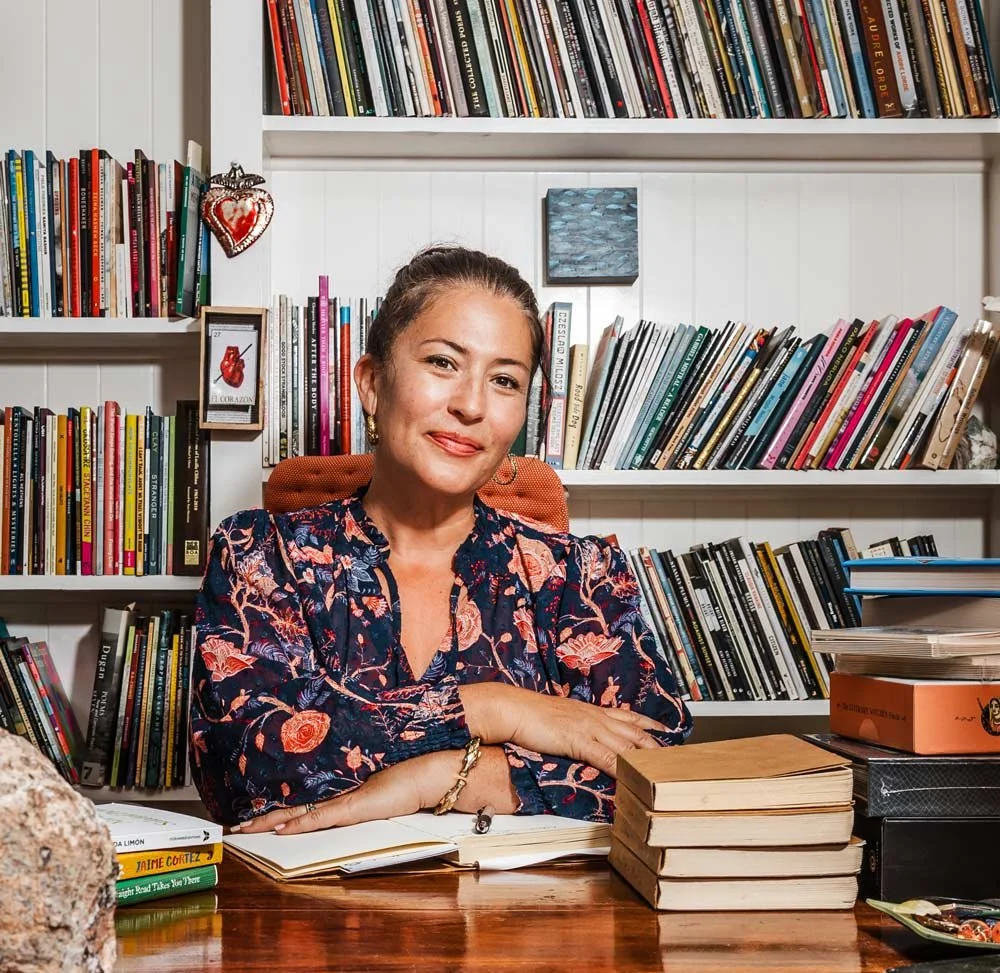
MARIE NIPPER
Director · Co-owner of Creator Projects
Fmr. Director · Arken Museum of Contemporary Art · Denmark
What is important to remember when you think about the works—the big immersive, beautiful light installations of James Turrell and Douglas Wheeler—is that they come from a time in the sixties where, a little similar to where we are now, you had political revolts and wars going on at the other end of the world from a US perspective. You had technology booming. It was a tumultuous world where things were changing quite rapidly. A lot of these artists took their point of departure in this technological revolution, but they also used it to provide us with a way to have a sensory experience. You can lose track of your senses, of your body and of your being in the world.
That groundedness is essential in a world that is so challenging and filled with crisis, such as the one we are in now. Those types of work can give you that bodily based experience where you enter a space that lies beyond actual reality. Think of Malevich, who, during the Russian Revolution in 1917, was creating his abstract paintings of black on black. He was sitting there with this war around him, and he escaped into this abstract reality. It can also be an expression or a consequence of a world that is extremely hard to be in and to deal with, where impulses are coming at you every day.
Having an artistic experience where the actual world is left for a moment or two, and you step into something else, creates a room of potential. This can also be subversive in the sense that it can give you agency and reconnect you with your body and the world. That is extremely interesting, important and maybe something that a lot of us need in times of crisis.
ARASH ABIZADEH
Professor of Political Science · McGill University
Author of Hobbes and the Two Faces of Ethics
The question is, why is it that sometimes people react with fear and aggression, and sometimes they react with a tremendous amount of kindness, altruism and generosity? We are capable of all of these different kinds of reactions. My first response is not necessarily to look to genetics or to think about what the essence of the human being is in that way.
I am more interested in social structures and the way that they channel our actions. They shape our beliefs and our dispositions to behave, react and respond to different circumstances. I think you are absolutely right to point to the rise of social media. This is a new phenomenon, as is the internet in general. It is a new phenomenon that we are grappling with and do not completely understand.
DAVID J. LINDEN
Author of Unique: The New Science of Human Individuality · The Accidental Mind · The Compass of Pleasure · Touch
Professor of Neuroscience at Johns Hopkins University
This is particularly important all through life. Touch is a fundamentally emotional sense, and we tend not to think about it. It is probably the least discussed and least understood sense. It does not have the primacy of vision or hearing. You can be born blind and have a perfectly rich, terrific life, and you can be born deaf and have a perfectly rich, terrific life in many ways. However, if you are deprived of touch as an infant—say, in the first year or year and a half of life, as happened in the orphanages under the Ceaușescu regime in Romania in the 1970s and eighties when there were not enough caretakers to hold and snuggle the babies—those infants developed chronic neuropsychiatric diseases that unfortunately seem to be lifelong.
It is not just neuropsychiatric diseases, but immune diseases, digestive diseases and all kinds of problems. You might say, how do you know it was the lack of touch that did it? Maybe these children were getting malnourished in these orphanages too, and maybe it was really that. The reason we know is that in some cases, there were volunteers who were able to come into some orphanages and cuddle the babies for a certain amount of time, and that was able to almost completely reverse these deleterious effects in adulthood.
There is a critical period where touch is required from birth up to around one and a half to two years of age. If the touch only starts happening afterwards, unfortunately, the die is cast, and those problems are already there and will last throughout life. Touch is crucial in early life, but it continues being crucial throughout childhood and adulthood. The way I like to think of it is that touch is our social glue. It is what helps make us feel connected to those around us, whether it is in our family, our friends or, depending on cultural situations, maybe in the workplace or the community broadly.
BAYO AKOMOLAFE
Philosopher · Psychologist Public Intellectual · Author · Founder of the Emergence Network
Speaking of hope, of course, you know of Pandora's box. I worry about the insidious effects of hope and how hope can perpetuate cyclicity, keeping us in familiar methods or patterns of behaving that only reinforce the conditions that hope is trying to get us out from. I would not say that my work is about seeking wholeness. My work is, in some sense, about doing the opposite.
It is about sniffing out the cracks within wholeness so that our bodies can transmutate into other kinds of things. That is the reason why I would not say it is about solutions or problems. It is about shapeshifting. It is about using the ingredients of these moments to form a new kind of altar—to look differently, think differently and talk differently, not as a religious imperative but as a way of relating and experimenting tentatively with a world that is alive.
MASTER SHI HENG YI
35th Generation of Shaolin Masters
Headmaster of the Shaolin Temple Europe
It is just a question of time until your time is over. That means the realization that this lifetime, as you know it at the moment, is limited. In a way, it is your obligation to take care of the body, which serves as the vehicle transporting you through this lifetime. It gives the creativity, imaginations and dreams that you have created in your mind a vehicle to bring them here on Earth, manifest them and make them real.
The dreaming, the expectation and everything that we create in the mind is mind-made. It is not manifested; it is not yet a part of this Earth. It is just a part of you, of the heavenly part, as we sometimes call it. You are in between. You are the human between heaven and Earth. Receiving the inspiration from heaven and finding a way with your body and your mind to bring it back here on Earth to make your dream life come true—that is something to spend a lifetime on.
It is so interesting when you mentioned octopus consciousness and where consciousness exists. We think it is behind our eyes because that is the way we are orientated. If your body is different, the experience changes. I know dancers who are thinking with their limbs as much as through their heads.
ANIL SETH
Author of Being You: A New Science of Consciousness
Co-director of the Sussex Centre for Consciousness Science · Canadian Institute for Advanced Research Program on Brain, Mind & Consciousness
I think we all do that to some extent. I am not a dancer, but I enjoy various sports, and even when sitting at my desk, there is a sense in which I think through my body. We make gestures, and we scrawl on pieces of paper. Of course, the brain is embodied, and the body is embedded. This has been quite a sea change in cognitive science and neuroscience, moving away from the tradition that was very dominant in most of the 20th century. That was the idea, especially from the fifties and sixties onward, that the brain was a kind of computer and the body was there mainly to move it around from meeting to meeting.
The brain would send out commands to the body and take information in. Just as much as you can put a computer chip in an object of any shape and it still does the same thing, there was the underlying assumption that the body itself did not contribute to our perception, cognition or thinking very much. This was not something everybody believed, but it was an implicit belief in a lot of cognitive science, and that has really changed. Very few people would defend that today.
There is increasing recognition that the body shapes and partly constitutes our perceptions and our beliefs, both through structuring our interactions with the environment and through the body itself. Emotion is probably best considered or understood as a perception of the interior of the body—a perception of how well the brain is doing at keeping the body alive. It is quite an old idea in psychology, but bringing it up to date and thinking about it in terms of the concept of controlled hallucination gives it a new lease of life.
The body is the reason we have brains, after all; brains evolved to control and regulate the body and keep it alive.Everything starts to make sense in consciousness research when you think about it through that lens.
ROBERT WALDINGER
Director of Harvard Study of Adult Development
Author of The Good Life: Lessons from the World's Longest Scientific Study of Happiness
We all have creative impulses, and we express them in so many different ways. We have studied a lot of lives where people's creativity was expressed in ways that won the Nobel Prize, and some creativity was expressed in ways that made for delicious family dinners, with everything in between. Creativity springs in part from a wish to both embrace the world and be seen by the world.
You embrace the world, take in things and then metabolize them in such a way that you put them out for other people to see. In much creative effort, there is a wish to have people see what is inside of you and what you want to express.
I imagine dance is an ephemeral sort of experience. You are inside your body and outside of your body, and you are just coming now from a performance. Can you describe that feeling when it seems almost transcendental, or does that come in certain moments during a performance?
NOELANI PANTASTICO
Fmr. Principal Dancer · Pacific Northwest Ballet · Freelance Ballet Teacher · Coach · Stager for Jean-Christophe Maillot
Honestly, it depends on how new a role is, how long I have done it and if I am repeating it. It does not always feel that way. That being said, whenever I do something, I always try to look at myself from the outside. Mostly when I am doing something with acting, I consider how things will come across from an audience point of view. Even in regular repertoire, I always try to think about how this movement or how this acting is going to reach the last person in the audience.
With some roles that I am so comfortable with, you really do get into this transcendental state that you are talking about. That happens to me more with characters like Juliet or Cinderella. Those are roles that I danced for years and years, several times over. I am just more comfortable if I become another person. Because of the work that I have done with Jean-Christophe Maillot—I worked very intensely with him for almost eight years—that has stayed with me when I do acting on stage.
SEAN CURRAN
Choreographer · Dancer · Director of Sean Curran Company
I like to say it is an abstract visual language. I feel that dance and music—I am going to combine them here—can rouse emotion in an audience member in a way like nothing else can. Certainly, music can do it on its own. When there is a human being up there moving to this music, it is almost like you cannot even name the emotion, but it will make you feel something.
Dancers' careers are so short in a way that there is something precious about it. I work in opera, and as you know, opera singers are not hitting their stride until their late thirties or forties. They sing into their seventies, some of them. We dance a lot longer than we used to, but one thing I say to my students is that I really miss dancing. I miss performing. So savor it. Do not take it for granted.
SIRI HUSTVEDT
Novelist · Memoirist · Essayist
Memories of the Future · Living, Thinking, Looking
Ghost Stories · Mothers, Fathers, and Others
It changes, but it does not go away. I think the body adapts to the loss. This is a truly embodied physical reality: as time goes on, that sense of what the heck is going on here, where is that other body, and what happened to it shifts. You physically adapt to the absence, and that makes the everyday easier in some way.
It certainly does not change the fact that you would love it if the person could just be resurrected and come back, and it does not stop your grief. I do feel so lucky that I do not have regrets. There was really nothing undone between us that had to be fixed. I think that is extremely hard for people when someone dies and there is so much that either was not said—declarations of love or difficulty and pain—and people are really tormented because you cannot change it then. You cannot repair it. Repair is between the living. I feel deeply fortunate that that was not our story.