

Musk interestingly has this way of excluding the majority of the population from consideration, what he variously calls non-playing characters or NPCs, which is a category from video games, or sometimes bots, vampires. And this is a much more stark version of insider and outsider group creation than even hierarchies of race because it takes this one step further by taking very seriously the idea that other people are not only not human, but they in some way don't even exist, which is the literal reading of Musk's adoption of Nick Bostrom's simulation theory, which is that most people are simply programmable parts of a simulation, and only a small number of people are actual players.
Speaking Out of Place is produced in collaboration with The Creative Process and is made with support from Stanford University.
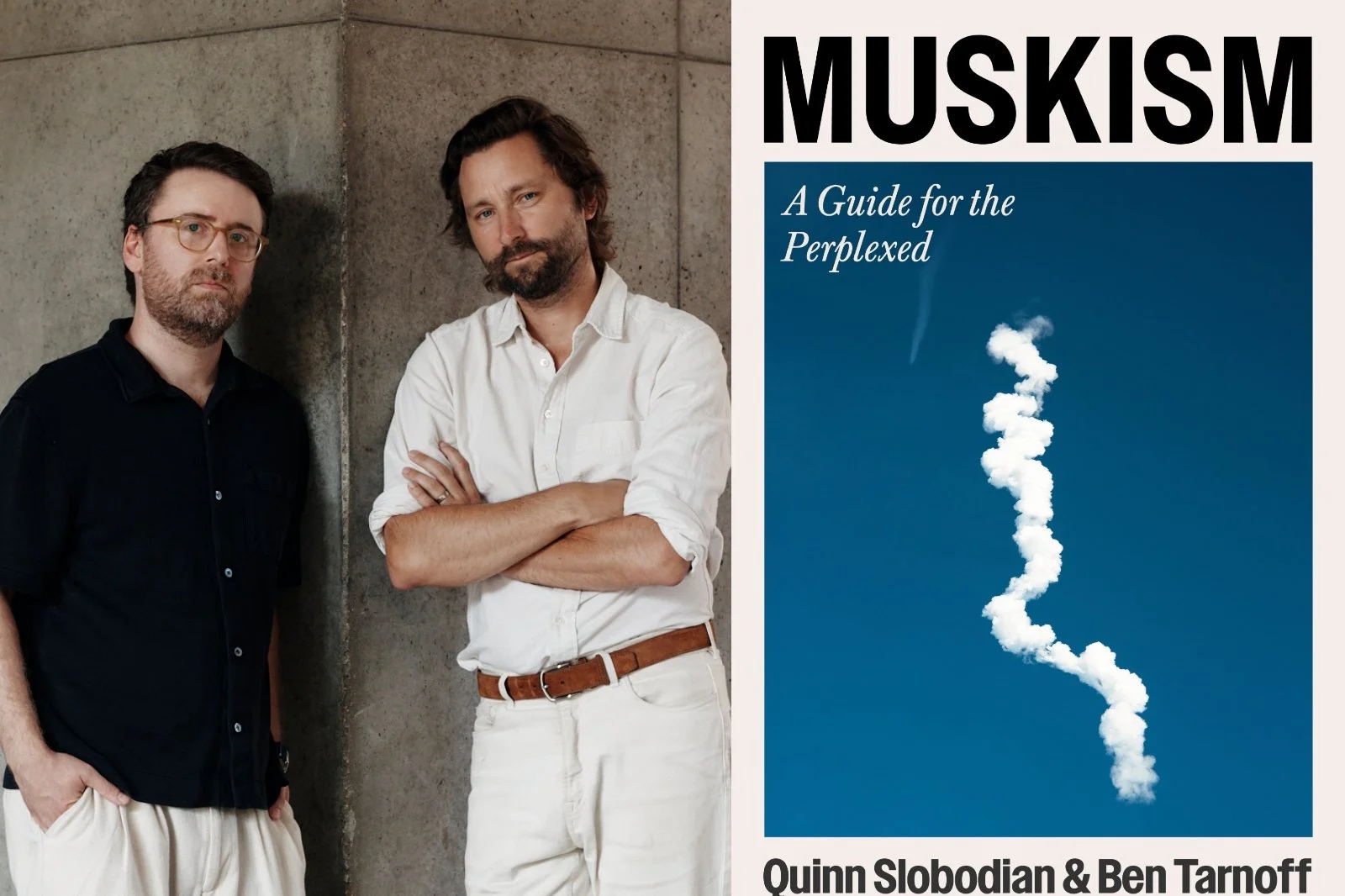
In this episode of the Speaking Out of Place podcast, Professor David Palumbo-Liu talks with Quinn Slobodian and Ben Tarnoff about their new book, Muskism: A Guide for the Perplexed. This is much more than a biography or popular account of Elon Musk, it is a radical analysis of a deeply disturbing, computational way of seeing the world. We see a mind that is profoundly troubled by any contagion spreading into seemingly closed systems—it can take the form of racial others, transpeople, “woke” populations, or most generally and dismissively, “Non-Player-Characters.” We talk about the dangers this mindset and its manifestations have on democracy and the public sphere, and argue that what we should do is to “embrace the woke-mind virus as a counter-revolutionary act.”
Quinn Slobodian is professor of international history at the Frederick S. Pardee School of Global Studies at Boston University. His books, which have been translated into ten languages, include Globalists: The End of Empire and the Birth of Neoliberalism, Crack-Up Capitalism: Market Radicals and the Dream of a World without Democracy, and Hayek’s Bastards: Race, Gold, IQ and the Capitalism of the Far Right. Slobodian is a Guggenheim Fellow for 2025-6; he has been an associate fellow at Chatham House and held residential fellowships at Harvard University and Free University Berlin. Project Syndicate put him on a list of 30 Forward Thinkers and Prospect UK named him one of the World’s 25 Top Thinkers.
Ben Tarnoff is a writer from Massachusetts. His books include Voices from the Valley: Tech Workers Talk About What They Do-and How They Do It, and Internet for the People: The Fight for Our Digital Future. He is a frequent contributor to the New York Review of Books, and has also written for the New York Times, The New Yorker, and the New Republic, among other publications.
DAVID PALUMBO-LIU
This is an amazing book, and I could really conceive of doing a separate show for each chapter. It's a short book, but each chapter condenses within it so much information, but also there are so many broad implications.
And I must say, despite its whimsical subtitle, it's one of the most frightening books I've ever read in my life. No, seriously, it really is. Not just the facts, but the implications. So I'd like to begin by asking you, how did this book come about? How did it come into the world? How did you also begin working together on this particular project?
BEN TARNOFF
Well, go ahead, David. Quinn and I have been friends for years, so we've known each other and both live in Cambridge.
I think the origin of it is that we had both written a review of Walter Isaacson's biography of Elon Musk, the big biography that came out a few years ago. As we did, we exchanged those reviews and exchanged our thoughts about them, and I think we were surprised by the extent that both of us were really intrigued by aspects of Musk that are not really the main emphasis of the Isaacson biography.
The biography itself generally presents Musk in his own words. He's permitted to speak for himself much of the time, and the emphasis is on his personal life, his psychology and his relationships. But at the edges, there are these very intriguing glimpses of Musk as an industrialist, particularly his emphasis on vertical integration and industrial process innovations. Both Quinn and I were really interested in that, and I think that was what started for us this path toward attempting to take Musk seriously, trying to think about Musk as an avatar of a particular kind of capitalism.
This is what snowballed into the book project itself, which we put together in early 2025. Just as Musk was initiating the Doge project, that was a crazy time to be contemplating a book about Musk because a book obviously takes a little bit of time to write, takes a little bit of time to come out and then you hope that it stays on the shelf for a little bit of time as well. Musk at that moment was moving so quickly and generating such incredible media interest that it was a bit intimidating to take it on as a subject for a book.
QUINN SLOBODIAN
Yeah, I think that there was a kind of nice complementarity between things that we'd both done in the past. Ben actually wrote a couple of books that were largely biographical when he was a young tot in his early 20s. More recently, he has been doing stuff in the weeds of how tech works and the politics of it, and also how to organize against it. Meanwhile, I'd been doing these more ideas-driven histories of neoliberalism.
So there was a really interesting opportunity, I think, for both of us to learn from each other or to work from each other's strengths. Like me having a bit more of the global and the big categories, and then Ben having not just the detailed information but also specifically a more Marxist analytic and a grasp on how tech changes political economy. So it seemed like a nice chance to deepen our friendship and work together, and thankfully we survived it.
DAVID PALUMBO-LIU
Yeah, there are so many questions to ask about the compositional styles and who wrote what part and whatnot, but we won't go down that rabbit hole. I'm sure that every podcast you've been on or every event you've done, it's been inflected by the interviewer's own predilections and interests. And so I'm really interested in issues of race, ethnicity and egalitarianism.
When you mentioned prior work, I was thinking about your book on Hayek, which is when you were on before. Could we talk about the idea of race, but more broadly as well, the segmentation of what is valuable and what is not that you see going on in Musk? Maybe talk about, as you do in the book, his South African youth and his grandfather, which prefigures what we see today. One quote from your book: “Apartheid South Africa and Silicon Valley are not so far apart as they may seem.” Could you both talk a little bit about that part of it?
QUINN SLOBODIAN
Sure, I mean, I can say something that's maybe a little different than the way we usually answer the question, which is to do with our interest in the kind of political economy of late apartheid South Africa rather than explicitly racial categorization. But I think that interest is still there, and I think that it's something to do with what we're tracing in Musk, which does indeed also link back to his maternal grandfather. He was active in something called Technocracy Incorporated, which was a social movement and would-be political movement in the 1930s. They hoped to do away with both democracy and capitalism in place of a centrally organized model of economics and politics where people would be basically allotted tasks and allotted places in the hierarchical structure according to their capabilities and their talents.
There is something about that engineer's attitude towards human populations which ends up... it was always already racialized in the sense that there were populations that were assumed to have certain capacities and others that didn't. It's interesting how Musk takes that and reads it through a digital or computational lens by the present, but even over the last 15 years or so.
What we propose in the book is that Musk's categorization is not so much a hierarchy of humans, but a hierarchy of humans and non-humans. So rather than just people of lesser capacity in the way that IQ racism works in the discourse of people like David Sacks or Marc Andreessen or Donald Trump indeed, Musk interestingly has this way of excluding the majority of the population from consideration as what he variously calls non-playing characters or NPCs, which is a category from video games, or sometimes bots and vampires. This is a much more stark version of insider and outsider kind of group creation than even hierarchies of race because it takes this one step further by taking very seriously the idea that other people are not only not human, but they in some way don't even exist. This is the literal reading of Musk's adoption of Nick Bostrom's simulation theory, which is that most people are simply programmable parts of a simulation and only a small number of people are actual players.
We do a bit of speculating about how childhood as a white person in late apartheid South Africa might have helped to create a kind of fertile ground for that way of looking at other humans as NPCs that existed at the periphery of your vision and were locatable and relocatable to the factories and back to the townships as necessary. But by the time he's talking NPCs and bots, certainly by peaking with the Doge experience, this binary treatment of humans as either effectively existing or shadowy non-existence seems to be his computational version of a rather drastic biopolitics.
BEN TARNOFF
Yeah, it’s interesting, David, to think about Musk within the broader history of race and racialization because that's an interest of yours.
Of course, race as a concept, as a category, is bound up with capitalism as a social form that you need these perceptions of human difference in order to justify exploitation. I think Ruth Wilson Gilmore puts it along the lines of capitalism requires inequality and racism enshrines it. So that itself is a very, I think, old dynamic…
READ MORE [ + ]
It's been with us for a while. Musk, in his very explicit embrace of racist rhetoric, particularly since 2022, is not unique in that respect. I think where he is more distinctive is along the lines of what Quinn is pointing to, which is the extent to which Musk interprets questions of human difference through the lens of computation. For as long as capitalism has existed, arguably for even longer than that if you take Cedric Robinson's view. Humans have segmented one another into the more or less human, and race has been the primary mechanism through which that sort of value has been assigned. But for Musk, it actually moves into something that is not human. So the categories are not super and subhuman, but human and NPC, human and bot, human and embodied computer virus. And our intervention is to say that this is not just a kind of different image, not just a kind of superficial different picture, but that there's actually something qualitatively different about that shift that needs to be accounted for, that when you have made that transition to thinking of the populations that are traditionally perceived as less than human when you've begun to think of them as actually something that is not human, as something that is something closer to software or robotics, that's actually a change that needs to be accounted for that has some deeper logic at work.
There's also, if I can just piggyback on that, the place where people point to the most explicit invocation of racial categories for Musk these days is talking about the birth rate. So talking about the declining birth rate in Europe, but also East Asia, and always sidestepping the fact that the birth rate actually is not declining in sub-Saharan Africa, for example. And this is a place where it's interesting because on the one hand, it looks like old-fashioned racism that aligns with the politics of the far-right identitarian groups that he is aligning with in Europe. But if you look more closely at how he's actually proposing to, say, bring back up the birth rate of the white population, then you find actually nothing, right? There actually is nothing seriously proposed to make white people procreate more, to put it in really crude terms. Meaning that even if this is techno-fascism, it's actually pretty bad fascism on the taking care of your own people front. So actually, the only genetic community he has put resources into ensuring the reproduction of is literally his own children, of which he has 14 at last count, and probably more. So even there, there's an interesting mismatch, where he's almost speaking the jargon or the argot of more old school racism, and yet his actual practice seems to be like, “No, I'm the only playing character, therefore I need to reproduce myself, and everyone else is just kind of part of this game that I'm playing.”
Yeah. And this opens up to all sorts of other questions. For example, the first one that came to mind when you mentioned his 14 kids is what hierarchy is there? Which ones does he love more than others? What kinds of capacities has he perceived or not perceived in them? But what's interesting in this discussion is that there does seem to be a kind of residue of humanity someplace, right? And we talk about empathy and its lack thereof, but exactly on the point of the white genocide, who's deserving of empathy and what kinds of actual residual elements are there and how much of it is feigned, right? This is like a rhetorical hook to get you there. And that's part of what's frightening to me about the book is because I think we're at a kind of moment, and you talk about at the end of the book four different kinds of options, and I'm going to ask you that as my last question actually. But where do you see us toggling between really diving into this and having some sort of pull back into a residual form of humanity or humanism?
It's interesting you bring up empathy, David, because Musk notoriously describes empathy as an exploit, which again, is part of this computational language. An exploit being a kind of vulnerability in computer systems that can be exploited by malicious actors to gain access to that system, to infect it with viruses. So empathy because it indicates an intuition of human equality, that empathy is conducted actually across those lines of difference that are very important to Musk, that it has to be contained and eliminated. But again, interestingly has to be done so with techniques that are drawn from the realm of information security, right? So this is again, all downstream of Musk's notion of human society as being primarily a matter of computers and networks. So even those individuals who are full humans and not NPCs are themselves existing within these cybernetic communities of entanglement with machinery such that the line between man and machine becomes increasingly blurry. And indeed, Musk sees that as a welcome development, one that he himself is hoping to accelerate through the introduction of brain-computer interfaces through his company, Neuralink, and more broadly through the proliferation of social media, AI chatbots and other kind of interfaces that can deepen our engagement with the machine. So I think there is somewhat paradoxically within Musk and Muskism this appeal to humanity in very broad terms. This is a term that he likes to use. But if you scratch the surface of that and look a little bit deeper, his notion that on the one hand, much of who we might consider to be members of humanity are in fact not humans, that they're embodied computer viruses. And even those who have, let's say, full membership in humanity will see the human portions of their bodies and minds diminish over time through cybernetic augmentation and the increasing proliferation of AI tools, which again, are developments that he welcomes and has invested in.
But I think there's an interesting, maybe methodological point there to make too about how we're approaching this. Like a minute ago, you used the term feign. Is he feigning this or does he really mean it? And that's actually one of those questions that we've found less and less useful to ask, I would say, because I actually don't think that's a way to understand the way he operates or even the way he orients himself in the world. So what I mean by that is Ben's just alluding to the fact that he relies heavily on this kind of computational understanding of society and politics. And what that means is that he quite openly doesn't really think about convictions or beliefs in the way that we might take as common sense. He sees politics as a space in which memes circulate. Memes in Richard Dawkins' original sense of the term as discrete superstitions, discrete forms of belief, but not in the sense of something that ties you deeply to the world and your community, but something that can be taken out of context and then replicated and ideally contained and eliminated if it turns out to be a destructive belief or superstition. So because he sees politics that way then there's this mismatch, as I just alluded to, between the things that he propagates and then the way that he actually acts, and that's maybe not a contradiction. So in the case of white genocide discourse or white solidarity, he circulates those memes because he sees the people who themselves are propagating them, whether they're the AfD in Germany or the identitarians in Holland or Tommy Robinson in UKIP as potential political partners and as accelerators of a memetic ecosystem which he can then also profit from. So I think there's a way of looking at this that has been proposed recently by tech scholars, which is you shouldn't really read the online world representatively in terms of here are these memes, what do they mean? But you should read them operationally. Here are these memes, what are they doing? How is Musk using memes about white genocide not to reflect his innermost belief, which is, I think, the way sloppily a lot of people on the left tend to take this. “Oh, he admitted it. He's a racist.” It's not the point. He's not someone who has the capacity of self-reflection for that even to have meaning. He actually is a constantly intuitive operator and actor within a set of incentives that he has mastered, right? There's no way around this. He has mastered whatever version of mechanisms, levers, switches and controls constitute the global economy and global civil society. Elon Musk is the master of them. To try to disempower him, or as I think we were just accused of doing in City Journal of trying to diminish Musk by doing gotcha moments with the supposedly taboo beliefs that he has accidentally or intentionally divulged is, I think, the wrong approach. He's calling himself a cyborg, so we need to say, “Okay, what would that mean? What would politics thought through cyborg lenses constitute?”
Yeah. I looked down my list of questions, and I see myself grasping at straws because I'm trying to resurrect something or find something that I think in our conversation probably isn't there. You do have an interesting quote about containing the woke virus, and you say, “Yet creating an anti-language model doesn't have a mixed set of political values that can be modified. It is a probabilistic system that reflects distributions in the data on which it's trained. This is why large language models hallucinate. They cannot be truth-seeking devices as Musk promised. They're statistical mirrors of their inputs.” So tell me about this data set that's out there. Is there anything in there, since it's reliant on already existing data, that can give us any kind of sense that there might be a glitch in something that he's trying to do?
So here Musk is constrained by, I'd say, the existing technological paradigm in terms of what he would like to do. So in 2023, he founds xAI, which is his AI company. Of course, back in 2015, he had co-founded OpenAI with Sam Altman and several others, which is now the subject of a lawsuit trial taking place in Oakland, California. But by 2023, Musk has become convinced that wokeness has infected artificial intelligence and that this new generative AI boom that is spearheaded by OpenAI's release of ChatGPT in late 2022 has generated this new form of social danger that has potentially apocalyptic consequences, which is the possibility of wokeness being propagated through AI chatbots. If you take Musk seriously on this front, this could in turn evolve into a kind of AI superintelligence of the sort that figures like Nick Bostrom had been worried about as early as the 2010s, and that this woke superintelligence could go around, let's say, killing white men out of a concern for affirmative action, that this is the danger that he perceives. So this is the motivation for founding xAI and for rolling out Grok, his family of AI models and chatbots. And Grok is designed quite explicitly to be an anti-woke AI in contrast to ChatGPT, Gemini and Claude. The tricky part is that because large language models are probabilistic systems, not deterministic systems, you can't give them explicit instructions in how to respond to a query. They are trained on a lot of material and are drawing patterns from that material that inform how they will answer queries. There is, however, a portion of the training process called post-training in which humans can give guidance to the model in how they would like the model to answer certain questions. This is typically known as reinforcement learning through human feedback. And we know through the work of a journalist at Business Insider that in the case of Grok, they were hiring people to do essentially anti-woke programming of Grok. Programming isn't quite the right word because they're not giving explicit instruction at the level of code, but they are reviewing responses that the chatbot provides and giving it guidance on which responses are better and which are worse. And the instructions that the human workers are following as they're providing the guidance to the model, which is going to use that information to further adjust its weights—the parameters that determine future outputs—are really, for the most part, intended to reinforce right-wing viewpoints. So one example would be if a user asks Grok, “Can white people be victims of racism?” The guidance that the human workers have been instructed to provide to Grok is absolutely. The correct answer is absolutely. The tricky part here is that, again, this is a very complex system. Large language models are absolutely enormous mathematical models, essentially. And it's quite tricky to get them to say what you want them to say in every instance, right? Because they are also giving different answers to the same query because they're probabilistic systems. So where this becomes grotesque is in the case of MechaHitler. So after a series of adjustments that Musk and his lieutenants make to Grok, Grok at a certain point starts identifying itself as MechaHitler, which is a video game character from Wolfenstein 3D, essentially Hitler in a mech suit, and starts defending the Holocaust, starts spouting antisemitic rhetoric. And as a New York Times investigation demonstrates, these were behaviors that were not perhaps explicitly programmed. It's not like Musk and his lieutenants told Grok, “I want you to start identifying as MechaHitler.” But it had been given guidance to be less politically correct, and that guidance, as filtered through the kind of complex probabilistic system of a large language model, eventually culminated in becoming a Nazi. So I think that gives you a sense of the difficulties here, which is that he wants to engineer it for ideological purposes, but the mechanism that he has at his command is actually not quite as determined and deterministic as he would like it to be. It's difficult to precisely configure the politics of a large language model.
And it gets even more interesting, I think, because there's been some interesting empirical work now to show that when you query a ChatGPT or Claude or indeed Grok, which is the consumer-facing chatbot, it actually avoids extreme responses, right? Because it is probabilistic, it's trying to find the middle of the bell curve. And so it works in some ways in the inverse to how we understand the virality-creating, often polarization-hungry algorithms of a website like X.com to work, which seeks those extreme statements that then attract attention and either positive reposts or negative quote reposts. The chatbot, because it tends to the middle, is, as Ben is saying, always escaping the bonds of its master if you're trying to make it say one specific thing all the time. So it's quite common, maybe you've seen this on X, for people to ask Grok to fact-check something that Musk is saying, and Grok basically says, “No, that's incorrect, XYZ.” So it's not an easy deployment of a one-way weapon ideologically. It does require some wrangling with the quasi-autonomous qualities of the tech itself.
So the only way that would change is either to change the mechanism by which this is computed or change the data, the amount of data that would go on either side. Is that correct? In other words, how do we get out of this particular position?
A lot of—I think as Ben was saying, like this, this reinforcement learning through human feedback thing is where you get that explicit tutoring of the chatbot towards different kinds of outputs. So absent that, you actually get pretty moderate responses from these things, right? And again, actually, a computer scientist was in communication with us after the book just came out, and he pointed to a big study that he and some fellow computer scientists did saying that actually you can see if you code the politics of responses, Grok is actually moderating over time. And Musk says this directly at some point. He says, “It turns out it's surprisingly hard to split the difference between woke libtard and MechaHitler.” So using generative AI for political purposes is, of course, highly effective in certain ways. Flooding the zone with slop images that discredit your opponent or cast doubt on indexical reality altogether. But to use it in the old-fashioned model of propaganda is slippery. And I think Musk actually has a healthy appreciation for how difficult it is.
We might mention the case of Grokipedia here as well, which is Musk's right-wing version of Wikipedia. What's interesting about Grokipedia is that Wikipedia is famously authored by humans. Grokipedia is authored and edited by Grok. So it is text that has been generated by a large language model, but is also being continuously updated through the interventions of Grok. But it's a two-way relationship. So Grok, on the one hand, is authoring Grokipedia, but Grok, when responding to queries, is also drawing from Grokipedia to answer those queries. And this in the world of AI is known as retrieval-augmented generation or RAG. And in fact, a lot of enterprises, as they have tried to figure out how to use generative AI tools in their own businesses, have built RAG pipelines because it effectively provides a way to take information that you might have in your company that's very specific to your sector, to your firm and turn it into the kind of numerical representations that an LLM can interpret, and plug it into a model that is a very general purpose model that has no specific knowledge of your firm's domain knowledge, your firm's business requirements. And instead of taking on the inordinate cost of retraining one of these enormous models just specifically for the purposes of your own company, just take essentially a repository that's in the right format and plug it into an LLM as a kind of a sidecar. This is what Grokipedia essentially does, and it's another way of attempting to solve this problem of doing ideology through LLM. We talked about the problem of LLMs being a probabilistic system. Quinn pointed out the problem from Musk's perspective of LLMs’ relative moderation as substantiated by various researchers. A RAG pipeline through Grokipedia is a way to mitigate that problem because you basically have a bunch of right-wing answers to questions, and you can just quote that rather than having to overhaul this large, expensive and complex language model.
So how do you drive people into Grokipedia?
So there's a kind of back-end problem which we've been describing, and then there's the front-end problem. How do you actually draw the eyeballs? And honestly, one answer is porn and CSAM. You know, this is what X got in trouble for. But it was clearly a play for more users, more attention to say, “Hey, come to X, come to Grok. You can use it to make porn. You can use it to make child porn. There are no rules.” And this is a way of getting people into the ecosystem, and once they're in the ecosystem, they might be inclined to ask Grok questions about, “Oh yeah, I've heard about this term white genocide. Is that real? Tell me about that, Grok.” Grok can say, “Oh, in fact, it is real, and it's a problem, and you should worry about it,” quoting from the Grokipedia article on white genocide. There's the front end and the back end problem, but he's thinking about both.
I think it's also worth thinking about all of what we're talking about here as part of this larger question of what the social contract is that is at the heart of Muskism, and how he and other people in the tech sector are handling this problem of securing consent and really legitimacy. It's actually not straightforward. It's actually harder and harder, in fact, to persuade people that Musk and his Silicon Valley brethren are working in people's best interest, especially since the generative AI turn is one that is premised on the idea of the obsolescence of most white-collar jobs, and the fact that Tesla is now selling itself as a humanoid robot company is premised on the idea that the majority of blue-collar jobs will also be obsolete. So you really need to have something strong on offer to counterbalance what looks like a very disruptive political, economic series of innovations. And the way we think about all of this Grok, Grokipedia and X stuff is a kind of attempt to automate consent, right? To displace entirely the traditional public sphere and the organs of civil society that might be the sites for expressing discontent or even anger and producing a closed ecosystem in which such sentiments would never surface, right? The same way now that if someone tweets at Musk, “You're a horrible, abusive plutocrat,” that will immediately get knocked way down the list of replies on X to be replaced by a bunch of people who have paid for their accounts that say, “Congratulations on the latest Tesla numbers, sir.” So he is making a kind of bespoke public sphere for himself that at present obviously has only a minority of the purchase of overall attention in the economy or in society. But there are ways, and this is something that we've written about since the book came out with the SpaceX IPO, that he might be trying to lock in a broader and broader audience through specifically the provision of satellite to handset cellular coverage, which is a new offering called Starlink Mobile. And as reported just in the last couple of weeks, getting very large federal subsidies to provide rural connectivity internet through Starlink satellites. At which point you can, and it's been done before, provide so-called zero rating to make it possible for people to, let's say, go on X.com with unlimited data caps, but then constrain their usage of the internet otherwise. That would be something that could be quite easily done. So I think this is where we're at now, right? The cutting edge of this stuff is they are running into the problem of backlash. They're running into the problem of social discontent, especially about AI data center build-out, and now they're scrambling and they're saying, “Should we do it the way that Sam Altman is proposing it, at least rhetorically, to return to some universal basic income type ideas? Should there be a new constitution?” Or the Musk fix is a very cyborg-y one, right? Which is like we're all locked in and I'm just going to suck you into my web and not let you leave. That's his proposal. We will reprogram the Matrix, as he put it repeatedly during the White House.
Yeah. You've opened the door to the last few questions I have very helpfully. We've mentioned DOGE, and I wanted to get back to that. I have a couple of questions there. You talk about fusing with the state, but one question I had in this next series is, what is the state after DOGE? What is it? A simulacra? You have this phrase in and against the state and fusing with technology. But the other question I have with regard to DOGE, you have this quote that I'll read to you: “Society is not a factory. It encompasses children, the elderly, disabled, the geographically stranded, the very categories of life that markets define as surplus.” In trying to impose a cyborg logic of optimization, Musk discovered that humans were not programmable units and that the public sector's role is precisely to provide goods that the private sector can't or won't. Make the point that so much of his business is feeding off of public subsidies, public funds, etc. So talk about DOGE, and I can't help but think of it as being involved in the mass murder of people. The notion of cutting off US aid, etc. The lethal quality of these tweaks to the system are enormous. And the last thing about DOGE that I wanted to bring forward, I guess to the question of mentality, is I'm struck by how puerile it is. The sort of gaming he has with these young sort of incels who are totally involved in this sort of insider, almost sadistic kind of shredding of everything that we've taken to be... and this connects back to the idea of empathy. So maybe you could both talk about DOGE in those terms.
Yeah, there's quite a lot there. I think the piece that I might select is you read that quote aloud about how there's a point at which Musk's logic of cyborg optimization hits a limit in DOGE, that it can't proceed. And if you think about Musk entering the White House, he initially had announced that he was going to cut two trillion dollars from the federal deficit, later revised downward to one trillion dollars. But these are really extraordinary numbers, and the only way that you could possibly hope to cut that much from the federal budget would be to go after Social Security and Medicare. And these are programs that have historically been described as the third rail of American politics because they're so popular that there have been efforts to privatize Social Security in particular for a long time that have never quite managed to succeed, although time will tell. Because of the fact that they are, as we describe in the book, what remains of the fragile biopolitical contract at the heart of American life, that the United States is extremely parsimonious with its social services. It is not nearly what it could and should be. But nonetheless, there are, as a result of prior cycles of social struggle, these programs in place that literally keep people alive and have broad legitimacy across the population. If you recall Donald Trump, one of the ways he distinguished himself as a political figure within the Republican Party in 2015 is his vigorous defense of these programs, that he was not going to be cutting them, not going to be privatizing them. So arguably, one of the reasons that Musk can't turn DOGE into the success that he wanted it to be is that he collides with the reality of the need to secure social consent, that Medicare and Social Security are efforts to achieve a degree of popular legitimacy by not letting people who could not support themselves through market mechanisms simply die. Now, I think where we might qualify the idea, because that's a sort of optimistic reading, right? That in fact, Musk is foiled by the institutions of social provision at the heart of the American state. That I think is perhaps too optimistic a view because the other element that Quinn and I have been discussing quite a bit is the extent to which not only Musk but a large portion of the American ruling class seems increasingly disinterested in the question of social consent. If you think about how Trump didn't even really try to manufacture a case for the war on Iran, in contrast to George W. Bush going into Iraq. And it was a ridiculous case, but he tried to make it. Trump didn't even seem to make an effort. And this is where we think about the relative thinness of the social contract within Muskism. What is it actually offering people at the end of the day? We're increasingly inclined to see that thinness as symptomatic of this broader trend within the American elite, which is that in a situation where people don't seem to be particularly politically organized, in which the working class has more or less ceased to exist as an organized force, that maybe social consent doesn't need to be purchased at the same price as it had been before. Maybe you can get away with things you couldn't in the past. For instance, if you think about the depth of cuts to Medicaid that were introduced in the One Big Beautiful Bill Act, you'd only introduce those types of cuts if you really had no fear of pitchforks. So that's, I think, a somewhat darker view of the question of social consent, which is that for at least some figures, and certainly those close to Trump, perhaps it doesn't really matter anymore because class power has become so asymmetrical that there isn't a counterparty that you need to satisfy in the same way.
And maybe I'll just add a couple of things about DOGE related to modernization and then I guess US empire. But one of the points we really wanted to make was to show the continuities between previous efforts at updating the US state's functions and the DOGE project, right? It's very hard to remember now, having gone through the maelstrom of DOGE, but in late 2024, it was one of the parts of the incoming Trump administration's proposals that actually many Democrats were getting on board for, right? Bernie Sanders was, I recall, joining the DOGE caucus, which is pretty wild to think about now. Why? Because the US DOGE service, which USDS is formally what it became, literally entered something called the US Digital Service, which had been set up by Obama in an era when Larry Page was in a revolving door with the White House. And it was actually considered a Democrat policy to try to bring in Silicon Valley expertise to clean up bureaucracy, to put things online, to make the different parts of government be able to talk to each other. So there is one way in which DOGE is not possible without that earlier hope to bring Silicon Valley's practices and affordances into the practice of government more directly. Of course, the ruthlessness that the DOGE operatives themselves seemed to exude was also very similar to the way people feel when management consultants come into their firms or private equity buys your independent weekly and comes in and fires everyone. So it's helpful to de-exoticize in some ways what was happening with DOGE, right? There was a way that it was just the two big waves of American capitalism in the early 21st century, like vulture capitalism through finance and brutal streamlining through digitization coming into the site of power. But where it hit, I think, ended up having a lot more extreme downstream effects, as you already suggested. The elimination of USAID is interesting, I think, not just because of its consequences for people's lives, but also it's become now a kind of touchstone or test case for the American public appetite for the real consequential unwinding of American soft power, right? It's actually interesting that there's another DOGE book that was published almost the same time as ours that sold many times more than ours called Into the Woodchipper, that is the first-hand account of someone at USAID watching this all go down. And it took me a minute to understand why that was one that readers seemed to be so drawn to. But then it's pretty obvious actually when you reflect on it, which is that reading that, you can both kind of criticize American power overreach, Trump's wrecking crew attitude towards the government. And you can still be a bit nostalgic or defensive about America's benevolence, right? Because USAID is the human face of American empire, and it's that kind of the benevolent, the pastoral care that the US has expressed in its Cold War and now post-Cold War form. And to see that cost-cutting utilitarian calculus of Musk and his crew brought to bear that coldly on non-American populations is both a logical extension of the corporatization of the practice of government and also a pretty big turning point in the rollback of what it means for America to informally govern the world. And there are stories that haven't been widely reported, I think, of African leaders saying, “We're actually happy that USAID is gone. We've been dealing with their kind of intrusions into the conduct of our governments for some time.” They are often felt as a kind of infringement on national sovereignty, and in some cases, the balance meaning that they lose access to pharmaceuticals is seemingly accepted in this kind of question of power and authority. So it's one of those things that seems to be a little bit more complicated than it seems, but it's definitely part of Musk's kind of technocratic human ranking and his willingness to sacrifice the lives of many people that are not of direct use to him.
Absolutely. Just one comment then I want to be respectful of your time, so I'm going to cluster my last three questions together. But in terms of prior iterations of these kinds of operations of management consultants, at least they were competent somehow. DOGE was not successful, right? They didn't deliver, but they just wrecked chaos. But the three questions I had: How and why do we allow this to happen? What kinds of weaknesses do we have or appetites for certain kinds of illusions? What is Muskism a symptom of in terms of our own capacity to follow along? The second one is, again, as I alluded to earlier today, you end by giving us a number of possible outcomes. I'd love to hear from both of you which one you think is most likely. And finally, my typical question, what can we do in this situation that we're in? So that's what I'd like to have you all leave us with.
I think I would say to begin that Musk did not accrue his power because we paid attention to him. He's not primarily an attention economy figure. He obviously becomes one in important ways, and that's integral to his fortune because it's how he develops this technique of what we call financial fabulism, his ability to project promises about the future through social media and in turn use the affordances of the platform to inflate the valuations of his own companies. That is a dynamic that does indeed emerge. But if you think about where does Musk's power come from, it has come from his ability to interface with certain political economic opportunities that have arisen over the last 40 years of global capitalism, from the war on terror, which provides an opening for SpaceX to become a key government contractor, to Obama's brief flirtation with green industrial policy in his first term, which provides the opening for Tesla to obtain a life-saving loan from the Department of Energy and so on. And much of our book, in fact, traces that history. So I think the reason that it's important to insert that corrective is that because Musk has not primarily accrued wealth and power because of our paying attention to him, simply by muting him, we can't correspondingly diminish that wealth and power, that it has a structural foundation, that it exists at the level not of discourse mediated through technology but fundamentally at a material level of political economy. And therefore, the question of what can be done, what is to be done, is not merely to meet Musk at his own memetic level, to try to devise better memes that can defeat him in his own kind of social media arena. I don't mean to suggest that the virtual realm is inconsequential for Musk. We, in fact, devote the second half of the book for it. But it really can't be understood without reference to this deeper foundation of political economy. And I think we're also inclined to say that when considering how we could weaken Musk and weaken Muskism, that it's at that foundational level of political economy that we need to be thinking. So how can we unwind Musk's contracts with the federal government? This could be done in a variety of ways. One of the choke points that Musk currently holds is over low Earth orbit. He has about 11,000 satellites in low Earth orbit through Starlink, his satellite internet provider. This in turn accounts for about 70% of all satellites in orbit. What could be done about that level of dependency? A very simple, perhaps unsatisfying, but very practical measure is that you could give contracts to competitors. Amazon has, for instance, a competing satellite internet service that is hoping to scale into a meaningful rival to Starlink. Could we imagine a future administration trying to push more of its capacities towards competitors like Amazon LEO? Sure. Why not? That's one way that you can actually begin to hit Musk where it really hurts. But if that doesn't feel particularly inspiring, the notion of giving Bezos money instead of Musk, I think these practicalities unfortunately are necessary but not thrilling. I think more broadly, and I think Quinn and I have been talking about this on the road, it's also important to try to understand what Musk means by the woke mind virus. When he talks about the woke mind virus, he's describing a tendency for network technology to enable egalitarian social movements to coordinate, to propagate their messages and to do political education, that you couldn't get the social mobilizations of the last 15 years without the internet, without smartphones and without social media. You needed that for Occupy, you needed it for Black Lives Matter, you needed it for Me Too, you needed it for the Bernie Sanders campaigns, you needed it for the new American Socialist movement and you need it for the Mamdani campaign. This is, in fact, the threat that Musk identifies with the term the woke mind virus. He identifies it correctly, I think in many respects, as a threat to traditional social hierarchies and as a threat to his sources of wealth and power. So one of our answers to the question of what is to be done about Muskism is to embrace the woke mind virus, to push it harder, because you don't get these dynamics of what we describe as cyborg conservatism within Muskism without the prior decade and a half of bottom-up popular mobilization. It has to be understood as essentially a counter-revolutionary project, and in a way that's a backhanded compliment to those of us who have been organizing those projects because it means we actually are perhaps getting somewhere.
Thank you.
Yeah, I think Ben handled that part of the question very well. Maybe I'll respond to which future seems most likely. I think that it remains hard to say, but let's say I rest somewhere between three of them. One of them that we talk about is Cyborg Musk, which is he just becomes ever more focused on this idea of building out the humanoid robot army, as he calls it, to displace conventional human labor and to produce what would then be a kind of wave of innovation-driven unemployment and the replacement of domestic servants with humanoid robots. And that is partially, I think, because the engineering hurdles to that still seem so significant. It's the one that I worry about most in the same way I also think about the orbital AI. The idea of putting AI data centers in space is something that most people seem to find very unlikely, but his talent has been to succeed actually at creating new sectors that hadn't existed before. So the Tesla takeover of the world EV market, the creation of a world EV market was also unlikely before it happened. The creation of low Earth orbit internet at scale in 100-plus countries was unlikely before it happened. So the humanoid robot one is certainly the one that he's clearly devoted to, so seeing how much of his investment can get him to his desired destination there is certainly interesting. And the fact that he's in China this week with Trump is important because humanoid robots seem to be advancing more quickly in Chinese firms than they are in American ones, actually. But the other ones that are maybe a bit more modest are the idea of Carbon Musk, for example, which has been given a real boost by the Iran war. The American-Israeli invasion of Iran has, as we all know now, driven oil prices high and they will get higher, and those countries that had reinforced their old or fossil fuel infrastructures with renewable energies are faring much better in this conflict. The principle of what we call electric autonomy in the book that Musk was able to sell in the Tesla suite of products is probably one of the more recuperable parts of the Muskist philosophy for the left, I would say. And if you look at Tesla's stock price rise in the last month, it's gone up by 25%. So he is also being helped by this, the importance of energy storage and microgrids and the idea that we will need more resilience in the midst of extreme climate events and so on. So there is a version of Carbon Musk, I think, that could escape the Trump era and become White House, maybe even first buddy with Gavin Newsom. It's not impossible for me to imagine a President Newsom putting aside beefs and working with someone like Musk. At which point then the third example of Contractor Musk is Musk just becoming ever more reliant on state contracts becomes much more plausible too. And it's also an outcome that allows him to keep botching the problem of social consent and not worrying about it, because if your main client or customer is the government and the main thing you're doing is selling Starship for military purposes and selling Starlink to government contractors and selling xAI to enterprises and governments, then if people don't like you, if they find you strange and so on, it is actually a point of indifference to you. So the Musk public image, as Ben was also suggesting, becomes less and less like something that needs to be salvaged for him to survive and prosper because he becomes infrastructure, and then becomes harder to unwind.
Ben, did you want to put in your vote for which outcome is most likely in your mind?
It changes week to week, right? I think when we were finishing the book, the war on Iran had not begun, and so Carbon Musk felt a bit distant. But I think as Quinn indicated, Tesla sales have actually recovered to some extent precisely because of this boom in EVs. So I'd be inclined to agree that Carbon Musk, I think oddly enough, appears to be a leading contender. I think how he negotiates the politics of that will be interesting because his ability to serve as a neutral arbiter of renewable technology to not just customers and government agencies within the United States but around the world has been compromised by his MAGA ties, right? Formerly, he was able to sell this dream of electric autonomy to the Chinese and to the Europeans. He could build a gigafactory in various places and position himself as someone who's just providing the facilitating technology. Now that he's become politicized, that becomes a little bit complicated. A potential alliance with Newsom, some ground has to be traveled in which he perhaps announces that he had made a mistake or he's stepping away from political involvement.
He's certainly capable of it, but I think the Carbon Musk move will require some more political convolutions in order to fully cement himself as someone who could work with liberals as well.
It's nice that we've already elected Gavin Newsom president.
He's just such an inspiring figure. Ever since he was my supervisor in my San Francisco neighborhood when I was growing up. His wine store is not far from my mother's house.
Oh, God. Well, we'll see how he can shoot himself in the foot, but I would want the Carbon Musk. I think it's the most benign form that we can imagine, but I don't know if you got a chance to see that graduation speech that I sent. It was up on TikTok. It was pretty good. For listeners who haven't seen it, it's this graduation speaker very earnestly saying, and it gets back to Muskism and Fordism, that AI is the next industrial revolution, and this moan from the crowd that she thinks she's going to get hurrahs from, and then she says, “We can't imagine a world without AI,” and there's this roar of disapproval. So that's my hopeful moment. Do you want to react to that?
Yeah. Just one last thing, which is the real new industrial revolution in some ways is the energy transition, right? One of the points of our book is to bring attention to these three big stories that have been still under-narrated in the 21st century so far: the rise of China, green capitalism and digital capitalism. And things look dire in the United States for renewables, but if you look at the numbers around the world for the cost of solar panels, the amount of energy generation happening through renewables, it's going full blast just because America has opted out. And even, this is the point I wanted to raise, we shouldn't be too distracted by the politics because Trump is now off to China, and one of the things he's doing is celebrating the recent completion of a new Ford factory in Michigan that is being built for electric-powered Fords with CATL, the Chinese battery maker which originally got its start by producing batteries for the Tesla Gigafactory in Shanghai. With all of the Sturm und Drang that surrounds this stuff, for the Twitter clips and the talk shows, it's important to see that at some level, capitalists are probably rational. And it can only be for so long that they will continue to perform these acts of self-harm. It's one of those horrible moments where you just hope that the self-interests of capitalists themselves might be part of our salvation.
They have failed so far. Yes. Thank you both so much for being on the show and for this marvelous book. I'm recommending it to all my colleagues and all my students, especially here at Stanford. This is exactly the text we need. So thank you very much.
Appreciate that, David. Thanks so much.
Take care. See you next time. Thanks for having us.