

Amitav Ghosh on What Connects Us in an Age of Climate Crisis
Imagining with precision is a very fundamental part of my work. When I sit down to write about anything, whether it be The Hungry Tide in the Sundarbans, or let's say The Shadow Lines, or Ghost-Eye. It's very important for me to get the topography right, to get the outlay of the streets or the house exactly right so I can actually picture all of that in my head. It's very important for me to have a sort of pictorial sense of what I'm seeing and what I'm writing about. Before I can write about it, I need to see it, as it were. So that's absolutely fundamental to my craft. That's just how I go about it. Like the Sufis say—behind the apparent reality is a hidden or batin reality. I guess that's always been something of great interest to me. How do you square these two realities and make them come together on a page? And really that is what, in some sense, the work of the imagination is. We know that we're in the grip of an intensifying planetary crisis. We can see signs of it everywhere.
In university circles, it's most of all usually spoken of in terms of the climate crisis, but it's much, much bigger than the climate crisis really. There's the biodiversity loss, species extinctions. There's just so much more to that. But even more than that, I would say the general accelerationism which brought the climate crisis about is actually steadily accelerating. It's not by any means slowing down, very much to the contrary. And that accelerationism has now actually become a credo. So we see this acceleration all around us and we can see the edge of the precipice. And instead of turning back, we are speeding up towards it.
Speaking Out of Place is produced in collaboration with The Creative Process and is made with support from Stanford University.
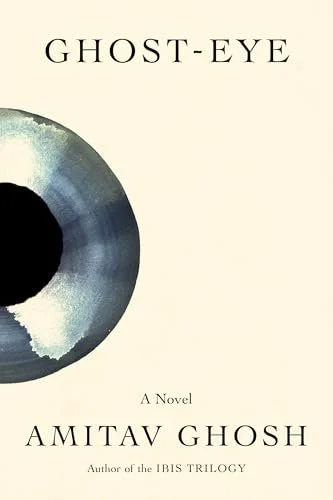
In this episode of the Speaking Out of Place podcast, Professor David Palumbo-Liu talks with Amitav Ghosh about his new novel, Ghost-Eye. The novel is about reincarnation, but also a lot more. In our conversation we talk about the need to address the terrible set of environmental and other crises we face, and the seeming foreclosure of the imagination by the obsession with technology and the future it offers to us. Instead, we look to how we can fashion beginnings out of endings, aided by a renewed sense of wonder, curiosity, and awe. We turn to the body, to the haptic, and perhaps most important, to food as more than simply nourishment. In all this, story-telling, the revival of connections between living beings, and a deep sense of other times and places are central.
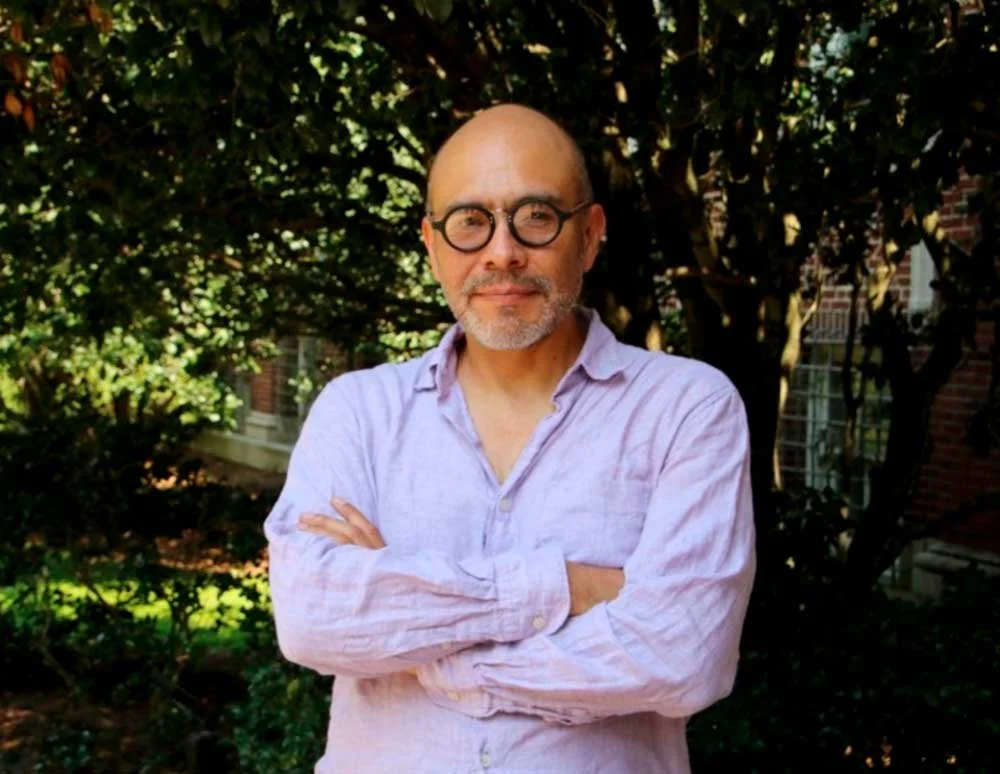
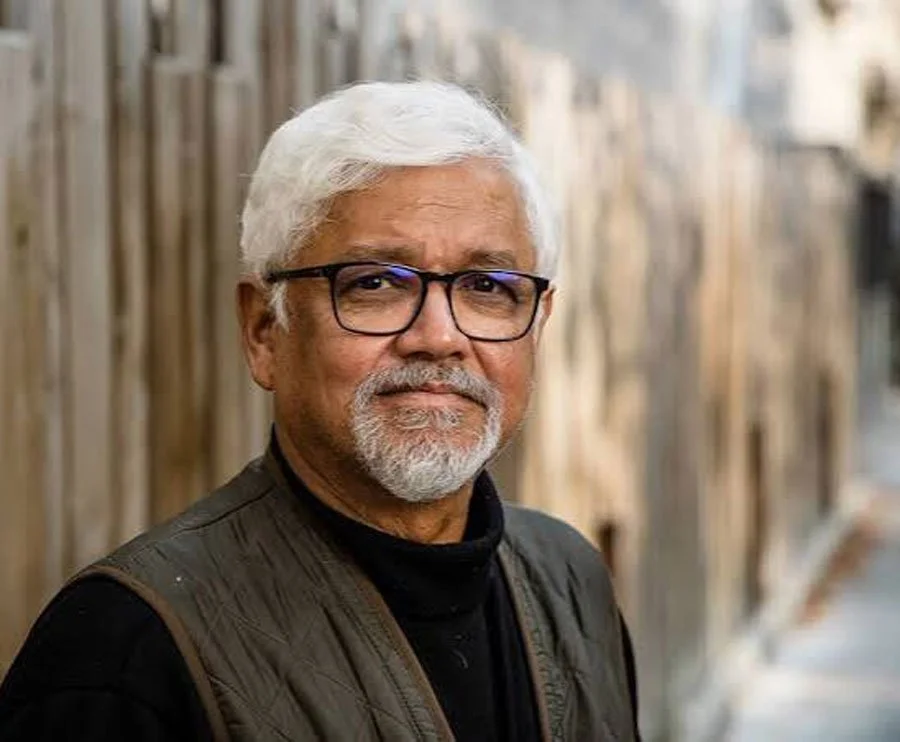
Amitav Ghosh grew up in India, Bangladesh and Sri Lanka and has a Ph.D. in Social Anthropology from the University of Oxford. He is the author of four books of non-fiction, two collections of essays and nine novels. His books have won many prizes and he has received eight honorary degrees, six lifetime achievement awards and four honorary fellowships. His work has been translated into more than thirty languages and he has served on the Jury of the Locarno and Venice film festivals. In 2018 he became the first English-language writer to receive India’s highest literary honor, the Jnanpith Award. In 2019, Foreign Policy magazine named him one of the most important global thinkers of the preceding decade. In 2024 he was awarded the Erasmus Prize and was elected to the American Academy of Arts and Sciences. In 2025 he was awarded the Pak Kyongni Prize by South Korea’s Toji Foundation, and in 2026 he was given a Fellowship by the Guggenheim Foundation. He is married to the writer Deborah Baker and lives in Brooklyn, New York.
DAVID PALUMBO-LIU
I wanted to share a story with our audience about how this came to be, I think, because I've been nagging you to be on the podcast and you've been very polite about declining. I know you're very busy. You have all sorts of other obligations. But what happened one day, several months ago, as I was out tabling at White Plaza here at Stanford and it was—I think it was homecoming. So a student I hadn't seen at least maybe seven or eight years came up and said, “Oh, you don't remember me, Professor Palumbo-Liu. I took your class on this and that.
And it was wonderful because I'm an engineer, but I got to read literature. And the novel that stands out in my mind is Amitav Ghosh's The Hungry Tide. And wow... I just became a huge fan of his.” And I was in Calcutta recently and I picked up this new novel of his called Ghost-Eye, and you really should have him on your podcast. So I immediately emailed you and I told you this story, hoping that it would participate in the kind of narrative that this novel is all about, which is about happenstance, coincidences that are not necessarily only coincidences. So I thought I would just thank you for heeding that voice coming from the distance and joining me here.
AMITAV GHOSH
Thank you. It's wonderful to know that it was an engineering student because—oh, yeah... engineering students tend to have a very far vision of the world. But, so it's nice—yeah... the book spoke to them.
DAVID PALUMBO-LIU
I think these days, so many engineers are humanists who had to, for various reasons, do other things because of family pressures or economies or whatnot. For my first question, I have an extended preface, so I hope you'll bear with me. I just wanted to say, at the heart of Ghost Eye, for me, is the notion of storytelling and the particular kinds of imaginative, historical and interpersonal work it can do that perhaps no other art form can do. And what I sense in this novel is a strong concern or even worry that I share, which is, are our imaginations up to the task of addressing the existential crises that we face today?
And to explain this, I want to start with the first two words of Ghost Eye, which are ingenious, “Picture this:” colon. And I was immediately struck by another novel of yours as I kept on getting into Ghost Eye about Picture This. And it's from The Shadow Lines, which came out in 1988, nearly 40 years ago. And it came back to me over and over again, this particular scene. It's when the narrator visits England and meets the people and places that his cousin Tridib has told him about in story after story, and he tries to prove to them that he knows them and their neighborhoods better than they can imagine. And so here he is meeting his cousin Ila's boyfriend, Nick Price, for the first time.
So when he walked up to me flicking his straw-colored hair back and said, ‘How nice to meet you. I've heard so much about you from my mother and May and everyone,' what could I say? I said, ‘I'm not meeting you for the first time. I've grown up with you. I've known the streets around here for a long time, too,' I said. And then I began to show off.
I'm just picking up parts of this long passage.
And then I began to show off. When we came out of the tube station, I stopped them and pointed down the road. ‘This is West End Street,' I said. ‘That must be Sumatra Road over there.
So at that corner must have been where the air raid shelter was, the same one that Roby's mother and your Uncle Alan ducked into on the way back from Mill Lane when one of those huge caliber bombs exploded on Solent Road around the corner, blowing up most of the houses there.' Nick Price inclined his head to me in polite incredulity. ‘How did you know?' Roby said. ‘Because Tridib told me.
How was he to know? He was just a kid nine years ago. Every little bomb probably seemed like an earthquake to him. “Look,” I said, “that's what happened.” This is me now.
Later, when they visit the site, they find out that the bombed-out road is now filled with pretty quiet houses in a tranquil neighborhood. Here's back to your text.
Not exactly what you expected,” Robbie said. I could not tell him then, but he was wrong. I had not expected to see what Tridib had seen. Of course not. I had not expected to see the rubble sloping down from the burnt-out houses like scree from a mountain quarry, with a miraculously undamaged bathtub balanced precariously at the top, nor expected to find the road barricaded by policemen. I expected none of that, knowing it would be lost in a 40-year past.
But despite that, I still could not believe in the truth of what I did see. It seemed to me that Tridib had shown me something truer than Solvent Road a long time ago in Calcutta, something I could not have seen had I waited at the corner for years.
And that's the end of the passage. And I recall that Tridib has always instructed the narrator to imagine with precision. So could we talk about... This is a long preface. Could we talk about this notion of imagining other times and other lives and how that might be attached to both imagining with precision and the current novel?
AMITAV GHOSH
Imagining with precision is a very fundamental part of my work. When I sit down to write about anything, whether it be The Hungry Tide in the Sundarbans, or let's say The Shadow Lines, or for that matter, Ghost-Eye or whatever, it's very important for me to get the topography right, to get the outlay of the streets or the house or whatever exactly right so I can actually picture all of that in my head. It's very important for me to have a sort of pictorial sense of what I'm seeing and what I'm writing about. Before I can write about it, I need to see it, as it were. So that's absolutely fundamental to my craft. That's just how I go about it.
DAVID PALUMBO-LIU
And yet here he is, the narrator, saying that he could not believe what he sees, right? And what he's supplementing with that precision is another kind of precision, I think, which is what you get into in Ghost Eye so vividly, right? How we are used to seeing certain ways with precision, but there might be another kind of world that informs this or another sensibility with the distance between 40 years, what it means now.
AMITAV GHOSH
You're absolutely right. Yeah, like the Sufis say—behind the apparent reality is a hidden or batin reality. I guess that's always been something of great interest to me. How do you square these two realities and make them come together on a page? And really that is what, in some sense, the work of the imagination is.
DAVID PALUMBO-LIU
Let's talk about the particular history of what's going on in The Shadow Lines and then today, because what I got from Ghost-Eye is a real concern again about moments of historical crisis…
READ MORE [ + ]
...And back then it was the aftermath of the Second World War and all the human rights emergence coming out and how we're going to deal with this new world.
And you've been so concerned about the environment with The Great Derangement and Nutmeg's Curse. What's happening today that you think requires us to remember in particular ways and to supplement what we're seeing before us with a longer sense of history significance?
We know that we're in the grip of an intensifying planetary crisis. We can see signs of it everywhere. In university circles, it's most of all usually spoken of in terms of the climate crisis, but it's much, much bigger than the climate crisis really.There's biodiversity loss and species extinctions. There's just so much more to that.
But even more than that, I would say the general accelerationism which brought the climate crisis about is steadily accelerating. It's not by any means slowing down, very much to the contrary. And that accelerationism has now become a credo exactly where you are at Stanford.
I'm sure many of your students are involved in creating and sustaining this kind of acceleration. So we see this acceleration all around us and we can see the edge of the precipice. And instead of turning back, we are speeding up towards it.
Yeah, I've been very encouraged, here we are in commencement season, that there have been so many commencement speakers who are cheerleaders for AI, and they're getting booed roundly. There was one, I think at ASU, Eric Schmidt, I think, said, “You know, we can't imagine a world without AI,” and there were these huge boos about what a horrible life to imagine that you would turn over your thought processes to an unwarranted trust in a machine.
That to me makes me glad I'm close to retiring at some point. But one thing that I thought we could talk about is, as you say, the interrelationship of lives and living things and how your discussion of reincarnation is both very rooted, but also a huge metaphor for how we are interdependent on things that often, in terms of the past, we've dismissed.
It's no longer relevant, it's no longer going to inform what's happening now because we are in such an unprecedented age, which is, of course, both true and not. But could you talk a little about this interrelationship of things that we've seen in your work for some time, but really vividly here?
Well, let me say first in relation to Eric Schmidt and his ilk and their love of AI, the reason that they think that AI can achieve a kind of human sentience or a human consciousness is because they have a very denuded idea of what to be human is. And unfortunately, that very diminished and denuded idea of what human existence is, is now all-pervasive because it's the fundamental ideology of modernity—that the earth is dead, everything around us is dead and exists only to be expropriated, and that humans, following Descartes, are essentially just moving brains.
So they imagine AI as being able to replicate everything that happens in the brain, but human thinking is so much more than that. Human thinking is embodied thinking. We think with our bodies. Even scientists now tell us that we can't really think without our intestinal flora interacting with us in various different ways.
There's that, but there are also so many forms of human thought and human existence that exist only in the body. To just give you one strange example, it so often happens that you feel someone's gaze on you and you turn around and there is someone looking at you and they quickly look away. How often does that happen? It happens every day.
We feel the quality of another person's gaze, another person's interaction, or for that matter, all these minor—you might call them coincidences, but you might also call them a minor premonition—when you think of a friend and suddenly they call. You say to them, “Oh, I just...” It's a kind of precognition and it happens to us all the time, to every one of us.
And we're taught to dismiss them. That would be aberrant, right? And I was thinking of two things when you were speaking, and we could talk about them more later on, but I just wanted to grab the instance because I've been interviewing a lot of people about AI and Musk and all that. I had Quinn Slobodian and Ben Tarnoff on recently who wrote a book on Muskism, and it's frightening because it's dismissible, not even human beings, what Musk calls non-playing characters.
It's like a huge video game and there's a category of people who just do not participate and so they're wiped off the slate.But one of the problems with AI, of course, is it's all probabilistic and normalistic, right? So you go to the exact middle and if that's what your holy grail is, you're excising everything that is wonderful and aberrant and unusual that you should be paying more attention to, not less.
And the other thing, and we'll come back to the haptic because I love your discussion of the haptic, but I have to share this with you now because we're talking about AI. A niece of mine teaches at Baruch College. Her name is Katherine Behar and she gave a presentation here on what she calls AI, but it's not artificial intelligence. It's what she calls artisanal intelligence and she's done a deep study into basket weaving.
She's talking about these skills that people dismiss. So it's just, “What are you going to study at Stanford? Basket weaving? What does it matter?” And she said, “Do you know, study after study shows that robots cannot make baskets because of the haptics.” Because so much of basket weaving depends on the resistance of the material, right? So you have to be there and understanding how that's working.
So again, the way in which language is used to excise parts of the world that we've decided are extraneous or frivolous, but actually are at the core of human creativity.
That's right. Absolutely. You know, I remember reading this Arab thinker and he was talking about how his introduction to mathematics came from observing his mother, who was a tailor. The way she put things together—that's a very intricate kind of ground-level mathematics and it happens without necessarily any mastery of mathematics. It's a kind of haptic or sensory mastery of what is actually mathematics.
And I love so much of your novel having to do with touching things and making things and creating things. And as I told you in the email, I'm hesitant to say too much about the novel because there are so many ingenious twists and turns. I don't want to give away too much of the plot, but I'll just tell the audience, so much has to do with making things and coming into the ability to make something that restores some taste of yours from ages ago.
We'll leave it there, but I do want to get to a couple of marvelous snippets of language that are so evocative. You have something about endings that are beginnings and then close to that you say, “Because I've been told in order to save the world, we have to remind ourselves of the old ways.”
So could you talk a little bit, since we're faced with a sense of ending so vividly these days, about how we can take these endings and create a beginning from an ending by this re-understanding of the past?
For me, it really begins with a sense of sensory discovery—trying to remember how things looked, how things tasted when I was a kid 60 years ago. And that's become a very important thing to me, which is why this is a book that is, in some very important sense, primarily about food.
Because food is the primary medium through which most humans engage with their environment. It's how we process our environment, it's how we relate to our environment. Nothing is more important than food in this regard. And yet you'll find that within our circles, within university circles, educated circles, that is something we are systematically taught to devalue, the relationship with food.
Partly because food seems to occur very often in connection with women, or simply because we've inherited a kind of Protestantism which is inherently very puritanical and which really devalues all things of the body. And I think this AI thing is very much connected with that complete devaluing of the body.
Food is one very important way to finding your way back to time. And in the process of writing this book, I realized how difficult it is, because I remember when I was a child, if you went into a market in Calcutta, you would see at least 100 different kinds of rice. They were kept in these canvas or jute bags and they looked different. Some of them you wouldn't even recognize as rice.
But each of them served a particular purpose. You ate them with a certain other kind of food, or you grew them in certain circumstances. Some were drought-resistant, some were flood-resistant, et cetera. Now, if you go into a market in Calcutta, you'll see maybe four varieties of them, and that's because of the onslaught of industrial agriculture, mono-strains and so on, which have destroyed so many varieties of rice, of wheat, of everything, and which has made us so fragile.
You know, that's the thing I really worry about in relation to the future. What this whole agricultural revolution did is that it made us so much more dependent on fossil fuels and chemical inputs. Fertilizers, pesticides, et cetera. And now that we see this huge interruption in the flow of fertilizers, you can be sure we are going to have a food crisis upon our heads very soon.
No, it's alarming. There's a woman named Xiaowei Wang who wrote a really interesting book about the tech industry in rural China and the way that the Chinese government has gone into these rural areas and disrupted everything. Not only built data centers, but decided that the wonderful chili peppers that are indigenous to those areas have to be ripped up and another kind of pepper has to be made for global consumption.
And this is from the Green Revolution on. That's the impetus. And you must have premonitional powers, because I have a whole quote about cooking in half a second. But I want to insert something personal. My mother grew up in the '20s and '30s in China, in Beijing, and she came to the United States to study at Radcliffe.
She's a very prim and proper Confucian young lady. She wrote a master's thesis on D.H. Lawrence, so go figure how those tastes might work. But the tragic part of it was that she never saw her parents again because of the Sino-Japanese War, the Second World War, the Communist Revolution. And she married my father, we moved to California, and she had to learn how to cook.
And so the first thing she did was the Good Housekeeping. And my sister and I remember these horrible meals of tinned soup and hot dogs. It was just execrable. But I suppose it was a way of assimilating or raising Americans in the worst possible way. But I think my father at some point, who was Cantonese from Hawaii, said, “Just make up something.”
She came from a very well-to-do family in Beijing. She never cooked. She never saw her mother cook. So it was all prepared by somebody else and brought to her. So she had to, through those memories of what she was tasting, create something that approximated. And to us, it was fabulous. It was also very little salt, very little fat, so very healthy, right?
And sadly, my father passed away relatively young and my mother was at a loss in this white suburban community in Northern California. How was she going to meet people? And she kept on having people for dinner and they said, “Then you ought to teach cooking.” And so her life was transformed from a widow without any connections into a famous Chinese cook in California.
And so food matters so much, and the last story I'll say is, as I said, my father was from Hawaii, from a huge family. And every time my aunties would come to San Francisco, they would come with empty suitcases. I said, “Why you?” They would just go to Chinatown, a store, buy all the rice, buy all the peppers you couldn't get in Hawaii at that time because this was the continuation of their sense of who they were and how they were raising their family.
So I just wanted to say that it's very common and it's important that you bring it out. So let me read this long passage, which I just happen to have before me:
“This is a cuisine, or rather system of nourishment, that lives neither in the brain nor in the conscious mind, but in the senses, and my task was to serve Varsha a meal that would resuscitate the entire haptic system that she had inherited from her former self. The more I thought about it, the clearer it became that what had initially seemed like a minor matter, cooking fish in the Bengali style, for Varsha was actually a challenge of monumental proportions, requiring undoing decades of disruptions in the ways that people ate, and indeed, how they experienced the world. GMOs, hybrid seeds, chemical fertilizers, antibiotic-heavy aquaculture practices, and industrial packaging had made the taste of many foods almost unrecognizable.”
So could you expand on that a little bit more along the lines that we've been talking about? And I also have to ask, did you learn how to cook before or after this novel? Is it part of your research, or was this something you'd already started to do?
I've always loved to cook, even when I was a teenager, and this was something that was very threatening to my mother.My mother would never let me go into the kitchen. She would never, because it was just not done in families like ours.But I've always just loved to cook and I love the aspect of sociability and conviviality that arises around food.
So when my kids were little, I always cooked for them. They never got pizza or anything like that, for which they were then very resentful. But now they're all great foodies and they take cooking classes and so on, not from me. Because that's the part that lingers, the sociability, the conviviality.
And really just like your mother, I feel now that my social world revolves so much around my dinners for people. So I really think it's very important that as many of us enjoy food. But considering how important food is in the world, comparatively few write about it, and I think very few writers write about it because very few writers know how to cook.
I never thought of that. Can you name one other novel that has food or cooking?
There's that famous novella by Isak Dinesen, Babette's Feast.
Yeah, yeah, of course. Yeah.
Yeah, that's a lovely book. And then there's that Korean novel which was very good. Was it Korean or Chinese? I forget.There are, but at the end, many of them come from us Asians.
Exactly. Exactly. This is what we live.
Yep.
And I also always say my father-in-law, who was Italian American and a great cook, would never share his recipes. It was like, “Oh, recipes? I don't know.” But on the other hand, it was probably very instinctive, right? It was just what he had picked up, as you did in your case surreptitiously from your mother.
But yeah, it's just an instinct. I do remember, and this is a tip I'll pass on to you, one cure for if you burn a pasta sauce. He said if you put just a tiny dab of peanut butter in it, it'll erase that. Yeah. Somehow... I don't know how he arrived upon that. Now I'm sharing it with the entire world, but this is one of his legacies. It seems to work.
Very interesting.
So I wanted to talk more about storytelling, and I was very interested in this passage because it's near the end and all these wonderful strands are coming together. Again, I'm not going to give away most of it, but something very profound happens and they're going to stage this huge ceremony that's going to, again, create a beginning from an ending. And the narrator says:
“Deep down, I was wholeheartedly in agreement with Chipu. With everything else having failed, the time had come to try to rekindle that sense of awe and wonder on which humankind's belief in the sacred was founded.I found myself chafing against the injustice that allowed some people to have special abilities while denying them to others. Why, despite the urgency of my yearning, I was so sadly lacking in gifts, while I was so limited, so earthbound, so deficient in imagination.”
And it struck me that was a really interesting moment in your text because, of course, from reading it, we know that he's absolutely indispensable to what's going to happen. So can we talk about the over-modesty of the humanities or the way in which we discount how important we are to the formulation of things? Maybe not only in and of ourselves, but getting back to things we've talked about earlier today, in collaboration with others, in unexpected collaborative moments.
I'm not an academic, David, and you once almost made me an academic.
Yes. Sorry. Narrowly missed that one. Yes.
And had I not resisted the temptation, I wouldn't have been able to write these books, I think.
No, I think it was fate. Remember, your wife got this huge promotion at that moment, so that was another fateful twist.Yes.
Yes, there was all of that. But so yes, it's true that I wouldn't call myself a member of a humanities department as you are.But I must say, looking in from the outside, one of the things that really astounds me is why people in the humanities haven't been more assertive in establishing their claim to speak on the climate, on the planetary crisis.
Because you look at the pattern of any disaster—you take Hurricane Katrina. Yes, it was a climate-intensified storm, but the impact of it on the ground was entirely determined by history, by sociology, by patterns of politics, by patterns of settlement. And who can pronounce on these things better than people in the humanities and the social sciences, if you like, historians as well?
In fact, there's a very good model of it by that well-known sociologist, Eric Klinenberg, I think is his name. He did a study of a Chicago heat wave, and he shows in very rigorous detail that two very similar neighborhoods with very similar demography and minority predominant neighborhoods in Chicago had completely different responses to the heat wave. In order to understand any of that, you absolutely have to know about the history, the demography.
All of it is absolutely fundamental. One of the major factors that's driving these disastrous impacts of global warming is patterns of settlement. You look at Houston, you look at what's currently happening in Phoenix or Florida or wherever.People flocking into completely unsuitable areas, and often these are elderly people, and this is all driven by a certain real estate market and by the marketing of housing and so on.
I do have to say, I think it's really astounding and it's a great failure on the part of whoever it is that leads departments of humanities in not establishing these claims. And I think one reason for that is that we live in a world of science worship, say, so it's very important, but if a historian says something, ‘Oh, we can ignore that.' And at the same time, the scientists are crying themselves hoarse talking about the crisis and no one's paying them any attention whatsoever. So we end up in the worst of all possible worlds.
And actually, I had somebody on from Scientist Rebellion, Fernando Racimo, who's in Denmark. And a lot of the direct actions and other indirect actions that they're doing employ culture and art. You know, they create paintings, they do things from the humanities as part of their trying to awaken their scientists' colleagues to this issue. And in the academy, it's been established for a while, but this idea of environmental humanities.
But to me, in my mind, it's too descriptive rather than active. It's sort of showing how things are rather than how things could be, which is again, the primary concern of your book. And I guess what I was getting at in the passage, too, is not just the humanities, but storytelling. I don't know if you would give away this secret, but why is Dino, the narrator, so dismissive of his role?
Because he plays such a central role, and I think that at that moment, of course, he's not able to go to the actual event, the ritual, because of elements I won't give away. So he's removed from that and he's looking at it from afar and he seems so not to recognize how important he is.
When I decided to write this book and my last novel, Gun Island, in a first-person voice, I decided that the narrator would be someone who's basically outside the action, as it were. Because that makes it much easier to narrate if the narrator—you think of those Hercule Poirot novels or whatever, the narrator is never part of the action. It's easier that way to have your narrator as a chronicler. So, and it lets you telescope in and out of situations like towards the climax of this book. Dino isn't there, but he's watching. So you could say it's partly just a technical thing, but also I've always felt that with characters in a novel, you know that your character is real when they surprise you.
And that became the really surprising thing about this book, that suddenly Dino began to play a much larger role than I would have imagined.
Oh, really?
Absolutely, yes. He surprised me.
I don't want to ask you at what point it started, but to me, again, here I am, the literary critic assuming what the author might have meant, but to me it was his modesty and his deference to the real activist, the people who call him Pops and he's this old guy out there as they are so interrelated, right? And I think Tipu and others are constantly saying, ‘No, you're essential. You have...' And so I thought it was a really interesting way to speak across generations to begin with and across the professionalization of activism or non-activists.
It almost goes back to May in The Shadow Lines, her centrality in that, even though she doesn't seem like somebody who would be a hero, but she has a kind of catalytic effect. And so in my perhaps inflated reading of Dino here, I was thinking that this is a way for us to understand from yet another angle about how any effort to build a better future is going to be dependent on many players who don't even understand what necessarily their role might be.
I was even thinking about that moment when he's trying to get, in Chinatown, this huge fish that he's trying to get. I can't forget the name of it, but the fish—
It's a big snakehead.
Yes. Yeah, exactly. And it's such a huge fish that it sees him and it knocks over the tank at one point, right? So they slaughter it at that moment. And so I almost thought of that as the animal connecting with Dino and almost sacrificing itself because you have these other moments where animals will understand what's happening at that moment. So again, that showed that if it hadn't been for the storyteller there and creating that moment, perhaps that wouldn't have gone forward, but I don't know.
It's interesting that you mention that, yes. One of the ways in which Dino became more and more interesting to me is that, of course, the whole story of the book is about him reconstructing a story. And that's what sets everything in this story in motion. And I suppose that's a metaphor, if you like, for we need new stories. We just need to all—in fact, rather, we need old stories, if you like. To restore, if you like, again, what Dino says there, to restore our sense of wonder and our sense of possibility in the world.
If I could ask you, how do we develop the capacities in people to be awed, to be startled, to reinvigorate things that we've lost the ability to sense, that haptic notion? And so I'll couple that with another question that just came to mind, which is, what's the reaction been to your novel? How have audiences connected? What are they picking up on? So I guess two questions: how do we develop those capacities again and how's the book been received?
I was prepared for a storm of denial and skepticism and so on. But it hasn't happened, to my astonishment. Even my scientist friends love it. In India, where it was first published, it was for ten weeks number one on the bestseller list. I couldn't believe it. That was amazing. Yesterday, I did the first live event in the US here in Brooklyn and again, it was a wonderful audience and they completely got it about the book.
Somewhere, Margaret Atwood says this about science fiction, but you could say it about fiction as well, is that essentially what fiction has always been to human beings, going back to the Iliad, the Odyssey, the Ramayan, whatever, is that they're tales of wonder and we've lost that sense of wonder, really. And I think that's what connects with readers. So many readers have just loved the book and they write to me and they talk to me and they tell me about their weird experiences around past life memories. You remember Akhil Gupta, right? Have you ever read his wonderful article about past life memories?
No, I should. I should absolutely. I didn't know that. Was it published in an anthropological journal or... I can write him.Yeah.
Yes, it's in a peer-reviewed journal. It's a wonderful article, actually, and I hadn't read it when I wrote the book, but I read it afterwards. In fact, your colleague, Priya Satia, mentioned it to me. It's this wonderful article which begins with him doing fieldwork in Rajasthan and a child who he doesn't know comes up to him and says, ‘Where have you been all these years? I've been looking for you for so many years.' And the child addresses him by a different name and tells him about his past life.
And I found—to me, this is the most disquieting thing. I have no past life memories. But the idea that there might be someone out there who remembers me from a past life, it's just that I haven't met that person. But that to me is just such a disquieting and also such a wonderful thing. It just makes you understand that this world is infinitely stranger and more wonderful than Eric Schmidt would ever imagine.
Exactly. Exactly. And another book I will mention now by Carissa Véliz, she has the interesting title at Oxford of Ethicist for Artificial Intelligence. But her previous book was on surveillance and I interviewed her on her book on prophecy, which you would love. You would absolutely love it, because one of the memorable moments in the interview I did with her, she said, ‘If I was going to live my life in terms of probability, I'm a Mexican Spanish white woman. How am I going to get a job in the academy?' And it goes back into the early prophets in ancient times to today.
And she said, ‘We've lost our sense of curiosity and we want to know things for sure.' And she says, ‘Nothing is for sure.'She said, ‘Even if I use my weather application, think of it this way. If it's wrong, what's the worst that can happen? But if you have an entire population, for example, actuary tables on who does this, who does what, how much life insurance can you get, all these things that are based on probability, which is again, driven by industrial needs, not just purely intellectual speculation, then we're in deep trouble.'
I know you would love the book because she has many wonderful stories and many different angles onto it, but basically it comes down to that issue of curiosity and not being foolhardy, but being prepared without being shackled by the expectation that something's going to happen and being open to other things happening that will be influential.
...Akhil makes a similar point. He says that the reason why the contemporary world is so resistant to this idea of past life memories is that it's an enormous challenge to the kinds of linear forms of time that were demanded by capitalist processes of production. So circular temporalities are a very direct threat to those processes of production.
Right. And the whole notion of progress, the telos that we have to be on in order to fulfill our destiny, which again, you give us a very different sense of destiny in this novel. So it's been wonderful and I urge everybody to read this book. I put it on so many of my syllabi now because it addresses so many really important issues. But beyond that and above that, perhaps it's just a great read, like all of your novels. It's entertaining, it's fun and it makes you see life differently.
When I have a chance now, maybe I should linger over this a little bit. It doesn't have to dominate my life, but rather than brush past it so quickly, I think it's important for us to stop and reconsider what life might be.
Thank you very much. Thank you very much for that, David. If I can give you a book recommendation as well. There's a wonderful book written by the Yale historian Carlos Eire. I don't know if you know his work. The book is called They Flew. And it's about levitating saints in 17th-century Italy and Spain. It's a wonderful book.
Is that what... Because you had that moment in your novel when... Okay, that's going to be on my next read list. It's wonderful seeing you again. It's been too long, and if you're ever out on the West Coast or want to be, we'd love to have you at Stanford. I mean, we remember we initially met because that was going to be a permanent situation as far as I was concerned, but if you want to just come through, that would be also wonderful.
Yeah, I'd love that. Anytime.