

For 30 years, Gelah Penn has worked at the intersection of drawing, sculpture, and painting. Exhibitions include the National Academy Museum, Boulder Museum of Contemporary Art, Center for Maine Contemporary Art, Weatherspoon Art Museum, Muhlenberg College, SUNY Old Westbury, Brattleboro Museum, and Bibliothèque Nationale Municipale. Reviews of her work have been published in The New York Times, Art in America, The Brooklyn Rail, d'Art International, Whitehot Magazine, artcritical, and featured in Sculpture, Art Maze Mag, and Peripheral Vision Press. Penn's work is in the collections of the Weatherspoon Art Museum, Arkansas Arts Center, Columbus Museum, Brooklyn Museum Library, and Cleveland Institute of Art/Gund Library. Penn has received a Connecticut Artist Fellowship, a Tree of Life Individual Artist Grant, and residencies from the Sharpe-Walentas Studio Program, MacDowell, and Yaddo. After many years in New York City, the artist now lives and works in rural Connecticut. @gelahpenn

Reflecting on your childhood in Pennsylvania, how did it mold your approach to art? I was born and raised in Beaver Falls, a small town in Pennsylvania. My family later moved to a suburb of Washington, DC, where I lived (and loathed) until college. Although I spent most of my adult life in New York City, my love of hills and vistas seems to have remained strong. My continuing interest in vertical forms and a parts-to-the-whole approach to installation may have been influenced by the topography of western Pennsylvania.
When did you first fall in love with art and realize you wanted to be an artist? For you, what is the importance of the arts? Well, I played with silly putty and did paint-by-number thingies when I was a kid. But I think my first real experience of art was at the Louvre when I was 12. I sat in front of Jacques-Louis David’s enormous painting “The Coronation of Napoleon” for a long time. It felt like a freeze frame of a movie, where many figures were arrayed in space. They were so imposing in the expanse of this painting situated in the vastness of the museum. I now understand this as my first encounter with installation.
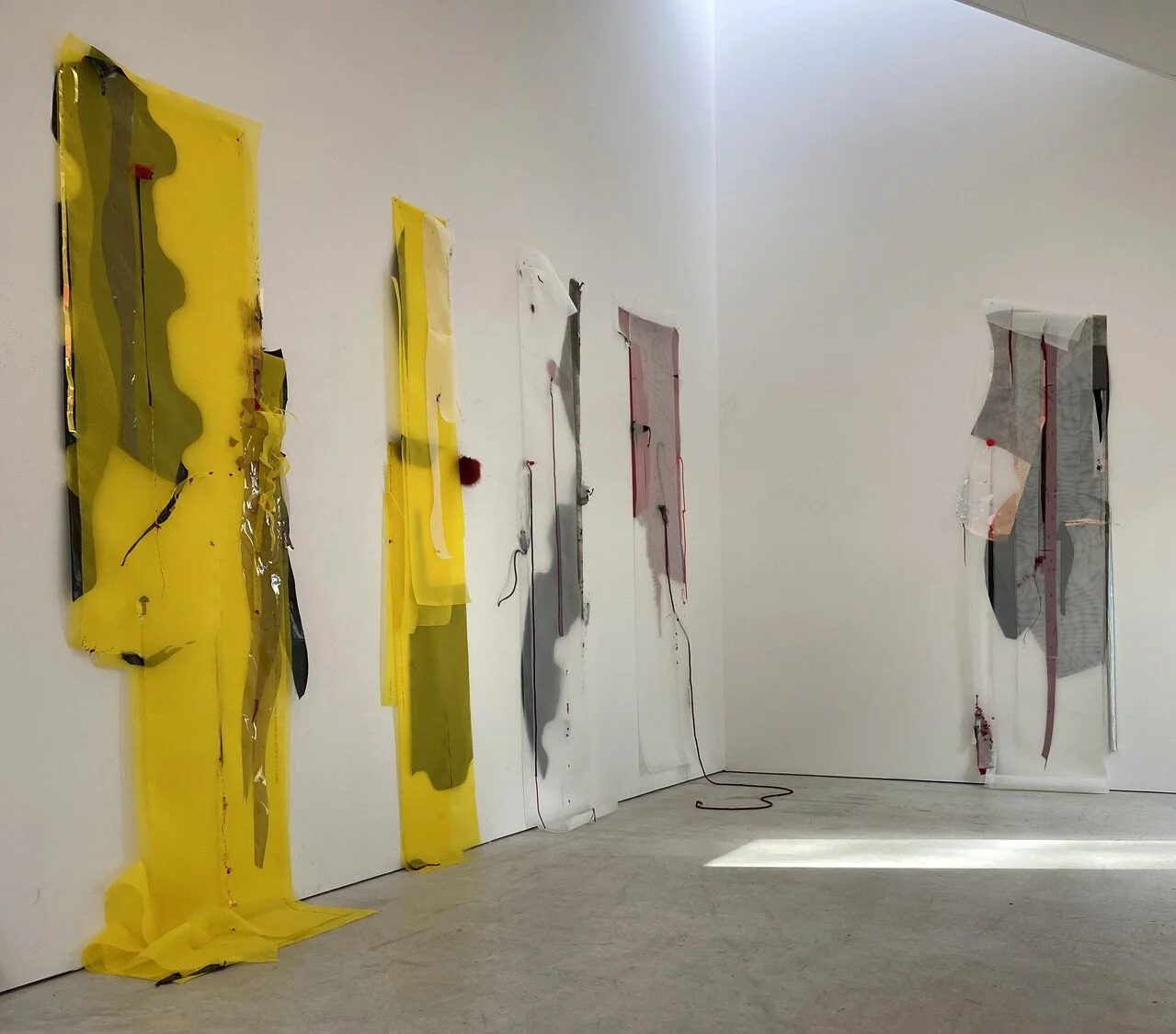
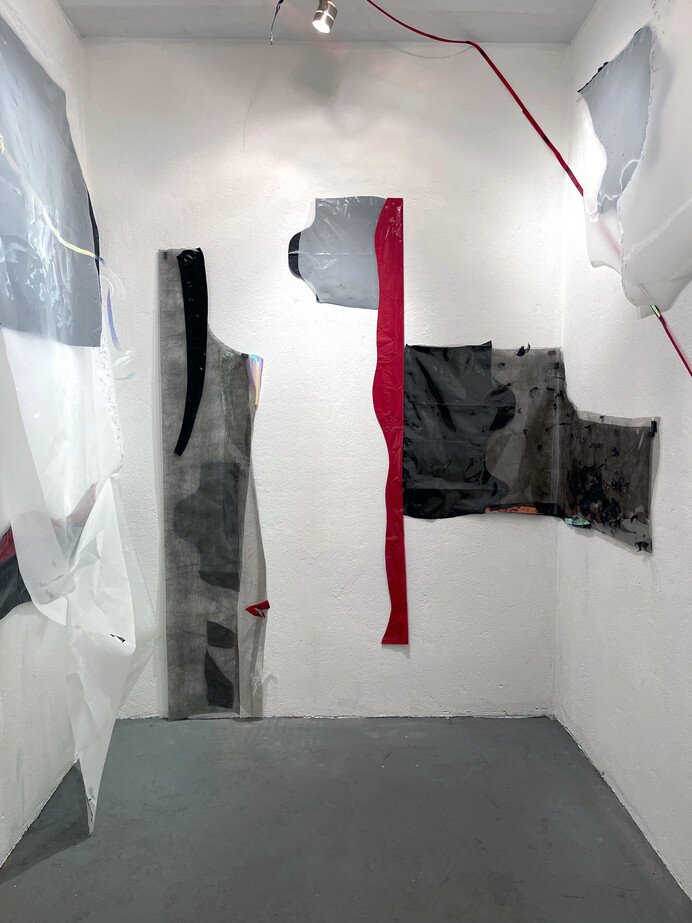
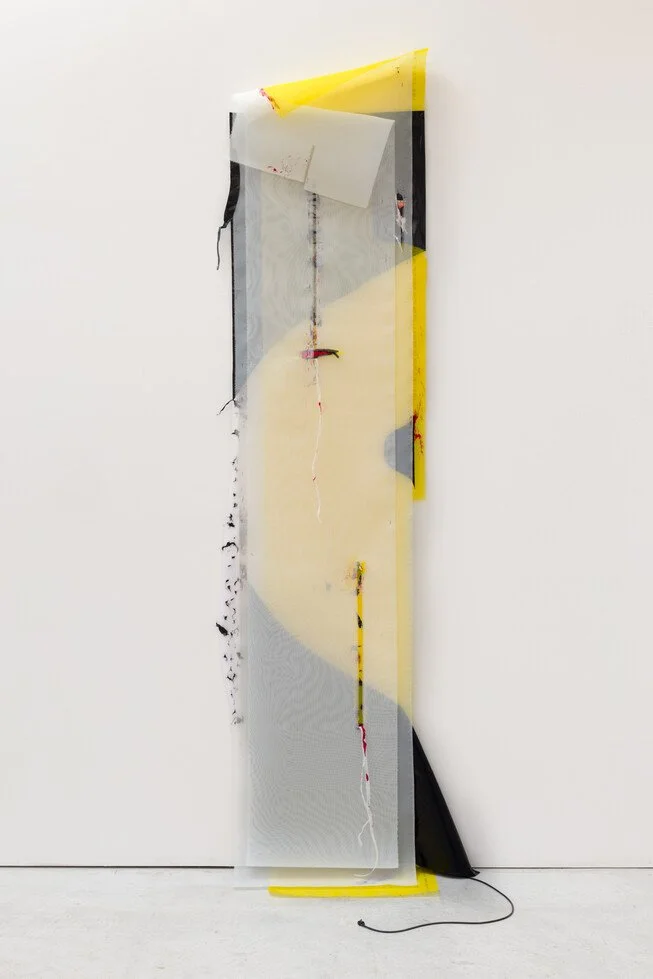
What does your typical day in the studio look like? Walk us through your studio and your most used materials and tools. Ideally, I’m in the middle of a piece as it’s usually difficult to begin a new one. My process is really about assemblage and collage, so I’m always cutting, tearing, stapling, and moving components around on a variety of translucent materials pinned to the wall. One action leads to another. My work is very much about incidents happening on, between, and behind all these layers. I listen to podcasts, mostly, as I find music too distracting. I grew up half-watching and listening to TV while I did homework, so I seem to work best with the sounds of conversation. Go figure. I’m very analogue and rarely work with assistants. The tools I use most are my long-arm stapler, scissors, a hammer, and T-pins. My materials at the moment include polyester mesh and fabrics, optical plastics, plastic bags, and silicone tubing, among others.
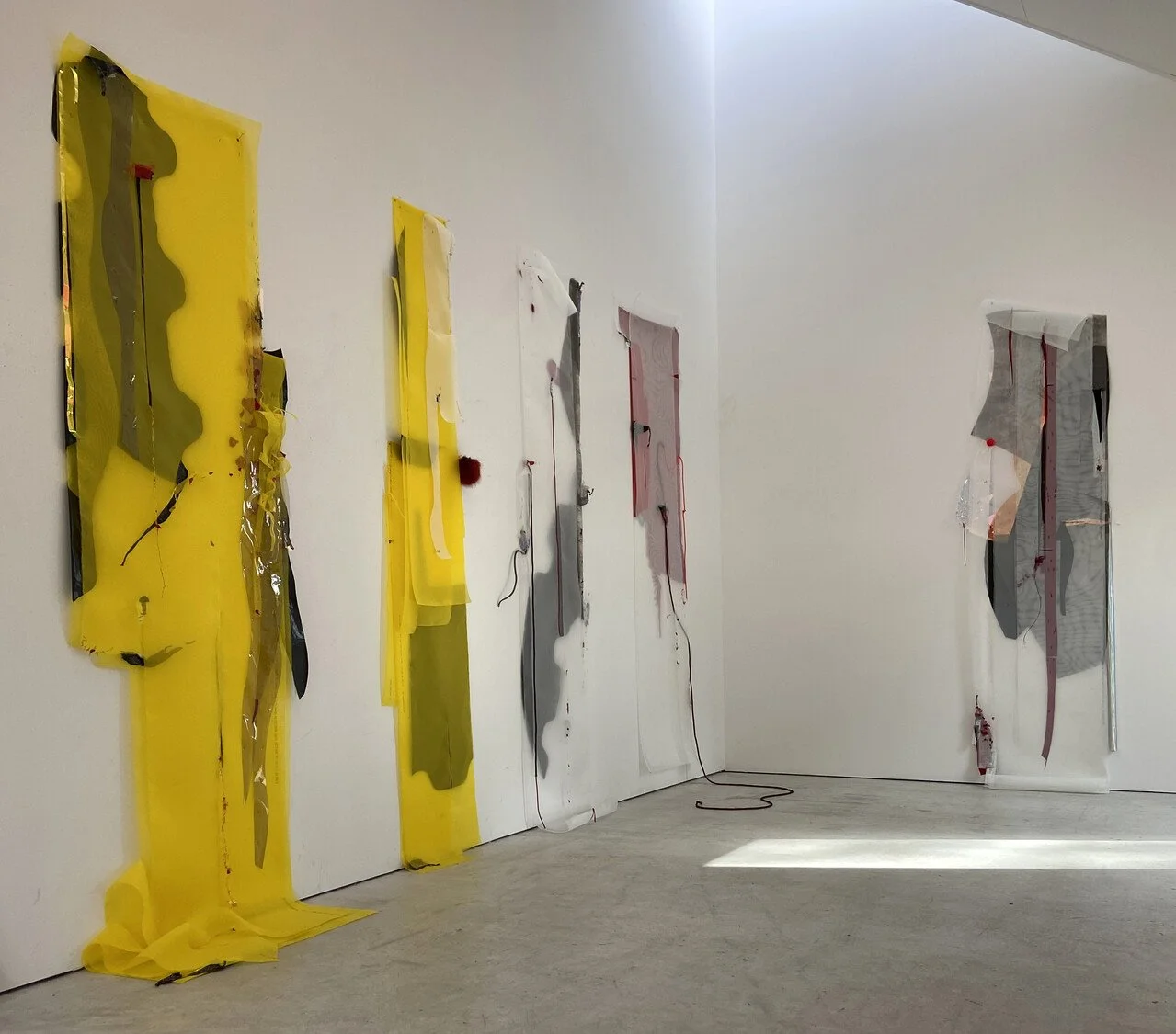
What projects are you at work on at the moment? And what themes or ideas are currently driving your work? For the past few years, I’ve been focusing on the monumental, totemic wall pieces of my Phantom series. A dialogue between gravity and instability animates these works. I construct them with materials chosen for their malleability as well as their capacity to activate light. I place material shapes, gestures, and marks between veils of polyester mesh to function as dreamlike semaphores. I think their scale and allusion to the commemorative stone stelae found in antiquity evoke an oblique figural presence.
What do you hope people feel when they experience your art? What are you trying to express? I like the mysterious quality that I get from the translucent layers, so you don’t know exactly what’s happening where. There’s the interaction between major gestures and forms, and the background noise that comes to the surface and sometimes recedes. I’m more interested in a phenomenological approach or presentation to the work, so ambiguity is important to me. I want the viewer to connect with the work in some way, but it’s not a didactic or depictive process for me. It’s very much about transformation. So my ideas about gravity – physical, metaphorical, or emotional – can be conveyed through the materials and mark-making. I'm keen on the way manipulating simple materials like polyester mesh and plastic bags can be incredibly evocative. And the dualities I'm interested in—fragmentation/cohesion, substance/materiality—function in the same way. The incidents that I develop in the work can be seen as theatrical, forensic, cinematic, or almost anything, depending on the viewer.
Which artists, past or present, would you like to meet? And why? Past: Goya, Turner. Present: Richard Tuttle, Charles Long, Daisy Youngblood. I’m drawn to work that’s a bit jarring in one way or another.
Do you draw inspiration from music, art, or other disciplines? I’m not sure I believe in inspiration, but my work is informed by film. I’m always watching movies and thinking about them. I’m especially interested in shadow and psychological unease, and that’s a large part of film noir, which I love. But it’s not a one-to-one relationship with any particular movie. I’m interested in the kind of effect that presents itself in noir: that uncertainty, mystery, anxiety, where you don’t really know what’s going on, and people aren’t what they seem. It’s part of what I’m trying to get at in the work, in addition to humor and other things. There’s a bit of everything in there.
A great thing about living in Connecticut is… Aside from birds and the sounds of occasional farm machinery, our small rural town in northwest Connecticut is very quiet, which is important to me now. And being in proximity to hills and woods, and water is lovely. We’re also lucky to live near many writers and visual artists. And we can make our way to NYC to see art whenever we need an infusion of urban life.
Can you describe a project that challenged you creatively or emotionally—and how you worked through it? Developing site-responsive installations is always challenging. No matter how much I work out ideas in the studio in advance, there are always changes once I’m on-site. Architectural curveballs and sight lines are often part of the mix. You just work through them and devise solutions. Then other ideas start percolating and work their way into the next installation or piece—it’s a continuum.
Tell us about important teachers/mentors/collaborators in your life. I had a wonderful sculpture teacher in high school. Later, I studied at the San Francisco Art Institute with Mary O’Neill, a terrific painter, as well as master printer Kathan Brown of Crown Point Press. In New York, I worked at Dia Art Foundation and met Fred Sandback, James Turrell, and other significant contemporary artists who prompted a deeper investigation of materials and methods in my own work.
Sustainability in the art world is an important issue. Can you share a memory or reflection about the beauty and wonder of the natural world? Does being in nature inspire your art or your process? I don’t know how much nature inspires the work, but it does feel more necessary to make it now. It used to be that the ocean was my go-to wonder, but now it's more about hills and rivers.
AI is changing everything - the way we see the world, creativity, art, our ideas of beauty and the way we communicate with each other and our imaginations. What are your reflections about AI and technology? What is the importance of human art and handmade creative works over industrialized creative practices? I think it will have a huge influence on our world and makers, but I have no idea how that will manifest. I worry about it supplanting personal curiosity and investigation, but I can also imagine it as an incredible tool for both those things, too. We’ll see.
Exploring ideas, art and the creative process connects me to… pretty much everything.