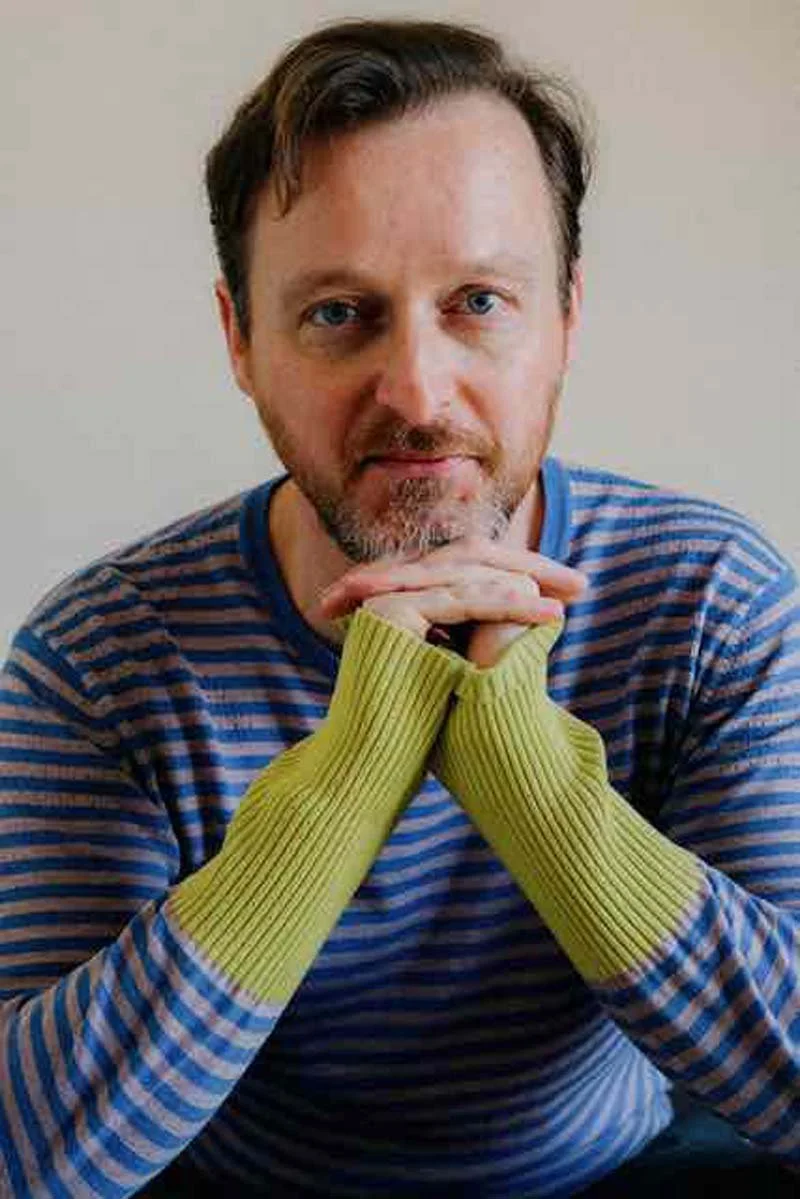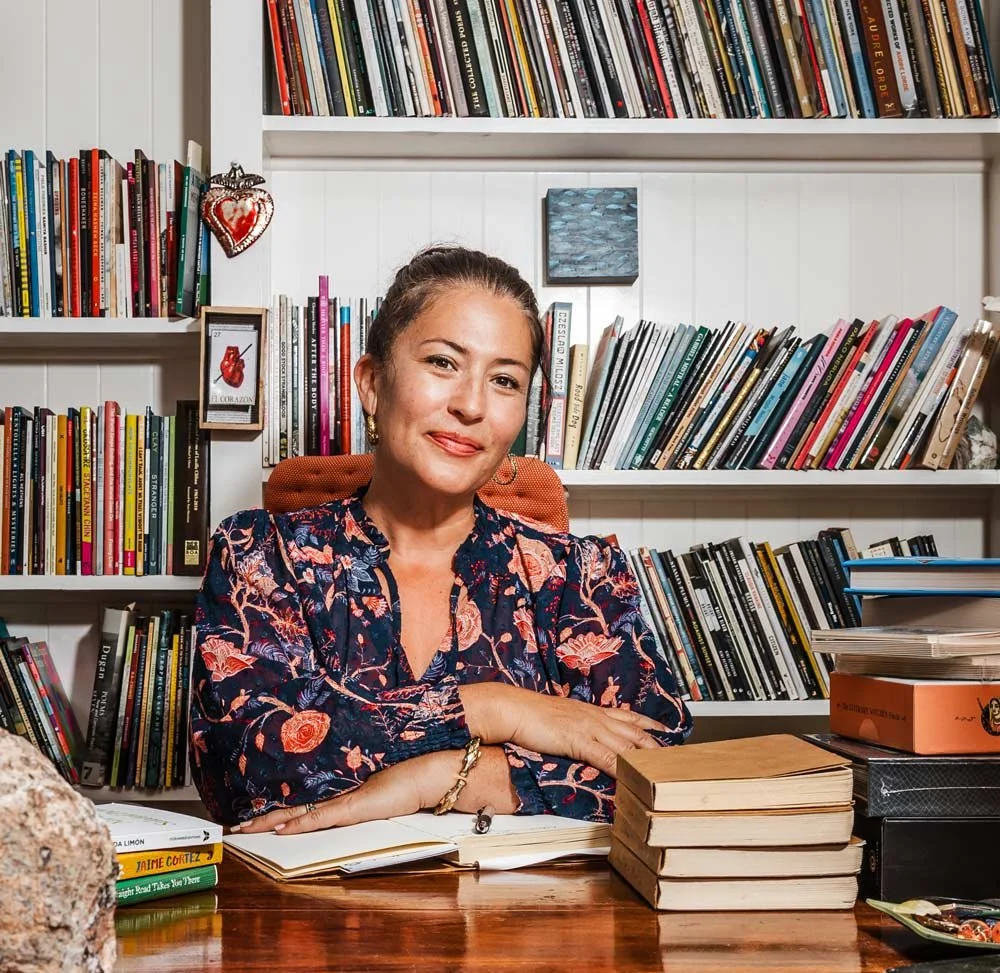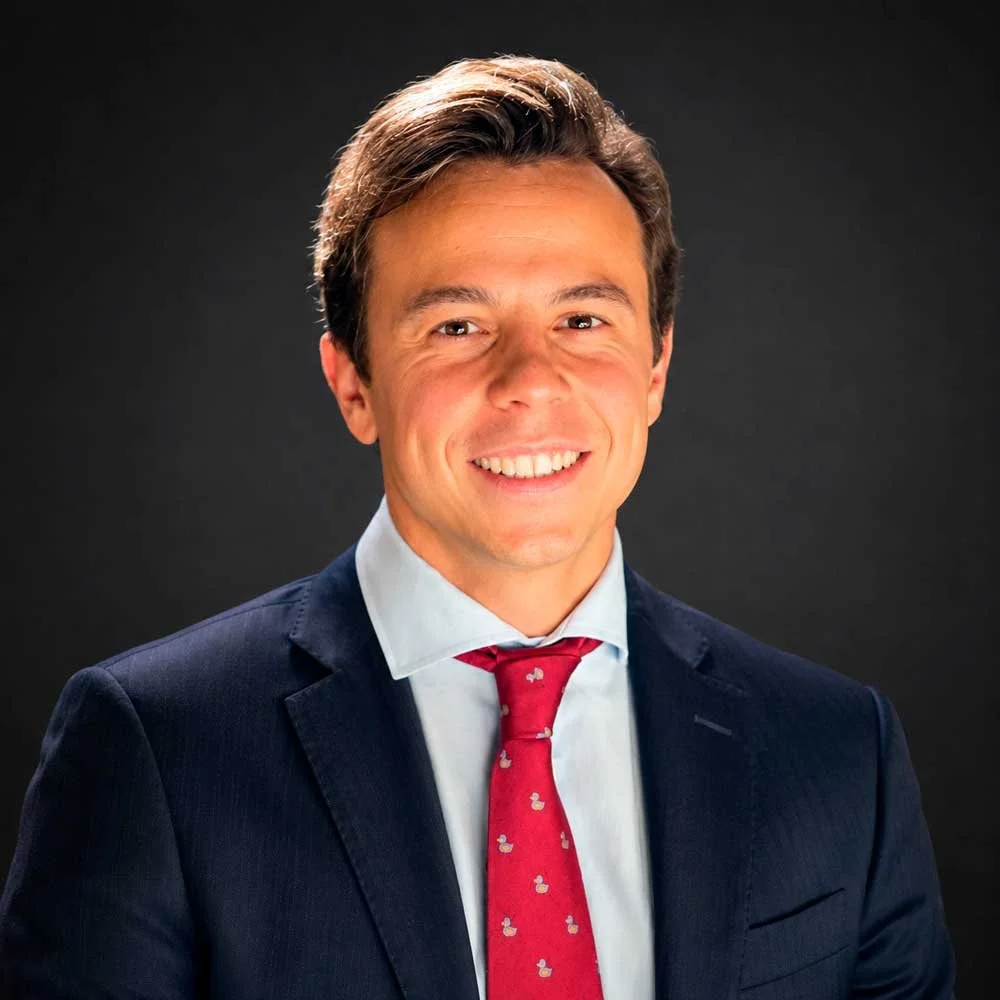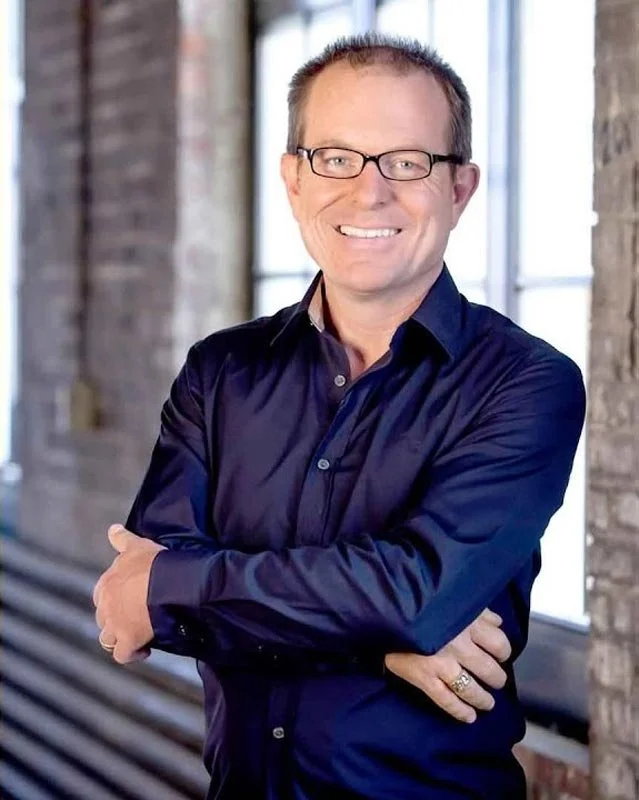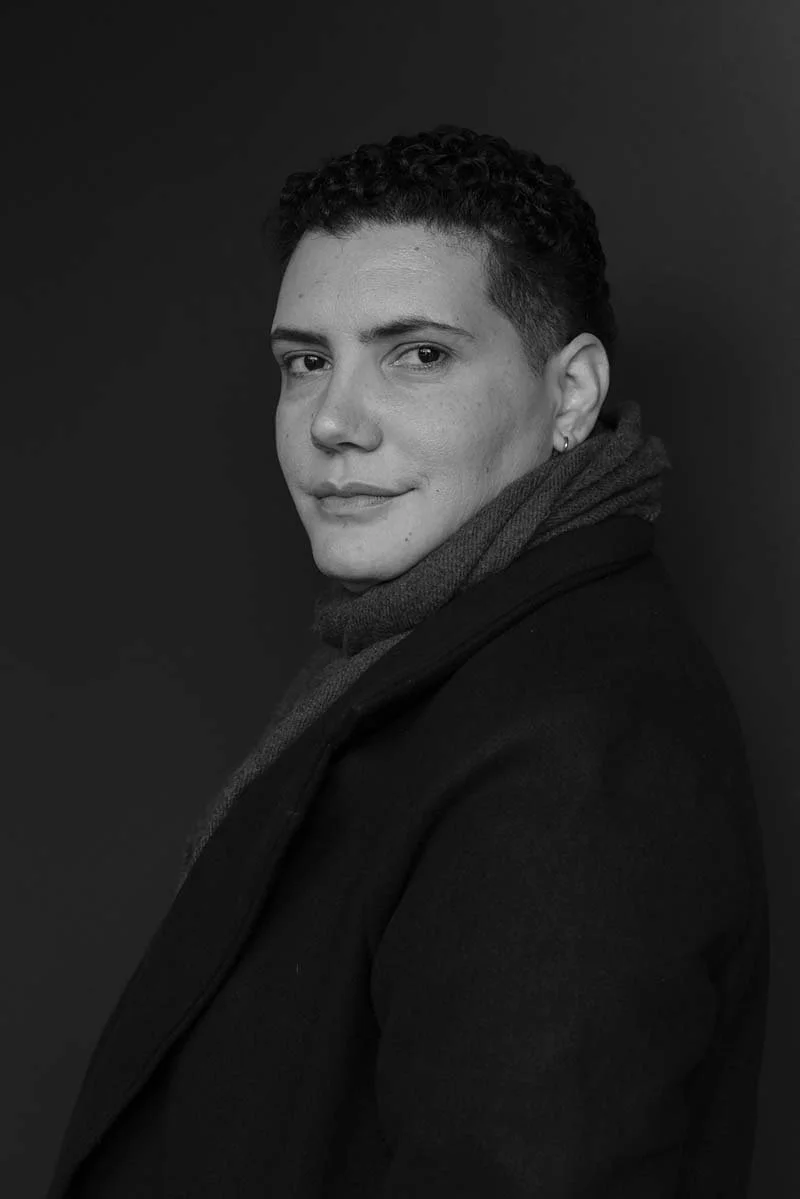


Roque Raquel Salas Rivera is a Puerto Rican poet and translator. The 2018-19 Poet Laureate of Philadelphia, he has received the Ambroggio Prize, the Juan Felipe Herrera Award, and the Letras Boricuas Fellowship. Among his seven poetry books are lo terciario/ the tertiary, longlisted for the National Book Award and winner of the Lambda Literary Award, and while they sleep (under the bed is another country), which inspired the title of no existe un mundo poshuracán: Puerto Rican Art in the Wake of Hurricane Maria at the Whitney Museum. Algarabía (Graywolf, 2025), his eighth collection, is a speculative trans epic. @roquesalasrivera
You were born in Puerto Rico and have since moved all around the U.S. How did that kind of childhood in motion change the way you think and write? I was born in Mayagüez, Puerto Rico. At six months, my parents moved to the United States, and I lived all over the U.S. (Wisconsin, California, Nebraska, Alabama, Texas) for fourteen years, after which I returned to Puerto Rico. I have lived half my life in Puerto Rico and the other half in the United States.
I write in Spanish and self-translate my work into English, with some exceptions. Many of my collections are dual-language flip books where the relationship between languages is played with, strained, and intensified. I often do not translate certain words, which I call "knots" and consider so tied to a context that translating them would defang and render them meaningless. My self-translation practice is rooted in the colonial relationship between our Puerto Rican dialect of Spanish and the pressure to assimilate to English-only policies in the United States.
My writing centers the economics of gender and coloniality. Living in a colony shapes one’s understanding of the world. Being in a poet in a colony shapes one’s understanding of language, beauty, and violence.
My parents were political activists during a period known as the "carpeteo," in which the Puerto Rican government actively persecuted, blacklisted, and harassed activists. Information often had to be protected. This has shaped my writing style into one that moves between open, direct language to one that is more obscure and coded.
Being both diasporic and of the archipiélago has shaped how I see Puerto Rican literary movements. I advocate for increased collaboration. We are often separated, not just between "el aquí y el allá" but also within the Caribbean, by colonial languages and imposed narratives.
What kind of reader were you as a child? What books made you fall in love with reading as a child? As a child, I began reading scholastic books. I remember being very influenced by the Goosebumps series, Edgar Allan Poe, and José Martí's stories. As a teenager, I moved on to Langston Hughes, Federico García Lorca, Ángela María Dávila Malavé, Anne Sexton. It was Hughes who inspired me to start writing poetry.
In Puerto Rico, as a teenager, I became very involved in a poetry scene and learned from listening to, reading, and sharing with writers such as Yolanda Arroyo Pizarro, José Raúl “Gallego” González, and Mara Pastor. I also began reading a larger scope of work, including Pedro Pietri, Amiri Baraka, José María Lima, Julia de Burgos, Sotero Rivera Avilés, Marigloria Palma, Oliverio Girondo, and César Vallejo.
I was a voracious reader. Literature was salve, salvation. I was often a lonely kid, but even as I grew older and became very social, literature was a refuge I could return to that would help me come to grips with what felt like an unfair world.
Describe your typical writing day. My writing tends to be concentrated in bursts. When I am not completely focused on a project, poems come to me in the most unusual moments. I usually jot them down on the Notes app in my phone and then gather them later.
When I am working on a project, I need complete concentration and isolation. I make sure the room I am in is at a perfect temperature. I stock up on water, prepare coffee, eat before so that I don't get hungry, and make myself comfortable. The idea is to have minimal distractions so that I can fully concentrate on the work. In the past, residencies have been helpful because they create the ideal conditions for writing.
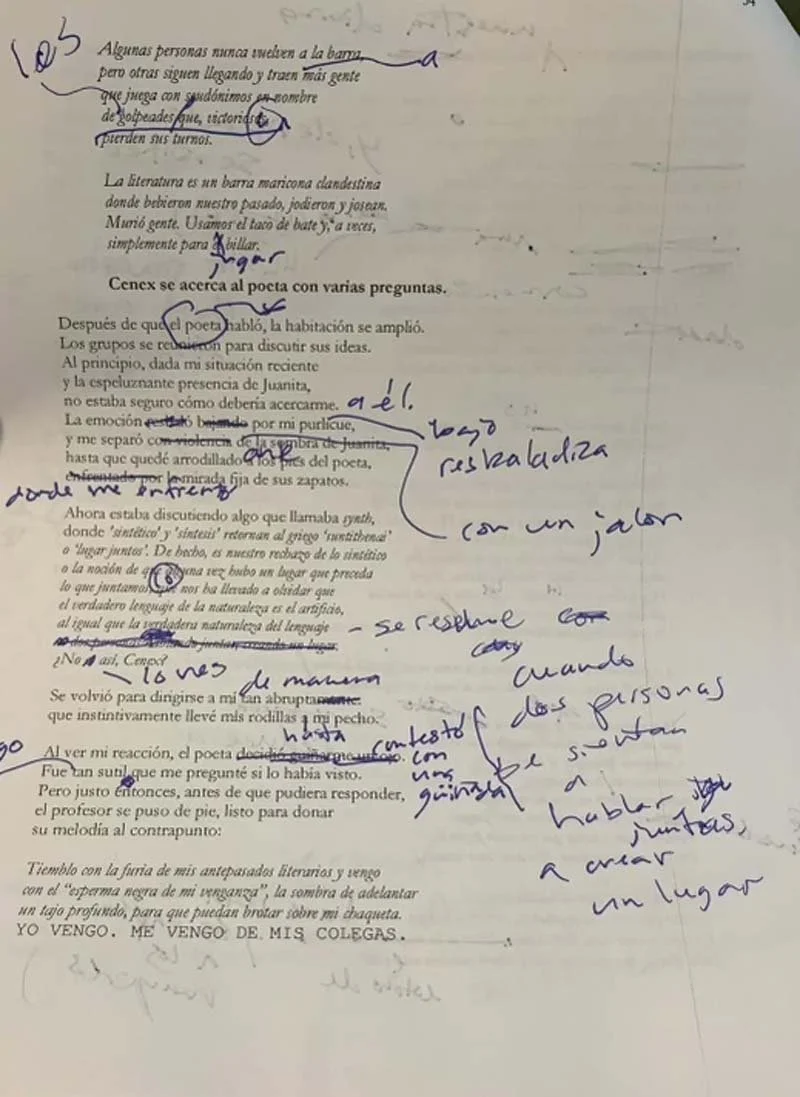
I usually edit as I am compiling a draft, after compiling, and print the poems out so that I can write the edits in by hand. Each poem goes through many many edits. Sometimes that means I am adding new writing, other times, I am refining an image or a verse. It can feel feverish and is as much a part of the writing process as when I first write the poem.
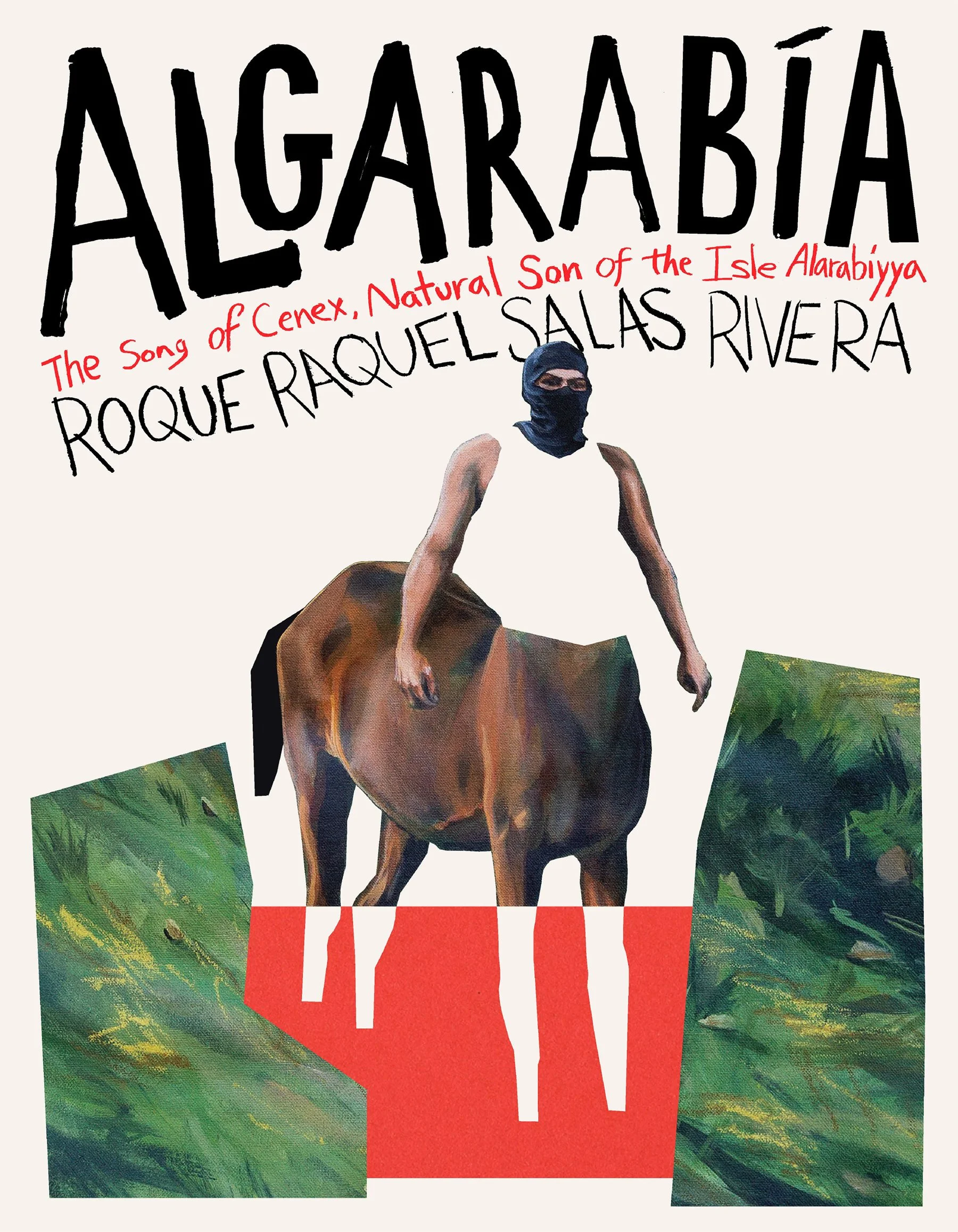
Tell us about the creative process behind your current project, Algarabía—how did the idea take shape, and what has surprised you about the writing process? Algarabía is an epic poem that follows the journey of Cenex, a trans being who retrospectively narrates his life while navigating the stories told on his behalf.
An inhabitant of Algarabía, a colony of Earth in a parallel universe, Cenex struggles to find a name, a body, and a stable home. The song of Cenex weaves and clashes texts by cis writers on trans figures with fragments from historical, legal, and other nonliterary texts. Its protagonist leads us through his childhood hospitalization, his years as an experimental subject, a brief stay in suburbia, twisted meanderings, and not-so-far-off lands accompanied by a merry band of chosen queers.
Referencing everything from pop culture to Taino cosmology and philosophy (at times in a single line), this book laughs at its survival with sharp, unserious rage. The edition is composed of two original texts—one in the Puerto Rican dialect of Spanish, the other in a reconsideration of English. Algarabía inscribes an origin narrative for trans people in the face of their erasure from both colonial and anti-colonial literary canons.
Writing it was one of the most challenging and powerful experiences I have ever had. I wrote the first draft in about three years and then edited it with extensive feedback from Graywolf editors Carmen Giménez and Brittany Torres Rivera. I also worked with editors Gaddiel Francisco Ruiz Rivera, Carmen Marín, and Legna Rodríguez Iglesias. For six months, I took time to focus completely on perfecting the final manuscript, after which there was an additional year of edits.
During both the writing and editing, I cried, argued with the text, stayed up to work on specific sections, and went through all the emotions. I isolated myself during that period because I wanted to get everything just right.
Do you keep a journal or notebook? If so, what’s in it? I have kept many notebooks over the years, but in the last decade, my travel needs made it easy for me to lose notebooks. I would often find myself resorting to writing on napkins, book covers, and the Notes app on my phone. When I am home, I write on my computer or on blank, unruled paper.
You’ve mentioned that each of your books requires a great deal of research—how do you go about conducting that research, and how does it work with your writing process? Each book requires a great deal of research, although that doesn't always mean an archival search. For Algarabía, I drew from my work creating a digital archive. For two and a half years, I was the main person digitizing literary documents for the online Puerto Rican poetry platform I co-founded. I was in different collections, such as the Colección Puertorriqueña at the University of Puerto Rico and the Institute of Puerto Rican Culture’s Archivo General. I was in private collections. I interviewed contemporary poets, living poets, for 3 to 6 hours about their work in order to generate these biographical profiles. All of this research informed my writing. What I discovered was that there were no openly trans people in these archives before the XXI century, except for one author in the late 1990s. This was crushing, because poetry has always been a kind of refuge, a place where I can create my own language on my own terms as a colonized person, as a trans person, as a person in general. To not find openly trans people was a sign, not of our absence, but of our erasure. This fact inspired me to write a trans epic.
Which writer, living or dead, would you most like to have dinner with? I feel so lucky that I've gotten to meet many of the writers I most admire. Samuel R. Delany is one of my heroes, and the first time we had a meal together, I thought, "My god, I'm at a diner with Chip Delany drinking bad coffee. Now I can die happy."
If I could hang out with someone who is dead, it would be Lorca. Poeta en Nueva York changed me and my writing. I'd want to know what it was like to be a poet during the Spanish Civil War and how fighting fascism impacted his practice.
Do you draw inspiration from music, art, or other disciplines? Villano Antillano and Bad Bunny's last albums are fire. I listen to boleros sometimes while I write.
My biggest influence is cinematic. I am completely obsessed with the films of Andrea Arnold. I want to do with poetry what she does with film. My favorite Puerto Rican filmmaker is Gisela Rosario Ramos. Perfume de gardenias changed many of us. I'm also really into Gregg Araki and Jordan Peele. My range of taste is pretty broad. Algarabía also includes references to some of my favorite Hollywood classics, such as Clueless, The NeverEnding Story, and Face/Off.
AI and technology are changing the ways we write and receive poetry. What are your reflections on AI and the future of literature? And why is it important that humans remain at the center of the creative process? One of the things I love most about linguistics is that it taught me just how complex language is and how much we still don't fully understand about how it works. For example, you don't need to teach children a language, just expose them, because when we are that young, we still have the ability to acquire it. If we don't fully understand how language works, how can we teach a computer to speak? Language is ever-changing because we are ever-changing. We are not programmable.
I'm not essentially against AI, but I don't trust that there will be regulation, and the ecological impact of its use cannot be overstated. At this point, it does seem like the plan is to replace a workforce through mechanization, but who will buy all the products being put out there if most people are unemployed? I also think you can't replicate James Baldwin or Francisco Matos Paoli. Their work has a unique aura. Some things can only be made by other living beings.
Tell us about some books you've recently enjoyed and your favorite books and writers of all time. Some recent books I've enjoyed include Here I Stand by Paul Robeson, Marsha by Tourmaline, La máscara del santo by Daniel Rosa Hunter, Mano negra by Francisco Félix, and Cüiruba: Libro de Afrodivinidades by Yolanda Arroyo Pizarro.
Some of my favorite prose writers include James Baldwin, Carmelo Rodríguez Torres, Carson McCullers, Juan Rulfo, Olga Orozco, José Lezama Lima, Alejo Carpentier, Toni Morrison, Rita Indiana, Luis Negrón, Samuel Delany, Clarice Lispector, Marc Anthony Richardson, Gabriel García Márquez, Reinaldo Arenas, Ana Lydia Vega, Luis Rafael Sánchez, Ena Lucía Portela, Octavia Butler, Miguel de Cervantes, Ursula K. Leguin, China Miéville, René Philoctète, Salvador Elizondo, Arundhati Roy, Horacio Quiroga, Alejandro Tapia y Rivera, Diamela Eltit, Pedro Lemebel, and Mario Bellatin.
Some of my favorite poets include Ángela María Dávila, José María Lima, Julia de Burgos; Sotero Rivera Avilés, Marigloria Palma, Fred Moten, Will Alexander, Mara Pastor, Nicole Delgado, José Raúl “Gallego” González, Gaddiel Francisco Ruiz Rivera, Francisco Matos Paoli, Roberto Net Carlos, Kattia Chico, Luis Cartañá, Angel Dominguez, Rubén Ramos Colón; Jotamario Arbelaez, Néstor Perlongher, Manuel Ramos Otero, Jack Spicer, César Vallejo, Tongo Eisen-Martin, Miguel Hernández, Federico García Lorca, Roberto Harrison, June Jordan, Kirwyn Sutherland, CA Conrad, Rubén Darío, Oliverio Girondo, Alfonsina Storni, Julio Herrera y Reissig, Anne Sexton, Jimmy Santiago Baca, Charles Baudelaire, Aimé Césaire, Vladimir Mayakovsky, Sor Juana Inés de la Cruz, José Martí, Leopoldo Lugones, Francisco Quevedo, Alice Notley, Anne Boyer, Amiri Baraka, Sonia Sánchez, e.e. cummings, Mina Loy, Jamila Medina, Langston Hughes, Manuel del Cabral, Legna Rodríguez Iglesias, Urayoán Noel, Yolanda Rivera-Castillo, and Pedro Pietri.
Exploring literature, the arts, and the creative process connects me to… Others, for it is soul work that allows the transference of experience, even if only for the duration of a poem.