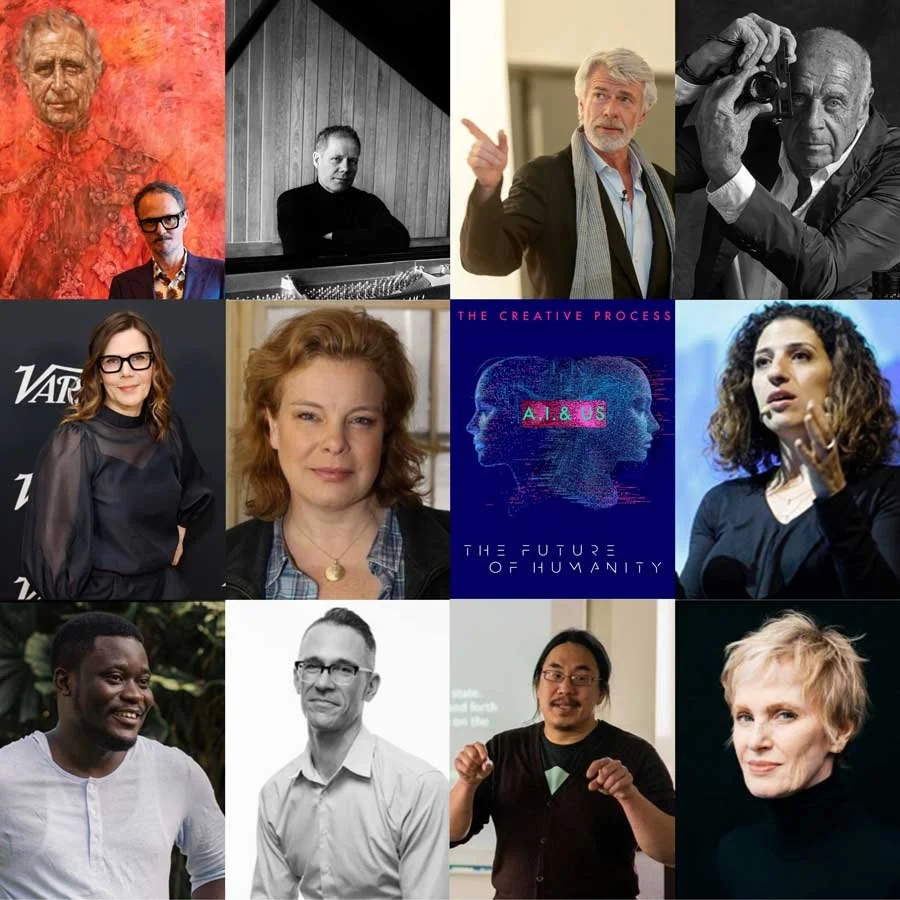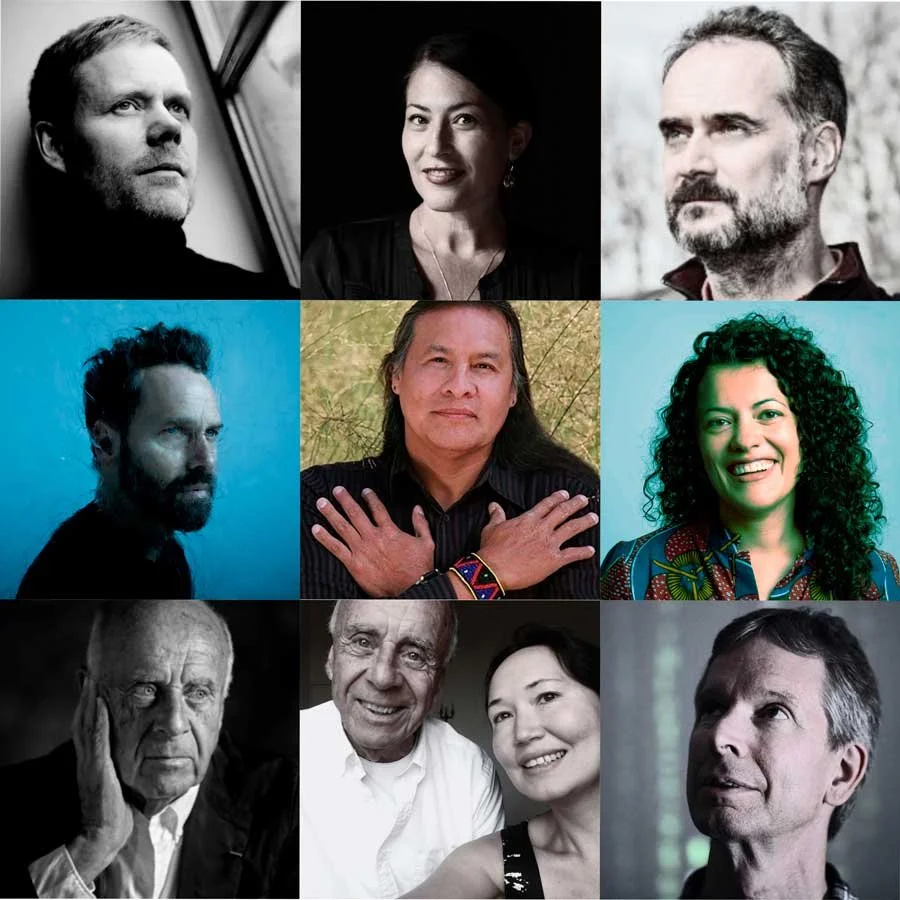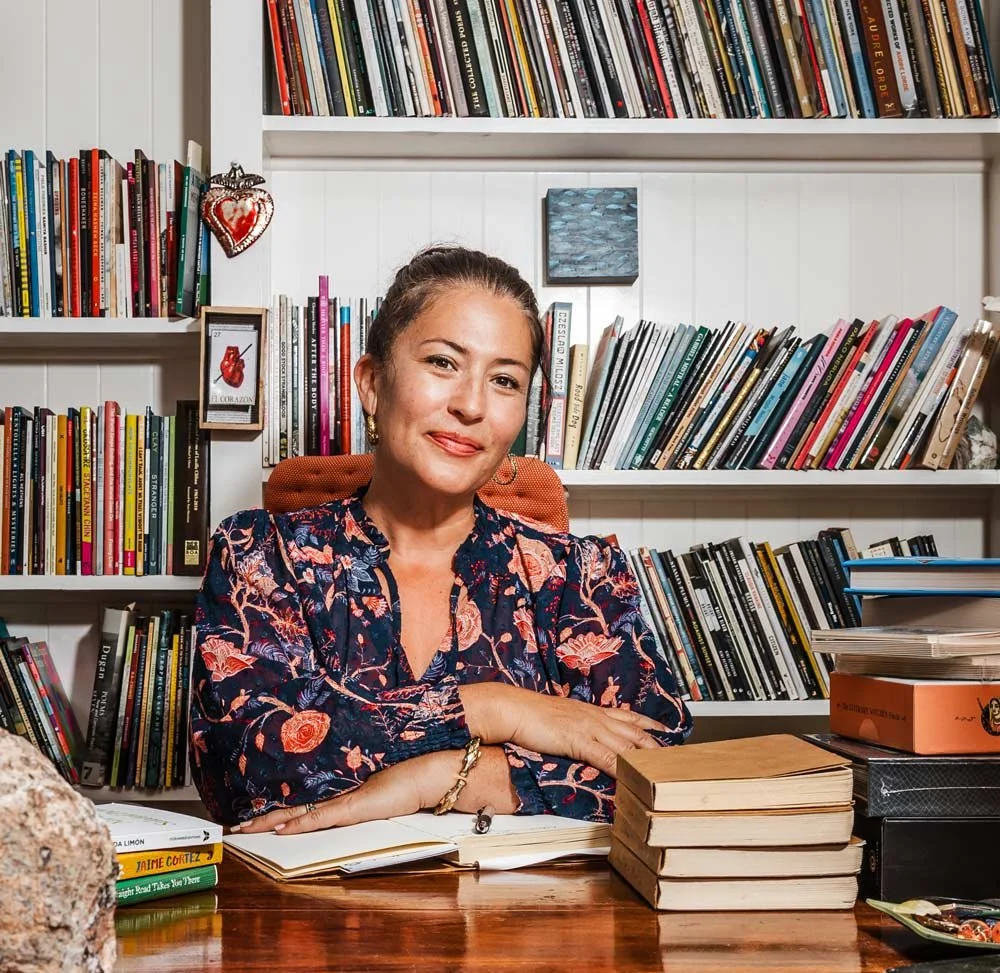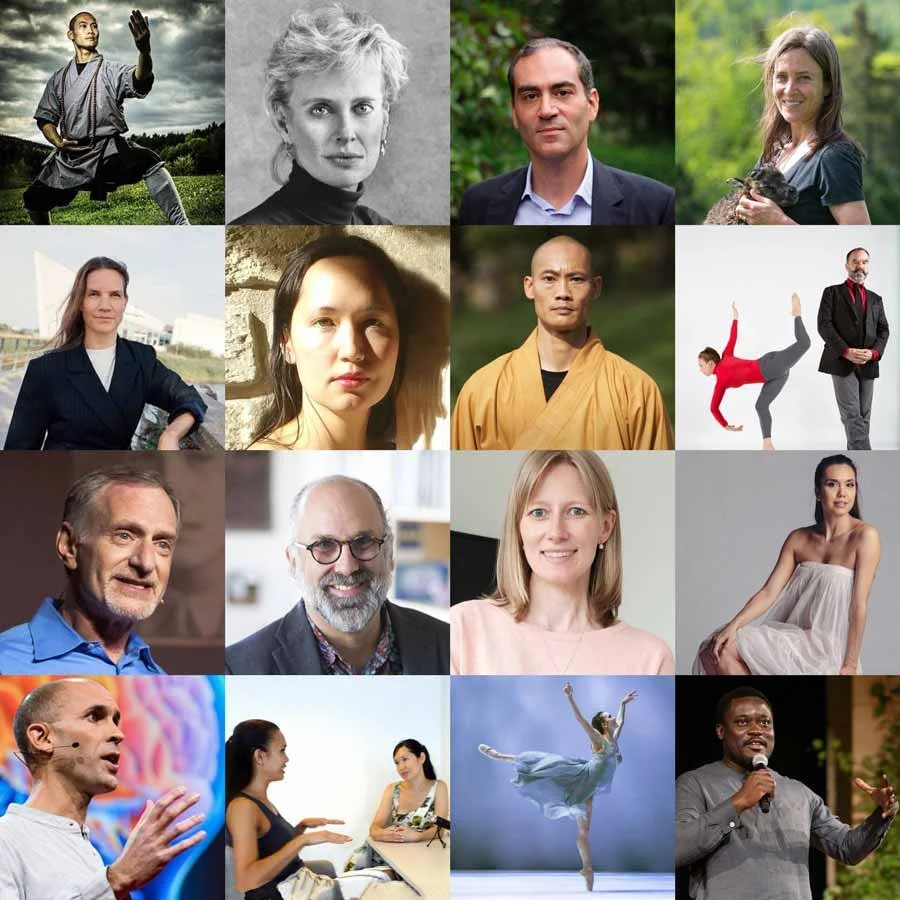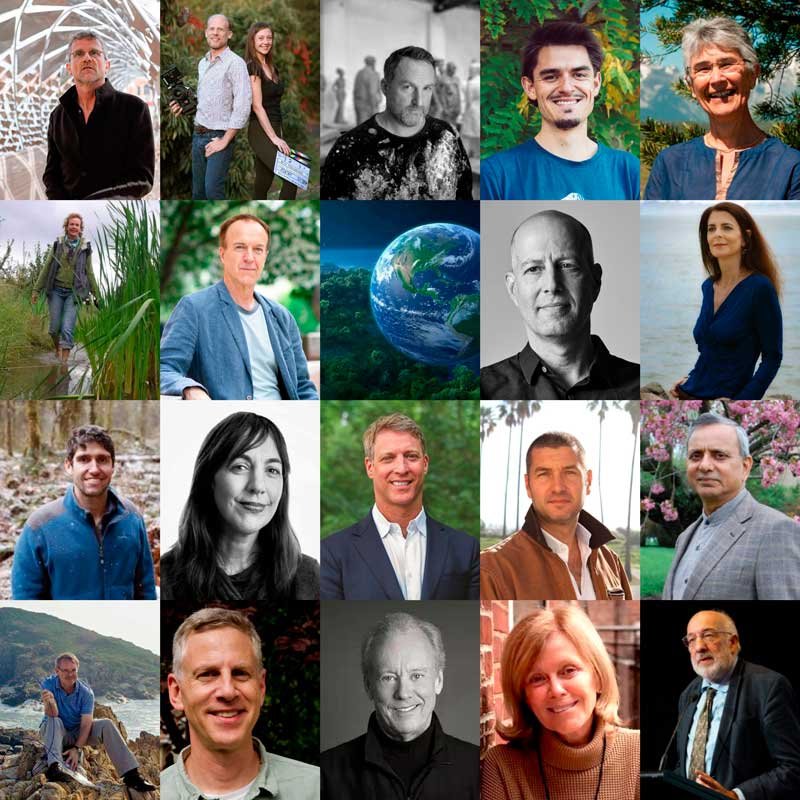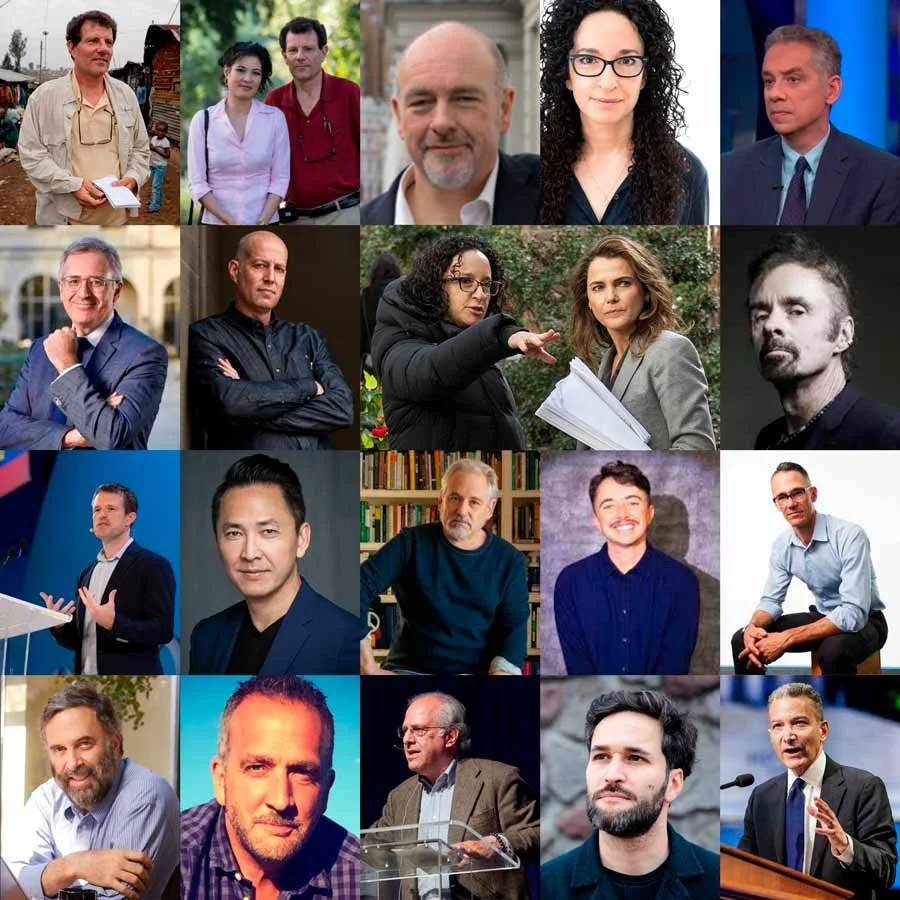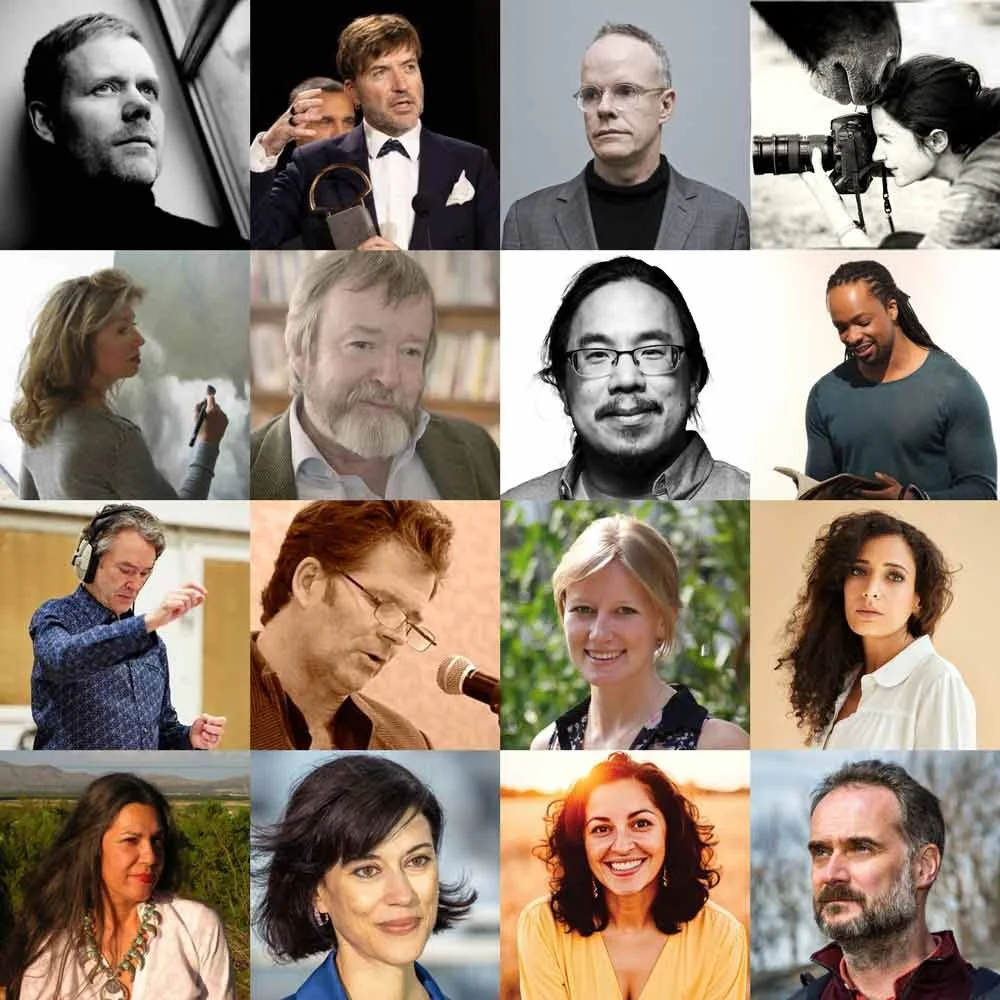


Creativity is an infinite conversation. The impulse to speak and be heard is what keeps us tethered to each other and to the world. Today, we explore creativity not as a luxury, but as a survival mechanism. From the cinematic scores of Max Richter and Carter Burwell to the Pulitzer Prize-winning poetry of Jericho Brown, we examine the human imagination. Psychiatrist philosopher Iain McGilchrist and writers Ana Castillo, Andre Dubus III and Hala Alyan discuss the power of the unconscious and embracing imperfection. We listen to the hidden life of nature with painter April Gornik, photographer Ami Vitale and writer Aimee Nezhukumatathil. Curator Hans Ulrich Obrist, scientist Daisy Fancourt, biologist David George Haskell, and philosopher C. Thi Nguyen remind us of the art of living and human connection. Finally, filmmakers Cherien Dabis and Albert Serra underscore that whether we are fighting for justice or simply seeking "maximum fun," the process is the prize.
To hear more from each guest, listen to their full interviews with The Creative Process.
MAX RICHTER
Award-winning Composer & Pianist
Sleep · In A Landscape · The Blue Notebooks
The world is very busy and we do tend to get sidetracked with things which are not important. Creativity is a way to reconnect with the things that are important. Literature is a big part of what I am about. I love stories. Music, literature, and visual art are ways to experience how another mind encounters the world. For me, that is the most exciting thing about it.
When you are reading a piece of writing or seeing a piece of visual art, you are seeing a window into that person's encounter with reality. You see their biography and what things mean to them. Then you can compare notes with that person. How is it that person sees these things? And how do I see these things? It is a way to understand one another. I think that is one of the most important things that creativity does in our world. Our children are facing some of the biggest challenges we have ever faced; they are existential. I think the kinds of narratives and perspectives that we put into the world with creativity can be a way to elevate the gaze.
Speaking for myself about somebody who lived 250 years ago, Beethoven makes my life better every day. It is not huge, but it is a little bit better every day. I think that is what creativity can do.
ANDRE DUBUS III
NYTimes Bestselling Author · House of Sand and Fog · Ghost Dogs
I read over what I wrote, and I had never felt more like myself. I felt like Andre for the first time. I was in my early 20s. I am not saying that at that moment I knew I wanted to be a writer, but I knew that in order to keep feeling this authentically like me, I would have to keep writing. That night was many years ago, and it is the only reason I have been writing all these years.
Even after I began to publish books, I do not write to publish books. There is a wonderful line from the writer Thomas Williams. He was asked late in his life why he wrote. He said, "I write so I do not die before I am dead". That is how I felt.
I teach young people and I find it immensely gratifying to do so. Especially for those who have already found writing in their blood so young, I tell them how lucky they are to have found something that makes them feel so alive this early in their lives. People live whole lives and never find it.
IAIN McGILCHRIST
Psychiatrist · Philosopher · Author of The Matter with Things: Our Brains, Our Delusions, and the Unmaking of the World
We certainly need a degree of resistance. In the West, we think of resistance as something negative, but it is actually part of the creative process. Without resistance, nothing new can come into being. The very things that we think of as perhaps obstructing or negating are the very things that will lead to something new and greater.
We need to get over this idea that friction is only a hindrance. For example, we are only able to move in space because there is friction. Friction is a force that stops you from moving, but without a degree of friction, you cannot actually move because you would not have anything to move in relation to.
Perfection is itself an imperfection. In a number of traditions, this is memorialized by the idea that when you create something, there should be deliberately some imperfection in it. In oriental rug making, there is the concept of the imperfect stitch. In the traditional building of houses in China, it was always the custom to leave three tiles off so that it was not in competition with heaven, because heaven itself was not perfect.
ANA CASTILLO
Award-winning Xicana Activist · Artist · Author of My Book of the Dead
When I returned to line drawing, it was something I learned decades ago in an art class. Back then we used India Ink and a fountain pen, which takes a certain amount of skill. Now I pick up a Sharpie and just start doing these freehand drawings. For me, it was elicited by my subconscious. It is what you are thinking and maybe not able to verbalize.
Some of the first drawings were done in those blank journal books that you buy, sort of random picking it up and doing it. They were hybrid people, such as a male figure with lobster claws or a rat’s tail. It was all unpremeditated. It was not as if I was planning on doing something weird or a weird self-portrait. It was always very spontaneous.
I like your instant insight about it because that is exactly what it was for me. It has been for me, it’s just allowing my subconscious to express itself when words do not come.
ALBERT SERRA
Award-winning Director · Pacifiction · The Death of Louis XIV · Afternoons of Solitude
I want to have fun. We are making films, so the question is, how can we make films having potentially the maximum amount of fun? Then you start to create a methodology that only answers this question. This is totally insane because people often start making films because they have a script or a vision of something. But here, the goal was just to have fun.
DAISY FANCOURT
Director of WHO Collaborating Centre on Arts & Health · Author of Art Cure: The Science of How the Arts Transform Our Health
We are all producers of art. We are a planet of eight billion artists. Tangible evidence of our artistic prowess as a species can be traced back 40,000 years. Around this time, a remarkable evolutionary development meant that Homo sapiens became capable of performing three advanced cognitive processes at the same time: mentally conceiving an image, intentionally communicating this image, and attributing meaning to it.
This resulted in the first physical examples of art that still survive today, such as stone figurines, bone flutes, and cave paintings. Art subsequently accompanied human beings as they spread across the globe. Every society and culture has art. We use it to express every emotion and every experience, from love and hatred to war and politics.
Art awakens our passions, causing public outcry, protests, and riots. Humans idolize artists as demigods and make pilgrimages to see them perform. Artworks are preserved for thousands of years to enshrine their beauty, bought for more than their weight in gold, and even sent for preservation on the moon.
As a species, we are obsessed. Yet despite this obsession for most of the past 40,000 years, we have failed to reach a consensus and provide a coherent scientific answer to a fundamental question: Is art good for us? I mean this not in the sense of being positive and pleasant, but actually having tangible, meaningful effects on our health.
DAVID GEORGE HASKELL
Biologist · Author of The Songs of Trees · How Flowers Made Our World
It's kind of you to say there's poetry in the work. For me, it is about honoring the language of the natural world. A book is in a way a sound sculpture because those words are symbolizing human language, which is primarily an oral and gestural language. As I am writing, I am thinking about the sound of the words. I want them to be well-paced and for the analogies to really work.
I do that not for the sake of literary pyrotechnics, but because that feels true to the experience of being in the forest or of smelling a flower. It feels true to the idea of how a tree makes it through a very cold night when the water in its body is freezing. If my body froze overnight, I would be dead.
Plant physiologists have discovered all sorts of interesting ways in which trees can survive ice inside their bodies. To me, those are extraordinarily fascinating and deserve to be honored by good words.
C. THI NGUYEN
Philosopher · Author ofThe Score: How to Stop Playing Somebody Else's Game · Games: Agency as Art
To be in the process of making things and talking to people about what things mean is the most meaningful part of life. However, it is very hard to measure. It is amazing to be on a podcast called The Creative Process because I want to say that the meaningful part of life is the creative process, but that is very hard to quantify.
When we get shoved towards a world that demands easy measurables, it is very hard to optimize away from things that are more static. We lose sight of the value of the process. I have been working a lot on the nature of games and play. To truly understand the value of a game, people make a mistake when they try to understand it in terms of its output or the points we get.
The modern world of outcomes and metrics is very good at measuring clean, extractable things, whether it is a book, a record, or a screw. These are clean, measurable extractables. But there is something else, something mysterious and fuzzy that I think is the most important thing: the process of figuring things out yourself.
CHERIEN DABIS
Actress · Director
All That’s Left of You · Only Murders in the Building · Ozark
My parents bought a camcorder when I was 12, and I just started using it to explain my life as a Palestinian American who grew up with one foot in the US and one foot in the Arab world. I felt like I was always having to explain myself to someone. The camera and stories became my way of doing that, and of trying to bring the two sides of my identity closer together.
I consciously decided that I wanted to become a filmmaker during the first Gulf War. During that time, my family experienced an insane amount of racism. My dad, who is a physician, lost many of his patients. We received death threats on a daily basis. This town that we had lived in for a decade totally turned on us overnight.
I remember asking how this happened. Why are people who know us suddenly believing these horrible things about us? I became obsessed with that question. I started to notice the media's portrayal of us and the dangerous way in which we were being stereotyped. There was a complete dearth of any authentic representation.
I became impassioned about it. I was like, "This cannot continue". That was the moment that really activated me and eventually put me on the path toward becoming a filmmaker.
AIMEE NEZHUKUMATATHIL
Poet · Author
World of Wonders · Bite by Bite: Nourishments and Jamborees
In some ways, it was the best thing because it took the pressure off. I kept thinking that no one was going to read this, so I was just going to write about the things that I love. I wrote about my family's resilience, joy, and astonishment. If I had felt a lot of pressure as a celebrated naturalist, I think I would have had major writer's block.
Once I got past that and decided to simply write what I love, whatever hesitation I had in the beginning vanished. Then it was just a celebration. It was so fun to get to the desk every day and think, "I am going to write about a vampire squid". I had the best afternoon possible getting to nerd out a little bit.
I would recollect moments of my childhood as well. It was unlike any other writing experience I have ever had.
AMI VITALE
National Geographic Photojournalist · Founder of Vital Impacts
The book The Hidden Life of Trees profoundly changed the way I see and feel about our world. Trees are a beautiful metaphor for humanity. You see one thing on the surface, but underneath there is a whole ecosystem of roots that are communicating and supporting one another. They give nutrition to each other when needed.
There was a story about a trunk that was 500 years old, and a whole ecosystem of trees were still trying to feed it and save it. I reference that every time I look at Beth Moon’s work. She gives personalities to these trees; you feel you know them. The list goes on and on, and then there are Jane Goodall's prints there. There is another artist named Xavi Bou whom I love. He does these time-lapses of birds as they are flying and weaving in the sky. It creates this whole magical way of seeing the birds. I love the metaphor of that. It is like, only until you slow down—like slow the shutter speed down—do you truly see what is happening and see the story? One of my favorite lines is: slowing down is the fastest way to get to where you want to be.
APRIL GORNIK
Artist · Curator · Co-founder of The Church Arts Center · Sag Harbor
I have chosen my work because I have loved the outside world. I love the things outside of myself. I love what is not immediate to me. I love projecting onto that as a way of trying to reach the distance between my inner self and vastness. I try to do that in a way that makes other people feel inspired by it, not be chided for not taking care of it. It is not something that I intend to be a message per se, but I think it might be a better message if it is not saying, "People, you have been bad. You have to change your evil ways."
I would rather people look at the natural world and see the heartbreaking beauty of it. I want them to sense its fragility, its impermanence, their own impermanence and fragility, and then have a response to that rather than say, "You have to act, you have to do something." I would hope that would inspire action rather than to cudgel them with a directive. I think that there is a lot of landscape art that has very specific messages, sometimes written into them, literally, with words.
Sometimes it is those kinds of horrifying photographs of land that has been destroyed by industry. I am thinking of the Niger Delta photographs of Sebastião Salgado. Those are all really, really important. Landscape is a portrait of a place, in a sense, but it is also a self-portrait; it reflects the artist and reflects the place. I personally think that all photography also reflects the auteur, the maker. There is such a variety of ways that people are trying to make a statement about how alarming this all is and how important landscape is. Everybody is doing it in a slightly different way, and I think it will keep evolving.
CARTER BURWELL
Film Composer · Carol · True Grit · Three Billboards Outside Ebbing, Missouri
Usually, what I do is look at the film and then go away from it. When I am writing, I begin away from the film because I do not want to be watching it or too locked into a particular scene. I want to be thinking about the emotional and dramatic issues the film presents. I usually sit at the piano.
The themes in Carol came in different ways. There is one theme that is almost like a hymn, representing the spiritual level of what is going on. Because of the way the film is shot—often through colored or dirty glass—there are all these screens between you and the characters. I want the music to get on the other side of that screen and say something about the deep things inside the character.
There is another scene where Therese first goes for a ride with Carol. It is shot with very tight closeups, where her vision has been contracted. I wanted to go with that in the music and make it sound like an altered state of mind. The piano piles up into clouds of notes so that it feels like you are in a different world.
I make it sound like I am solving problems, but there is free association involved. It is not necessarily a direct, logical path. When I sit at the piano and play, I try to ensure there is always a possibility for random events or mistakes. Sometimes I even read the newspaper on the piano while I am playing. When I hear my fingers do something interesting, I try to chase the idea that isn't necessarily even my idea; it just came from chance or the subconscious. There are any number of ways to look at it.
THE CREATIVE PROCESS
Do you feel now that you are writing from a place of it's beyond survival, it's now something closer to freedom?
HALA ALYAN
Novelist · Poet · Psychologist · I’ll Tell You When I’m Home: A Memoir
What a beautiful question. I think so. I hope so. I would like to believe so. I definitely think there was something in this project that was unlike anything else I have worked on before, in that it was, first of all, nonfiction. It is the first long-form nonfiction thing I have done. But I do think there was something liberatory about being like, there is nowhere to hide.
When I say "I" in a poem, I can always just say that is the speaker, that is the subject. We do not know that that is what I felt. Whereas in a memoir, you are essentially saying in the title—from the word mémoire in French—it is like, "This is my memory; this is me that is remembering and putting this together and telling you the story." And there is just nowhere to hide in that.
And I think while that is very terrifying, there is something, like most things that are scary, that is freeing about it too. For me, it has changed my relationship to how I conceptualize these things in ways that feel unlike anything I have ever worked on in my life because it forced me to have to confront not just my memories and my recollection of things, but also just: what is truly my commitment to the truth here?
What happens if that truth actually does not fit well with me? What happens if my truth is contradicted by someone else's truth, which happens all the time? It has been very painful, but I really would not trade it for anything.
JERICHO BROWN
Pulitzer Prize-winning Poet · The Tradition
MacArthur "Genius" Fellow
I decided what the form would look like before I ever wrote a poem. I understood it was 14 lines and where the repeated lines were. I knew I wanted a poem of couplets where each couplet seemed like its own poem. I knew it was going to be nine to 11 syllables.
Every line I ever wrote that was in a failed poem but that I was attracted to, I put in a single document. It went on for pages. I printed that document and cut all these lines into slivers of paper. I looked at all of them all over my house—the dining room table and the floor. I picked the strangest and best and decided those would be the first and last lines.
Because of the repeated lines in a Duplex, you actually only need seven lines. I would put every one of those slivers under a line to see which one sung out to me as a couplet. Once I got a couplet that was a poem on its own, I would take that second line and do it all over again. I kept doing that until I had couplets I could put together and revise.
HANS ULRICH OBRIST
Curator · Artistic Director of Serpentine Galleries
Author of Life in Progress · Ways of Curating
I always thought that curating has to do with junction making, which is somehow what J.G. Ballard defined when I met him. The great English writer. I think in a way, when I wake up in the morning, I always think about how I can bring people together who have not met each other yet. I think my activity has always to do with junction making.
When I do exhibitions, I make junctions between artworks. I make junctions between artists. I make junctions between art and different disciplines because I think we live in a society where there are a lot of silos. There is this difference—very specialized worlds. I have always seen it as my role to make connections and make junctions between these different worlds.
If we want to address the big questions or challenges of the twenty-first century—if it is extinction ecology, inequality, or the future of technology—I think it is very important that we go beyond the fear of pooling knowledge. We must go beyond the silos of knowledge and bring the different disciplines together. That is really at the core of what I do.
I do it through my exhibitions and through my conferences. I do it also every day because, on a day like today, I am in Paris. I took the train this morning and I would visit artists. I was at the studio of Simone Fattal and Etel Adnan. I have work meetings for projects. At the same time, I would go and see exhibitions. Then at the end of the day, from six or seven onwards until midnight, I would do meetings. Very often these meetings overlap. People meet each other. It is a kind of an infinite conversation.
THE CREATIVE PROCESS
Tell us about Studio Richter Mahr. What were your principles in founding it? Because I know that it uses cutting-edge, solar-powered heat pump technology, and you also engage with the community.
MAX RICHTER
Award-winning Composer & Pianist · Sleep · Voices
Co-founder of Studio Richter Mahr
This is a kind of a 20-year dream that Yulia, my partner, and I had: that we would found a studio which we could use for our own work. Yulia is a visual artist, but we also wanted to provide a facility for artists in earlier stages in their careers who do not have the opportunities to record music or spend time concentrating on their work.
We have set up a program of residencies where we have younger musicians and people involved in the art world just come and spend time here. We make available the recording facilities or whatever else they need. We have the opportunity for them to stay in the woods in these little huts. It is a project which really is the outcome of an idealistic vision of how creativity can coexist with the broader community.
Yulia and I passionately believe in the possibility of creative work having an elevating effect in society more broadly. In a way, it is a laboratory. We are excited by other people with their own ideas and their own thoughts coming in. So it is a space where we can exchange ideas. Yulia is really important in kind of everything I do because we have collaborated explicitly on some projects.
For example, on Voices, that is very much the outcome of a million conversations we had. She has made some beautiful visual material for that project. Sleep was a great big long conversation between us. We have sat around our kitchen table for 20 years having ideas and talking to one another about creative ideas and approaches to how creativity can sit in the world and what we should do next.
How is her work going? And how is my work going? This is what we do. If we are talking about sources, then I guess that is really the primary source. Then, of course, we are also on our own creative journeys, exploring, researching, and thinking about the things we see in our daily lives. Artists are just, in a way, ordinary people. Instead of having a conversation with a friend about something, I make a piece of music about it. It is the same impulse.