

If magnolias were rare animals, they'd be corralled into theme parks at the center of movie franchises and central characters in thousands of children's storybooks. In the floral world, we don't need a dinosaur movie. We live in one.
For at least 150 years biological sciences emphasized individuality and aloneness. So individual species, individual genes, individual organisms. And that's a useful view, up to a point. I mean, it is true that I am an individual organism. I've got a skin, and then the air begins and there's a gap between me and the next person over. But that view is also utterly false in many ways, in that the human body is not just comprised of human cells. There are bacteria, fungi, and viruses, all these other creatures that we now know are essential to our health. Our minds are not solitary. They're formed in relation to other beings. Ecosystems work only through relationship. So relationship and interconnection, not separation. And atomism is in fact the fundamental nature of life. Even from the very, very first fossils that we have of living organisms way back more than 3 billion years ago, these little cells are sitting next to one another.
THE CREATIVE PROCESS · ONE PLANET PODCAST
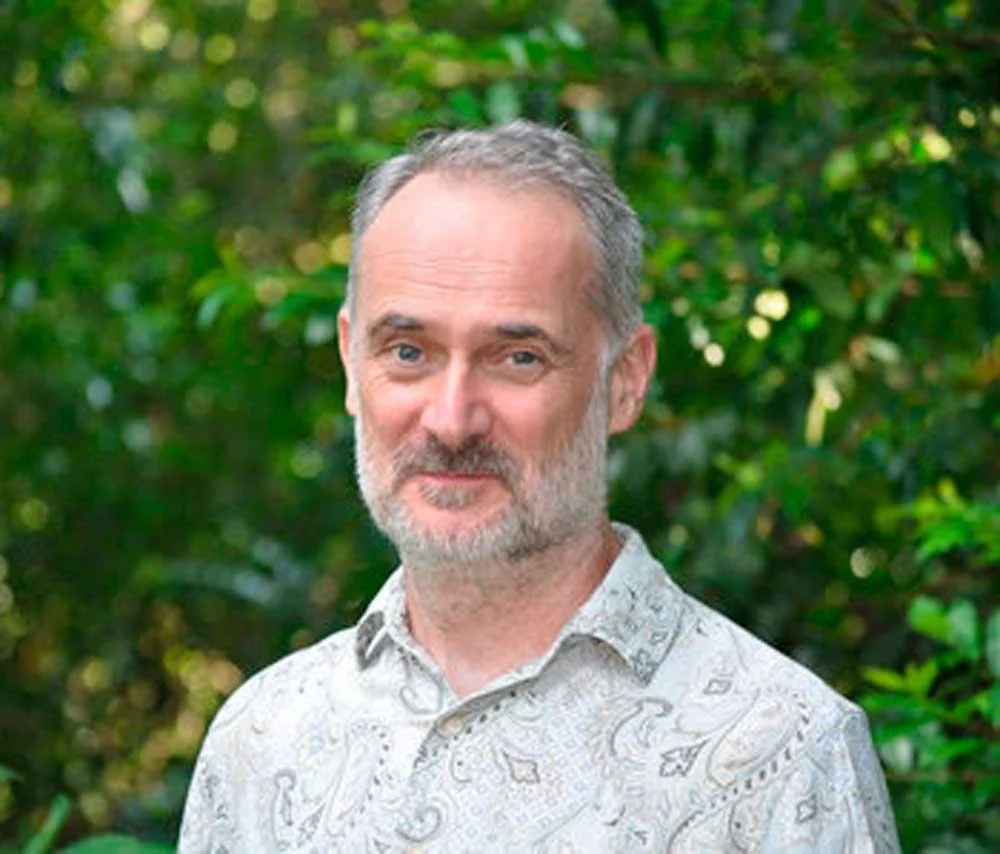
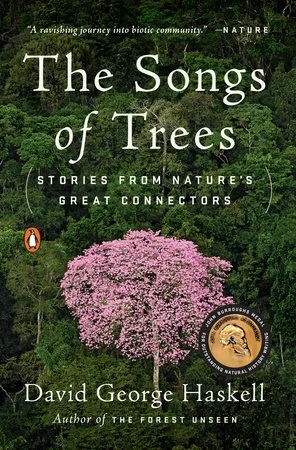
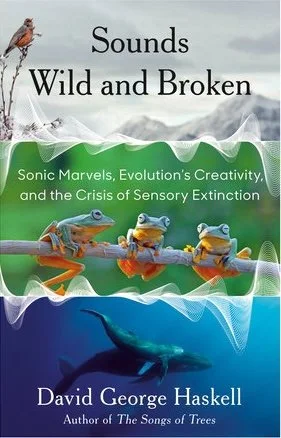
Our guest today is David George Haskell, a biologist who has spent much of his life training himself to see the universal within the infinitesimally small. He's famously sat for a year in a single square meter of Tennessee's forest, a mandala experience that revealed the deep history of the world through a single fallen leaf. He's a two-time finalist for the Pulitzer Prize for his books The Forest Unseen and Sounds Wild and Broken, and he received the John Burroughs Medal for The Songs of Trees.
His work often focuses on what he calls the unwaged labor of the natural world, the complex biological communities that sustain our planet without a monetary ledger. And his latest book is How Flowers Made Our World. In it, he argues that we are essentially grass apes dependent on the ancient innovations of flowering plants for two-thirds of our daily calories.
DAVID GEORGE HASKELL
Thank you, Mia. It's such a pleasure to be with you. I'm looking forward to our conversation.
THE CREATIVE PROCESS · ONE PLANET PODCAST
As I was reading How Flowers Made Our World, I was thinking back to your first book, The Forest Unseen, where you told the story of an old-growth forest by bearing witness to a single square meter on the forest floor. And now in your new book you focus in on flowers, a single seed, and how all of life comes from that. Moving beyond the individual to the relationships to tell us stories about the vastness of life on earth, and then in earlier books, you take us further back to ancient time examining evolution and the sounds of the universe. What I really appreciate about your writing and teaching is that you're really involved in showing us the beauty of the world. Because I think especially now, we can be so distracted by our daily struggles and surviving in our capitalist systems that we forget what is important and what gives our life meaning. So David, what started you on this journey of trying to understand life, and why did you focus on flowers to tell the story of us?
DAVID GEORGE HASKELL
Yes. The flowers I think are the great untold story of life. When we think about how our modern world came to be, of course we think about all of the human contributions. And then if we go to the Natural History Museum, we look at dinosaurs and other ancient animals and flowers are really not on the radar. But if we look at who built most of the modern ecosystems that we depend on and by we, I include humans and all the rest of life, whether it's human agriculture or the ecosystems that support the other species on the planet. Most of them are built by flowering plants, rainforests, prairies, mangroves, sea grass meadows, many temperate forests. And so flowering plants are creators. They're also very creative.
And I wrote this book partly to put them back at the center of the story of how our world came to be and to honor and celebrate them. And also to look at some ways in which we humans are working in productive, and then sometimes in destructive ways with these green companions and creators on the planet.
And you're right in saying that, you know, a lot of my work is very much focused on looking at very small areas or seemingly insignificant sense impressions, and then expanding out from that. And of course, I'm certainly not the only person to have done that. The most contemplative practices in religious and philosophical traditions doing exactly the same thing, meditating on a breath or on a particular artwork or a phrase of music again and again. And paradoxically by having quite a small aperture and restricting our gaze, restricting our senses to one object for attention or place that we honor with our attention, we perhaps see further or at least see and sense and understand and feel in different ways.
And I started that by sitting, watching a forest, basically a pile of dead leaves out in the woods for a year. And seeing where that process would take me by my practice there was really about opening my senses and reconnecting my senses back to all the intellectual stuff. You know, as a scientist, I know all sorts of interesting stories, hopefully about biology and life, but often that can be very disembodied. So bringing things back together, contemplative practice, intellectual study of science, sensory embodied experience. Both in my life, but also in my writing. I try and weave these and try and find some coherence as these things come back together.
THE CREATIVE PROCESS · ONE PLANET PODCAST
Yes. And it awakens us. We need to be reminded with humility that we are only one part of this. In talking about soil, a lot of people don't realize how our soil is becoming infertile, but within healthy soil one teaspoon contains more living organisms than there are people in the world. To think about just how much life is there and we are, many of us, neglecting it through our industrial agriculture. I want to follow up on one other thing that you said. The way you write, you combine the poetry with your science, and that's really refreshing because you don't deny that there's this moving relationship that oftentimes in the sciences, it's like we're supposed to just think in logical terms and forget about the relationship.
DAVID GEORGE HASKELL
It's kind of, you'd say there's poetry in the work and for me it's about honoring the language, right? A book is in a way a sound sculpture because what are those words in the book? They're symbolizing human language, which of course is primarily first of all, an oral language as well as gestural. And there are other elements to language there as well. But as I'm writing, I'm thinking about the sound of the words, and I want them to be well-paced and for the analogies to really work and for the verbs to activate a sense of emotion or engagement in people's minds as they read.
And for me, I do that not for the sake of literary pyrotechnics, but because that feels true to the experience of being in the forest or of smelling a flower, and also true to the idea, say, how does a tree make it through a very cold night when all the water in its body is freezing. How does a tree do that? If my body froze overnight, I'd be dead. So plant physiologists have discovered all sorts of interesting ways in which trees can survive ice inside their bodies. And to me those are extraordinarily fascinating and deserve to be honored by good words as well.
THE CREATIVE PROCESS
It is really a kind of loving relationship if you are sticking to the pollinators and their flowers, there's an attraction. You talk about the seduction of it and even the manipulation of it. We can go into each of the flowers that you explore. I didn't know the psychology of orchids and their relationship with fungi, but we are getting a bit ahead. I believe you have selected a passage from How Flowers Made Our World just to let us listen a bit to your poetry and science.
DAVID GEORGE HASKELL
Sure. I think I'll start with this is just from the very first chapter of How Flowers Made Our World, and the chapter is called Magnolia, and it centers on magnolia trees. And I live in Atlanta now, and magnolia trees are a significant part of people's experience of flowers and the plant world here.
A delicious aroma announces summer's arrival in Atlanta. In front of office buildings in Midtown, my nose plunges into sweetened almond and tangerine then resurfaces in a miasma of truck fumes. The scent brushes past me too in the scuffed lawns of city parks and along shady streets in older neighborhoods. To find the source of these delights, I look up. White flowers, the size and color of porcelain dinner plates, sprout from branch tips of huge southern magnolia trees, a plume of scent streams from each bloom. These aromatic trails dance like ribbons in a breeze, so I can never know when one will warm me with its touch. Over the next month, this scant first bloom will grow by June. A large tree can have 100 or more flowers open at the same time.
The delights of magnolia flowers are portals into deep time. When Tyrannosaurus stomped through the subtropical forests of the late Cretaceous, magnolia plants, or magnolia-like plants had been thriving for 50 or more million years. If magnolias were rare animals, they'd be corralled into theme parks at the center of movie franchises and central characters in thousands of children's storybooks. In the floral world, we don't need a dinosaur movie. We live in one.
The earth's first flowers left traces of pollen in the fossil record about 130 million years ago in the early Cretaceous. This is astonishingly late in the evolution of life. Most of the major groups of complex animals evolved 500 or more million years ago. The first plants, none of which had flowers, came onto land at about the same time too. Flowers were latecomers, but when they finally showed up, the party really got going. Within a few million years of flowers' appearance, perhaps as few as 3 million, the family tree of flowering plants splayed into almost all of the main branches that are still with us today. After this initial frenzy of diversification, evolution calmed down, producing new floral diversity at a more leisurely pace.
Truly, this was a revolution in a few million years. The green-brown world of tree ferns, conifers, and other ancient plants was overthrown by the flowering plants. Plants that had dominated the land surface for 300 million years were suddenly in the shade of the upstarts. Nothing was ever again the same. Most ecosystems are now founded on flowering plants. Our own species would never have evolved without them. We are sustained today by floral gifts from the food on our plates to the perfumes on our skin. The earth is a floral planet, and although we seldom realize it, we are a species almost entirely dependent on flowers.
READ MORE [ + ]
Yeah. And that's so important to hear and I'm so glad to hear it because as you address, for years many people have thought of flowers as being mere decoration. It's just a little bit of flavoring on the top. And then we know, of course, that we need the pollinators and all that, but they had been set aside as a decorative thing. Maybe as you write about, that's considered feminine. But actually so much more important to that revolution. I like to hear it said, and I only also say that because I'm a painter and I've been painting flowers and trees and water for years, so I know they are more than decoration.
Yeah it is. And there's an interesting another point I'd sort of just add onto that is that the beauty is part of their power. So the beauty isn't just superficial, no, actual beauty and connection. Aesthetic connection is a creative force, not just in the human world, but in the biological world as well. So that creative power, revolutionary power that flowers have is partly, not entirely, but partly because they are so beautiful. So their beauty isn't an aside or distraction. It's part of who they are and part of how they remade the world.
Indeed and it excites our reproductive instincts. It tells us what's good and bad. There are so many signals. You talk about plant communication generally, and throughout your body of work, you're always exploring different kinds of communication through sound and music. I am wondering what your reflections overall are on plant consciousness, but also maybe touch on the consciousness of trees, the mycelial networks, the different forms of artistic and creative connection and communication you've addressed throughout your body of work.
Sure. Well, for at least 150 years biological sciences emphasized individuality and aloneness, if you like. So individual species, individual genes, individual organisms. And, you know, that's a useful view, up to a point. I mean, it is true that I am an individual organism. I've got a skin, and then the air begins and there's a gap between me and the next person over. But that view is also utterly false in many ways, in that the human body is not just comprised of human cells. There are bacteria and fungi, viruses, all these other creatures that we now know are essential to our health. Our minds are not solitary. They're formed in relation to other beings. Ecosystems work only through relationship.
And so relationship and interconnection, not separation, and atomism is in fact the fundamental nature of life. Even from the very, very first fossils that we have of living organisms way back more than 3 billion years ago, these little cells are sitting next to one another. So, they seem to be engaged in these cooperative connections that we can still see today in modern bacterial communities.
So networked connection is the foundation of life. Whether you're talking about how genes work or how ecosystems work, how that then manifests in subjective experience. So consciousness is I think a big mystery, because we don't really understand how human consciousness comes to be. We know it's got something to do with network connections among particularly nerve cells. And our brains, you know, anesthesia and a bottle of wine quickly demonstrate the relationship between the nervous system and the subjective experience of consciousness. How a plant, a forest, a network, series of relationships among trees and fungi and microbes in the forest. We know those are real and very important. What they produce in terms of consciousness is a mystery.
I would say that whatever manifestation is going to be of a very different texture than consciousness as it appears in humans, because our consciousness is very much knotted up from a cranium and a mammalian body that's very hierarchically organized. And that's part of the genius of vertebrate animals is that hierarchy. But a tree is not hierarchical and a forest is even less hierarchical. And so there's going to be a more diffuse arrangement of consciousness, but no less complex because as you mentioned, even a teaspoon of soil, if it's rich, healthy soil has as many organisms in it as there are human beings on the planet. Take a handful of soil. There are as many potential connections among the cells in that handful of soil as there are connections in the human brain.
So the level of complexity is at a similar level to what we would find in humans, but it's arranged in a very different architecture, very different geometry. So the relationship between geometry and consciousness I think is an interesting place to think and to imagine. It's, as far as I know, an almost near impossible place to actually get any firm answers. Which is okay. It's okay to live in a world that has some mystery in it. In fact, it's a delight to do that.
Yeah, it's wonderful to wonder and remind ourselves of that because we tend to prioritize our own intelligence. We understand with our development of AI that we are the creatures of written language. And now we have a real identity crisis because we have been prioritizing our intelligence, which we've almost disembodied in some ways in our industrial societies. As you teach, we have to get onto the land, into the earth, and think with our whole bodies. What we see in nature is an intelligence that is not just seated in the brain. We talk about the importance of scent in flowers, but we almost kill our sense of smell and our sensitivity to noise. There are so many other nuanced ways of communicating that I just love exploring in your books.
Well, thank you. Yeah. Coming back to our senses I think is an important theme here. Because those forms of intelligence, even just within our human bodies, you're right, are not just neurological or in our brain or in our written work, although those of course are important aspects of human intelligence and memory, but are found throughout our body. I mean, even a simple experiment of getting thirsty or hungry through the process of a day, like through fasting or because we can't find anything to eat quickly, shows us that our consciousness is deeply related to the state of our body. And even more so when we are around other people who are experiencing either delight or suffering.
And so human consciousness, even though we imagine it to be a quality of individuals, is actually the quality of the community. And now, and I think a really great thing that's happened over the last 10, 20 years is, it's become a lot more acceptable both in the scientific community and then also more importantly beyond the scientific community to think about forms of intelligence and memory and agency in what David Abram has called the more than human world of creatures and processes and relationships that may include us, but extend far beyond.
And I think the ethical lesson there is one that we need to deepen our respect. If we're on a planet filled with other intelligent beings, with agency we should honor them, not just out of an anthropomorphic sense of, well, this is in our own best interest, although of course not deforesting the world is in our own best interest as humans, but also because these are our kin and our neighbors, our sister brothers that share the intelligence and potentially the consciousness of the world. And are in a way, and especially when we're talking about flowers, are inviting other beings into collaboration, which is what flowers have been really amazing at doing over more than a hundred million years now, is building collaborative networks to transform ecosystems in ways that before flowers just could not have happened.
Interlude: Sadie de Beer (Sarah Lawrence College Student, Creative Writing & Spanish)[+]
Hi, my name is Sadie de Beer. I am a Sarah Lawrence College student, and I study creative writing and Spanish. As I listened to David Haskell's comments on his studies and our lost connection to the world of plants, I pondered my own relationship with nature. I thought of how I have shown up as a listening ear at times attuned and at others shut off. I wondered whether I had properly envisioned the plants I loved as members of their own separate non-human community. I want to continue and improve this relationship while respecting the boundary between the grass apes and the grasses.
Several biologists with indigenous roots are leading the efforts to push their field in a direction to this effect. One such scientist, Robin Wall Kimmerer, wrote the highly acclaimed book Braiding Sweetgrass into which she wove both Potawatomi wisdom and her extensive scientific expertise. She encourages readers to listen to the plants, especially highlighting the native practice of introducing herself and asking permission from each plant before she harvests. Leigh Joseph, an ethnobotanist and citizen of the Squamish tribe, proposes her own indigenous model of plant-related research in her paper, turning to culturally important plants and indigenous conceptualizations of health. Both women bring indigenous ways of knowing into their work with either equal or greater value to scientific ways of knowing.
Haskell readily acknowledges that he is not of indigenous ancestry and does not draw from the same sources of generational memory. Nevertheless, the three scholars all share an interdisciplinary approach which blends the scientific processes of observation and experimentation with spirituality and humility. Post-colonization it has become the human tendency to see ourselves as the most powerful, most feeling and most deserving of empathy in our world. When we wish to show respect for another being, we speak of it as more like ourselves. The trees can communicate, they are just like us, therefore we should not cut them down. This well-intentioned environmental argument assumes a superior level of knowledge. Perhaps we can shift our mindset to one of more humility: trees communicate completely differently from ourselves, therefore we have something to learn from them.
But then another part of what flowering plants have done is they're extremely genetically flexible, they're nimble, almost playful. They can skip around and find all sorts of innovative new ways of gathering sunlight and of attracting pollinators and working with microbes. And, you know, of course our human senses can't access that directly, but there are plants that are particularly genetically nimble and have been through genetic revolutions just in the last hundred years. And scientists have documented this. And so I went to parts of the Western US where some of these plants live. And so there's a chapter on goat's beard, which essentially looks like a badass dandelion, it's like a dandelion with spiky petals. And the dandelion head is about three times the size of a regular dandelion, and they've very recently been through a doubling of their whole genome, and they united the genome of one species with another. It's been a whole shakeup, almost like a rave happening there in terms of producing new genetic diversity and exploring new possibilities. And these plants have then adapted themselves to quite new environments by doing this.
So that is a species that I picked because it was a great example of a hidden process, and then I always want to write about things that are accessible to human senses and we can relate to. And, you know, many readers, at least in areas where there's cultivated land, will know goat's beard as a weed so-called in agricultural landscapes. It's also a food and a medicine, at least in some parts of Europe. So I chose that plant for that reason. Others, roses, because they're the epitome of how we combine our individual identities with those of plants to express ourselves through perfume. Not the only plant that's used in modern perfumery, of course, but roses have been used for thousands of years because we are so entranced by their aromas. And then other plants that are really obscure, seagrasses that grow in muddy sediments off the shores around many continents all over the world. And most people have never heard of a sea grass, but it turns out they're vital for the health of marine ecosystems. They store a lot of carbon in their sediments and they're one of the few flowering plants that actually flowers underwater, which to me are just kind of very amazing and beautiful. So I had a chapter on them because they're so important. And I wanted to elevate some of the stories of flowers that many people have not heard of. Roses, of course, and magnolias. Most people know about those. And I want to illuminate those in new light, but also pick out some other characters that deserve a little bit more of the spotlight.
A second way in which we're grass apes is about our origins because our ancestors 7 million years ago were little tropical primates living in trees in the forest. They came down from those trees and became clever bipedal pre-humans by walking out of the forest into grasslands. So grasslands created the habitat in which our prehuman ancestors evolved, and there were lots of different species of these ancestors, some of which went extinct and others led to modern humans eventually. And their diet was very much based on grasses back then. They either ate the grass or ate the animals that were eating the grass. So we are a species that evolved in African grasslands and savannahs, so we're grass apes in terms of our origins as well as what we eat today. So yeah, we owe our lives to grasses and in religious contexts we should have grasses displayed on the altar or the front of the place of worship. So these are our creators. Now, maybe there are some Gods involved and so on as well. I don't know, but we do know that the grasses were very much involved.
And, you know, looking back, and even in European history, English kings used roses as their symbols of power. In France, the fleur-de-lis was used as the royal symbol, the chrysanthemum, the imperial symbol of Japan. And so there are lots of examples of flowers being used as examples of basically entitled masculinity because an English king is the kind of apex of entitled masculinity right within humans. Roses. So rose perfume is regarded in contemporary western culture mostly as quite feminine, but that's not at all the case across a lot of the Middle East where for thousands of years rosewater has been used in cooking, but also as a perfume for both men and women. And for some Persian aristocracy roses were the smell for men. And so I hope the book is an invitation for people to think about the ways that we pigeonhole flowers into narrow roles, but also pigeonhole ourselves into narrow roles. And hopefully there's an argument for some more diverse set of ways of thinking about our relationship to flowers and the complex relationships between human gender, biological sex in humans, which of course is not a one-to-one mapping at all, and then biological sex in plants, which is a whole other thing, right? So we are not flowers, we are not plants. And so we should understand them in their own terms. So yes, gender is, and biological sex take many different forms within flowers. And part of the genetic nimbleness that I mentioned earlier is that flowering plants, most flowers are biologically bisexual. They have both male and female parts within them. But some of them have separated male and female to have more efficient pollination. Some, like some little wild flowers start off expressing the male side of their genetic identity by producing pollen. And then when the plant gets big enough and has enough food reserves to produce fruits and seeds, then switches to produce female flowers, and then other flowers produce both male and female. So there's a flexibility there that is not only flowers that do that, lots of fishes also regularly change their biological sex.
And flowers represent a very particularly complex tangle of those ideas that is sometimes very rich and beautiful, and other times used in aggressive ways. Think about all the floral slurs that are used for men who are quote unquote effeminate, right? So often flowers are used to put down and to attack people with particular gender or sexual identities. And so yes, there is beauty in all that diversity of expression among flowers, but also within the human realm there is some weaponization as well.
But alongside that was an emphasis on beauty. So even in the wartime allotment gardens my great grandparents and grandparents were growing flowers because humans, we don't just need calories. We need beauty in our lives and growing some flowers to provide a sense of connection to the living beautiful green world was one way of doing that. And so I continued and I picked that up whenever I'd go visit relatives. Usually they were sometimes spent in the garden, tending plants or looking at what vegetables or flowers were coming along, and at home we had a garden and I liked to grow, and my sister also liked to grow food plants, but also giant sunflowers and other fun big things that little kids can get involved with. And then my mother in particular was very passionate about orchids and finding wild orchids.
And so we would, I grew up in Paris mostly, and back then in the 1970s in Paris, the parks were very manicured and very strict, you weren't allowed to step on the grass. If you stepped on the grass, you'd get whistled at, and the adherence to rules has not changed. Although I am actually stunned coming back to Paris now on my few visits, how many gardens have incorporated many more native plants, putting out nesting sites for pollinators. There's much more ecological awareness, which to me is really inspiring and the air is breathable. It's important to realize back in the 1970s, the air pollution in Paris and in London, New York, many major cities was just horrendous. And to me, it's extraordinary now that there are some parts of Paris that still have a fair amount of traffic, but it is like a whole different planet.
So, but for a kid growing up, we didn't get much experience of quote unquote nature, right? You couldn't even step on the only green thing in the neighborhood without getting in trouble, the manicured lawns. So we would go out into the countryside and my mother would take us to places that particularly had a lot of limestone in them, where orchids loved to live and she would take photographs of them. And as kids, we enjoyed those outings. We'd grumble about looking, because as a little kid, a small orchid is not that exciting. It's not as exciting as a big sunflower. But over time, I think both my sister and I came to appreciate the orchids for their beauty, their diversity, and the fact that it's just extraordinary that these untended wild places, open meadows and grasslands are just an incredible number of species all packed into one place.
And what's even better is some of those orchids are really sneaky. They're not offering nectar for their pollinators. Instead, some of them are, the orchid looks and smells and feels just like a female wasp. So the male wasps, they're all amorous and they try to mate with what they think is a female wasp, but it's an orchid flower, and the male wasp is wasting his time, but he gets a little piece of orchid pollen put on the back of his head and then flies to the next flower and deposits that pollen. And so the wasp has been deceived by the orchid into carrying its pollen and the wasp gains no reward. So there are these stories of deception and illusion that are particularly well developed among the orchids. There are other orchids that look like they've got lots of pollen, but don't have any. There are some that look and smell like rival male bees and the males try and fight them, but there's no one to fight there and instead they act as pollinators. So some of the fascination with flowering plants, well, I would say a lot of it came out of my experiences with my family, both in gardens, but also going into somewhat wilder places to look at the diversity of flowers.
It makes us think about our own microbiome and how many things are living in and on us, which can influence our consciousness and desires. It makes you wonder how much free will we have, and how much of it is co-authored with those around us. I want to point people to your book The Songs of Trees as well. We are talking about living in the present moment and our relationship with plants in the natural world, which is something that non-human animals do so well. They are very connected to the moment, but in your book Sounds Wild and Broken you also invite us to think about deep time and sound that existed before this earth existed. What got you into that dimension of thinking?
Well, the trees were my portal into thinking about sound because my book The Songs of Trees partly, it's quite literally about listening to trees over and over again, listening to individual trees. In different parts of the world, located in seemingly very different places. So a tree on the streets of Manhattan, a tree outside the old gates of Jerusalem, a tree in the Amazon rainforest. Go back again and sit and listen and open my senses to what the sounds in and through that tree mean about the nature of its community.
And then listening to trees then let open my ears and my imagination to the sounds well beyond the tree, of course. Because the tree sound is composed of many different creatures in addition to the leaves and the sound of water in the xylem. And so in thinking about trees, I came to really wonder how did this earth come to be so sonically diverse? Every bird species has its own particular song. Every insect has its own sound. In the summertime, you walk into most ecosystems and the primary method of communication for many of the animals in that ecosystem is through sound. How did that come to be and what would it be like if we were in a forest 300 million years ago? And so easy enough to ask that question actually turned out to be quite difficult to make reconstructions of what the soundscape of early earth would be like. And so in Sounds Wild and Broken I try. And the first part of the book is tracing the sonic history of our planet. How did we go from a planet where the main sounds were of rain and wind? Very few sounds of life to a planet that is essentially in full voice. In full song most of the time with very, very diverse songs.
And then the next part of the book is thinking a little bit about where humans fit into that. Of course, sometimes we can smother sounds with our noise, and by raising habitats we silence parts of the planet. But we are also in a way pinnacles of evolutionary creativity when it comes to sound because human language and music. Extraordinary expressions of sonic interconnection and music in particular is an interspecies experience because if I play a violin, I've got horse hair and maple and spruce wood, all kind of working together with my body to produce a sound that connects me to other human beings. So the second voice of the forest draws people back together. So my inspiration for thinking about sounds were sort of listening to specific things like trees and bird songs, but then thinking about creativity more generally. Why is it that earth sounds are so diverse and where do humans fit within that extraordinary exuberance and diversity of sound?
I was interested in thinking about how we originally became sonic creatures ourselves. Our body becomes an instrument, just like other creatures, plants and trees have their own instruments. It is something we should really think about because we often do not realize how noise pollution affects us. It affects animals and their navigation, and part of losing biodiversity is the apocalypse of our soundscapes.
Yes, and soundscapes, we're losing sonic diversity, I should say. In some parts of the world, sonic diversity is coming back because of careful restoration and care that people have given to the land. But in general, of course, we're living in a time of rapidly declining biodiversity. And biodiversity isn't just about how many species or how much genetic diversity, it's about the sensory diversity of the world, the aromatic diversity, the sonic diversity, the diversity of colors and textures and forms as well. And so these are all parts of what biodiversity is. So that's what we're losing. It turns out sound, because sound passes through leafy barriers and it passes through even the dark of night, sound is a really good way of assessing biodiversity. So when scientists want to examine how is this forest doing in terms of conservation compared to some other forest? Often they'll make sound recordings. And from the sound recordings you can then figure out what is the diversity level in each forest, because of course, an impoverished forest will have a very impoverished soundscape. So with just a few microphones, it turns out you can make a fairly rapid assessment that can be helpful for conservationists and land managers to try to protect habitats to meet human needs, say for timber or for food without damaging biodiversity.
And so sound recording, I mean, sound is beautiful and we should value for its own sake. It also has a sort of practical use when people are trying to understand habitat conservation and there's a lot of work with that now. People using all sorts of remote recording devices and statistical algorithms to pull out ways of measuring biodiversity.
We see how non-human animals, plants and all of life really respond to music. It makes me think about how the arts, and particularly music, can be used to help harmonize us around important decisions like mitigating climate change. It might sound airy-fairy, but we are entering into wars and find ourselves in so much disagreement. As sonic beings, bringing us together through music could help bridge areas where we have opposing minds. I have seen you discuss how music helps us connect and communicate with animals. We recently had a French violinist named Plume on our show who plays for animals, and you can see how it crosses barriers of communication. He plays for wild animals in sanctuaries, like rhinoceroses and tigers, and there is a profound trust and communication. Can this help us find more agreement on difficult issues?
No, I don't think it's airy-fairy at all. I think listening is fundamental to living in good relationship with others. And in terms of human wars, right? If people would just sit down and listen to one another, of course we'd be in much better shape, both the leaders, but also culturally, you know? And if people in the US, for example, had a deeper appreciation of the musics of Iran, I mean, right now the US as we're recording this is bombing Iran. And the cultural appreciation and connection through music, through other forms of art are really, really important because that reminds us of our shared humanity. It's inspiring to us to hear and to sense things from other people, from other cultures.
So it's absolutely, I mean, just as a tree, if you cut off all the roots of the tree and kill all the fungi that are connecting the tree to other trees, that tree will wither and die. We humans, if we cut off from one another, calamity ensues. And I think the same is true in the modern human realm. I mean, making music with other creatures for or with other creatures. David Rothenberg is another great example of someone who's done a lot of this work. A musician who improvises along with birds and whales and insects.
And for those of us who don't play instruments, the practice of listening to the living world and celebrating, say, the return of the swifts back to cities in North America and Europe. We should be having parties when we hear the first chimney swifts coming back, tuning into the sounds of the frogs or what insects are singing, celebrating, mourning the ones that we've lost, inviting young people into these practices of listening, I think is really important because we know this from say, close human relationships. If you stop listening to your partner or to other people in your family, it's not going to go well.
If we as a human species and we're a very powerful species now stop listening to the voices of the living earth, that's not going to go well either. And that's partly what's happened. You can get a degree in biology in most places without knowing the songs of the 10 most common birds that live in the place where you are studying and getting your degree, or being able to identify the trees that grow right outside the biology lab. So even at the heart of the science that is supposedly about studying life, we have a disconnect, a forgetting to listen that I think is problematic.
And the good thing is restoring those connections isn't a burden. It's a joy going, listening to bird songs and learning to identify and connect with the trees of our neighborhood. This enriches our life. So it's not like learning another thing for the science test. It's reconnecting in ways that we then want to share with other people. So I do think the fact that the innate human love and need of connection with other species gives us so much pleasure and joy is actually a good thing, a hopeful thing.
It is really true. You open our eyes to appreciate all our senses. What was your first awakening to beauty in the world and that sense of curiosity and learning?
That's a very hard question because for me, beauty is so multidimensional. As a young child, I used to smell everything. Every book I would sniff, I'd sniff the spice jars. I loved to go to the cheese shop because there were so many different aromas. So, you know, there were pleasant aromas and then some quote unquote not so pleasant. And so the joy that comes from aesthetic appreciation, although I wouldn't have termed it like that when I was five years old came to me first I think, through my sense of smell. And later probably through music. But the sense of smell was very, very important to me.
And then later on in life, I started connecting those aromas into stories. Oh, you know, this flower smells this way because it's speaking in an aromatic language to a single species of bee or to some flies, or whatever the pollinator is. And that to me is a sort of intellectual beauty of these sense impressions then lead into ideas and stories from the present and past. And then my own past is like, oh, I remember this flower from 20 years ago. And so there's an emotional connection. And so that sense of beauty for me, there are early moments, but then they grow, they sort of blossom if you like. As I think this is true for a lot of us as we age, we stitch new parts into those stories. Some of them are very sad. They remind us of people and places that are now gone from us. But even in that connection, in that grief, there's a remembrance that I think is really important and really human.
It is strange how much can be contained in these moments. We do not even think we are taking them in. We are so obsessed sometimes with language that we forget all the things that are in our unconscious. From your first book onward, you have had this mandala approach, celebrating the smallness as a way of viewing the vastness and beauty of the world. How have your spiritual beliefs evolved over the years?
Yeah, the word spirit is another one that's difficult because it means so many different things to different people in our culture. For me, the sense of say, sitting with the same patch of forest over and over again for whole, now it's been nearly 15 years, and I still go back to that patch of forest, not every day as I did in the beginning, is this sense of humility, that my story is just one part of many, many other stories that far transcend me. And also simultaneous sense of deep connection. I'm connected to these trees and my bodily sustenance and the energy that keeps me going comes from the living earth, but also of distance that, you know, that woodpecker, this tree, this flower, there is an otherness there that I want to honor. I'm not going to pretend that these are all little humanoids running around and project my allegories and metaphors onto them the whole time. They need to have their own space to be their own mysterious selves.
And so for me, that feels spiritual in the sense that it transcends the self into something that is of a time scale and a physical scale and a level of complexity that is far beyond me. How that connects into other forms of spirituality, so traditional religious practices and so on. I mean, I've moved around a lot over the years. The constant in all of that, I guess, has been the importance of silence and of sitting with, and this is from T.S. Eliot, sitting without expectation, right? To go to the forest. Or to go to a place of worship or to go to a meditation retreat and to sit and to just be with whatever's coming up inside and whatever's happening outside without expecting enlightenment or sacrament or excitement of any kind or any progress.
And that practice has been really, really important to me, because it feels like an anchor in the world that of course the outside world is rapidly changing, but also just as we go through the decades in our lives, the inner world, the nature of our relationships changes, our health changes. So being able to sit among tumult and find a measure of centeredness has been quite important. And again, for me, that is spiritual, whether it's mystical or connecting to some deities beyond the... I don't know, I'm sort of agnostic about that. But I do know that it's very important so that in a way it's a form of prayer to sit in silence without expectation.
Speaking of spirituality, I noticed in the book you include several references to biblical texts. It seems like you have made a concerted effort to appeal to a wide range of audiences and make sure different people become interested in putting flowers at the forefront of their imaginations. It seems intentional to tie religion into the book in a very true sense, but also in a strategic way. I was wondering what other ideas you have for getting people interested in these environmental arguments.
Yeah, thank you. I love the way you've drawn those strands together. You're right in that my hope for this book is to really share the stories of flowers with a wide audience. For people who maybe don't think about the environment or science or plant biology, but most people do connect with flowers one way or another. Right? Even if it's just once a year we buy a bouquet for our loved one, right? On Valentine's Day or something like that. But there is this cultural understanding and honestly, I'm not that strategic about it. For me, I let the stories that feel important to me in my gut and that really tell part of the bigger picture find the right flowers to tell those. And then the words are trying to draw people into those stories and experiences in ways that, say, for example, the biblical references that, you know, one of them is Isaiah, right? Who said that all flesh is grass, right? And that the original biblical meaning of that is that our human lives are short and are going to wither away very quickly. At least that's my understanding of the theology behind that. But there's actually an ecological truth in it as well that I don't think Isaiah was intending in those prophetic messages. And that is literally my flesh. My human flesh is mostly made of grass because I'm eating rice and wheat, and if I eat any beef, it was grown from a pasture and the sugar in my drink and my cup of tea and so on, all of that came from grasses.
And so often with these quotes, I'm actually trying to triangulate out to sort of well-known cultural references, but also to make us think a little differently about those cultural references. So, for example, Isaiah, I don't know a lot about the history of these biblical prophets, but lived in a seasonally arid environment where annual grasses were really important food plants. And so in what way could we understand the Bible as coming from a particular ecological context, right? And the importance of clean water in the Bible is also really important.
The time when I visited the West Bank and Israel more than a decade ago now, to write about olive trees for The Songs of Trees, I finally understood why in the Bible there are so many references to springs of clear water because it felt like a miracle to me in that landscape that this water even existed. It was so dry, it was so hot. There was not a river or a pond to be seen. Like where, how are we going to survive the next 24 hours here? And then you come on this spring and it really does feel like God. And so honestly in the southeast of the US where I live, water does not feel like God. It feels like a problem. Like the basement is flooded, the river is full of mud. I mean, there's just water everywhere.
And so understanding these texts in their ecological context I think is important there. And in terms of political messaging the book has political messages in it about cooperation and revolution doesn't need to be violent and we need to rethink how we think about biological sex and human gender and things like that. One political message that sort of resonates for me is the old rallying cry of bread and roses. So this is an old leftist rallying cry, and I believe it was a suffragist who first came up with it. Her name isn't on the tip of my head now. And then it became encompassed into the wider movement. And what it means is that what we are fighting for politically is not just bread, like people being able to put food on the table. It's access to beauty and to experiences of a meaningful life. So roses as well are a fundamental human right. And there's a lot of wisdom encapsulated in that slogan. How we get there, you know, there are lots of different political suggestions about how we get there, but I think bread and roses is something that should be revived because who doesn't need more flowers in their life right now? And who's against putting bread on the table?
As a botanist and a critic of the colonizing rationale that fathers of modern-day botany started with, have you ever been frustrated with the rules of taxonomy and binomial nomenclature?
Yeah, and I should say, you know, I am a white male from Western Europe, and so I acknowledge that I live in the 21st century now. I'm within my own particular box, just as Linnaeus was and so Linnaeus came up with a binomial system. He also encoded racism into the foundation of modern biology. I talk some about that in the book. In my own experience, I find specific names, binomial names can be useful, right? They help increase clarity and it makes it easier to look up a plant in a field guide. So they have that utility, which is why Linnaeus came up with them. He was basically a database manager. And so he literally said that we should use latinized names for science and ignore all the local names for plants.
And those local names come from indigenous people all over the world, whether it's in the Americas or Western Europe. I mean, the colonization happened worldwide. It wasn't just, it was within Europe as well as elsewhere in that local names got erased. And so most plants I know by their common name or by my nickname for them and so on, not by their scientific name, but I do acknowledge the scientific name is useful. I personally wish that the rules for scientific nomenclature could be more flexible and allow more changes. So, for example, plants that are named for no other reason than some benefactor or some friend or enemy of Linnaeus that seems irrelevant to the plant. It dishonors the plant's place of origin.
And the people in that place of origin that have many other names, they're like, okay, we are clever enough to figure out how to change those names. But there's a lot of resistance to that within the scientific community. I mean, almost a complete wall of resistance to that.
Talking about that spiritual element, there is a lot of people who get caught up in distractions in our consumer society, but we also have a huge surge of interest in mindfulness today. I guess the real challenge is how we take the knowledge you share in your books to transform our extractivist capitalist systems. How do we translate that reverence for the earth into a more cooperative economy based on love?
Yeah, that's a big question. And I think we do it together. I don't think there is a single thing that's going to cause that transformation. So my contributions in my own life have been through writing, which hopefully reaches people and changes the way we think about the world, which seems, I mean, some days I think it is completely insignificant. Other days, I think, no, this cultural work of changing how we think of ourselves in terms of relation to other beings is really important because without that shift of realizing that we're kin with the flowers and the flowers made us, how are we going to honor flowers? And if we just think of them in a more instrumental way as just sort of dead creatures that we use and process to produce profit.
And then as a teacher, I've been a teacher for more than 35 years and sharing those experiences and ways of thinking with students and when I'm on the road giving lectures and so on. But you know, it's not all about me. I'm doing my little bit that hopefully connects and I try and work with other people to make those connections happen. So that bit by bit we have a cultural shift that then leads to policy shifts. I don't think culture is enough, particularly in the face of authoritarian takeovers, which is what's happening in my opinion, in the US right now. We need political engagement and activism on the streets and ensuring that we can still have the right to vote and getting the right people to run for those offices.
So I do think political action and cultural action and personal transformation, right? I mean that's sort of a Buddhist perspective is you worry a little bit less about changing the world and change yourself and paradoxically in changing yourself, you produce more change in the outside world. I mean, that's a horrible way of sort of butchering a lot of Buddhist wisdom. But I do think sometimes we have an excess of people looking to transform other people and not thinking a little bit more about transforming ourselves. And I feel that in myself as well. And so maybe I'm offering a self critique here, to be a little more careful about my own thoughts and behaviors, rather than thinking all the time about pointing the finger elsewhere, because, you know, we're embedded and enmeshed in these systems.
I know that part of your teaching focuses on urban ecology as well. Even though there are lots of movements, like regenerative agriculture, there are so many ways our cities and factories need to be transformed. This is hard for the individual to do on their own through purchasing power.
Yeah, no, and I don't think, I'm not at all a believer in transformation entirely through consumer power. When I'm talking about changing ourselves, I'm talking about the ways that we think and relate and feel to the rest of the world that then helps us with the collective action that is necessary to change things like cities. And you know, my take on urban ecology is that for too long, ecologists and environmentalists have dissed urban areas and have ignored them. And yet if you look at the carbon footprint, the amount of material used by people living in urban areas, it is a fraction of what most people are using sort of outside the city, particularly in the suburbs.
So cities are part of the solution to what it means to have a sustainable planet moving forward. The cities need to live in fruitful, reciprocal relationship with rural areas. And of course the suburbs get in the way because they sort of combine the worst of both worlds. Hugely car dependent, hugely infrastructure dependent and completely isolated from connection with the living world. And, you know, I know there are many people in suburban areas trying to bring agriculture and bring wild creatures back into those areas. And I applaud that. But I do think dense housing in relation to vibrant rural areas is if humans are doing well in 300 years, it'll be because we'll have more of that.
I want to ask you a twofold question about the future of education. As a teacher, how do you see the future of technology and AI making us rethink our old systems? I always remind people that there is more than one intelligence. We should not leave by the wayside adaptive, ancient and artistic intelligences as we adapt to having AI teachers. How do we hold onto what is human and our various forms of intelligence?
I mean, I am a great believer in not having a lot of screens and those sorts of technologies in the classroom. Because it's one of the few places where you can have real human to human connection and then human to more than human. So in most of my classes, almost all of them, I had a rule that we spent at least 50% of the time outside. Why is that? So the trees and the traffic and the crows and whatever else is happening has a chance to help direct our conversations and lead us in fruitful directions. I don't think that we need more time on our laptops and on our screens. There's a place for that of course.
You know, if somebody comes up with an AI that is really great at diagnosing particular diseases or treating them, that seems to me an overall positive thing. But most AI is not being used for those positive ends. And I live in a part of the world here in Atlanta where we are in the epicenter of data center creation. And AI we have to remember, is built on a massive ramp up of fossil fuel burning. And so in the state of Georgia where I live, our electricity generator is planning to increase by 40% the amount of electricity produced almost entirely by burning fossil fuels in order exclusively to meet the demands of AI data centers.
That's an extraordinary leap. So all this stuff about is AI good in education or not, it's like, if AI was really intelligent, it would not be doing the very thing that we know we need to stop doing, which is burning fossil fuels. And instead, we are massively increasing fossil fuel burning to supply this technology. And that seems to me fundamentally unintelligent and unjust in present generations, but also particularly for future generations. And yes, we need to connect to the other as angiosperms, animals, all the other things that are not coming through those data centers.
But in terms of AI as a way of plagiarizing artists' work, plagiarizing writers' work, making our students less able to write and to think and to connect to other human beings, I think that's a horrible idea. And I think most AI is founded on a completely immoral principle and that is that it is okay to burn massive amounts of methane gas in order to create funny videos or to shortcut the writing of a cover letter or to force AI into all of these social media algorithms. That seems to me improvident and wrong based on any understanding of ethics that I've ever come across. If we are in a climate crisis, we need to take that seriously, and AI is going exactly in the opposite direction. Of course, AI promoters will say, well, AI will solve this problem because it's so intelligent. As of yet, it has not solved the problem. It's moved us deeper down into the hole of burning down the future to provide profits to a very small number of people in the present. That seems horrific to me.
That is an important point. I would love to ask you one more question about regenerative agriculture. We are talking about the drawdown process of carbons in our atmosphere. How can regenerative agriculture help us scale up?
Yeah. Regenerative agriculture is a great example of people partnering with flowering plants mostly in order to build a productive future, which is what flowering plants have been doing with animals for more than a hundred million years. So of course agriculture depends a lot on local conditions, right? So what is right in southern Georgia is not going to be the same as what's right in Sweden or in Australia or in Tanzania, right. So regenerative agriculture has to work with the local animals and plants to figure out how to build carbon in the soil, how to meet human needs, how to support local biodiversity. But it is worth noting that often at the center of those regenerative agricultural practices are flowering plants and humans and other animals working with them, which is a very, very old story. And it's in fact what made our modern world is that most of the soil in prairies and forests, for example, was built by flowering plants working with microbes and pollinators and fruit dispersers. And we are stepping into that role hopefully in a more productive way.
I would love to see that. In closing, the reason we call our project The Creative Process is because I truly believe each life can be a work of art. I am thinking about your personal seed bank. We carry with us museums of memory, the people, the arts, the sciences and everything that moves us. Who and what would you put in your museum of memory? How have they given your life meaning?
Yeah. You know, I mean, at a personal level, what I would like to do is preserve all those subconscious memories. Because memory is a tricky thing. We have access to just a very small part of it with our conscious minds and particularly working with sounds and smells and aromas, I've come to realize how much of those memories are lodged below the level of consciousness. And they only surface very occasionally when there's a particular stimulus. So if my personal museum of memory, I would love to have those subconscious emotional associations with sounds and smells located in there because I think that really is a part of who I am. And I'm very intrigued by what those are.
More generally the people who encourage us to open our senses and our curiosity and our emotions to the more than human world, I think have been really important catalysts, I mean, for me personally, but also more generally in our culture. And those take very different forms. I mean, Jane Goodall, who has done that. I mean, she had some imperfections and some of the work that she did, but she really opened the imagination of a lot of people in ways that were necessary and were better for it to the lives of non-human primates. And another person for me, Annie Dillard's work, Pilgrim at Tinker Creek, again, left out a lot of stuff and has been critiqued for that in modern era. But at its root is this beautiful language to honor human awakening to both the beauty and the brokenness of the world, as we find it and as we interpret it in all our culturally prejudiced imperfections. So she's another one that I would add in my own museum of memory.
Unknown artists who worked with flowering plants sometimes thousands of years ago to bring us the crop plants that now we work with and that sustain us. So the people in the Mediterranean region who work with wild ancestors of lettuces to bring lettuce. So when I hold a lettuce seed and plant it in my garden, I'm connected to those unknown unnamed ancestors. Or maybe they weren't my ancestors, but there were somebody's ancestors. And I benefit from that, not just in terms of feeding myself, but in terms of connecting my trajectory to theirs and to the biological trajectory of these plants, and that applies for plants that we've worked with as crops, in medicines and in other ways all around the world. So those are people I think there are a few crop breeders who've developed modern varieties of apples and things like that, whose names are known. But mostly these are stories that go back thousands of years. And I suspect that most of the people were anonymous farmers, agrarians and so on. But I think they belong in our memory. And those are the kind of people or the spirit that we need to carry with us into the future because those collaborations with plants are the source of our life now and will be into the future.
THE CREATIVE PROCESS
As you think about the future and the kind of world we are leaving for the next generation, what would you like young people to know, preserve and remember?
DAVID GEORGE HASKELL
The sensory connection in the present moment really matters. Just going for a walk in the park, appreciating the colors of the leaves changing or the sounds of the birds, or how human sounds emerging with others is really important. Because it brings us into the present moment. It connects us to other human beings and to the more than human world. And yet our education system, our culture, dismisses it, distracts us from it. So developing this aesthetic capacity to be curious about and to take delight and to find sorrow in the everyday things like the taste of a cup of tea, whilst that's a camellia plant that you're tasting and somebody's hands picked that tea.
So really being present for that, for me, has been transformative. And in my own work as an educator, I try and offer that invitation to people both as a way of enriching our writing and our scientific practices, but also more importantly, just enriching our lives and bringing something worth remembering to the future. Because in 50 years for young people now, you're still alive. In 50 years, the people who haven't yet been born will want to hear those stories. What was springtime like back in 2026? What were the sounds of the birds that you heard or didn't hear? And if you've paid attention now, you'll have stories to tell the future.
THE CREATIVE PROCESS
Indeed, and it will help us to conserve as well, and regenerate. Thank you, David George Haskell, for all you do to help us change the way we think of ourselves in relation to other beings. You help us open our senses, our mind, and our appreciation of beauty as blueprints for resilience and creativity on this planet. By helping us understand how flowers made our world, we can better navigate climate change and the challenges we face. Opening our eyes and ears to the songs of nature, we can lead more cooperative, connected lives and create a better tomorrow. We all live on one planet we call home. Thank you for adding your voice to One Planet Podcast and The Creative Process.
DAVID GEORGE HASKELL
Thank you, Mia. Thank you, Sadie.