

Ami Vitale, Yann Martel, Carl Safina, David George Haskell and Others on Climate Change and The Rights of Nature
I want to be wowed by the world. I want to gaze at it in awe and wonder.
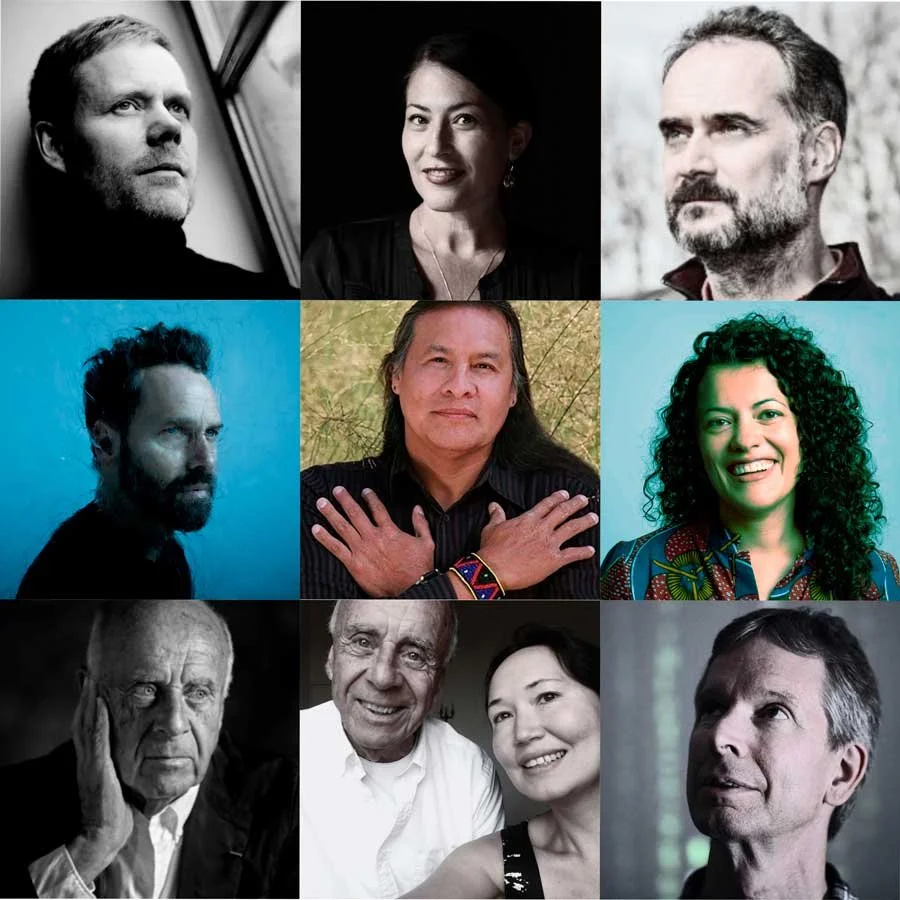
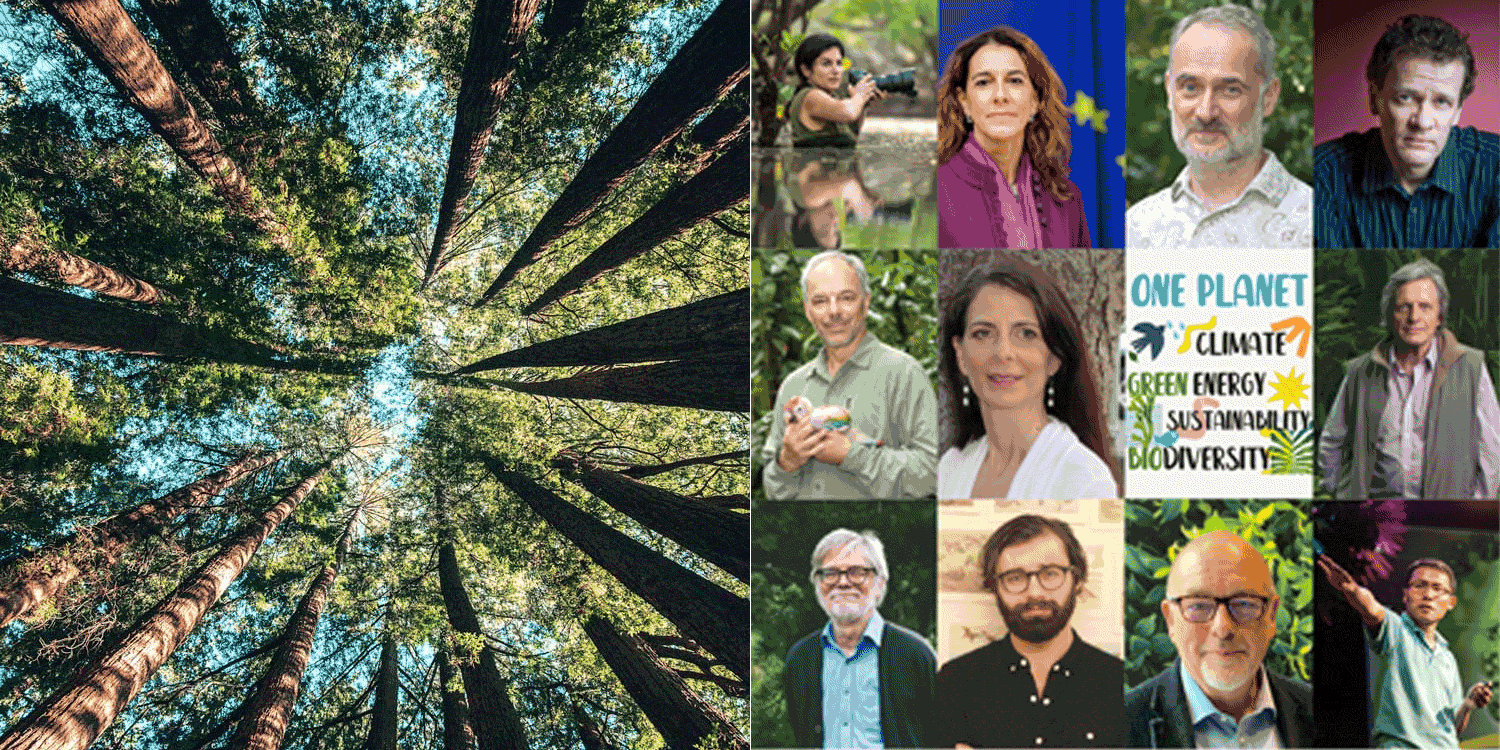
Today, we hear from writers Yann Martel, Carl Safina and David George Haskell on the practice of listening to the living world. Tom Chi discusses the dangerous volatility of a one-degree shift. Clayton Aldern explores how climate change alters brain health and behavior, while Ami Vitale, Osprey Orielle Lake and Martín Von Hildebrand remind us of the kinship we share with nature. Fred Pearce discusses 40 years as a journalist reporting on climate from around the world, while Richard Black of the environmental think tank Ember and Paula Pinho, European Commission’s Chief Spokesperson, talk about policy, hope and the radical empathy required to protect the planet for future generations.
CLAYTON PAGE ALDERN
Neuroscientist · Environmental Journalist at Grist
Author of The Weight of Nature
I'm much more interested in desire. I'm much more interested in painting a picture of a world that we want and then figuring out how to make that world come into focus, come into reality. What does that world look like to me? Where do I see hints or suggestions at what it could be? What is it that inspires desire within me? It's exactly what you suggested. It's awe and wonder and beauty. I want to be wowed by the world. I want to gaze at it in awe and wonder.
DAVID GEORGE HASKELL
Biologist · Author
The Songs of Trees · How Flowers Made Our World
The practice of listening to the living world and celebrating, say, the return of the swifts back to cities in North America and Europe. We should be having parties when we hear the first chimney swifts coming back, tuning into the sounds of the frogs or what insects are singing, celebrating, mourning the ones that we've lost, inviting young people into these practices of listening, I think is really important because we know this from, say, close human relationships. If you stop listening to your partner or to other people in your family, it's not going to go well. If we, as a human species, and we're a very powerful species, now stop listening to the voices of the living Earth, that's not going to go well either.
YANN MARTEL
Booker Prize-winning Author of Life of Pi · Son of Nobody
You can use wild animals in wonderful ways to tell human stories cause we tend to project so much onto wild animals. So animals to me as a writer are wonderful literary devices. As a citizen of this planet, my tortoise is kind of like a little ambassador of the wild. It represents its wild species, and I realized if I'm going to relate to it, I have to take care of it, I have to make sure it eats every day, I have to take care of the terrarium. It asks me to step out of my humanity and try to interact with something whose language I do not speak, and in fact, whose little culture I don't understand. But I have to nonetheless somehow relate to it. So animals, I think, ask us to become diplomats and to relate to each other like diplomats would with other cultures, cause after all, we share the same planet, we're co-responsible for it in terms of humans. That means allowing them to live and to thrive, really. And we're not doing that very well right now. So I think animals ask us to be, in some ways, non-human and relate to them in ways that sustain the whole planet.
CARL SAFINA
Ecologist · Author of Becoming Wild · Alfie & Me
For many animals, people for a long time have said that they don't have any thoughts or they don't have any emotions or they're certainly not capable of doing any planning. They have no sense of themselves. And none of that is true at all. I think that what we see with these other animals is that their existence is very vivid to them. With the social animals in particular, they know who they are because of who they are with. They understand themselves as individuals within the context of other individuals, they have group identities and they are capable of communicating things sometimes with sound, with what you might call verbal communication. I mean, just for instance, you know, the whales that we call killer whales or orca whales, they travel about 75 miles a day. Where they travel, the visibility is almost never more than about 50 feet. They will see the exact same individuals still together because they recognize their voices in the ocean when they cannot see each other, and they know who is in their group and what group they belong to. They do understand a lot about what they're doing in the moment.
And, you know, I'll say this for humans and our brains. I think that in terms of many kinds of things, we are the extreme animal. We're certainly, technologically speaking, there's no comparison to what humans can do among all the animals that make some tools. And I think the most crucial thing is that while we are such extraordinary tinkerers, that we can keep doing trial and error and figure things out and creating unbelievable kinds of technologies, we are not very smart about what we do with those things or seeing them through to the implications of what happens when we do these things.
AMI VITALE
National Geographic Photojournalist · Filmmaker
Founder of Vital Impacts
After covering conflicts for almost a decade, I had this profound moment when I began to realize and see this connection that every single conflict was deeply connected to the natural world in some way. You think about it, everything is about our resources, the environment, the planet, even wildlife is a part of the human existence. So when the environment and the natural world starts to fall apart, people suffer too. And I realized that in almost every conflict I had been covering, the story of the natural world was being left out. And it was deeply interconnected to all of the other issues that I was covering of the human experience. For the people living closest to the natural world, many indigenous cultures are still living in these landscapes. That is their supermarket, truly, and I just felt this deep passion to start trying to tell a more holistic story about what we are doing to this planet and why it matters to all of us. And so even these stories that might be thousands of miles away, actually, you start to understand that we are all impacting one another's lives, particularly the cultures that are taking a lot of resources of the planet. You realize it is having an impact on people very far away.
MARTÍN VON HILDEBRAND
Ethnologist · Anthropologist · Founder of Gaia Amazonas
The danger we have of not having water and losing the rainforest. And so this is fundamental, the whole water system that the Amazon produces, and particularly in this area where we are under the equator, the climatic equator, where the different types of seasons meet with the water. So indigenous people are so important because they have a different understanding, they have a different way of being a human being because there are different ways of being human beings. There are different ways of understanding nature. And for the indigenous people, we are nature. They see the forest as a community, a community of subjects. They have a relationship. They will talk about the forest. They will talk about people in the community, about their family, about the indoors. There's a close relationship, a kinship relationship with the forest. And they have a holistic point of view, a systemic point of view.
A shaman is trained. We are trained in rationality, and we become rational and we divide things in parts, and we see the forest as a collection of objects which we can exploit for our wellbeing. They see it as a community of subjects which are all interrelated, all interdependent. We are depending on that and therefore we must take care of the forest if we want to survive. Our health as part of the forest depends on the general health of the forest, so they have a whole system of exchanging reciprocity through their meditation.
RICHARD BLACK
Director of Policy & Strategy · Global Energy Think Tank · Ember
Author of The Future of Energy
The fact is, you've got a lot of industrial muscle and a political muscle now coming behind clean energy, especially from China, which is, you know, the leading country deploying wind energy, deploying solar, the leading manufacturer and user of electric vehicles by miles. There was one report put it, we have petrostates in the world, China is the first electrostate, and China is, you know, on its way to becoming the world's most powerful country. So, where China leads the rest of the world is almost certain to follow. Yes, there are massive air pollution problems in China, of course, but I think it's more than that. It's also about seeing that this is the future that the world is going to have. And if these goods are going to be made anywhere, well, the Chinese government clearly would like them to be made in China. And they've set out industrial policies and all kinds of other policies for, well, at least a decade now, in pursuit of that aim. It's interesting now to see other countries, India, for example, and the United States now sort of deploying muscle to try and carve out a slice of the pie themselves as well.
THE CREATIVE PROCESS · ONE PLANET PODCAST
You say according to the International Monetary Fund, the total of around five trillion dollars per year on average is what we pay. That's about a thousand dollars per year for every man, woman and child that's helped subsidizing the fossil fuel industry.
RICHARD BLACK
Fmr. BBC Science & Environment Correspondent
Director of Policy & Strategy at Ember
Yes, when I broke it down for every inhabitant of planet Earth, I was staggered at how much money it is, but there it is. So, if you take things like subsidies, and they could be consumption or production subsidies, it's less than a trillion, but then if you add in the costs of climate change and other damages which are done by using the fossil fuels that we get to this figure of five trillion, and actually in the last few years it's been more than that. It's been up six and seven trillion as well. So if you compare it for example with the amount that the governments of the West are supposed to supply each year in climate finance, that's a hundred billion. So that's about one fiftieth of the amount that we're actually subsidizing the fossil fuel industry, which is the major cause of the problem.
TOM CHI
Founding Partner · At One Ventures · Author of Climate Capital
Fmr. Head of Product Experience at Google X
Like what a one-degree increase might mean on a particular spot on Earth is six degrees hotter in the summer, four degrees colder in the winter, that's actually closer to what it means that the bands of volatility are expanding substantially more than the averages. And our life experience of the breakdown isn't going to come from, oh, every single day of the year it's half a degree warmer than it was. Like, that would probably not even be noticeable to most people. Or if it was, it'd be very mildly noticeable. Since the volatility actually is the driving curve of what the human experience of climate destabilization is going to be, we miss the chance to actually communicate the main thing that's going to happen.
The main thing that's going to happen is one degree in some places is going to be six degrees hotter in the summer, four degrees colder in the winter. Two degrees might be eight degrees hotter in the summer, four degrees colder in the winter, right? We are missing that. The extremes, the edges of the extremes, are going to keep expanding, expanding, expanding. And they're going to be expanding at a higher rate than the averages are evolving.
PAULA PINHO
Chief Spokesperson for the European Commission
And now looking at the vision of Europe as the first climate-neutral continent in the world, and we have put forward extremely ambitious proposals in that sense. It started already some years ago, and then with the new impetus with the Green Deal, which is really about decarbonizing the energy system. Today, in face of the tragedy that we are witnessing, we realize that the Green Deal and what we are aiming at is not just about decarbonization. Really one of the big challenges that our society is facing today is climate change. And the Green Deal is about tackling that societal challenge, but it is more than that for the EU. It is also about energy security and about diversification. And if it was not clear to everyone, I think today, and within one week even, those who may have been more reserved about some of the ambitions of the Green Deal now realize that it's absolutely urgent to diversify even more than we had done over the past years and to radically reduce our dependence on fossil fuels.
RICHARD BLACK
Fmr. BBC Climate Journalist · Director of Policy & Strategy at Ember
I would like young people to have the sort of growing-up experience that allows them to be children as long as they need to be children. There's something very, very pure about the curiosity of a toddler and the way they interact with the world and the open eyes, amazement of seven and eight-year-olds as they discover things that they hadn't seen before, their first big waterfall, their first encounter with a giraffe, whatever it may be. It's a very pure way of looking at the world. And I think that childhoods now have become a little bit compressed. By the time it's a good idea for a child to have a mobile phone, then that's already stuff that's coming into their life that can be a pressure. We know the kind of pressures this exerts on teenagers. So I just want them to have the freedom to grow up basically as kids and just not be forced into a sort of early adulthood.
And yeah, I grew up, as you mentioned, in radio. And really brilliant speech radio is eavesdropping on a conversation where someone is telling the story about something. So it's very, very important to everything that's done. And I think in this field of energy and climate change, contrarians have got the easy job because the ingredients of their stories resonate. So it won't work. It's going to cost too much. They're trying to make you have something that you don't want. Let's stick with the old ways, the ones that we know are safe, as opposed to this can work. And here's an explanation of how it can work. A lot of the biggest insights I've ever had in any parts of my life have come from literature. Literature takes the world and looks at it through a certain window and tells a story in a way that you might not have thought of doing it yourself. And so by engaging in it, you just get richer, I think, in terms of the way that you look at the world yourself.
OSPREY ORIELLE LAKE
Founder of WECAN · Author of The Story is in Our Bones
And I think that one of the things that I've learned from a lot of indigenous leaders that I've had the honor to spend time with is really renewing this understanding that we're all relatives. That the water and the forest and the air and the mountain and all of the animals wherever we live. We are relatives, we have a relationship with our human and non-human family. And it's really different when we hold this view that the river is our relative, is part of our family. And so how would we treat Mother Nature in a different way if we understood that we are all relatives and we have this relationship and this reciprocal responsibility to care for the life-giving systems, the sacred systems of life.
And it reminds me of something that a beautiful Maori indigenous elder told me when I was in New Zealand a couple of years ago. I traveled there with a delegation to learn more about how they view rights of nature and how nature needs rights as much as humans need rights. In the Maori world, they really see the natural world, as many indigenous peoples do, a relative as a being that has personhood in essence, to have those same rights that people have. And so I went to the river with this wonderful elder, and she said, "We have a saying in our culture that I am the river and the river is me. I am the river, and the river is me.”
They, not metaphorically or symbolically, but literally see the Whanganui River as their ancestor, that they come from this ancestor, and that they are there to attend to and care for the health of their ancestor. And I think it's just such a healthy way to view our natural world, because we are all one family. We have evolved from these natural systems biologically. When we view the natural world as our ancestor, as our relative, it completely transforms how we treat the natural environment.
BILL HARE
CEO of Climate Analytics
Well look, getting to limit warming to 1.5 degrees above pre-industrial is going to be a very tightly run game. The one and a half degree issue is very acute. We know now that if we don't limit warming to that level or close to it, we run the risk of really serious damages to natural systems and to a lot of vulnerable countries. And their territorial integrity is at risk. We know from the physics of it that if we got onto an emission pathway, which involves a 50 percent reduction in emissions by 2030 and getting carbon dioxide emissions to net zero by 2050, then we would limit warming very, very close to one and a half degrees. Right? So the big question now is, will we do it? Will the world actually make those emission reductions? And that's really the game that we're in now, a long way to go. So that's why there's a lot of focus this year and next year on getting countries to step up their actual ambition levels and their action levels. So I think that's a really big challenge for everyone now, is to really make sure that their governments and their industries get behind this target.
FRED PEARCE
Environmental Journalist · Author of Despite it All · A Trillion Trees
I think it's traveling the world that gives me hope. I mean, I'm an environmental journalist. I've been writing for 40 years about all the bad stuff that we are doing and very often the predictions of doom. So I come at this from two points. First of all, observing the world and talking to people around the world, and I find a huge amount of sort of still spirit and optimism and hope among communities around the world. That really helps. And it's fabulous to also to see how nature recovers from almost the worst things that we are doing. So I'm not denying where we are. But I am saying that if we're going to get out of this, we've got to look for solutions and we've got to have some faith in those solutions. I don't think that's being panglossian. I think that's being really realistic.
CLAYTON PAGE ALDERN
Author of The Weight of Nature: How a Changing Climate Changes Our Brains
Senior Data Reporter at Grist
I want to be wowed by the world. I want to gaze at it in awe and wonder. And it's so easy to do so, I think, when we take a step back and begin to appreciate the complexity of the interactions around us, right? Complexity is very beautiful. We've talked a lot about some scary stuff here, right? All the manners in which a changing environment is reaching in and changing us. That's scary, but I think it's also, in a sense, really beautiful insofar as here we're taking note of a very porous boundary between the self and the rest of the world. We are literally observing our enmeshment in our environment. We are self-conscious selves coming to understand the fact that we are not somehow walled off from the rest of the world. And unbelievably beautiful. And so I think if we can begin to reframe some of these frightening relationships as profoundly intimate relationships that certainly require addressing, it's that kind of reference frame shift that I think is going to help us move out of some of the darkness.