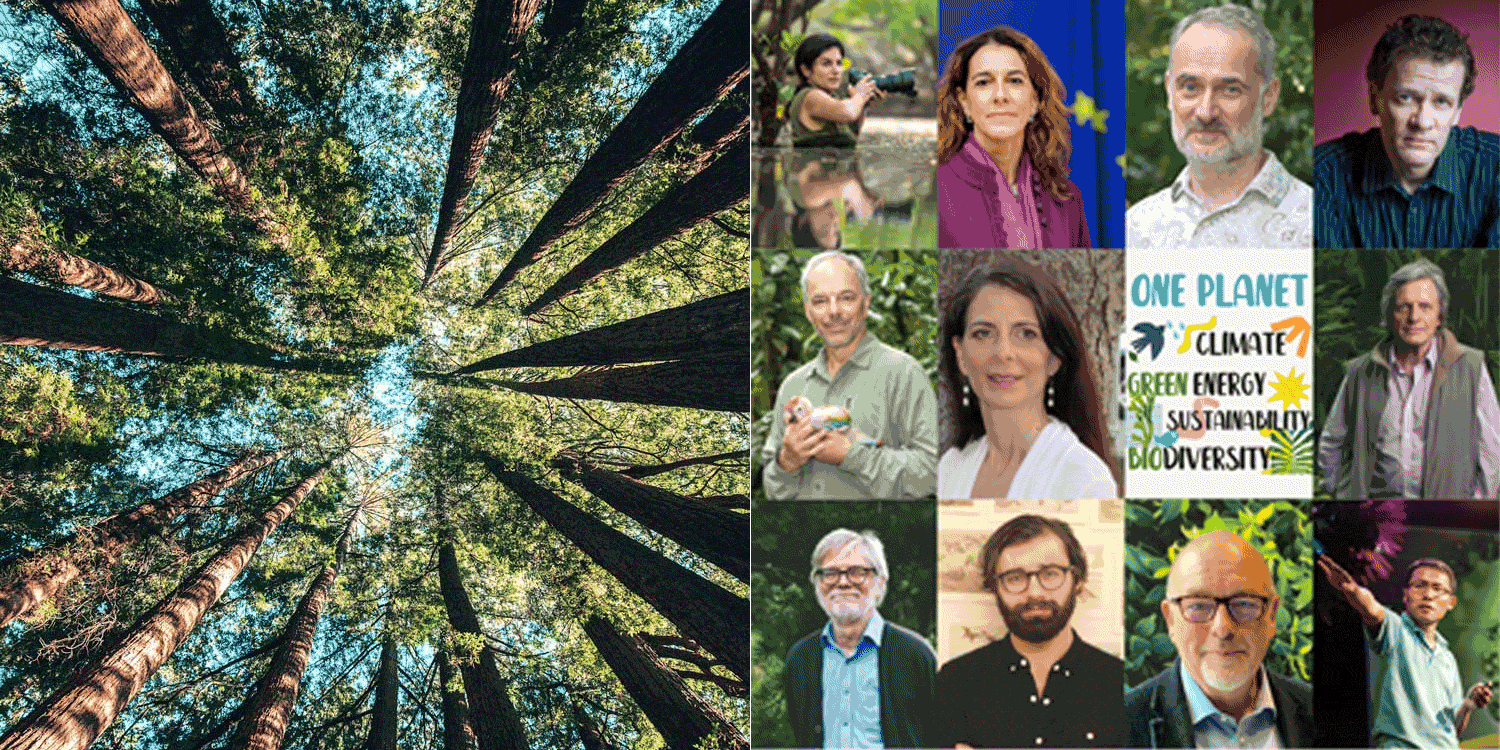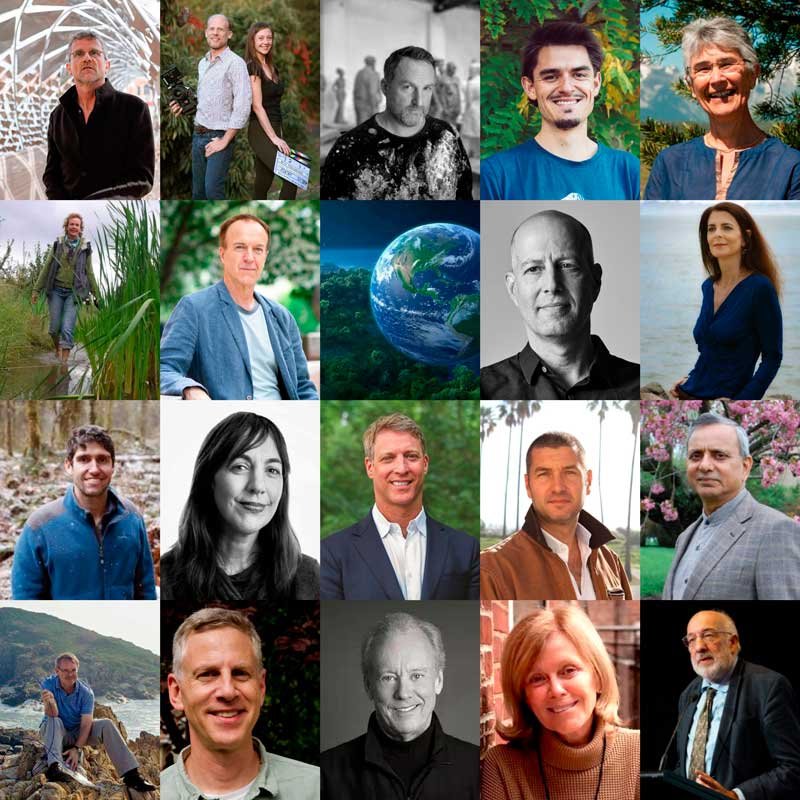


Today, on Earth Day, we explore the Living World—a reality where we are not merely on a planet, but are a moving part of its very metabolism. From the mycelial networks that mirror our own social structures to the literal carbon cycle that breathes through our lungs, we are becoming earth every moment we are alive. We live on a sensate, conscious planet, yet for centuries, we have acted as though we were the only voice in the room. Today, we travel from the High Sierras with Paul Hawken to the glowing forests of Costa Rica with Thomas Crowther. Guided by the insights of Merlin Sheldrake and David George Haskell, we bridge the gap between policy and poetry with guests Paula Pinho, Hans Bruyninckx, Bill Hare, and Alice Schmidt. Alongside Tiokasin Ghosthorse, Tom Chi, Erland Cooper, Rebecca Tickell and Britt Wray, we ask what happens when we stop trying to dominate and start trying to collaborate with the Earth?
TIOKASIN GHOSTHORSE
Founder · Host · Producer of First Voices Radio
Member of the Cheyenne River Lakota Nation · Musician
We start seeing that we are becoming earth as we are born into this physical dimension. And then as we are living during this time, we are alive, we are becoming earth. And when we are finished with this body, we are becoming earth.
Because we say the ancestors have gone into the future, and this may be confusing. Ancestors are the future because they went ahead of us. They died. Their energy was here first in the past. Now they have gone on into the future. So we follow and this is why we listen to elders, plants, the animals, all the energy that you see out here, the rocks. They were here long before any human being came. At least we know that. So, who do we listen to? These are our ancestors.
Not because I am older or they are older in this lifetime, because if we are alive as a baby born one hour ago to the one who just passes into another dimension, then we are all the same age. Energy does not have age. It is always here at this moment.
PAUL HAWKEN
Environmentalist · Entrepreneur and author of the NYTimes bestsellers Drawdown and Regeneration
There is just a raft of young, extraordinary scientists, women and men who are going out into the natural world, with and without instrumentation, by acoustics and recording and parsing and looking at the animal kingdom and the insects. They are coming back with astonishing reports and science about how snakes can identify by different snakes. They have personalities. Mother bats speak a certain dialect; they call it "motherese" for lack of any other description.
They name their children. They warn them off some of the male bats who are predatory. We are just beginning to understand that, in fact, every creature on earth is in communication with at least themselves and others. We live on a sensate conscious planet. It is much more interesting to think about us as wanting to listen and appreciate all the voices instead of thinking we are the only voice, which is very lonely if you think about it and that we are in charge.
We are not in charge. We are in charge of one thing, which is destroying life on earth. We are doing that. But that is not being in charge; that is being a fool and nothing else is doing that. There is no other creature doing what we are doing. We are one of 8.4 billion different species. And we are the only one who has decided to double glaze the planet and ruin life on Earth.
With our mining and our pollution and our plastics, it is just like, "stop." This book is to stop and take a look. This is not my story. This is not fiction. I am just saying: this is where you live. This is who we are. This is our brothers and sisters.
It is our family and our life depends entirely on the whole of life. Not on technology, not on Silicon Valley, not on Elon Musk, not on lies and cheats and people who accumulate capital and money. It is actually so much different, so exquisite than the world we are confronted with when we open up the New York Times or The Guardian or go online every day.
What is also happening is people unheralded, who do not make the news or headlines, who are restoring life on earth on every single level out of respect, out of love and of grief too for seeing what has been lost.
THOMAS CROWTHER
Ecologist · Founder of Restor · Author of Nature's Echo
Founding Chair of the UN Decade on Ecosystem Restoration
We are just a moving ecosystem. It is just that we have got this weird thing called consciousness that gives us this impression that we are somehow separate. But we are just part of the ecosystem. We are a bag of microbes that is interacting with all the microbes around us.
I think there is a real need for us to appreciate our harmony and our interrelatedness with nature. I do think that the biggest challenge or the biggest problem we have had over the last hundred years is our separation with nature.
People often think of things like fungi and microbes as dirty and the mold on your bread. But when you discover the wonder of these things, it is an endless source of inspiration. You know, there is fungi in Costa Rica that I have seen which glow in the night. It looks like a scene from Avatar. It is just like unbelievable worlds of life.
It is particularly this microscopic world—the smaller and smaller you look, the more alien wonder world it starts to look like. It is very inspiring and it makes it easier for you to throw your life into promoting the health of the planet.
MERLIN SHELDRAKE
Biologist · Winner of the Climate Breakthrough Award 2025
Author of Entangled Life: How Fungi Make Our Worlds, Change Our Minds, and Shape Our Futures
When I think about plants, I tend to think about plants as algae that have evolved to farm fungi and fungi that have evolved to farm algae. Plants are a visible outgrowth of ancient mycorrhizal fungal associations. Just that awareness shifts the way that I experience the food that I eat, the plants that I eat and the ecologies that I encounter and walk through and live among.
There are lots of levels on which we can learn from fungi. One might be the importance of networks of relationship; that life is networks of relationships. That the smallest unit of analysis, as Donna Haraway says, is a relationship. When we are talking about the living world, fungi remind us of this because they form persistent physical connections between organisms.
They embody the principle of ecology, which is the relationships between organisms. They make very good poster organisms for ecological thinking. Fungi are symbiotically prolific and have entered into so many world-changing symbiotic relationships over the billion years that they have been around on the planet.
These symbiotic relationships raise really interesting questions for us. When we say interrelationship, it implies that there are two separate entities that need to be connected. But in symbiotic relationships, the entities arise out of their relationship. The relationship is fundamental to the identity of these parties; it is not like the prior existing two parties that then need to be connected afterward.
Fungi teach us about the fundamental symbiotic nature of the living world and of the various currents and patterns in evolution. Another point is the formation of networks—decentralized, robust networks that are sensitive to changes in their surroundings.
Fungi are profoundly embedded in their environments. They are remarkable metabolically ingenious appetites in bodily form. There are lots of ways that we can learn to think in more cyclical ways about waste and what it means to think of a waste stream and design a waste stream.
Fungi form mycelial networks which have no defined body plan. There is no fixed endpoint, no shape. They do not become fully grown in the way that a human could become fully grown. They remind us that all life forms are a continual process, that we are all in a state of continual becoming. Fixed, neatly identifiable things are a fiction that we come up with to help us understand the world.
DAVID GEORGE HASKELL
Biologist · Author
The Songs of Trees · How Flowers Made Our World
For at least 150 years, biological sciences emphasized individuality and aloneness—individual species, individual genes, individual organisms. That is a useful view up to a point. It is true that I am an individual organism. I have got a skin, and then the air begins and there is a gap between me and the next person over.
But that view is also utterly false in many ways, in that the human body is not just comprised of human cells. There are bacteria and fungi, viruses, all these other creatures that we now know are essential to our health. Our minds are not solitary; they are formed in relation to other beings. Ecosystems work only through relationship.
Relationship and interconnection, not separation and atomism, is in fact the fundamental nature of life. Even from the very first fossils that we have of living organisms way back more than three billion years ago, these little cells are sitting next to one another.
HANS BRUYNINCKX
Professor of Environmental Governance
Fmr. Director of the European Environment Agency
I love being outside. I did hiking in the mountains above the Arctic Circle and in mountains in Europe. That was where my interest was and it is still part of who I am. Through my wife, I discovered sea sailing some decades ago. When you are on the sea, the forces of nature and some of the silence there is just formidable.
Those who think that the environment is external to us and that, as human beings, we have moved on and are not so dependent on it anymore—well, I invite you to sail through the night when you do not see anything else and you are exposed to only the sound of the waves and the wind and the vastness and the power of it. It is a deep experience and I think if more people would still understand that connection and be exposed at some level, we would maybe have a better foundation and more motivation to work on environment and climate issues.
REBECCA TICKELL
Documentary Filmmaker · Producer · Environmental Activist
Kiss the Ground · Common Ground · Groundswell
Everybody that is a farmer loves soil. They want to be a good land steward. A lot of farmers have been misinformed through educations at land grant universities and through propaganda spread by chemical companies that have infiltrated our regulatory systems. They have skewed the science to make it seem as though it is not harmful for human life and for the environment to use these neonicotinoids and neurotoxins on our food.
The fact of the matter is that these poisons have a skull and crossbone on the label. Many of them say "fatal if inhaled." They were designed to kill people during wartime and the way that they are applying them, at least where I live in Ojai, California, is with World War II fan sprayers.
These chemicals go up into the air and they volatilize and then they drift for days and days. Where we live in Ojai, it is the Chumash word for "the nest." We have mountains all around us in a low inversion layer. If you are spraying hundreds of thousands of pounds of these neurotoxins designed to kill and they are being volatilized up into the air, people cannot see it.
Most of the time people are not notified that these chemicals were even there. But then you start to see clusters of people with health issues. We call Ojai the "Cancer Valley" because we have a whole street where people are dying from cancer and their dogs have seizures and they have all kinds of neurological issues. It just disrupts the biology and the functionality of any ecosystem.
For the last two decades, I have made over 20 films about the environment. If you look at the COP—the Conference of the Parties—they have not even been talking about regeneration. They have been holding these conferences in places that are oil-rich countries and then talking about reducing carbon emissions.
Soil has the power through photosynthesis to draw down carbon from the atmosphere. It is called bio-sequestration. It takes that carbon down into the roots and then it turns it into healthy humus. That is the food for life in the soil. It needs that carbon.
We have forgotten the simple tool of the solution that is right beneath our feet called soil health and soil regeneration. Not only does it draw down carbon, it is the only place that we can put that teraton of carbon that we have emitted. There is only one place for it and it is in the soil.
TOM CHI
Founding Partner of At One Ventures
Fmr. Head of Product Experience at Google X
I spend a bunch of time basically teaching skills and teaching frameworks of thinking. This is not an ideology where you need to believe exactly these things. This is about how one uses their minds effectively to solve problems that have been solved before. You fill in the blank on what you care about in the world and what you want to solve.
I work on things that have to do with investment and climate and the future of the economy and automation. The main things I am trying to teach are skills around creativity, critical thinking, community compassion and frameworks around how to go and use that on problems that should be relatively portable to a bunch of problems that are meaningful to you.
The way that education needs to change is that people need to actively be working on things that truly matter to them and making a difference on them in an iterative way so that over time they end up being able to go make that difference.
PAULA PINHO
Chief Spokesperson for the European Commission
How do we communicate with the citizens about the policies? How do we raise awareness? A lot is through education early at school. Personally, I think we are still far from an ideal school program. We should introduce new disciplines in terms of sustainability from early on.
I am always impressed by the awareness that young people and even children have—I speak for my own children—who are sometimes more conscious and environmentally friendly than their parents. They draw our attention to how to go about energy consumption efficiently and not to buy fruits in plastics.
Today there is much more awareness than there was in my generation. But yet I think we could do much more from much earlier on in a structured manner. Bring it into the school programs: how important it is to really care for the planet and how it can be done by every single one of us in the way we consume, not just energy, but in the way we make our choices of what we buy.
BILL HARE
CEO and Senior Scientist at Climate Analytics · Physicist
Net zero is a big idea. Unfortunately, many ways to look like you are doing net zero when you are not are growing up. In the ideal world, getting to net zero means essentially reducing your emissions and then, where you have residual emissions left, it means you may need to have negative emissions.
It is relatively easy to decarbonize the power sector completely and you could do it quickly and cheaply in most places, but you are always going to be left with some level of emissions from agriculture. Whether it is enteric fermentation from ruminants—from cows—or whether it is emissions from grain production, it is very difficult to get rid of.
Negative emissions can be real; they can be technological. We can use biomass carbon capture and storage at an appropriate scale. You can plant trees which are going to be beneficial and will store carbon at a reasonable scale. We need to look at the details of what governments and companies are proposing to understand whether or not this is really something that is going to work.
ALICE SCHMIDT
Sustainable business advisor and author of The Sustainability Puzzle.
A lot of the solutions already exist. We know what needs to happen in terms of climate action, in terms of a circular economy and in terms of social justice. We know what sustainable business needs to look like, but we also know that if you do not zoom out before you then zoom in on specific solutions, you are actually at risk of creating more problems than you solve.
Electric mobility is an important part of the puzzle. It is certainly a part of the solution, but if your energy mix is such that this electric car is powered by dirty energy—by fossil fuels—that is not a great idea. It is really also about overcoming sectoral divides.
Because we are so specialized in today’s world, we are actually able to dig extremely deep and understand every little detail of one problem, but this also means we are in our silos. We really need to break outside the silos. We really need to collaborate with an open mind.
ERLAND COOPER
Multi-instrumentalist · Composer · Folded Landscapes
Carve the Runes Then Be Content With Silence
In every piece of music I have done, the Earth itself has played a part, whether from a narrative point of view, a sense of place or myth and mythology wrapped up in that location. I often feel landscapes can hold memory and it is kind of plowing that field, that landscape to see what memory it can evoke in me.
I wrote a classical piece of music—arguably my first concerto. At the end of the recording, I put it onto a magnetic tape, a 10-inch reel-to-reel tape. I told the musicians that once I had put it onto the tape, I would delete all the digital copies. So there only existed one copy, and all of a sudden this process of creativity became incredibly precious.
I am going to plant it in the earth, in the soil, somewhere in the Scottish Highlands. I would like the soil over the next three years to collaborate with the music. Magnetic tape does not like moisture; it does not like sunlight or salt. To me, I like the idea that the soil itself would effectively cause a process of decomposition.
I like this idea of: to compose, to decompose and then recompose. The final piece of work, when it comes out of the earth, will be the recomposed sounding recording. To me, it is a kind of meditation on value and patience in a world of instant gratification. It asks the question: at what point do you really value the arts or really value music? So it was asking myself lots of questions and teaching me how to be patient and collaborate with the timeline as well as Earth itself.
BRITT WRAY
Director · Stanford’s Special Initiative of the Chair on Planetary Health
Author of Generation Dread
People from all walks are understanding that this is here—it is not a future threat. It is active now. A lot of people are asking themselves: how can I be of service? What can I do at this time? There are more climate job boards and networking communities bringing people together to figure out how they are going to go on their climate journey.
We should infuse this with a sense of joy and how we can make this fun. How can we reshift so this is not just focusing on the negative, but really focusing on what we want to be building and what is abundant and the better life that we are working toward? That gives me an honest sense of hope.
It is possible to have high wellbeing, high meaning and high engagement with things that matter and that are purposeful. Even as the systems around us change, there are lots of things that we can do within ourselves to stretch our capacity to be caring and continue taking action for the present moment.
PAUL HAWKEN
Environmentalist · Entrepreneur
Author of the NYTimes Bestsellers Drawdown and Regeneration · Carbon: The Book of Life
People like you and others around the world, unheralded, who are restoring life on earth out of respect and out of love, and of grief too for seeing what has been lost. I am a Californian and I used to be a firefighter in the Sierras when I was a young man. The one thing about the fires in California—because we are so prone to fires and always will be—is that after the fire is over, you go back and it is just a black carbon landscape.
But you go back in the spring and you see grasses and wildflowers and this peculiar green color because it is so nourished by the ashes. There are wildflower seeds that actually can only break the carapace and grow after they have been subjected to extreme heat. When you get these fires, you will get plants you have not seen for 50 or 100 years. This is what is happening now. The Earth is burning.
Civilization is an act of self-immolation. It is killing itself. But underneath that is this extraordinary understanding of human beings wanting to regenerate and restore life on earth. The action of it itself is how you restore yourself too. It is the same thing.
When you are there, whether you are a farmer or a forester, you are now the flow of life. It is the flow of carbon and that is the book of life. We have just lost our way. For the last 500 years, we have lost our way completely and we are not going to solve it by some new technology. Technology is not leading us to where we want to go.
REBECCA TICKELL
Documentary Filmmaker · Producer · Environmental Activist
Kiss the Ground · Common Ground · Groundswell
Soil health and soil regeneration is the solution right beneath our feet. Not only does it draw down carbon, it is the only place that we can put that teraton of carbon that we have emitted. Why is that not the main conversation of every climate conversation?
When you bring the soil back to life, you are creating nutrient-dense food. You are giving plants the ability to work in symbiosis with the soil that it co-evolved with. We are a reflection of the soil. There is such an intelligence to nature that it knows how to be resilient.
The way that we heal and the way that we regenerate and stabilize the climate is literally one inch and one acre at a time. It is through communities waking up to the power of soil and biodiversity. When we do that, you create thriving ecosystems, water infiltration to reduce flooding and you help reverse desertification. It staves off droughts by being able to hold water like a sponge. And it promotes biodiversity.