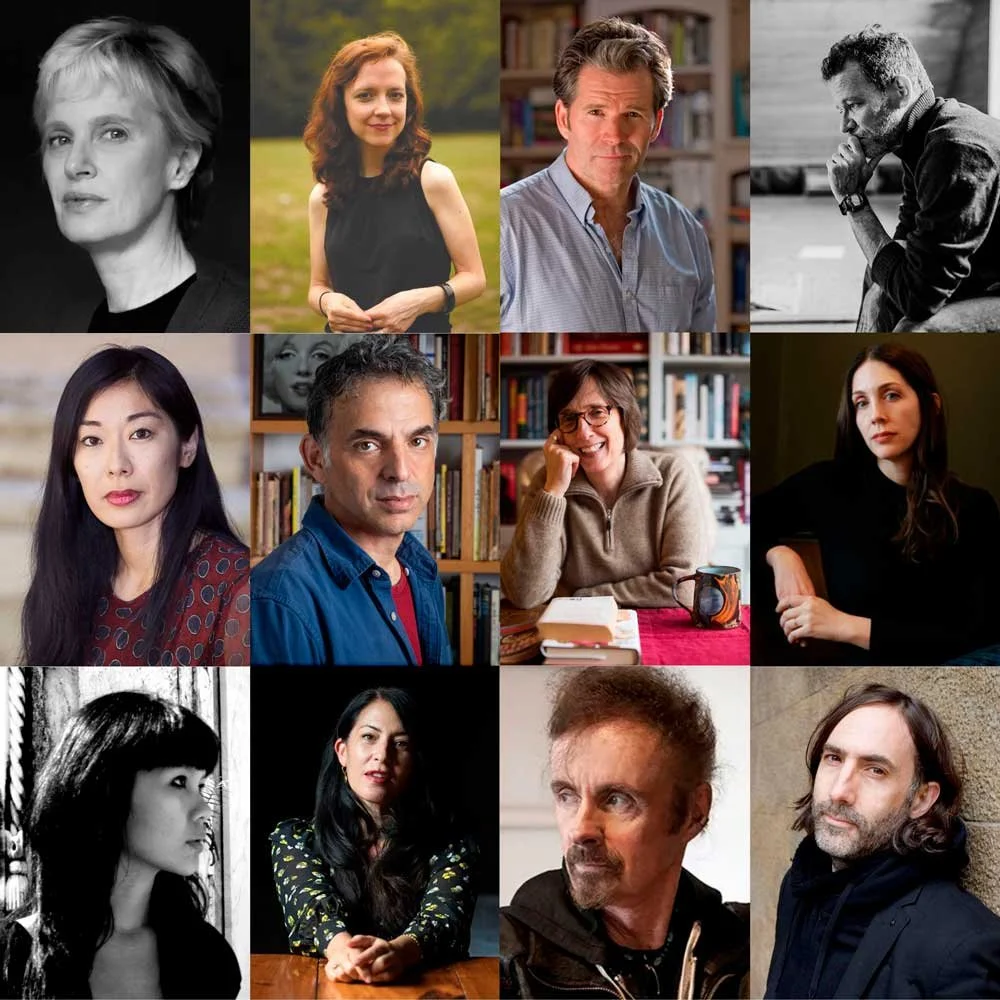


We look to the arts to help us make sense of the world. Today on The Creative Process, we bring together twelve writers. We hear from Booker Prize winners, Paul Lynch, discussing "cosmic fiction", and Yann Martel on the necessity of magical thinking. We’re joined by Andre Dubus III and Megan Abbott, who share their thoughts on memory and family; while Siri Hustvedt, Etgar Keret and A.L. Kennedy explore the ordinary madness of grief. We listen to the novelists Katie Kitamura, Intan Paramaditha, and Liz Moore reflecting on displacement, trauma and the liminal state—and find a connection to the natural world with T.C. Boyle, and Ada Limón.
ANDRE DUBUS III
NYTimes Bestselling Author · House of Sand and Fog · The Garden of Last Days · Ghost Dogs · Townie
I rely on the writing process to bring me back to memory. A dear friend of mine who is a Jungian psychologist and a poet taught me the opposite of the word “remember” many years ago, and I find it so helpful. The opposite of remember is not forget.
So to remember means to reach for the pieces, to reach for the fragments, to reach for the shards. I think in many ways all creative writing is that act of reaching for the pieces to put it back together again. With the memoir or the essay, it is human memory—your memory for your own existence.
With fiction, it is something else. It is a dream world where you are reaching for the shards. It is so moving because that is what it feels like when I feel that I might be writing well, which is once every 18 days or so. It is just uncovering and uncovering. It is immensely pleasurable and it is why I have never lost enthusiasm all these years for it.
ETGAR KERET
Author · Filmmaker · Winner of Cannes Film Festival’s Caméra d’Or · Charles Bronfman Prize & Sapir Prize
Sometimes when you go to hotels there is this kind of pianist that plays in the bar. As a writer, I always felt that I was playing in the bar of humanity. I was playing and I was looking. I saw two people and I wrote about how it is beautiful. I saw a man cheating on his wife and I wrote about that.
Currently, the trajectory of humanity feels as if we are constantly falling down the stairs. I am playing music for people who are falling down the stairs. It is a little bit like Charlie Chaplin music. The idea is that I am doing whatever I can to empathize with you, to hope with you and to see the good in life while we both fall down the stairs.
These are the rules. I wish that one day I will not feel that we are falling down the stairs. Maybe when it happens, I will stop writing or start playing a different tune. But for now, I feel like I am the band on the Titanic. I am playing good music for getting your trousers wet in cold water. I am playing the music that will make it most bearable.
PAUL LYNCH
Booker Prize-winning Novelist · Prophet Song · Beyond the Sea
Red Sky in the Morning
I wrote an essay about this last year and I call it “cosmic fiction.” When I say cosmic, I am referring to writers such as Melville, Dostoyevsky, Conrad and Faulkner. These are writers who are crafting fictions as though from a cosmic eye in the sky—as though looking from a great distance at what we are as human beings.
At the same time, it is fiction that has the ability to get down to the furniture in the room. It can describe the texture of the wood in the table and describe human beings in extraordinary detail. It possesses that sense of scalability and the absolute within reach. It captures that sense of the cosmos and our position in this vast universe.
You have the heat of life: the wants, desires, needs, foolish aspirations and the emotions that tangle us up. To get them down into one place is the goal. This kind of fiction always has within reach a sense of the infinite.
MEGAN ABBOTT
Author of El Dorado Drive · Beware the Woman · You Will Know Me · Give Me Your Hand · The Turnout · Co-creator of Netflix’s Dare Me
I think that it all goes back to childhood. I have always been writing about family. I suppose we always are. I do think that it is the original wound and it is where we are wired and built from those early years. Every other relationship just replicates that.
It is very natural for me to go there because the feelings are most intense. We just keep recycling these relationships and dynamics over and over again. As the famous Freud essay suggests: remembering, repeating and working through. Maybe someday we can catch ourselves and try to break the bad patterns.
It just feels the most visceral and real to me. You are always looking for that in writing. You want everything to be at this peak intensity, or at least I do. That seems always like the most natural place to start.
ETGAR KERET
Author of Autocorrect · The Seven Good Years
Suddenly, A Knock on the Door
When I write my stories, I do not want to solve things in life. I just want to persuade myself there is a way out. Maybe I am in a cell; maybe I am trapped. If I can imagine a plan for escape, then I will be less trapped because, at least in my mind, there is a way.
My parents are survivors and they always talked about this idea of humanity. They always said to me that when you look at people, do not look at their political views—those are not that important. Look at the way they look at you. If they see you, if they listen to you and if they can understand your intention, even if it is a failing one, then they are your people.
KATIE KITAMURA
Author of Audition · Intimacies · A Separation
I am really interested in characters who are channeling language—who are speaking the words of other people. I am drawn to characters who are aware of how little agency they actually have. They have passivity forced upon them, but eventually seek out where they can enact their agency.
I have a very powerful sense that a book is made in collaboration with a reader. I wanted it to be especially true of this book. The feeling I had while writing was that I needed to make a structure that was airy and capacious enough for the reader to step inside. They need space to make the book alongside me.
Having written so many characters who were physically displaced, I wanted to explore characters who are literally arriving in a new location and trying to understand the world. There is often a real gap between themselves and the world they are inhabiting. In this novel, I felt that gap was inside the character. It is a kind of internal schism rather than a distance between the character and New York City itself.
In Intimacies, the character arrives in The Hague and feels very displaced. Similarly, in A Separation, the character goes to Greece and the landscape is bewildering to her. In this novel, the landscape of New York City is not bewildering; it is where she has lived for very many years. It is actually the internal landscape that is, in some way, confounding her.
LIZ MOORE
Author of Long Bright River · The God of the Woods · The Unseen World
I have lived in Philadelphia about 16 years. The inspiration for the book came out of my time spent in the neighborhood of Kensington. One of the first experiences I had was going to this neighborhood to do nonfiction writing and interviewing the people I met there. I spoke with both longtime residents and people who were transient.
A lot of people were struggling with addiction and many women were doing sex work to fund their physical addiction to opioids. You find out about their past, their road into addiction, their aspirations and their fears. I began to lead free writing workshops at an organization named St. Francis Inn. It is a food service organization in the community.
They had a women's day shelter where I taught. I was able to connect with people within the community on a personal level and loved my experiences in Kensington. I am still quite close with a number of the community workers and people who run free healthcare clinics. All of it ultimately informed the writing of Long Bright River.
A.L. KENNEDY
Award-winning Author · Comedian · Day · The Blue Book · All the Rage
If you have love, eventually you are going to win. It is not that people are not going to die or that terrible things are not going to happen. But if you stay with that and stay centered, you will get through. You will not have turned into a monster in order to overcome monsters.
The thing is to be essential. Then you get close to universal humanity, which becomes essential to the person reading you. You have to leave space in your narrative for their voice to fit as they read it to themselves. I spend a lot of time doing the Alfred Wolfson voice method. He was a soldier in the First World War. When he was hearing people scream for their lives, it was completely irresistible. You hear someone screaming for their life and you want to go into no man's land and rescue them. It is unbearable to listen to—it is a full expression of their humanity screaming for you.
He was thoughtful. The thing that puzzled him was why people do not agree to be fully expressed while they are alive. Why does it only happen in their last moment? Why would you not live being fully expressed?
SIRI HUSTVEDT
Award-winning Author of Ghost Stories · What I Loved
The Summer Without Men
Grief is ordinary madness. It is not at all strange that there are many books about grief that focus on that ordinary madness. If one can come away from the book without feeling it, that is what I hoped, despite the raw feelings of deprivation. It changes, but it does not go away. I think the body adapts to the loss. This is a truly embodied physical reality. As time goes on, that sense of where the other body went—what happened to it—is something you physically adapt to. That absence makes the every day easier in some way.
But it certainly does not change the fact that you would love it if the person could just be resurrected. You don't stop grieving. I do feel so lucky that I don't have regrets. There was really nothing undone between us that had to be fixed. I think it is extremely hard for people when someone dies and there is so much that was not said. Whether declarations of love or difficulty and pain, people are tormented because you cannot change it. You cannot repair it. Repair is between the living.
I feel deeply fortunate that that was not our story. When Paul asked me for information on phantom limb… and then later when I was writing the book, I thought, well, of course, it is a huge part of the phenomenology of perception. As a metaphor, and possibly as a real scientific phenomenon, I think this is beautiful way to describe grief. The beloved is taken away and it feels as if you are amputated or gutted. Nevertheless, there is this sense of the presence of the other, sometimes vividly in hallucinations. You do not stop loving just because the person dies. That is a strange reality to negotiate.
YANN MARTEL
Booker Prize-winning Author of Life of Pi · Son of Nobody
What do you do with the sadness of mortals? Once again, we come to the limits of rationality. You can be as rational as you want, but why did my father die? Why did my daughter die? Why is there human suffering? Rationality has no answer to give you. It may provide good insights as to the psychology of grief, but that does not really answer the fundamental question. When someone asks why there is suffering, you cannot stick to rational terms. You have to go back to magical thinking.
You cannot tinker with factual history. You have to interpret what it means, but you cannot tinker with the facts. Myth, however, is open for discussion. That is what is wonderful about myth—it is endlessly talkative to people because they can play with it.
History often leaves most of us indifferent because of its abundance of hardcore facts. It takes a lot of persistence to read up on Russian history, for example. But you can read a wonderful allegory like Animal Farm to understand Stalinism. Art can make things transportable and relatable because it speaks in metaphorical terms that you can personalize. It can make your own. So myth is meant to be interpreted.
Author of The Wandering · Apple and Knife · Editor of Deviant Disciples: Indonesian Women Poets
The Wandering is a choose your own adventure novel. The reader is situated in the shoes of a brown woman from the Global South—an Indonesian woman who is 27. In a way, she is stuck with her life. She aspires to be middle class, but her job does not allow for social mobility. She cannot even go abroad. In her condition, she makes a deal with the devil, which is a reference to the story of Faust and Mephistopheles. You exchange something to get something. This woman finally gets a pair of red shoes that will take her anywhere, but that means she will never be able to find home. That is the curse of the shoes.
In the Indonesian language, the title is Gentayangan. It means wandering, but it also means haunting. It is a word we use to describe ghosts who exist in a liminal state. They have not really crossed over or they are not resting in peace.
I wanted to capture the sense of being everywhere, which is kind of liberating, but also the sense of displacement and dislocation. My background as a brown woman growing up made me think only rich people could travel. It drove me to ask who can travel and who can cross boundaries. Our experiences are different depending on our passports, gender, class and race.
T.C. BOYLE
Author of Blue Skies · The Terranauts · World's End · No Way Home
I write every day. Sometimes it goes well, sometimes it does not. But it confines me to sitting right here at a desk. When I am done, I just go out into nature. Sometimes I am doing yard work, but when I can, I go to the beach.
I sit there, read a book and see what is happening. To see the pelicans crashing into the water or the seals is amazing to me. In the Sierra Nevada, we used to rent a place up there. I could simply open the back door and be in the Sequoia National Forest.
I never went on any trails. I knew everything there—my favorite waterfalls and favorite spots. I would walk out into the woods with the dog and just stay there for the day. I was not worrying about the bark beetles or the scientific names of the plants. I was just like a child looking. I think that is really refreshing. I know most people in the world do not have the opportunity to do that. Nature for them often is confined to the city. But I like to be totally alone in nature to commune in a way that is very basic. Sometimes I'll even take a nap out in the woods, just close my eyes and let it happen.
ADA LIMÓN
24th Poet Laureate of the United States
Author of Startlement · The Hurting Kind · The Carrying
I do not think I could write without my attention and connection to the natural world. I feel like it is as important to me as people are. As we connect ourselves into our natural world—even if it is just the tree in front of our house—it helps us. I lived in New York for years and yet I was connected to every tree on my block. In a very overwhelmingly concrete space, I found that there was a place for living things. I had a friend once who said that plants in a house say, “This is a place for living things.”
My connection with nature began very early as a child. It was where I felt like I could go if I just needed to lay my belly in the grass and watch the ants. It was always in nature. Even in my mind, when I return to think of where I want a poem to come from, I think of the creek that was by my house.
It feels like the natural world has given me some kind of song in my blood that it wants me to excavate. I feel like it is also an obligation in some ways to praise the natural world. I have leaned into it even more because the connectedness of all things is one of the few things that gets me through.
I like to think of looking at these trees and wondering what that tree thinks of me. It has to witness something. Even the chemical reaction under the roots—whether I water it or not—is a symbiotic relationship.
I think of the wonderful book Braiding Sweetgrass by Robin Wall Kimmerer, who has the wonderful quote, “All flourishing is mutual.” She talks a lot about that idea of reciprocity. It is not just what I can do, but also absorbing. What is it to listen and watch? And what is the gift of that? And then what is it to once I have received in silence and sat with images and sounds, what is it then to try to. Give something back. And what is it to maybe give it just to the natural world even, you know?
T.C. BOYLE
Author · Blue Skies · The Terranauts · World's End · No Way Home
It is also about language, and I am fascinated by that. I have written two books in this mode: Talk to Me, which has a deaf heroine, and its companion about trying to teach chimpanzees our language. We look down upon the deaf because they are not speaking to us “properly.”
What is language? How does it develop? Can we communicate in our language with other species? Well, no, we cannot because they have their own language. The apes were perfectly happy living in Africa developing their own gestural language until we came along, destroyed their environment and put them in cages.
As we study it more, animal communication goes far deeper than ours. Animal brains do too. Consider the chickadee putting away thousands of seeds and remembering where every single one is. It is just a question of whether we can hold other animals to our standard, which is very prejudicial. I explore these subjects in fiction.