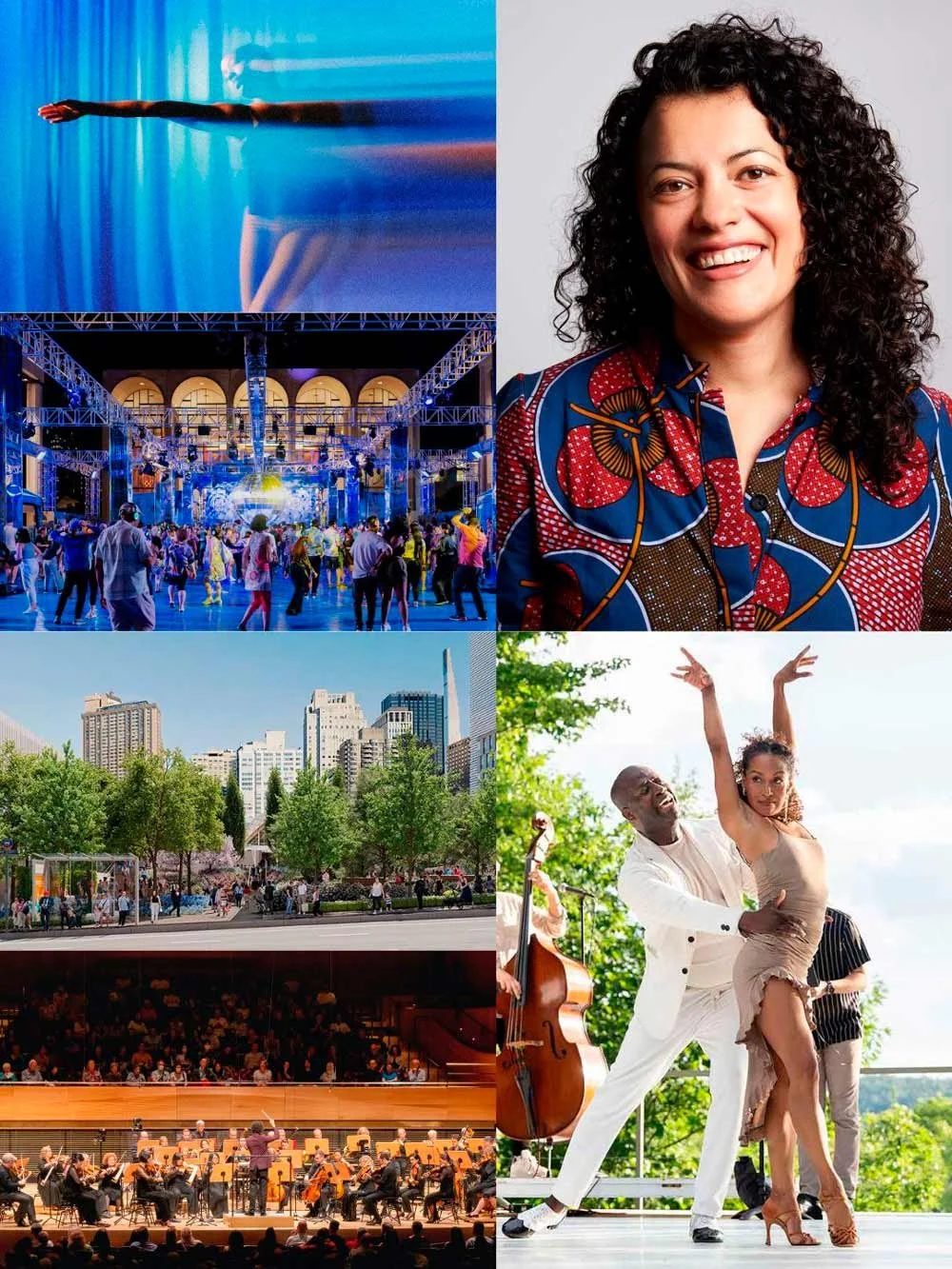


Lincoln Center is multiple stages. I think probably over three dozen stages across 16 acres. It is a vast canvas in and of itself. And then we have this beautiful plaza that leads to this beautiful campus, and that’s the visual I think that most people have when they think of Lincoln Center is this beautiful fountain in the center and these three gorgeous buildings.It’s New York’s biggest plaza, and it feels very vibrant and beautiful. In the summer, we really take that plaza and we transform it into a dance floor. So this idea of also interrupting what people’s notion of Lincoln Center is because it’s a space that is very aspirational, which is a great thing.
I think it holds this idea that something important is happening there. But I think it also holds an idea that, oh, maybe I don’t know the rules to what happens there. There’s this sort of separation that can be caused by that feeling. So we do these fun, visual reminders to people that this is actually for them. And Clint Ramos is one of our artists in residence, and he does these incredible designs with us for the summer where we really transform these spaces. So every nook and cranny is an opportunity to really interrupt people’s assumptions about who should be there or how they imagined themselves there.
And so I really do believe that the arts are critical to how we move forward together, and live performance in particular, I think, is a way of us practicing how to move across our ideological boundaries and find one another and imagine these new worlds together and create together.
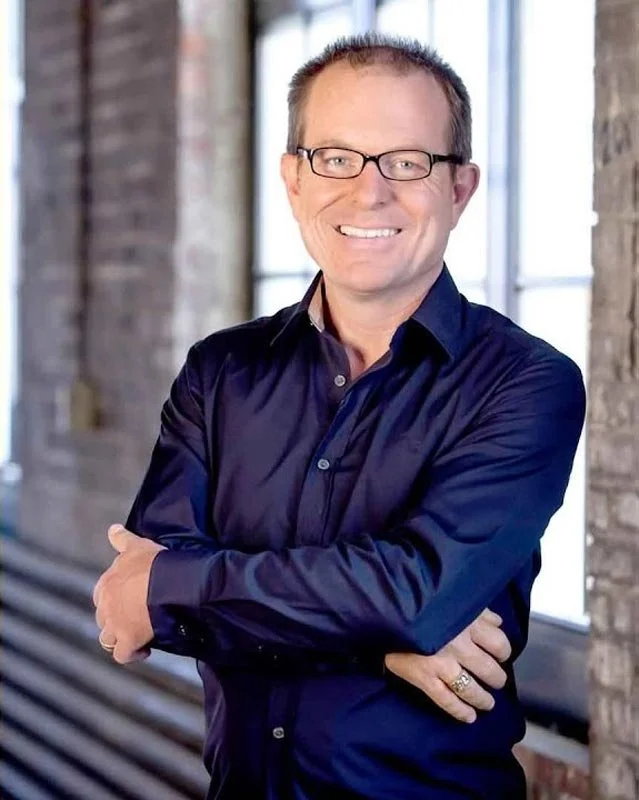
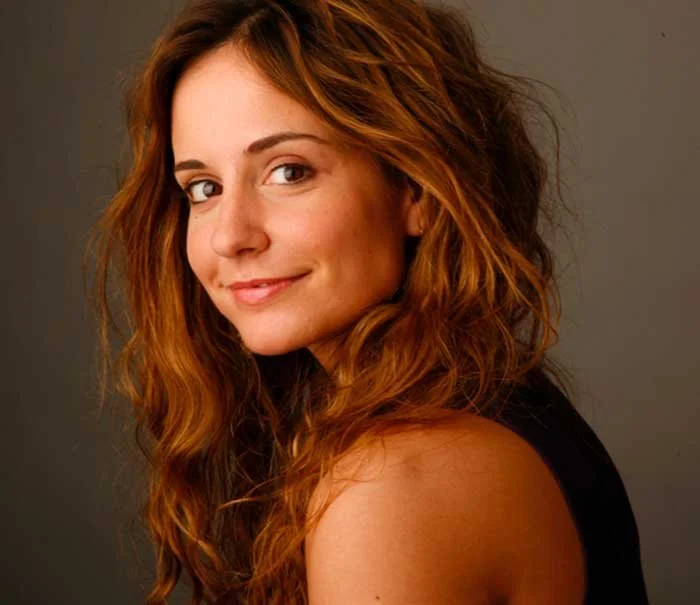
Shanta Thake is the Chief Artistic Officer at Lincoln Center for the Performing Arts—the nation's largest performing arts complex. Before stepping into this role, she spent nineteen years at The Public Theater, shaping the city's cultural landscape through Joe's Pub and expansive community initiatives. Today, she is tearing down walls—both the literal barriers separating Lincoln Center from its neighbors, and the figurative ones that dictate who belongs in our cultural spaces. She views the arts not as a luxury, but as essential civic infrastructure. We are pleased to have Shanta Thake to discuss her journey, the power of radical curation, and the future of public performance.
THE CREATIVE PROCESS
Shanta Thake, welcome to The Creative Process.
SHANTA THAKE
Thank you for having me. I’m so happy to be here.
THE CREATIVE PROCESS
So we see at Lincoln Center, you’re like a maestro of plate spinning with all the things you’re doing. I read that in any given year, Lincoln Center puts on 5,000 performances and projects.
SHANTA THAKE
I think that might be somewhere in the vicinity. There are 11 organizations here on campus, so between the movie screenings and our summer festival and the philharmonic and everything in between, I think that’s probably close to right. It certainly feels that way.
THE CREATIVE PROCESS
Well, it’s a lot with all these other initiatives as well. I know people don’t even realize how extensive it is, and you’ve taken on even more since you’ve come onboard. I just can’t imagine how many moving parts that is to keep them all in motion, just nonstop spinning. We only see the effortless part. We get to sit in the audience. But before this, you were at The Public Theater. You trained as an actress. You grew up in Indiana. Just walk us through your path to the arts and when did you discover your love for the arts?
SHANTA THAKE
I would say I’ve always been a very curious person, and I was definitely a curious kid. I grew up in the Midwest, in Wisconsin and then Indiana. My father was a forester for the US Forest Service. So we grew up in very small towns across the country. And really, I was very fortunate to have a family who had personal practices around the arts.
So my grandfather was an engineer but also was a violinist. I had a grandmother who was a professional singer. She sang Kathakali, which is a South Indian dance drama form, but she was also a singer on Radio Singapore. So my life growing up, and my mom studied as a dancer, and so, you know, I grew up always having this very vibrant family, singing, dancing, talking about these things, appreciating these things, even though the access to the professional field of these was very minimal.
There was, you know, a sense that the arts were important, although I don’t know that people articulated it in that way. That really didn’t come until my aunt moved to New York City. She started working at Alvin Ailey, which is, of course, you know, one of the great dance companies of all time. And so she was the assistant to Judith Jamison, and that was our first entrée into New York.
We would come visit her and spend time in New York, and New York just completely blew my mind. Seeing the people, feeling this energy, and then, of course, seeing Alvin Ailey, it’s not a bad first high art experience to have.
And so that really, I think, blew the doors wide open for me in terms of what was possible. I thought of myself as a performer and grew up doing community theater and theater in high school and singing in choirs, playing instruments, and went to school for theater to be an actress. But I think the whole time, I had this amazing example of seeing what was actually behind the scenes at a large performing arts institution.
I just had never thought of that. I always thought, “Oh, I’m going to be obviously on the stage, and how lovely that there are these people doing these jobs, but I will find a way to be on stage.” As soon as I moved to New York to start my life in acting, I realized that I actually much preferred being in the office.
And I got a job right away at The Public Theater. I was very fortunate to get an internship at The Public Theater in 2002, so right after 9/11. When people were fleeing the city and the arts were at a very precarious time and place in New York, I came in as a 22-year-old and just saw nothing but possibility. And then I never wanted to leave the office to go to auditions. I wanted to just stay and soak in as much as I could of what was happening at The Public Theater at that time.
THE CREATIVE PROCESS
Well, that’s so interesting. I think it’s really important that you had that experience, as it is something we’ll get to later in the conversation. Your dad was a forester. I mean, I feel like the arts, and I know that wellness is a really big part or important community engagement, all these ways that the arts improve our lives and our wellbeing is a really an important initiative at Lincoln Center. And so I think it helps us by bringing us in touch with each other. I think that’s a great part of your foundation to getting to the core of something and why it’s important to you, that you didn’t just come studying just administration. You approach it from the inside out.
SHANTA THAKE
Yeah, I agree. You know, I often say that I went to school for theater, but I also got my degree. They had this liberal arts management program at Indiana University where I got a certificate, which is kind of more than a minor, less than a major in business, in management. And I would often say that my management classes were very similar to my directing classes. You know, these are the same skills, the same ideas of sort of bringing people in a room together and creating something.
THE CREATIVE PROCESS
Yeah, I call it the invisible arts. Things happen, making people safe where they can be their creative selves. That’s really important, that there’s a lot of business in arts. There’s a lot of management in arts. It’s the scaffolding. Without that, all the creatives wouldn’t have a place to perform. It’s making things happen, which is the most important thing of producing.
You had a lot of initiatives where you’re bringing public theater out to audiences outside the theater. Of course, the musical Hamilton, I think famously debuted there. Give us a top five, a top ten of these really fulfilling experiences where you learned a lot and then you grew as a community and collective.
SHANTA THAKE
So many. Well, I’ll say The Public Theater is an amazing place. It’s in downtown New York. It has a season of, you know, five or six shows. There are a couple of musicals and some plays. It also runs Shakespeare in the Park in Central Park, one of the first large free Shakespeare offerings in the country in that way, where people line up and see the best of acting and directing in the middle of the park for free.
And it also has these programs of The Public Theater, one of which is Joe’s Pub, which is a small cabaret venue where we would bring about 800 shows a year, you know, two to three shows a night, and be in this beautiful intimate space and see the best in live performance in that way. There is also a mobile unit which took Shakespeare to correctional facilities, community centers, shelters and everything in between across the city.
There was Public Works, which did these classes throughout the year with community partners, and then a large-scale pageant in Central Park as well, featuring about 200 performers, a magical and joy-filled expression of what really is the city. You know, seeing the city reflected back at you on stage. Public Forum, which had these beautiful humanities talks, Under the Radar, which brought work from around the world, the avant-garde contemporary theater into this January festival.
So all of these different tentacles of The Public existed and were responsible for different parts of a community. And New York City is a big community to try to understand, and I like to think that all of that work helped feed each other. You know, the work that's happening in Shakespeare in the Park definitely had to affect the work that was happening at Joe's Pub. Whether you could draw a very clear line or not was a little bit beside the point. The point is that we're all responsible showing the best to the city of New York, and how do we make sure that we're each doing our part? So in terms of top experiences, they so range. I would say Allen Toussaint coming to Joe's Pub post-Hurricane Katrina. Allen Toussaint is, you know, one of the great songwriters of all time and really found a home in New York post-Hurricane Katrina, where he would come back and forth, and he would play these beautiful solo piano sets at Joe's Pub and throw Mardi Gras beads out into the audience.
But you just couldn't believe this true master sitting in a room with you, telling these stories, just an ultimate gentleman who has really affected so much of popular music in this country. Seeing him with 100 other people at a time is pretty miraculous. One of my first big shows that I curated before I was the director of Joe's Pub was a late-night show. We decided to throw an after-party for New Year's Eve. So we kept the pub open. We had Sandra Bernhard ringing in the New Year at midnight, and then starting from 12:30 to 6:00 am, we threw this New Year's Eve after-party and invited really the downtown, transgressive queer community to do this giant celebration hosted by the King and Queen of New York, who were John Cameron Mitchell and Murray Hill.
John Cameron Mitchell was Hedwig of Hedwig and the Angry Inch, so the Queen of New York, and then Murray Hill, who is a famous drag king personality. It was just so magical, this opportunity to celebrate these artists and to celebrate with one another and to have this wild, insane idea. We had to apply for special licenses in New York to stay open that late to eat breakfast together, and it really became a family in that moment.
Then I would say the first Public Works pageant. I think it was The Tempest, but I was also in it. I was in a gospel choir, and our gospel choir was one of the cameo groups for The Tempest, so it was so nice to be a staff member working at The Public and then also in the production itself and really get to see the experience of what it was to be a part of this performing community, not only my gospel choir but then this larger 200-person extravaganza for New York.
THE CREATIVE PROCESS
Just to hear all that, it sounds like such fun, and I know that it's not just the art that's made, it's the community that comes together in the making of it, right? So from The Public Theater, you come to Lincoln Center. And you're taking on a lot. You have your own kind of West Side Story initiative right now. You have Summer in the City. What were those qualities do you feel that you were specifically brought in for, you know, that you nurtured at The Public Theater, but that now you have this larger canvas and you're making sure that it all runs smoothly across all of Lincoln Center's different organizations?…
SHOW FULL INTERVIEW ▼
...I'll say that, you know, Lincoln Center is 11 organizations, so I'm the chief artistic officer of Lincoln Center for the Performing Arts, which is one of those. We are uniquely positioned to actually look at what the other ten are doing, make sure that we're supporting their work, and really celebrating the work that they're doing but also doing the work that they're not doing. And so I think part of what had set me up for coming into this place was my deep love of New York City, which I think coming in 2021 really meant having to understand what the city had gone through, was going through, coming through a pandemic and still really being in the aftermath of it.
You know, I think we still are actually feeling the aftershocks of what that meant for all of us and the fragility of being in an urban environment.
So I think at The Public Theater and my last few years at The Public, I oversaw all of the programs of The Public Theater that I mentioned earlier. I really did have a good sense of all of these different communities and also the importance of a wide breadth, a wide reach into deep relationship with artist community and audience. And really understanding or beginning to understand—I will always be trying to understand and unpack the power of what it means to bring these audiences and artists together and what is really possible and necessary about that in an urban environment, and how do we take people over that bridge of being too afraid to gather to knowing that gathering together is the most important thing we should be doing.
I think that was really part of the trajectory, and really feeling like coming into a very particular time again as I had come into The Public Theater at a very particular time. This new kind of crisis also brought forth a lot of opportunity and a lot of ways of looking at each other and saying, we can do this differently.
We can really come to our audience differently. We can imagine... our job is imagination. So if we can't do it, who can?And taking that as a real exciting challenge for all of us and something that we could all get behind moving into whatever came next.
I think it was very uplifting. So many people went through hardship, lost family members and so many of those people dear to them. But it was uplifting to hear that also among the essential workers were artists, and that's what they went back to. That's how much we need storytelling, because that's how we understand who we are.
So just how do you decide on the programming? Because you have so much choice of all this creative talent, apart from listening and seeing. What are the questions you're asking, and what kind of creative discussions are you considering? And how do you know what makes an artist's vision essentially a good fit? How much leeway and trust is involved in letting them craft the actual performance, because I know some of them are established voices, but they're also newcomers who've maybe not had that stage before. What are those things that you're considering?
Yeah, I think so much of programming is listening, is really listening to the world around us, to noticing the questions that keep coming up that feel unanswered. And then we have the great gift of listening to our artist community, and the curators that work with me are really in ongoing decades-long conversations with the artists that they have worked with, and finding new artists and traveling and going to shows and meeting new people.
Part of that is an understanding or a belief that artists are telling the stories that we have yet to see for ourselves.They're in a world of noticing that we, because we are moving through our own days and our own work lives and family lives, have not taken that perspective or have not allowed ourselves the time and energy to move into a space of really recognizing what's happening and putting it into a timeline of not just the art that's come before and after, but just the literal timeline of human history, and then putting that into a story that is reflective of the community that they come from or the community that they have left or want to be a part of.
So I think it's a combination of those things. You know, we have shows that are happening right now on this campus that have been decades in the making. I saw a show yesterday by Shen Wei called Mindscapes. Now Shen Wei is a contemporary dance artist from China who really blends these dancers from China, from all over the world, and yesterday he had a company of 30 dancers coming together.
They paint with their bodies on stage. They roller skated across the plaza with pinwheels on their head. I mean, it was a wild display, but also deeply beautiful and meaningful. Shen Wei has been a practicing artist for 50 years, and he was celebrating the 30th anniversary of being on the Lincoln Center Plaza.
He had performed at the Lincoln Center Plaza in 1996, and here he is in 2026 on another part of the plaza. Since then, he's performed in almost every space on campus, but this is a relationship with the stories of today, with an artist who's been grappling with and changing his own form to meet a new time and meeting an audience. You know, I sat next to a critic who had been following his work for 20 years and writing about it, and we're surrounded by probably 1,000 people outside watching this who are laughing and crying and just given this chance to imagine together. But we started this particular conversation 30 years ago.
It also started two years ago when we started to think about what we could commission together and what would make sense and what space would make sense because he was really ready to have a new piece at Lincoln Center. So that's one example of an artist who... there are so many timelines of how and why a piece lands at the right time in the right place.I'll say he came to look at the space maybe two weeks ago and said, "Oh, I need 12 more dancers. This piece is too big."So you know, it's an evolving conversation, and again, we have to trust the artist. It's their responsibility to their public, and it's our job to make sure that vision is fulfilled in whatever way we can make possible. But there are other shows that take two months that I'll see tomorrow, and then we'll try to fit into the season.
So that's the adaptability where really true creativity comes into play. You know, budgetary creativity, space creativity. Yeah, it's an improvisational art even if it's scripted. So that's one of those performances that's multidisciplinary. You're catching people who may be attracted to dance, but then they're finding this is sculpture, this is painterly, this is something else.
And you mentioned several times the campus. A lot of people think of Lincoln Center as the buildings themselves. But there's been a lot of expansion. You have also your West Side Story project where you're opening that back up, you know, there's a wall there historically.I hope you'll go into that. But also with the Summer in the City where you have pay-what-you-can performances that allow the performing arts, and it's not always seen as accessible to a lot of people, so I really like all these initiatives that reach out where people are.
Yeah, thank you. I think Lincoln Center is multiple stages. I think probably over three dozen stages across 16 acres. It is a vast canvas in and of itself. And then we have this beautiful plaza. You know, when you walk up or down Columbus Avenue to the west is these grand stairs that lead to this beautiful campus, and that's the visual I think that most people have when they think of Lincoln Center is this beautiful fountain in the center and these three gorgeous buildings.
It's New York's biggest plaza, and it feels very vibrant and beautiful. And two things. One is that in the summer, we really take that plaza and we transform it into a dance floor. So this idea of also interrupting what people's notion of Lincoln Center is because it can also feel quite severe and like a space that is very aspirational, which is a great thing.
You know, I think it holds this idea that something important is happening there. But I think it also holds an idea that, oh, maybe I don't know the rules to what happens there. There's this sort of a separation that can be caused by that feeling. So we do these fun reminders to people that this is actually for them.
And Clint Ramos is one of our artists in residence, and he does these incredible designs with us for the summer where we really transform these spaces. So every nook and cranny is an opportunity to really interrupt people's assumptions about who should be there or how they imagined themselves there.
We had a summer where we put 200 pink flamingos in one of the pools. And this sense of joy and whimsy and again, just a different kind of welcome, a different way in for people that maybe have not felt at home at Lincoln Center.
And that has been so fun to imagine and reimagine, and Clint has been a huge part of that. And then the other thing to say, just to place us and to speak to your question about the West Side, is that if you enter, like I said, from Columbus Avenue and walk to the west, you'll have this grand staircase. But if you were to walk along Amsterdam Avenue on our west side of campus and look over to the east, you would just see a wall.
You would see this 20-foot wall. You would see the back of the Metropolitan Opera, and you would never know that Lincoln Center was there. You would never know that this incredible array of performance, the best from around the world, was waiting for you across that wall. And some people, you know, really didn't know.
And people on the other side, you know, really felt like not only this wall telling me to not look over here, but it's telling me not to come here, that I don't belong here, that this is not a place for me. So we have spent the last, I would say, five to six years in conversation with our community. Really from the beginning, but definitely during the pandemic, that was very supercharged, of meeting our neighbors and saying, "What do you need, and how can we help?" And offering things like food pantries and blood drives and other pieces of meeting direct needs that then became an invitation into a new kind of relationship.
And that relationship opened us up to some very hard truths, a very complicated truth about what it meant to have Lincoln Center in this neighborhood. Who we were for some of our neighbors was not who we were for all of our neighbors. And so that just began this incredible, very enriching dialogue about the history of Lincoln Center when it was built.
Yes, indeed, let's go into that a little. I'm just thinking about the past and how the area was transformed into this creative collective garden that it is today. I know that you're doing a lot of renovation at the moment. I don't know what the progress is on your West Side project, but I believe you're tearing down a 20-foot wall on Amsterdam Avenue. Just tell us about that. It's kind of a different West Side Story.
That's right. That's exactly right. And West Side Story really is based within our neighborhood of San Juan Hill, this beautiful vibrant neighborhood that was here that was part of what was torn down to make Lincoln Center under the banner of urban redevelopment and this idea that it was a slum, and we would come in with this palace to culture, which was Lincoln Center.
And when people did that in the '50s and '60s, what was done is that we have this incredible iconic campus that I think most people can kind of picture in your mind. If you were to walk on the west side of campus, you would see a 20-foot wall, and really you would never know that these buildings were on the other side. It looks like a large parking garage essentially from that entrance. And on the other side of that, we have our neighbors. We cleared 8,000 homes and multiple businesses and made way for Lincoln Center and Fordham University and a swath of other things.
The pain was still very much felt from many of the people that lived to the west side of campus. So those conversations really took us on a journey, and that journey led us to really investigating what would it take to bring down this wall.What would it take to really create an entrance on our west side that was as grand as the one on Columbus Avenue from the east side? And that has been, I will say, just one of the most fulfilling conversations I've ever had the chance to be a part of professionally, personally even, and just continues to offer this richness of complicating the narrative, which I think is the goal of the arts anyway. And we've of course learned that Thelonious Monk lived in this neighborhood, that Shuffle Along, which is one of the longest running Broadway shows in history, started right here on campus basically, created by people that lived in San Juan Hill.
I mean, it's just like these endless stories of actually the artistry that was here and how now we're in a process of rebuilding the west side and creating a new park and entrance and a brand new theater. And it's moving quite quickly along. It will reopen in summer of 2028, and it's been amazing.
Yes, and I think that you're doing a lot of new projects. But really you're investing heavily in the next generation, including the new Pasqualano collaborative for contemporary dance. I guess that's a decade from now. But if your vision for Lincoln Center is fully realized, you know, the campus doesn't just look different, for you it feels—
Yeah. If the campus, you know, we are very place-based. I think it's an opportunity when you're on a campus and when you're responsible for a campus in the heart of New York City, it's a chance to show what's possible in a space, and how it really can be a space for everyone, and I think that's the job. There are many jobs actually. I think that we hold a lot of responsibility and privilege in this space at Lincoln Center. So one of them is to make sure the great artists of our time have a space here. Of course, artists work in a number of disciplines across a number of forms. One of those is arts and technology, artists that are working with technology in brand new ways, totally fascinating, that are creating new works that are now trying to find spaces to even perform them in because these spaces have not been built to even hold some of these new works. Also contemporary dance, which of course, of the 11 organizations on campus, none of them are focused on contemporary dance, and that was one of the original ideas of Lincoln Center when it was built, that we would have this American modern contemporary dance company, it just never got the energy that it needed to sustain itself.
And so we have gotten this incredible gift and have just launched our first Pasqualano contemporary dance festival in June, and we'll have another one in January. And we'll be really cementing the place of contemporary dance on campus and making sure that those great artists of right now have a space to come and perform. But also just to complete that loop, that the artists of today and the audiences of today understand that live performance is the most vibrant thing they could be doing with their time, and we have to make sure that's true.
It's interesting that you mention technology and those new technology-based or technology cooperative, you know, works of art or works of performing arts, and then you mention that side by side with contemporary dance. Because we’ve been having a lot of discussions about this and what it means to be an artist, you know, in the age of AI.
I wonder broadly what you feel are, you know, the positives or negatives. I mean, it can obviously open new pathways, but also in some ways they're... It kind of, if you follow industrial creativity down its natural, you know, endpoint, it almost seems to say artists eventually will not be needed. We've scraped enough, and we can almost do it almost on our own with maybe an overall director.
Yeah. I think to me it's kind of, well, what's the point of all of it? Of the whole thing, the whole enterprise of life, of what we're doing here, of how we imagine ourselves. I mean, one of the things that we have been also thinking a lot about, especially I would say personally what I've been thinking a lot about in my own curation and my own way of thinking about why and how we do the work that we do, is participation.
And so imagining that we as individuals, as non-professional artists also have... It's important for us to find our creativity, to be able to express ourselves, to hone that creativity, to be able to find our own voice, our individuality, to not be thought of as simply data to be mined for something else.
That is not the point. You know, the point is that if we are moving through this world and we want to enjoy what it means to be fully human, I think then you have to be fully human and creation is part of that. This idea of thinking through, moving through, expressing yourself in your body and your words and your voice, through your paintbrush, those are all part of the human experience. And to imagine that we have something to offer each other, this act of generosity that creation gives us, I think is deeply important.
And I do think AI is pulling from things that have already been created, but artists are again working ahead of us. And I think the artists we're working with in the Collider, we have this Collider Fellowship. We bring six artists from very different disciplines but that are really invested in what new technology has to offer either their practice to one another. And I would say almost to a person, the work that they're creating is about illuminating what makes us uniquely human. They're using AI, they're using technology, they're using bioplastics and robotics and VR and AR. But the work itself is about, oh, I'm still a critical part of this.
Bioplastics is something I think is so interesting, and it's fairly, I think, simple and beautiful context of Cynthia Chen, who's this amazing theater artist. She makes these bioplastics that then conduct—I know so little about the actual science of it.
But it's basically conducting electricity, but you need a human connection to finish the connection. So you're completing the circuit by holding hands with another person. If you put your own hand on it, it does some beautiful things. It's still like there's some beautiful imagery that pops up, but when you're holding hands with somebody else, it's just this wild new landscape that emerges. And that's, you know, that is truly just reacting to the water and electricity that is in each of our bodies. So it's using this technology and science and what we know just to ask a question about how powerful are we alone versus together versus what can we make together?
So yeah, I think that we have every reason to be terrified of AI as a tool. And we have a responsibility to harness it and bring it into humanity. And I'm really interested in the artists that are taking on that challenge and moving us into that conversation together. Art is a technology. It's the oldest technology there is. It's a communication tool. And so figuring out how we don't shy away from these new ways of thinking but also keep control of what makes us human.
I think that's such a beautiful image. It makes me think about your father the forester, about how in the arts you're planting seeds for future generations. And this whole bioacoustics and how we're all connected, we're learning so much about the mycelial networks in forests, how, you know, they communicate and they're interconnected.
You have the mother tree, and if they sense a tree or a sapling far away is in trouble, you know, it can send nutrients. So I think that we're like that. We forget that we're acoustic, we are part of this living world. So I just want to say that's a beautiful image. And you're doing so many exciting projects. You also co-direct GlobalFest, bringing world music to stages across the country. I guess there's the New York Voices Commission. Just tell us some of the other things you're excited about.
Yeah. I'm a co-director of GlobalFest, which is a global music festival that now happens twice a year, but it also is a year-round organization that really highlights traditional music from around the world, including America, the United States of America and our traditional forms, and brings them into the touring networks of North America.
So we have a big festival in January that now happens at Lincoln Center, so to combine my worlds. But GlobalFest, I think, is in its 24th year this January. And we've been, you know, volunteer co-directors pulling this together and bringing now ten artists from around the world into one night only onto three different stages.
It's this beautiful festival. I think the beautiful thing is, I think people were imagining... This was a long time ago. We started in the wake of 9/11, actually, when touring was very difficult. Visas were hard to come by. Borders were closing, so not so dissimilar to what we're experiencing. And really to show the value of cultural exchange and that it actually... it's wonderful to be a Colombian artist and see a Colombian band with your Colombian brothers and sisters and friends and family.
But it's unbelievably nurturing and celebratory to be in a room of people that do not look like you, that bring people from all around every diasporic community in the world and are watching a Colombian band, watching your favorite Colombian band on stage with a group of people that look like the most diverse group of people on the planet watching this.
So to have ten bands from around the world and watch the bands themselves watching each other, the audiences for each of these bands moving and understanding that clarity of we are so much more alike than we are different, even though we manifest our individuality in these amazingly particular ways.
And speaking of GlobalFest and different multicultural influences, I'm thinking of your own background. There was certainly a diversity of voices that went into making you who you are today.
Yeah. My dad is German and he's born and raised in Chicago from German parents. I think he's third generation. And my mom is Indian. And she was born and raised in Malaysia and then immigrated to the United States after she married my father. They met when he was in the Peace Corps in Malaysia, working in the rainforest there. And then they met and got married and moved to Wisconsin.
And so I'm wondering, because you're managing so many projects that are not only multidisciplinary but really multicultural, and you're engaging with so many people from all around the world. So how do you feel your background helps you in your role as artistic director?
I think in general, because I grew up in small towns and in pretty homogenous areas of the country and perhaps that are less homogenous now, this feeling of belonging, of wanting to create spaces of belonging for people from every different background is really important to me.
And the more that I've grown older and I've thought, you know, you grow up and you think, "I've never really fit in." And now, you know, I realize that almost everyone at some point has that. You know, that's such a universal feeling of not fitting in.
I have a very particular way that it manifested in my life growing up in these towns where we were the only people of color. But everybody has that feeling in some way. And for a lot of people, it's a major driver of either their passion or a continuing burden to them. And so I really do believe that the arts are critical to how we move forward together. And live performance in particular, I think, is a way of us practicing how to move across our ideological boundaries and find one another and imagine and create these new worlds together.
And so if I believe that it's this most important thing, then I have to make sure everybody feels welcome there. And I have to figure out what is the right container, how many containers do we have to create to make sure that people can find their way in and have this experience of feeling othered but feeling like they are a part of something and that they have something to offer. So I think it's really this sort of cross-cultural, beautiful window into what I want to see possible for other people in terms of finding themselves within these spaces.
And I think if I may, this is a bit of a long question, but because of your father's background in forestry, I mean, talking about biodiversity of the arts but also of the natural world, I've been thinking a lot about animal communication. Of course, in Indian culture, the animal is sacred, and I'm thinking a lot lately about animal intelligence and creativity as things we can learn from.
But that also means the human animal. And something that we're seeing a lot now, all around the world, we're going through heat waves and we're kind of getting disconnected. Like, synchronicity is something that's really developed in the arts. Timing, instincts, the songs that we sing, they're not just in the arts. In the animal world, it's a means of survival and a way of navigating the world.
And when they get out of sync with their internal technology through our noise pollution, you'll see whales getting beached on the shore. And I'm wondering what your reflections are. You talked about how we're always moving forward with our hectic lives and this disruptive technology and the inhuman pace of AI.
We don't even know all the ways we may be, you know, getting beached or being led off course of our internal timing and what's natural to us, how we get back to our animal selves and our dreaming mind. Sorry for the long question, but I'm just wondering what your reflections on this are and how we get back to the deep waters of who we are and why we're here.
Oh, that's such a beautiful question. I mean, that's so many beautiful noticings I feel like I'm going to want to spend some time with too. That is also one of the gifts of performance. When you're seeing something with other people, it is the gift of pause and contemplation. And sometimes, you know, when people go to see a symphony, I don't need or want or expect that they're going to spend that time thinking about Dvořák. You know?
That's not the point. The point is actually that it's okay to think about your grocery list. It's wonderful if you can be transported to be thinking about just the beauty of what's possible and the sound and the quality of what it means to be hit with 80 instruments playing in your direction for any amount of time.
But it's also okay to have your phone away and to pause and to be looking around at the audience and to be seen by other audience members. And those are also moments of sync that can happen when we are together and we actually take what is a privilege of taking the time to stop and to offer ourselves that ability to allow ourselves to think and to process and to have that space.
And I do think, again, this idea of us being beached by these waves of who knows that are crossing our transom and we don't know it yet. But I do think a creative practice for everyone is part of that. This ability to really think about, "What do I want to say about this? How can I sing about this? How can I use what I have to respond?" And that I think is a real necessity as well in this time to really just continue to remind ourselves that there is an agency that we have, and it doesn't have to be an agency to destroy. It can be an agency to create.
Absolutely. And if we don't see ourselves or we're not actively involved in the arts, we're in the audience. We've been having conversations about how it works like a kind of time capsule or time machine. You can go back to your childhood when you felt more free, when you have all these kind of profound and mundane thoughts together, and that is freeing the mind.
It's just like a collective dream we can all experience. America's now celebrating its 250th anniversary, its 250th year. And so we're thinking a lot about freedom these days. What does it mean, personal, artistic and then democratic? All these things that we're thinking about a lot. So when do you feel most free, and what is freedom to you?
I would say freedom... I do feel most free when I am singing. I love to sing. Like I said, I was in a gospel choir for years. And that idea of moving with other people, of expressing through this joy-filled music, and gospel music is good news. You know, that is what its structure is.
And so it is just this beautiful, immersive experience. And you can feel the power of it and, of course, the well-documented power of spiritual music. But I think that to me is one thing that I absolutely love. But I also feel free in New York City.
You know, I love being in an urban environment. And this feeling that you can really do just about anything and you'll be happy to be noticed but also happy to be totally unnoticed by the vast swaths of people walking around, doing whatever it is they're doing. And so I love that kind of invisibility that a city gives you, but also the permission that it gives you to kind of be who you want to be.
Yeah, interesting. Ways of disappearing, and it's funny that you mentioned spirituality and city life side by side. Like there's a choreography going on. So that brings me to my next question, because I was wondering, you know, spiritually, you talk a lot about connection and what the arts do. You know, they can connect us to things beyond what we can see and touch. So how have your feelings of spirituality and the meaning of life changed over time?
You know, I love religion. I'm a very spiritual person. I grew up going to church but also to temple. I grew up Hindu and Christian and have now been, I think, a collector of religions my whole life. But I find it to be, or I think it has been both for good and bad, an incredible organizer. You know, it has brought people together to do good. I think it's also obviously done a lot of harm. But for me, it's one of the only ways that people organize around feeding the hungry and helping the poor and being in a practice of understanding that there's a responsibility to give more than you get in this world.
And so I love that as an organizing principle, and I think religion has done a very good job of it. And now, of course, we're also seeing that organized religion is also falling away from a practice for most people. And so I would say my own sense of meaning, of the meaning of life, how it's changed over time, is a big question. But I would say, you know, I still want to believe that there is certainly a lot more good out there than there is bad.
And I see this fracturing of society happening in real time in a way that I hope we can really still stitch together and really be able to find ways of reflecting to each other this good and what's possible and allowing people opportunities for empathy in big ways. And also the empathy, joy, feeling of abundance that can be hard to come by, but a real feeling of thinking through what we have to offer each other on an individual basis and a collective basis.
...If you close your eyes, is there a sound or scent that feels like home to you, that brings you back to the comforts of home life, the big city of New York, growing up in Indiana?
Let's see. I would say... Oh, I grew up next to an amusement park, so I always liked the sound of a rollercoaster. I have a huge sense memory of being at home. I worked at this amusement park, Holiday World, for five or six years of my childhood since I was 14 years old.
So I have many, many sense memories of a rollercoaster, the sound of the clicking up of a rollercoaster. And the sights and sounds, the scents of corn and soy fields and what that is like. The sound of a football game, a Friday night football game, which animated most of my high school life. Marching bands. All of those, I think, feel very uniquely American, but it certainly was a huge part of my childhood.
That actually seems very appropriate. Well, at least just understanding the excitement and the tension and release of roller coasters. But all those things, the immediate visceral response. I was hoping you might share some things about New York or Lincoln Center too.
Like a visualization? I mean, New York, you know, luckily I don't have a very good sense of smell in general, so I think the scents of New York are not the ones that I would call to mind right away. But I love the sound of an audience before curtain, the sort of quieting, the unwrapping of candies, the hush when the lights dim. Those to me are some of the most beautiful moments. I love being on stage for those moments and seeing an audience really sort of settle in this shared moment of collective imagining.
So those are some of my favorite moments. I mean, Joe's Pub, the smell of french fries. Anytime I smell french fries, I think of Joe's Pub. Because it's a beautiful cabaret venue and we had great french fries. So there are some immediate responses.
Oh, no, it's great because all those things can bring it home, you know, simple to large. What was your first memory or the first thing of beauty that you were drawn to, maybe in the arts, or maybe your first memory of coming to New York or an early important memory?
I would say, I think one of the shows that really changed my life and one of the first things I saw on Broadway was Bring in 'da Noise, Bring in 'da Funk. And it was such a miracle to me in so many ways. I had seen contemporary dance, obviously, with Alvin Ailey. I'd seen other Broadway shows. But this was something wholly different, where there was spoken word and there was a story being told, and it felt so raw but so polished at the same time. So much energy. And it really shifted for me what was possible, what was performance.
Again, having not seen much professional work. I was seeing my high school musicals and Bye Bye Birdie, and I was seeing Les Misérables when it toured to the local theater. But that totally broke open my world, and it was directed and created by George C. Wolfe, who was my first boss then in New York. So it was really a full-circle moment for me right away, stepping into that office and understanding that anything was really possible.
It's wonderful when those possibilities open up to you. So, in closing, what would you put into your Museum of Memory and how have they given your life meaning?
Museum of Memory is sort of anything from your past life?
People, important teachers, parents, books. You can put anything.
I would certainly put my family, my parents and the way that they really allowed us to find ourselves and to follow our passion, and to be joy-filled about that, to be excited about life and what was possible, and to trust that we would land where we were supposed to land. I would put Graceland. Paul Simon's Graceland is an album that, from the time I was very young, I would listen to in full before every major event in my life. So I had it on my headphones in my little Walkman as a fourth grader, and I continued to play it before every major audition, before my wedding. It's been this sort of ritual of my life that I could not do without.
I would put Bring in 'da Noise, Bring in 'da Funk in there. The first time, that show totally changed my perception of what was possible. I would put Rent, the musical Rent. I saw it on my 16th birthday, and it made me want to be an actress.
And then a lot of firsts. I think the first time coming to New York, the first time walking into The Public Theater, the first time seeing an opera at the Metropolitan Opera. I saw an opera for New Year's Eve, and I think it was Carmen, and again, totally changed my sense of scale and beauty and the power of what was possible in a singular room with people and how magical that was. And then I would put photos, I think, from all of the audiences that have come into these spaces that I've been fortunate enough to work within and really look at these faces and see this sort of new possibility that exists with every single show. And I would put my gospel choir.
I liked all those memories you shared. That's a great wing of the museum, sort of your personal exhibition. And so for your public wing, I do want to ask about this because it sounds fatalistic, but actually it's positive. If a cataclysm were to sweep away our civilization and we had to rebuild our world from scratch, what knowledge do you think it's important to hold onto?
And I ask it in just a particular way because of all the disciplines that you offer at Lincoln Center and before at Joe's Pub, not everyone has access to that. So if it's the different individual performing arts or whatever knowledge you think is important, but just why, because I don't think everyone is exposed to them.
Yeah, I mean, if it's a cataclysmic event, I really think about the beginning of the world as it was and how storytelling was at the center of that from the beginning. And even how storytelling about how magical this place is, this idea imagining what this world is for and asking real questions about why we are here.
And I think it will always start with a story, and I hope that that's how it continues to start. That it's stories shared between people, eventually written down, eventually sung out loud, where we're gathering people around, where we're sharing our own ideas of what this might be for and about. That there begins to be a sense of a collective caretaking for story and for these gifts that we've been given. We find ways to amuse ourselves. And I'm sure the building blocks of science and sports and all of those beautiful things that sprout from the human imagination will come to life again.
But I think this ability to really look at one another and imagine this is all such a gift, that nothing has been promised, and to be so aware of that in real time. Which I think, actually, we have the ability to do right now, to be very aware that this is all very precious and fragile. And so if it is, what is the most important thing we need to say and notice about one another and do for one another is a great way to begin. In the most dire of circumstances on this planet, people are still telling stories and still finding ways to laugh with one another and gather together and enjoy one another's company. And I think I would hope that we could do that at the beginning of something new.
Well, those are such important words. It is indeed the gift of the arts, but the gift of being alive and just understanding the preciousness of life. So thank you, Shanta Thake, for creating spaces and collective experiences that help us understand who we are and why we're here, for supporting the arts and artists and helping audiences find that fire, creativity, potential and meaning in their lives.
Thank you and Lincoln Center for adding your voice to The Creative Process.
Oh, thank you so much.