

I think through the ways in which you do not have the rise of the museum form or the poetry archive without the acceleration and mutations of racial capitalism and settler colonialism. A friend and a scholar I admire, Jarrett Drake, says he doesn't study museums. He studies slavery and he studies fascism. And I think that I would extend that and say I'm not studying the museum. This isn't a case study of the museum form. I'm really thinking about the ways in which art spaces, in particular cultural spaces, the space of poetry often advertises itself to be an exceptional site, a site that's removed from the world. But it's actually in those very spaces that you can so clearly see the ways in which the trenchant dynamics of racial capitalism but also colonialism manifest.
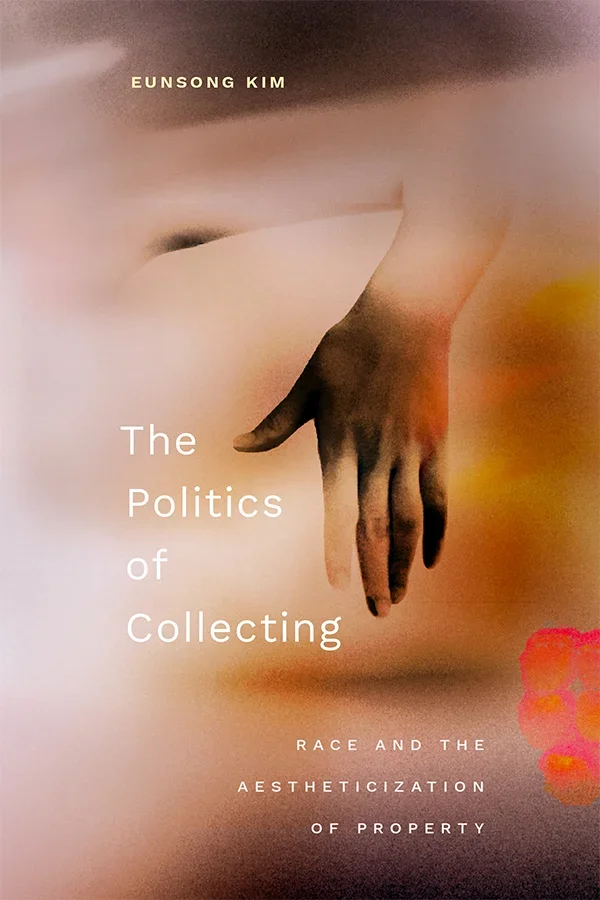
In this episode of the Speaking Out of Place podcast, Professor David Palumbo-Liu talks with Eunsong Kim about her stunning book, The Politics of Collecting: Race & the Aestheticization of Property. It is remarkable in its theoretical conceptualization, argument, and archival work. Kim argues that the beginnings of elite art collection in the United States coincided with the rise of the robber barons and the suppression of the labor movement. She connects this to Taylorism and the idea of scientific management, that further extenuated the rift between the mind and the body, between intellectual activity and labor. Not coincidentally, this distribution of kinds of work created a new distribution of value. In each case, Kim argues, race played a fundamental role. Ranging from the “found” art of Duchamp to the pseudo-Marxist conceptual art of Sierra, Kim eviscerates both pretention and cruelty, and restores the laboring body and what it produces to prominence, along with a truly reinvigorated and capacious sense of the Imagination outside of the constraints of neoliberal aesthetics.
Eunsong Kim is an Associate Professor in the Department of English at Northeastern University. She is the author of gospel of regicide (2017), and with Sung Gi Kim she translated Kim Eon Hee’s poetic text Have You Been Feeling Blue These Days? published in 2019. Her monograph, The Politics of Collecting: Race & the Aestheticization of Property (Duke 2024) materializes the histories of immaterialism by examining the rise of US museums, avant-garde forms, digitization, and neoliberal aesthetics, to consider how race and property become foundational to modern artistic institutions. In 2021 she co-founded offshoot, an arts space for transnational activist conversations.
DAVID PALUMBO-LIU
So let's begin with you just telling us—I know this is a big task because you have a big argument, but it's so important. Could you just tell us what your basic argument is? We can discuss the number of cases that illustrate some of the key points, but what's the main argument of your book?
EUNSONG KIM
Yeah, so the main argument of my book is I look at the site of the personal collection or the museum in the US, or the development of the personal collection museum and the rise of philanthropy. And I think through the ways in which you do not have the rise of the museum form or the poetry archive without the acceleration and mutations of racial capitalism and settler colonialism. A friend and a scholar I admire, Jarrett Drake, says he doesn't study museums. He studies slavery and he studies fascism. And I think that I would extend that and say I'm not studying the museum. This isn't a case study of the museum form. I'm really thinking about the ways in which art spaces, in particular cultural spaces, the space of poetry often advertises itself to be an exceptional site, a site that's removed from the world. But it's actually in those very spaces that you can so clearly see the ways in which the trenchant dynamics of racial capitalism but also colonialism manifest.
I use Cheryl Harris's formative legal article, Whiteness as Property, to really think about not just the museum as a kind of segregated space, which it is, but also the various forms that it supports, like the artistic and aesthetic forms. The form of the found object or the forms that become denoted as the elevated form. So there are multi-layered moving parts to the argument. And I guess maybe the last thing that I would say is because I pay so much attention to the rise of philanthropy, which I connect to the personal collection museum by thinking about Carnegie Steel Company and Carnegie, who's considered the father of US and modern philanthropy. I look at his business partner Henry Clay Frick's personal collection museum, now called the Frick Museum, which was recently renovated for millions of dollars and just had a new unveiling. I think about the ways in which both of their philanthropic projects, but also the project of the museum, could only really begin post the violent de-unionization of the steel mills. The ways in which the forms that become elevated through the museum site actually mirror the loss of labor autonomy that we witnessed in the twentieth century, but also throughout the twenty-first century into this moment.
DAVID PALUMBO-LIU
To me, one of the linchpins of the book is the question of value. What is available to be valued, and that hyper-value inflationary cycles of valuing and value upon value, the intellect of the manager and the disappearance of those things that go into the making. You counter the creation of the Frick and the Homestead strike. Could we talk about those two things in conjunction with your discussion of Taylorism and the notion of scientific management? Especially when this notion comes about that management is presented as a kind of art in itself.
EUNSONG KIM
That's such a wonderful question. And my original conceit was that I would do all of that in one chapter, and then I ended up having to break it apart. So I really like this question because it's one that I was hoping to work through the first time I drafted that chapter. David is pointing to how I pair the acquisition history of what becomes the Frick Collection in New York City with the labor history from the Homestead strike of 1892. The Homestead strike of 1892 is considered one of the most violent strikes in US history. Carnegie and Frick coordinated with the police and also hired private militia, the Pinkertons, to open fire on striking workers and effectively de-unionize that steel mill. And then by the 1900s there are no recognized unions in any of the steel companies that they operate. This was important at the time and into the present because the steel unions were some of the strongest unions, and the things that they were able to organize and win for themselves in a moment when the eight-hour workday was not the law was an eight-hour shift.
The thing that I really noticed reading different labor history books, but also looking through the main newspaper that was reporting on worker strikes, was that it wasn't that Carnegie and Frick's particular Homestead steel plant was not profitable. It had made something like four million in profit that year, and adjusted for inflation that was like a hundred million dollars. They had described in their press releases that this is the thing that has to be done. But I think the wonderful thing about archives and thinking through the past in this moment is you can go and see actually it was not about a profit incentive. Historians across the political spectrum agree that it really is the de-unionization that leads to the philanthropic projects that Carnegie and Frick are known for. Carnegie goes on to build 2,611 libraries. Workers notice that you get a library after he breaks the town's union. Something like 225 communities turn them down. And when I started looking at the acquisition records for the Frick Collection, my thesis was perhaps the two of them were too involved in philanthropic projects, but it was very clear that the acquisitions really begin post the union busting. So it's not just the wealth accumulates, it's the wealth accelerates rapaciously. By the early 1900s under JP Morgan as an amalgamation of the various steel mills and Carnegie selling it, it becomes the first billion-dollar company in the world called US Steel.
None of this is an act of generosity on their part. There's a complete loss of not just worker autonomy, but an understanding, a collective understanding of labor and work, and then it's redesigned and paternalistic in the ideals of the robber barons. The kind of library that Carnegie wanted to build had useful knowledge. When he gave speeches, there are speeches where he says you should not read Shakespeare; you should just have useful knowledge and learn stenography. Simultaneously, his business partner is collecting art. The disparity of what is the life you can live, you want to live... I think the conclusion is supposed to be they are successful capitalists and only successful capitalists can live the life that they want to live and remake society in that way. I lay this history out because I think this argument is too often naturalized in polite society, but also academia. It's in the de-unionized steel mills that we have Frederick Taylor's first experiments for this thing called scientific management, which is not a science. Frederick Taylor was someone who had grown up fairly affluent and rejected going to Harvard, asking a friend of his father's to essentially take a management position at one of the steel mills. He thought the most efficient site of management was the slave plantation. He really thought that he could have a reorganization of the workplace by splitting what he said was mind work to this thing called hand work. So he wanted to have central planning where those who are involved in mind work could decide how the hand workers would operate.
When he was attempting to do all of this, the workers rejected every single one of these experiments. He tried to time the workers to see how fast someone should be doing something, and it was all rejected. But nevertheless, he wrote a book and this became very popular. This is why it's so important to stress this is not a science. It's grounded in an anti-Black legacy of what he thinks the world should look like. Catherine Stone, in one of her reviews of Taylorism and scientific management, describes how foremen had to be retrained to be managers. They wanted to do the work, and so many people had to really be convinced and almost coerced into not doing the thing that was supposed to be beneath them. The naturalization of this worker hierarchy is all part of the argument for the book because I'm really thinking about the rise of conceptual forms like the found object. Taylor has this very eerie line that people will begin to understand management as a kind of art. Harry Braverman is important to invoke at this moment. He wrote this very thorough critique of scientific management and Taylorism called Labor and Monopoly Capital. He situates how it's through this process you can see that there are no unskilled workers; it's that workers are de-skilled. This is a process in which workers who have knowledge are being forced and separated in order to extract the knowledge of production so that there can be a situating of this thing called management that thinks about how to do the work, and then everyone else who does the work.
He says this is a process of de-skilling, and I think that word is important today because I really wonder about the process of de-skilling that's occurring right now. Braverman's not making a nostalgic argument that 40 years ago in capitalism it was better. He's saying there was a different kind of organization of work. If the workers had some ways in which the production was coordinated, it's been completely extracted to central planning, and the process of de-skilling is something he really wants to materialize.
DAVID PALUMBO-LIU
I just wanted to add a couple of tiny footnotes. The violent suppression of workers by Carnegie and Rockefeller, wasn't that the birth of public relations? This is when public relations comes out. They had Rockefeller go down to the workers' quarters and shake their hands, and so this is the beginning of another kind of management skill, which is management of public opinion. Also when you were talking about de-skilling, there is the interchangeability of labor and workers, but the person who is irreplaceable is the artist. It's the particular genius that they have tapped into that is uniquely theirs, and that capacity is so rare that it has to be protected and represented in the archive, but workers come in faceless. Could you talk about Duchamp and Sierra together? Both wonderful discussions. The Sierra one was horrific. I wasn't sure what was more horrific: him as a person, his self-promotion or the people that promoted him. We need to do Duchamp first because that's necessary for us to understand how horrible Sierra is.
READ MORE [ + ]
DAVID PALUMBO-LIU
I thought about grad student organizing. Are they workers or students? The university can cut and parse and redistribute either of those to their benefit.
EUNSONG KIM
One of the reasons you and I can't unionize is because private university professors are considered managers, not workers. The identification with the manager position is fascinating because the unskilled worker category is really situated as replaceability, while managers are supposed to be irreplaceable. I teach a Race and AI class. I told the students I cannot partake in the de-skilling of your mind. I am very worried that what this does is not just a form of alienation from labor, it's an alienation of self and thought.
DAVID PALUMBO-LIU
We have just barely scratched the surface of this amazing book. It aggregates evocative details into a really powerful argument about the separation between the body and the mind, and the way that we've come to accept the primacy of one over the other. Thank you so much for being on the podcast.
EUNSONG KIM
Thank you so much for having me, David.