I prefer to be considered a particular person, although I’m from Nowhere. Where I come from doesn’t exist. This creates a confusing situation since logic dictates that everyone come from somewhere. It looks like I defy logic. I come from Nowhere. It has been told to me many times, by many authorities, and government officials, and all sorts of serious people in their decent suits. I see no reason to doubt them. I’d rather doubt your logic.
Strangely, I don’t have a language. People where I’m from speak in a nonexistent language. It has been stated by many experts and authorities, and there is no reason to doubt them. But I also don’t speak much of the nonexistent language. I speak some existing languages, but I cannot call any of them my native language. As a result, I have no language of my own. I borrow other people’s languages. I speak weirdly with my unusual accent and occasional pronunciation errors. I guess everyone assumes I must be speaking well in some other language. I don’t. To me, every language is a foreign language. Every word I utter is borrowed. I have no words of my own.
In this episode of the Speaking Out of Place podcast, Professor David Palumbo-Liu talks with Serhat Tutkal and Hevin Karakurt to Speaking Out of Place. These two scholars engage in a broad discussion of Kurdish history, culture, politics, literature and language, with particular attention to issues of statelessness, identity, and violence. We talk about the current moment with regard to Turkey, Syria, Palestine, and the US-Israel war on Iran and beyond. We use as a starting poet Serhat’s remarkable essay, “Note from Non-People,” and then move to a discussion of his work on dehumanization. We end with imagining paths out of cycles of violence and dehumanization, and consider specifically the way we might imagine new sorts of utopias and vistas of life-affirmation.
Speaking Out of Place is produced in collaboration with The Creative Process and is made with support from Stanford University.
Hevin Karakurt is a PhD candidate in Comparative Literature at Stanford University, where she studies Kurdish literature across languages and territories. In this way, she works on the question of how a literature of a collective that shares neither one nation nor any one language might function. Before coming to Stanford, she worked as a researcher in the Swiss National Science Foundation funded research project “Half-Truths. Truth, Fiction, and Conspiracy in the ‘Post-Factual’ Age”, at the University of Basel.
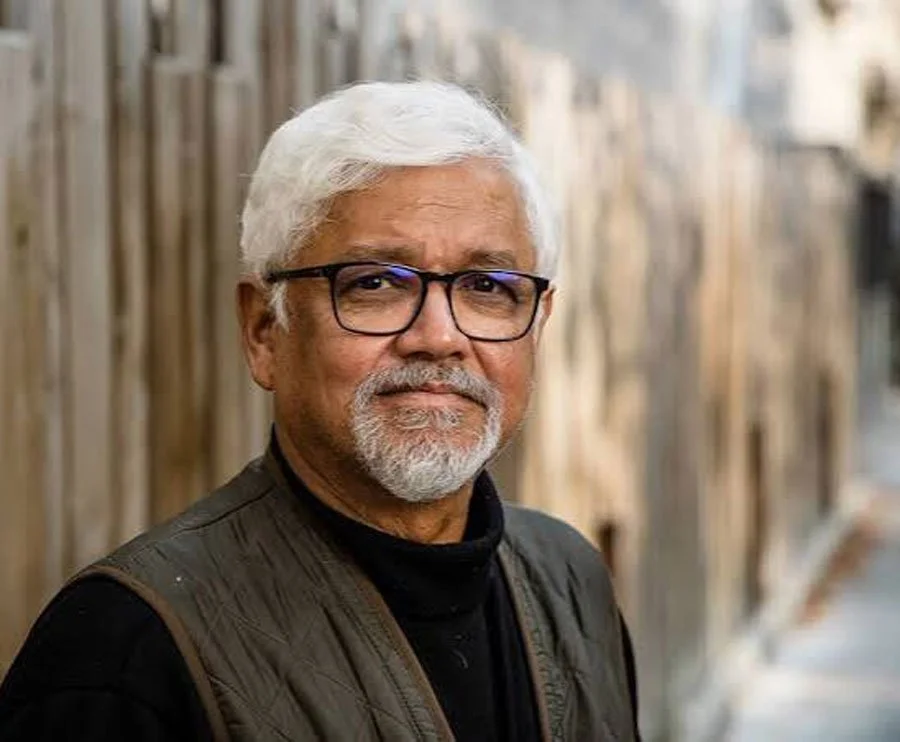
Serhat Tutkal is a Kurdish academic. He is a postdoctoral researcher funded by the Secretariat of Science, Humanities, Technology and Innovation (Secihti) in Mexico. He has a PhD from Universidad Nacional de Colombia (Bogotá) with a dissertation on the legitimation and delegitimation of Colombian state violence. He mainly works on violence, racism, and dehumanization in West Asia and Latin America.
DAVID PALUMBO-LIU
Thank you both for being on Speaking Out of Place. This is a rather special episode because it came about through a course that Hevin and I were co-teaching called Living Through Catastrophe, and we were covering a lot of terrain from Indigenous peoples in the United States to Palestine and to the Black diaspora. Hevin very graciously and generously introduced us to Kurdish literature, Kurdish history, and the political situation. This is such a critical time to know more about what's going on with the Kurdish people in Kurdistan. One of the pieces that I think our students most appreciated was "Note from Non-People," which is an incredibly evocative piece of writing. You say you're a social scientist, but you're also a great writer, and I would encourage you to develop that side because you get to these very important issues in a very multi-dimensional way. And so I've invited Hevin to start the conversation with that piece, and then we'll just take it from there because there are so many questions that we have for you that we'd like you to be able to address at your leisure and in depth. So Hevin, why don't you start.
HEVIN KARAKURT
Thank you, David, for inviting me, inviting us, and I am just as excited to be here and talk more with Serhat and talk more about "Note from Non-People" and many other things. It was interesting for me as I read this as my first piece of writing from you. And I think it'll be a great starting point to get into your research and into your other work. Maybe because I want listeners to hear some of the text, maybe you can actually start us off by just reading a little bit from the beginning. It's a short piece, so read however much you like and then we'll take it from there.
SERHAT TUTKAL
I prefer to be considered a particular person, although I’m from Nowhere. Where I come from doesn’t exist. This creates a confusing situation since logic dictates that everyone come from somewhere. It looks like I defy logic. I come from Nowhere. It has been told to me many times, by many authorities, and government officials, and all sorts of serious people in their decent suits. I see no reason to doubt them. I’d rather doubt your logic.
Strangely, I don’t have a language. People where I’m from speak in a nonexistent language. It has been stated by many experts and authorities, and there is no reason to doubt them. But I also don’t speak much of the nonexistent language. I speak some existing languages, but I cannot call any of them my native language. As a result, I have no language of my own. I borrow other people’s languages. I speak weirdly with my unusual accent and occasional pronunciation errors. I guess everyone assumes I must be speaking well in some other language. I don’t. To me, every language is a foreign language. Every word I utter is borrowed. I have no words of my own.
I speak in these foreign languages in my head when I take walks. They become entangled, creating a creole language that would be unintelligible to nearly everyone else. Maybe that is why I like talking to myself. I also like walking. I usually combine these two favorite activities of mine.
If I have to move from one place to another, I always prefer to walk. I enjoy walking the most when it isn’t directed towards the aim of arriving somewhere. Because when you aren’t walking towards somewhere, it can be said that you’re walking to Nowhere. So, I know that if I don’t walk towards a specific place and I still insist on walking, I’ll eventually arrive Nowhere. And that is where I’m from. I go out and walk aimlessly, secretly hoping that I may eventually visit my hometown: Nowhere. I miss Nowhere. All these somewheres have been tiring me for quite some time now. They are very noisy and full of unpleasant faces.
I never get to visit my Nowhere though. Sometimes I find myself in Nowheres that are not exactly like mine. I may see nonpeople there, sitting on both sides of the long street that runs through Nowhere; but they won’t be sitting on short stools. That is how I know immediately that this isn’t my Nowhere. They may drink something, but it won’t look like black tea. They may speak some nonexistent languages, but I won’t be familiar with them. “I’m at someone else’s Nowhere again”, I say to myself when this happens. It’s still good to visit Nowheres even when they’re different than mine. The familiarity of Nowheres is usually nice. But not always. Not when I see an intruder, for example. The intruders are also all too familiar to me, but there is nothing pleasant about them.
The intruders are actual persons in a Nowhere full of nonpeople. There are always some of them in Nowheres, but you usually manage to avoid them. They come from somewhere, you see, and they speak existing languages. They tend to wear nice uniforms. They are hostile to nonpeople wherever they find them. They can smell us. It doesn’t matter that I’m not from this particular Nowhere. Nonpeople are nonpeople. The intruders know that. They don’t like being in a Nowhere. They take it out on us.
You can also see these intruders in existing places. That is where they come from, after all. They look at us with disdain, they can tell that we are one of the nonpeople. They know we come from Nowhere and we don’t belong here. We don’t belong anywhere, except for Nowhere, obviously. They make us feel that. They talk about their somewheres, and their somethings, and their someones with absolute confidence. We can’t talk about our Nowhere, and our nothing, and our nonpeople with the same confidence. We become silent. Our weirdly pronounced foreign words become reserved for our conversations inside our heads. Until we decide to write them down.
Let us nonpeople take long walks whenever we can. It may get us Nowhere.
HEVIN KARAKURT
Thank you. Wow. It's great to hear you read it. I wanted our listeners to have the same experience that our students had, which is just to hear this without getting a lot of context or actually any context. And what it created for our students were many questions. I think because we have a tendency to always want to know what the ciphers stand for. We wanna be able to fill them with concrete names of places, of peoples, of ethnicities. But you withhold that in this text. It remains a non-people, a non-place, a non-existent language.
And so I felt maybe we can, before we parse any of this in more concrete terms, just talk a little bit about what to you is an actual person or in the text sometimes you call it a particular person versus a non-person or a non-people collectively. And then what does it mean to come from nowhere or from a place, for that place from which one comes to not exist and be called a nowhere.
SERHAT TUTKAL
Thank you very much for the questions. They also make me think more about what I feel, and maybe I should start by just mentioning something which wouldn't be maybe the right starting point, but it may help me to organize my thoughts. There are times when I am in somewhere very far away from where I come from actually, and I feel this feeling as if I know this place, as if I know these people. It happened to me various times in Latin America. The first time it happened, I think when I visited Ayacucho in Peru, which is heavily populated by Indigenous peoples and also has a history of armed conflict because it was the center of Sendero Luminoso, Shining Path.
So when I was just walking around and I didn't know any of these people, I felt this kind of having been there before, and it happened to me on the Colombian side of the Amazon when I lived there, and it happened in Chiapas, in the Mayan mountain villages. So there is a thing that reminds me, these are nowheres. So when I was thinking about nowhere and not just a particular place, or not just the one I come from, I think of all of these places which are considered nowhere principally, I would say. I think because the people are considered non-people, and we know this from a very vocal expression of the case of Israel and Palestine, "A land without a people for a people without a land," because the land ceased to exist, then it's not owned in a sense by actual people.
So the familiarity I think comes from the fact that the people remind me where I come from. That is something you keep accumulating through different experiences, your experiences, and also the experiences of the people and the things you hear that teach you, and not just the actual persons, but also to you that your life has much less value or no value at all compared to these other people. So it's knowing that in a way your whole life is a borrowed one. And actually you don't have really a right to keep it if the circumstances require. And this I think affects the collective and individual behavior in a way that I see similarities across different cultures.
And it's not just with racialized peoples, but it's very clear in the case of racialized peoples because then the whole town becomes a nowhere and the whole people becomes non-people and not just certain individuals. So it's a bit easier to see and it's something in a way that is also internalized in that even though we may not agree with them, we know that our life is less than their lives and our customs and our culture and our language, in case it exists, they are worth much less. They're in a way much more primitive. And I have seen examples of it that it usually leads to a self-hatred.
And I thought about it once when I was on the Colombian side of the Amazon in 2019 and I was visiting a town of Ticuna people. Ticuna people actually, they're transborder people, they live in Peru, Brazil, and Colombia. So I was talking with a Ticuna woman, and I asked her about the Ticuna people on the Brazilian side of the border and the relationship with them. And she told me that they were uncivilized on the Brazilian side of the border. And I asked her why. And all the explanation was actually about maintaining at least a higher level of cultural elements like the religion, the certain rituals, the way of dressing. And it stayed with me because I've seen it, not that explicitly, but with fellow Kurds and other people, that we have this idea of being backwards, of being underdeveloped or under in a way.
And all these elements, we see them as things to get rid of. I think it also has to do with the fact that these customs, these cultural elements, most of them are not really comfortable with the prevailing political system, the prevailing economic system. So actually they do not allow complete integration within the system. And I think that is what one feels in these places. They exist in a way, like they're not isolated islands, utopian places where there is no influence, they're part of this world, but they're in-between places where something else also lives. This has a lot of political implications and I think this is what also one feels in this nowhere.
READ MORE [ + ]
Of course, I read it knowing you are a Kurdish academic abroad, and so immediately parsed it as that. And I think in a way it's productive for many things, but also I was able to order it into an existing framework for me and for how I see the world in which questioning these certainties and questioning a status quo is built into a worldview. An element I would love to hear from you more about is that of language. I think it's one of the most emotional and sad parts in a way of your essay, this sense of language-lessness, because it's not just having a non-recognized language by official standards. It's also the sense of actually maybe the language or languages I would consider my native language and my first languages, I don't even feel that I am in command, whatever that means, of them.
What does it mean to not have a language, to borrow languages, but to feel that none of them really are yours in a way, to not have an owner relationship with any, or a relationship that maybe too many other people feel is natural and they don't question it. So could you speak a little bit about language and then maybe also about language in the Kurdish case in particular, which I think for you specifically will add more interesting layers.
Because you can't really think in one language when you have this kind of situation. So actually you need to modify the language in which you're speaking so that it allows you to say what you wanna say. And this is a constant tension. Languages and not having a native language is also an emotional one. In my case, many Kurds in Turkey, and particularly all people around my age coming from Zazaki speaking regions, everyone speaks Turkish better than Zazaki at this point because there is no formal education in Zazaki because Zazaki was also forbidden during some time. And unlike other Kurdish languages, Kurmanji, which is spoken also in Rojava, Zazaki is only spoken in parts that are under Turkish jurisdiction except for the diaspora.
So they don't have outside materials. I remember at least, and I heard a lot about the Kurmanji speakers listening to radio in Soviet times because they had broadcasts and they had music in Kurmanji, and they had things that were banned in Turkey so they could listen to them. In the Zazaki case, there is no outside influence. It's a dying language unfortunately, although there are various valuable efforts, particularly from the diaspora and a bit from Northern Kurdistan too in the last decades or so. But the thing is that the people who speak better Turkish than Zazaki or the people who were brought up speaking in Turkish, since the Zazaki speaking zones have been the host for the two very large Kurdish rebellions in the early years of the Turkish Republic—Sheikh Said in 1925 and Dersim in 1937.
So there have been a lot of exiled populations, massive forced displacement. So a lot of Zaza speaking families ended up having to move to central parts of Turkey where there are no other Kurdish people. All these dynamics affected the language in that it started to be less and less used, and particularly in writing, because Zazaki has always been heavily an oral language. Even in Ottoman times, we have very few writings in Zazaki, they're all from the 19th century. Basically, the Zazaki speaking zones have different types of dynamics. They're usually mountainous zones. A lot of the people were semi-nomadic, we don't have even much information about that because the zones were mostly not accessible to Ottoman influence and the Ottoman Army.
So they were only symbolically included within the empire, which will change until the Turkish Republic, actually, once the cities fall. All of this to say that it's a particular situation, even within Kurdish languages in a way. There is a certain richness in that there are a lot of local variants, in terms that one village can use some different words than another village just a two-hour walk away, because there was no standardization attempt. Which in a way allows to protect the richness of the language, but in another way, it makes it a bit difficult to teach and learn as an adult because there is no single canon of how to speak and grammar.
So one may wonder if a lot of these Zazaki speakers speak very good Turkish, like people coming from Zazaki speaking families, wouldn't they have a native language in Turkish, right? Because they use it as the language of education since a very young age. And some of them, as I say, living in cities where there are not many Kurdish speakers anymore, due to exile families, the massive migrations to big cities due to the forced displacement during the armed conflict. But the thing is that you know that it's not your language, and this knowledge itself, even if you don't have an accent—in most cases you do have one. But even if you don't have an accent and if your speech is identical to the way someone who identifies themselves as an ethnic Turk speaks, you always know that this is not your language.
You are constantly reminded when you say something out of place. Effectively when you criticize on social media, you see very frequent criticisms of Kurdish people saying that, why don't you write in Turkish? Why don't you write in Kurdish? Because that is not your language. And we see this even with great authors. I mean, Yaşar Kemal, in my opinion, is the greatest author in the Turkish language. He was a Kurd who wrote in Turkish and who wrote very well. But even in Kemal's case, one feels he is not considered on the same level as some other Turkish authors. It is because of his style and there is a way of praising him, but this actually hides a certain disdain.
They praise him because he's able to replicate a certain oral rural tradition of storytelling, and people usually tell it in a positive way, but then you realize that they consider this a more primitive way of doing literature compared to some other contemporary authors. And I think this should be linked to his Kurdishness because I can't remember any other accomplished author considered such and actually his is a very rich narrative. He has many books and he uses different styles, and his work is really well done. And I think there is this thing in the reception knowing that he's not writing in his language.
And maybe one other example, when we study in school in Turkish, we all learn that the first Turkish novel is Taaşşuk-ı Talat ve Fitnat, and then I found out much later that actually, this wasn't true. The first Turkish novel was written by a Greek person with Greek letters, but in the Turkish language, but it was never mentioned in school. This also shows that you can write the first novel in Turkish, but if you're a Greek and if you use the Greek alphabet to write it, it doesn't count. So in a way, when you speak, you know that it's not your native language, and then you feel as if you're a trespasser. And that feeling is necessarily linked to your dominion over the language.
And then obviously all the other situation is that I have been living in Spanish-speaking countries for the past ten years. So that's the language I use in my daily life. And when I teach in Spanish, there is a thing that one has to learn. And in cases of people with non-existing languages, maybe from a younger age, but all migrants may have to learn this, that you have to constantly make sure that you're understood. You have to make a much greater effort to make yourself understood compared to the other people. You are not as free to make a confusion because it'll be your fault.
So you are always nervous when you speak and when you don't have actually a native language, then you're nervous all the time when you speak because you are never sure if you are using it in the correct way. And if you are making yourself understood. And it's always your fault of making yourself understood instead of other people who don't understand you, because this is actually a mutual thing. If I'm not understood, the fault may not be with me all the time, but that is the feeling we have, and it also becomes a marker.
Finally, the accents, as the Kurdish accent in Turkish. The accent of Indigenous people in Mexico and in South America, and also the migrants speaking with accents also makes you hesitant before speaking because you uttering the word will mark you as the other. A lot of times you consider if you should say a word or not, if the situation is worth the trouble of marking yourself within a multitude as the other. But that is something a certain type of people feel and others don't.
And maybe we can talk about it later because when I talk about the intruders, I am thinking precisely of this kind of people who don't have such reservation, and when they're in a place where they're the other, they consider it a superiority, not an inferiority. And they make actually a show of it and they want to mark themselves because they consider themselves superior. And this happens with some kind of tourists compared to others when one visits places and one learns how to note them and say which people tend to do it more, and which people actually seem ashamed to not being able to speak in the native language. And this is also interesting to see because you see some of the tourists as if they're almost proud that they don't speak the language and the others are bowing their head and muttering things because they're very ashamed of not speaking the language. And I think one learns how to read this kind of body language and it gives for a very interesting political analysis.
When I was there, I was enrolling our son in kindergarten and I was explaining why certain papers had to be signed a certain way. As I was leaving, the staff member said, "I just want to say your English is so good." So even though it is my native language, the mark of difference always creates a gap. I just want to insert that note of appreciation for the discussion.
And I'm wondering if you can just say a little bit about how you think of dehumanization and maybe specifically today. I know also because your research works with large data sets, but also in an age of AI-created content maybe, where we can ask, where is the human in this even and what does it do to the actual humans? And then, because we are speaking in spheres of academia and we're also now speaking about your research. I wonder what you think of academia's role in this broader knowledge nexus at which universities tend to be located.
And I think of your research on the Colombian student protests that were crushed, or I know like when we talk about Turkey, we can think of the Academics for Peace and attacks on institutions or hollowing out the few academic programs that did or still do in some form exist for Kurdish studies or Kurdish language and literary studies. How do you think of dehumanization both in terms of your work, but also as we're looking at that from an academic point of view?
And academia can always be criticized because it produced certain hierarchies and undeniably it contributed much to colonialism, sexism, and racism. But still there is an important thing in that the academia also hosted people who were trying to produce a certain type of counter-knowledge and who were trying to promote a way of critical thinking and who were working with the sense of social responsibility. So the academia had this within it, although institutionally it has in most cases been controlled to a certain level. It was also an important place, and that is why a lot of important movements, revolutionary movements, they come from the university, particularly student movements.
And in Latin America, this is very important as student movements in Colombia and Mexico have been one of the fundamental political movements that existed in these countries. And with the Kurdish political movement in Kurdistan too, actually the origins have been with the students a lot of times, and the student-led organizations started at first as a cultural organization, and then the armed group also evolved out of the student movements. And that is also true for the Turkish left. Any influential left organization in Turkey should, if we trace it back to its roots, we'll find some student movement in a university. So my feeling is that this is something we're losing due to a restructuring of the university's social function.
What is expected is mostly a professional formation, and the changes in the curricula, particularly in cases of explicit authoritarianism, like in the US right now, in Turkey and in many other countries, this is obviously very clear that the government just tries to ban certain topics. Topics like, in the case of Turkey, the Armenian genocide and the Kurdish question, and in the US a lot with gender studies and critical race studies. But even in countries where this doesn't happen, usually we see a devaluation of humanities and critical thinking because they're not considered valuable as part of the professional formation. They're seen in the best case as a distraction, a waste of time, and in the worst case as harmful because they lead to dissidence.
So we see that courses from a critical thinking perspective, philosophy, ancient languages, a lot of courses are disappearing or not being chosen by the students because they also have their own economic worries and all too understandably. And at the same time, there is a control of the academics who can possibly be intellectuals and have been in a lot of cases in the past. This control actually, I think, is the constant performance evaluation criteria and the job precariousness. All these issues actually lead academics to dedicate their time to other areas that are considered more valuable from the perspective of the criteria, and dedicating less time to different activities, particularly activities of accompaniment, activities of community building, because these are not quantifiable things.
So they won't help you secure a new contract, find another postdoc, or get tenure. So these are a bit sidetracked, but these are the fundamental values of the university and what made them alternative spaces in which dialogue was possible among different people. Before this latest crackdown ten years ago, the universities were not really decent places in most cases, but there were some exceptions. And I've been to one of them at the Faculty of Political Science at Ankara University where there were some of these voices. And actually I think a lot of Turkish students for the first time in their life, they heard the Kurdish demands on that campus.
They had no idea, because you don't see them on media, you don't hear them from your family. You don't see them at school. So actually it was the first time I think they heard these demands, and obviously some of them were not sympathetic, but some were. So actually it allowed for making the voices heard. This also happened with professors in a particular way because there were certain professors that were outside of the mainstream way of thinking, and I think this was the first time a lot of students heard this kind of anti-system ideas from someone in a position of authority. Someone who didn't look like the stereotype of the anti-system person, but actually a university professor who knows how to speak and whose knowledge is legitimized by the very nation-state itself because this person is teaching at the university.
And to say things makes you question. Actually, people would joke about that, that a lot of Kurds find out that they are Kurds at the faculty, people would say, because a lot of Kurds would come from non-political families. And they were discouraged from talking about politics because it was a very dangerous activity, obviously. And they started doing so at the university, not before. So it was an interesting experience where one was discovering that they have a voice, and that voice can be heard, and it may even generate a reply by a different voice. And the university had all these dynamics.
And now I see a bit that many universities, particularly a lot of universities in the Global South, have become much more concerned with meeting the demands of certain job markets. And it's becoming more and more like a high school in which the students come and take the class and go back and do their assignments. And the professors are working on collecting their points so that they can get the salary points or the points necessary for renewing the contract. And it's disheartening because we're the people actually who are being paid for doing the intellectual work, and all the time we dedicate to these activities, in a way, is time taken away from students who could have a different kind of experience, a different kind of accompaniment.
Because the university is a very important thing for a certain type of students who come from different kinds of places. And it's the first time you hear a lot of things and your world expands like a hundred times larger than it was before. And it's sad to see that all of these are being lost, and not much resistance is being put up in certain places. Colombia has been very resistant, actually. Right now they are again on strike at the Universidad Nacional de Colombia, where I studied my PhD, they have had a rector imposed upon them again, the one they did not choose because they still have the elections.
They're on strike again and they're trying to change the situation. At least they're trying to maintain the autonomy they have. But in a lot of places, unfortunately, these changes were able to occur thanks to the job precaritization and a weakening of labor unions. Again, it has a lot of reasons, but in the end, the situation is worrying and I don't know if you would like to say something about that too.
Whether it was attitudes towards the Kurdish population in general, but then also specifically to political segments. Back then it was the HDP party or then the PKK as the armed fraction of the Kurdish political movement. And right now I think people might be most aware of this ongoing and newly instituted peace process. I'm using air quotes for this, but I would ask you to comment a little bit about that because that specifically targets an organization where an existing discourse of dehumanization already exists. So what do you do now in a context where, on a surface level of political discourse, we're talking about a peace process, we're talking about disarmament, we're talking about the dissolution of an organization?
And then especially because we cannot, I think, talk about this right now without considering our current situation of war. The Israeli-American war on Iran. Then again, Iran bombing so many of the neighboring countries, also bombing the Kurdistan region of Iraq. And then news of there being attacks maybe on Turkey, maybe on Cyprus, some leaks or supposed leaks of who is going to bring in Kurdish forces to fight in Iran against the regime. And then all of those forces actually disputing that they've agreed to anything. So you have a lot of back and forth and a lot of discursive chaos in all of this.
Again, you have a discourse of these groups being associated with the PKK, for example. And so for Turkey it would be a big problem if they got into this conflict and they say so to their NATO ally, the US. How do you bridge your research into dehumanization and a treatment of the public sphere of organizations like the PKK and our current political moment? I know it's a huge question, so also just pick one thing that you feel inclined to talk about.
I am positive in that it can be replaced by small data sets and digital ethnographic work, but still the mass data, because that dataset includes every tweet that mentions a large vocabulary, like 160 something words because of the Turkish language's particularities. And it allowed to show that it was a massive phenomenon, how common it was, and allowed to think about why it may be occurring and its political implications. Briefly mentioning how I started working on dehumanization is that it was a side project and it was my first published article in 2020 in Media, War & Conflict, "Dehumanization on Twitter in the Turkish-Kurdish Conflict." That was the name.
And it analyzed comments on Twitter made to mutilated and humiliated dead bodies. That was how I started, and I started because I used Twitter at the time and I was seeing all these accounts, anonymous accounts obviously operated by officers of police and army. They were sharing these images of killed, mutilated dead bodies. And there were a lot of comments, likes, and you see those. And I thought about first, obviously, how the effect of it, because the effect of it to see them constantly as a Kurd on your regular use of social media, because a lot of people use social media very frequently and the image just pops on your screen and you see a person, a mutilated dead body.
And you know that one thing that made this possible is the identity that you share with him. So I chose two cases and analyzed these comments. I was also struck by the fact that some of the comments, they were not anonymous accounts. They were like a father with the profile photo with his three-year-old daughter smiling. And the photo of the body of a woman killed, the woman combatant, was his hopes that at least they would've raped her before, and they did thousands of such comments. And I started thinking about this as a large phenomenon because these discourses work on both sides.
They make you know that your life has less value and they make the others know that your life is less value. So there are people who may be very critical politically. But there is a difference between those people and you because they will never see someone like them mutilated there on the photo with the celebrating comments. So that's how I got into it. And this has a very large history, even though social media spectacle allowed it for massive and constant dissemination of this dehumanizing discourse. And we have seen them, unfortunately, particularly we've seen them in Palestine with Israeli soldiers' publications. We've seen it in Rojava during the conflict with the Syrian Army and affiliated groups' publications.
We've seen them doing the same thing before with the Kurdish people. So actually this is a global phenomenon. But this is inherited by hundreds of years of history that even if one reads ancient Greek literature, we can see how the dead bodies were paraded. And I remember that when I was a child. It also happened in Kurdistan sometimes when they just tied the dead body of some important guerrilla member and they just paraded it so that everyone knows that he's dead. And the treatment itself lets you know your place. So when we talk about such a large history of dehumanization, we see that in a society some people are not considered equal.
Some people are present as a potential contaminant, and we see this in a lot of different countries. Without combating this, a peace process in itself doesn't really have much sense because as long as one side's life has less value, a real nonviolent society with pluralistic values cannot be built. And in Colombia this happened in some ways, but it was also combated in some others, particularly by the birth of the Truth Commission, which collected a mass collection of individual stories about their victimization. So they made the victims' voices heard and their faces were seen, and they were allowed to tell their story. And this actually helps to start dialogue.
Now what I see in the Turkish case, and this will link it to Iran and Palestine and all these issues because it's more of a geopolitical discourse, that the Turkish state considers the Kurds as a homogenous, unified actor that can be detrimental. So the discourse is mostly about the terror-free Turkey. This means that the Kurdish threat should be neutralized so that Turkey can face other regional threats. Particularly they worry about the changing power balances between Turkey and Israel, and I should always clarify that Turkey and Israel are allies. Technically, Turkey has been a longstanding NATO member and they have no history or any type of clashes or conflict with Israel other than the discursive level.
But I think their worry is not much about what Israel is doing against Turkey, but they are worrying that the loss of Iranian control in the region can lead to an increase in Israeli control. And in those terms, they're rivals more than enemies. They're rivals competing for being the best ally of the current US administration, I think. And then obviously Netanyahu is winning it, but Erdoğan also is in the race, and that is the main worry because Turkey would like to control this gap that the Turkish state would like to influence, and that has been an important factor in the Syrian civil war. So this worry leads them to present the Kurds as a potential threat that can be used by external forces.
And this is actually something I also found in my research about the Kurdish organizations being referred to as dogs of this or that actor, or sometimes donkeys to be more insulting. But these external actors are usually either Europe or US or Israel, because that is what the public opinion promotes. The Kurds can be used by these other groups and they can harm our national security in a time of conflict. So the discourse is mainly on that. But my worry is that if we allow the Kurds to be represented as a homogeneous group that can be threatening, if the negotiations fail, the next option will be extermination because the threat has to be pacified.
So we can pacify them through negotiations or conceding some cultural rights, or we can pacify them by mass massacres also. These are options, and it's as if this geopolitical discourse completely ignores the value of human life and just thinks about, for example, the argument against mass violence would be the global complaints maybe, or problems with the public image or the problems with the image of the state. That is the main worry with the Armenian genocide discussions too. So this discourse seems dangerous because actually the conflict has historical roots. It has to be placed within a political, social, cultural, economic context, which constantly produced these violences.
And without changing these elements of the context, the peacebuilding is not possible. The most would be a complete subordination by mass violence, which would be maybe short-term as it happened with previous cases of mass violence and genocide in some places, which can eliminate the opposition in the short term, but never in the long term because, as we know through history, it's very difficult to exterminate a whole population. It has been done, I've seen it in Chile and Patagonia unfortunately. But in modern contemporary times with such large populations, it'll not be possible, particularly with transborder peoples who live in four main countries in addition to a large diaspora and a small population in ex-Soviet Union countries.
It's not going to be possible. But discussing this in such terms of utility, as if which would be more useful and more beneficial to me, is not a way to promote the construction of a non-violent society. It's a discourse that will keep reproducing the violence. So actually what should be done is to establish a platform for dialogue, making the sides speak and hear each other, and engage in dialogue without one side having the upper hand thanks to a mechanism of violence, the state violence and its support. Without that, the dialogue, which will allow people to understand each other and try to see the possibilities for coexistence, peaceful coexistence at least.
And this would require criticizing all the contextual elements that allow for the reproduction of such violence. And what I see a lot in media discourses from both sides is a fiction of brotherhood. I'll translate it in masculine. Turkish is gender-neutral, but if they were speaking in English, I'm sure they would say brotherhood. So I'll also say this, knowing the way of thinking, this brotherhood that existed in Ottoman times and then it was interrupted by the Turkish Republic's certain actions, and we should go back to being brothers. This fiction seems harmful to me because the 19th-century Ottoman Empire is constant attacks after attacks against the Kurdish people.
Actually, even the official newspaper mentions Kurdistan in around 1850, I think. So this actually, factually it's not correct, but other than that, actually the Ottoman Empire being a very hierarchical situation and with all the problems from ethnic and religious and linguistic assimilation, which people don't know much about. But actually it's something that has existed during a long time in the Ottoman Empire too. And the question of racism and the question of slavery, which was legal in the Ottoman Empire and has been practiced. And we have a lot of written documents of it, including a very important text by Evliya Çelebi, who is a very important traveler.
And he has large volumes of text talking about distinct lands of the Ottoman Empire, and one of the chief ways of funding his travels is actually slavery; he buys and sells slaves on the way. So that is the main economic activity actually. So all these questions and all the importance of such violence, without questioning them and just talking about going back to this point before the violence, I can't really see it as yielding any kind of peaceful society in the long term. The same discourse of violence and all the references, which I'll mention, is they are war. We have fought together in the independence war. We have fought together against the enemies 500 years ago.
People are talking about it, and all the references are about war. We have fought together, and no one asks, or some people ask obviously, but we don't see much in the media discourses, but what happened then? And fighting against the common enemy and using this violence so that the state in question increases its authority and its ability to exercise power, this is not a positive thing for anyone. So that's why when I see these columns from both sides saying that the Turkish state would be stronger if there is peace, but why do we want the Turkish state to be stronger or any state? It's not as if I'm against just one particular state, but why do we want them to be stronger?
What benefit would we have? Stronger means, what does it mean? Stronger doesn't mean more ability to provide the population with public health and public education. They're not using it in this sense. Stronger means more domination within and outside borders. This is not beneficial to anyone and I don't think it should be part of these discourses. And finally linking it to the war on Iran and in Palestine and in Syria. We see, I would say that we see this strengthening of a neocolonial logic, which considers that the racialized people are both not capable of self-governance and also it's dangerous to let them govern themselves because they're a threat.
So what we see, this administration in Gaza, for example, it's a clear example of center-long colonial discourse and we keep seeing this. The region and the governments that are considered legitimate are governments that are supported by the centers of global power relations. The current Syrian government became legitimate overnight because they have been supported by the current US government and the European governments. So they consider the Syrian government as legitimate, even though it's not created out of a democratic process. Actually, it does not have a way to demonstrate popular support even, but we consider them legitimate because I see them as vassals of legitimate global entities.
And all these colonial discourses in the end come through in levels, that we consider the European colonialists the most human and the most capable entity, and the ones below trying to imitate them and colonize their own others. And at the bottom we have stateless people, stateless in the term that it's not as if they don't have a state in their land actually. They usually have too much of a state and sometimes multiple states, but they don't associate themselves with a state and no state considers them as legitimate citizens. And we see this in Turkey that they have an organization called Akraba Topluluklar, it mentions communities, the family maybe, I don't know how to translate exactly in this context, Akraba.
But there are these communities that are considered tied by blood to Turkey, and they're all Turkic-speaking communities. For example, no Kurdish community outside of Turkey is considered this, but the Turkish-speaking minorities in Iraq, in Iran, in Syria, they are considered part of these communities. So we see that actually there is a racist structure within the nation-state and within many nation-states. And even though you can be a full citizen, you're not really considered one when it comes to taking certain political decisions. And when it comes to seeing how much the nation-state will protect you against a foreign state if you are persecuted. And we have a lot of these cases with the US citizens killed by Israeli forces, but they're US citizens of West Asian origin in a lot of cases.
You mentioned statelessness, and of course, this is a fundamental issue for so many peoples. But there is also a reverse figure to that, which is the tethering into a nation-state formation and the way that commits you to a certain set of operations on the international scale that makes you a reactive party, not just a positive one. Could you talk a little bit about how this horrible cycle of violence that is facilitated by, enabled by, and enacted by dehumanization might have, as you say at the end of one of your articles, an exit possibility through two mechanisms? One is the dissolution of binaries.
But you also mentioned the notion of the posthuman, which is also something in the back of my mind as you focused on the notion of dehumanization. Can we think beyond these binaries in a way that frees us from the cycle, that is not simply a matter of negotiations between people, but the prerequisite for what those two entities might look like to begin with?
And believing in that and trying to think about the concrete conditions in which a better society is possible is a very valuable thing in itself. It shows that, at least in ideological terms, there are many people who are fighting against this and there are many people here in Latin America, particularly well known as the Zapatistas, but also there are a lot of Indigenous communities with their autonomous or semi-autonomous zones in Mexico. And we still have the initiatives in Kurdistan, even in a very difficult geopolitical context. And we have them all over the world, these different initiatives. In a way, being located in this nowhere or coming in contact with them helps us think about other possibilities because these are places that are more free than the others actually, in the terms that they don't have the definitive hegemonic structures controlling them.
But they have this certain level of autonomy still, even though they may be very vulnerable against violence, but in terms of thinking, they have these autonomous possibilities. And the post-human thinking is a theory I find very promising and I am much influenced by certain writers of it. One thing is that it helps us destroy this idea of exclusionary dichotomies, something being this or that because this way of categorization obviously doesn't correspond to the world and it erases all the differences between each group. And it also leads to a thinking that considers difference an inferiority. Because you always have one that is the ideal, that is the superior, and the other that isn't.
The ability of questioning these limits and seeing how they are very important to establish a sort of dialogue between many people who question the state of things and questioning of the human itself is very important because this is the basis of the colonialist idea, that a human, an isolated human being, self-sufficient, exists. If we take this away, I think the whole ideological structure will fall if we show that no human can exist in isolation and there is no way to define a human by separating them from everything that surrounds the human. And we show that everything is actually interrelated and in a material way.
Everything is related. And actually we can never talk about an entity that is not linked to other entities, human or non-human. And if we can actually promote this idea to show that the human is not a static thing. So this makes it very difficult for all these racist and sexist discourses because they're all based in a homogenizing discourse, which allows us to talk that the Kurds are like this, or Black people are like that, or the Chinese are like this. Because in these discourses, racializing and homogenizing an entire population, we can combat them by showing that actually we cannot even homogenize one single person because one single person is something that keeps changing all the time.
Depending on the relations and the passage of time and the spaces and all the things that change in the context. Actually, no human can stay the same, not even for a short amount of time. This would be a very fictional thing. And this is something we have in other cultures and in other ages before the promotion of this sort of idea. I remember a text with a utopian influence, even though it's not utopian itself, it's a text by the Japanese author Akutagawa. I remember that in Kappa he talks about this society of Kappas, which obviously are not human, but I remember something that seemed very interesting to me is that a man was to be punished for a crime he committed, but he committed this crime for his son who was sick, and the son dies.
And he says that they should not punish him anymore because he was a father and he had a motive to commit this crime that he no longer has. And he has become a different person now. And the society agrees with that. And this makes one think a lot about the motives behind all these legal structures, political structures, the very idea of punishment. It makes us think about how actually forcing people into very closed, concrete categories allows for the reproduction of, again, a dehumanizing way of economic production and a political system. So I would really like to decentralize this idea of the human, and I think the people that I mentioned are people who know this by experience actually.
And they have, in this sense, they are in a privileged situation. They're in a privileged position because they understand certain things without necessarily having to contemplate them in a theoretical way. So my hope would be that more people like this are integrated in the societies who come into contact with other people who have not had the opportunity in the past, maybe due to the strict hierarchical structures that don't allow them to come into dialogue with these people. And I think things can start changing. So migration to me seems a great opportunity to question these categories, these exclusionary dichotomies, these things that we have been taught are correct since we were little children and no one ever said otherwise.
And then you meet some person with a very different idea of what it looks like. I think this is the most enriching experience someone can have, and I am still hoping that all these violences in the end can stop thanks to this questioning and this disturbing of fixed categories, which will not allow for certain groups who benefit from the war to represent the other as a complete threat that has to be eliminated.
DAVID PALUMBO-LIU
Such a marvelous and capacious, poetic and inspiring answer. Hevin, did you want to say anything?
HEVIN KARAKURT
I think I will leave it at this inspiring word to finish. I think the awareness that we do in fact all contain multitudes is an important one. And let's hope for that awareness to take hold and influence a better tomorrow.
DAVID PALUMBO-LIU
At the beginning of the podcast, I said it was going to be a very special episode and it has turned out to be that and much, much more. It is so special to have you both on to tell us so much that we do not know and help us to understand it in a way that can help us avoid these traps and imagine utopias, because I think that is the only thing we can do. Whether it comes about or not is not really foreseeable, but the effort is worth it. So thank you very much for being on the show.
HEVIN KARAKURT
Thank you for having us.
SERHAT TUTKAL
Thank you very much for the opportunity to speak.