

I think when we're talking about institutionalization, we're really talking about the period after the epic protests that would go on to establish the interdisciplinary fields, especially ethnic studies and gender studies and the protests that were taking place among queer and trans folks post-Stonewall. To use Judith Butler's phrase—there's a real psychic life of power that happens at that moment, and that's always intrigued me. Because it's one thing to say that this stuff is external, but when it sets up shop inside of us, we crave the recognition. We don't think that we've achieved anything unless it is authorized and celebrated by the institution on its terms.
Speaking Out of Place is produced in collaboration with The Creative Process and is made with support from Stanford University.
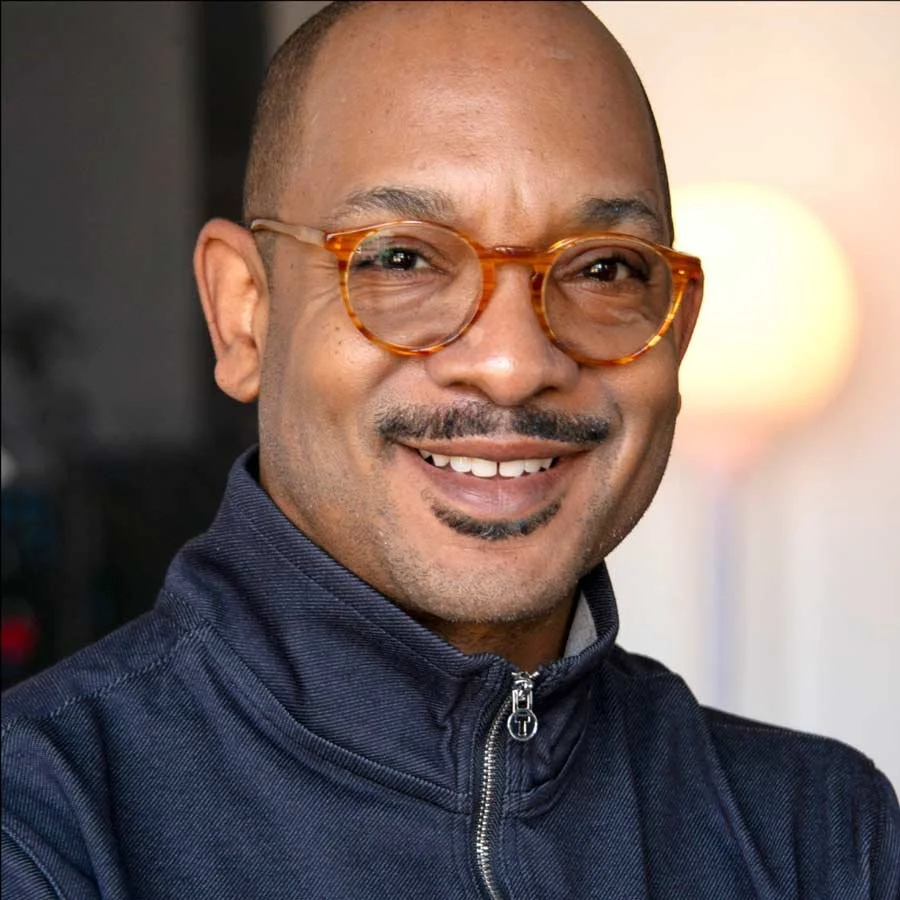
In this episode of the Speaking Out of Place podcast, Professor David Palumbo-Liu talks with Roderick Ferguson about his provocative and much-needed intervention, “An Interruption in Our Cowardice.” Initially driven by his deep disappointment in some Black intellectuals’ compliance and even assistance with reactionary forces, this essay opens onto profound issues of institutionalization, professionalization, and the deadening and repressive mental, social, and intellectual habits being “accepted” create. In our conversation we spend some time talking about alternative, and very real counterexamples to cowardice, such as the fearless examples of the encampments of the Student Intifada. We note that such alternative sites have always been there historically, and that it is crucial to turn our eyes to those spaces, if we are going to preserve the promise of liberatory education.
Roderick A. Ferguson is the William Robertson Coe Professor of Women’s, Gender, and Sexuality Studies and American Studies at Yale University. He is also faculty in the Yale Prison Education Initiative as well as the Yale-New Haven Teachers Institute/Yale National Initiative. He is the author of One-Dimensional Queer (Polity, 2019), We Demand: The University and Student Protests (University of California, 2017), The Reorder of Things: The University and Its Pedagogies of Minority Difference (University of Minnesota, 2012), and Aberrations in Black: Toward a Queer of Color Critique(University of Minnesota, 2004). He is the co-editor with Grace Hong of the anthology Strange Affinities: The Gender and Sexual Politics of Comparative Racialization (Duke University, 2011). He is also co-editor with Erica Edwards and Jeffrey Ogbar of Keywords of African American Studies (NYU, 2018). He is the 2020 recipient of the Kessler Award from the Center for LGBTQ Studies (CLAGS). His book In View of the Tradition: Black Art and Radical Thought will be released Fall 2026.
DAVID PALUMBO-LIU
I'm really delighted to have you on the podcast and to be able to discuss with you your great essay, “An Interruption of Our Cowardice.” And I'd like to start with a broad question first. A lot of your work has dealt with issues of educational institutions and their ancillary apparatuses, and the ways they both serve as conveyances to but also obstacles to truthful education.
And I thought we might start with the institutionalization of studies of race, ethnicity and gender. Move to the moment that you captured in 2023 and then update that critique to the present. And just to start on a personal note, I came to Stanford in 1990, and this was right after William Bennett had come out to debate Jesse Jackson about the culture wars.
And to throw in another thing, this is when Peter Thiel started the Stanford Review. And this is when he starts to write his book, The Diversity Myth. And so you had this weird convergence of things that we come up with today.
RODERICK FERGUSON
Wow, that's really interesting.
DAVID PALUMBO-LIU
Yeah. And you point out in your great intervention the reorder of things, how quickly things became contained and professionalized. And in fact, in 1995, I edited a volume responding to the same kind of perceptions, and that volume was called The Ethnic Canon: Histories, Interventions, Institutions. We had Barbara Christian, Paula Gunn Allen and a lot of folks.
RODERICK FERGUSON
That's a great volume.
DAVID PALUMBO-LIU
So could you tell us a little bit about the start of the institutionalization, the quick professionalization and how this contributes to the things that you saw in 2023?
RODERICK FERGUSON
Sure. I think when we're talking about institutionalization, we're really talking about the period after the epic protests that would go on to establish the interdisciplinary fields, especially ethnic studies and gender studies. I would also include within that the protests that were taking place among queer and trans folks post-Stonewall.
So I'm thinking in particular of the work that Marsha P. Johnson and Sylvia Rivera were doing with Street Transvestite Action Revolutionaries. And part of that work was allying with students at the time at NYU who were also trying to deal with the sort of institutionalized homophobia and transphobia there in the early ’70s.
But also, one of the things that they proposed was what we would now think of as LGBT studies or queer studies. So I would include them in that, although formally, queer studies didn't really take off until the ’90s. But that launch was preceded by committed activism among students and also people outside of the academy.
Anyway, so we're talking about that period, and it's after that—and in many ways a response to that—that we see the kind of institutionalization that would really try to move things away from what the originating activists were calling for. These were activists, many of them students but not all of them, who were calling for the university to be a site that would have a bridge to community spaces and that there would be a reorganization of knowledge inspired by those community spaces.
You could have alliances between the gay and lesbian students at NYU and houseless trans women who were veterans of the Stonewall Rebellion and really inaugurated what we now know as trans liberation and queer liberation.
You could have that, and you could also have at the City University of New York real coalitions between folks inside—African American students, Puerto Rican students, Black and Latina faculty and also progressive white faculty—allying with activists and everyday people in Harlem at that moment. They were really trying to figure out how the academy could not only be accountable to those folks on the outside but also be reinvigorated by the kinds of knowledge production and cultural production taking place on the outside.
DAVID PALUMBO-LIU
Yeah. Just to insert very quickly, because you mentioned CUNY, I was thinking about the fact that the founder of the field of Asian American studies, Ling-chi Wang, was doing classical archaic languages at the University of Chicago. He comes out to San Francisco and becomes de-professionalized from that classical training and re-energized as an activist.
And I was thinking about, for example, Adrienne Rich going to CUNY, and she's there with June Jordan, Audre Lorde and Toni Cade Bambara. And she becomes de-professionalized.
RODERICK FERGUSON
Yeah, that kind of encounter was a critical de-professionalization and decanonization. That was the promise of that encounter. And I know that there were people who saw that kind of de-professionalization and decanonization, and they were really afraid of losing status.
I'm thinking about Martin Kilson's essay around that time. That really exemplifies that fear, Reflections on Structure and Content in Black Studies. You also get this in Noliwe Rooks' book about the rise of the foundations, like the Ford Foundation, and the funding streams that were targeted towards Black studies.
They were designed to reinstate the professionalization that was displaced by the encounter between formations outside the university in communities and organizing, and people inside the university. And then you also had a return to the disciplines, so that Black studies—this is partly the Martin Kilson argument—would be only legible through the disciplinary presentation.
DAVID PALUMBO-LIU
Yeah. Performance.
RODERICK FERGUSON
It is also the logic that produced that shift within funding agencies like the Ford Foundation, but we could also probably add the Mellon Foundation as well here.
DAVID PALUMBO-LIU
So that the professionalization was another way of recapturing these areas that were held by activism, by organizing and by a vision of knowledge production that was not a bending of the knee to the disciplines. Absolutely, and this notion of recognition, right? You're essentially invisible until you take on the mantle of all these disciplines. You speak the language, and you twist your interpretations to be consistent with what's going on in other fields, right?
RODERICK FERGUSON
Yeah. And then there's a real kind of—to use Judith Butler's phrase—there's a real psychic life of power that happens at that moment, and that's always intrigued me. Because it's one thing to say that this stuff is external, but when it sets up shop inside of us, we crave the recognition. We don't think that we've achieved anything unless it is authorized and celebrated by the institution on its terms.
What does that do to the work? And what does that also do to the bridge-building that occasioned the inter-disciplines? Like I started out at first talking about when the students at City College took over that college, they renamed it Harlem University. There are all these fantastic stories about folks from the neighborhood bringing food and establishing almost a kind of marketplace. A community, a neighborhood marketplace at the university, in addition to having the first Puerto Rican studies…
READ MORE [ + ]
Yeah, exactly. Classes. The idea of a free university, you know?
Precisely. And then when you get to the stage we were just talking about, it becomes so customary to get very transactional. I'm doing it for the cause. I'm going to bend. It's the only way to get these, as you said, the material resources and the kind of quote-unquote “freedom to move,” but in a very constrained way. And the tethering of movement is really—
Mm-hmm.
Oh, God, yeah.
Yeah. And it's so easy to even capture those moments with this very branded community service. A dip in and out of the community. You were there, and you did something.
Fantastic.
Fantastic.
Exactly. No, I was about to say that when it becomes normalized, it becomes more natural rather than these special things, but it becomes integrated, as you say, the muscle reaction. I was thinking about how I also had Jesse Hagopian on from the Zinn Education Project. These great lesson plans that they build about the debates within SNCC about organizing.
Like, how would you, if you were there, how would you do it? And of course, all those things are also stories of partial failures, right? And that is so important to note, you know?
Yeah.
It was interesting because the only other job I had besides Stanford, I was at Georgetown. There was a bus line that started at Georgetown and went down to Howard.
Yeah. And that journey was so interesting. I got there in 1988, and it was just beginning to get incredibly gentrified. It was already starting at that point, but Jackie Onassis had prohibited the Metro from going to Georgetown because she didn't want those kinds of people getting... So we had to stop at Dupont Circle. You had to take the bus or a cab.
Oh, yeah. That was her thing. And then when I was there, there were various budget cuts, and they said police services were cut. But within the next edition of the paper, like four hours later, it was like, “Except for at Georgetown.” So there was a careful policing of that boundary.
And so I always used to take students through and look at all these interstitial spaces. Because otherwise, you just stay there in Georgetown.
Unfortunately, how that worked. So tell us about how this is not seen as cowardice but practicality and the way things are done, but that has really corrosive effects that then we see in this 2023 moment that you move into. And I'd like to ask you, what prompted you to write that essay then, right? What was so pivotal about that moment? Because you traced the erosion of all this, but there was something really startling.
Oh my God.
Oh, I had no idea about the nondisclosure.
And you do it so beautifully. I was thinking about that essay you talked about from Said, and his discussion of the amateur is so wonderful. Because what I'm thinking about is, what's the name of that TV show? Severance or something. And you think, well, yeah, you're that thing on campus, but you come home, and there's no separation. I mean, who do you think you are? And this is what really bothers me when I go on campuses, because people take their souls, or what's left of their souls and hearts, with them, and that becomes the affective part of it.
Not just the professional, but the affective is so clear. And then when Said talks about amateur coming from the word for love, this notion of doing things out of love. You're provoking all sorts of really interesting thoughts. So the first professional organization to endorse BDS was the Association for Asian American Studies.
And I remember the meeting at the ASA. There was a roundtable, and the last person who spoke was Angela Davis, and she said, “And we have to catch up with the Asian Americans.” I went down, and I said, “Thank you, because we've been hung out to dry.” We were this tiny organization, a few hundred people. But what really blew people's minds outside was it was unanimous. It was a unanimous vote.
And we got some flak from older Asian American activists. Our Jewish friends reached out to us wondering how we could betray them. So all these kinds of splinterings came about, and this is all moving me to read you back to yourself, because you have one particularly stunning paragraph that I think captures a lot of this.
As an ideology and a habit hiding within our understanding of profession, cowardice names our modern vulnerability: how we are always in danger of capitulating to powers that would obscure inequality and our fight against it. Very often, cowardice triumphs through solipsism. That is, we renounce our social accountability for the consequences of our individual choices. Cowardice allows us to deny our fundamental interdependence with each other, promoting a calculus by which we can evade not only the fullest realization of the self, but also the cause of the other.
What really popped out is the fundamental interdependence with each other. Could you talk more about that? I thought that was so important to add.
It is, you're outside yourself at some point.
No, it's exactly the opposite.
I was thinking about the encampments. It's the students who are leading, the most precarious there.
And when you were talking about the awards and all that, I was thinking about Omar El Akkad, who I had on the show many months ago. His book is just mind-blowing. I asked the same question I asked you, “What led you to write?” And he said, “I really wrote the book for myself because I was going to these award ceremonies, and I wasn't speaking up. I couldn't do that anymore. I had to write this book.” And again, it's this idea that at some point you have to reflect back on what's happening.
But the momentum of professionalization is, and it's gotten even worse as the academy has become more and more endangered by its own cowardice, continuing this rapid pace of battening down the hatches, but they're just suffocating.
Exactly.
And it's not a loss; it's a gain, as you point out.
Yeah. No, that's so well put because I'm thinking it's this retreat into individualism, but it's with a different kind of target community, right? You're the professionals, and you're the ones who hold the power. So it's about the consolidation of non-precarity, right? I'm safe, I'm here, and I'm clothing my self-protection under the vestige of intellectual responsibility, right?
Yeah. Because you have all the gatekeepers' language down, and we're protecting even what you talked about in the College Board, we're safeguarding that little tiny sliver that makes it out. But wouldn't it be better to just fight even the diminution of it to begin with?
Yeah. And I can imagine people floating out the alibi that, “No, this is autonomy. We'll give them this little bit, and they'll want to learn more, and then they will.” But no, the books are banned. So it's not.
So just two more phases, as it were, I wanted to get to, and then anything else you want to talk about. So bring us up to date from 2023 to now, because it seems like an eternity has passed. Maybe that was hyperbolic.
Yeah. Goes without saying.
Exactly. I was about to mention that. It's such bullshit.
I don't know what it's like at Yale, but at Stanford, the neutrality statement says, “We will not speak on issues of politics. We will not make statements except for when it has to do with the mission of the university.” And so we keep bringing them back. Well, doesn't all this have to do with the mission of the university? Right. They say, “That's political. You can't—”
Oh, God. Even better. Are we not there?
Oh my God. Absolutely.
Oh, God. When you said that, I—and I will send you this the minute we get off—wrote an op-ed because this person from the Hoover Institution, who is not a terrible person, wrote this op-ed in the student newspaper about how it was so important to re-engage in civic life and have robust discussions and not have censorship and whatnot. It was basically the liberal appeal. And I said, “That's a good idea. However, under these conditions, when you have international students, when you have ICE on campus, when you have all these conditions, you might think that there are certain people who don't want to speak up because of the consequences of them speaking up.” And you should not mistake that for a lack of interest in engaging with or understanding what civic life is these days.
And then I end exactly with your point, which is we have to move the education off-site or create these subterranean spaces. Which can be, because that's what the encampments were. They were precisely—
Yeah. The very first day of the first classes, we had two encampments, actually, but the second one... I was going to begin the first class, and there was a bunch of noise, a bunch of people coming, marching down. It was the Black Student Union, and they said, “This is the Black Panthers' free breakfast program. Here's some breakfast for you all.” It was totally spontaneous.
Wow. That is incredible. And the students were giving classes. They were bringing knowledge from outside the campus.It was amazing. I mean, it was really amazing.
Exactly. Well, you end your essay on the note I want to end on, which is you talk about courage. And so I also had a person on, she's a law professor at George Washington, Mary Anne Franks, and she wrote a book called Fearless Speech: Breaking Free of the First Amendment. And she points out how the First Amendment has been used to allow stalkers to harass women, corporations to spew misinformation and the KKK to march in predominantly Jewish neighborhoods.
And she says we need to break free of both openly violent institutions and those that seem benign or even beneficent because they don't really protect anybody. And she uses Michel Foucault's notion of fearless speech. And I'm just going to quote Foucault and ask you to talk about the idea of fearless speech or courage, because I think what he says resonates with your conception quite well.
Fearless speech is a kind of verbal activity where the speaker has a specific relation to truth through frankness, a certain relationship to his own life through danger, a certain type of relation to himself or other people through criticism, and a specific relation to moral law through freedom and duty. More precisely, fearless speech is a verbal activity in which a speaker expresses his personal relationship to truth and risks his life because he recognizes truth-telling as a duty to improve or help other people as well as himself. In fearless speech, the speaker uses his freedom and chooses frankness instead of persuasion, truth instead of falsehood or silence, the risk of death instead of life and security, criticism instead of flattery, and moral duty instead of self-interest and moral apathy.
And again, I think this echoes a lot of what you argue in your essay. Could you talk about fearless speech, courage or whatnot? And most importantly, how do we develop this either individually or collectively in different kinds of practices or acts?
The book is called Fearless Speech. Actually, it was translated.
It's both of theirs. But she's riffing off his, but he has a book called Fearless Speech too.
I love that, yeah.
I just want to insert for folks who may not know, but being president of the ASA is one of the most onerous tasks that one could imagine even in ordinary circumstances. But on top of that, you add this incredible lawsuit and all the antagonists.It's a frivolous lawsuit to begin with. So it wasn't even a fair fight.
Yeah. And it's really good to capture those historical records because otherwise they get lost, and people don't understand that we're basically building off what other people have done. Are you going to come back and talk about that essay?
Wow. Let's talk about that book. Let's talk about your four-pager and anything else. This is great. Thank you so much for being on. This has been so edifying, but also a real pleasure.