

In Paris, when these same people, who had friends who were their police, came to Paris and found themselves tear gassed and shot with LBDs and losing their eyes and feet, and coming back with red all down their faces and blood everywhere, and they began to understand that the violence is beyond legal. And so they began to understand what was happening in areas, what we might call the ghettos or the poor areas of Paris, where Black people or people of color were being harassed by the police.
Speaking Out of Place is produced in collaboration with The Creative Process and is made with support from Stanford University.
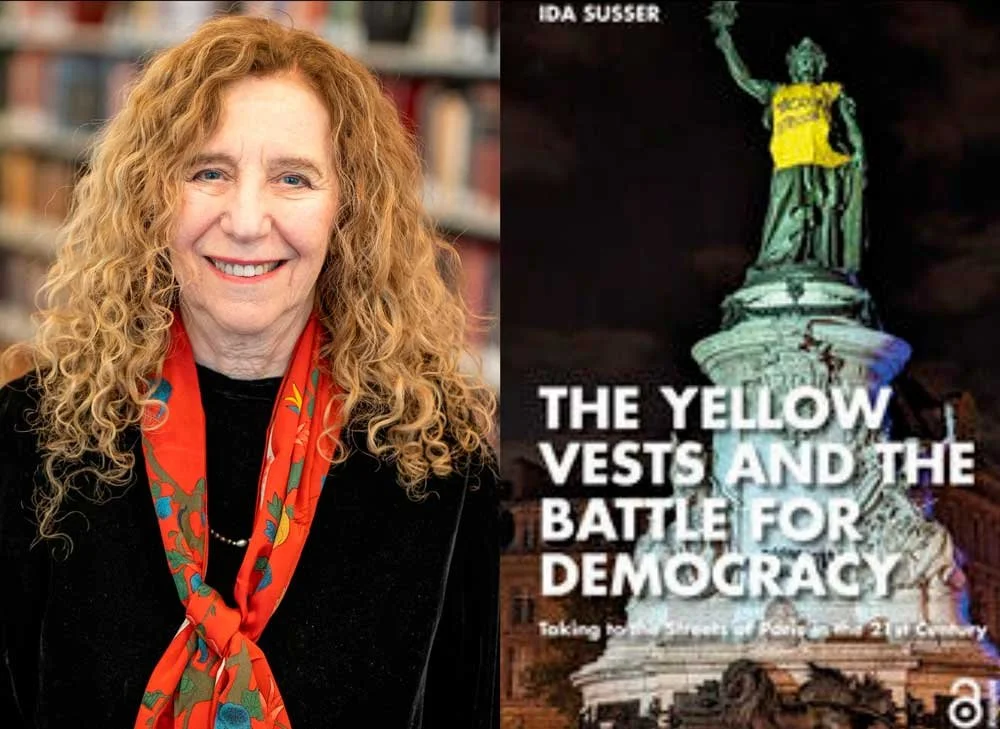
In 2018, hundreds of thousands of people in France showed up day after day, month after month, to protest the French government’s attacks on labor, on social benefits, and on the environment, among other things, including police violence. Anthropologist Ida Susser took part in these communal actions, interviewing a vast array of participants, who came from all walks of life, from political positions across the spectrum, and from many different regions and class identities. We learn how people formed common cause, organized unique social worlds, and how their struggles, defeats, and successes, can teach us critical lessons in making the a new, more just, world. In the spirit of communing, Ida Susser has made Yellow Vests a free download here.
Ida Susser, PhD is Distinguished Professor of Anthropology at the Graduate Center and Hunter College, CUNY. Her recent book The Yellow Vests and the Battle for Democracy: taking to the streets of Paris in the 21st Century (Routledge 2026) focuses on commoning movements and new visions. Her previous books include: Norman Street (Oxford, 2012) a study of working class opposition to cutbacks during the New York City fiscal crisis and the transition of Greenpoint-Williamsburg from a working class neighborhood to a gentrified enclave, and AIDS, Sex and Culture: Global Politics and Survival in Southern Africa (Wiley-Blackwell 2009), a history of the power of social movements to transform health.
DAVID PALUMBO-LIU
Who are the yellow vests? Before we get into the details, just give us the broader picture of what happens in 2018.
IDA SUSSER
So this is what happened. I will give you a blow-by-blow very quickly. So in the spring of 2018, there had already been, like Macron, President Macron was elected in 2017, and at that time there were huge demonstrations, and the people I was interviewing said to me, “He will learn all the things he's done to destroy the labor laws will come back to bite him.
This is not the end of it. There will be huge demonstrations even though he's won,” because he led the battle against the labor laws. They destroyed the labor laws before he—
DAVID PALUMBO-LIU
Tell us a little bit about what the labor laws were.
IDA SUSSER
So since World War II, there was in France a real movement. They said, “We fought this war even though we were defeated, but we were the resistance,” de Gaulle said.
The people of France deserve to live better. We don't want fascism. We want a true democracy, which includes free healthcare, national health, unemployment benefits. They never had any of this. Pensions starting at 60. Limits on how many hours you can work, and overtime, and vacations and seniority. All of those things were implemented post-World War II by various governments, and it was a product of the way people had to fight to maintain their society.
It happened in Britain the same way. Happened here to a certain extent, but Roosevelt did it earlier. But France really developed a very rich and strong welfare state. So the people, even though they don't earn nearly as much as we do, and they don't have the money, and they pay taxes—
DAVID PALUMBO-LIU
Yeah, heavy taxes. Exactly.
IDA SUSSER
—but they never need to worry. Their healthcare is all covered. They don't go bankrupt from the cost of healthcare. Their schools, their universities, in this country you have to worry from the moment your child is born how you're going to pay for their college educations. In France, all of that was paid for.
So although you didn't earn a lot, for 50 years you could count on your pension, you could count on your vacations more than we ever get, you could count on your healthcare being free and you could count on your children being able to afford higher education. Those things were just written in. So then all you really needed was rent as a problem and food.
But nothing like what we have to do in this society, in America, to keep in the middle class. It was nothing like that. So they really valued that. The French love their welfare state. That's France. The state is me. That's how they see it. Which comes from Louis XIV. But anyway, the state is them, and they regarded this breaking of the labor laws as really treason.
And actually, it was under the socialist government, and they said the socialists are traitors. We voted for them, and they are traitors. And guess what? The next election, the reason Macron won, instead of being the majority as the Socialist Party had been, it went down to two percent of the vote. Two percent. Imagine if the Democrats went down to two percent of the vote.
It used to be Socialist Republicans, each one 51, 41, 51, 41. Yeah. No other parties. Suddenly, the socialists went down to two percent because they broke the labor laws. Wow. But who was this person who did that? It was Macron. And the many lefties knew that they thought of it as treason. And it led to the growth of Mélenchon, who's a more left—another left party who hadn't been really in the picture. So anyway, Macron broke the labor laws. He led it, and he came out of a bank to go into the Socialist Party, to be the treasurer for the socialists. So that was that. So then Macron is elected. Many people didn't understand this. The French themselves hadn’t... Only the demonstrators, the protesters really knew who Macron was. And so he won.
And the youth very much were angry because they felt they would never have the job security that their parents had. So we come to lots of student demonstrations. In the spring of 2018, there was a railroad demonstration. The students were out on strike sitting in at the Sorbonne for the changes Macron made.
But then he also made this law to tax diesel gas. And like, why would we care? Why do they care? Diesel gas was what many poor people had shifted to because it didn't have a tax. All the other gas is very expensive, and diesel gas didn't have a tax. And they had bought these little cars that could take diesel, and because all the transportation, like the buses and the trains, you see these old railroads that are no longer used, just shut down in all directions. So the villagers, to get their kids to school, they had to drive. To get to healthcare, whatever, they had to drive these cars, and they had switched to diesel for the economy of it.
So somebody, actually she was from Martinique, which just means she, in our American words, was of color. But she was a citizen. People from Martinique are French citizens. And she was a civil service worker outside Paris, and she sent out an email. I interviewed her. She sent out an email saying, “We should protest. We should have a petition against this diesel tax.” And it just, we say went viral. That's what we say. Suddenly, people were against the diesel tax, and then somewhere during the summer, the truck drivers who pay diesel, they are independent entrepreneurs. They no longer have the protection of labor laws, like in this country, Sue said.
So they own their own trucks, and they pay the diesel. So they got into it really strong, and then in France, a yellow vest like we wear for construction is required in every car in France. It's like state protection, so when the car breaks down, you can get out without being run over. Every car. So these truck drivers started putting the yellow vests in their front window to show that they're opposed to the diesel tax.
Became the measure. All over Facebook, email, et cetera, a yellow vest became the marker for you support the opposition to the diesel tax. And all the truckers and all the cars were driving around, not in Paris where nobody drives, but in the provinces.
So that happened all through the summer, and by the fall, they were setting up these roundabouts where they built cabins to hang out, and all the yellow vests met at these cabins daily and talked about their life and the problems in their lives.
And what are they going to do? And they have no money for the end of the month, and women who were stuck home with kids came, and people who were unemployed came, and truckers came, and nurses came, and civil servants came, and teachers and principals, and they hung out in these cabins. And nobody listened. It wasn't even in the news in France.
DAVID PALUMBO-LIU
Wow. It was nowhere. Nowhere. That's incredible.
IDA SUSSER
But they were all over. There are maps done. They were in so many roundabouts around France, you wouldn't believe it. Really, like, over 100.
DAVID PALUMBO-LIU
And the press didn't cover this at all?
IDA SUSSER
No. And then on November 17 they decided to run into Paris and drive there seven or eight hours. Mm-hmm. So the date that the yellow vests in the media, the date where they really are counted from is November 17 to 18. And of course, they went into every city. Some people Toulouse, Bordeaux, you know, but the ones that made the news were the ones that came into Paris. And that 300,000 people ran through the streets wearing these yellow vests.
They called them wild demonstrations because they didn't stay on the curb, they had no permits. Mm-hmm. They didn't know their way. They had never demonstrated before. They had heard of the Champs-Élysées, the richest part of Paris and the Arc de Triomphe, and they were running all through Paris trying to find these places. So that's how they started.
DAVID PALUMBO-LIU
That's incredible. As I said, you have a really interesting conceptual framework. Some key words that I want to dig into, among them commoning, thresholding, liminality, process, historical bloc.
I'm going to read this one passage that I think encapsulates a lot of it and then ask you to riff off of that. Quote, "I argue that the combination of the three commons, first around work and social reproduction, including caring and public services. Second, around the use of urban space such as streets, squares and other shared public areas, including the Internet.
And third, the sharing of creative space and the building of a unifying vision are central to progressive social transformation." So could you talk about these three commons and then also bring in the idea of thresholding and liminality and process because again, you capture this both conceptually but also embodied in these wonderful stories of these roundabouts, these cabins. So just take this question and run with it any way you want…
READ MORE +
...Thank you. I had been working on the commons. I wrote an article about it I started in 2003 to tell you the truth. I was director of a seminar. I don't know if you need all these things. Neil Smith had funding to have a seminar, and he made me the director. Yeah. And David Harvey was one of the founders. So David Harvey came to the seminar, and he brought Lefebvre, and he brought the ideas of the urban, and it was a wonderful seminar. And every paper was brilliant. Some were about Beijing, et cetera, et cetera.
Some were about the Philippines. So me and this guy, Stéphane Tonnelat, who's in my book, he wrote the last part. We got together, and we wrote an article. Took us ten years. That's why I think it's like, I think it's very important. It summarized, it came out of all these different people's ideas.
And that's what I call collective organic intellectual. I don't think an organic intellectual, which sounds like obscure wording from Gramsci, it's not one person. It's not me. It's not even you who are, like, very established and organic, I think. But it's all the people that you hang out with and talk to.
So I wrote that article, 2012 or something, and it was about the Occupy movement, like starting in Tunis and Egypt, and then that's what I was explaining. That's what me and Stéphane were talking about. But when it came for me to write, after I'd written all my chapters, to think about, "What is this book really about?"
I found that conceptual plan super helpful, and I had faith in it because we had invented it about something else, and it also came out organically out of the seminar, which David wrote Rebel Cities, you know, David Harvey and stuff like that. So I felt it really... We had captured something with all those people talking.
And that's why I took that idea, and I wrote to Stéphane Tonnelat, and I said, "You write the afterword," because I feel that I'm using exactly the article that we both wrote together to think through my whole work. And so I did. And so the commons comes out of Lefebvre. The idea from Lefebvre is the right to the city. It's the idea that when you walk in the streets, when you use the subways, when you take the elevators, when you hang out in the squares, this is a collective experience where you begin to understand humanity.
You begin to understand sharing and solidarity, even when you're just walking down the sidewalk, and you have to move this way and that way and see all these weird people. And like the French would say, um—
You know, flâneurs.
This is part of understanding... I don't want to be too literary, but like Flaubert—
Also like Baudelaire, you think it.
Yes, precisely.
Yeah. And the recognition of class comes through walking in the streets, and he's looking in a glass window or I think there's a Baudelaire thing where maybe it's a poem where he's looking through a glass window and he's looking at the rich people eating at the park.
Yeah, The Eyes of the Poor. Yeah, that great prose poem. Yeah.
So yes, it's exactly that. So I felt this is the commons. This is the idea that we all have rights together and share them. So that is the commons of space. I make that number two. Number one is the commons of the unions, the commons of the parties where people organize and institutions like your welfare office or your library or where you go to community centers or things like that. Frances Fox Piven and Cloward, they influenced me tremendously.
She was also in '68 climbing the walls, and they talked about how in the welfare system in New York, which I wrote about, that the people who were handing out the money, the officials and the people who were coming for the money were not that different. And that like the actual welfare rights movement was based on both of them.
That the people who are in that institutional position are often not that different than the people that they're working to help, and sometimes you get a coalition. And so that's what I call the commons number one, unions, parties, institutional kind of coalition. Commons number two is the sense of the right to the city, the space. We're here together. We're in it together. When 9/11 happened in New York, we're in it together.
We're walking down the streets. We're smelling the burning flesh and stuff. So we're all here together. Then the third commons, it's like a creative vision. You know what Gramsci called the concrete utopia or what Erik Olin Wright, if you're a sociologist, he talks about real utopias. It's like you can live sharing. You can live seeing the possibilities, and I think that's so crucial because my students are so hopeless. I wanted to give my students hope. I know how miserable they are, how cynical they are.
Absolutely.
And I wanted to give them a reason. I feel I was honored, I was privileged because I grew up in a South Africa of fascism, and I lived to see liberation. It was 30 years or more. My parents went back after they retired, but I saw what people can do. I don't think our students believe it.
And so that's part of why I think we need a concrete utopia, and in those cabins was a kind of real utopia, people sharing. Now, there's also obviously people that are feeling discriminated against. There's racism. There's antisemitism. There's anti-Muslim. There's anti-this.
There's anti-that. All of that is obviously going on in France or in New York or wherever you are, and people in those cabins in the moment were meeting across these kind of different... When the environmental justice movement is here, and the Yellow Vests are here. And the Yellow Vests have been accused of being anti-ecological. That's the first thing that the president said.
Exactly, yeah.
So then they came together in their own funny way. The environmentalists marched straightforward, and the Yellow Vests rushed off after the speeches in wild running—
—to the Arc de Triomphe, whatever, but they were in the same space, and then they met again for speeches in the Place de la République. I call that thresholding. And after those kind of movements, it's not convergence, they're not all going the same way like we would love.
But they're thresholding. They're meeting in the lobby and talking across the lobby, and they're meeting and trusting each other in human cells.
And that's what I call thresholding. So that after those mixed demonstrations, it became the end of the month, that's when you're starving and you can't afford food to feed your kids, they're all living on cornflakes at the end of the month. So the end of the month to the end of the world, and they put those two slogans together.
Wow.
That's what I call thresholding. Many of them were very strong environmentalists, those Yellow Vests, but they were being accused by Macron, and the other thing they were accused of was antisemitism. But they were also at the same time accused of being racist and anti-Arab. They were accused of everything. So when you saw the kind of crossovers between all these groups, you have to tone it down. You have to see that yes, there are many of these things going on, but they don't become political footballs.
That's the way I understood it. I wouldn't deny some of the people who were in the Yellow Vests came from the far right, and of course, it's antisemitic and anti-Arab. And the far-right platform of Marine Le Pen is to give immigrants who even were born in the country second-class citizenship, so they don't get the welfare state. So some of the people who were joining Yellow Vests had been part of Marine Le Pen, and some of them were far left, like Mélenchon and people like that.
They were all there. But what I'm saying, it's not like the Yellow Vests followed like we have with Trump. They were a grassroots movement. They didn't follow a populist leader with a racist whisper. It didn't become what the Yellow Vests were able to coalesce around. It didn't become the meaning of their movement. And I think that's the crucial thing for me. I tried very hard. It was very hard to write this book, I want you to know. It took me a long time.
Okay, tell me why it was hard, or how it was hard.
It was totally hard. Because first of all, I didn't really understand what is racism in France. I had to become educated. I finally understood they call it, you can call it post-colonial, you can call it New France. You're not allowed to talk about race.
Exactly.
And like I interviewed people like Éric Fassin, who says you have to talk about race. And I went up to the university, which is in the suburbs called Paris VIII, where they very much had demonstrations about this, but still I had to learn, and then how to think about that. And then because of all the derogatory things that were said about the Yellow Vests, they were accused in all the international press of being antisemitic. They were accused, of course, of being anti-ecological. So I had to all the time worry, was I supporting a movement that maybe really underneath was right-wing?
That I was supporting the potential fascist legacy. And I had to work really hard for myself, reading history, and I have a whole chapter looking at the history of antisemitism, looking at the right, looking at the history of colonialism. I had to really go very in detail through that to understand which of these meanings were going to characterize the group that I was studying, and I was always being challenged.
Yeah. I'm glad you gave that answer and introduced the whole idea of complexity and difficulty. Another word that I tossed at you was the idea of process and liminality. I love that. Because what you're teaching us is that the best part of life is a process, and there are some really interesting stories that you tell about how people work through these things, not to a harmonious ending, but rather a moment in time when they get things done. And one of the best stories that you come up with are these commissions that they had and the cycle co-op.
Could you tell us about that? Because that's one of the great success stories for me, how they got to that place through that. Yeah, please talk about it. Yeah.
Oh, I love that. I love those people. I'm still in touch with them. I've known them for 15 years now. I don't however long it is, probably ten years. But... And honestly, it's more and more successful. I can't believe... So that comes out of the Occupy movement that happened in 2016, CoopCycle. And the commissions, there were 80, if you can believe it.
Wow.
100,000 people demonstrating.
Oh my God.
They were demonstrating about the destruction of the labor law. So those were the people in 2016 when the Socialist Party was destroying the labor laws with Macron as the inventor of the idea. He was the treasurer and the finance minister, and he started it all. So they had 80 commissions, and I used to go to the Political Economy Commission. I thought that's a fun place to go. They had commissions on food.
We ate vegan food, all kind of things. But me, I'm an academic, I went to the Political Economy Commission. And I sat down on the ground with them. They set up their tents every night and whether it rained or whatever, and I got to know them very well.
They were so sweet. They were great. They were students. They were dropouts. They were young. But it's good for me, so I hung out with them. And they believed in consensus. Everybody in the, in this Occupy movement, you couldn't be a leader. Everything had to be collective. Anything you wrote had to be collective.
So they started writing an analysis of why they were opposed to the trade agreements like NAFTA, but the more modern ones. We all know the problems with NAFTA, so they were writing about the problem with this trade agreement. But every day, they were writing lines, and then they'd read out loud, and they'd make about three sentences.
And one of the guys who was there, he was a dropout, a doctoral student in political economy, and he said to me, "I'm a Marxist. I came in here a Marxist, and I believe in hierarchy," he said, "but now I understand to get consensus, this is how we learn."
He said, "I don't want to write this thing for us. This has to come from all of us, and nobody can say they wrote it. And when we read it, we'll read paragraph by paragraph. Whoever stands up will read a paragraph, and we'll write it sentence by sentence."
That's lovely. Yeah.
"And nobody will own it. It will be a collective product." And he said, "The process is more important than that we have a paper written by tomorrow."
Wow.
And they did that, and they read it at the General Assembly, which was also consensual every night at 7:00 pm, went on for hours and hours, and they would read. The different commissions would read what they'd written or thought or say what they thought. They had an unemployment commission. They had everything.
And the political economy commission was reading this thing. And by the end of the summer, by September, they went to Strasbourg, which is where the treaty was being discussed, and they organized a demonstration in Strasbourg against this treaty. But they had spent the whole summer meeting every night.
So they went completely informed and with their thing that they had written together as a group with no leadership. And I interviewed a lot of people who said they learned about horizontalism in participating in this, in this occupy of the square. It was the process that they valued, and they all learned.
Nobody had ever lived that way before. And that's what I mean by commoning. It's like they're learning in the process. And then I think that it's very important what you said about liminality, too, because the process is maybe running through the streets, but they're sharing that wild experience and seeing each other and trusting each other as they go through the streets, when they get arrested, when they get kettled, when they get gassed.
I experienced all that, too. It was pretty unpleasant. But you begin to know people as... and they help you through it. And I think that all of that process, bodies on the line, is a liminal process. It's not structured like we go to school, we go to work. We wake up at 9:00 am. It's out of the blue, and it follows its own logic, and there's no leadership. That's liminality. Now, those things, anti-structure and liminality and process, I learned those from anthropology. So even though I don't do what most anthropologists do, I'm very much an anthropologist, and I learned a huge amount from it.
Yeah. You know? But you also come up with these great stories that animate this from all sorts of different angles.
And I was just going to add, I've also had people on talking about what's going on in the Congo, what's happening in Kosovo, and you find very similar kinds of, you wouldn't call them structures, but processes, which is non-hierarchical. When I try to interview, some people say, "Well, no, he's not the... you know, I'm not the spokesperson this month.
This month so-and-so is the spokesperson, right?" So it's always the shifting of quote unquote leadership roles, and we saw that in the encampments as well in the United States.
Right...
Yeah. So this is how young people are actually sustaining these kinds of movements is precisely because they're avoiding the stratification and the solidity which they've been taught is necessary for organizing, right? It has to be—
Well, the left is terrified of it because—
Exactly.
—Stalin and the whole history of the left. They have to reinvent the left. And that's part of it. But I forgot to tell you that CoopCycle came out of that. Those people who worked all that summer on that statement, when Nuit Debout, when the Occupy was over, they said, "What can we do?" And they invented CoopCycle, which was an app so that instead of Uber, which the app is owned by management and all the profits go to management and basically the Uber people are pretty much slaves. You could call it a killer app.
Yeah. It's terrible.
With the CoopCycle, they invented an app that was meant for cooperative bike riders who in a cooperative set their own times, they set their own routes, and it's now got hundreds of co-ops all over Europe or in the United States.
They meet every year, two, 3,000 people. In Paris, they've set up community centers, immigrant co-op riders and stuff. Some experts from Nuit Debout, from the Occupy, computer experts, and all kinds of things set it up, but then they trained actual bike riders to run the show, and they've now set up community centers where the bike riders can rest and get their health insurance and get on computers, and it all came out of that Occupy movement, that one little commission that I followed, which was not huge.
It comes from the freeing of the imagination, right? It comes from the process of being together and not being under the spell of the easy fixes or the solutions that seem to be predicted or predetermined.
Could you talk a little bit, because you mentioned various ways in which, again, categories that we inherit are being rethought and reformed, and you talk about the idea of class, which I thought was really fundamental. Could you talk about what you discovered happening there that gives you a new sense of what's going on in terms of issues of class?
As a theoretician coming out of anthropology, sociology, I do believe that class is crucial. However, class is not like a layer cake. I don't... Very helpful to think of it that way. I think we have to think about class as being a motivation, as being a way in which people build a unified vision, okay? Or shared goals.
And so also, obviously, the old Marxist image of industrial capitalism is down. There are some places where there's still, obviously in China, you might find, funnily enough, or in places where the industry has moved. But the idea that there's an assembly line and everybody's meeting there, like Marx had that idea, really doesn't characterize class today.
So who and where are we going to find it? And that's why I talk about the commons, because to me, with what I would call the flexible economy, with the economy where people can be home or at work or in the streets, they're working, but they don't even meet their other workers. There had to be a way for groups to get together with common interests, and I think that Occupy was brilliant that way.
Occupy Wall Street. I wrote about homelessness way long ago, and I wrote about New York City working class. But then the gentrification meant that there were no more places, there were no more neighborhoods, there were no more, et cetera. And the unions are not powerful enough. They're very weakened by the departure of industry from the centers of capital.
So what we find is that what Occupy Wall Street did, they took this little part, this little square right next to Wall Street and they said, "It's the 99 percent." And I think the 99 percent is very crucial. We have to expand our ideas. We have to begin to think about it as there's the people who are so wealthy that you can't even see them, the Elon Musk with their chainsaw and who knows who are destroying our society. But then there's a space between us and them and bigger than it's ever been in—
Exactly. Exactly...
—bigger than the 1890s, and everybody else is down below. Now, there could be people down below who are stood up by Elon Musk, his particular people, his little team that he went in to destroy our data with.
However, nearly everybody else in that NIH or in AI or wherever it was, our Social Security, they're all on the other side. So I think we have to have a very expansive view of class, and I think that we have to take into account things like generation and gender and the ways in which the state frames those things, and government regulation frames those things, and race, super exploitation and immigration.
But at the same time, we have to see a very expansive view of who is really the working class these days, who has less and less power. And in Europe, it's also that the treaties like the EU and then the global treaties have taken a lot of the decisions out from even the president, and so the people down below, they can't even vote on those things.
And in this country, the global treaties, they can undermine—I wrote a book about this. They can undermine our occupational safety and health regulations. They can undermine our EPA. Of course, Trump has undermined it all anyway. But all those rules are overruled by the treaties that we've made at the global level. All of those rules.
Yeah, exactly. Yeah.
So where is our voice? And that is why I think we have to have an expansive view of class, and we have to have this...Obviously, I would never take away identity. We have to recognize. So for example, me as a woman, women are undermined, whatever. Each group has its own interests, and sometimes they're not the same.
There's the feminists and then there's the sex workers, which I know historically have always fought. You've got all these different ones. But what I talk about is thresholding. So you've got all these different fragments of the working class, but they meet tangentially, and they develop trust in the threshold on the doorstep, and that trust has to gel around some kind of unified vision that they all understand here in this country that what the government is doing now is destroying our democracy.
So that has to be real. It has to be bodily felt by all the different groups. The racism, the sexism, the anti-environment. It's all there in what's happening up top. But somehow we haven't yet developed that thresholding where these groups can come to some kind of unified vision. There's some tangential connection in that they understand and they trust each other.
It's all about trust, I think, and that happens, I think, in bodily going on a demonstration together and the liminality of breaking the rules together. Yeah. So that's the sorts of things that I think come out of this work.
I'm going to come back with a quote from you, which is really powerful.
"There's a possibility that the battle for the commons today can draw on earlier struggles for a collective freedom. It is here that the analysis of the relations between unions, parties and street protests become central. Will they become the building blocks for a potential historical bloc? The history of protest in France over the past decade shows that the relations between different commoning groups with other movements, parties and organizations have the potential to construct an expansive historical bloc across subaltern groups among civil society. They may yet generate a unifying vision, crossing thresholds of racism and religion and the fractures widened by histories of super exploitation and colonialism."
So this is a wonderful condensation of what you just said in a longer, more informal way. But if you'd like to add anything to that, and then explain why you decided to make your book free.
...For me, this question of super exploitation and race is central. I come out of the United States where it's the most central divider we live with. In France, it's less obvious and less spoken about, but still it's post-colonial. But when you work across these, and an example was that the Yellow Vests were, they were never recognized by Macron as demonstrators, so they were shot with these non-lethal guns.
They lost their hands. They lost their eyes. They lost their feet. These were non-lethal, but they never got them back. They were mutilated. So they set up this group called Les Mutilés, the Mutilated. And they joined all the Black Lives Matter movements. They had never known before. They lived in the province where the gendarmes are pretty nice and they help you with the traffic, and you go there when you can't find your way.
But in Paris, when these same people who had kind of had friends who were their police in their local place, came to Paris and found themselves tear-gassed and shot with LBDs and losing their eyes and feet, and coming back with red all down their faces, blood, and blood everywhere, and they began to understand that the violence is beyond legal. And so they began to understand what was happening in the areas in the, what we might call the ghettos or the poor areas of Paris, where Black people or people of color were being harassed by the police. And so they joined in 2020. The Yellow Vests went to the Black Lives Matter meetings, and it was huge. It was 100,000. The sister of a guy who died in prison, who was from somewhere in North Africa, she led that demonstration, Adama Traoré.
And so they came to that, and the Yellow Vests joined, and they only joined at that point in 2020 because they had experienced the actual police violence that they never underwent before. Yeah. So I'm not saying that it's the same at all. But if you wear a yellow vest in France, you will be arrested. They stopped wearing the yellow vest. They became a target, and they began to understand what it's like to have the police just target you, even if it's just being of color, and they are still joining those movements. So that's not to say that it's the same experience, but it's to say a recognition that we see the same thing.
That's an incredible story. Thank you for that.
So I feel that I studied the commons. Sharing, that's what commons is all about. It's about people taking over squares. It's about people squatting in buildings. They don't pay the rent. The Yellow Vests, I'm not sure they invented this, but they would open the toll booth so that nobody in the cars didn't have to pay driving down the highways. And they had a huge support from the French population.
That was one of the things they loved to do was open the toll booths. Anyway, so I felt I could not write a book about the yellow vests and make it cost money. So actually, I had to put money forward in order for it to be free online, open access. Anywhere where you see it, whether you find it on Amazon or the Routledge site or Taylor & Francis, these corporate centers where you buy a book online, you also can download it for free. Wherever you find it online, there will be a free download because it was paid beforehand, and it's available to anyone who wants to read it.
You can download a chapter, you can download the whole thing, you can send it to your friends, and I felt that was crucial. All these people spoke to me. They adopted me. I never wore a yellow vest. I thought that was not correct, but I was friends with many others. So they all just included me, knowing that I wasn't quite the same, but maybe I was all right. And so they took me into their lives, and I felt that I had to make it open access. Yeah.
That is such a beautiful gesture, but it's also a real sentiment and a political commitment that you inspire in all of us. You asked me about process and a thing that might be really important for people in this country. So the first demonstration, I told you they were mixed at the squares. I met quite a few right-wing women, especially one that I talk about. They wrote me testimonials where they joined groups. One woman said, "I joined the front because it was singing." That singing actually happened to be anti-capitalist, and she made friends with those anti-capitalist groups.
And she said she learned from them, and she had always voted Marine Le Pen, which is the right-wing extreme. And she said, in her testimony, she said, "I had used to vote Marine Le Pen more extreme than my parents on the right. But it was because I thought I was a lesbian. I thought I was attracted to women.
I was very upset about it, and so I went to the extreme right. When I met these anti-capitalists and I began to hang out with them because they were singing every day, every weekend, they became my best friends. And now they all laugh at me at how I used to be right-wing, and now I'm autonomous." I think the idea that Americans don't have is that process can actually lead people to think differently when they're friends when they spend a lot of time together.
Exactly. Exactly. Yeah. That's a beautiful story, and I'm sure it's not unique at all. It's a question of having the opportunity, and we have to invent the opportunities. We can't wait for them to fall from the sky. But I think because precisely of the crisis and because the old politics just haven't worked, that people are hungry for this.
This has been one of the most delightful conversations, podcast or no, I've ever had, and there's so many things that resonate with me and with everything that goes on in terms of my activist circles, in terms of my classrooms, and this book is just filled with so many human stories that talk about precarity, that talk about struggle, that talk about the betrayal of the state.
And you give us the wherewithal in the social science data, but also with those stories and the great photographs, by the way. I forgot to mention that. How could I? You are a great photographer, and you capture these moments. So everybody listening, please download the copy and share. I think this is one of the most—
Definitely.
—the most important things we can do. Share it in your classes, share it with your neighbors, repost it online because it really is exactly what we need at this moment. We're in a mode of crisis, but you gave us so many examples of people making good things real. So thank you so much for being on the show.