

Architecture should bring a true sensation of wellbeing. We were really lucky to experience that as children, and now as architects, we try to bring all that we learned into our practice.
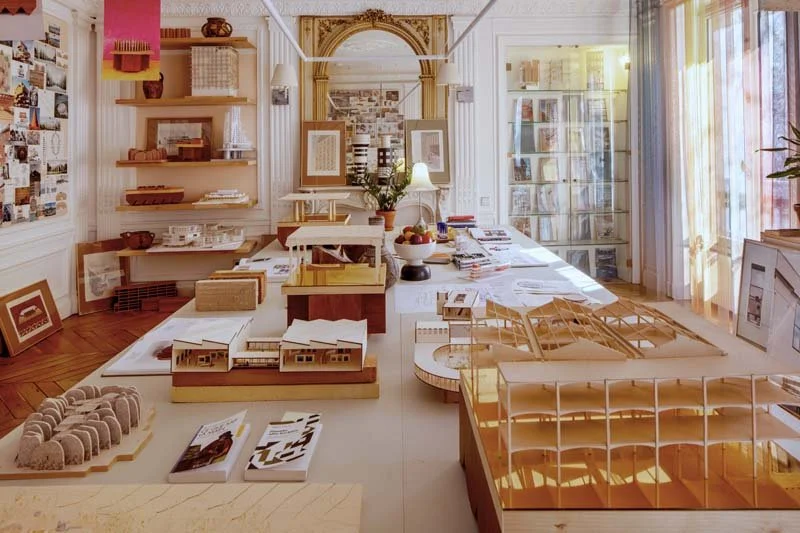
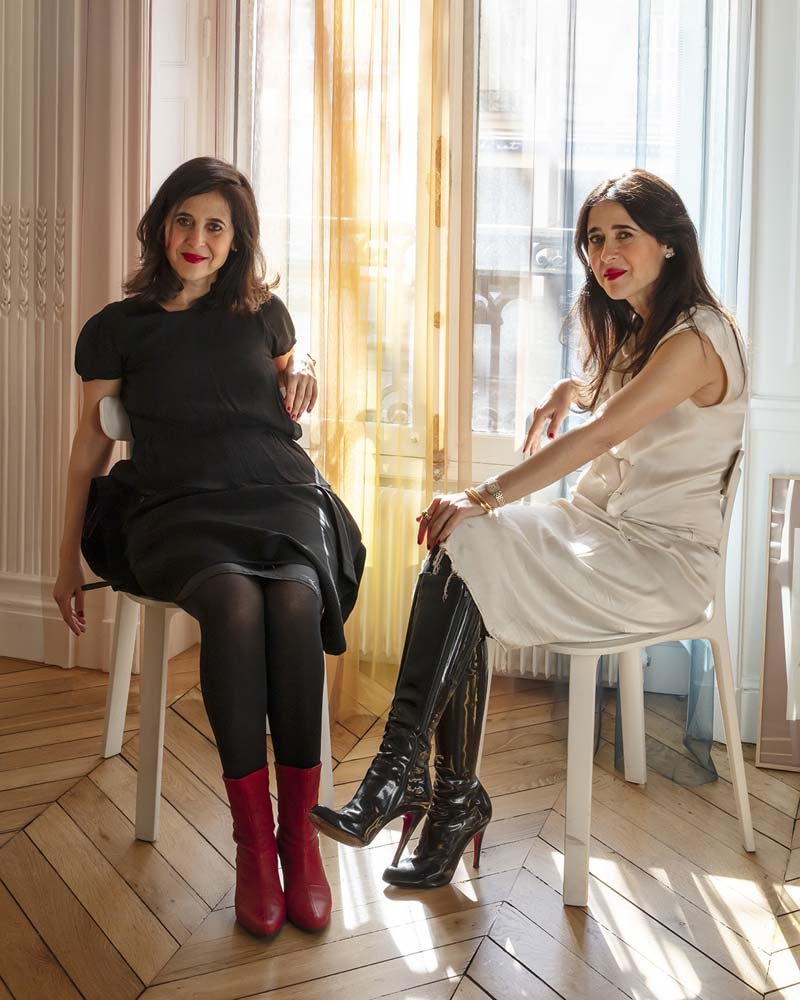
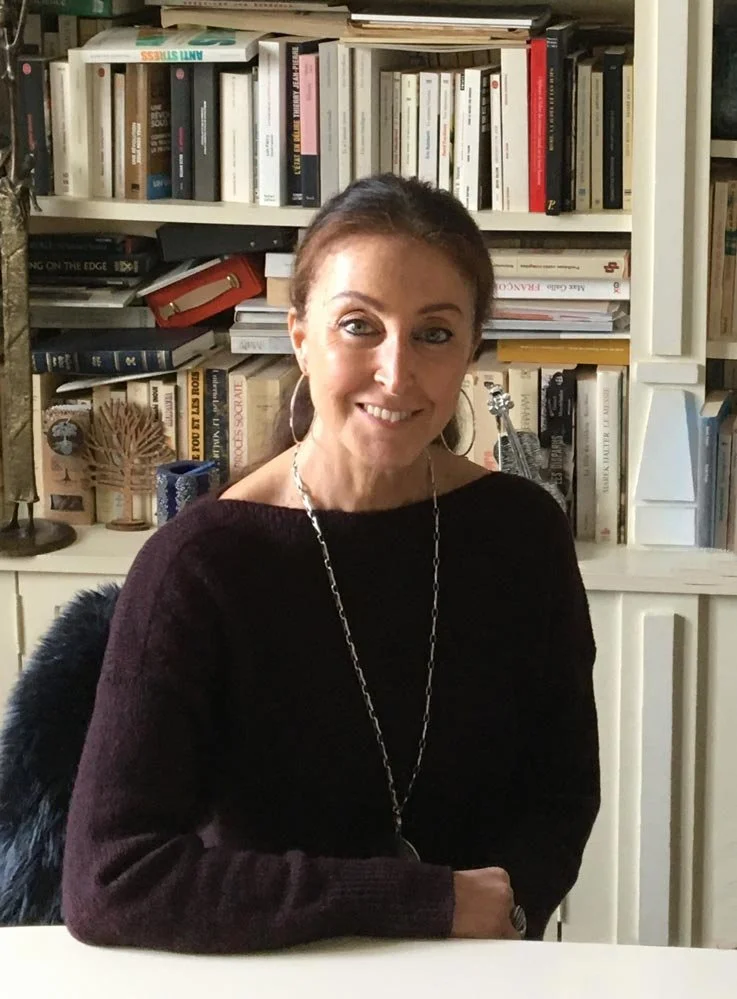
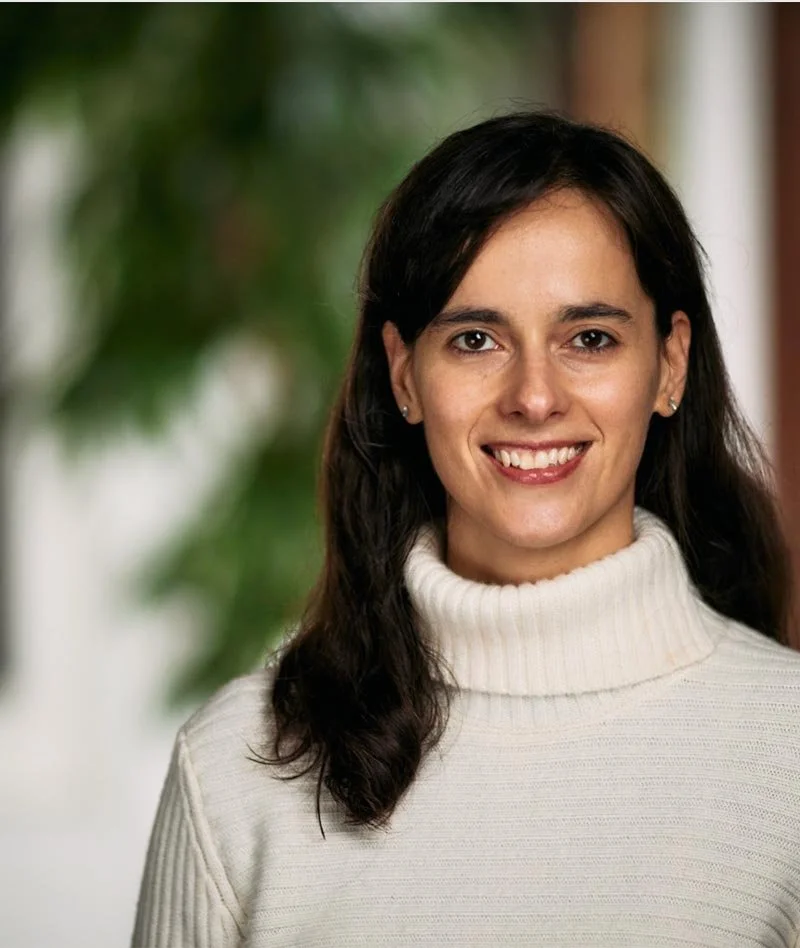
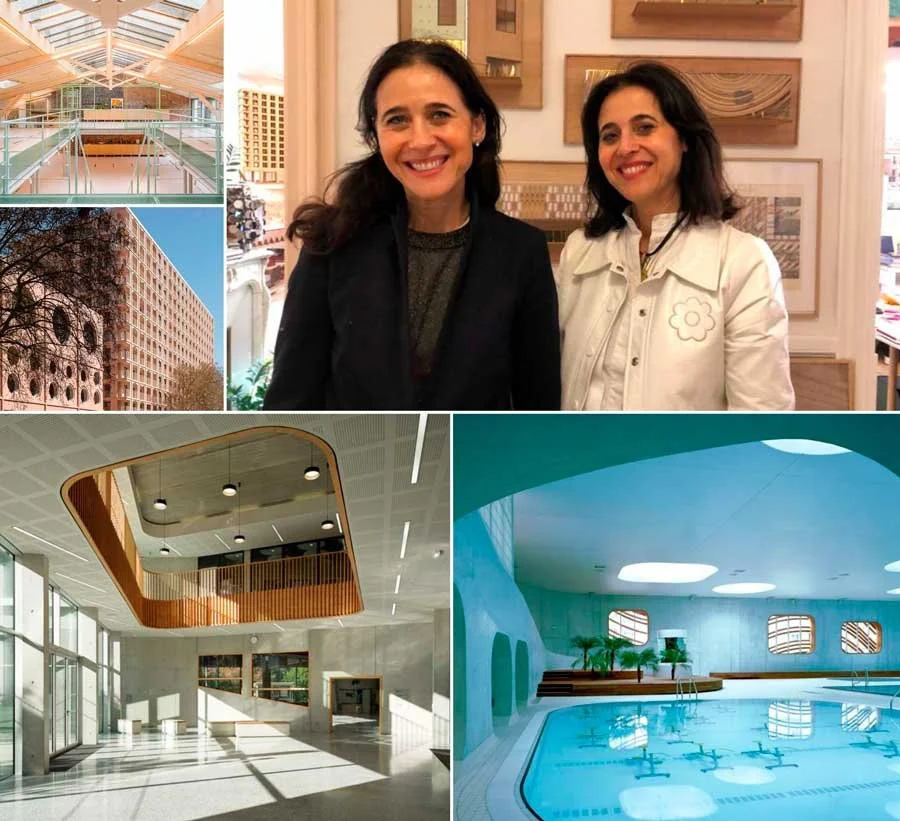
Salwa and Selma Mikou are the founders of Paris-based Mikoü Architectures. Born in Fez, Morocco and educated in Paris, they have spent the last two decades reimagining the relationship between the built environment and the cultural landscape.
After honing their craft under two of the world’s most iconic architects, Jean Nouvel and Renzo Piano, they founded their own studio. For them, architecture is a living interaction with landscape and what they call the Atlas of Resonance, interpreting the hidden layers of a territory, geology, memory, and craft. It is a philosophy that rejects the generic, seeking instead to weave together technological innovation with local materials. Whether it is a mosque in the north of England or a hybrid innovation hub in a former royal manufactory, their work asks a fundamental question: How does space shape the way we think, learn and remember?
They were selected by Rem Koolhaas to represent Morocco at the Venice Biennale. Most recently, they were commissioned by Hermès to create a 17,000-square-meter facility that bridges industrial performance with poetic expression. At the heart of their practice is a belief that architecture is not just about building—it’s about shaping relationships: between people, between past and future, between technology and craft.
THE CREATIVE PROCESS
Salwa and Selma Mikou, welcome to The Creative Process.
SALWA & SELMA MIKOU
Thank you. Thank you. Hello, Mia. It is such a pleasure to be with you and to have the chance to converse with you.
THE CREATIVE PROCESS
Yes, I am enjoying walking into your imaginative world. It is a little bit like walking into your joint brains' diverse influences, and we talked a little bit about there, but between looking to the future and the cultural Atlas of Resonance that forms the foundation of your philosophy of design. But just going back, I feel like it is the place of childhood that exerts that very strong influence on our imaginations. How do you feel that Fez influenced not just your imaginative world, but also that social and visual imagination and the way you see the world?
SALWA MIKOU
Yeah, it is totally true that we were born in a city that definitively shaped our way of looking at architecture, of looking at spaces, looking also at the landscape because the Medina is very particular because it is a kind of quite closed space. It is not a space where we can have a horizon. It is a space where we can only see the sky, you know? And it is quite labyrinthic. So it is a space where you cannot really have repairs. Whereas when we pass from the Medina to our home, it is exactly the contrary. We are living in a riad. We call it a riad because it is a reference in our landscape. A riad means in Arabic a garden. So it is the typology of the house, which is oriented toward a kind of inner garden open to the sky. Very geometric, but also plenty of ornament, plenty of materiality, plenty of color, plenty of colors as well. And also, it is a typology that was very interesting to us as a child because there were many rooms. You know, in the riads it is all about rooms, you know? So, as it is quite geometric, we have like a kind of cross. We have four rooms that are in a cross oriented on the gardens, but we also have other levels and also we have a terrace. And the terrace is something that was wonderful because it was the space where we really had the view on the city, but also we had the contact with the other neighborhoods and so. This vertical situation, this superimpose position between a ground and the terrace, is something that I really kept in my mind and something that was very relevant. Yeah.
SELMA MIKOU
And for me as well, living in an imperial city as Fez was very remarkable also because I have learned that contrasts are part of our reality, you know? Because being outside was totally different from being inside. And as a child, it was very important, and it was also amazing to have the experience of being in a public environment that is, as Salwa said, quite labyrinthic, quite narrow, with lots of diversity in scale, in shape, and to have this perception of only the sky, not the horizon. This is very particular. And coming inside houses and having a totally different perception. Having perception of bigness, of ornament, of color. And these kinds of contrasts are very particular to Oriental cities. And they are quite different from our Occidental environment. It is totally different from an ecosystem like Paris, for example. So, as a child, we had the chance to experience that, and we have it in our DNA forever. And I think even if we are not conscious about that, we bring that in our architecture. Yes, I think so. You know what I am going to say?
THE CREATIVE PROCESS
If I might just interject briefly, because I had the chance to come to Fez and to stay in one of these houses in the Medina, and actually interview a lot of different artists, musicians and educators. But what is really important, which you said, these courtyard buildings where you are on one level, there is a certain, I do not want to say voyeurism, but a collective experience. You do not get this. And if it is multi-families within— It is very social.
SALWA MIKOU
Exactly. Yeah. Yes, exactly. Yeah, it is very social. And it is something that, you know, Moroccan culture is also a very social culture. You know, we need each other to exchange. It is focused on also family, of course, because family links are very important, but also the neighborhood is so important. We have this consciousness of neighborhood, and we share lots of things. I remember my parents, for example, on Friday, it is the couscous day, and sometimes my mother said, "I would like to cook also for the other neighborhoods," you know? To share things. So it is something that is very important to share. And the terraces, you have the views on the other terraces, so you can see how people are living. You can see also the rooftops. Yeah, you can see the other children. So there are lots of things that are happening on the terraces, you know?
And it is also a kind of social place really. And for us it is very important. Even if now as architects, we realize how important this experience was for us because we were experiencing the way where architecture could shape a kind of social being and social behaving. And this is very important to have what we call this kind of collective space that is a very important space in the house. It is so important to see how architecture could interact with behaviors, with the way we are inhabiting spaces. And now in our practice, it is something that means a lot for us. So each time we receive a brief, each time we have a program, we tend to go beyond the program and say how we could invent a kind of typology that would make all these uses be inhabited. And sometimes this typology does not even exist. We have to create them. We have to invent them. That is why with my sister, we speak about our project as social infrastructure. We see how we could amplify the uses.
THE CREATIVE PROCESS
And I want to touch on that too, because I do believe that—I mean, it has been said and I believe it is true. I think every life can be like a work of art. Like, we can bring the art into people's lives. You have to say, if you were designing a workspace and it is manufacturing, but every kind of workspace that they can feel like artists or artisanal workers who are contributing to the whole. It is not mundane work. Or educational spaces, which I know you have also a design for educational spaces. Different technological hubs or these beautiful projects around swimming pools. There should be a joy of living, I think. What I see in your work. And you can design spaces where everyone can feel like designers. Like, we have to introduce, I believe, design intelligence at a very young age. In order for the designs that we live in not to be bad designs, but to aid in human flourishing. So that is what I see in your work, that it is really thought out. It is a social level first idea, and then the space. How can you create that with space?
SALWA MIKOU
Yeah, it is very interesting, this question, Mia, because it is not about having a space that is over-designed. It is about how we could, you know, volumes, form. You know, architecture is about form geometry. It is about light, and it is about proportion, and of course, it is about atmosphere. So you know, what is very important above all, is to create an atmosphere. Because what we also, looking back also to our culture, it is... we were really attracted. You know, sometimes you do not even need to understand something. You just have to feel it, you know? And this is what also we have learned from Moroccan culture. All these pieces, all this wood, all these materials that are bringing together, they give a sense of beauty, a sense of domesticity that is very relevant for a space, you know? So in a way, this is what we try to do in our project is how can we bring materials that give a sense of comfort, that we can really appreciate the space. And also we love working with natural light of course because light is so important. We try to make the light inside our project circulate. So it is all these elements putting together that allow us to think first about atmospheres.
SELMA MIKOU
Totally, that is true that your question about art and how it enters in resonance with architecture is very interesting, Mia, because what we have noticed with time is that in our country and in our culture and tradition, art is everywhere.
SALWA MIKOU
Art is not in museums. All art is in the street. Art is in the houses. But it is not about making art, it is about living art. So it is totally different. So we have noticed that all this knowledge, sometimes colors are matching together in a way that is so mystical, so wonderful. It is about an intuitive knowledge. It is about matching materiality, matching colors, doing it in a way that is very intuitive, that brings in houses and in all the public spaces a kind of well-being sensation, and that is about architecture. Architecture should bring a kind of sensation of well-being.
SELMA MIKOU
For us, we were really lucky to experience that as children, and now as architects, we try to bring all what we learned in our practice.
SALWA MIKOU
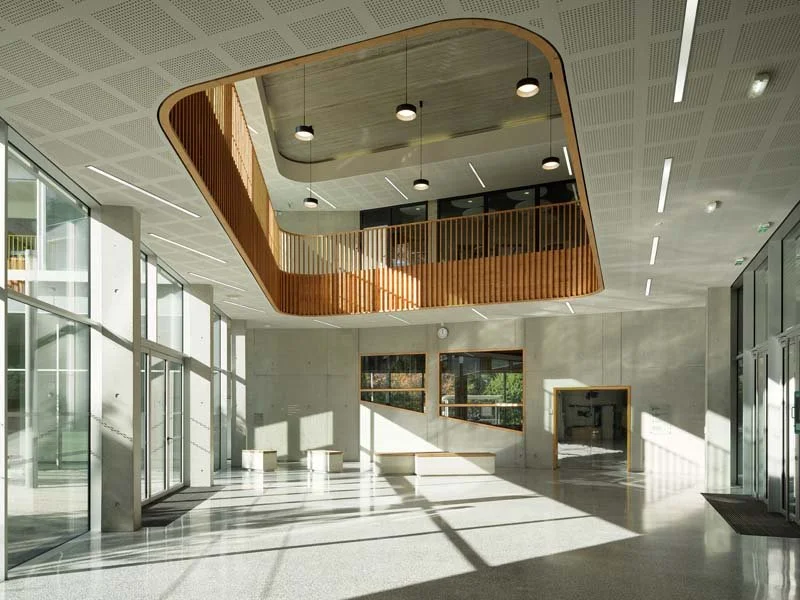
The more we give space materiality, the more people say they really feel it. That is a kind of mark of consideration for them, for the users. So it brings a really kind of well-being and these kinds of attentions. We have noticed, for example, for an educational campus that we have delivered recently, Campus Renault, where we tend to bring really a sense of domesticity because we noticed that students are there all day long. So they need to have spaces that are really warm, and they need to have a kind of sense of materiality. So we try to inform that in the spaces, you know? And we have noticed how it was at the end that this was very well received.
THE CREATIVE PROCESS
You are talking about bridging history, giving that sense of the symbolic, the memory. Talk about going into the past, the traditional homes in the Medina, where everything is a work of art, but making it also be in conversation with clarity and simplicity. And then how you can translate that into... It is like a simplification process?
SALWA MIKOU
Yeah, this is really interesting because, for example, of course, we never choose the sites. The sites are given to us. And for us, each site is unique. Each site is singular. Each site has its own truth. And we love going deeper and deeper to reveal what are the traces, what are heard, how kind of local narratives we could find. For example, we worked in the Département de Seine-Saint-Denis, and we had a site along the railways. But still we were not that far from the cathedral Saint-Denis with all this vitro amazing colors, amazing history. And we noticed that the street was like a very famous street because it was the street that the old Kings they took to go to the cathedral. So then when we make some research about the site, we can find lots of things about geology, about history, topography, symbolic. And all these traces for us are very amazing. And layers that we try to bring into the project and we try to interact them with the program, with the space, and so that to be able to build like a kind of very rooted building in a way. Yeah.
THE CREATIVE PROCESS
Part of the ecosystem.
SALWA MIKOU
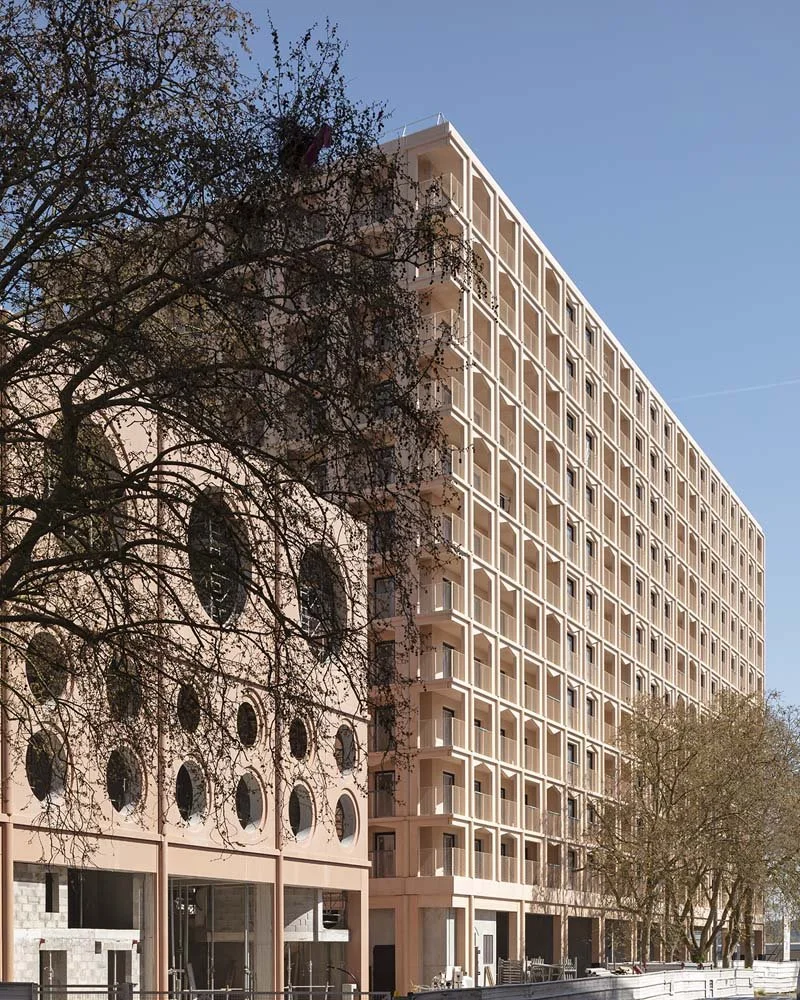
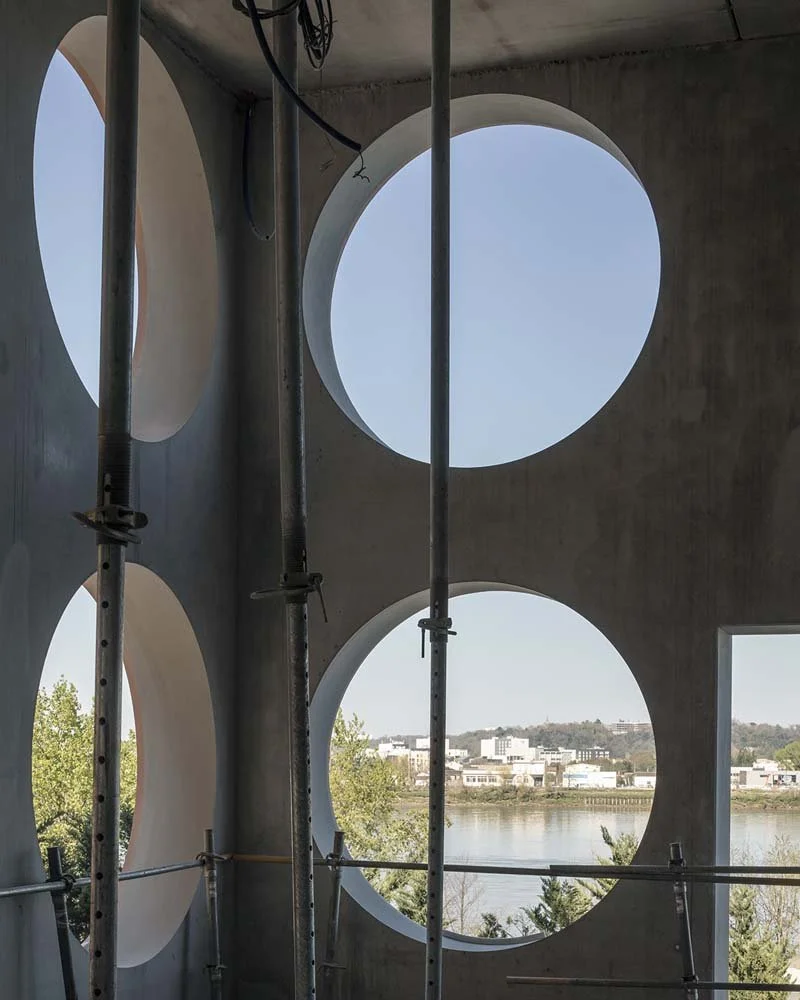
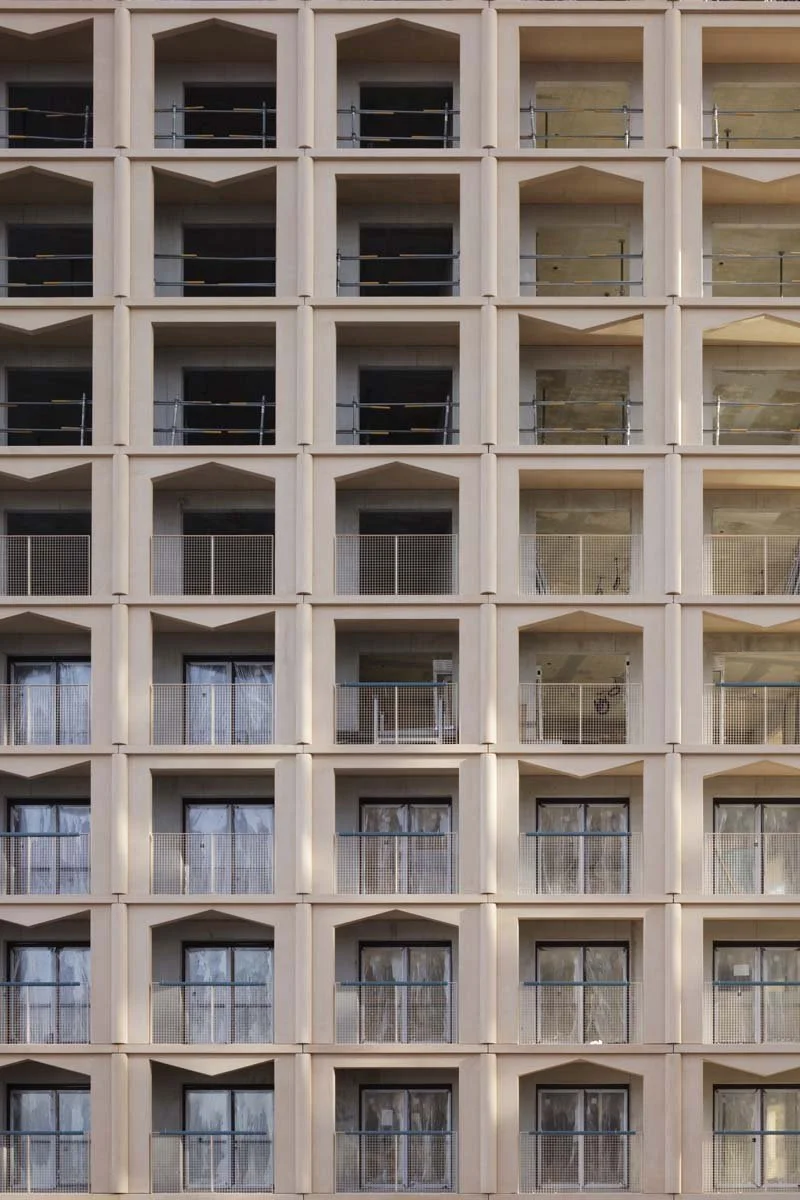
Exactly. That is true that also, we are experiencing a project now in Bordeaux which is very iconic because it is situated along the river. So it has a situation that is quite remarkable and also it is in a space where Bordeaux was listed because Bordeaux as a city with stone, it has been listed by UNESCO. So the idea was to kind of create a contemporary building, of course, but that can be articulated and can be inspired by the old tradition of stone of Bordeaux as a city. So we tried to make research and then we finally came with kind of panels with clay concrete and all clay was taken from Bordeaux environments. And then we managed to create some kind of marquetry of mineral materiality that resonates with Bordeaux tradition and history, but still is a kind of very contemporary and this marquetry is made by a kind of assembly of modular panels. Construction system that is offsite and is made with dry construction. So for us, it is also a very virtuous system that we have created to be able to respond to the issue of building now in Bordeaux. But also in all the contemporary issues of how to build in a way that is very, let's say soft, that is virtuous, that is using decarbonation, using dry construction system to be able to have a low impact on construction sites. All this kind of reflection came with this program.
THE CREATIVE PROCESS
And I think all the history somehow taps into that collective memory that we must have. And to feel, going back to that idea of the inner courtyard and that a building is alive. And if we can make a building feel alive that has, you know, like with our secret gardens, that we feel more alive in that, and can awaken our creative capacity.
SALWA MIKOU
Exactly.
THE CREATIVE PROCESS
Now, because this is audio primarily, we have not talked about you being twins and— I think it must be great, a second pair of hands, eyes, maybe disagreements, maybe— To me, you two are like the living metaphor of what is collaboration, right? Two separate or different minds but then can come together.
SALWA MIKOU
Yeah. It is something really specific, but we have to say that sometimes people, they see us as very identical twins, but we are not. We are very complementary, but we really are very different in a way, and that is why it works well because each of us has our own talent, its own vision. And sometimes we... I mean, it is very often that we disagree on lots of things, but this is good because then there is like a kind of exchange. And also we can implement each of us have our own vision, and then we can... It is much more rich than having, you know, the same opinion on everything. So this complementarity is our force in a way.
READ MORE [ + ]
Totally true. Actually, being twins for us is a way also to experience the difference, you know? And we like it as well because we have our own way to see architecture, and a very specific way to think about architecture as well. We like also to exchange, to be able to cross our visions. And for me, it is also very important when I have a kind of first idea or first intuition about a project to kind of explore it with Salwa because I am sure she will have another vision. It never happened that we see the same thing.
So then I see, you know, it is the confrontation to l'autre. La confrontation à l'autre. I like it, so she is, for me, she is l'autre. So she has her own regard, and the way she will see my intuition will implement and will make this vision be amplified. And this is, I think, very important.
That is true that, for example, this is something that we have not chosen, but I wish to work with Jean Nouvel. My sister used to work with Renzo Piano, and it is exactly our... You know, Jean Nouvel and Renzo Piano are very different architects, but it resonates with what we are, you know? I am much more artistic in a way. I like to have concepts. I like to have the imaginary to work with all this narrative. My sister is very strong in all the rational constructive systems to work like, in a very, let's say, very strong and very structured way. So we are, yeah, we have these two visions that are very complementary in a way.
Yeah, I want to get to client relations and understand the architecture world.
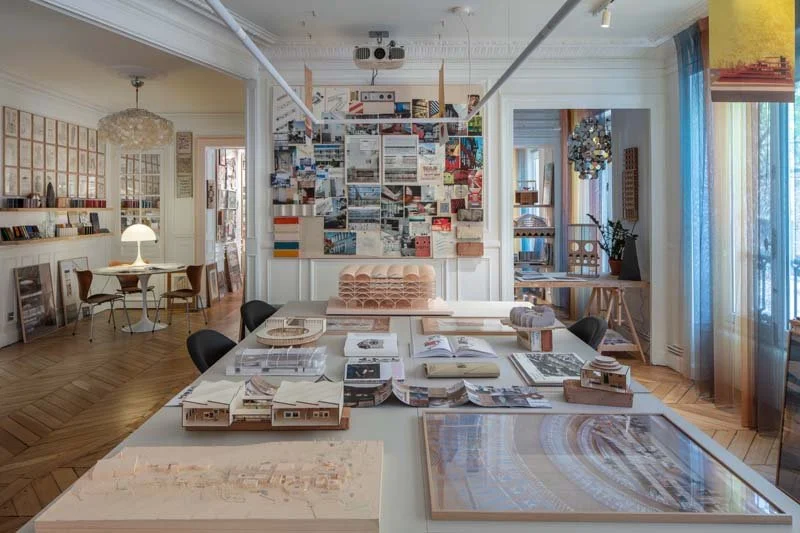
Yeah, you are right, architecture is a very competitive field. So we do not have that much chance to exchange with the client because everything is anonymous. You know, when I was in Jean Nouvel, I was very young because it was after my studies, and it is actually the first experiences and the last one because I was there, I was thinking just for one year and at the end, I stayed like more than five or almost six years. So yeah, it was quite interesting for me because the first time, I was surprised by the fact that we cannot see anything on the tables. We cannot see anything on the walls. And when there is no people, it is just tables and screens, nothing to see. And it was, "Oh my God, what's that?" And Jean Nouvel, he likes to work with digital, with images.
But it was not like a kind of ecosystem or environment that we had this tradition of pinning up and exchanging all with the other team because we exchanged but only with Jean. So it was like a kind of face-to-face, so we even did not know what the other teams were working on because everything was a little bit strange for me at the beginning, but I got used to it because what I have learned is also that Jean has his own imaginary on the project, and he has a strong ability to conceptualize things. So I liked absolutely working with him on projects because we never knew what would be the orientation that he would choose. It was always about liking to work with memories, with narration, with stories. And so I think it is here where I also get more and more conscious that a site has a kind of very strong ecosystem. The idea of contextualizing architecture, that is something that Jean is very strong to do that, to find to understand the context of each site and to make the appropriate project that seems exactly accurate for this site. So, yeah.
And for us as well, as we begun, we had really the consciousness and intuition that for us, architecture is about building culture.
Because the places where we were born, we could see in every corner piece of cultural history.
So walls could speak, and architecture is speaking a lot in the country where we are coming from. So for us, it was obvious that we had to be able to make architecture speak and even make architecture singing. So that is our cradle.
Oh, so you think also about acoustics then, too. I think about acoustics. There is a lot of invisible design that we do not see. We were talking a little bit before about even the algorithms that we live in and the society is, you know, politics, this is a design. So, but you think about making a building sing.
Yes, the building, it sings when it resonates well with people. You know? When people can see the building and it is the same way it could read a good book. So the building enters in dialogue with people, and there is this kind of resonance. And it happens to us that some buildings make us be happy. We feel we are very touched, and we are moved. And this is something we believe in. And for me, singing means being in resonance and being in dialogue.
So when you are working with people who are commissioning buildings, and there is the competition, as you say, and there is this distance. So would you be going to the site? Because the people who inhabit the building are not always those who are commissioning, right? Exactly, the clients. So how do you get to be in resonance and to listen to those inhabitants or the users of those buildings to make sure it is a building for the people, not just the commissioner?
Of course. Yeah, this is the miracle of being an architect, I would say. Really. It is because also, when you do architecture, you think about others. Of course, we think about how we would do it the best. So it is doing by human, for human, of course we think about uses, we think also about our intuitions, our vision, our way of doing. And when you build this kind of intuition, when you succeed of giving a good space that resonates with the users, that resonates with the program, that is accurate with the site.
And at the end, a building that also gives a sense of beauty, then you feel you are in the good way.
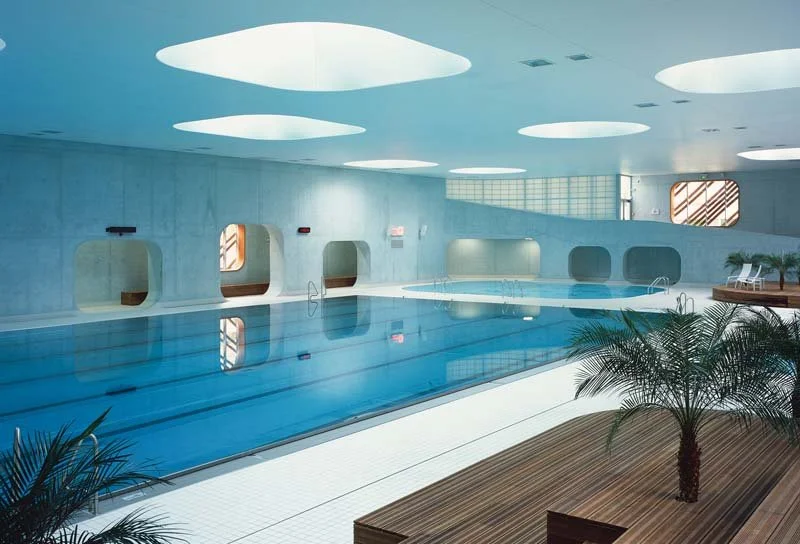
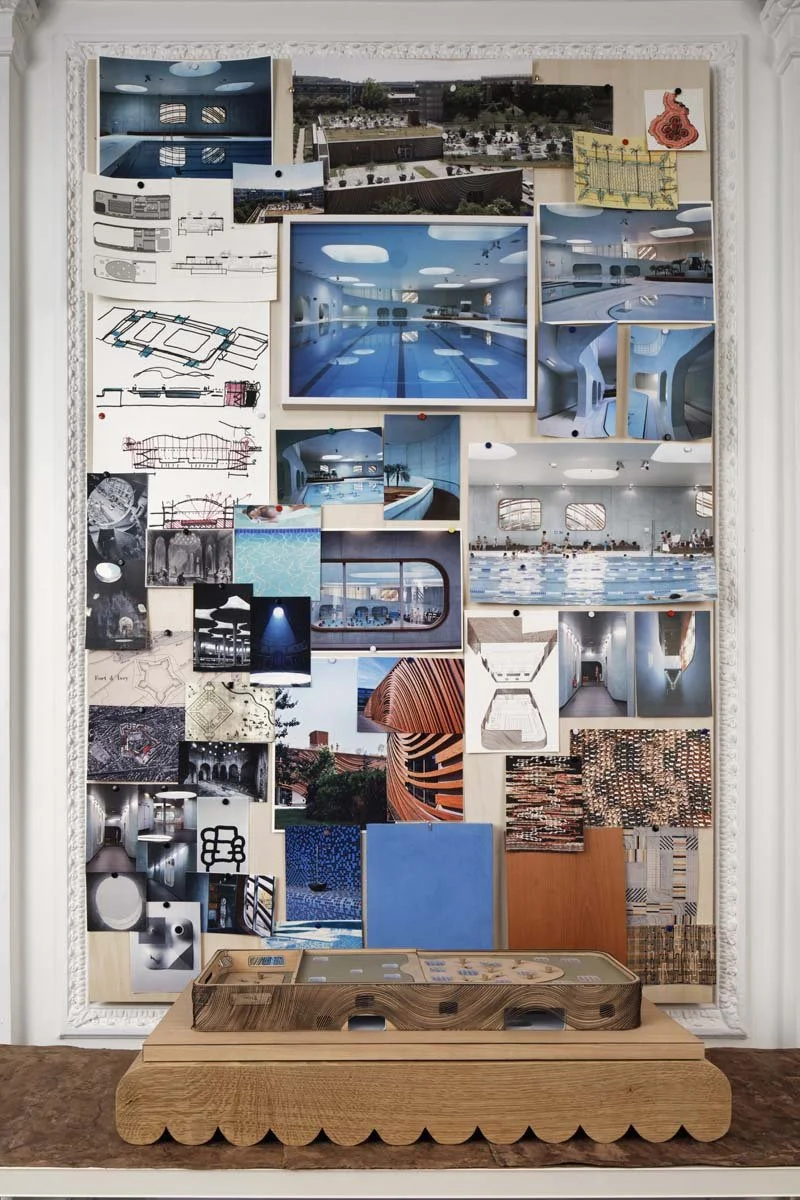
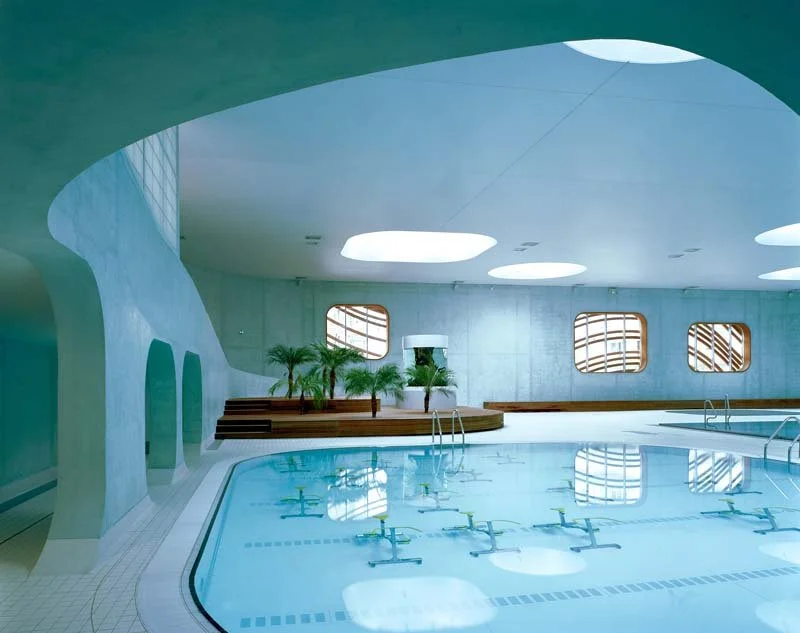
Yeah, I have to say, for example, we had the experience with the sports center and swimming pool Aquazena in Issy-les-Moulineaux, and that was a quite interesting experience for us because the site was amazing. We had this ancient fort, like le fort Vauban. Exactly, an old fort. And it is a kind of space, a district that is a little bit closed on itself, but still a very high topography because then we have a very strong view on Saint-Cloud and also on Paris and on la Tour Eiffel. And the site was quite narrow because we had like just a rectangle to do a building. No way to add a garden or even an exterior space. And we really wanted to give to people a kind of experience that is going from inside to outside, we wanted to experiment this kind of relationship. Because when you do, for example, spaces for water, like swimming pools or with sport facilities, there is always this wish to go outside, you know, after sport and also to experiment well-being and the sky.
So for this building, we worked a lot with a kind of levels and then we added a ramp, an interior ramp to allow people to go on the rooftop from inside after swimming, and having a garden on the rooftop. And at the beginning it was not written on the program. It was not something that was required for the brief. But yeah, it was something that naturally we have proposed as a kind of promenade, and it was very well received actually. And also, for example, we were speaking about how all the people can feel in a building and how they could have like a good experience with it. For us, for example, these kinds of programs, we call it "Les Temples de l'Eau," so water temples. It is something that we like a lot because in our childhood we used to go to hammam. And for example, we love hammam because, you know, it is a place for women. We had a kind of very specific rooms. It is very specific light, very specific atmospheres, and it was like a very important moment. You clean yourself but it is also very spiritual and holistic.
So when we began to work on these kinds of programs in France, for example, we wanted to bring this holistic atmosphere that we had in our culture. So that is why, for example, we worked with blue concrete. We worked with a kind of very specific light going from the roof. We worked this to create a kind of atmosphere but also sequences. You know, architecture is also for us about sequences, you know? And this kind of sequence, we really feel it when you are in the Medina because you pass always through a space to another, through another with different kinds of light and atmospheres.
So for example, here it was the idea, okay, when we arrive then, then we go for, you know, spaces for les cabines. Then here we change. After that we take corridors then. And after we arrive to the big hall when there is the swimming pool, and then we try to bring different atmospheres for all the sequences so that to give like a kind of very different sense of spaces for each sequence, and then arriving to the main space and after that taking the promenade and going on the roof. So it is all this how a building could give a kind of spatial experience, so this is very important.
It seems very transformative as you describe that. It is not just a place where you go to do one thing. Maybe you go to be transformed, as you say, like you go to a theater piece or a book. You talked about that. You go through different chapters and you get to the core of maybe it is like the hammam experience. You get to the core. I think that that is a wonderful philosophy to have about buildings not just being spaces that are functional, but emotional, intellectual or physical transformation.
Absolutely, yeah. Totally. And we love to think about architecture as a level of transformation. It was, by the way, a kind of topic we developed when we were teaching at the Architecture Association in London. We experienced with students how architecture could activate transformations because of course transformation is very important. I mean, everything is done to be transformed. So speaking and seeing architecture as a way to transform people and be itself transformed is very interesting, I think.
So speaking of those conversations with history or having a direct spiritual aspect and how would you take on your project in the mosque in Preston in the north of England?
Yeah, this was like a kind of very strong commission because when we begun even after our studies, we really wanted to work on mosques. We love mosques because in Morocco but in all the Arab world, mosques have different typologies, but still they are all very abstract, you know? In our culture, when we enter a mosque, we just sit on the floor. You know, no furniture, very simple things. But it is only the space that gave a sense of richness and a sense of holistic and spiritual things. So we also really tend to think about that, and when we receive this commission from a Pakistanis association to work on this mosque in Preston, we were very happy. And what we have done is like we tried to make lots of research on their history, their narrative also because of course they are Muslim but they are different, you know, there are different Muslim cultures anyway.
I mean, we are all Muslim, but each of the regions has its own culture, its own way to see the space, to see also the relationship between women and men in the building because, for example, there are some cultures where you can merge, you can have one space for both women and men, whereas here they were like very affirmative. They wanted to separate the spaces. They wanted to separate the courtyard, and also to separate also the promenade and the accesses. So we tried to make a very coherent building while still having different parcours for women and for men and still having this sensation of a whole thing and a unique thing even if they are separated. Yeah.
That is true that for us masalas, we call it masalas, are very important regarding our architecture history. Because when we were children, we used to go to mosques. And what I can remember, it is a mosque is a kind of, as Salwa said, we were always sitting on the floor. And the building was a kind of structural system. So at the end a mosque is about creating space, a space, a kind of holistic space with a structural system with materiality and light. So we had the sensation that with mosques, it was about creating spatiality with elements of architecture.
So really, how can I say? Very important because for us mosques, they could summarize the issue of architecture in itself because what is architecture? It is about working with the elements. Working with light, working with matter, with materiality, with structural systems, and giving people a sensation of space. And at the end, the masalas, they do it, and they do it so well and so differently.
Because we used to go to a hypostyle mosque as a child. The same typology as a Mosque de Cordoue, for example, Mosque Karawiyyin in Fes, La Mosquée de la Kutubiyya in Marrakesh. But there are other typologies of mosques. For example, in Turkey, mosques are not made of hypostyle structure, but they are made with big structural systems of cupolas so it gives another sensation of space. But still, it is the same thing. We are sitting on the floor, and we are given the sensation of space and light with another kind of structural system. So at the end, it is very good teaching, actually. Experiencing all typologies of mosques is really relevant and incredibly rich for architects and architecture.
Well, particularly when you are talking about that building and creating memories or being in conversation with history, to go back, those are designs that really survived the century. So to go back to understand why that is powerful, to bring it forward. Actually, we like organic things.
We really like... Because of course sometimes, when we speak about architecture, there are lots of grids, for example, of the uses. We have the grids of the program. We have the grids of the structure grids of the economy and the budget. But inside this grid, we like to give like a kind of sense of freedom, a sense of joy, a sense of a kind of playful thing. So for us, for example, even if we design a kind of very shaped and very geometrical project, we like inside to bring some organic elements, whether in the stairs or in the windows. Because you spoke about how we can deal with art into architecture. So for me, it is that. How we can bring a kind of a sense of warmth, inattendu. Something unexpected. This is very important, you know, this sense of unexpected. It is something that is really for me very important because it could be just how we match with materiality, maybe some colors, maybe like a kind of things that gives like another layer to the project and brings like richness and awareness.
It is so interesting. I want to get into how, because you, of course, you have taught the principles of design. You have brought people along their path to become architects or designers, and it seems to me it is something that is not taught in most of our educational systems, we are kind of design illiterate even though we are constantly surrounded by design. It is not something that is part of our basic literacy. So how can we improve that? You know, because otherwise, if each of us learns how to be better designers or to be at least vocal about the world how we want it designed, there is a number of systems that are not even just design, physical design objects, but we talk about our political systems. This course, we talk about algorithms. We talk about all these other things that can be imposed upon us if we do not take a more role in designing the future we want.
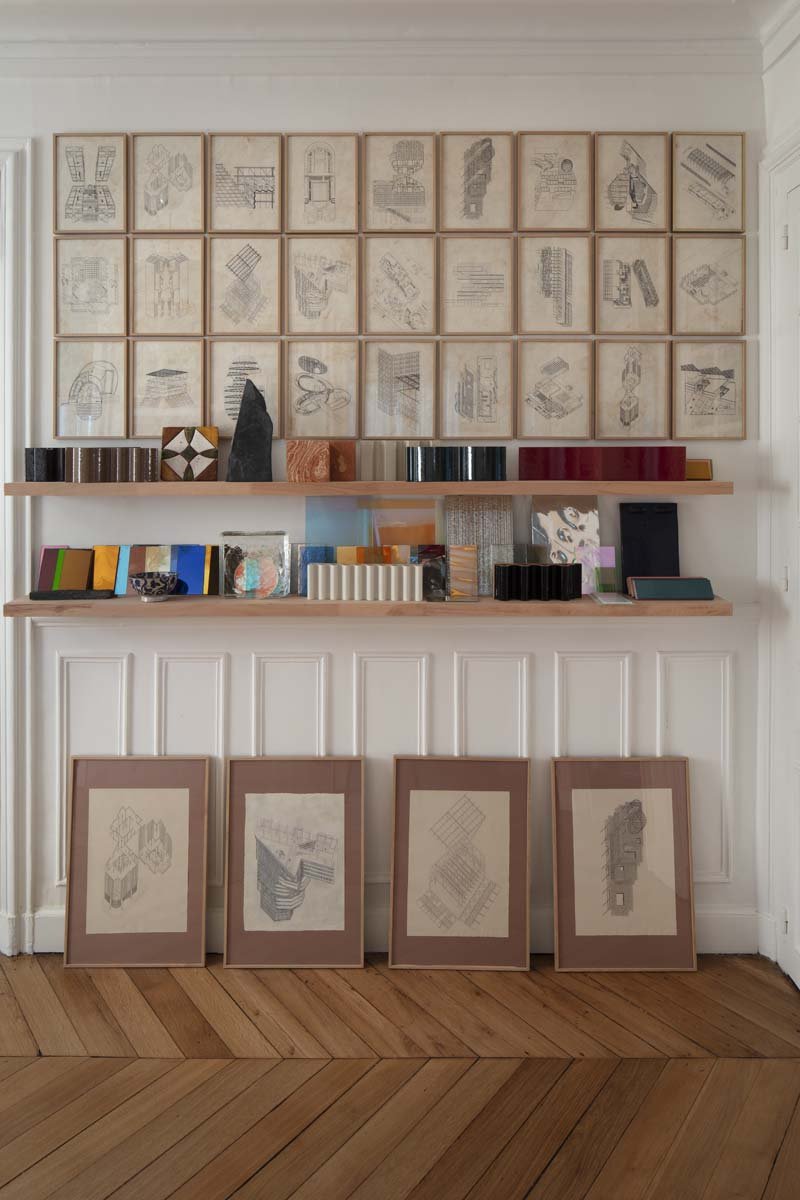
Yeah, for me, it is a very interesting question you ask because for us, we are very interested in structural systems. And we have noticed that structural systems, sometimes they come from a kind of necessity, a cessation of essentiality. You know, we have made some research, and we are now currently doing a big research about structural systems in crisis periods. And we have noticed that after each war, for example, when there is a lack of resources, of materiality, then architects have built some structural systems that are very clever and, for example, Philibert Delorme, he created some very interesting structural systems with wood but with very small pieces of wood because wood was not available. So he had to look at what are resources that were available to do something with it, to build with it.
So it was Philibert Delorme, and then after Friedrich Zollinger did the same, and he built some very challenging big constructive systems, cupolas or some things that were very challenging but with very small pieces of wood. And he tended to articulate them in a way that we could do a big thing with very small things. And other also architects that we appreciate a lot, like Le Ricolais or Konrad Wachsmann or even Angelo Mangiarotti. These kinds of architects, they really created some architectural systems that are very interesting in their time. And for us it could be very interesting now to kind of go back to this knowledge and reinvent it because now there is crisis of ecology. There is the crisis of materiality. We have to think about economy of matter, you know, to be careful about what we use and how we use it. And I think we can learn a lot about these kinds of structural systems that have been made in the '70s or even before and do something with it. And it is what we are doing right now.
For us, for each project, we start with a kind of working about structure, about a structural system that is very accurate. It is like our body, you know, it is made by this vertebral column. So we have to think about a kind of essential structure that is accurate for the project, and then we add layers. We add, of course, layers of traces, memory, narrative, but it has to be aligned with a kind of very accurate structural system.
And speaking, working with the ecology and what is already there, talking a little bit about the circular economy and making buildings that maybe it is not always a completely new building either. I guess seeing something that is there, it is not serving its purposes but then your adding to it and being in dialogue with it. And that is also important, I guess, if we do not want to add to the waste stream too. So is there a project where the narrative of the site changed your fundamental initial vision of it? You know, as you were in it, it is like, "Oh, actually, this is what the site is saying to me, folks. Let's put our ideas aside and listen"?
You know, we are doing a project now in Brittany and it is a region that is full of histories. For example, our site is really next to Brocéliande Forest, which is an amazing forest with lots of stories, you know? And full of narrative and imaginaries. And we had this idea that we think about Brittany, so La Bretagne, we think about littoral. So we think about the sea. But here, there is no sea. It is the center of Brittany, so we do not have this imaginary of the ocean. But we have another imaginary about the forest, about bocage, about another type of landscape, because we spent lots of time on the site. For us, it is very important. So when we went to the site the first time and then the second time, then we used to be really touched by the spirit that is there.
And after that, we ended with a very nice project. But we wanted to bring these stories inside the building itself, you know? The stories of La Forêt de Brocéliande. It is amazing. So we said we want to make a project full of stories. And it is also what happens for a project we are currently doing in Caen, because it is a museum. Because for us it was lovely to work in a kind of city we did not know before. But also it is because the program is about doing a museum, it is also about a kind of collector that is quite specific as well. He has his own collection, he has his own vision about art, and also he has a very diverse collection from archeology, ethnography, both art and also African art. So, and also art deco. So it was very rich.
And also this man, he was born in Egypt, in Alexandria. So for us it was very interesting to kind of match his own culture and the site where the project was going to be built. So it was a way for us to kind of bring together different stories, different culture. And then when we were working on the site we had the opportunity to go and visit the client and show him our work, and he came back with other ideas and with other vision about what kind of museum, how he sees a museum as a private collector. And this all as well was a kind of dialogue and interesting to merge all the stories together and all the vision together in this project.
Yes, there is always personal vision I can imagine in the commissioning process, but where you are also telling the story of the collector, so you also at the Venice Biennale, seems like a very interesting dialogue. And what conversations went into that?
Actually, we were part of a selection of eight Moroccan architects for the Moroccan pavilion, and it was under the patronage of Rem Koolhaas and Fundamentals. So it was amazing because, of course, it was very inspiring what are fundamentals of architecture and Morocco has a very strong history, culture, and it was amazing to go back to visit, of course, all this knowledge that we have in terms of culture and architecture, but also to think about what could be the future, you know, of Morocco as a country and how we could address architecture also address the needs of the new society, because Moroccan society is a very young society, so it is a society who evoluates very quickly who is more and more Occidental in a way. So architecture has to address this and to bring different kinds of places to make people live together and interact, and also how we could bring a new identity for Morocco regarding architecture.
Because when we think about Morocco, of course, we think about the old buildings which are amazing and full of knowledge. But we need, of course, to build a new narration that is much oriented to the future and also oriented to the present and what is the present of architecture today in Morocco, how can new buildings bring new ways of living together, how can we share things. Yeah, so it is a big deal because also our parents used to live in the Medina, but all the new generation, of course, they do not live anymore in the Medina. They live in contemporary cities.
That is true that it was interesting to interpret this idea of working with essential elements.
And that is why the pavilion was about living in the desert, also living in the Sahara, more precisely. And we love to experience this issue, and we created a kind of way of living in a city, we call it Boukra because it is a city that exists and used to be extracted with phosphates. And all this phosphate extraction left traces. And we went to the site, and we saw all these traces that are almost, are very architectural in a way. And we were thinking what to do with that, how we could transform this extraction in a kind of resilience approach that could make this extraction positive. And that is why we came with a kind of typology of living. We created a kind of landscape that is a kind of living landscape and very rooted in this city. And we were very happy about this project, and we really hope we could go forward and do something with it. Because these traces are still there, and it could be really nice to make them be livable. And our project was about living, inhabiting these traces.
I do want to talk about your commissions with Hermès or Yves Saint Laurent. You know, the thinking that went into these projects.
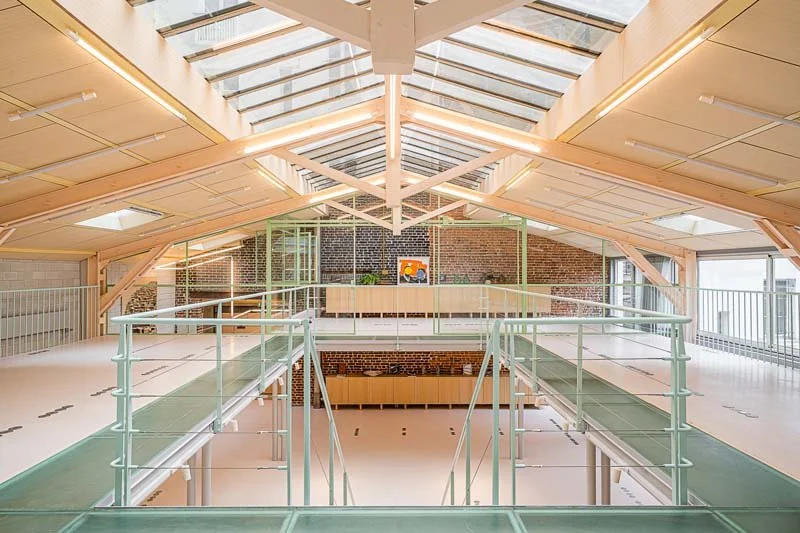
Actually, for example, if we begin with Yves Saint Laurent, it was for us like an amazing experience because it was not such a big project because it is a kind of inner project in a very interesting and listed building. But what was amazing there and very touching is that it was the first showroom of Mr. Yves Saint Laurent and Pierre Bergé. They bought it in 1985, and they never touch it until now. And once the Fondation Yves Saint Laurent, they came to us, actually the building was really untouchable, so and they ask us to transform it in a way to bring the spirit of Yves Saint Laurent during the first part of his career, when he used to work with color, with geometric things. And for us, informing architecture in a way to bring the spirit of the designer was very challenging. And also what we loved is that it is a building with a very strong art deco spirit, so for us it was quite easy to take off all the thing that was superficial, and then we let just the brick walls, we let all the thing that was very important.
And then we transformed it in a way to free the space, actually. We really want to free the space, to let just light and structural systems to be there, so it was an amazing experience also because of course Yves Saint Laurent is a very demanding client, but in a good way.
Yes, it was about building culture with architecture.
And we like these kinds of issues because it is about also transposing into spaces, into architecture some elements that are not architectural. For example, the idea was to create a space that could speak and resonate with the first spirit of Yves Saint Laurent creations. So we have made lots of research about how he was drawing, what colors he was working with in that period. We went to his archives and saw the geometry because all his clothes and he was also about working with space as well and with geometry, in the way he was creating all these kinds of elements was very interesting for us to bring them into a special narrative.
And so I just wonder what that imaginative process is, also just on a spatial level, you know, how you imagine from the small to bring it from the micro to the macro. I do not understand how that works quite.
Yeah, this is a very good question, you know. From the micro to the macro, but also the other way around. It could be also from macro to micro. And I would like to say, how we zoom in and how we zoom out, for example, speaking about narrative and speaking about local traces and all these layers, of course it is very abstract. It is something that is sometimes even not really rational. But we like it because we need to bring some irrational things into architecture because sometimes architecture is too serious, you know? To bring together ecology, economy, uses, program, all these things. And sometimes we need to have a kind of framework that could a little bit like make all this much more light, so for me, abstract things, for example, let's say a multi-sensorial approach, it is something that is very macro. Whereas when we think about, for example, uses, we think about what could be the answer here? What could be the main space? The space like we call it in Germany, they call the aula, this space that we share, you know? And in Morocco we call it wast ed-dar (وسط الدار) that means that it is not a space dedicated to a unique activity. It is a space that even has no uses actually because it has all the uses, it is this kind of space where we share things, we are interconnecting, and we are exchanging. So for example, we try to find in each program what could be the space that we share, that could be like kind of the central space and then all the uses are constelling around it.
It is the heart of—
It is the heart. Exactly. It is the heart, what is the heart of each building, you know? What could be the heart of a building? Exactly.
That is very beautiful because we always think about function, function, function, but we have to have a space where we breathe, but it can connect all those things. It is important. A building is where we live our lives, where we do our work, where we have our dreams. And so you can affect us all on an unconscious level, subliminal level that is a lovely thing to be a part of. And so the Hermès building, I think, you are dealing with creating spaces for artisans. Tell us about that.
Yes, working for an enjoyable brand as strong as Hermès, we were very inspired, of course. And I have to say that this kind of program was very technical and very demanding in terms of sequences of space, it was a very kind of composition between grace and gravity that we had to address. And in the other hand, we had to deal with beauty and how to create beauty. And it was a right to think about beauty in the architectural spaces. And for us, it was a very interesting experience.
You know, in terms of when you are teaching, what do you think are some fundamentals that young architects starting out, you are seeing things that they need to learn or maybe need to unlearn or address these challenges of sustainability, all the elements?
That is a really good question because, you know, there are two schools. There are, for example, French schools which promote a way of learning that is really very rational, very rooted, quite technical to be able for young architects to address all the issues that we were speaking about. But there is as teachers in, for example, in London, AA School, we noticed that in this school, for example, and also in Britain in general, there is another way to teach let's say much more oriented to develop the imaginary of each architect, to let it find its own way of thinking because they know that at the end anyway when they will be confronting themselves in a professional way, they will learn, of course, all the other things. So it is another way of speaking and also teaching architecture, much more inspirational, much more let's say sensitive. It is all about sensitivity. And for example, in our unit, we let students work with lots of materials. We also did not impose one thing.
We let them discover either the way that they want to express, to represent their own work. But the only thing that we fixed is we agreed with a way, with the topic, which was very important that we try to find together, we invite them to think about what could be a space for togetherness in architecture, it was this idea of togetherness, this idea of building a space, conceiving a space that is a place for experience. And then they had this freedom to think about different kinds of spaces and the only thing also is like we have chosen the site. So that we have some parameters that are fixed and then we let them free to reinvent also that program and to reinvent the uses and materiality and things like that.
And I am thinking now, I mean, you talk about this very much organic iterative process of discovering your voice through architecture. Now, I think we are all confronting those even outside of architecture. AI is shortcutting a lot of things. I do not know how you confront those challenges.
For us, we talked about craft, and we talked about how architecture is about expressing our human being. So frankly in my opinion of course, we have to use technology, and we have to continue evolving and using the best of all the invention could offer to us. But there is something about finding new tools that could help us do some tasks that are difficult to do. So then we can ask for robots to do that kind of tasks, of course. For example, when we are planned, there are lots of dimensions in our professional ecosystem that could be done by robots. And we gain time, and we gain energy, and we can save time to do other things.
But for me, there is a kind of core that has to stay untouchable. And this core is about thinking, is about feeling, and it is about preserving our own space of expression. And this space of expression is the space architects should keep really preciously because if we think about robots doing architecture for ourselves, then I cannot imagine what could be the cities of tomorrow. Because we all know that architecture is about transmitting, you know? Transmitting culture, crossing together ideas and speaking about our woman condition. So these kinds of things had to be done by and for women and not by robots. It is for me, it is clear.
Architecture already produces spatial intelligence at a very high level, but rarely names it or formalizes it. So kind of this kind of stuff that you know without knowing. Do you think that architecture needs a clearer theory of how it thinks in order to evolve as a discipline? That something that we can all be involved in?
Yeah, this is a great question actually. You know, my parents, they are living in Morocco. They used to have a very interesting neighbor. He was an architect from Corsica but Moroccan and he used to become our friend. It was during our studies on architecture. And he always said to us that a good building—they do not need any words, you know? Good buildings do not need theory. Good buildings they speak for themselves, so sometimes, when, for example, it is the same for a piece of art. Do we need a storytelling to understand a piece of art? This is a question. Do we need tools, face art and to be touched by it?
For me, maybe it is the same in architecture because, for example, when you go to a very old church, when you go to Roman architecture, it is so beautiful. It is so well done. It is so clear that even when you are not an architect, you are touched, and you can just understand the clarity and the idea that is behind the building. So for me I am a little bit skeptical about all the theories on architecture, there are many, of course. I mean, they are interesting if they challenge architecture itself, if they help us, you know, to gain maybe clarity in our message or to gain a sense of conscientiousness about our field. But I am not that much a fan of being part of this movement or another one, you know? I like to be a little bit like an outsider, so that it gives a much more sensation of freedom. And also, it is not that much intellectualizing, to intellectualize architecture, you know?
That is the intuition. And I think I... Listen, you know, I had an interesting conversation with one of the co-founders of Google X recently, Tom Chi. And so he came from Taiwan to America, but he describes his first years of life and until he was five, like he literally only was given his American name like when he arrived at school and they had to like pick, you know? So he was experiencing for his first five years of life, I guess he was kind of wild and experiencing it through his eyes. But understanding the world as a design object. And so maybe theory is not about, I think we have to, I think having a common language around this would really help us solve problems. But it is almost, I mean, okay, sign language will not work for everyone, but to have some fundamentals like that, that will help. I thought it was so interesting. He was practically silent the whole time.
It is the common ground. Exactly. It is the common ground. We like it. Actually, there are two different things. One thing is about entering in dialogue with people. For example, when there is a project, sometimes we go and meet people that are not architects, that are people from the neighborhood, that are connected to all the ecosystem. And we love to speak about how they see architecture as non-architects because sometimes it is very inspiring to hear about these kinds of people that have their own feelings and their own intuition. But the other thing is about speaking about architecture as a kind of abstractive thing, just putting word about how it is, how it works without relating it to the act of construction, just speaking about. This is another thing. What we like a lot is a kind of crossing curatorial aspects of architecture. We sometimes love to work with curators when we are preparing exhibitions or when we are invited to do big keynotes. So we love to hear about the way they see architecture and what is for them issues about our discipline as non-architects. Then this is a very inspiring and nourishing dialogue. Actually, all kind of cross-disciplinarity and dialogue is always interesting for us.
And you work with a lot of architects, but you work with a multidisciplinary international team.
Exactly. And more and more we tend also to interact with artists. For example, from the beginning actually when as we are doing public buildings, we have this kind of 1% for art. So we carefully choose artists that could work with us in situ on the building. We had the chance to work with Felice Varini, with Benoit Van Innis, with Hicham Berrada. So it is all these artists, they bring of course their own sensibility and then we cross, we exchange ideas. We really try to bring as much as competence, as much as knowledge that we can to enrich the project. For example, when we do cultural buildings, it is very important to have a kind of very large and rich team because, for example, doing a museum, to address this issue, what is a new museum today? How can a museum have a kind of daily life, not only about exhibitions, not only about galleries, but about a kind of civic activities, cultural activities so that people could interact with the building and applicate the program and to make this kind of appropriation, this kind of interaction.
So to do this, we have to understand also what kind of people around who will come. And of course, having a museum in Paris, it is not the same than having it in Caen because people they do not have the same cultural background so it is very important to understand quite well who will be the users and what are their needs, so they inhabit the building properly, and it could be this kind of osmotic relationship that is important.
I like that image of whatever city you are living in. It is a body. It is a human being. And you put the acupuncture points to make the energy flow. Exactly, we can make the energy flow by focusing on those little areas, and suddenly the body is breathing. So we talked about beauty, but what was your first awakening to beauty in the world?
Ah, that is interesting. Beauty, I think for me, this kind of awareness of beauty, I really have to say I spoke about this architect the neighbor, really living close to my parents in a house in Casablanca. And he had an amazing house, really. And he had done it for himself, and it was just about walls, and not normal walls, but earth walls. And it was like kind of an orange, like a very powerful color. And yeah, and I have to say that it was amazing. And unfamiliar for me, to see this house that was so different from the others. And this gave me a kind of awareness of beauty could be not necessarily conformist, you know? To have something very singular, but still very touching. And I have to say that this was very important.
For me, beauty first came when I was young, from the sensation of materiality. Always touching things. And that is true that touching all the materials was very intuitive, and it lets to me some traces. The first relationship to beauty is also about sensitivity and how I can be moved by a sensation that is of course could be seen, but also could be touched.
It is important. We forget that is one sensation that’s often a neglected one, right? We are so visual all the time or so in our head, but yes. They interact together. Alwin, what is one thing that your parents made sure you cared about?
I think this question of togetherness. Because we are four sisters. We did not have brothers. And, you know, in Morocco when you are a family with no brothers, it is like sometimes the parents, they feel that something is missing, you know? A brother who could take care of his sisters or this kind of protection by men. And I have to say that when we were living in Morocco and then we went to do our studies abroad, our parents always said to us, "Oh, stay together. Really stay together and be kind to your sister, and she has to be kind to you because, you know, you are together, it is like a kind of how to address the unknown and also the adversity that could have a kind of big city." So yeah, this idea to keep very strong and very sacred this relationship sisters. It is important. Sisterhood.
Yeah, and also remember what they offered us is the sensation of being singular. As Salwa said, we are four sisters, but each of us is different obviously. And our parents tended to see us, each sister was unique to them. So we kind of grow up with this sensation to be a whole, but also to be unique in our own ecosystem. And this helped us a lot as twins to develop our unicity within our sisterhood.
And is there a scent or a sound that brings... We talked a lot about the influence of Fez on your imagination and your creative vision, but is there a scent or a sound that brings you back home or that makes it instantly puts you at ease, you know, brings you back to—
This is a really, I love your question, Mia. We really feel that they are from heart, you know? Yeah, this kind of sounds for me is, for example, the muezzin, the call for prayer, you know? For example in Morocco, each house, each district has a mosque, and you know, five times a day, the muezzin, they call for the prayer. And it is so nice, you know. You hear normally they choose muezzin to have a marvelous voice, and it is very nice to listen to that, you know? And then when I listen to that, you know? "Oh, it is that time." So it evolves with the day. And when, of course, in France we do not have this, but when I go back home and I listen to that, it seems to me, oh, nothing changed, you know? I am back home, and everything is like I left it like it is, you know? So yeah, it is a really sense of a very important thing.
And for me, it is really the perfume and smell of wood. For example, when we were collective familiar events, my mother used to put this oud system, and it smells really beautifully. And now we tend to notice that, for example, recently I really wanted to buy a kind of beautifully perfume made with wood, and really well appreciated it.
THE CREATIVE PROCESS
What does it mean for you to live a good life?
SALWA MIKOU
Yeah, I think to live a good life that has all these kinds of completed things, you know? Life is about work, but it is also about relationship, it is also about friendship, it is also about togetherness and social interactions. And I have to say that sometimes it seems to me that in occidental societies, we always have to choose, you know, because work is so demanding. We always have to balance work and relationship and personal life. So it is all about finding the good balance, and giving each moment, living each moment in its very profound and deep way.
SELMA MIKOU
Yeah. For me, it is about finding balance between exterior and interior. I mean, I really feel I have also an interior ecosystem that I have to look after. And sometimes I am outside myself because also, as Salwa said, we all lived very demanding lives. And for me, a great equation would be to balance an interior relationship to myself and also find harmony with nature because I like to resource myself with nature and being always in a kind of urban ecosystem is quite hard. Also, I feel it so yeah, always balancing between nature and urban life and always balancing between being more introverted, finding my own resource space, and balancing it with being with others, with my family, with friends, with my sister. Yes.
THE CREATIVE PROCESS
And we have talked a lot about, you know, transient experiences, the senses beyond those that you can, you know, the tangible. So do you believe there is more to reality than you can see and touch?
SALWA MIKOU
Yeah. I think you mean a kind of sacred space that we could preserve. Yes, it is actually, for me, for example, it is all about what we can give and what we need to keep for ourselves, you know? This is something very important also in architecture and particularly, for example, when we do competitions because our professional field is so competitive that every project we win is after, you know, this kind of phase of competition. And during competition, sometimes at the beginning we were like thinking, "Oh, we need to give everything. We need to be totally focused on that project. We need to give all what we have to win this project," because sometimes we feel that it is so important.
But project after project, we have learned to be much more conscious of we do not need to give all this, you know? We need to give the right proportion. Or to be confident that the project and the others will receive it in a kind of very good way, and they also have their own sensitivity to interpret it and to understand it. So it is all about to be confident that the project has also its own way of communicating its truths. You know what I mean? So the project could speak by itself. And if we implement it with all that we give to it, then yeah, it could be really well understood and very well received. We do not need to worry about that. And so it is really that. How to find this kind of good proportion, good balance between what we keep for ourselves and what we give to the others.
THE CREATIVE PROCESS
Your answer is so interesting because I kind of make the question in a vague way to ask about spirituality. But then because you took that and the idea of like the sound of silence or leaving a space for other people's imagination, so I thought that was interesting that you touched on all those things, which is a kind of spiritual question. But you said that you can invite them in, you can listen to them, and the project might know things you do not know yet. It was there, but you do not know. So then that is the mystery of creation.
SALWA MIKOU
Yes. Actually, for example, living in Paris and also when I travel, I always go to kind of prayer hall because for me, these kinds of spaces are very interesting in the way we could have a kind of calm sensation of beauty. And for example, we evoked mosques, but of course, in Paris there are so many churches and beautiful churches. And when I go there, I feel they are kind of untouched spaces that are so inspiring when I can experiment silence, but I can experiment some very good vibes. For example, sometimes I go to la rotonde, the Pinault Foundation, not far from here. I like it a lot. Just I stay ten minutes and I experience this kind of space, I enter in resonance with one piece of art, but for me art is always a good way to be moved.
So I think the most important thing for me is integrity. You know, to be, to have this kind of integrity toward our own system of thought, but also toward the others. You know? I think we could lose everything, but the value, the human value that we have in our consciousness is the most important thing, you know. Because having this kind of knowledge, having these kinds of values, we could rebuild everything as it was. Because it is all about our philosophy and our kindness and our sense of community. So if we have all this richness, all this consciousness inside, we could rebuild all our history and all the richness that we need. So it is all about being so deeply rooted to ourselves, this is something so important.
THE CREATIVE PROCESS
Speaking about that intergenerational dialogue, integrity, and what we pass on to others, as you think about the future and the kind of world we are leaving the next generation and all the things that we value, the humanities of our culture, what would you like young people to know, preserve, and remember?
SELMA MIKOU
Yeah. I was thinking that the most important thing to preserve is traditions and culture. That is immutable, because traditions are evolving. But it is very important to keep roots, to know from where we are so we can facing the future. Because if you see from where you are, you can see where to go. And for me, it is very important to be rooted in a culture and to preserve the culture as a kind of collective value. Because when you have something, then you can share it with others.
THE CREATIVE PROCESS
Well, thank you Salwa and Selma for inviting us into your imaginative worlds, your secret gardens, your collaborative quilt of knowing and experiencing the world, and sharing your philosophy of architecture, reminding us that buildings are sites of culture and places of civic understanding and shared values. Thank you for adding your voice to the creative process.
SELMA MIKOU
Thank you Mia. Thank you so much, Mia, for your questions. They were so meaningful. It was an amazing exchange and also so meaningful for us. It truly, truly enjoyable. Thank you. It was great.
THE CREATIVE PROCESS
Thank you. You give so much meaning into your projects and your buildings. It has given us a lot to think about.